



Abstract
Early exposure to multiple languages can enhance children’s communication skills, even when children are effectively monolingual (Fan, Liberman, Keysar, & Kinzler, 2015). Here we report evidence that the social benefits of multilingual exposure emerge in infancy. Sixteen-month-old infants participated in a communication task that required taking a speaker’s perspective to understand her intended meaning. Infants were presented with two identical toys, such as two cars. One toy was mutually visible to both the infant and the speaker, but the other was visible only to the infant and blocked from the speaker’s view by an opaque barrier. The speaker requested the mutually visible toy and we evaluated whether infants understood the speaker’s request. Whereas monolingual infants were at chance at choosing between the two toys, infants with multilingual exposure reliably chose the toy the speaker requested. Successful performance was not related to the degree of exposure to other languages, suggesting that even minimal multilingual exposure may enhance communication skills.
The fundamentals of human communication emerge early. Well before they can speak, infants understand words spoken in their native language (e.g., Bergelson & Swingley, 2012; 2013), and they begin to play an active role in communication. For example, by early in the second year, infants use pointing and other gestures to engage people in joint attention (e.g., Liszkowski, Carpenter, Henning, Striano, & Tomasello, 2004), to provide information (Lizkowski, Carpenter, Striano, & Tomasello, 2006), to be understood (Gross, Behne, Carpenter, & Tomasello, 2010), and even to communicate about abstract and absent identities (Liszkowski, Shafter, Carpenter, & Tomasello, 2009). Young children understand that communication is deeply social (e.g., Krehm, Onishi, & Vouloumanos, 2014; Tomasello, Carpenter, & Liszkowski, 2007), and they take into account social cues and context when deciding how to communicate and how to interpret other people’s utterances and communicative gestures (e.g., Graham, Sedivy, & Khu, 2014; Liebal, Behne, Carpenter, & Tomasello, 2009; Liszkowski, Carpenter, & Tomasello, 2008; Martin, Onishi, & Vouloumanos, 2012; Matthews, Lieven, & Tomasello, 2010; Moll & Tomasello, 2007). Taken together, these findings suggest that the building blocks for effective communication begin in infancy.
Although the roots of communication are in place early, communicating effectively is difficult. Language is inherently ambiguous, and understanding another person’s communication requires taking into account myriad linguistic and pragmatic cues such as social context, common ground, mental states, and eye gaze (e.g., Allbritton, McKoon, & Ratcliff, 1996; Baldwin, 1995; Clark & Brennan, 1991; Clark & Carlson, 1981; Clark & Lucy, 1975; Glucksberg, 1986; Sperber et al., 2010). Successfully integrating all of these cues can be difficult, and failure to integrate this information could lead to miscommunication. Indeed, even adults show systematic miscommunication, due partially to overconfidence in their ability to communicate and a failure to consider common ground with their communicative partner (Epley, Morewedge & Keysar, 2004; Keysar, Barr, Balin, & Brauner, 2000; Keysar & Henly, 2002; Savitsky, Epley, Carter, Swanson & Keysar, 2011). The protracted period of development for effective communication, along with the fact that there are individual differences in communicative abilities, suggests it is important to consider factors that influence communicative development.
One such factor is the linguistic environment in which an infant is immersed. In particular, infants growing up in a monolingual versus a multilingual environment have different social experiences that could impact early communication skills. As example, an infant immersed in only one language would rarely encounter alternative linguistic environments and therefore may have limited opportunities to develop meta-linguistic insight. In contrast, an infant exposed to more than one language is tasked with tracking multiple linguistic systems and socio-linguistic relationships. Indeed, evidence from older children suggests that bilingualism supports children’s insights regarding the nature of language: compared to monolingual children, bilingual children are more likely to recognize that language is inherently ambiguous, can better understand abstract properties and features of linguistic utterances (known as meta-linguistic awareness), and are more flexible when learning novel word meanings (Ben-Zeev, 1977; Bialystok & Barac, 2012a; Byers-Heinlein & Werker, 2009; Cummings, 1987; Davidson & Tell, 2005; Galambos & Goldin-Meadow, 1990; Galambos & Hakuta, 1989; Hakyta, 1987; Healey & Skarabela, 2008; Ianco-Worrall, 1972). In order to avoid communicative breakdowns and to repair miscommunications, bilingual children also effectively code switch by alternating between each of their languages depending on whom they are speaking to and on the social context (e.g., Comeau, Genesee, & Mendelson, 2007; Genesee, Boivin, & Nicholadis, 1996; Genesee, Nicholadis, & Paradis, 1995; Tare & Gelman, 2010). Further, compared to monolingual children, bilingual children are better at integrating communicative cues to determine a speaker’s meaning (Yow & Markman, 2011a; 2011b, 2014) and they are more sensitive to what types of information their communicative partner may need (Genesee, Tucker, & Lambert, 1975).
A recent study by Fan, Liberman, Keysar & Kinzler (2015) suggests that exposure to a multilingual social environment alone, rather than actively speaking two or more languages per se, impacts early communication abilities. This study tested three groups of 4–6 year old children: monolinguals, bilinguals, and children who were regularly exposed to a multilingual environment but who only spoke English. Children in the study interacted with an adult in a communication game that required them to take the adult’s visual perspective in order to interpret her intended meaning. Both bilingual children and children who were raised in multilingual environments but spoke only English were better than monolingual children at interpreting the speaker’s request.
One possibility is that these enhanced communication abilities could be due to differences in executive function. Previous research suggests that bilinguals can show advantages in cognitive flexibility and executive functioning (e.g., Bialystok, 2009; Carlson & Meltzoff, 2008; Kovacs & Mehler, 2009a; 2009b; c.f. Antón et al., 2014; Duñabeitia et al., 2014). However, in Fan et al. (2015), executive function scores of the children who spoke only English but who were regularly exposed to multiple languages did not differ from those of purely monolingual children, and executive functioning scores were not correlated with performance on the communication task. This suggests that enhanced executive functioning is not the cause of the observed communicative benefits. Instead, the social experiences of being raised in a multilingual environment might provide children with extensive practice in taking other people’s linguistic perspective. Specifically, multilingual environments present children with a rich set of communication problems to solve: they must track who is able to speak to whom, and who understands which utterances. Having these social experiences could impact communication even for children who are merely exposed to speakers of multiple languages yet who are effectively monolingual in that they only speak one language.
In the current study we investigated whether the impact of a multilingual environment on developing communication skills may emerge as early as infancy. Could the social experiences provided by a multilingual environment impact communication abilities before infants are even speaking much themselves? To address our question, we investigated how infants from varied linguistic backgrounds performed on an interactive social communication task that required taking a speaker’s visual perspective to understand her intended meaning. In the task, an adult experimenter, subsequently referred to as the “director,” requested an object from the infant by saying, for example, “Ooh, a car! I see the car! Can you give me the car?” On the table in front of the infant were two objects, in this example two cars: one that both the director and the infant could see, and one that only the infant could see because it was blocked from the director’s view by a barrier. If infants take the director’s perspective, they would understand that they should reach to the mutually visible object. However, if the infants do not consider the perspective of the director and merely understand that the director was requesting an object, then they should be equally likely to reach for either object. We predicted that infants who were regularly exposed to multiple languages would be more likely than infants from monolingual backgrounds to take the director’s perspective and reach to the mutually visible object.
Method
Participants
Participants were recruited from Chicago, Illinois using a database of parents who had agreed to have their children participate in early childhood research. Sixty-four full term (at least 37 weeks gestation) 14- to 17-month-old infants participated (32 female; Mage=15 months 25 days, Range=14;8–17;15). Half (N=32) were from monolingual English-speaking households (16 female; Mage=15 months 24 days, Range=14;14–17;15), and the other half (N=32) were regularly exposed to English and at least one other language (16 female; Mage=15 months 25 days, Range=14;8–17;15). Twelve additional infants participated but were excluded due to distress (N=5 monolingual, N=6 multilingual) or parental interference (N=1 monolingual).
Parents of infants in the monolingual group reported that their children had no regular exposure to a language other than English. Infants in the multilingual exposure group were exposed to their non-English language from a parent (N=22) or their nanny or daycare (N=10). Because the study was in English and required infants to understand the toy labels, to be included in the study we required infants to be exposed to English at least 30% of the time. Additionally, because past research suggests that any regular exposure to a second language may be sufficient to increase communicative perspective taking (Fan et al., 2015), our multilingual exposure group included any infant whose parent reported that he or she regularly heard even a minimal amount of a language other than English. Parents filled out a demographic form and were led through a more detailed language survey by the experimenter. Specifically, the experimenter asked parents to list each language their child regularly heard, and then asked questions about who spoke each language around the child and the approximate percentage of time the child’s interactions were in each language. In addition to this information about language background, parents filled out a checklist asking them about whether their infant understood the English-labels that would be used in the study (see Supplemental Materials for demographic form, language survey, and vocabulary list). Infants in the multilingual exposure group were exposed to their non-English language between 5% and 70% of the time (M=35.3% non-English). The languages they heard were: Spanish (N=21), French (N=3), Yoruba (N=2), Filipino (N=1), Hebrew (N=1), Hindi (N=1), Mandarin (N=1), Arabic & Spanish (N=1), and Dutch & Spanish (N=1).
We evaluated whether the two language groups were as equivalent as possible on potentially relevant demographic variables. Most importantly, the two groups did not differ significantly in terms of age, race, reported receptive knowledge of the words for the toys used in the study, level of maternal education, or family income. Tables 1 & 2 provide the details of this demographic information.
Table 1.
Demographic Information
| Age in years | Maternal Education | Income | Vocabulary | |
|---|---|---|---|---|
| Monolingual | 1.32 (0.07) | 28 | 6.25 (2.15) | 11.7 (3.68) |
| Multilingual Exposure | 1.33 (0.07) | 29 | 7.47 (1.50) | 12.1 (4.41) |
Means (and standard deviations) of demographic variables. Monolingual and Multilingual-exposure populations did not differ significantly on any of these measures. Maternal education is measured as the number of infants in each group whose mother had at least a bachelor’s degree. Income was measured using a 9-point-scale, ranging from 1=less than $15,000 per year to 9=over $150,000 per year. Both groups had families across the entire range of the scale. Not all families chose to report income, so the data is only from the families who did report (N=20 parents of Monolinguals and N=23 parents of Multilinguals). Vocab was measured as the number of toy labels (out of 18) each mother said her infant understood.
Table 2.
Race
| White | Black | Asian | Mixed Race | |
|---|---|---|---|---|
| Monolingual | 21 | 8 | 0 | 3 |
| Multilingual Exposure | 20 | 6 | 4 | 2 |
Number of infants of each racial background according to parental report
Procedure
The perspective-taking procedure was based on the task in Krogh-Jespersen, Liberman, & Woodward (2015). Two researchers conducted the session: we will refer to them as “the director” and “the experimenter.” The experimenter facilitated the session by consenting and giving instructions to the parent and setting up the trials, and the director interacted with the infant during the experimental session by requesting toys. The director did not participate actively in the consent process and therefore was unaware of the language background of each subject. Infants were first introduced to the toys that would be used in the task. The director sat across from the infant and presented the toys in sets of three. Infants were encouraged to play with the toys until they became uninterested, at which point the director presented the next set of toys until the infant played with all 18 toys. For the toys, we chose familiar objects: apple, banana, bowl, book, car, cow, cup, duck, hat, keys, orange, phone, pig, train, truck, shoe, sock, and spoon. During this phase parents were instructed to interact with their infants as they would normally, typically by letting their infant explore on their own or by helping them play with the toys. The introductory phase lasted approximately 5 minutes.
Then the experimenter, who stood behind the parent and infant when she was not setting up each trial, introduced the more structured rules to parents. Parents were asked to keep their infant equidistant from the toys by sitting centered at the table, and to hold their infants back from reaching to the toys until the director completed her request. To familiarize subjects with reaching to both sides of the table, each infant completed four single-object reaching trials. In these introductory trials, the experimenter placed a toy at one end of the table, and the director placed her hand on the table while asking for the toy by saying, “Can I have it?” The side of the toy in the first trial was counterbalanced across infants and the subsequent trials alternated sides. If infants did not give the director the toy, the experimenter helped by giving the director the toy so all infants saw that the purpose of the game was to share toys with the director. Once the director received the toy, she said, “Thank you!” and placed it into a basket behind her.
After these introductory trials, the perspective-taking task began. The director hid behind a curtain while the experimenter placed an opaque barrier and two toys on the table (see Figure 1). The location of the barrier (left or right) remained constant for each infant throughout the testing session, but was counterbalanced across infants such that half of the infants in each language group had the barrier on either side. This barrier prevented the director from seeing the object behind it, but the infant could see both objects: one in front of the barrier, and one on the other side of the table. When the director emerged, she asked the infant to hand her the toy that she could see. For instance, she said, “Ooh, a car. I see the car. Can you give me the car?” and placed her hand palm-up on the table between the two toys. She maintained eye contact with the infant throughout the entirety of her request and then alternated her gaze between the infant and her outstretched hand until the infant made a response by choosing a toy.
Figure 1.
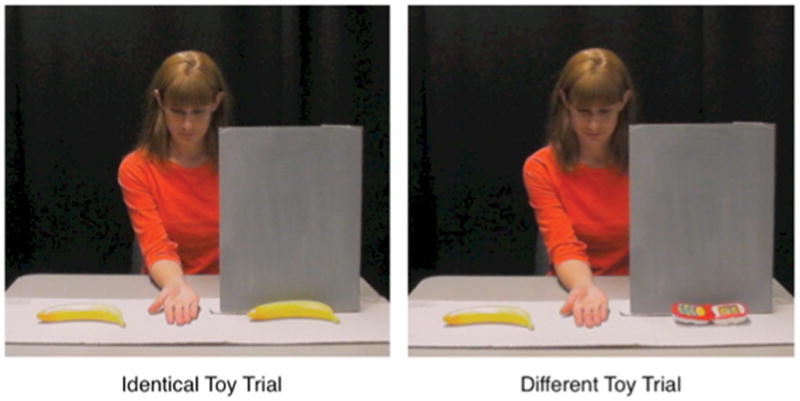
Experimental Set-Up. The director (shown here) sat across from the infant and requested the toy that she could see by saying, for example, “Ooh, a banana! I see the banana! Can you give me the banana?” We coded whether infants reached to the mutually visible toy, or the toy hidden from the director’s view. Whereas Different Toy Trials could be solved using the label because only one toy matches the label “banana”, infants had to take the director’s perspective in Identical Toy Trials to correctly select the seen toy. All types of toys (e.g., “banana” and “phone”) were used as referents for some infants in Identical Toy Trials and for other infants in Different Toy Trials.
Across 12 trials, the experimenter recorded which toy the infant reached to first after hearing the director’s request. Trials were of two types, Different Toy trials and Identical Toy trials. Different Toy Trials featured two distinct toys such as an apple and a set of keys, whereas Identical Toy Trials featured two identical toys such as two identical cars. Different Toy Trials provided a baseline measure of understanding reference: rather than having to take the director’s perspective, infants could select the correct toy based on the label alone since only one toy matched the director’s label. Thus, correct responses on Different Toy trials could reflect infants’ general engagement with the task, their interest in responding appropriately to the director’s requests, and their ability to match labels to objects. We used these Different Toy Trials to make sure the two groups were equal in these abilities. In contrast, on Identical Toy Trials, the utterance was ambiguous in the sense that both objects matched the director’s label, so infants needed to consider the director’s perspective in order to interpret her intended meaning and give her the requested toy.
Half of the trials were Different Toy Trials, and half of the trials were Identical Toy Trials. Infants were assigned to one of 8 trial orders. Trial orders were randomized with the caveat that the same trial type (Different Toy or Identical Toy) never appeared more than twice in a row. Each type of toy was featured in a Different Toy Trial for some infants and in an Identical Toy Trial for other infants. No infant was ever asked for the same type of toy (e.g., “the car”) in both an Identical Toy Trial and a Different Toy Trial. The director was unaware of the type of trial (Different or Identical) when she made her request because all toys were used in both trial types, the order of Identical Toy Trials and Different Toy Trials differed across subjects, and because she could only see the mutually visible toy.
Coding
The experimenter recorded which toy the infant reached to first on each trial. In order for a reach to be counted, it had to be visually guided and intentional. For every trial, infants could reach to the seen object, the hidden object, to both objects simultaneously, or to neither object. Additionally, the session was videotaped using two cameras: one behind the director that recorded the infant’s face, and one behind the infant that showed the trial type (Identical Toy or Different Toy) and the infants’ reaching behavior. These videos were put together into one picture-in-picture movie file. A reliability coder, who was unaware of infants’ linguistic background, coded all of the infants’ reaching behaviors from this picture-in-picture video. Agreement between the experimenter’s coding during the study and the reliability coder’s coding from video regarding infants’ responses was 97%. Trials where the coders disagreed were resolved by discussion between the experimenter and the reliability coder.
Results
We first considered infants’ ambiguous behavior, when they reached to both toys simultaneously or to neither toy. Although reaching to both toys unsurprisingly occurred more often on Identical Toy Trials than on Different Toy Trials (MIdentical=1.11 of 6 trials; MDifferent=0.13 of 6 trials; t(63)=5.83, p<.001), levels of reaching to both toys or to neither toy were relatively uncommon (Both toys: M=1.24 of 12 trials; Neither toy: M=0.20 of 12 trials) and did not differ based on language background (ps>.5), so we did not analyze ambiguous reaches further.
We then investigated infants’ performance on the perspective-taking task by looking at the average proportion of trials on which infants unambiguously reached for the mutually visible toy. Each infant was given a score based on his or her proportion of correct reaches. This proportion score was calculated by dividing the number of times the infant reached to the correct toy by the total number of times the infant reached for a single toy, either the correct or incorrect toy. If an infant were responding randomly, she would be equally like to choose the correct or incorrect toy, resulting in 0.5 proportion correct, which corresponds to chance. If an infant made 4 reaches to correct toy, 1 to the incorrect toy and behaved ambiguously on 1 trial, her proportion correct would be 4/5=0.80. On the critical Identical Toy Trials, infants with multilingual exposure were better than chance in correctly identifying the director’s intended meaning (M=.683, t(31)=3.60, p=.001; Figure 3). In contrast, infants with monolingual exposure showed no ability to take the director’s perspective on these trials and as a group they performed at chance (M=.553, t(31)=0.889, p=.376). In a direct comparison of the two groups, monolingual exposure infants were marginally worse than multilingual exposure infants (t(62)= 1.682, p=.098, two-tailed).
Figure 3.

Proportion of Correct Reaches. The average proportion of trials where infants in each group correctly reached to the seen toy. Asterisks show which bars are above chance according to one-sample t-tests.
We analyzed the Different Toy Trials using the same proportion correct score to ask whether the multilingual exposure advantage was truly due to perspective taking. On these trials, which do not require active perspective taking, both monolingual infants and multilingual exposure infants selected the correct toy at levels significantly above chance (MMono=.670, t(31)=3.80, p<.001; MMulti =.674, t(31)=4.82, p<.001), and performance was not different across language groups, (t(62)= 0.528, p=.958, two-tailed). These trials did not require perspective taking and could instead be solved by choosing the toy that matched the label in the director’s request. Equal performance for each language exposure group suggests that the two groups were just as good at engaging with the director and understanding object labels, and the differences between the groups seen in the Identical Toy Trials genuinely reflect a perspective taking advantage.
To further investigate performance on the perspective-taking task we evaluated whether infants in each language group regularly took the director’s perspective. To do this, we compared the number of infants who took the director’s perspective on the majority of trials, meaning that they selected the correct toy more times than the incorrect toy, to the number of infants who did not regularly take the director’s perspective, meaning that they selected the incorrect toy more times than the correct toy. We performed two-tailed binomial sign tests on each language group to ask whether they were above chance, and Fisher’s exact tests to compare performance across the two language groups.
On Identical Toy Trials, the great majority of infants in the multilingual exposure group actively took the director’s perspective: 23 infants made more correct choices compared to only 4 infants who made more incorrect choices (p=.0005). Five multilingual exposure infants made the same number of correct and incorrect responses and were not included in this analysis. In contrast, approximately equal numbers of monolingual infants were able to take the director’s perspective as were not: 14 infants made more correct choices compared to 12 infants who made more incorrect choices (p=.85). Six monolingual exposure infants made the same number of correct and incorrect responses and were not included in this analysis. A 2×2 Fisher’s Exact Test revealed a significant difference in the number of infants from each language group who actively took the director’s perspective by making more correct choices to those who did not take the director’s perspective by making more incorrect choices (p=.0177; Figure 2). Whereas most infants in the multilingual exposure group were active perspective-takers, infants in the monolingual group did not systematically use the director’s perspective to decide how to respond.
Figure 2.
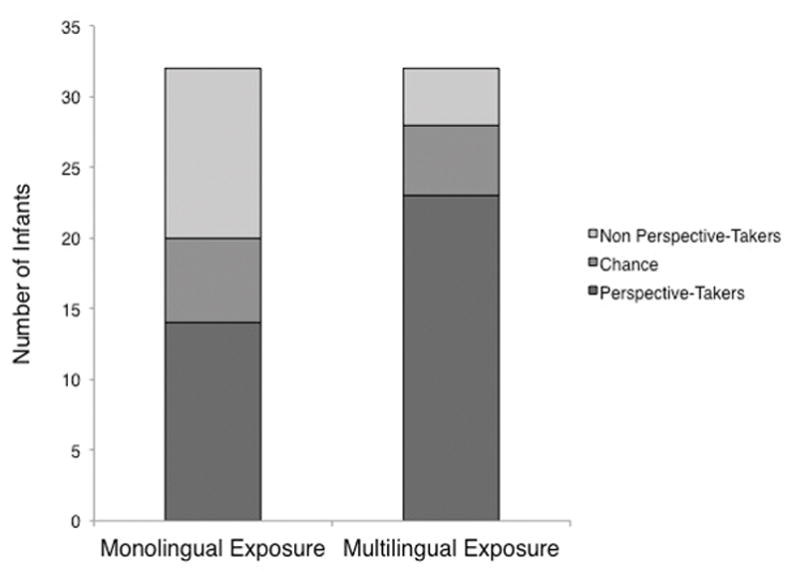
Results for Identical Toy Trials. Infants who correctly chose the seen toy more times than the hidden toy on Identical Toy Trials were classified as “perspective-takers,” and infants who incorrectly chose the hidden toy more times than the seen toy on Identical Toys Trials were classified as “non-perspective-takers.” Infants who chose the seen toy the same number of times as the hidden toy on Identical Toy Trials were classified as being at “chance.” Infants with multilingual exposure were more likely to be “perspective-takers” than “non-perspective-takers.”
On the other hand, infants from both groups performed well on Different Toy Trials: more infants made more correct than incorrect choices regardless of language exposure (monolingual exposure: 22 infants made more correct choices compared to 6 infants who made more incorrect choices; p=.004; multilingual exposure: 20 infants made more correct choices compared to 3 infants who made more incorrect choices; p=.001). Four monolingual exposure infants and nine multilingual exposure infants made the same number of correct and incorrect responses and were not included in this analysis. A 2×2 Fisher’s Exact Test suggested that performance was not significantly different across the language groups (p=.488). These results parallel the proportion correct results and provide further evidence that the two groups differed on trials that required active perspective taking, but were equally good at engaging with the director and matching her label to the correct object on trials that did not require active perspective taking.
Although we intentionally chose a task that would be difficult for infants of this age in order to avoid ceiling level performance, we were also interested in looking at the number of infants in each language group who were able to correctly reach to the seen toy on all trials that required active perspective-taking (Identical Toy trials). This high level of performance was rare in both groups, but happened significantly more in the multilingual exposure group than in the monolingual exposure group (χ2 (2, N=64)=6.62, p=0.010). Specifically, 6 of 32 infants in multilingual exposure groups performed at maximum accuracy on Identical Toy trials, whereas none of the monolingual infants did. Thus, even when considering only infants whose performance meets the highest bar of success, infants from multilingual exposure backgrounds outperformed infants from monolingual backgrounds.
Amount of exposure
While we hypothesized that the perspective-taking benefits that we discovered were due to the social experiences of being raised in a multilingual environment, it is also possible that they could be due to executive function benefits of becoming bilingual per se. Learning to use and inhibit multiple linguistic systems could enhance infants’ executive function and therefore their ability to inhibit their own perspective. To begin to evaluate this question, we investigated whether variation in performance on the perspective-taking task among infants in the multilingual exposure group was related to how much exposure they had to their second language. An executive function account would predict that infants with more balanced exposure to each of their languages would perform better on the perspective-taking task than infants with minimal second language exposure because they would have more practice inhibiting each linguistic system, which would lead to better inhibition on the perspective-taking task (e.g., Bialystok & Barac, 2012b). On the other hand, if the ability to take a speaker’s perspective to understand her intended meaning is due to the social experiences of living in multilingual environment, then even minimal multilingual exposure could provide these experiences, such that enhanced perspective taking may not be related to the degree of language exposure.
We ran a correlation between how balanced an infants’ language exposure was (reported percentage of time infants were exposed to their less heard language; range=5% to 50%) and performance on Identical Toy trials (number of correct responses out of 6). All infants were included in the analysis, meaning infants who were exposed to English 70% of the time and Spanish 30% of the time and infants who were exposed to Spanish 70% of the time and English 30% of the time were both scored the same in terms of “balance” – since infants in both groups have 30% exposure to their less heard language. If having balanced exposure to both languages helps build social communication skills via executive function, we would expect to see a positive correlation such that infants who have higher exposure to their less heard language (closest to 50% exposure to each language) perform better on the task. Language exposure was not correlated with perspective-taking performance (r(31)= −.12, p=.513; Figure 4). Although this type of correlational analysis is not fully conclusive it suggests that the amount of exposure to each language may not be the driving factor in infants’ ability to take the director’s perspective. If anything, the trend was slightly in the opposite direction as would be expected under the executive function hypothesis. Instead, it is possible that the social environment that comes with even minimal but regular exposure to multiple languages lays the ground for more effective perspective taking in communication.
Figure 4.
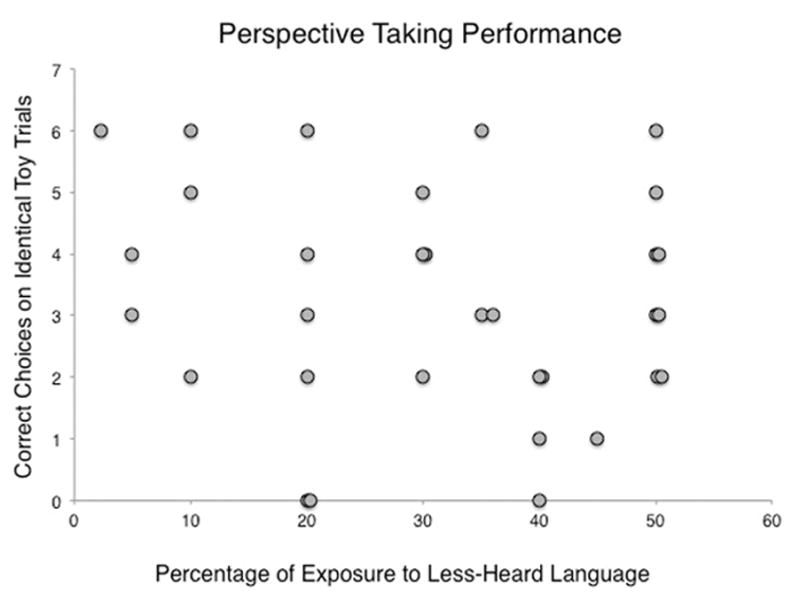
Performance on Identical Toy Trials based on language exposure. There was no significant correlation between the percentage of time parents reported their infants were exposed to their less heard language and accurate performance on trials that required perspective taking.
Discussion
The current study investigated the impact of multilingual exposure on early communication skills. Infants from monolingual and multilingual backgrounds were both able to follow directions on a task that required social engagement and understanding object labels. However, as a group, only infants with multilingual exposure were above chance at taking a speaker’s visual perspective to understand her request. These findings provide evidence that early multilingual exposure influences communication skills: infants who regularly hear multiple languages have an advantage in understanding a speaker’s intended meaning.
Our discovery extends recent findings with young children by Fan, Liberman, Keysar & Kinzler (2015). Using a similar task, Fan et. al found that children who were merely exposed to a multilingual environment were better at taking a speaker’s perspective than monolingual children without such exposure. Here we demonstrate that this perspective-taking advantage emerges in the second year of life, before most infants speak more than a few words. We propose that this exposure advantage is social in nature, and likely due to infants’ experiences keeping track of people’s perspectives, or thinking about who can speak to whom and who understands which language.
Although we suggest that communication benefits may be due to social experiences of being raised in a multilingual environment, much of the recent research on bilingualism has focused on enhanced executive functioning abilities in bilingual populations (e.g., Bialystok, 2009; Carlson & Meltzoff, 2008; Filippi et al., 2015; Kovács & Mehler 2009a; 2009b). The dominant explanation for the origin of these benefits concerns the joint activation involved in actively learning two languages. In order to successfully use each language, bilinguals must separate their language systems and inhibit the unused language. This practice inhibiting the unused language system could facilitate the development of executive function skills more generally (e.g., Green, 1998). Even for tasks that are inherently social, such as those that tap theory of mind, researchers have argued that enhanced performance of bilinguals is due to increased executive functioning abilities (e.g., Kovács, 2009).
Because we did not collect measures of executive functioning, it is conceivable that a non-social account such as one based on executive functioning could contribute to our findings. For instance, enhanced inhibitory control could have helped infants focus on the director’s perspective by more effectively inhibiting reaching for the hidden toy. Although our data cannot address this account directly, there are several reasons to doubt that this is the main reason for the observed perspective taking advantage. First, similar studies with older children have found no such role for executive functioning in impacting children’s communication skills (e.g., Fan, Liberman, Keysar, & Kinzler, 2015; Yow & Markman, 2014). Given the similarity between our task and those administered to older children, it is unlikely that the advantage we discovered with infants has a different underlying cause than the advantage discovered with children. Second, an executive functioning account would likely predict that infants with more balanced exposure to each of their languages would outperform infants with only minimal exposure to a second language (e.g., Bialystok & Barac, 2012b). However, we find that “balanced” exposure was not related to differences in communication abilities. Thus, communicative benefits may instead be due to the social experiences that arise from being raised in a multilingual environment, even if a child’s exposure a second language is limited.
Moreover, although we cannot fully determine the exact role of executive function skills on performance in our task, it is important to consider a range of mechanisms that may underlie potential cognitive and social differences between monolingual and bilingual children. A growing body of research suggests the purported bilingual advantage in executive functioning is complex, and moderated by a variety of factors (e.g., Anton et al., 2014; Duñabeitia et al., 2014; Paap, Johnson, & Sawi, 2015). Going forward it will be important for researchers to think critically about what factors of the bilingual experience might lead to executive functioning benefits, as well as which pieces of executive functioning are most likely to be influenced by regular exposure to multiple languages (e.g., Costa, Hernandez, Costa-Faidella, & Sebastián-Galles, 2009). It will also be important to consider whether differences in executive function across groups can be accounted for by factors other than language exposure per se, such as genetic components (Friedman, Miyake, Young, Defries, Corley, & Hewitt, 2008). More generally, although our research does not directly provide support for either side of the executive function and bilingualism debate, we use this debate to place our work in the context of the larger field and to suggest the importance of thinking about a diverse set of mechanisms that may contribute to cognitive and social differences between monolingual and bilingual populations.
Our research provides evidence that children in monolingual and multilingual environments differ in their early ability to interpret someone else’s communication as relying on her visual perspective. It is nonetheless unclear precisely how multilingual experiences increases communication skills. One possibility is that exposure to a multilingual environment enhances visual perspective-taking by giving infants myriad experiences with people who have different knowledge states, which could aid an understanding of people as having differential visual perspectives. Indeed, there is some evidence that bilinguals show enhanced visual perspective-taking even in non-communication tasks (Greenberg, Bellana, & Bialystok, 2013). Alternatively, exposure to a multilingual environment could aid communication more generally, even in situations that do not require active visual perspective-taking. As example, regularly tracking who speaks each language and who can converse with whom may lead infants to be better able to map linguistic utterances onto intended meanings. Because our task was fundamentally a communication task but required taking the director’s visual perspective, we cannot fully distinguish between these possibilities. Future work could tease apart these mechanisms by investigating performance on perspective-taking tasks that do not require social communication and communication tasks that do not require active visual perspective-taking.
Our findings give rise to a host of novel questions about how multilingual environments could influence effective communication. For instance: The types of linguistic environments and experiences that people face vary, so determining which aspects of multilingual environments promote effective communication might allow us to take advantage of such natural factors to limit miscommunication. Particularly, it will be important to investigate differential impact of language exposure as a function of the identity of the person using each language, and the types of contexts in which the infant hears each language. As examples, research could investigate whether infants who are exposed to multiple languages in their home environment perform differently than infants who are exposed to their second language in a school setting, and whether mere exposure in overheard settings can lead to enhanced communication. Finally, although our results suggest that early experience in a multilingual environment aids the development of intention understanding in communication, it would be important to investigate whether multilingual exposure later in life could also increase effective communication.
A monolingual environment is the exception, not the rule around the world, and it has been so throughout human evolutionary history (e.g., Hamers & Blanc, 2000). Fan, Liberman, Keysar & Kinzler (2015) showed that the more common, diverse linguistic environment provides children with powerful perspective taking tools that allow them to better understand a speaker’s intended meaning. Here we discovered that these enhanced communication skills already emerge with infants as young as 14 months old. Although language and communication are tightly linked, they are not the same thing. Early exposure to a language is critical for learning how to speak that language effectively and with a native phonology, but early exposure to multiple languages may be important for learning how to communicate effectively.
Supplementary Material
Research Highlights.
Infants raised in monolingual versus multilingual environments have drastically different social experiences that may lead to differences in social cognition.
We provide evidence that infants raised in multilingual environments outperform infants raised in monolingual environments at taking a speaker’s visual perspective to understand her intended meaning.
Even relatively minimal exposure to multiple languages can enhance communication
Acknowledgments
This research was supported by funding from the Templeton Foundation, NICHD grant R01HD070890 and by a NSF GRFP. We thank Samantha Fan, Madeline Garza, Sheila Krogh-Jespersen, and Anna Pfautz for help with data collection and coding.
References
- Allbritton DW, McKoon G, Ratcliff R. Reliability of prosodic cues for resolving syntactic ambiguity. Journal of Experimental Psychology: Learning and Memory. 1996;22(3):714–735. doi: 10.1037//0278-7393.22.3.714. [DOI] [PubMed] [Google Scholar]
- Antón E, Duñabeitia JA, Estévez A, Hernández JA, Castillo A, Fuentes LJ, Davidson DJ, Carreiras M. Is there a bilingual advantage in the ANT task? Evidence from children. Frontiers in Psychology. 2014;5(398):1–12. doi: 10.3389/fpsyg.2014.00398. [DOI] [PMC free article] [PubMed] [Google Scholar]
- Baldwin DA. Understanding the link between joint attention and language. In: Moore C, Dunham P, editors. Joint Attention: Its origins and role in development. Hillsdale, NJ, England: Lawrence Erlbaum Associates, Inc; 1995. pp. 131–158. [Google Scholar]
- Ben-Zeev S. The influence of bilingualism on cognitive strategy and cognitive development. Child Development. 1977;48(3):1009–1018. [Google Scholar]
- Bergelson E, Swingley D. At 6 to 9 months, humans infants know the meanings of many common nouns. Proceedings of the National Academy of Sciences of the USA. 2012;109:3253–3258. doi: 10.1073/pnas.1113380109. [DOI] [PMC free article] [PubMed] [Google Scholar]
- Bergelson E, Swingley D. The acquisition of abstract words by young infants. Cognition. 2013;127:391–397. doi: 10.1016/j.cognition.2013.02.011. [DOI] [PMC free article] [PubMed] [Google Scholar]
- Bialystok E. Bilingualism: The good, the bad, and the indifferent. Bilingualism: Language and Cognition. 2009;12:3–11. [Google Scholar]
- Bialystok E, Barac R. Bilingual effects on cognitive and linguistic development: Role of language, cultural background, and education. Child Development. 2012a;83:413–422. doi: 10.1111/j.1467-8624.2011.01707.x. [DOI] [PMC free article] [PubMed] [Google Scholar]
- Bialystok E, Barac R. Emerging Bilingualism: Dissociating advantages for metalinguistic awareness and executive control. Cognition. 2012b;122(1):67–73. doi: 10.1016/j.cognition.2011.08.003. [DOI] [PMC free article] [PubMed] [Google Scholar]
- Byers-Heinlein K, Werker JF. Monolingual, bilingual, trilingual: infants’ language experience influences the development of a word-learning heuristic. Developmental Science. 2009;12(5):815–823. doi: 10.1111/j.1467-7687.2009.00902.x. [DOI] [PubMed] [Google Scholar]
- Carlson SM, Meltzoff AN. Bilingual experience and executive functioning in young children. Developmental Science. 2008;11:282–298. doi: 10.1111/j.1467-7687.2008.00675.x. [DOI] [PMC free article] [PubMed] [Google Scholar]
- Clark HH, Brennan SA. Grounding in communication. In: Resnick LB, Levine JM, Teasley SD, editors. Perspectives on socially shared cognition. Washington: APA Books; 1991. pp. 127–149. [Google Scholar]
- Clark HH, Carlson TB. Context for comprehension. In: Long J, Baddeley A, editors. Attention and performance IX. Hillsdale, NJ: Lawrence Erlbaum Associates; 1981. pp. 313–330. [Google Scholar]
- Clark HH, Lucy P. Understanding what is meant from what is said: A study in conversationally conveyed requests. Journal of Verbal Learning and Verbal Behavior. 1975;14:56–72. [Google Scholar]
- Comeau L, Genesee F, Mendelson M. Bilingual children’s repairs of breakdowns in communication. Journal of Child Language. 2007;34:159–174. doi: 10.1017/s0305000906007690. [DOI] [PubMed] [Google Scholar]
- Costa A, Hernandez M, Costa-Faidella J, Sebastián-Galles N. On the bilingual advantage in conflict processing: Now you see it, now you don’t. Cognition. 2009;113:135–149. doi: 10.1016/j.cognition.2009.08.001. [DOI] [PubMed] [Google Scholar]
- Cummings J. Bilingualism, language proficiency, and metalinguistic development. In: Homel P, Palij M, Aaronson D, editors. Childhood Bilingualism: Aspects of Linguistic, Cognitive, and Social Development. Hillsdale, NJ: Erlbaum; 1987. pp. 57–73. [Google Scholar]
- Davidson D, Tell D. Monolingual and bilingual children’s use of mutual exclusivity in the naming of whole objects. Journal of Experimental Child Psychology. 2005;92(1):25–45. doi: 10.1016/j.jecp.2005.03.007. [DOI] [PubMed] [Google Scholar]
- Duñabeitia JA, Hernández JA, Antón E, Macizo P, Estévez A, Fuentes LJ, Carreiras M. The inhibitory advantage in bilingual children revisited: myth or reality? Experimental Psychology. 2014;61(3):234–251. doi: 10.1027/1618-3169/a000243. [DOI] [PubMed] [Google Scholar]
- Epley N, Morewedge CK, Keysar B. Perspective-taking in children and adults: Equivalent egocentrism but differential correction. Journal of Experimental Social Psychology. 2004;40:760–768. [Google Scholar]
- Fan SP, Liberman Z, Keysar B, Kinzler KD. The exposure advantage: Early exposure to a multilingual environment promotes effective communication. Psychological Science. 2015;26(7):1090–1097. doi: 10.1177/0956797615574699. [DOI] [PMC free article] [PubMed] [Google Scholar]
- Filippi R, Morris J, Richardson FM, Bright P, Thomas MSC, Karmiloff-Smith A, Marian V. Bilingual children show an advantage in controlling verbal interference during spoken language comprehension. Bilingualism: Language and Cognition. 2015;18(3):490–501. doi: 10.1017/S1366728914000686. [DOI] [PMC free article] [PubMed] [Google Scholar]
- Friedman NP, Miyake A, Young SE, Defries JC, Corley RP, Hewitt JK. Individual differences in executive functions are almost entirely genetic in origin. Journal of Experimental Psychology: General. 2008;137(2):201–225. doi: 10.1037/0096-3445.137.2.201. [DOI] [PMC free article] [PubMed] [Google Scholar]
- Galambos SJ, Goldin-Meadow S. The effects of learning two languages on levels of metalinguistic awareness. Cognition. 1990;34:1–56. doi: 10.1016/0010-0277(90)90030-n. [DOI] [PubMed] [Google Scholar]
- Galambos SJ, Hakuta K. Subject-specific and task-specific characteristics of metalinguistic awareness in bilingual children. Applied Psycholinguistics. 1989;9(2):141–162. [Google Scholar]
- Genesee F, Boivin I, Nicoladis E. Talking with strangers: A study of bilingual children’s communicative competence. Applied Psycholinguistics. 1996;17:427–442. [Google Scholar]
- Genesee F, Nicoladis E, Paradis J. Language differentiation in early bilingual development. Journal of Child Language. 1995;22:611–632. doi: 10.1017/s0305000900009971. [DOI] [PubMed] [Google Scholar]
- Genesee F, Tucker GR, Lambert WE. Communication skills of bilingual children. Child Development. 1975;46:1010–1014. [Google Scholar]
- Glucksberg S. How people use context to resolve ambiguity: Implications for an interactive model of language understanding. Advances in Psychology. 1986;39:303–325. [Google Scholar]
- Graham SA, Sedivy J, Khu M. That’s not what you said earlier: Preschoolers expect partners to be referentially consistent. Journal of Child Language. 2014;41(1):34–50. doi: 10.1017/S0305000912000530. [DOI] [PubMed] [Google Scholar]
- Green DW. Mental control of the bilingual lexico-semantic system. Bilingualism: Language and Cognition. 1998;1:67–81. [Google Scholar]
- Greenberg A, Bellana B, Bialystok E. Perspective-taking ability in bilingual children: Extending advantages in executive control to spatial reasoning. Cognitive Development. 2013;28(1):41–50. doi: 10.1016/j.cogdev.2012.10.002. [DOI] [PMC free article] [PubMed] [Google Scholar]
- Grosse G, Behne T, Carpenter M, Tomasello M. Infants communicate in order to be understood. Developmental Psychology. 2010;46:1710–22. doi: 10.1037/a0020727. [DOI] [PubMed] [Google Scholar]
- Hakuta K. Degree of bilingualism and cognitive ability in mainland Puerto Rican children. Child Development. 1987;58(5):1372–1388. [Google Scholar]
- Hamers JF, Blanc MHA. Bilinguality and Bilingualism. Cambrige MA: Cambridge University Press; 2000. [Google Scholar]
- Healey E, Skarabela B. Are children willing to accept two labels for a single object? A comparative study of mutual exclusivity in monolingual and bilingual children. In: Marinis T, Papangeli A, Stojanovik V, editors. Proceedings of the 2007 Child Language Seminar: 30 Year Anniversary. University of Reading; 2008. pp. 49–58. [Google Scholar]
- Ianco-Worrall AD. Bilingualism and cognitive development. Child Development. 1972;43(4):1390–1400. [Google Scholar]
- Keysar B, Barr DJ, Balin JA, Brauner JS. Taking perspective in conversation: The role of mutual knowledge in comprehension. Psychological Science. 2000;11(1):32–38. doi: 10.1111/1467-9280.00211. [DOI] [PubMed] [Google Scholar]
- Keysar B, Henly AS. Speakers’ overestimation of their effectiveness. Psychological Science. 2002;13(3):207–212. doi: 10.1111/1467-9280.00439. [DOI] [PubMed] [Google Scholar]
- Kovács ÁM. Early bilingualism enhances mechanisms of false-belief reasoning. Developmental Science. 2009;12:48–54. doi: 10.1111/j.1467-7687.2008.00742.x. [DOI] [PubMed] [Google Scholar]
- Kovács ÁM, Mehler J. Flexible learning of multiple speech structures in bilingual infants. Science. 2009a;325:611–612. doi: 10.1126/science.1173947. [DOI] [PubMed] [Google Scholar]
- Kovács ÁM, Mehler J. Cognitive gains in 7-month-old bilingual infants. Proceedings of the National Academy of Sciences. 2009b;106:6556–6560. doi: 10.1073/pnas.0811323106. [DOI] [PMC free article] [PubMed] [Google Scholar]
- Krehm M, Onishi KH, Vouloumanos A. I see your point: Infants under 12 months understand that pointing in communicative. Journal of Cognition and Development. 2014;15(4):527–538. [Google Scholar]
- Krogh-Jespersen S, Liberman Z, Woodward AL. Think fast! The relationship between goal prediction speed and social competence in infants. Developmental Science. 2015;18(5):815–823. doi: 10.1111/desc.12249. [DOI] [PMC free article] [PubMed] [Google Scholar]
- Liebal K, Behne T, Carpenter M, Tomasello M. Infants use shared experience to interpret pointing gestures. Developmental Science. 2009;12:264–271. doi: 10.1111/j.1467-7687.2008.00758.x. [DOI] [PubMed] [Google Scholar]
- Liszkowski U, Carpenter M, Tomasello M. Twelve-month-olds communicate helpfully and appropriately for knowledgeable and ignorant partners. Cognition. 2008;108(3):732–739. doi: 10.1016/j.cognition.2008.06.013. [DOI] [PubMed] [Google Scholar]
- Liszkowski U, Carpenter M, Henning A, Striano T, Tomasello M. Twelve-month-olds point to share attention and interest. Developmental Science. 2004;7(3):297–307. doi: 10.1111/j.1467-7687.2004.00349.x. [DOI] [PubMed] [Google Scholar]
- Liszkowski U, Carpenter M, Striano T, Tomasello M. Twelve- and 18-month-olds point to provide information for others. Journal of Cognition and Development. 2006;7:173–187. [Google Scholar]
- Liszkowski U, Schäfer M, Carpenter M, Tomasello M. Prelinguistic infants, but not chimpanzees, communicate about absent entities. Psychological Science. 2009;20:654–660. doi: 10.1111/j.1467-9280.2009.02346.x. [DOI] [PubMed] [Google Scholar]
- Martin A, Onishi KH, Vouloumanos A. Understanding the abstract role of speech in communication at 12 months. Cognition. 2012;123:50–60. doi: 10.1016/j.cognition.2011.12.003. [DOI] [PubMed] [Google Scholar]
- Matthews D, Lieven E, Tomasello M. What’s in a manner of speaking? Children’ sensitivity to partner-specific referential precedents. Developmental Psychology. 2010;46:749–60. doi: 10.1037/a0019657. [DOI] [PubMed] [Google Scholar]
- Moll H, Tomasello M. How 14- and 18-month-olds know what others have experienced. Developmental Psychology. 2007;43(2):309–317. doi: 10.1037/0012-1649.43.2.309. [DOI] [PubMed] [Google Scholar]
- Paap KR, Johnson HA, Sawi O. Bilingual advantages in executive functioning either do not exist or are restricted to very specific and undetermined circumstances. Cortex. 2015;69:265–278. doi: 10.1016/j.cortex.2015.04.014. [DOI] [PubMed] [Google Scholar]
- Savitsky K, Keysar B, Epley N, Carter TJ, Swanson AT. The closeness-communication bias: increased egocentrism among friends versus strangers. Journal of Experimental Social Psychology. 2011;47:269–273. [Google Scholar]
- Sperber D, Clement F, Heintz C, Mascaro O, Mercier H, Origgi G, Wilson D. Epistemic vigilance. Mind and Language. 2010;25:359–393. [Google Scholar]
- Tare M, Gelman SA. Can you say it another way? Cognitive factorsin bilingual children’s pragmatic language skills. Journal of Cognition and Development. 2010;11(2):137–158. doi: 10.1080/15248371003699951. [DOI] [PMC free article] [PubMed] [Google Scholar]
- Tomasello M, Carpenter M, Liszkowski U. A new look at infant pointing. Child Development. 2007;78:705–722. doi: 10.1111/j.1467-8624.2007.01025.x. [DOI] [PubMed] [Google Scholar]
- Yow WQ, Markman EM. Young bilingual children’s heightened sensitivity to referential cues. Journal of Cognition and Development. 2011a;12(1):12–31. [Google Scholar]
- Yow WQ, Markman EM. Bilingualism and children’s use of paralinguistic cues to interpret emotion in speech. Bilingualism: Language and Cognition. 2011b;14(4):562–569. [Google Scholar]
- Yow WQ, Markman EM. A bilingual advantage in how children integrate multiple cues to understand a speaker’s referential intent. Bilingualism: Language and Cognition. 2015;18(3):391–399. [Google Scholar]
Associated Data
This section collects any data citations, data availability statements, or supplementary materials included in this article.