



Abstract
Background
Isolated nocturnal hypertension (INH) has been studied among the general population and hypertensive patients. However, little insight is available on the prognostic effect of INH in patients with chronic kidney disease (CKD). This study investigated the prognostic effect of INH in a cohort of Chinese patients with nondialysis CKD.
Methods and Results
A total of 588 Chinese CKD patients who were admitted to the Third Affiliated Hospital of Sun Yat‐Sen University were enrolled in this study. We monitored blood pressure (BP) throughout the day and followed health outcomes in the 588 CKD patients admitted to our hospital division. We recorded time to total mortality, cardiovascular mortality, renal events, and cardiovascular events. A total of 370 (62.92%) individuals had nocturnal hypertension, which included 136 (23.13%) patients with INH. Multivariable Cox regression analyses showed that nocturnal BP was a significant risk factor for renal events and cardiovascular events in CKD patients, even when adjusted for clinic BP, 24‐hour BP, or daytime BP. Patients with nocturnal hypertension showed a worse prognosis compared with patients with nocturnal normotension (P<0.05), and nocturnal hypertension (versus nocturnal normotension) was associated with an increased risk for renal events (hazard ratio [HR], 3.81; 95% CI, 1.74–8.36) and cardiovascular events (HR, 8.34; 95% CI, 1.98–35.07). In addition, patients with INH had a worse prognosis than patients with normotension (P<0.017), whereas INH (versus normotension) was associated with a higher risk of renal events (HR, 2.78; 95% CI, 1.16–6.65) and cardiovascular events (HR, 6.82; 95% CI, 1.52–30.63).
Conclusions
INH was associated with a poor prognosis in Chinese nondialysis CKD patients.
Keywords: ambulatory blood pressure monitoring, chronic kidney disease, hypertension, isolated nocturnal hypertension, kidney, kidney (diabetes), prognosis
Subject Categories: High Blood Pressure
Introduction
Chronic kidney disease (CKD) is a worldwide public health problem. The incidence of end‐stage renal disease (ESRD) in many industrialized countries continues to increase despite widespread use of interventions to slow CKD progression.1 The same phenomenon is found in China. The prevalence of CKD in China is 10.8%, with the number of patients with CKD in China ≈119.5 million.2 The prevalence of hypertension in CKD patients is considerably greater than that in the healthy population and increases with the loss of kidney function as a result of the key role of kidney regulation on blood pressure (BP). Hypertension is the leading risk factor for death in patients with CKD, which contributes to 45% of male deaths and 46% of female deaths in CKD patients.3 However, hypertension is among the most important modifiable risk factors for CKD progression.4 Therefore, appropriate evaluation and management of hypertension to achieve BP goals in patients with CKD can slow CKD progression and reduce the high risk of cardiovascular (CV) disease.5
Evidence has accumulated on the substantial benefits of ambulatory BP monitoring (ABPM) for risk stratification and classification of hypertension.6 ABPM has increased the ability to identify circadian variations in BP and identify daytime and nighttime BP. Superiority of nighttime BP levels as captured by ABPM (rather than daytime or clinic values of BP) for prediction of target organ damage or development of CV disease in the general population and in hypertensive patients has been reported.7, 8
Isolated nocturnal hypertension (INH) was identified first in 2007 by Li et al, and was defined as nocturnal hypertension without daytime hypertension. Investigation into INH was a better tool to assess the role of nocturnal hypertension because all patients with INH had only nocturnal hypertension without daytime hypertension. They reported a prevalence of 10.9% in a Chinese cohort of >600 participants, and these patients had more severe target organ damage.9 Data on the prognostic effect of INH in nondialysis CKD patients in China are lacking. Previously, we reported that CKD patients have a higher prevalence of nocturnal hypertension and investigated its close association with target organ damage in CKD patients and the possible relationship between INH and target organ damage in CKD patients.10, 11, 12 However, data on the prognostic effect of INH in nondialysis CKD patients are lacking. We hypothesized that INH has a role in the prognosis of CKD patients based on these cross‐sectional studies. We designed a prospective cohort study to explore the prognostic role of INH in nondialysis Chinese CKD patients.
Methods
Study Population
The study protocol was approved by the ethics committee of the Third Affiliated Hospital of Sun Yat‐Sen University (Guangdong, China). The study protocol was approved by the institutional review board of our university. Informed consent was obtained from patients before enrollment. Consecutive patients were recruited from the Third Affiliated Hospital of Sun Yat‐Sen University (Guangdong, China) from July 2010 to December 2014.
Inclusion criteria were: (1) age ≥14 and <75 years, (2) CKD, and (3) available follow‐up data (duration of follow‐up >6 months or end point event observed in 6 months).
Exclusion criteria were: (1) acute changes in the estimated glomerular filtration rate (eGFR) >30% in the previous 3 months, (2) dialysis, (3) recipients of kidney transplantation, (4) atrial fibrillation, (5) CV events in the previous 3 months, (6) pregnancy, (7) night work or shift‐work employment, and (8) intolerance to ABPM or invalid ABPM data.
A total of 697 CKD patients fulfilled the inclusion criteria, and 71 patients who fulfilled exclusion criteria were excluded and the detailed reasons are shown in Figure 1. Thirty‐eight patients were lost to follow‐up after their first visit. Finally, 588 CKD patients were enrolled in this study. In terms of causes of renal diseases, 397 patients had chronic glomerulonephritis, 63 had diabetic nephropathy, 32 had hypertensive nephropathy, 28 had lupus nephritis, and 68 had other causes of renal disease (Figure 1).
Figure 1.
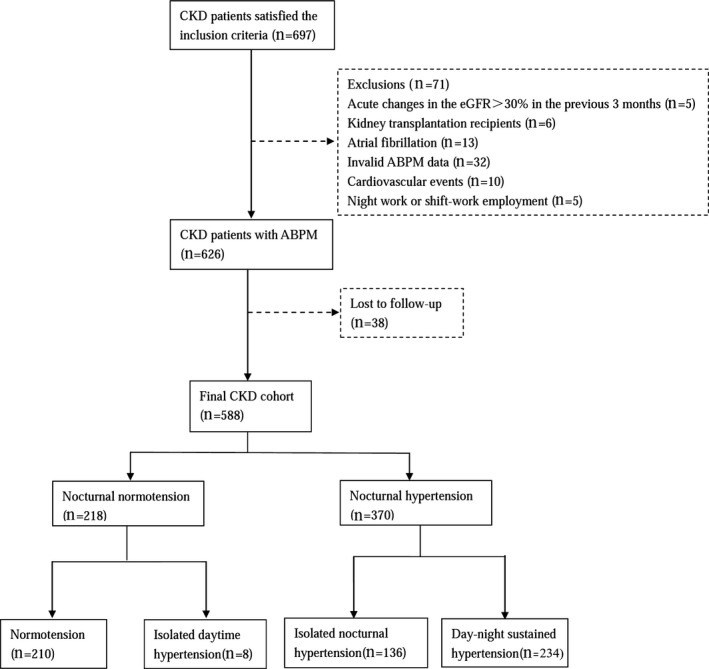
Patient selection and assignment to different ambulatory blood pressure status. ABPM indicates ambulatory blood pressure monitoring; CKD, chronic kidney disease; eGFR, estimated glomerular filtration rate.
Measurements
BP monitoring
Patients underwent 24‐hour ABPM using a TM‐2430 Monitor (A&D, Tokyo, Japan) as previously reported.10, 11, 12 Clinic BP was measured for each patient during a visit to the physician. Details have been previously reported.10, 11, 12
Collection of other data
We collected urine samples from 7 am to 7 am the next day to detect the extent of proteinuria and sodium levels over 24 hours. These patients were asked to void their bladders before and after the urine collection. Proteinuria was measured by immunoturbidimetry. In addition, medical history, including demographics, laboratory data (hemoglobin, albumin, calcium, phosphorus, intact parathyroid hormone, serum fasting glucose, cholesterol, triglycerides, high‐density lipoprotein cholesterol [HDL‐C], low‐density lipoprotein‐cholesterol, homocysteine, uric acid, serum creatinine, and blood urea nitrogen [BUN]), and current therapy were obtained at the initial study visit. All these experimental data were measured using a 7180 Biochemistry Autoanalyzer (Hitachi, Tokyo, Japan).
Definitions
“ABPM daytime” and “ABPM nighttime” were defined according to patients’ schedules. Nocturnal hypertension was defined as nighttime systolic BP (SBP) ≥120 mm Hg or/and diastolic BP (DBP) ≥70 mm Hg. Nocturnal normotension was defined as nighttime SBP <120 mm Hg and DBP <70 mm Hg.13 Normotension (NT) was defined as both daytime BP <135/85 mm Hg and nocturnal BP <120/70 mm Hg; INH was defined as daytime BP <135/85 mm Hg and nocturnal BP ≥120/70 mm Hg; Day‐night sustained hypertension (DNH) was regarded as daytime BP ≥135/85 mm Hg and nocturnal BP ≥120/70 mm Hg, and isolated daytime hypertension (IDH) was defined as daytime BP ≥135/85 mm Hg and nocturnal BP <120/70 mm Hg.14 CKD is defined according to the Kidney Disease: Improving Global Outcomes (KDIGO) 2012 clinical practice guideline.15 eGFR was calculated using the 2009 Chronic Kidney Disease Epidemiology Collaboration (CKD‐EPI) creatinine equation.16 We divided these CKD patients into 6 stages (1, 2, 3a, 3b, 4, 5) according to the KDIGO 2012 clinical practice guideline.15 Diabetes mellitus (DM) was defined as the need for antidiabetic drugs or meeting the diagnostic criteria based on the American Diabetes Association's “standards of medical care in diabetes.”17
Outcomes
Primary end points were time to total mortality and time to CV mortality. Secondary end points were time to renal events and time to CV events. CV mortality was defined as death caused by CV events. Renal events were a composite of doubling of serum levels of creatinine or ESRD, whichever occurred first. The end point of ESRD was reached on the day of the first dialysis session.18 CV events included a fatal or nonfatal CV event: myocardial infarction, heart failure, revascularization, stroke, and other events (acute arterial occlusion of lower extremities and thrombotic occlusion of the retinal artery), whichever occurred first. The cause of death was identified according to death certificates and autopsy reports based on the 10th revision of the International Classification of Diseases. Hospital records were collected to establish the diagnosis based on criteria set by the American College of Cardiology and the European Society of Cardiology.19, 20 Patients were followed up until March 31, 2016, or death, and censored on the date of the last visit to the nephrology clinic.
Statistical Analyses
Data were analyzed using SPSS version 20.0 (IBM, Armonk, NY) and STATA version 14.0 (STATA, College Station, TX). Descriptive statistics are the mean±SD for continuous variables and median values/interquartile range for nonparametric variables. Frequency and percentages were used for categorical variables. Comparisons of continuous variables between groups were evaluated by the Student t test or nonparametric tests. Differences among categorical variables were analyzed using the χ2 test. Comparisons of continuous variables among groups were evaluated by ANOVA or nonparametric tests. P values for multiple comparisons were corrected according to the Bonferroni method. We used STATA to calculate the prevalence of end points. Crude rates as well as rates standardized by the direct method for sex and age are reported. Comparison of the prevalence of events among groups was performed by the log‐rank test. The P value for multiple comparisons was corrected according to the Bonferroni method. We employed Kaplan–Meier estimates of survival (plotted according to current recommendations) and the log‐rank test to compare survival in different groups.21 We used multivariable Cox regression models, adjusting for important predictors, to evaluate the prognostic value of nocturnal BP, nocturnal hypertension, and INH. Adjustment factors included age, sex (female=0, male=1), DM (no=0, yes=1), smoking and drinking (no=0, yes=1), body mass index, history of CV disease (no=0, yes=1), eGFR, hemoglobin, phosphate, cholesterol, proteinuria, and on renin‐angiotensin system blockade (no=0, yes=1). The HRs associated with nocturnal BP were additionally adjusted for clinic BP, daytime BP, and 24‐hour BP. The assumption of proportional hazards was assessed by visual judgment of log‐minus‐log survival plots. All P values were two‐sided and the level of the test (α) was set as 0.05.
Results
Baseline Characteristics of the Study Population
A total of 588 CKD patients were enrolled. The mean age of patients was (42.76±16.71) years, and 336 were men (57.14%). The median course of disease was 6 months, and 92 patients (15.65%) had DM. At enrollment, 109 patients (18.54%) were current smokers, and 55 patients (9.35%) reported alcohol intake. Forty‐two patients (7.14%) had a history of CV disease (Table 1). The number of patients with CKD stage 1, 2, 3, 4, or 5 was 219, 102, 122, 72, and 73, respectively.
Table 1.
Differences of Baseline Characteristics in Chinese Nondialysis CKD Patients
| Total (N=588) | Nocturnal Normotension | Nocturnal Hypertension | ||||
|---|---|---|---|---|---|---|
| Total (n=218) | NT (n=210) | Total (n=370) | INH (n=136) | DNH (n=234) | ||
| Age, y | 42.76±16.71 | 35.66±14.62 | 35.28±14.49 | 46.95±16.46* | 43.72±17.12† | 48.82±15.81†, ‡ |
| Men, No. (%) | 336 (57.1) | 114 (52.3) | 109 (51.9) | 222 (60.0) | 81 (59.6) | 141 (60.3) |
| Course, mo | 6 (1–24) | 1 (3–12) | 3 (1–12) | 6 (1–24)* | 5 (1–24) | 6 (1–24)† |
| Diabetes mellitus, No. (%) | 92 (15.6) | 13 (6.0) | 12 (5.7) | 79 (21.3)* | 20 (14.7)† | 59 (25.2)†, ‡ |
| Current smoker, No. (%) | 109 (18.5) | 27 (12.4) | 26 (12.4) | 82 (22.2)* | 27 (20.0) | 55 (23.5)† |
| Alcohol intake, No. (%) | 55 (9.35) | 15 (7.14) | 15 (7.14) | 40 (10.81) | 11 (8.09) | 29 (12.39) |
| BMI, kg/m2 | 23.16±3.61 | 22.68±3.74 | 22.64±3.74 | 23.46±3.51* | 22.99±3.77 | 23.74±3.32† |
| History of cardiovascular disease, No. (%) | 42 (7.1) | 4 (1.8) | 4 (1.9) | 38 (10.3)* | 9 (6.6)† | 29 (12.4)† |
| eGFR, mL/min per 1.73 m2 | 67.84 (29.83–106.69) | 103.73 (68.25–120.95) | 104.56 (70.53–121.42) | 45.27 (20.66–87.37)* | 71.52 (32.36–103.94)† | 35.84 (15.90–72.64)†, ‡ |
| Hemoglobin, g/L | 122.20±24.15 | 130.57±20.51 | 130.67±20.37 | 117.28±24.80* | 123.33±24.57† | 113.75±24.29†, ‡ |
| Albumin, g/L | 33.30±9.02 | 32.92±9.88 | 32.80±9.85 | 33.53±8.48 | 33.04±9.24 | 33.81±8.01 |
| Total calcium level, mmol/L | 2.19±0.20 | 2.18±0.21 | 2.18±0.21 | 2.20±0.19 | 2.20±0.22 | 2.19±0.20 |
| Phosphate level, mmol/L | 1.26±0.24 | 1.22±0.22 | 1.22±0.22 | 1.28±0.24* | 1.22±0.21 | 1.31±0.26†, ‡ |
| iPTH, pg/mL | 51.87 (31.56–87.89) | 36.78 (23.01–61.01) | 36.78 (22.91–60.21) | 57.85 (38.38–110.33)* | 51.15 (34.02–85.86)† | 64.12 (39.82–119.76)†, ‡ |
| Serum fasting glucose, mmol/L | 5.09±1.44 | 4.87±1.08 | 4.88±1.10 | 5.23±1.60* | 5.17±1.47 | 5.26±1.68† |
| Cholesterol, mmol/L | 6.15±2.96 | 6.35±3.06 | 6.38±3.08 | 6.03±2.90 | 6.30±2.85 | 5.88±2.92 |
| Triglycerides, mmol/L | 1.63 (1.12–2.45) | 1.39 (1.01–2.14) | 1.38 (1.01–2.13) | 1.70 (1.14–2.62)* | 1.66 (1.04–2.32) | 1.82 (1.18–2.74)† |
| HDL‐C, mmol/L | 1.23±0.42 | 1.35±0.45 | 1.36±0.46 | 1.17±0.39* | 1.23±0.43† | 1.13±0.36† |
| LDL‐C, mmol/L | 4.03±2.32 | 4.21±2.34 | 4.24±2.36 | 3.93±2.30 | 4.15±2.34 | 3.79±2.27 |
| Uric acid, mmol/L | 444.60±130.67 | 401.70±126.84 | 401.61±128.47 | 469.82±126.40* | 445.33±125.00† | 483.95±125.30†, ‡ |
| Blood urea nitrogen, mmol/L | 6.80 (4.93–11.13) | 5.07 (3.69–6.59) | 5.01 (3.67–6.47) | 8.40 (5.89–13.96)* | 6.98 (5.38–11.74)† | 9.30 (6.66–15.38)†, ‡ |
| Serum creatinine, μmol/L | 107.2 (71.90–192.00) | 77.30 (60.30–112.45) | 76.50 (59.90–110.45) | 145.75 (85.30–271.42)* | 102.5 (74.25–184.65)† | 171.5 (97.95–327.95)†, ‡ |
| Homocysteine, μmol/L | 15.60±8.31 | 12.13±5.90 | 11.92±5.85 | 17.45±8.80* | 16.97±10.21† | 17.75±7.82† |
| Urinary sodium excretion, mmol/24 h | 130.69±80.60 | 130.47±95.40 | 131.00±97.31 | 130.82±69.97 | 126.68±70.75 | 133.64±69.57 |
| Proteinuria, g/24 h | 1.73 (0.46–4.55) | 1.07 (0.25–4.13) | 1.07 (0.25–4.17) | 2.04 (0.75–4.94)* | 1.84 (0.44–4.66) | 2.15 (0.95–5.04)† |
| Clinic SBP, mm Hg | 140.25±22.92 | 127.03±16.26 | 126.68±16.35 | 148.00±22.74* | 137.76±20.20† | 153.94±22.03†, ‡ |
| Clinic DBP, mm Hg | 85.38±13.23 | 79.55±10.45 | 79.36±10.32 | 88.81±13.50* | 85.68±11.85† | 90.63±14.07†, ‡ |
| 24‐h SBP, mm Hg | 129.05±17.24 | 113.91±8.87 | 113.27±8.35 | 137.97±14.53* | 124.36±6.72† | 145.88±11.72†, ‡ |
| 24‐h DBP, mm Hg | 77.80±10.03 | 69.49±5.58 | 69.10±5.20 | 82.69±8.77* | 75.96±4.81† | 86.61±8.15†, ‡ |
| Daytime SBP, mm Hg | 130.61±17.19 | 116.14±9.59 | 115.41±8.94 | 139.14±14.81* | 124.96±6.90† | 147.38±11.59†, ‡ |
| Daytime DBP, mm Hg | 78.96±10.10 | 71.16±6.07 | 70.70±5.59 | 83.56±9.14* | 76.34±5.07† | 87.75±8.33†, ‡ |
| Nighttime SBP, mm Hg | 121.00±19.57 | 102.54±8.23 | 102.30±8.16 | 131.88±15.80* | 121.37±9.29† | 137.99±15.60†, ‡ |
| Nighttime DBP, mm Hg | 71.77±11.56 | 60.72±5.44 | 60.65±5.49 | 78.28±8.98* | 73.79±6.02† | 80.90±9.38†, ‡ |
| Receiving no antihypertensive drugs | 147 (25%) | 74 (33.9%) | 72 (34.3%) | 73 (19.7%)* | 45 (33.1%) | 28 (12.0%)†, ‡ |
| Receiving 1 antihypertensive drug | 251 (42.7%) | 126 (57.8%) | 122 (58.1%) | 125 (33.8%)* | 54 (39.7%)† | 71 (30.3%)†, ‡ |
| Receiving ≥2 antihypertensive drugs | 190 (32.3%) | 18 (8.3%) | 16 (7.6%) | 172 (46.5%)* | 37 (27.2%)† | 135 (57.7%)†, ‡ |
| Bedtime dosing of hypertensive drugs | 118 (20.1%) | 44 (20.2%) | 42 (20%) | 74 (20%) | 27 (19.8%) | 47 (20.1%) |
| RAS blockade | 341 (58.0%) | 135 (62.0%) | 129 (61.4%) | 206 (55.7%) | 74 (54.4%) | 132 (56.4%) |
| Calcium channel blocker | 196 (33.3%) | 16 (7.3%) | 14 (6.7%) | 180 (48.6%)* | 34 (25%)† | 146 (62.4%)†, ‡ |
| α‐Blocker | 46 (7.8%) | 2 (0.9%) | 2 (0.9%) | 44 (11.9%)* | 2 (1.5%) | 42 (17.9%)†, ‡ |
| β‐Blocker | 94 (16.0%) | 8 (3.7%) | 7 (3.3%) | 86 (23.2%)* | 18 (13.2%)† | 68 (29.1%)†, ‡ |
| Statins | 103 (17.5%) | 34 (15.6%) | 31 (14.7%) | 69 (18.7%) | 23 (17.0%) | 46 (20.0%) |
Only 8 patients exhibited isolated daytime hypertension (IDH) in this cohort; therefore, we omitted this group. BMI indicates body mass index; CKD, chronic kidney disease; DBP, diastolic blood pressure; DNH, day‐night sustained hypertension; eGFR, estimated glomerular filtration rate; HDL‐C, high‐density lipoprotein cholesterol; INH, isolated nocturnal hypertension; iPTH, intact parathyroid hormone; LDL‐C, low‐density lipoprotein cholesterol; NT, normotension; RAS, renin‐angiotensin system; SBP, systolic blood pressure.
We made comparisons between the nocturnal normotension group and the nocturnal hypertension group. *Comparison with the nocturnal normotension group (P<0.05). We then made comparisons between the NT group, INH group, and DNH group. P value for multiple comparisons was corrected according to the Bonferroni method (3 comparisons). †Comparison with the NT group (P<0.017). ‡Comparison with the INH group (P<0.017).
A total of 136 (23.13%) CKD patients had INH and 234 (39.80%) had DNH, whereas only 210 (35.71%) patients had NT and 8 (1.36%) had IDH. Compared with patients with NT (P<0.017), patients with INH were older and had a higher prevalence of DM and history of CV disease; higher levels of serum intact parathyroid hormone (iPTH), uric acid, BUN, creatinine, and homocysteine; lower levels of hemoglobin and HDL‐C; lower eGFR; higher levels of clinical, 24‐hour, daytime and nocturnal BP; and higher frequency of use of calcium channel blockers and β‐blockers. Compared with those in the DNH group (P<0.017), patients were younger and had a lower prevalence of DM; lower level of phosphorus, iPTH, uric acid, BUN, and serum creatinine; higher levels of hemoglobin, HDL‐C, and eGFR; lower levels of clinical, 24‐hour, daytime, and nocturnal BP; and lower frequency of use of antihypertensive drugs (Table 1).
Incidence of Events
For total mortality, median follow‐up was 35 (interquartile range: 24–49) months, and total follow‐up time was 1762 patient‐years. During follow‐up, 44 patients died (event incidence: 24.98 per 1000 patient‐years), and the cause of death included fatal heart failure (22), acute myocardial infarction (10), stroke (7), malignant tumor, (4) and gastrointestinal bleeding (1). Hence, 39 patients among this cohort died of CV events (event incidence: 22.00 per 1000 patient‐years).
For renal events, median follow‐up was 31 (interquartile range: 19–45) months, and total follow‐up time was 1594 patient‐years. During follow‐up, 140 renal events were recorded in this cohort (event incidence: 87.83 per 1000 patient‐years).
For CV events, median follow‐up was 34 (interquartile range: 24–49) months, and total follow‐up time was 1717 patient‐years. During follow‐up, 74 CV events were recorded (event incidence: 43.10 per 1000 patient‐years), including 39 fatal events (as described above) and 35 nonfatal events (heart failure [27], acute myocardial infarction [7], and acute arterial occlusion of the lower extremities [1]).
Prognostic Value of Nocturnal BP
In partly multivariable‐adjusted models (adjusted for important predictors), nocturnal SBP was associated with renal and CV events. Further adjustment for clinic SBP, daytime SBP, or 24‐hour SBP did not change the associations. In partly adjusted models, the associations between nocturnal DBP and renal and CV events remained significant. Further adjustment for clinic DBP did not change the associations. When adjusted for daytime DBP or 24‐hour DBP, nocturnal DBP was still associated with renal events. Nocturnal BP was a significant risk factor for patient prognosis even when adjusted for clinic, 24‐hour, or daytime BP (Table 2).
Table 2.
Exploration of the Prognostic Value of Nocturnal Blood Pressure With Multivariate‐Adjusted Cox Analyses
| Nocturnal Blood Pressure | Renal Events | Cardiovascular Events |
|---|---|---|
| SBP, per 10 mm Hg | ||
| Not adjusted | 1.61 (1.48–1.77), P<0.001 | 1.69 (1.49–1.91), P<0.001 |
| Partly adjusted | 1.22 (1.10–1.36), P<0.001 | 1.38 (1.20–1.60), P<0.001 |
| Fully adjusted* (+clinic SBP) | 1.22 (1.08–1.37), P=0.001 | 1.34 (1.15–1.57), P<0.001 |
| Fully adjusted† (+daytime SBP) | 1.28 (1.04–1.57), P=0.019 | 1.58 (1.21–2.06), P=0.001 |
| Fully adjusted‡ (+24 hour SBP) | 1.29 (1.01–1.64), P=0.039 | 1.60 (1.17–2.20), P=0.003 |
| DBP, per 10 mm Hg | ||
| Not adjusted | 1.66 (1.48–1.86), P<0.001 | 1.54 (1.31–1.81), P<0.001 |
| Partly adjusted | 1.37 (1.15–1.64), P=0.001 | 1.44 (1.14–1.84), P=0.003 |
| Fully adjusted* (+clinic DBP) | 1.36 (1.12–1.64), P=0.002 | 1.34 (1.03–1.76), P=0.031 |
| Fully adjusted† (+daytime DBP) | 1.42 (1.06–1.93), P=0.019 | 1.42 (0.97–2.08), P=0.067 |
| Fully adjusted‡ (+24‐hour DBP) | 1.48 (1.05–2.1), P=0.026 | 1.45 (0.94–2.26), P=0.092 |
Data are presented as hazard ratios (95% CIs), followed by P value, which express the risk per 10‐mm Hg increase in the blood pressure variables. Partly adjusted hazard ratios were adjusted for age, sex (female=0, male=1), diabetes mellitus (no=0, yes=1), smoking and drinking (no=0, yes=1), body mass index, history of cardiovascular disease (no=0, yes=1), estimated glomerular filtration rate, hemoglobin, phosphate, cholesterol, proteinuria, and renin‐angiotensin system blockade (no=0, yes=1). In fully adjusted models, nocturnal pressure was additionally adjusted for clinic blood pressure, daytime blood pressure, and 24‐hour blood pressure separately. DBP indicates diastolic blood pressure; SBP, systolic blood pressure.
*Comparison with the nocturnal normotension group (P<0.05). We then made comparisons between the NT group, INH group, and DNH group. †Comparison with the NT group (P<0.017). ‡Comparison with the INH group (P<0.017).
Risks Associated With Nocturnal Hypertension
Crude and standardized prevalence rates of total mortality, CV mortality, renal events, and CV events were higher in patients with nocturnal hypertension than those in patients with nocturnal NT (P<0.001) (Table 3). Survival rates of patients with nocturnal NT were higher than those of patients with nocturnal hypertension with respect to total mortality, CV mortality, renal events, and CV events (P<0.001) (Figure 2). Multivariable‐adjusted Cox regressions analyses were carried out to identify the hazard ratios (HRs). In these models, nocturnal hypertension (versus nocturnal NT) was associated with an increased risk for renal events (HR, 3.81; 95% CI, 1.74–8.36) and CV events (HR, 8.34; 95% CI, 1.98–35.07) (Table 4).
Table 3.
Incidence of Events by Nocturnal Blood Pressure Status
| Nocturnal Normotension | Nocturnal Hypertension | P Value | |
|---|---|---|---|
| Total mortality | |||
| Crude rate | 4.48 (−0.58 to 9.54) | 37.53 (26.26–48.80) | <0.001 |
| Standardized rate | 8.52 (1.56–15.48) | 32.92 (22.34–43.50) | <0.001 |
| Cardiovascular mortality | |||
| Crude rate | 2.96 (−1.14 to 7.06) | 33.73 (23.05–44.41) | <0.001 |
| Standardized rate | 5.08 (−0.28 to 10.44) | 29.33 (19.34–39.32) | <0.001 |
| Renal events | |||
| Crude rate | 12.04 (3.75–20.33) | 142.01 (119.57–164.45) | <0.001 |
| Standardized rate | 14.43 (5.36–23.50) | 132.38 (110.59–154.17) | <0.001 |
| Cardiovascular events | |||
| Crude rate | 4.46 (−0.57 to 9.49) | 68.01 (52.74–83.28) | <0.001 |
| Standardized rate | 6.99 (0.70–13.28) | 55.91 (41.97–69.85) | <0.001 |
Values are presented as rates (95% CI), expressed as number of events per 1000 patient‐years. Rates are crude or standardized for sex and age (<30, 30–50, and ≥50 years) by the direct method. Comparison of event rates between the two groups was done by log‐rank test.
Figure 2.
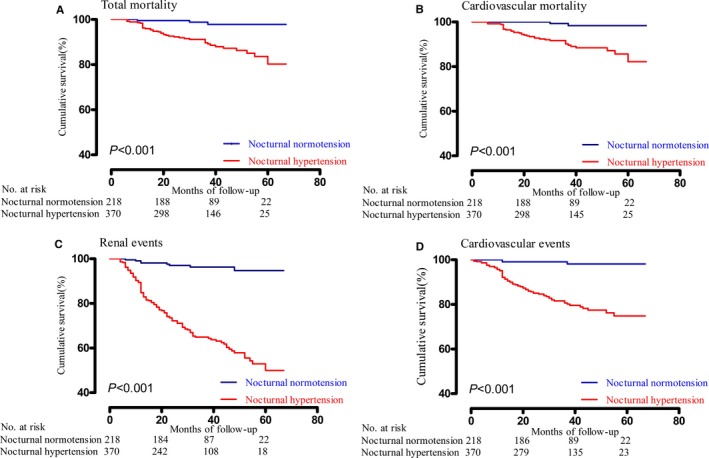
Kaplan–Meier survival curves as a function of patients with or without nocturnal hypertension. A, Cumulative survival curves for total mortality in patients with or without nocturnal hypertension. B, Cumulative survival curves for cardiovascular mortality in patients with or without nocturnal hypertension. C, Cumulative survival curves for renal events in patients with or without nocturnal hypertension. D, Cumulative survival curves for cardiovascular events in patients with or without nocturnal hypertension. P<0.001 indicated a comparison between the nocturnal normotension and nocturnal hypertension groups.
Table 4.
Multivariate‐Adjusted Cox Regression Analyses of Renal Events and Cardiovascular Events in CKD Patients With Different Blood Pressure Status
| Renal Events | Cardiovascular Events | |
|---|---|---|
| Nocturnal hypertension (vs nocturnal normotension) | ||
| Not adjusted | 11.69 (5.73–23.88), P<0.001 | 15.06 (4.74–47.83), P<0.001 |
| Adjusted | 3.81 (1.74–8.36), P=0.001 | 8.34 (1.98–35.07), P=0.004 |
| INH (vs NT) | ||
| Not adjusted | 5.58 (2.53–12.34), P<0.001 | 12.43 (2.84–54.37), P=0.001 |
| Adjusted | 2.78 (1.16–6.65), P=0.021 | 6.82 (1.52–30.63), P=0.012 |
| DNH (vs NT) | ||
| Not adjusted | 15.11 (7.36–31.01), P<0.001 | 27.37 (6.68–112.17), P<0.001 |
| Adjusted | 4.30 (1.93–9.55), P<0.001 | 9.10 (2.13–38.91), P=0.003 |
Data are presented as hazard ratios (95% CIs), followed by P value. Adjusted hazard ratios were adjusted for age, sex (female=0, male=1), diabetes mellitus (no=0, yes=1), smoking and drinking (no=0, yes=1), body mass index, history of cardiovascular disease (no=0, yes=1), estimated glomerular filtration rate, hemoglobin, phosphate, cholesterol, proteinuria, and renin‐angiotensin system blockade (no=0, yes=1). CKD indicates chronic kidney disease; DNH, day‐night sustained hypertension; INH, isolated nocturnal hypertension; NT, normotension.
Risks Associated With INH
Crude and standardized prevalence rates of total mortality, CV mortality, renal events, and CV events were significantly higher in patients with INH than those in patients with NT (P<0.017). Only the prevalence rates of renal events and CV events in patients with INH were lower than in patients with DNH (P<0.017), whereas the prevalence rates of total mortality and CV mortality remained not different between these two groups of patients (Table 5).
Table 5.
Incidence of Events by Ambulatory Blood Pressure Status
| NT | INH | DNH | |
|---|---|---|---|
| Total mortality | |||
| Crude rate | 3.09 (−1.19 to 7.37) | 23.33 (8.27–38.39)* | 45.28 (29.95–60.61)* |
| Standardized rate | 7.38 (0.78–13.98) | 21.57 (7.07–36.07)* | 36.33 (22.54–50.12)* |
| Cardiovascular mortality | |||
| Crude rate | 1.53 (−1.47 to 4.53) | 18.04 (4.79–31.29)* | 42.32 (27.50–57.14)* |
| Standardized rate | 3.95 (−0.86 to 8.76) | 17.49 (4.44–30.54)* | 33.85 (20.54–47.16)* |
| Renal events | |||
| Crude rate | 12.45 (3.87–21.03) | 71.01 (44.70–97.32)* | 188.17 (155.89–220.45)*, † |
| Standardized rate | 15.68 (6.07–25.29) | 63.99 (38.92–89.06)* | 180.69 (148.92–212.46)*, † |
| Cardiovascular events | |||
| Crude rate | 3.07 (−1.18 to 7.32) | 39.53 (19.92–59.14)* | 84.26 (63.14–105.38)*, † |
| Standardized rate | 4.66 (−0.57 to 9.89) | 36.11 (17.34–54.88)* | 73.97 (54.07–93.87)*, † |
Values are presented as rates (95% CIs), expressed as number of events per 1000 patient‐years. Rates are crude or standardized for sex and age (<30, 30–50, and ≥50 years) by the direct method. DNH indicates day‐night sustained hypertension; INH, isolated nocturnal hypertension; NT, normotension.
Comparison of event rates among groups was done by log‐rank test. P value for multiple comparisons was corrected according to the Bonferroni method (3 comparisons). *Comparison with the NT group, P<0.017. †Comparison with the INH group, P<0.017.
With respect to total mortality, CV mortality, renal events, and CV events, there was a significant difference among the three survival curves (P<0.001). For all end points, the survival rate for patients with INH was lower than that for patients with NT (P<0.017) (Figure 3).
Figure 3.
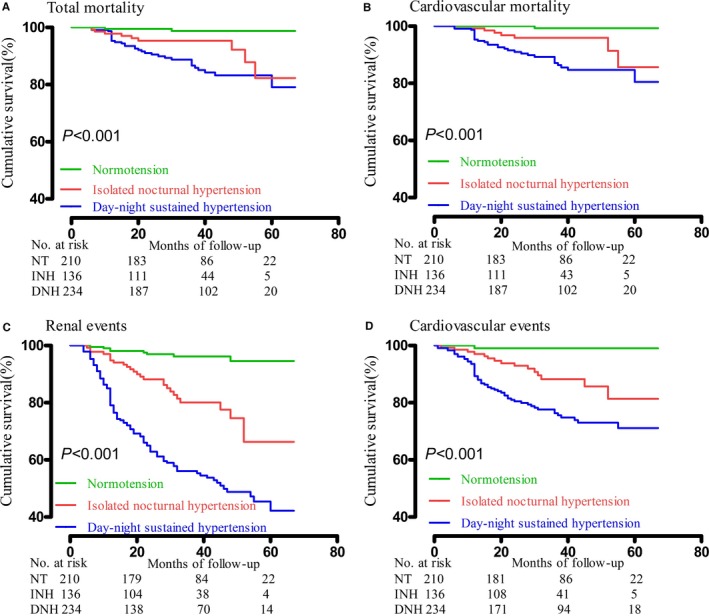
Kaplan–Meier survival curves as a function of patients with normotension (NT), isolated nocturnal hypertension (INH), or day‐night sustained hypertension (DNH). A, Cumulative survival curves for total mortality in patients with INH or NT or DNH. B, Cumulative survival curves for cardiovascular mortality in patients with INH or NT or DNH. C, Cumulative survival curves for renal events in patients with INH or NT or DNH. D, Cumulative survival curves for cardiovascular events in patients with INH or NT or DNH. P<0.001 indicated a comparison between these 3 groups.
In multivariable‐adjusted models, INH (versus NT) was associated with a higher risk of renal events (HR, 2.78; 95% CI, 1.16–6.65) and CV events (HR, 6.82; 95% CI, 1.52–30.63) (Table 4).
Discussion
We investigated the prognostic effect of INH in Chinese nondialysis CKD patients. First, we found that nocturnal BP was an independent risk factor for the renal and CV events in CKD patients even when adjusted for clinic, 24‐hour, or daytime BP. Second, patients with nocturnal hypertension had more clinical events compared with patients with nocturnal NT, and nocturnal hypertension (versus nocturnal NT) was associated with an increased risk of renal events and all CV events. Finally, we found that patients with INH had a worse prognosis than patients with NT, and INH (versus NT) was associated with a higher risk of renal and CV events. Taken together, these results suggest that INH is an independent risk factor for the prognosis of renal events and cardiovascular events in Chinese nondialysis patients with CKD. Special attention should be paid to nocturnal hypertension, especially for INH in patients with CKD.
INH was defined as daytime NT and nighttime hypertension. Investigation into INH was a better tool to assess the role of nocturnal hypertension because all patients with INH had only nocturnal hypertension without daytime hypertension. Li and coworkers9 reported a prevalence of 10.9% in a Chinese cohort, and these patients had more severe target organ damage. Patients with INH had a higher risk of all‐cause death (HR, 1.29; P=0.045) and CV events (HR, 1.38; P=0.037) in unadjusted analyses.6 Previously, we reported that the prevalence of INH in Chinese patients with CKD was 20.44%, and that patients with INH had more severe target organ damage compared with normotensive patients. INH was correlated with an index of target organ damage.11 Data on the prognostic effect of INH in nondialysis CKD patients are lacking. We analyzed these patients to further investigate the prognostic effect of INH in Chinese nondialysis CKD patients. We found that patients with INH had a worse prognosis than patients with NT, and that INH (versus NT) was associated with a higher risk of renal and CV events. We cannot analyze the role of INH in the mortality based on few mortality events in this cohort, while Kaplan–Meier curves showed higher total mortality in patients with INH and nocturnal hypertension. A positive association between all clinical events and mortality might have been obtained if the duration of our follow‐up had been longer and the number of patients were increased. Nevertheless, our results showed the prognostic effect of nocturnal hypertension in Chinese nondialysis CKD patients. INH has been called “a masked disease in the dark” because it can be diagnosed only by ABPM.12 We must identify patients who may have INH and treat these patients based on evidence from the present study.
It is well known that the nocturnal BP fall is a physiological rhythm, while nocturnal hypertension has an opposite effect to the physiologic rhythm of BP. Nocturnal BP represents the minimal BP needed for adequate organ perfusion in healthy individuals.22 Maintaining a high nocturnal BP leads to overload on the CV system and a consequent negative impact on the heart and vascular structures, leading to a clinical event. It is not surprising that patients with nocturnal hypertension and INH had a worse prognosis among CKD patients. Therefore, lowering nocturnal BP could help reduce CV and renal risks for such patients. Antihypertensive chronotherapy could be used to lower nocturnal BP.23 Previously, we showed the advantages of bedtime scheduling of valsartan (80–320 mg once a day for 12 months) on 60 patients with CKD.24 However, antihypertensive chronotherapy is controversial because some studies have failed to show the difference between types of therapy.25 Further prospective randomized clinical trials are needed to ascertain whether antihypertensive chronotherapy has a beneficial effect in CKD patients.
Study Limitations
The present study has 5 main limitations. First, the size of the cohort was large but was from a single center. Second, all CKD patients underwent only one ABPM, therefore we could not rule out subsequent changes in ABPM. Third, all CKD patients were admitted to our hospital division, which helped to complete the assessment. These patients had severe proteinuria or severe renal damage, and therefore some CKD patients with nonsevere proteinuria or nonsevere renal damage might have been excluded, leading to bias. Fourth, only one ethnic group (Chinese) was enrolled in this cohort, which limits the generalization of the study outcomes. Fifth, the definition of INH was different in different guidelines, which could lead to different results in studies. Finally, all patients did not accept standard therapy at follow‐up, thus we cannot rule out the effect of drugs.
Conclusions
We reported that INH and nocturnal hypertension was associated with risk factors for the prognosis in Chinese nondialysis CKD patients. Further prospective randomized clinical trials are needed to ascertain the role of INH and nocturnal hypertension in mortality and whether lowering of BP INH and nocturnal hypertension can have a beneficial effect in CKD patients.
Sources of Funding
This work was supported by a training project for excellent younger scholars of the Third Affiliated Hospital of Sun Yat‐Sen University (2010).
Disclosures
None.
Acknowledgments
We would like to thank all of the patients and their families for participating in this study.
(J Am Heart Assoc. 2016;5:e004198 doi: 10.1161/JAHA.116.004198)
References
- 1. Stenvinkel P. Chronic kidney disease: a public health priority and harbinger of premature cardiovascular disease. J Intern Med. 2010;268:456–467. [DOI] [PubMed] [Google Scholar]
- 2. Zhang L, Wang F, Wang L, Wang W, Liu B, Liu J, Chen M, He Q, Liao Y, Yu X, Chen N, Zhang JE, Hu Z, Liu F, Hong D, Ma L, Liu H, Zhou X, Chen J, Pan L, Chen W, Wang W, Li X, Wang H. Prevalence of chronic kidney disease in China: a cross‐sectional survey. Lancet. 2012;379:815–822. [DOI] [PubMed] [Google Scholar]
- 3. The Global Burden of Metabolic Risk Factors for Chronic Diseases Collaboration Writing and global analysis group . Cardiovascular disease, chronic kidney disease, and diabetes mortality burden of cardiometabolic risk factors from 1980 to 2010: a comparative risk assessment. Lancet Diabetes Endocrinol. 2014;2:634–647. [DOI] [PMC free article] [PubMed] [Google Scholar]
- 4. Johnson ES, Thorp ML, Yang X, Charansonney OL, Smith DH. Predicting renal replacement therapy and mortality in CKD. Am J Kidney Dis. 2007;50:559–565. [DOI] [PubMed] [Google Scholar]
- 5. Tonelli M, Wiebe N, Culleton B, House A, Rabbat C, Fok M, McAlister F, Garg AX. Chronic kidney disease and mortality risk: a systematic review. J Am Soc Nephrol. 2006;17:2034–2047. [DOI] [PubMed] [Google Scholar]
- 6. Fan HQ, Li Y, Thijs L, Hansen TW, Boggia J, Kikuya M, Bjorklund‐Bodegard K, Richart T, Ohkubo T, Jeppesen J, Torp‐Pedersen C, Dolan E, Kuznetsova T, Stolarz‐Skrzypek K, Tikhonoff V, Malyutina S, Casiglia E, Nikitin Y, Lind L, Sandoya E, Kawecka‐Jaszcz K, Imai Y, Ibsen H, O'Brien E, Wang J, Staessen JA. Prognostic value of isolated nocturnal hypertension on ambulatory measurement in 8711 individuals from 10 populations. J Hypertens. 2010;28:2036–2045. [DOI] [PubMed] [Google Scholar]
- 7. Hansen TW, Li Y, Boggia J, Thijs L, Richart T, Staessen JA. Predictive role of the nighttime blood pressure. Hypertension. 2011;57:3–10. [DOI] [PubMed] [Google Scholar]
- 8. Yano Y, Kario K. Nocturnal blood pressure and cardiovascular disease: a review of recent advances. Hypertens Res. 2012;35:695–701. [DOI] [PubMed] [Google Scholar]
- 9. Li Y, Staessen JA, Lu L, Li LH, Wang GL, Wang JG. Is isolated nocturnal hypertension a novel clinical entity? Findings from a Chinese population study. Hypertension. 2007;50:333–339. [DOI] [PubMed] [Google Scholar]
- 10. Wang C, Deng WJ, Gong WY, Zhang J, Zhang QZ, Ye ZC, Lou T. Nocturnal hypertension correlates better with target organ damage in patients with chronic kidney disease than a nondipping pattern. J Clin Hypertens (Greenwich). 2015;17:792–801. [DOI] [PMC free article] [PubMed] [Google Scholar]
- 11. Wang C, Zhang J, Liu X, Li C, Ye Z, Peng H, Chen Z, Lou T. Reversed dipper blood‐pressure pattern is closely related to severe renal and cardiovascular damage in patients with chronic kidney disease. PLoS One. 2013;8:e55419. [DOI] [PMC free article] [PubMed] [Google Scholar]
- 12. Wang C, Deng WJ, Gong WY, Zhang J, Tang H, Peng H, Zhang QZ, Ye ZC, Lou T. High prevalence of isolated nocturnal hypertension in Chinese patients with chronic kidney disease. J Am Heart Assoc. 2015;4:e002025 doi: 10.1161/JAHA.115.002025. [DOI] [PMC free article] [PubMed] [Google Scholar]
- 13. Mancia G, Fagard R, Narkiewicz K, Redon J, Zanchetti A, Bohm M, Christiaens T, Cifkova R, De Backer G, Dominiczak A, Galderisi M, Grobbee DE, Jaarsma T, Kirchhof P, Kjeldsen SE, Laurent S, Manolis AJ, Nilsson PM, Ruilope LM, Schmieder RE, Sirnes PA, Sleight P, Viigimaa M, Waeber B, Zannad F. 2013 ESH/ESC practice guidelines for the management of arterial hypertension. Blood Press. 2014;23:3–16. [DOI] [PubMed] [Google Scholar]
- 14. Li Y, Wang JG. Isolated nocturnal hypertension: a disease masked in the dark. Hypertension. 2013;61:278–283. [DOI] [PubMed] [Google Scholar]
- 15. Andrassy KM. Comments on ‘KDIGO 2012 clinical practice guideline for the evaluation and management of chronic kidney disease’. Kidney Int. 2013;84:622–623. [DOI] [PubMed] [Google Scholar]
- 16. Levey AS, Stevens LA, Schmid CH, Zhang YL, Castro AR, Feldman HI, Kusek JW, Eggers P, Van Lente F, Greene T, Coresh J. A new equation to estimate glomerular filtration rate. Ann Intern Med. 2009;150:604–612. [DOI] [PMC free article] [PubMed] [Google Scholar]
- 17. American Diabetes Association . Classification and diagnosis of diabetes. Diabetes Care. 2015;38(suppl):S8–S16. [DOI] [PubMed] [Google Scholar]
- 18. Gabbai FB, Rahman M, Hu B, Appel LJ, Charleston J, Contreras G, Faulkner ML, Hiremath L, Jamerson KA, Lea JP, Lipkowitz MS, Pogue VA, Rostand SG, Smogorzewski MJ, Wright JT, Greene T, Gassman J, Wang X, Phillips RA. Relationship between ambulatory BP and clinical outcomes in patients with hypertensive CKD. Clin J Am Soc Nephrol. 2012;7:1770–1776. [DOI] [PMC free article] [PubMed] [Google Scholar]
- 19. Alpert JS, Thygesen K, Antman E, Bassand JP. Myocardial infarction redefined–a consensus document of The Joint European Society of Cardiology/American College of Cardiology Committee for the redefinition of myocardial infarction. J Am Coll Cardiol. 2000;36:959–969. [DOI] [PubMed] [Google Scholar]
- 20. Luepker RV, Apple FS, Christenson RH, Crow RS, Fortmann SP, Goff D, Goldberg RJ, Hand MM, Jaffe AS, Julian DG, Levy D, Manolio T, Mendis S, Mensah G, Pajak A, Prineas RJ, Reddy KS, Roger VL, Rosamond WD, Shahar E, Sharrett AR, Sorlie P, Tunstall‐Pedoe H. Case definitions for acute coronary heart disease in epidemiology and clinical research studies: a statement from the AHA Council on Epidemiology and Prevention; AHA Statistics Committee; World Heart Federation Council on Epidemiology and Prevention; the European Society of Cardiology Working Group on Epidemiology and Prevention; Centers for Disease Control and Prevention; and the National Heart, Lung, and Blood Institute. Circulation. 2003;108:2543–2549. [DOI] [PubMed] [Google Scholar]
- 21. Pocock SJ, Clayton TC, Altman DG. Survival plots of time‐to‐event outcomes in clinical trials: good practice and pitfalls. Lancet. 2002;359:1686–1689. [DOI] [PubMed] [Google Scholar]
- 22. Gonzalez RE, Hernandez A, Dibner C, Koehler BB, Pechere‐Bertschi A. Arterial blood pressure circadian rhythm: significance and clinical implications. Rev Med Suisse. 2012;8:1709–1712. [PubMed] [Google Scholar]
- 23. Hermida RC, Smolensky MH, Ayala DE, Fernandez JR, Moya A, Crespo JJ, Mojon A, Rios MT, Fabbian F, Portaluppi F. Abnormalities in chronic kidney disease of ambulatory blood pressure 24 h patterning and normalization by bedtime hypertension chronotherapy. Nephrol Dial Transplant. 2014;29:1160–1167. [DOI] [PubMed] [Google Scholar]
- 24. Wang C, Zhang J, Liu X, Li CC, Ye ZC, Peng H, Chen Z, Lou T. Effect of valsartan with bedtime dosing on chronic kidney disease patients with nondipping blood pressure pattern. J Clin Hypertens (Greenwich). 2013;15:48–54. [DOI] [PMC free article] [PubMed] [Google Scholar]
- 25. Rahman M, Greene T, Phillips RA, Agodoa LY, Bakris GL, Charleston J, Contreras G, Gabbai F, Hiremath L, Jamerson K, Kendrick C, Kusek JW, Lash JP, Lea J, Miller ER, Rostand S, Toto R, Wang X, Wright JJ, Appel LJ. A trial of 2 strategies to reduce nocturnal blood pressure in blacks with chronic kidney disease. Hypertension. 2013;61:82–88. [DOI] [PMC free article] [PubMed] [Google Scholar]