



ABSTRACT
The first Institute of Biochemistry in Japan was founded by Leonor Michaelis from Berlin at Nagoya in 1922, and there have been numerous interrelations between Japanese and German biochemists since. Some such relationships are presented here from a personal point of view as one illustrative example, which could be extended amply by the experience of many other scientists from the two countries. Fruitful exchanges are facilitated by organisations such as the Alexander von Humboldt Foundation (AvH) and the Deutscher Akademischer Austauschienst (DAAD) or the Japanese Society for the Promotion of Science (JSPS) and by the many bilateral agreements between universities and research institutions.
Key Words: redox biology, oxidative stress, glutathione, glutamine metabolism
INTRODUCTION
When Professor Shinya Toyokuni invited me to contribute an article on the topic of German-Japanese relationships in Biochemistry, out of friendship it was easy to accept the invitation. At first glance, it is an attractive task, given the history of the role of Leonor Michaelis as founder of the first Institute of Biochemistry in Japan in 1922. However, the scope of interrelations becomes much larger if one considers biochemistry as being part of preclinical and clinical medicine and of life sciences in general: the history of German-Japanese relations in medicine dates back about 300 years. This led to the decision to limit this brief Commentary to my own recollections and perspective, which may serve only as one illustrative example of experiences of numerous other colleagues from the two countries.
MY EARLY EXPOSURE TO JAPANESE BIOCHEMISTS
As a young postdoc in 1968, I was working together with Bolko Brauser at Theodor Bücher’s Institute of Physiological Chemistry at the Ludwig-Maximilians-University at Munich. The key publications by Tsuneo Omura and Ryo Sato from the Institute of Protein Research at Osaka on cytochrome P-450 from 19641, 2) were impressive and helpful in our studies of the reduction kinetics of cytochrome P-450 in the intact perfused liver.3) Martin Klingenberg had described the carbon-monoxide binding pigment (named cytochrome P-450) in microsomes in 1958, then working at the Johnson Research Foundation at Philadelphia headed by Britton Chance, being a professor in Munich in 1968.4)
In the work with Brauser, we looked mainly on the Soret band (blue region of the visible spectrum) of cytochromes of the mitochondrial respiratory chain using dual-wavelength spectrophotometry. It was a special day for us when Professor Osamu Hayaishi, Department of Medical Chemistry, Kyoto University Faculty of Medicine, visited us at Munich to see the liver perfusion system coupled with organ spectrophotometry and fluorometry and how we could follow the redox changes of mitochondrial and extramitochondrial cytochromes in real time in the intact metabolizing organ.
My own ‘niche’ in the redox field opened when one evening at the basement lab in Munich I decided to look at yet another extramitochondrial pigment, the peroxisomal hemeprotein catalase. Britton Chance had described catalase Compound I in 1947, using Soret band difference spectra. In 1969 I looked, however, at the spectral region beyond the reduction peak of cytochrome c oxidase at 605 nm: at 640 minus 660 nm, in the near-infrared where light scattering is less of a problem than at the near-ultraviolet (Soret) region of the spectrum. I infused ethanol at low concentration for it to act as a hydrogen donor for the peroxidatic reaction of catalase: eureka, it worked!5) This was the discovery of the existence of steady-state hydrogen peroxide production in a mammalian organ, a slightly heretical thought at that time, now mainstream. Discussing these findings with Britton Chance on one of his visits to Munich and after appropriate control experiments and extensions, this was published in 1970.6)
The developments led to a highly productive era at the Johnson Research Foundation and intense collaboration with our Munich group. Nozomu Oshino, who had worked with Ryo Sato at Osaka, joined Britton Chance’s group as a postdoc, and he and I collaborated in further characterizing and quantifying the cellular H2O2 production in the intact organ.7, 8) This also laid the basis for lifelong friendship with Nozomu and his wife, Reiko. The work, together with Alberto Boveris’ studies on mitochondrial H2O2 production, gave rise to an extended review on hydroperoxide metabolism in mammalian organs.9) The three of us remembered those times in the 1970s when we met again at the Kyoto meeting of the Society for Free Radical Research International in 2000 (Fig. 1).
Fig. 1.

Reminiscing the research times in the 1970s at the Johnson Research Foundation in Philadelphia during the Society for Free Radical Research International (SFRRI) Meeting at Kyoto in 2000. From left: Nozomu Oshino (Osaka), Alberto Boveris (Buenos Aires), Helmut Sies (Düsseldorf).
A second line of interaction with Japanese biochemists arose from common interests in glutathione, GSH. We had observed the release of glutathione disulfide, GSSG, from the perfused liver upon infusion of hydroperoxides.10) The field of glutathione was blossoming, and Albrecht Wendel and I organized an international meeting on GSH at Reisensburg Castle in Southern Germany in 1978. Among the invited speakers were Taneaki Higashi and Noriko Tateishi from the Department of Biochemistry, Institute of Cancer Research at Osaka University Medical School, headed by Yukiya Sakamoto. This led to further interactions, and at the celebration of the 20th anniversary of the Osaka Institute in 1981 I had the pleasure to participate and meet new Japanese friends. Among them, I would like to mention Naoyuki Taniguchi, then from the Biochemistry Laboratory, Cancer Institute, Hokkaido University, Sapporo, who had worked on gamma-glutamyl transpeptidase. The relationship to Hokkaido University intensified when Isao Yamazaki, Professor of Biophysics, sent his Ph.D. student, Toshihisa Ishikawa in 1982 to my lab in Düsseldorf, where I had moved to from Munich in 1979, on an initial DAAD-Fellowship, which led to fruitful and longstanding scientific and personal interaction with him and his wife, Naoko. The work was mainly on cardiac export of glutathione disulfide and S-conjugate.11) I would also like to mention Masayasu Inoue, from the Department of Biochemistry, Kumamoto University Medical School, then working on transport on glutathione S-conjugates. I remember a wonderful visit to him and his research group at Kumamoto in later years, including an excursion to the impressive Mount Aso. Importantly, he and his group translated the book, Oxidative Stress, into Japanese, which appeared in 1986 (Fig. 2).
Fig. 2.
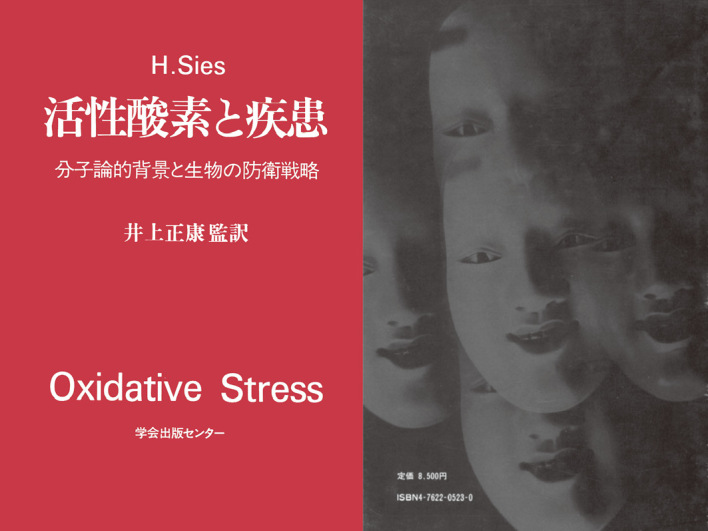
“Oxidative Stress” (Sies, H., ed.) in Japanese translation 1986. Back cover: Noh mask, the Japanese equivalent of Janus face. Translation was performed by Prof. Masayasu Inoue and his team, then at Kumamoto University.
Early on, I met with Junji Yodoi, from the Department of Biological Responses, Institute of Virus Research, Kyoto University, who first described a new disease entity, Adult T-Cell Leukemia (ATL), which later proved to be caused by HTLV-1 retrovirus. Through his interests in redox regulation of p53, of apoptosis and the functions in the thioredoxin system, I met him on several occasions at international meetings, including meetings of the Oxygen Club of California (OCC). He also visited our laboratory at Düsseldorf.
Society for Free Radical Research (SFRR). These and other direct scientific encounters leading to joint experimental work formed a wonderful personal basis in my further interactions with Japanese colleagues. One major segment relates to the Society for Free Radical Research (SFRR). The 3rd Biennial Meeting was held at Düsseldorf, July 20–23, 1986, and the two Japanese delegates were Etsuo Niki, Department of Reaction Chemistry, Faculty of Engineering, University of Tokyo, and ToshikazuYoshikawa, First Department of Medicine, Kyoto Prefectural University of Medicine, Kyoto. I remember vividly the committee meeting at our Institute, with these two Japanese colleagues entering the activities in free radical research, which led to enormously productive further research and meetings at the international level during the following decades. Both these colleagues, and also Noriko Noguchi and Yuji Naito at later years, hosted many high-level international meetings in Japan subsequently and actively participated elsewhere. A postdoc from Kyoto Prefectural University of Medicine, Kazuhito Rokutan, joined our laboratory at Düsseldorf, working together with Jim Thomas (on sabbatical from Iowa State University at Ames, Iowa) on protein S-glutathionylation.12)
Ebselen. In 1984, we had published on a selenoorganic compound called Ebselen, which mimics the reaction catalyzed by GSH peroxidase.13) Ebselen had been synthesized at the Nattermann Company (later Rhone-Poulenc) at Cologne, led by Erich Graf. The development of clinical application was spearheaded by the Daiichi Company, Tokyo, with Hiroyuki Masayasu at the helm (Fig. 3). Numerous experimental and clinical projects were carried out, and Hiroshi Masumoto spent a fruitful research visit with us at Düsseldorf.14-17)
Fig. 3.

Ebselen researchers together. From right: Hiroyuki Masayasu (Daiichi Co., Tokyo), Helmut Sies (University of Düsseldorf), Erich Graf (Nattermann Co., Cologne).
In another fruitful relationship with Japanese colleagues from industry, Toru Komai from Sankyo Co, Tokyo, spent a research visit at Düsseldorf in 1984, working on quinone redox cycling and naphthol metabolism. His wife Keiko and the children Chie and Wataru experienced life in Germany during the stay. Longlasting contact with Minoru Tanaka was also established.
NOBUHIKO KATUNUMA, TOKUSHIMA UNIVERSITY: GLUTAMINE METABOLISM
Studying the relationship of the ammonia concentration on hepatic glutamine metabolism with Dieter Häussinger,18) we came across the work of Takeyori Saheki and Nobuhiko Katunuma from the Institute of Enzyme Research at Tokushima University.19) We made contact, and this was the start of a longterm friendship. I first met Professor Katunuma personally in 1979 at the Advances in Enzyme Regulation Meeting organized by George Weber at Indianapolis. He visited us at Düsseldorf, and he had special ties to the University of Freiburg in Southern Germany, where he visited Professor Helmut Holzer. Katunuma was not only an eminent scientist in the field of proteolysis, he also held the 7th degree of Kendo (highest degree in Japan). On one of my visits to Tokushima, he was kind enough to give me a lesson of Kendo! The photo (Fig. 4) was taken in 1987. Further interactions led to an extended research visit by Takeshi Nikawa from Tokushima to Düsseldorf, the project being the interaction of ebselen with glutathione S-transferases.
Fig. 4.

Professor Nobuhiko Katunuma, Tokushima University, exercising Kendo (1987).
NAGOYA AND BIOCHEMICAL HISTORY: LEONOR MICHAELIS
The meeting on “The Molecular Biology of the Ageing Process and Mitochondrial Diseases” was held at Nagoya, May 30–June 1, 1992, which I had the pleasure of attending. Professor Takayuki Ozawa, Department of Biomedical Chemistry, Faculty of Medicine at the University of Nagoya, was the organizer. We had a stimulating discussion about Leonor Michaelis and his Nagoya time: It was a surprise for me to learn that Michaelis had founded, at Nagoya, the first Institute of Biochemistry in Japan in 1922. Like any student of life sciences and enzymology, the name of Michaelis was connected to the Michaelis constant, Km, which stemmed from his seminal publication in 1913, together with Maud Menten from Canada. Michaelis had worked in Berlin, and during the difficult times after the First World War, he was fortunate to be offered the opportunity at Nagoya, on the basis of support by the Rockefeller Foundation. He arrived by ship in 1922, taking with him his chemicals and purportedly even a supply of distilled water. Michaelis was an ardent pianist, and on a visit by the similarly ardent violinist, Albert Einstein, later in the year, there was a memorable music activity; it would have been great to have a photo to see Einstein and Michaelis playing music together at Nagoya! Kunio Yagi, a successor to Michaelis at the Institute in later years (see below), communicated an interesting story to Angelo Azzi regarding the influence of Michaelis on musical life20): “Michaelis used to listen to young violinists and advise them. Once he was asked by a young man if he could become a violin soloist. Michaelis, after having listened to him, told him to go to Europe and study further in Germany. After his return Michaelis listened to him again, but was not convinced of his talent and told him: ‘If scientists, like me, or artists, like you, cannot fly as high as they would like, we always have an alternative: teaching’. The young man, Kunio said, thanked Michaelis and decided to dedicate himself to teaching violin. His name was Shinichi Suzuki, the inventor of the [famous] “Suzuki method” of teaching violin and other instruments to children”. This is “fascinating, for the link between science and art and for the influence that a German professor of biochemistry could have on the teaching of music in Nagoya, in Japan and in the world”.20)
The history of the Institute of Biochemistry of the Aichi Medical College (now Graduate School of Medicine, Nagoya University) started with Leonor Michaelis, as mentioned. He gathered many bright young biochemists from all over Japan into his laboratory (Fig. 5) and made substantial contributions to the promotion of biochemistry in Japan.21) Lectures given by Michaelis in Japan were presented in German, and the assistants and medical students worked hard to master the German language in order to understand. Nowadays, the lingua franca is English and, of course, German and Japanese authors write their scientific papers for international journals in English.
Fig. 5.

Leonor Michaelis, Professor of Biochemistry of the Aichi Medical College (now Graduate School of Medicine, Nagoya University) 1922–1926. Left: Michaelis wearing a Japanese kimono. Right: Professor Leonor Michaelis in his Biochemistry Laboratory with his research assistants and students at Aichi Medical College in Nagoya. From: T. Nagatsu (20), with permission of the copyright holder.
Professor Kunio Yagi, who was mentioned above in conjunction with the story of Michaelis’ music activities, became Chairman and Professor of the First Department of Biochemistry of Nagoya University School of Medicine in 1962, i.e. he was a late successor of Michaelis. Yagi was active in research in the field of biological oxidations, especially studying flavoprotein enzymes such as D-aminoacid oxidase. He also worked on lipid hydroperoxides and their biological effects.
The 1st International Union of Biochemistry (IUB) Conference “Biochemistry of Disease” was also held at Nagoya, June 1–6, 1992. The President was Professor Osamu Hayaishi (who had visited us at Munich in the early 1970s), and the Chairman was Professor Kunio Yagi. This was a landmark conference which brought together most people working in this field from all over the world.
At the Expo 2005 in Nagoya, an Aichi Expo Symposium entitled “Research in Environmental Medicine” took place, with the subtitle “Common problems and similar solutions in Japan and Germany”, organized by Jean Krutmann from the Leibniz Research Institute of Environmental Medicine (Düsseldorf) and Akimichi Morita from the Department of Geriatric and Environmental Dermatology, Nagoya City University (Nagoya) and Masamitsu Ichihashi from the Sun Clinic, Sun Care Institute (Osaka). My contribution was entitled “The environment, oxidative stress and nutrition”. The Symposium was opened by Hartmut Krebs, the Vice Minister of the German State of North-Rhine Westphalia, and I was speaking also in my capacity as President of the Northrhine-Westphalian Academy of Sciences at the time. This activity attracted considerable interest and led to further Japanese-German research projects and mutual exchanges.
A final personal note on Nagoya relationships: my daughter, Katharina, a medical student at the University of Freiburg, stayed at the Department of Pathology and Biological Responses, headed by Shinya Toyokuni, for an internship in 2015. Not only did she learn pathology, but there also were cultural activities, e.g. learning the tea ceremony, together with another medical student, Ema Toyokuni (Fig. 6)
Fig. 6.
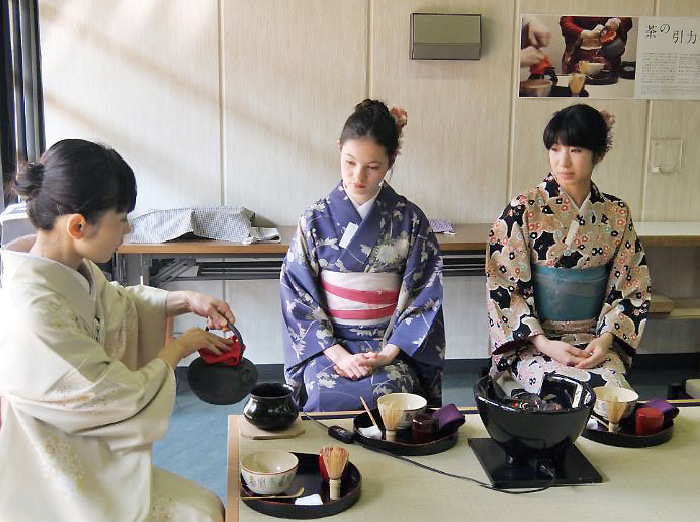
Tea ceremony experienced at Kyoto by two medical students. From right: Ema Toyokuni (Kyoto) and Katharina Sies (Freiburg), March 2015.
TOKYO: KEIO UNIVERSITY
Prof. Makoto Suematsu introduced me to Keio University, which was founded by Yukichi Fukuzawa. At the International Symposium for Life Sciences and Medicine in 1996, entitled “Conference on Oxygen Homeostasis and its Dynamics”, the conference photo was taken outside the lecture hall. The photographer negotiated at length with two of the participants to move to another position before he took the photo; the reason for this became clearer looking at the resulting photograph: the portrait sculpture of Fukuzawa is part of the group photo, shown at the upper left (Fig. 7.
Fig. 7.
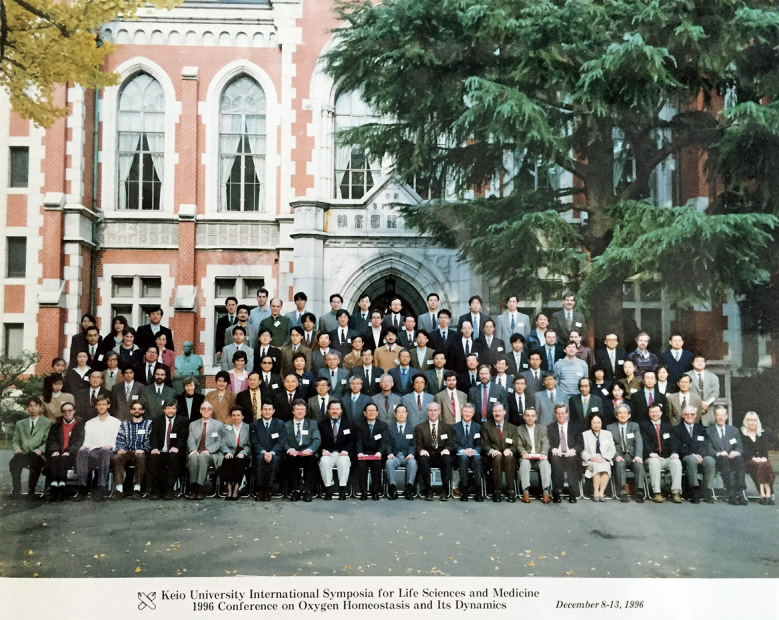
Conference on Oxygen Homeostasis and its Dynamics, Keio University, Tokyo 1996. Note the portrait sculpture of Yukichi Fukuzawa, Founder of Keio University at upper left.
TOKYO: NATIONAL CANCER CENTER RESEARCH INSTITUTE; TSUKUBA
Professors Susumu Nishimura, Takashi Sugimura and Hiroshi Kasai at the National Cancer Center were at the forefront of mutagenicity and carcinogenicity research, and it was a pleasure to visit them in 1987 to give a lecture entitled “Biochemistry of Oxidative Stress”. Later visits followed at Tsukuba, where other colleagues such as Shiro Bannai and Takashi Iyanagi performed innovative research of cystine transport and quinone reductases, respectively.
Polyphenols. Our research on flavonoids and their action on vascular endothelium had led to research on flavanols occurring in cocoa, notably (-)-epicatechin. High-flavanol cocoa, which retained much of the initial flavanols present in the cocoa beans, was vasoactive, as we had shown in 2003 by the profound increase in flow-mediated dilation of the brachial artery, whereas the (normal) low-flavanol cocoa did not.22) [Note: During standard processing of cocoa beans to make cocoa, most of the flavanols are being lost due to degradation by fermentation, heat, alkalinization]. In September 2004, the 9th International Symposium on Chocolate and Cocoa Nutrition was held at the International Conference Hall, Keidanren Kaikan, Tokyo; I presented at lecture entitled “Cocoa polyphenols and inflammatory mediators”. Toshihiko Osawa from Nagoya University presented on “Suppression by cocoa polyphenol metabolites of stress response of human vascular endothelial cells”. Since then, several international conferences were held, under the name of ICPH (International Conference of Polyphenols and Health), the last one having taken place as ICPH7 at Tours, France, in 2015. Many Japanese and German scientists are interacting in this research field, which also involves participation by researchers from industry.
KYOTO 2014
My recent memorable attendance of the splendid scientific meetings organized by the colleagues in Kyoto was the 17th Biennial Meeting of the Society for Free Radical Research International, held at Kyoto International Conference Center, March 23–26, 2014. Professors Shinya Toyokuni and Yuji Naito were the organizers. I had the honor of delivering the Trevor Slater Award Lecture “The role of metabolic H2O2 generation: Redox signaling and oxidative stress”. Apart from the good quality of the scientific sessions, the banquet with the sake ceremony was a highlight (Fig. 8).
Fig. 8.

From the17th Biennial Meeting of the Society for Free Radical Research International, held at Kyoto International Conference Center, March 23–26, 2014. The colleagues are, from left: Holger Steinbrenner, Helmut Sies (both Düsseldorf), Xingen Lei (Ithaca).
ALEXANDER VON HUMBOLDT FOUNDATION and DEUTSCHER AKADEMISCHER AUSTAUSCHDIENST
The Alexander von Humboldt (AvH) Foundation, founded in 1953, has contributed substantially to the mutual relationships between Germany and Japan. In the international comparison, next to the USA Japan is the second-strongest nation with almost 2,500 Japanese scientists having received AvH Research Fellowship or an AvH Research Award, two-thirds of which from natural sciences, with medicine and biosciences being largest. There is an active AvH-Alumni community. Also, close to 500 German scientists were supported to go to Japan by AvH in cooperation with the Japan Society for the Promotion of Sciences (JSPS), which had opened a JSPS Liaison Office at Bonn in 1991. In 2011, a Humboldt Colloquium took place in Kyoto, celebrating the 150th Anniversary of German-Japanese diplomatic relations, under the title:”Sustainable Relations between Japan and Germany in the Globalized World: Medicine since Philipp Franz von Siebold and Koan Ogata”. Professor Helmut Schwarz, AvH-President, addressed the audience with the following questions: “Which Japanese-German traditions in science and the humanities continue to thrive today? Which ones do we wish to strengthen or to revitalize? Where are today’s challenges for Japanese-German academic cooperation, and where are those of the future?” As mentioned above, several of the scientists visiting my laboratory for research visits were supported by the AvH and by the Deutscher Akademischer Austauschdienst (DAAD), for example Dr. Toshihisa Ishikawa as mentioned above, or Dr. Tomoko Oarada from Chiba University.
GERMAN JAPANESE HISTORY OF MEDICINE
The history of German-Japanese relationships in medicine goes back 300 years,23) a fascinating story which can be highlighted by the surgeon Leopold Müller who in 1870 came to Japan and introduced the medical curriculum at the Daigakko, the Imperial University at Tokyo. In 1922, the same year that Michaelis went to Nagoya, the surgeon Fritz Härtel became first director of the Surgery Clinic at Osaka University. Japanese doctors also came to Germany. The bacteriologist Shibasaburo Kitasato developed the tetanus vaccine in the Institute of Robert Koch, and with Emil von Behring the diphtheria vaccine. Sahachiro Hata developed the substance Ehrlich-Hata 606, which under the name of Salvarsan became a drug against syphilis in 1910. The anatomist Sunao Tawara, together with Ludwig Aschoff, discovered ‘Aschoff-Tawara node’ in the cardiac electrical conduction system.
A special topic is the important impetus for the professional development of female Japanese medical doctors, which was provided by their stay in Germany. In an article by Professor Aeka Ishihara focusing on the pivotal years from 1890–1915,24) the amazing stories of Mizuko Takahashi and of Tada Urata are presented. Takahashi came from the Aichi Prefecture, and on her own initiative in 1890 went to Berlin where she overcame administrative obstacles preventing females to study medicine, and returned to Japan for an ensuing career as medical doctor. Tada Urata came from Kumamoto and studied medicine at the University of Marburg, finishing with her dissertation thesis in 1905. Urata was not only the first female Japanese, but also the first female ever who obtained the title of medical doctor at Marburg University (no German female was before her). Both stories were much more intricate, and the aforementioned Fukuzawa and Kitasato played decisive roles in the development of these exceptional professional careers.
LOOKING BACK AND LOOKING FORWARD
The German-Japanese relationships in life science have been very lively. The present small article focuses on one particular aspect, redox biology and metabolism, and this only from a personal perspective. Much more could be said about relationships in cell biology and other fields, for example cancer biology and further fields of medicine. A main conclusion from the aforementioned could be that from the beginnings, almost 100 years ago, with Leonor Michaelis starting his influential time in 1922 in Nagoya, to the present there has been active mutual interchange. Some examples showed that establishing personal contact after initial reading of a published paper can lead to lifelong friendship and progress in science across the continents. To me it was particularly moving when, earlier this year, 2016, to my complete surprise, an issue of Archives in Biochemistry and Biophysics (ABB) appeared, edited by Henry J. Forman and Shinya Toyokuni, describing some of the worldwide interactions. The Japanese colleagues who contributed were numerous,25-34) and only some of the earlier development with each of them could be presented here in this brief article. My sincere thanks go to all these colleagues! I wish to extend special thanks to Shinya Toyokuni who visited Düsseldorf in the spring of 2016, experiencing not only scientific exchange but also having a glimpse at medieval history at Burg Linn, near Düsseldorf (Fig. 9).
Fig. 9.

Professor Shinya Toyokuni at Burg Linn near Düsseldorf, April 2016.
ACKNOWLEDGEMENTS
Helpful discussions with Dr. Steffen Mehlich (Alexander von Humboldt Stiftung, Bonn) and with Prof. Hans & Dr. Helga Esselborn (Cologne) are gratefully acknowledged. Research support by Deutsche Forschungsgemeinschaft (DFG), Bonn, and by National Foundation for Cancer Research (NFCR), Bethesda, is gratefully acknowledged as well.
LITERATURE CITED
- 1).Omura T, Sato R. The carbon monoxide binding pigment of liver microsomes. I. Evidence for its hemoprotein nature. J Biol Chem, 1964; 239: 2370–2378. [PubMed]
- 2).Omura T, Sato R. The carbon monoixde binding pigment of microsomes. II. Solubilisation, purification and properties. J Biol Chem, 1964; 239: 2379–2385. [PubMed]
- 3).Brauser B, Sies H, Bücher T. Reduction kinetics and content of cytochrome P-450 by application of dual wavelength techniques to hemoglobin-free perfused rat liver. FEBS Lett, 1969; 2: 167–169. [DOI] [PubMed]
- 4).Klingenberg M. Pigments of rat liver microsomes. Arch Biochem Biophys, 1958; 75: 376–386. [DOI] [PubMed]
- 5).Sies H. Biological redox systems and oxidative stress. Cell Mol Life Sci, 2007; 64: 2181–2188. [DOI] [PMC free article] [PubMed]
- 6).Sies H, Chance B. The steady state level of catalase compound I in isolated hemoglobin-free perfused rat liver. FEBS Lett, 1970; 11: 172–176. [DOI] [PubMed]
- 7).Oshino N, Chance B, Sies H, Bücher T. The role of H2O2 generation in perfused rat liver and the reaction of catalase compound I and hydrogen donors. Arch Biochem Biophys, 1973; 154: 117–131. [DOI] [PubMed]
- 8).Sies H, Bücher T, Oshino N, Chance B. Heme occupancy of catalase in hemoglobin-free perfused rat liver and of isolated rat liver catalase. Arch Biochem Biophys, 1973; 154: 106–116. [DOI] [PubMed]
- 9).Chance B, Sies H, Boveris A. Hydroperoxide metabolism in mammalian organs. Physiol Rev, 1979; 59: 527–605. [DOI] [PubMed]
- 10).Sies H, Gerstenecker C, Menzel H, Flohé L. Oxidation in the NADP system and release of GSSG from hemoglobin-free perfused rat liver during peroxidatic oxidation of glutathione by hydroperoxides. FEBS Lett, 1972; 27: 171–175. [DOI] [PubMed]
- 11).Ishikawa T, Sies H. Cardiac transport of glutathione disulfide and S-conjugate. Studies with isolated perfused rat heart during hydroperoxide metabolism. J Biol Chem, 1984; 259: 3838–3843. [PubMed]
- 12).Rokutan K, Thomas JA, Sies H. Specific S-thiolation of a 30-kDa cytosolic protein from rat liver under oxidative stress. Eur J Biochem, 1989; 179: 233–239. [DOI] [PubMed]
- 13).Müller A, Cadenas E, Graf P, Sies H. A novel biologically active seleno-organic compound--I. Glutathione peroxidase-like activity in vitro and antioxidant capacity of PZ 51 (Ebselen). Biochem Pharmacol, 1984; 33: 3235–3239. [DOI] [PubMed]
- 14).Masumoto H, Sies H. The reaction of ebselen with peroxynitrite. Chem Res Toxicol, 1996; 9: 262–267. [DOI] [PubMed]
- 15).Masumoto H, Sies H. The reaction of 2-(methylseleno)benzanilide with peroxynitrite. Chem Res Toxicol, 1996; 9: 1057–1062. [DOI] [PubMed]
- 16).Masumoto H, Kissner R, Koppenol WH, Sies H. Kinetic study of the reaction of ebselen with peroxynitrite. FEBS Lett, 1996; 398: 179–182. [DOI] [PubMed]
- 17).Parnham MJ, Sies H. The early research and development of ebselen. Biochem Pharmacol, 2013; 86: 1248–1253. [DOI] [PubMed]
- 18).Häussinger D, Sies H. Hepatic glutamine metabolism under the influence of the portal ammonia concentration in the perfused rat liver. Eur J Biochem, 1979; 101: 179–184. [DOI] [PubMed]
- 19).Saheki T, Katunuma N. Analysis of regulatory factors for urea synthesis by isolated perfused rat liver. I. Urea synthesis with ammonia and glutamine as nitrogen sources. J Biochem, 1975; 77: 659–669. [DOI] [PubMed]
- 20).Azzi A. Leonor Michaelis and music: transcript of a conversation with Kunio Yagi in 1986. IUBMB Life, 2006; 58: 378. [DOI] [PubMed]
- 21).Nagatsu TT. In memory of Professor Leonor Michaelis in Nagoya: great contributions to biochemistry in Japan in the first half of the 20th century. FEBS Lett, 2013; 587: 2721–2724. [DOI] [PubMed]
- 22).Heiss C, Dejam A., Kleinbongard P., Schewe T., Sies H., Kelm M. Vascular effects of coca rich in flavan-3-ols. J Amer Med Assoc, 2003; 290: 1030–1031. [DOI] [PubMed]
- 23).Kraas E, Hiki Y., eds. 300 Jahre deutsch-japanische Beziehungen in der Medizin. pp. 1–287. 1992, Springer Verlag, Tokyo, Berlin.
- 24).Ishihara A. Japanische Medizinerinnen in Deutschland 1890–1905. Mizuko Takahashi und Tada Urata. Hiyoshi-Studien zur Germanistik (Keio University), 2012; 49: 75–101.
- 25).Majima HJ, Indo HP, Nakanishi I, Suenaga S, Matsumoto K, Matsui H, et al. Chasing great paths of Helmut Sies “Oxidative Stress”. Arch Biochem Biophys, 2016; 595: 54–60. [DOI] [PubMed]
- 26).Niki E. Oxidative stress and antioxidants: Distress or eustress? Arch Biochem Biophys, 2016; 595: 19–24. [DOI] [PubMed]
- 27).Inoue M. Glutathionists in the battlefield of gamma-glutamyl cycle. Arch Biochem Biophys, 2016; 595: 61–63. [DOI] [PubMed]
- 28).Toyokuni S. Oxidative stress as an iceberg in carcinogenesis and cancer biology. Arch Biochem Biophys, 2016; 595: 46–49. [DOI] [PubMed]
- 29).Taniguchi N, Kizuka Y, Takamatsu S, Miyoshi E, Gao C, Suzuki K, et al. Glyco-redox, a link between oxidative stress and changes of glycans: Lessons from research on glutathione, reactive oxygen and nitrogen species to glycobiology. Arch Biochem Biophys, 2016; 595: 72–80. [DOI] [PubMed]
- 30).Yodoi J, Tian H, Masutani H, Nakamura H. Thiol redox barrier; local and systemic surveillance against stress and inflammatory diseases. Arch Biochem Biophys, 2016; 595: 88–93. [DOI] [PubMed]
- 31).Noguchi N. Ebselen, a useful tool for understanding cellular redox biology and a promising drug candidate for use in human diseases. Arch Biochem Biophys, 2016; 595: 109–112. [DOI] [PubMed]
- 32).Yamamoto Y. Coenzyme Q10 redox balance and a free radical scavenger drug. Arch Biochem Biophys, 2016; 595: 132–135. [DOI] [PubMed]
- 33).Fujii S, Sawa T, Nishida M, Ihara H, Ida T, Motohashi H, et al. Redox signaling regulated by an electrophilic cyclic nucleotide and reactive cysteine persulfides. Arch Biochem Biophys, 2016; 595: 140–146. [DOI] [PubMed]
- 34).Naito Y, Takagi T, Uchiyama K, Katada K, Yoshikawa T. Multiple targets of carbon monoxide gas in the intestinal inflammation. Arch Biochem Biophys, 2016; 595: 147–152. [DOI] [PubMed]