



Abstract
Background:
The effectiveness of neoadjuvant chemoradiotherapy (NCRT) treatment for patients with esophageal carcinoma (EC) remains controversial. The aim of this study was to compare the effect of NCRT followed by surgery (NCRTS) with surgery alone (SA) for EC.
Methods:
The PubMed, EMBASE, and the Cochrane Library databases were electronically searched up to August 2015 for all the published studies that investigated EC patients receiving either NCRTS or SA, and the reference lists were also manually examined for the eligible studies. The risk ratio (RR) with 95% confidence intervals (CIs) as effective size was determined to assess the 1-, 3-, 5-year survival rates (SRs), postoperative morbidity, and postoperative mortality. Heterogeneity was determined using the Q-test. The Begg's test and Egger's test were used for assessing any potential publication bias.
Results:
Of 1120 identified studies, 16 eligible studies were included in this analysis (involving 2549 patients). Overall, the pooled results suggested that NCRTS was associated with significantly improved 1-year (RR: 1.07, 95% CI: 1.02–1.13), 3-year (RR: 1.26, 95% CI: 1.14–1.39), and 5-year (RR: 1.36, 95% CI: 1.18–1.56) SRs. However, the results also indicated that NCRTS had no or little effect on postoperative morbidity (RR: 0.93, 95% CI: 0.82–1.05) and postoperative mortality (RR: 1.17, 95% CI: 0.56–2.44).
Conclusions:
Compared with SA, NCRTS can increase 1-, 3-, and 5-year SRs in patients with EC.
Keywords: Esophageal Carcinoma, Meta-analysis, Neoadjuvant Chemoradiotherapy, Survival Outcomes
Introduction
Esophageal carcinoma (EC) is one of the most common cancers and a leading cause of death, and is derived from various malignant cell types.[1] The studies of Kumagai et al.[2] and Duan et al.[3] estimated that there were more than 400,000 deaths per year caused by EC worldwide. As the main types of EC, squamous cell carcinoma (SCC) and adenocarcinoma (AC) are one of the six common causes of mortality, with 77/100,000 deaths per year in China,[4] 11/100,000 per year in Japan,[5] and 4.99/100,000 per year in Western countries.[6,7]
Although surgical resection for EC remains as the mainstream treatment over the past decades, surgery alone (SA) has been associated with a low long-term survival rate (SR).[3,8] Most EC patients who underwent surgical resection alone suffered from 4–10% morbidity and 54–69% mortality and exhibited a 5-year survival of 15–24% after surgery.[9] Chemoradiotherapy (CRT) could be administered before or after surgery; CRT before surgery as a neoadjuvant therapy is more often used in Europe and North America as compared to that in Asia.[10] Neoadjuvant CRT followed by surgery (NCRTS) has shown poor outcomes for EC treatment[2,3,10] whereas decreased recurrence and improved SR have been reported with various durations.[2,6,10,11] Thus, a consensus on the role of NCRTS in patients with EC is absent at present.
In our previous meta-analysis,[12] in comparison with SA, a significant association between NCRTS and 1-, 3-, and 5-year SRs was revealed. However, the SRs were not related to increased postoperative morbidity and mortality in those who suffered from EC. Furthermore, concurrent CRT was superior to sequential CRT.[12] Moreover, the different survival effects after CRT in patients from various ethnicities or genetic backgrounds were not analyzed, thereby necessitating further investigation.[12]
To assess the association between NCRTS and survival outcomes and evaluate whether the newly published or updated clinical trials can influence the results of our previous study, a comprehensive search of randomized clinical trials (RCTs) comparing NCRTS versus SA was carried out, and an up-to-date meta-analysis was performed in this study.
Methods
Search strategy
We followed the Preferred Reporting Items for Systematic Reviews and Meta-analyses guidelines for the present report.[13] To identify all the published studies regarding neoadjuvant CRT and EC, we conducted an electronic search in the databases including PubMed, EMBASE, and the Cochrane Library. The following terminologies “esophageal neoplasm”, “carcinoma”, “adjuvant”, “chemotherapy”, “radiotherapy”, “combined modality therapy”, and “clinical trial” were searched by two independent investigators (up to August 2015). Manual searches of the reference lists of all the relevant studies and review articles were also conducted.
Selection criteria
The inclusion and exclusion criteria in the current updated meta-analysis were the same as the criteria in the previous meta-analysis.[12] The criteria for eligibility of the studies were as follows: (1) RCTs evaluating NCRTS versus SA; (2) articles that provided survival data between patients from the NCRTS and SA groups; (3) articles that described the cases and controls in the diagnosis and the sources; and (4) having risk ratio (RR) with 95% confidence interval (CI) or data that could be calculated. The articles were excluded from the study if they met the following criteria: (1) non-RCT; (2) controls including patients with malignant tumors; and (3) if the publications were duplicate studies, abstracts, reviews, or the reported data were from an abstract presented at a meeting.
Data extraction and quality assessment
The following data were extracted from newly included RCTs by two investigators independently: number of participants, publication time, country, tumor histology, NCRTS regimen and sequence (concurrent CRTS or sequential CRTS), patient outcomes including 1-, 3-, and 5-year SRs, and postoperative morbidity and mortality. The quality of the eligible studies was assessed using the Jadad et al.'s guidelines.[14] Randomization, blinded, withdrawals, generation of random numbers, and concealment of allocation, which are the essential aspects of RCT, were scored from 0 to 5. A threshold of ≥4 points was regarded as a high-quality study. Any discrepancy was resolved by group discussion to achieve a consensus.
Statistical analysis
This meta-analysis was carried out using the STATA software version 10.0 (StataCorp, College Station, TX, USA). The primary outcomes of this study were 1-, 3-, and 5-year SRs. The RR with 95% CIs as effective size was determined to assess the 1-, 3-, and 5-year SRs, postoperative morbidity, and postoperative mortality. The significance of the pooled RR was determined by the Z-test. Heterogeneity was determined using the Q-test.[15,16] A random effects model was applied when heterogeneity existed among studies whereas a fixed effects model was applied when there was no statistical heterogeneity.[17] Sensitivity analysis was conducted by excluding those studies with distinct outliers in the results.[18] Subgroup analyses were conducted for 1-, 3-, and 5-year SRs, as well as postoperative morbidity and mortality based on publication year, ethnicity, sequence, and histology. The publication bias was evaluated with a funnel plot, Begg's test, and Egger's test.[19,20] All the P values were two-sided, and P < 0.05 was considered statistically significant.
Results
The process of the study selection is schematically illustrated in Figure 1. A total of 1120 articles from the initial search were identified and screened, and 53 studies were reviewed in detail. Finally, 16 studies were eligible, which included 11 RCTs[21,22,23,24,25,26,27,28,29,30,31] from the previous meta-analysis and 5 new RCTs [Table 1].[32,33,34,35,36] All these studies with a large, merged sample size were included in the updated analysis, randomly comparing EC patients with different therapies (NCRTS [n = 1305] vs. SA [n = 1244]), whereas the previous meta-analysis included a total of 1529 patients. The quality assessment by Jadad score [Table 1] encompassed 14 studies with scores of <4 and two studies with a high-quality score of 4.
Figure 1.
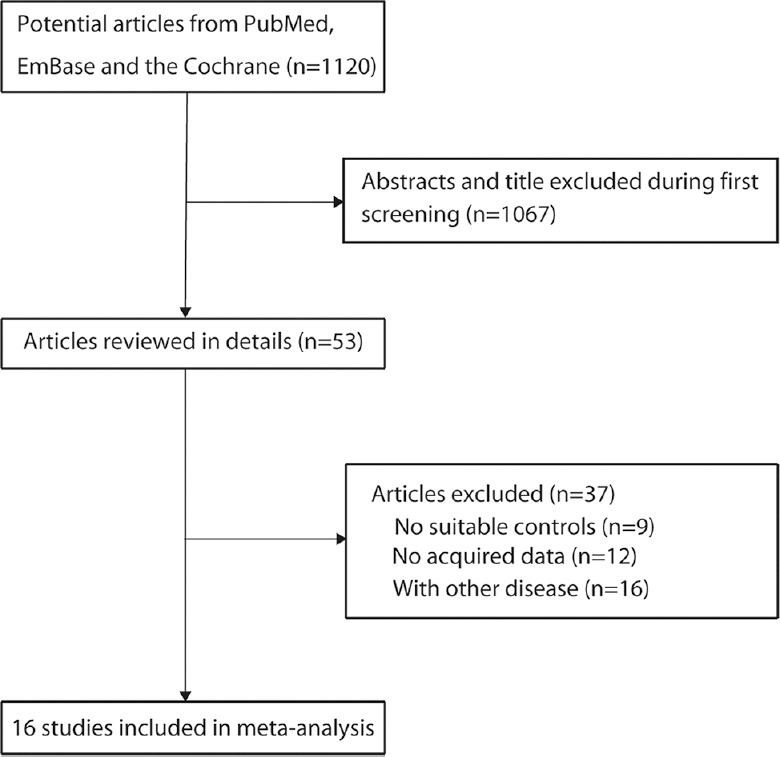
Flowchart of study selection and exclusion process.
Table 1.
Characteristics of 16 RCTs included in the final meta-analysis
| First author of study | Year of publication | Country | Sample size, n | Sequence of chemoradiotherapy | Histology | Jadad scores | ||
|---|---|---|---|---|---|---|---|---|
| NCRTS | SA | Total | ||||||
| Nygaard[21] | 1992 | Norway | 47 | 41 | 88 | Sequential | SCC | 2 |
| Apinop[22] | 1994 | Thailand | 35 | 34 | 69 | Concurrent | SCC | 1 |
| Le Prise[23] | 1994 | France | 41 | 45 | 86 | Sequential | SCC | 2 |
| Bosset[24] | 1997 | France | 143 | 139 | 282 | Sequential | SCC | 3 |
| Urba[25] | 2001 | USA | 50 | 50 | 100 | Concurrent | SCC (25.0%); AC (75.0%) | 2 |
| An[26] | 2003 | China | 48 | 49 | 97 | Sequential | SCC | 3 |
| Lee[27] | 2004 | Korea | 51 | 50 | 101 | Concurrent | SCC | 2 |
| Burmeister[28] | 2005 | Australia | 128 | 128 | 256 | Concurrent | SCC (37.0%); AC (63.0%) | 3 |
| Natsugoe[29] | 2006 | Japan | 22 | 23 | 45 | Concurrent | SCC | 2 |
| Tepper[30] | 2008 | USA | 30 | 26 | 56 | Concurrent | SCC (25.0%); AC (75.0%) | 2 |
| Cao[31] | 2009 | China | 118 | 118 | 236 | Concurrent | SCC | 2 |
| Lv[32] | 2010 | China | 158 | 80 | 238 | Concurrent | SCC | 4 |
| Yang[33] | 2012 | China | 54 | 69 | 123 | Concurrent | SCC | 4 |
| van Hagen[34] | 2012 | The Netherlands | 178 | 188 | 366 | Concurrent | SCC (75.0%); AC (23.0%); other (2.0%) | 2 |
| Mariette[35] | 2014 | France | 98 | 97 | 195 | Concurrent | SCC (70.3%); AC (29.2%); undifferentiated carcinoma (0.5%) | 3 |
| Bass[36] | 2014 | Ireland | 104 | 107 | 211 | Concurrent | SCC (46.4%); AC (53.6%) | 2 |
NCRTS: Neoadjuvant chemoradiotherapy followed by surgery; SCC: Squamous cell carcinoma; AC: Adenocarcinoma; RCTs: Randomized clinical trials; SA: Surgery alone.
A total of 14 studies reported the effect of NCRTS versus SA and the 1-year SR. The summary RR showed that the NCRTS were associated with a higher 1-year SR [RR: 1.07, 95% CI: 1.02–1.13, P = 0.005; Figure 2], and a nonsignificant heterogeneity was detected across the included studies (I2: 21.5%, P = 0.220). Similarly, pooled analysis suggested that patients who received NCRTS exhibited a significantly increased 3-year SR [RR: 1.26, 95% CI: 1.14–1.39, P < 0.001; nonsignificant heterogeneity; Figure 3]. Finally, the summary analysis for the 5-year SR indicated that the comparison of NCRTS versus SA displayed a beneficial effect [RR: 1.36, 95% CI: 1.18–1.56, P < 0.001; nonsignificant heterogeneity; Figure 4].
Figure 2.

Forest plot and pooled data showing the relative risk on the 1-year survival rate in the NCRTS and surgery alone groups. NCRTS: Neoadjuvant chemoradiotherapy followed by surgery; RR: Risk ratio; CI: Confidence interval.
Figure 3.

Forest plot and pooled data showing the relative risk in the 3-year survival rate in the NCRTS and surgery alone groups. NCRTS: Neoadjuvant chemoradiotherapy followed by surgery; RR: Risk ratio; CI: Confidence interval.
Figure 4.

Forest plot and pooled data showing the relative risk in the 5-year survival rate in the NCRTS and surgery alone groups. NCRTS: Neoadjuvant chemoradiotherapy followed by surgery; RR: Risk ratio; CI: Confidence interval.
The data for the effect of NCRTS on postoperative morbidity were available from 13 studies. Overall, we noted that although the patients who received NCRTS reduced the risk of postoperative morbidity by 7.0%, the decrease was not statistically significant [RR: 0.93, 95% CI: 0.82–1.05, P = 0.254; no evidence of heterogeneity; Figure 5]. Similarly, a significant effect between NCRTS and SA for postoperative mortality was not observed [RR, 1.17, 95% CI: 0.56–2.44, P = 0.684; Figure 6].
Figure 5.
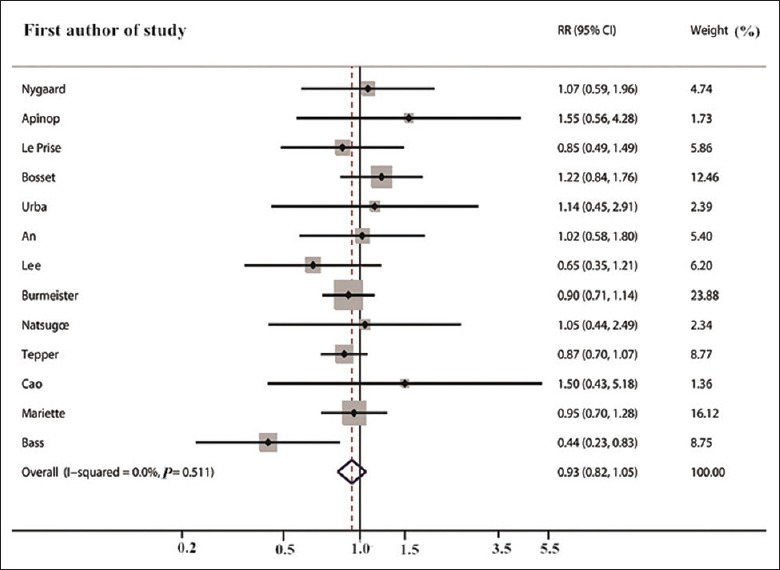
Forest plot and pooled data showing the relative risk of the postoperative morbidity in the NCRTS and surgery alone groups. NCRTS: Neoadjuvant chemoradiotherapy followed by surgery; RR: Risk ratio; CI: Confidence interval.
Figure 6.

Forest plot and pooled data showing the relative risk of the postoperative mortality in the NCRTS and surgery alone groups. NCRTS: Neoadjuvant chemoradiotherapy followed by surgery; RR: Risk ratio; CI: Confidence interval.
Although nonsignificant heterogeneity was observed for the outcomes, we conducted subgroup analyses for 1-, 3-, and 5-year SRs to evaluate the effect of NCRTS in specific subpopulations [Table 2]. First, we noted that NCRTS was associated with higher 1-year SR when the studies conducted in Western countries or patients receiving a concurrent sequence. Second, the patients who received NCRTS showed no significant effect on 3-year SR if the studies published before 2000, patients receiving sequential sequence, or patients suffering from AC. Third, NCRTS was not associated with 5-year SR when the studies published before 2000 or patients receiving a sequential sequence. Fourth, NCRTS significantly reduced the postoperative morbidity when the studies published in 2000 or after or patients suffering from AC. Finally, NCRTS was associated with a lower risk of postoperative mortality when the studies conducted in Eastern countries, patients receiving concurrent sequence, or patients suffering from SCC. Conversely, NCRTS significantly increased the postoperative mortality if the studies published before 2000, conducted in Western countries, patients receiving sequential sequence, or patients suffering from AC.
Table 2.
Subgroup analysis for survival outcomes
| Outcomes | Group | RR (95% CI) | P | Heterogeneity (%) | P for heterogeneity |
|---|---|---|---|---|---|
| 1-year survival rate | Publication year | ||||
| 2000 or after | 1.06 (0.99–1.14) | 0.085 | 43.8 | 0.067 | |
| Before 2000 | 1.04 (0.90–1.20) | 0.640 | 0 | 0.866 | |
| Ethnicity | |||||
| Eastern countries | 1.02 (0.96–1.08) | 0.558 | 20.7 | 0.272 | |
| Western countries | 1.13 (1.04–1.22) | 0.003 | 0 | 0.822 | |
| Sequence | |||||
| Sequential | 1.06 (0.93–1.12) | 0.380 | 0 | 0.676 | |
| Concurrent | 1.08 (1.02–1.14) | 0.005 | 41.2 | 0.083 | |
| Histology | |||||
| SCC | 1.04 (0.97–1.10) | 0.244 | 17.7 | 0.280 | |
| AC | 1.08 (0.97–1.20) | 0.173 | 10.2 | 0.291 | |
| 3-year survival rate | Publication year | ||||
| 2000 or after | 1.30 (1.10–1.53) | 0.002 | 51.9 | 0.023 | |
| Before 2000 | 1.17 (0.85–1.61) | 0.347 | 0 | 0.807 | |
| Ethnicity | |||||
| Eastern countries | 1.28 (1.12–1.47) | <0.001 | 0 | 0.887 | |
| Western countries | 1.30 (1.14–1.49) | <0.001 | 60.7 | 0.009 | |
| Sequence | |||||
| Sequential | 1.24 (0.94–1.64) | 0.130 | 0 | 0.697 | |
| Concurrent | 1.30 (1.17–1.44) | <0.001 | 51.3 | 0.025 | |
| Histology | |||||
| SCC | 1.26 (1.13–1.42) | <0.001 | 3.3 | 0.411 | |
| AC | 1.22 (0.98–1.51) | 0.073 | 61.5 | 0.051 | |
| 5-year survival rate | Publication year | ||||
| 2000 or after | 1.41 (1.17–1.69) | <0.001 | 31.4 | 0.167 | |
| Before 2000 | 1.41 (0.41–4.90) | 0.587 | 66.2 | 0.085 | |
| Ethnicity | |||||
| Eastern countries | 1.40 (1.14–1.71) | 0.001 | 0 | 0.740 | |
| Western countries | 1.42 (1.18–1.71) | <0.001 | 60.9 | 0.025 | |
| Sequence | |||||
| Sequential | 1.21 (0.75–1.95) | 0.440 | 45.6 | 0.175 | |
| Concurrent | 1.43 (1.24–1.65) | <0.001 | 38.1 | 0.115 | |
| Histology | |||||
| SCC | 1.37 (1.15–1.63) | <0.001 | 0 | 0.807 | |
| AC | 1.79 (1.12–2.87) | 0.014 | 72.0 | 0.028 | |
| Postoperative morbidity | Publication year | ||||
| 2000 or after | 0.88 (0.77–0.99) | 0.041 | 0 | 0.520 | |
| Before 2000 | 1.11 (0.85–1.45) | 0.427 | 0 | 0.676 | |
| Ethnicity | |||||
| Eastern countries | 0.98 (0.70–1.38) | 0.921 | 0 | 0.567 | |
| Western countries | 0.92 (0.80–1.05) | 0.216 | 13.9 | 0.321 | |
| Sequence | |||||
| Sequential | 1.08 (0.84–1.38) | 0.540 | 0 | 0.774 | |
| Concurrent | 0.87 (0.75–1.01) | 0.060 | 0.9 | 0.426 | |
| Histology | |||||
| SCC | 1.02 (0.86–1.21) | 0.837 | 0 | 0.805 | |
| AC | 0.44 (0.23–0.83) | 0.012 | – | – | |
| Postoperative mortality | Publication year | ||||
| 2000 or after | 1.06 (0.48–2.35) | 0.888 | 70.9 | <0.001 | |
| Before 2000 | 1.95 (1.01–3.77) | 0.048 | 4.6 | 0.351 | |
| Ethnicity | |||||
| Eastern countries | 0.35 (0.26–0.48) | <0.001 | 23.0 | 0.273 | |
| Western countries | 1.62 (1.09–2.40) | 0.017 | 6.9 | 0.378 | |
| Sequence | |||||
| Sequential | 2.06 (1.10–3.87) | 0.024 | 4.6 | 0.351 | |
| Concurrent | 0.59 (0.46–0.76) | <0.001 | 70.9 | <0.001 | |
| Histology | |||||
| SCC | 0.67 (0.52–0.86) | 0.001 | 85.1 | <0.001 | |
| AC | 2.97 (0.98–9.00) | 0.054 | 0 | 0.712 |
SCC: Squamous cell carcinoma; AC: Adenocarcinoma; CI: Confidence interval; RR: Risk ratio; –: Not applicable.
The results of Egger et al.[20] and Begg and Mazumdar[19] showed no evidence of publication bias for 1-, 3-, and 5-year SRs and postoperative morbidity. The funnel plot appeared to be symmetrical [Figure 7]. Although the results of Begg et al. showed no evidence of publication bias for postoperative mortality (P = 0.428), the results of Egger et al. showed potential evidence of publication bias for postoperative mortality (P = 0.007). However, the conclusions were not altered after adjustment for publication bias using the trim and fill method.[37]
Figure 7.

Funnel plot for studies reported 1-, 3-, and 5-year SRs, postoperative morbidity and postoperative mortality between the NCRTS and surgery alone groups. SRs: Survival rates; NCRTS: Neoadjuvant chemoradiotherapy followed by surgery; SE: Standard error; RR: Risk ratio.
Discussion
This updated meta-analysis for survival benefits of NCRTS included the data from previously published studies and five new RCTs, with 80% more patients in comparison with the previous meta-analysis.[10] The effect of NCRTS on survival outcomes for EC can be strengthened by the evidence from these additional studies. The results indicated that NCRTS could increase 1-, 3-, and 5-year SRs in patients with EC. The efficacy of NCRTS might be influenced by stratification analysis.
Our previously published meta-analysis explored the association between NCRT and the improvement of survival outcomes for EC; however, certain limitations were notable.[10] First, some controversial results and conclusions were reported in the previous meta-analysis, which reported contradictory results with respect to the postoperative mortality and subgroup analysis of 3-year survival outcome, according to histology and ethnicity.[10,38] Second, although some studies suggested concurrent CRT as a standard therapy for EC, a definite conclusion that the concurrent NCRTS was superior to sequential NCRTS due to its greater risk of adverse reactions was lacking because of insufficient evidence.[1,39,40] Third, a significant increase in the survival outcomes for SCC or AC by NCRTS was indicated in the meta-analysis by Sjoquist et al.,[8] whereas only improvements in the 3- and 5-year survival outcomes for SCC, but not AC, were evaluated in our previous meta-analysis. Moreover, the last searched article was an RCT published in 2009 in the previous meta-analysis, and the number of identified studies was limited. Therefore, it was deemed necessary to conduct an updated meta-analysis for exploring further information and demonstrating the efficacy of NCRTS.
The results of the previously published meta-analysis indicated that NCRTS increased the SR in patients with EC, which were similar to this updated meta-analysis.[10,11] The meta-analysis of Zheng et al.[11] reported that patients treated with NCRTS were disposed toward higher 1-, 3-, and 5-year SRs than patients who did not receive the NCRTS treatment. Similarly, some other studies including this updated meta-analysis suggested that SRs displayed as plateaus at the 3- and 5-year time points in the NCRTS group, compared with treatment without NCRTS.[10,11,40] On the other hand, although 1-year SR reached a significant level in this updated meta-analysis, some other studies indicated that patients after NCRTS experienced increased survival benefits as assessed from 3- or 5-year survival outcomes but not from 1-year.[11,41] The variability in the results between this meta-analysis and other studies might be attributable to the inadequate sample size. Among the five newly included studies in this updated meta-analysis, only 3 studies provided the results of 1-year survival outcomes. Although no significant difference was found in the 1-year overall survival in most of our included articles, a significant advantage in the long-term survival was pointed out in the NCRTS groups. Moreover, both NCRTS and SA groups showed an improved survival outcome, probably owing to the constant improvements and developments in surgical techniques, chemotherapy drugs, radiotherapy technology, patient selection, and staging methods over the years.[3,42] Consecutively, a survival benefit for NCRTS had accumulating evidence from recent results.
On the contrary, the postoperative complications and mortality after NCRTS are yet controversial. Although patients with EC receiving NCRTS had higher SRs compared with patients with non-NCRTS, some studies indicated that patients who underwent NCRT after esophagectomy were inclined to higher incidences of morbidity and mortality.[10,11,40,43] Furthermore, complications and toxicity of NCRTS effectuated a negative impact on higher postoperative mortality and morbidity.[11,44] These findings were ascribed to the nature of the selected patients and sample size; hence, a contradictive opinion in other studies has presented no increase in the incidence of postoperative mortality and morbidity, compared with the non-NCRTS group.[45,46,47,48] According to this updated meta-analysis and the study of Hamai et al.,[12,41] significant differences in the hospital mortality and postoperative morbidity between NCRTS treatment and SA were not observed. However, it should be pointed out, in particular, that the postoperative complications induced by NCRTS rather than NCRTS itself might be associated with worse survival and increased risk of recurrence, thereby affecting the tumor outcomes.[49]
This updated meta-analysis indicated that the recurrence patterns in EC patients treated with NCRTS showed a lower recurrence rate, compared to the SA group. Kato and Nakajima[40] described a benefit for the rates of local regional recurrence and distant metastasis. Similarly, as the common reason for EC-related death, recurrence was lower in patients receiving NCRTS than those treated with SA.[11] As a result, CRTS was indicated to decrease recurrence and serve as a suitable treatment option for patients with EC.
Subgroup analyses suggested that patients receiving NCRTS in a concurrent sequence showed a significantly increased 1-year SR in Western countries whereas no significant difference was seen in other subsets; this characteristic might be due to the different chemotherapeutic regimes in the various countries, which might affect the survival outcomes. Furthermore, we noted that there was no significant difference in 3- and 5-year SRs in patients receiving sequential sequence, which suggested that different sequences might play a vital role. In addition, the concurrent chemotherapy and radiotherapy before surgery might engender a powerful impact in narrowing of the tumor. Further, the method of operation and preoperative CRT might play an important role at different periods and affect the treatment effects. Finally, multiple significant differences were noted for postoperative mortality; however, these conclusions may be unreliable since smaller cohorts were included in such subsets. Therefore, we proposed a relative result and provided a synthetic and comprehensive review.
Several limitations of this updated meta-analysis should not be ignored. Although the RCTs included in the final meta-analysis demonstrated marked statistically significant or insignificant heterogeneity, the participants were enrolled with different tumor histologies (SCC, AC, or others). Furthermore, due to a lack of stratified data reported in the trials included in the present study, a subgroup analysis based on the pathological types was not conducted. Finally, this study-level meta-analysis did not include individual patient data, and thus, individual-level confounders could not be identified.
In summary, this updated meta-analysis showed that patients with EC can be benefitted from NCRTS. However, the postoperative morbidity and mortality showed no significant association with NCRTS compared to SA. In a future study, an increased attention may be focused on the risk factors for the incidence of morbidity and mortality, including postoperative complications, histology, and NCRTS toxic effects.
Financial support and sponsorship
Nil.
Conflicts of interest
There are no conflicts of interest.
Footnotes
Edited by: Xin Chen
References
- 1.Daly JM, Fry WA, Little AG, Winchester DP, McKee RF, Stewart AK, et al. Esophageal cancer: Results of an American College of Surgeons Patient Care Evaluation Study. J Am Coll Surg. 2000;190:562–72. doi: 10.1016/s1072-7515(00)00238-6. doi: 10.1016/S1072-7515(00)00238-6. [DOI] [PubMed] [Google Scholar]
- 2.Kumagai K, Rouvelas I, Tsai JA, Mariosa D, Klevebro F, Lindblad M, et al. Meta-analysis of postoperative morbidity and perioperative mortality in patients receiving neoadjuvant chemotherapy or chemoradiotherapy for resectable oesophageal and gastro-oesophageal junctional cancers. Br J Surg. 2014;101:321–38. doi: 10.1002/bjs.9418. doi: 10.1002/bjs.9418. [DOI] [PubMed] [Google Scholar]
- 3.Duan XF, Tang P, Yu ZT. Neoadjuvant chemoradiotherapy for resectable esophageal cancer: An in-depth study of randomized controlled trials and literature review. Cancer Biol Med. 2014;11:191–201. doi: 10.7497/j.issn.2095-3941.2014.03.005. doi: 10.7497/j.issn.2095-3941.2014.03.005. [DOI] [PMC free article] [PubMed] [Google Scholar]
- 4.Zhang SK, Guo LW, Chen Q, Zhang M, Liu SZ, Quan PL, et al. The association between human papillomavirus 16 and esophageal cancer in Chinese population: A meta-analysis. BMC Cancer. 2015;15:1096. doi: 10.1186/s12885-015-1096-1. doi: 10.1186/s12885-015-1096-1. [DOI] [PMC free article] [PubMed] [Google Scholar]
- 5.Roerecke M, Shield KD, Higuchi S, Yoshimura A, Larsen E, Rehm MX, et al. Estimates of alcohol-related oesophageal cancer burden in Japan: Systematic review and meta-analyses. Bull World Health Organ. 2015;93:329–38C. doi: 10.2471/BLT.14.142141. doi: 10.2471/BLT.14.142141. [DOI] [PMC free article] [PubMed] [Google Scholar]
- 6.Henry MA, Lerco MM, Ribeiro PW, Rodrigues MA. Epidemiological features of esophageal cancer. Squamous cell carcinoma versus adenocarcinoma. Acta Cir Bras. 2014;29:389–93. doi: 10.1590/s0102-86502014000600007. doi: 10.1590/S0102-86502014000600007. [DOI] [PubMed] [Google Scholar]
- 7.Castro C, Bosetti C, Malvezzi M, Bertuccio P, Levi F, Negri E, et al. Patterns and trends in esophageal cancer mortality and incidence in Europe (1980-2011) and predictions to 2015. Ann Oncol. 2014;25:283–90. doi: 10.1093/annonc/mdt486. doi: 10.1093/annonc/mdt486. [DOI] [PubMed] [Google Scholar]
- 8.Sjoquist KM, Burmeister BH, Smithers BM, Zalcberg JR, Simes RJ, Barbour A, et al. Survival after neoadjuvant chemotherapy or chemoradiotherapy for resectable oesophageal carcinoma: An updated meta-analysis. Lancet Oncol. 2011;12:681–92. doi: 10.1016/S1470-2045(11)70142-5. doi: 10.1016/S1470-2045(11)70142-5. [DOI] [PubMed] [Google Scholar]
- 9.Mariette C, Piessen G, Triboulet JP. Therapeutic strategies in oesophageal carcinoma: Role of surgery and other modalities. Lancet Oncol. 2007;8:545–53. doi: 10.1016/S1470-2045(07)70172-9. doi: 10.1016/S1470-2045(07)70172-9. [DOI] [PubMed] [Google Scholar]
- 10.Gwynne S, Wijnhoven BP, Hulshof M, Bateman A. Role of chemoradiotherapy in oesophageal cancer – Adjuvant and neoadjuvant therapy. Clin Oncol (R Coll Radiol) 2014;26:522–32. doi: 10.1016/j.clon.2014.05.015. doi: 10.1016/j.clon.2014.05.015. [DOI] [PubMed] [Google Scholar]
- 11.Zheng B, Zheng W, Zhu Y, Lin XY, Xu BH, Chen C. Role of adjuvant chemoradiotherapy in treatment of resectable esophageal carcinoma: A meta-analysis. Chin Med J. 2013;126:1178–82. doi: 10.3760/cma.j.issn.0366-6999.20121798. [PubMed] [Google Scholar]
- 12.Wang DB, Zhang X, Han HL, Xu YJ, Sun DQ, Shi ZL. Neoadjuvant chemoradiotherapy could improve survival outcomes for esophageal carcinoma: A meta-analysis. Dig Dis Sci. 2012;57:3226–33. doi: 10.1007/s10620-012-2263-8. doi: 10.1007/s10620-012-2263-8. [DOI] [PubMed] [Google Scholar]
- 13.Moher D, Liberati A, Tetzlaff J, Altman DG, The PRISMA. Preferred reporting items for systematic reviews and meta-analyses: The PRISMA statement. PLoS Med. 2009;6:e1000097. doi: 10.1371/journal.pmed.1000097. doi: 10.1016/j.ijsu.2010.02.007. [DOI] [PMC free article] [PubMed] [Google Scholar]
- 14.Jadad AR, Moore RA, Carroll D, Jenkinson C, Reynolds DJ, Gavaghan DJ, et al. Assessing the quality of reports of randomized clinical trials: Is blinding necessary? Control Clin Trials. 1996;17:1–12. doi: 10.1016/0197-2456(95)00134-4. doi: 10.1016/0197-2456(95)00134-4. [DOI] [PubMed] [Google Scholar]
- 15.Deeks JJ, Higgins JP, Altman DG. Analyzing data and undertaking meta-analyses. In: Higgins J, Green S, editors. Cochrane Handbook for Systematic Reviews of Interventions 5.0.1. Ch. 9. Oxford, UK: The Cochrane Collaboration; 2008. [Google Scholar]
- 16.Higgins JP, Thompson SG, Deeks JJ, Altman DG. Measuring inconsistency in meta-analyses. BMJ. 2003;327:557–60. doi: 10.1136/bmj.327.7414.557. doi: 10.1136/bmj.327.7414.557. [DOI] [PMC free article] [PubMed] [Google Scholar]
- 17.DerSimonian R, Laird N. Meta-analysis in clinical trials. Control Clin Trials. 1986;7:177–88. doi: 10.1016/0197-2456(86)90046-2. doi: 10.1016/0197-2456(86)90046-2. [DOI] [PubMed] [Google Scholar]
- 18.Tobias A. Assessing the influence of a single study in meta-analysis. Stata Tech Bull. 1999;47:15–7. [Google Scholar]
- 19.Begg CB, Mazumdar M. Operating characteristics of a rank correlation test for publication bias. Biometrics. 1994;50:1088–101. doi: 10.2307/2533446. [PubMed] [Google Scholar]
- 20.Egger M, Davey Smith G, Schneider M, Minder C. Bias in meta-analysis detected by a simple, graphical test. BMJ. 1997;315:629–34. doi: 10.1136/bmj.315.7109.629. doi: 10.1136/bmj.315.7109.629. [DOI] [PMC free article] [PubMed] [Google Scholar]
- 21.Nygaard K, Hagen S, Hansen HS, Hatlevoll R, Hultborn R, Jakobsen A, et al. Pre-operative radiotherapy prolongs survival in operable esophageal carcinoma: A randomized, multicenter study of pre-operative radiotherapy and chemotherapy. The second Scandinavian trial in esophageal cancer. World J Surg. 1992;16:1104–9. doi: 10.1007/BF02067069. doi: 10.1007/BF02067069. [DOI] [PubMed] [Google Scholar]
- 22.Apinop C, Puttisak P, Preecha N. A prospective study of combined therapy in esophageal cancer. Hepatogastroenterology. 1994;41:391–3. [PubMed] [Google Scholar]
- 23.Le Prise E, Etienne PL, Meunier B, Maddern G, Ben Hassel M, Gedouin D, et al. Arandomized study of chemotherapy, radiation therapy, and surgery versus surgery for localized squamous cell carcinoma of the esophagus. Cancer. 1994;73:1779–84. doi: 10.1002/1097-0142(19940401)73:7<1779::aid-cncr2820730702>3.0.co;2-t. doi: 10.1002/1097-0142(19940401)73:7<1779:AID-CNCR2820730702>3.0.CO;2-T<1779:AID-CNCR2820730702>. [DOI] [PubMed] [Google Scholar]
- 24.Bosset JF, Gignoux M, Triboulet JP, Tiret E, Mantion G, Elias D, et al. Chemoradiotherapy followed by surgery compared with surgery alone in squamous-cell cancer of the esophagus. N Engl J Med. 1997;337:161–7. doi: 10.1056/NEJM199707173370304. doi: 10.1056/NEJM199707173370304. [DOI] [PubMed] [Google Scholar]
- 25.Urba SG, Orringer MB, Turrisi A, Iannettoni M, Forastiere A, Strawderman M. Randomized trial of preoperative chemoradiation versus surgery alone in patients with locoregional esophageal carcinoma. J Clin Oncol. 2001;19:305–13. doi: 10.1200/JCO.2001.19.2.305. [DOI] [PubMed] [Google Scholar]
- 26.An FS, Huang JQ, Xie YT, Chen SH, Rong TH. A prospective study of combined chemoradiotherapy followed by surgery in the treatment of esophageal carcinoma (in Chinese) Chin J Oncol. 2003;25:376–9. [PubMed] [Google Scholar]
- 27.Lee JL, Park SI, Kim SB, Jung HY, Lee GH, Kim JH, et al. Asingle institutional phase III trial of preoperative chemotherapy with hyperfractionation radiotherapy plus surgery versus surgery alone for resectable esophageal squamous cell carcinoma. Ann Oncol. 2004;15:947–54. doi: 10.1093/annonc/mdh219. doi: 10.1093/annonc/mdh219. [DOI] [PubMed] [Google Scholar]
- 28.Burmeister BH, Smithers BM, Gebski V, Fitzgerald L, Simes RJ, Devitt P, et al. Surgery alone versus chemoradiotherapy followed by surgery for resectable cancer of the oesophagus: A randomised controlled phase III trial. Lancet Oncol. 2005;6:659–68. doi: 10.1016/S1470-2045(05)70288-6. doi: 10.1016/S1470-2045(05)70288-6. [DOI] [PubMed] [Google Scholar]
- 29.Natsugoe S, Okumura H, Matsumoto M, Uchikado Y, Setoyama T, Yokomakura N, et al. Randomized controlled study on preoperative chemoradiotherapy followed by surgery versus surgery alone for esophageal squamous cell cancer in a single institution. Dis Esophagus. 2006;19:468–72. doi: 10.1111/j.1442-2050.2006.00615.x. doi: 10.1111/j.1442-2050.2006.00615.x. [DOI] [PubMed] [Google Scholar]
- 30.Tepper J, Krasna MJ, Niedzwiecki D, Hollis D, Reed CE, Goldberg R, et al. Phase III trial of trimodality therapy with cisplatin, fluorouracil, radiotherapy, and surgery compared with surgery alone for esophageal cancer: CALGB 9781. J Clin Oncol. 2008;26:1086–92. doi: 10.1200/JCO.2007.12.9593. doi: 10.1200/JCO.2007.12.9593. [DOI] [PMC free article] [PubMed] [Google Scholar]
- 31.Cao XF, He XT, Ji L, Xiao J, Lv J. Effects of neoadjuvant radiochemotherapy on pathological staging and prognosis for locally advanced esophageal squamous cell carcinoma. Dis Esophagus. 2009;22:477–81. doi: 10.1111/j.1442-2050.2008.00910.x. doi: 10.1111/j.1442-2050.2008.00910.x. [DOI] [PubMed] [Google Scholar]
- 32.Lv J, Cao XF, Zhu B, Ji L, Tao L, Wang DD. Long-term efficacy of perioperative chemoradiotherapy on esophageal squamous cell carcinoma. World J Gastroenterol. 2010;16:1649–54. doi: 10.3748/wjg.v16.i13.1649. doi: 10.3748/WJG.v16.i13.1649. [DOI] [PMC free article] [PubMed] [Google Scholar]
- 33.Yang H, Fu JH, Liu MZ, Fang WT, Wang JM, Chen YP, et al. Amulti-centered randomized controlled study of neo-adjuvant chemoradiotherapy followed by surgery versus surgery alone for locally advanced squamous cell carcinoma of esophagus: An interim analysis. Zhonghua Yi Xue Za Zhi. 2012;92:1028–32. doi: 10.3760/cma.j.issn.0376-2491.2012.15.005. [PubMed] [Google Scholar]
- 34.van Hagen P, Hulshof MC, van Lanschot JJ, Steyerberg EW, van Berge Henegouwen MI, Wijnhoven BP, et al. Preoperative chemoradiotherapy for esophageal or junctional cancer. N Engl J Med. 2012;366:2074–84. doi: 10.1056/NEJMoa1112088. doi: 10.1056/NEJMoa1112088. [DOI] [PubMed] [Google Scholar]
- 35.Mariette C, Dahan L, Mornex F, Maillard E, Thomas PA, Meunier B, et al. Surgery alone versus chemoradiotherapy followed by surgery for stage I and II esophageal cancer: Final analysis of randomized controlled phase III trial FFCD 9901. J Clin Oncol. 2014;32:2416–22. doi: 10.1200/JCO.2013.53.6532. doi: 10.1200/JCO.2013.53.6532. [DOI] [PubMed] [Google Scholar]
- 36.Bass GA, Furlong H, O’Sullivan KE, Hennessy TP, Walsh TN. Chemoradiotherapy, with adjuvant surgery for local control, confers a durable survival advantage in adenocarcinoma and squamous cell carcinoma of the oesophagus. Eur J Cancer. 2014;50:1065–75. doi: 10.1016/j.ejca.2013.12.022. doi: 10.1016/j.ejca.2013.12.022. [DOI] [PubMed] [Google Scholar]
- 37.Todem D, Fine J, Peng L. A global sensitivity test for evaluating statistical hypotheses with nonidentifiable models. Biometrics. 2010;66:558–66. doi: 10.1111/j.1541-0420.2009.01290.x. doi: 10.1111/j.1541-0420.2009.01290.x. [DOI] [PMC free article] [PubMed] [Google Scholar]
- 38.Jin HL, Zhu H, Ling TS, Zhang HJ, Shi RH. Neoadjuvant chemoradiotherapy for resectable esophageal carcinoma: A meta-analysis. World J Gastroenterol. 2009;15:5983–91. doi: 10.3748/wjg.15.5983. doi: 10.3748/WJG.15.5983. [DOI] [PMC free article] [PubMed] [Google Scholar]
- 39.Gupta A, Roy S, Majumdar A, Hazra A, Mallik C. A randomized study to compare sequential chemoradiotherapy with concurrent chemoradiotherapy for unresectable locally advanced esophageal cancer. Indian J Med Paediatr Oncol. 2014;35:54–9. doi: 10.4103/0971-5851.133722. doi: 10.4103/0971-5851.133722. [DOI] [PMC free article] [PubMed] [Google Scholar]
- 40.Kato H, Nakajima M. Treatments for esophageal cancer: A review. Gen Thorac Cardiovasc Surg. 2013;61:330–5. doi: 10.1007/s11748-013-0246-0. doi: 10.1007/s11748-013-0246-0. [DOI] [PubMed] [Google Scholar]
- 41.Hamai Y, Hihara J, Taomoto J, Yamakita I, Ibuki Y, Okada M. Effects of neoadjuvant chemoradiotherapy on postoperative morbidity and mortality associated with esophageal cancer. Dis Esophagus. 2015;28:358–64. doi: 10.1111/dote.12207. doi: 10.1111/dote.12207. [DOI] [PubMed] [Google Scholar]
- 42.Ikebe M, Morita M, Yamamoto M, Toh Y. Neoadjuvant therapy for advanced esophageal cancer: The impact on surgical management. Gen Thorac Cardiovasc Surg. 2016;64:386–94. doi: 10.1007/s11748-016-0655-y. doi: 10.1007/s11748-016-0655-y. [DOI] [PubMed] [Google Scholar]
- 43.Tachimori Y. Role of salvage esophagectomy after definitive chemoradiotherapy. Gen Thorac Cardiovasc Surg. 2009;57:71–8. doi: 10.1007/s11748-008-0337-5. doi: 10.1007/s11748-008-0337-5. [DOI] [PubMed] [Google Scholar]
- 44.Gronnier C, Tréchot B, Duhamel A, Mabrut JY, Bail JP, Carrere N, et al. Impact of neoadjuvant chemoradiotherapy on postoperative outcomes after esophageal cancer resection: Results of a European multicenter study. Ann Surg. 2014;260:764–70. doi: 10.1097/SLA.0000000000000955. doi: 10.1097/SLA.0000000000000955. [DOI] [PubMed] [Google Scholar]
- 45.Lin FC, Durkin AE, Ferguson MK. Induction therapy does not increase surgical morbidity after esophagectomy for cancer. Ann Thorac Surg. 2004;78:1783–9. doi: 10.1016/j.athoracsur.2004.04.081. doi: 10.1016/j.athoracsur.2004.04.081. [DOI] [PubMed] [Google Scholar]
- 46.Kelley ST, Coppola D, Karl RC. Neoadjuvant chemoradiotherapy is not associated with a higher complication rate vs. surgery alone in patients undergoing esophagectomy. J Gastrointest Surg. 2004;8:227–31. doi: 10.1016/j.gassur.2003.11.024. doi: 10.1016/j.gassur.2003.11.024. [DOI] [PubMed] [Google Scholar]
- 47.Merritt RE, Whyte RI, D’Arcy NT, Hoang CD, Shrager JB. Morbidity and mortality after esophagectomy following neoadjuvant chemoradiation. Ann Thorac Surg. 2011;92:2034–40. doi: 10.1016/j.athoracsur.2011.05.121. doi: 10.1016/j.athoracsur.2011.05.121. [DOI] [PubMed] [Google Scholar]
- 48.Berger AC, Scott WJ, Freedman G, Konski A, Weiner L, Cheng JD, et al. Morbidity and mortality are not increased after induction chemoradiotherapy followed by esophagectomy in patients with esophageal cancer. Semin Oncol. 2005;32(6 Suppl 9):S16–20. doi: 10.1053/j.seminoncol.2005.04.017. doi: 10.1053/j.seminoncol.2005.04.017. [DOI] [PubMed] [Google Scholar]
- 49.Luc G, Gronnier C, Lebreton G, Brigand C, Mabrut JY, Bail JP, et al. Predictive factors of recurrence in patients with pathological complete response after esophagectomy following neoadjuvant chemoradiotherapy for esophageal cancer: A multicenter study. Ann Surg Oncol. 2015;22(Suppl 3):S1357–64. doi: 10.1245/s10434-015-4619-8. doi: 10.1245/s10434-015-4. [DOI] [PubMed] [Google Scholar]