



Abstract
Background
Current literature frequently indicates that experienced laparoscopic surgeons can safely perform single-incision laparoscopic cholecystectomy, but there have been few reports evaluating the feasibility and safety of performing single-incision laparoscopic cholecystectomy for obese patients. Therefore, a large single-center database was retrospectively reviewed to evaluate the feasibility and safety of single-incision laparoscopic cholecystectomy for obese patients by comparing the outcomes of normal-weight and obese patients undergoing single-incision laparoscopic cholecystectomy.
Methods
A retrospective analysis of 608 patients undergoing SILC between May 2009 and May 2015 at Osaka Police Hospital was performed, and the outcomes of obese [body mass index (BMI) ≥ 30 kg/m2] and normal-weight patients (18.5 ≤ BMI < 25 kg/m2) were compared.
Results
Thirty-eight obese patients (mean BMI 32.5 kg/m2) were compared to 362 normal-weight patients (mean BMI 22.0 kg/m2). The American Society of Anesthesiologists (ASA) scores of the obese patients were significantly higher than those of normal-weight patients. The mean operative times in the normal-weight and the obese groups were 110 min vs. 127 min, respectively (p < 0.05). There were no significant differences in the bleeding volume and the conversion rate to a different operative procedure. Perioperative complications were seen in 6% (23/362) of the patients in the normal-weight group and 8% (3/38) of the patients in the obese group (p = 0.7). The mean postoperative hospital stay was 4.5 days for the normal-weight group and 4.4 days for the obese group (p = 0.8).
Conclusions
Single-incision laparoscopic cholecystectomy, which offers good cosmetic outcomes, seems feasible and safe in obese patients.
Keywords: Laparoscopic cholecystectomy, Single-incision laparoscopic surgery (SILS), Obesity, Body mass index
Highlights
-
•
Single-incision laparoscopic cholecystectomy offers good cosmetic outcomes.
-
•
Single-incision laparoscopic cholecystectomy seems feasible and safe in obese patients.
1. Introduction
Single-incision laparoscopic cholecystectomy (SILC) is a new technique that is drawing increasing attention because of good cosmesis, though there are many difficulties accompanied with a confined operating space, close proximity of the working instruments with limited triangulation, in-line positioning of the laparoscope, and limited range of motion of the laparoscope and instruments [1], [2], [3], [4]. Obese patients are sometimes considered unsuitable candidates for SILC because of the need for a prolonged operative time or an increased conversion rate to conventional multi-port surgery [5]. However, current literature frequently indicates that experienced laparoscopic surgeons can safely perform SILC [1], [2], [3], [4], but there have been few reports evaluating the feasibility and safety of performing SILC for obese patients [6]. Therefore, a large single-center database was retrospectively reviewed to evaluate the safety and feasibility of SILC for obese patients by comparing the outcomes of normal-weight and obese patients undergoing SILC.
2. Methods
2.1. Clinical setting
A retrospective analysis of 608 patients undergoing SILC from May 2009 to May 2015 at our institution was performed. The indications for SILC were gallstone, benign polyp, and chronic cholecystitis; acute cholecystitis was excluded in this study. For the outcome analyses, patients were selected by their BMI (18.5 ≤ BMI < 25 kg/m2 vs. ≥ 30 kg/m2) defined as normal-weight vs. obese according to the World Health Organization (WHO) [7] and compared.
2.2. Surgical technique
A single-access system with working channels was inserted into the abdominal cavity via an umbilical incision under visual control. Depending on the operator's choice and our hospital supplies, several types of single-access system (EZ access and Lap-Protector, Hakko Co., Ltd., Nagano, Japan; SILS™, Covidien, Dublin, Ireland; X-gate, Sumitomo Bakelite Co., Ltd., Tokyo, Japan; OCTO™ port, Surgical Network Systems, Tokyo, Japan; and surgical glove technique that involves the use of a plastic wound retractor inserted transumbilically with an attached glove to prevent CO2 leakage, with its fingers functioning as multiple ports) were used in this study. Recently, EZ access on the Lap Protector was typically used for the insertion of trocars. A flexible 5-mm laparoscope, standard straight laparoscopic instruments, and laparoscopic coagulation shears were used during the operations (Fig. 1). In cases of difficult exposure, supplemental exposure systems (Mini Loop Retractor II, Covidien; or Endo Relief™, Hirata Precisions Co., Ltd., Chiba, Japan) were used according to the surgeon's preference and the clinical presentation [8]. Fig. 2 shows the postoperative scar after SILC.
Fig. 1.

The Endo Relief and the three ports secured to the EZ Access for SILC.
Fig. 2.
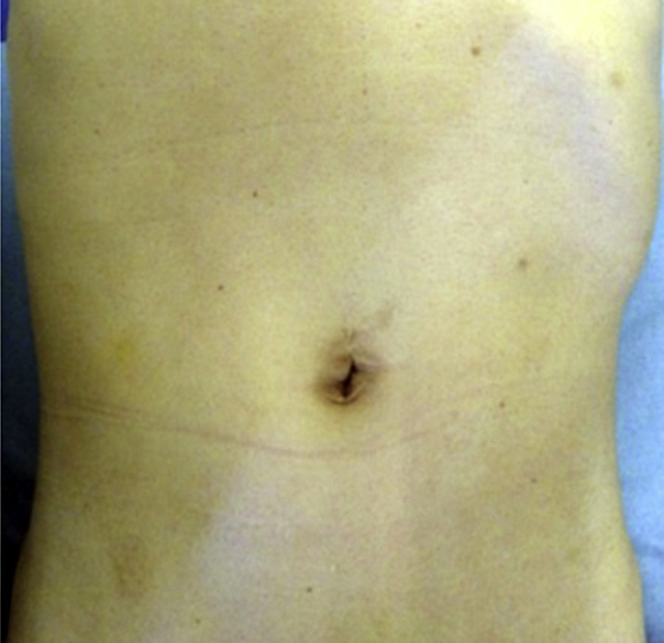
The postoperative scar after SILC.
2.3. Data collection
Data on the patients' age, sex, BMI, American Society of Anesthesiologists (ASA) score, history of previous abdominal surgery, operative time, bleeding volume, supplementary exposure system, conversion rate, perioperative complications, and postoperative hospital stay were obtained from the medical records.
2.4. Statistical analysis
Student's t-test, the Mann-Whitney U test, and Fisher's exact probability test were used for the analyses of data, as appropriate. All analyses were performed with EZR (Saitama Medical Center, Jichi Medical University, Saitama, Japan), which is a graphical user interface for R (The Foundation for Statistical Computing) [9]. Differences at p < 0.05 were considered significant.
3. Results
Table 1 shows the patients' characteristics. Between May 2009 and May 2015, 608 patients with a mean age of 60 years (range 18–89 years) and a mean BMI of 23.9 kg/m2 (range 15.0–41.0 kg/m2) underwent SILC at Osaka Police Hospital. Three hundred and sixty two patients (60%, 362/608) had a 18.5 ≤ BMI < 25 kg/m2, defined as normal-weight according to the WHO. Thirty-eight patients (6%, 38/608) had a BMI ≥30 kg/m2, defined as obese. The mean BMI differed significantly between the patient groups as expected. Furthermore, the ASA scores of the obese patients were significantly higher than those of the normal-weight patients, but the remaining baseline characteristics (age, sex, and history of previous abdominal surgery) were comparable.
Table 1.
Patients' characteristics.
| Characteristics | Normal weight patients (n = 362) | Obese patients (n = 38) | p value |
|---|---|---|---|
| Age, year | 60 ± 14 | 56 ± 13 | 0.1 |
| Male sex | 180 (50) | 15 (39) | 0.2 |
| BMI, kg/m2 | 22.0 ± 1.7 | 32.5 ± 2.4 | <0.05 |
| ASA score ≥ 3 | 27 (7) | 9 (24) | <0.05 |
| Previous abodominal surgery | 95 (26) | 11 (29) | 0.7 |
Datas are given mean ± SD or number (%), otherwise specified.
SD, standard deviation.
BMI, body mass index.
ASA, American Society of Anesthesiologists.
Table 2 shows the perioperative data. The mean operative time in the normal-weight and obese groups was 110 ± 44 min (range 35–371 min) and 127 ± 37 min (range 60–210 min) respectively, significantly longer in the obese groups (p < 0.05). The median bleeding volume in the normal-weight and the obese groups was 0 ml (range 0–1400 ml) and 0 ml (range 0–150 ml), respectively (p = 0.8). The conversion rate to a different procedure was 3% (12/362) in the normal-weight group and 5% (2/38) in the obese group (p = 0.5). Twelve cases in the normal-weight group were converted: eight to multi-port surgery and four to open surgery. Two cases in the obese group were converted to multi-port surgery. Perioperative complications were seen in 6% (23/362) of the patients in the normal-weight group and 8% (3/38) of the patients in the obese group (p = 0.7). The mean postoperative hospital stay was 4.5 ± 3.4 days (range 2–51 days) for the normal-weight group and 4.4 ± 1.6 days (range 2–9 days) for the obese group (p = 0.7).
Table 2.
Perioperative data.
| Normal weight patients (n = 362) | Obese patients (n = 38) | p value | |
|---|---|---|---|
| Operative time, min | 110 ± 44 | 127 ± 37 | <0.05 |
| Median bleeding volume, ml (range) | 0 (0–1400) | 0 (0–150) | 0.8 |
| Supplementary exposure system | 315 (87) | 37 (97) | 0.1 |
| Conversion (%) | 12 (3) | 2 (5) | 0.5 |
| Multiple port surgery | 8 (2) | 2 (5) | 0.3 |
| Open Surgery | 4 (1) | 0 | 0.5 |
| Complications (%) | 23 (6) | 3 (8) | 0.7 |
| Wound infection | 7 (2) | 1 (3) | 0.8 |
| Prolonged inflammation response | 4 (1) | 1 (3) | 0.4 |
| Incisional hernia of the umbilicus | 2 (0.6) | 1 (3) | 0.2 |
| Intraabdominal abscess | 3 (0.8) | 0 | 0.6 |
| Common bile duct stone | 2 (0.6) | 0 | 0.6 |
| Injury of the intestine | 2 (0.6) | 0 | 0.6 |
| Pneumonia | 1 (0.3) | 0 | 0.7 |
| Ileus | 1 (0.3) | 0 | 0.7 |
| Intraoperative bleeding | 1 (0.3) | 0 | 0.7 |
| Postoperative hospital stay, day | 4.5 ± 3.4 | 4.4 ± 1.6 | 0.7 |
Datas are given mean ± SD or number (%), otherwise specified.
SD; standard deviation.
4. Discussion
In the present study, there were two important clinical observations. First, the complication rate of obese patients after SILC was comparable to that of normal-weight patients though the obese patients were at significantly higher risk for surgery. Second, the conversion rate of the obese patients after SILC was comparable to that of the normal-weight patients though the operative time of the obese patients was longer than that of the normal-weight patients.
First, the complication rate of obese patients after SILC was comparable to that of normal-weight patients though the obese patients were at significantly higher risk for surgery. Ri et al. [10] reported in their nationwide study that both obese and excessively low weight patients had significantly higher rates of complications and mortality than those with a normal BMI in the fields of gastroenterological and cardiovascular surgery. In the present series, perioperative complications were seen in 6% (23/362) of patients in the normal-weight group and 8% (3/38) of patients in the obese group (p = 0.7). The complications seen in the obese patients were umbilical wound infections, prolonged inflammation response, and incisional hernia of the umbilicus. There were no severe complications such as injuries of the bile duct or intestine in the obese group. These outcomes were confirmed by several retrospective studies which successfully treated some morbidly obese patients with a BMI ≥40 kg/m2 using SILC technique [3], [11], [12].
Second, the conversion rate of the obese patients after SILC was comparable to that of the normal-weight patients though the operative time of the obese patients was longer than that of the normal-weight patients. Khambaty et al. [5] reported in their study, including 107 patients after SILC, that a higher BMI was a significant risk factor for conversion to multi-port surgery. Patients who underwent successful SILC had a mean BMI of 28.4 vs. 33.0 kg/m2 in the converted group (p < 0.05). Similarly, Brody et al. [13] concluded that patient weight seems to affect conversion from SILC to multi-port surgery, because in their series of 59 patients, the converted group tended to be heavier than the successful SILC group. Obese patients might require more operative time to make umbilical incisions, introducing single-access system and accurately perceive the cystic duct, and closing the wound than normal-weight patients. Especially, bad operative field and false recognition of the cystic duct caused by excessive intraabdominal adipose tissue might prolong the operative time and the perioperative complications. We might pay more attention to the possibility of the injuries of the bile duct or intestine in obese patients. Contrary to these previous reports, SILC was performed with a low conversion rate (5%, 2/38) though the operative time of the obese patients was slightly longer than that of normal-weight patients in the present study. Previous reports [5], [12] might include the patients receiving SILC on their learning curve.
Standardization of SILS for a wide range of operative procedures and substantial operative experience in our department might have led to the good operative performance of SILC. In our institution, which is currently one of the high volume centers for SILS, the first case of SILS procedure for cholecystectomy was carried out in May 2009. Gradually, the indications for SILS were expanded to include colectomy, appendectomy, gastrectomy, acute abdomen, and hernioplasty [14]. Because SILS is practically a standard laparoscopic approach for various procedures in our department, the surgeons developed the skills for SILS procedures, such as manipulation of the laparoscopic coagulation shears, forceps, and flexible laparoscope, and they overcame many difficulties due to the confined operating space, in-line positioning of the laparoscope, close proximity of the working instruments with limited triangulation, and the limited range of motion of the laparoscope and instruments.
This study has several limitations. First, the present study was a single center retrospective study. There might be a selection bias of the patients undergoing SILC and the operators performing SILC. Besides, there were no strict criteria for selecting patients treated by SILC or multi-port cholecystectomy. Second, this study included a limited number of obese patients (6%, 38/608). In Japan, only 5.8% of adult men and 4.4% of adult women were obese (BMI ≥ 30 kg/m2) compared with 10% of adult men and 14% of adult women in the world according to the WHO [7], [9].
5. Conclusions
This report of a series of SILC performed in Osaka Police Hospital demonstrates that SILC, which offers good cosmetic outcomes, seems feasible and safe in obese patients, though the obese patients were at significantly higher risk for the operation and the operative time of the obese patients was longer.
Ethical approval
This protocol for the research project were in accordance with the ethical standards of the institution and the provisions of the Declaration of Helsinki in 1995 (as revised in Edinburgh 2000). Written informed consent was obtained from the patients for the information to be included in our manuscript.
Sources of funding
No sources of funding
Author contribution
Study design: MW.
Data collection:MW, KF.
Data analysis/interpretation: All
Paper writing: MW, MT.
Review: MT, HA.
Conflict of interest
No conflict of interest to declared.
Guarantor
Masaki Wakasugi.
Consent
This protocol for the research project were in accordance with the ethical standards of the institution and the provisions of the Declaration of Helsinki in 1995 (as revised in Edinburgh 2000). Written informed consent was obtained from the patients for the information to be included in our manuscript.
Registration of research studies
researchregistry 1526.
References
- 1.Rivas H., Varela E., Scott D. Single-incision laparoscopic cholecystectomy: initial evaluation of a large series of patients. Surg. Endosc. 2010;24:1403–1412. doi: 10.1007/s00464-009-0786-7. [DOI] [PMC free article] [PubMed] [Google Scholar]
- 2.Curcillo P.G., 2nd, Wu A.S., Podolsky E.R. Single-port-access (SPA) cholecystectomy: a multi-institutional report of the first 297 cases. Surg. Endosc. 2010;24:1854–1860. doi: 10.1007/s00464-009-0856-x. [DOI] [PubMed] [Google Scholar]
- 3.Erbella J., Jr., Bunch G.M. Single-incision laparoscopic cholecystectomy: the first 100 outpatients. Surg. Endosc. 2010;24:1958–1961. doi: 10.1007/s00464-010-0886-4. [DOI] [PubMed] [Google Scholar]
- 4.Kameyama N., Miyata R., Tomita M., Mitsuhashi H., Baba S., Imai S. Tips for single-port laparoscopic cholecystectomy. J. Hepatobiliary Pancreat. Sci. 2014;21:E48–E52. doi: 10.1002/jhbp.106. [DOI] [PubMed] [Google Scholar]
- 5.Khambaty F., Brody F., Vaziri K., Edwards C. Laparoscopic versus single-incision cholecystectomy. World J. Surg. 2011;35:967–972. doi: 10.1007/s00268-011-0998-6. [DOI] [PubMed] [Google Scholar]
- 6.Reibetanz J., Germer C.T., Krajinovic K. Single-port cholecystectomy in obese patients: our experience and a review of the literature. Surg. Today. 2013;43:255–259. doi: 10.1007/s00595-012-0238-1. [DOI] [PubMed] [Google Scholar]
- 7.World Health Organization . 2010. Global Status Report on Noncommunicable Disease.http://www.who.int/nmh/publications/ncd_report_full_en.pdf Accessed: 13 November 2015. [Google Scholar]
- 8.Wakasugi M., Tei M., Omori T. Single-incision laparoscopic surgery as a teaching procedure: a single-center experience of more than 2100 procedures. Surg. Today. 2016;46:1318–1324. doi: 10.1007/s00595-016-1315-7. [DOI] [PubMed] [Google Scholar]
- 9.Kanda Y. Investigation of the freely available easy-to-use software 'EZR' for medical statistics. Bone Marrow Transpl. 2013;48:452–458. doi: 10.1038/bmt.2012.244. [DOI] [PMC free article] [PubMed] [Google Scholar]
- 10.Ri M., Miyata H., Aikou S. Effects of body mass index (BMI) on surgical outcomes: a nationwide survey using a Japanese web-based database. Surg. Today. 2015;45:1271–1279. doi: 10.1007/s00595-015-1231-2. [DOI] [PubMed] [Google Scholar]
- 11.Roberts K.E., Solomon D., Duffy A.J., Bell R.L. Single-incision laparoscopic cholecystectomy: a surgeon's initial experience with 56 consecutive cases and a review of the literature. J. Gastrointest. Surg. 2010;14:506–510. doi: 10.1007/s11605-009-1116-z. [DOI] [PubMed] [Google Scholar]
- 12.Romanelli J.R., Roshek T.B., 3rd, Lynn D.C., Earle D.B. Single-port laparoscopic cholecystectomy: initial experience. Surg. Endosc. 2010;24:1374–1379. doi: 10.1007/s00464-009-0781-z. [DOI] [PubMed] [Google Scholar]
- 13.Brody F., Vaziri K., Kasza J., Edwards C. Single incision laparoscopic cholecystectomy. J. Am. Coll. Surg. 2010;210:e9–e13. doi: 10.1016/j.jamcollsurg.2009.10.018. [DOI] [PubMed] [Google Scholar]
- 14.Wakasugi M., Masuzawa T., Tei M. Single-incision totally extraperitoneal inguinal hernia repair: our initial 100 cases and comparison with conventional three-port laparoscopic totally extraperitoneal inguinal hernia repair. Surg. Today. 2015;45:606–610. doi: 10.1007/s00595-014-0967-4. [DOI] [PubMed] [Google Scholar]