



Abstract
Genital lymphedema in men can affect the penis and/or scrotum, causing deformity and causing sexual limitations, social isolation, poor quality of life and recurrent subcutaneous infections due to difficulties in hygiene. There are few studies in the literature emphasizing the treatment of penile fibrosis after penoscrotal lymphedema. The purpose of this report is to describe a case of penile fibrosis treated using a new compression method.
Keywords: Clinical treatment, Compression, Fibrosis, Penoscrotal lymphedema
Introduction
Lymphedema is characterized by the retention of extracellular fluid rich in protein in the subcutaneous compartment due to an obstruction of the lymphatic flow1, 2 that results in an imbalance between production and absorption of lymph.3
When the etiology is primary or idiopathic, there is an intrinsic imbalance in lymph return, suggesting abnormal development of the lymphatic system. Whereas secondary lymphedema occurs after surgery, radiation, tumors or infections including filariasis that affect the lymphatics.4 Dilatation of lymphatic vessels occurs owing to obstruction of the lymphatic flow leading to hypertrophy, hyperplasia of connective tissue, interstitial edema and chronic inflammation.5
Genital lymphedema in men, independent of its etiology, is caused by reduced drainage of lymphatic fluid with subsequent swelling. It can affect the penis or scrotum, causing deformities of the external genital area.1, 2 Thus, lymphedema causes limitations in mobility, urination, fatigue, pain, and recurrent subcutaneous infections due to difficulty in hygiene. Furthermore, patients experience sexual limitations, social isolation and reduced quality of life.5
The clinical treatment recommended for lymphedema is a combination of therapies including mechanical and manual lymph drainage, and compression mechanisms. The current case demonstrates a new option for the treatment of male genital lymphedema using a compression garment made from grosgrain, a cotton-polyester fabric. Compression, one of the most important interventions in the treatment of lymphedema in general, is essential in penile swelling to remove excessive fluid and to improve in the shape and size of genitalia. However, few studies in the literature discuss the treatment of penile fibrosis in penoscrotal lymphedema.3 The aim of this study is to report the use of a grosgrain compression garment in the treatment of penile fibrosis after foreskin resection surgery followed by unsuccessful plastic surgery to correct the resulting fibrosis. This case was resolved using the compression garment made of grosgrain.
Case report
A 62-year-old patient was submitted to inguinal dissection and 30 radiotherapy sessions for left testicular cancer. Soon after cancer surgery, scrotal, penile and left leg edema was observed. Six months later, the edema had affected the entire left lower limb. The patient sought treatment and manual lymph drainage, bandaging with adhesive tape and pressure therapy were prescribed for 4 years. During this period, he was submitted to a surgery to treat lymphedema of the foreskin and scrotum. However, after 4 years he was unsuccessfully submitted to further surgery to correct penile fibrosis resulting from the first procedure. The patient was referred to the Clinica Godoy to reconsider the lymphedema treatment.
A physical examination detected severe leg lymphedema with a volume 82% greater than the contralateral lower limb and penile fibrosis (Figure 1, Figure 2). The patient was prescribed a stocking made of grosgrain as monotherapy to treat the lymphedema of the left leg and a penile compression garment, also made of grosgrain (Fig. 3A). With this conduct, the fibrosis reduced almost completely (Fig. 3B). The compression garment of grosgrain fabric is handmade according to the size of each specific penis and fastened in place using Velcro. This compression garment is easy to don and remove.
Figure 1.
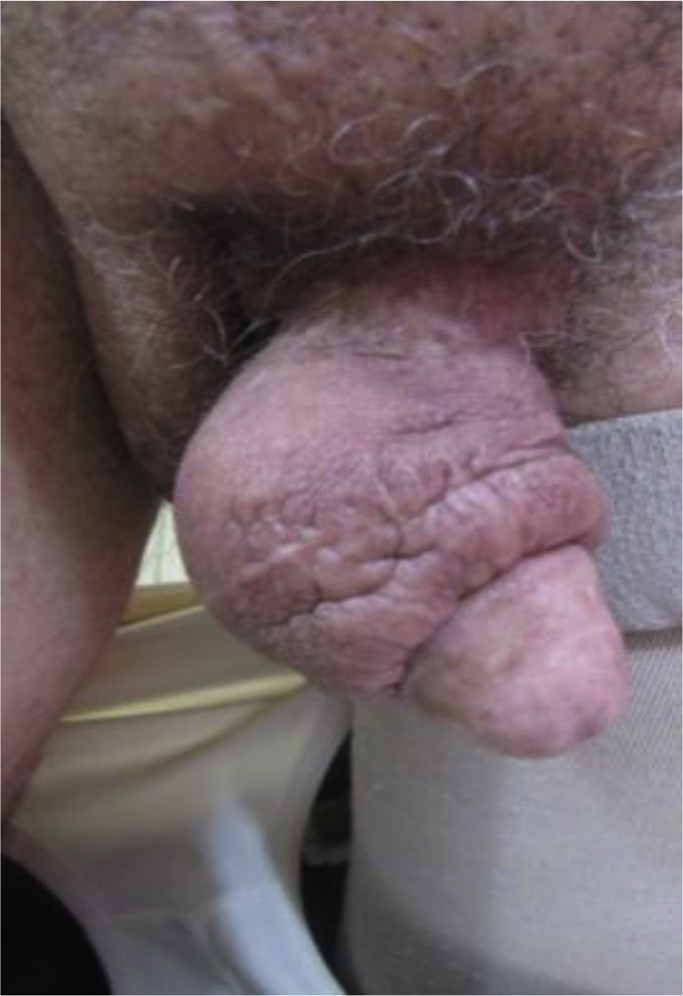
Fibrosis resulting from foreskin resection to treat penoscrotal lymphedema.
Figure 2.

Result of surgical treatment to correct the fibrosis.
Figure 3.

Compression garment made of grosgrain fabric with Velcro (A) and result of the clinical treatment using a grosgrain compression garment for 8 months (B).
Discussion
This report describes a new material to make a penis compression garment to eliminate penile fibrosis after foreskin resection to treat lymphedema. This is the first report in the literature on the use of grosgrain; this approach proved to be effective in reducing the amount of fibrotic tissue over 8 months of treatment. The ease of donning and removing the compression garment and its low cost improves the possibility in using this material.
The literature uses several techniques to treat penile fibrosis, such as oral or topical medications and in some cases injections or surgery such as plications or the Nesbit procedure. However, the purpose of this report is to describe the innovation and success of this new low-cost method with low risk of complications used to improve the self-image of the patient.
Another aspect in this case are the two previous surgeries that failed to rehabilitate the penis; further surgery would have a low probability of success. Nevertheless, the clinical approach reduced morbidity.
Sexual rehabilitation is an important aspect because of the cultural characteristics of the population. In this case, the reduced fibrosis allowed the patient to return to sexual activity. It proved to be a non-invasive low-cost clinical treatment that the patient found easy to use thereby improving his quality of life and adherence to treatment. Compression garments made of grosgrain fabric are an option in the treatment of penile fibrosis after surgery to treat penoscrotal lymphedema.
Conflicts of interest
None.
References
- 1.Ferrel R.E. Research perspectives in inherited lymphatic disease. Ann N Y Acad Sci. 2002;979:39–51. doi: 10.1111/j.1749-6632.2002.tb04866.x. [DOI] [PubMed] [Google Scholar]
- 2.Schulte-Merker S., Sabine A., Petrova T.V. Lymphatic Vascular morphogenesis in development, physiology, and disease. J Cell Biol. 2011;193:607–618. doi: 10.1083/jcb.201012094. [DOI] [PMC free article] [PubMed] [Google Scholar]
- 3.Godoy J.M.P., Facio F.N., Jr., Carvalho E.C.M., Godoy M.F.G. New compression mechanism in penile-scrotal lymphedema and sexual rehabilitation. Urol Ann. 2014;6(1):88–90. doi: 10.4103/0974-7796.127025. [DOI] [PMC free article] [PubMed] [Google Scholar]
- 4.Vives F., Garcia-Perdomo H.Á., Ocampo-Flórez G.M. Giant lymphedema of the penis and scrotum: a case report. Autopsy Case Rep. 2016;6(1):57–61. doi: 10.4322/acr.2016.026. [DOI] [PMC free article] [PubMed] [Google Scholar]
- 5.Singh V., Sinha R.J., Sankhwar S.N., Kumar V. Reconstructive surgery for penoscrotal ilarial lymphedema: a decade of experience and follow-up. Urology. 2011;77(5):1228–1231. doi: 10.1016/j.urology.2010.10.026. [DOI] [PubMed] [Google Scholar]