



Background
The Suzuki frame, as described by Suzuki et al in 1994, is a skeletal traction system for comminuted intra-articular fractures and fracture dislocations of the proximal interphalangeal joint of the hand (Fig 1).1 In order to fabricate such a frame, hand surgeons often use two needle holders to firmly hold the K-wires, and subsequently use one to form a series of 90° bends and turns. This method can be cumbersome, resulting in suboptimal angulation, and leaves the sharp K-wire ends exposed throughout the procedure.
Figure 1.

Suzuki frame
Technique
The metal suction cannula, which is readily available in standard instrument sets, is passed over the K-wire to the proposed point of angulation and bent (Fig 2). Using the principle of levers, the longer the distance from the fulcrum compared with the grip of a needle holder, the greater the moment of force and the better controlled the bend.
Figure 2.
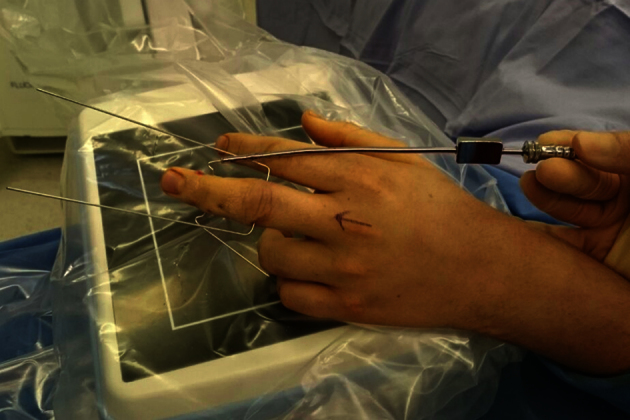
Metal cannula passed over K-wire
Discussion
The metal suction cannula thus simplifies the procedure, saving time and preventing needlestick injuries. The metal stilette of the suction cannula (Fig 3) can also be used as an intraoperative aid in hand surgery.
Figure 3.

Metal stilette of suction cannula
Evgeniou et al have described a rectangular metal frame to identify the bone graft harvest position on the distal radius using a straight 0.9mm K-wire bent to the desired size.2 The advantage of the suction stilette is that it is preformed; the ends are blunt and smooth, with no risk of sustaining a sharps injury.
Reference
- 1.Suzuki Y, Matsunaga T, Sato S, Yokoi T. The pins and rubbers traction system for treatment of comminuted intraarticular fractures and fracture-dislocations in the hand. J Hand Surg Br 1994; : 98–107. [DOI] [PubMed] [Google Scholar]
- 2.Evgeniou E, Dimitriadis PA, Kulkarni M. Metal frame for identification of bone graft harvest position. Ann R Coll Surg Engl 2014; : 315. [DOI] [PMC free article] [PubMed] [Google Scholar]