



Editor—Holland and Weiner's clinical review (albeit a traditional non-systematic, opinion based one) on the important topic of Bell's palsy is welcome,1 but we are concerned that their conclusions about treatment are simply not supported by current evidence.
The most recent Cochrane reviews show that no treatment has yet been shown to be more effective than placebo.2,3 The recent studies cited have not yet been included in the systematic reviews but since they are non-randomised, statements that combination therapy is beneficial are not secure.4 Since these treatments are neither inexpensive nor harmless, the issue is important for clinicians, patients, and the health service.
The review by the American Academy of Neurology cited by Holland and Weiner concluded that well designed studies of the effectiveness of treatments for Bell's palsy are still needed. Published trials are mainly hospital based and involve small numbers.5 We are running a trial that avoids these pitfalls and will hopefully provide an answer.
The Bell's trial (ISRCTN 71548196) is a randomised multicentre factorial trial of the early administration of steroids or antivirals for Bell's palsy. To our knowledge, it is the largest trial ever planned for Bell's palsy. We will randomise 720 patients over the next 18 months (www.dundee.ac.uk/bells).
We have been able to mount this trial because of the greatly improved research infrastructure in UK general practice in recent years. The Scottish School of Primary Care (www.show.scot.nhs.uk/sspc/) has developed a register of Scottish practices and professionals interested in research, which is working with others such as NHS24 to identify and refer patients early. Provided that Scottish general practitioners and accident and emergency doctors ignore Holland and Weiner's recommendations on treatment, we believe this trial will provide the evidence for treatment of Bell's palsy that is currently lacking.
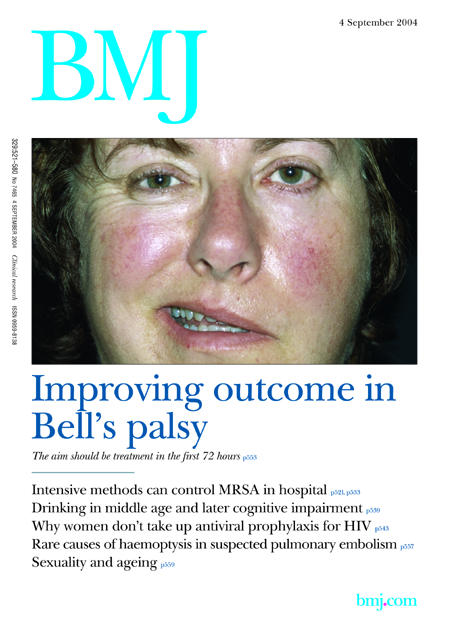
Figure 1.
Additional authors are: Jill Morrison, professor, Department of General Practice, University of Glasgow; Peter Donnan, senior lecturer in medical statistics, Community Health Sciences, University of Dundee; Richard Davenport, neurologist, Lothian University Hospitals Trust; Brian McKinstry, Chief Scientist Office clinician scientist, Lothian; Jan Clarkson, senior lecturer, Dental Health Services Research Unit, Community Health Sciences, University of Dundee; Luke Vale, senior research fellow, Health Economics Research Unit, University of Aberdeen; Lucy McCloughan, capacity and capability manager, Scottish School of Primary Care.
Competing interests: The authors are engaged in a randomised controlled trial in Bell's palsy that may be adversely affected by uncritical acceptance of Holland and Weiner's publication.
References
- 1.Holland NJ, Weiner GM. Recent developments in Bell's palsy. BMJ 2004;329: 553-7. (4 September.) [DOI] [PMC free article] [PubMed] [Google Scholar]
- 2.Salinas RA, Alvarez G, Alvarez MI, Ferreira J. Corticosteroids for Bell's palsy (idiopathic facial paralysis). Cochrane Library, Issue 3. Chichester: John Wiley, 2004.
- 3.Sipe J, Dunn L. Acyclovir for Bell's palsy (idiopathic facial paralysis). Cochrane Library, Issue 3. Chichester: John Wiley, 2004.
- 4.Hato N, Matsumoto S, Kisaki H, Takahashi H, Wakisaka H, Honda N, et al. Efficacy of early treatment of Bell's palsy with oral acyclovir and prednisolone. Otol Neurotol 2003;24: 948-51. [DOI] [PubMed] [Google Scholar]
- 5.Rowlands S, Hooper R, Hughes R, Burney P. The epidemiology and treatment of Bell's palsy in the UK. Eur J Neurol 2002;91: 6. [DOI] [PubMed] [Google Scholar]