


Abstract
Endotracheal tube (ETT) positioning using the cuff ballottement test, which confirms that the inflated cuff is positioned at the suprasternal notch with squeezing or inflating a pilot balloon, has been reported to be a simple and reliable method of preventing endobronchial intubation. However, in patients with a short vocal cord-to-suprasternal notch, ETT placement using the cuff ballottement test can cause vocal cord injury. In the present study, we assessed the distance from a point 15 mm below the vocal cord to the suprasternal notch (VSD-15), the safe position for ETT cuff placement above the suprasternal notch, and investigated variables for predicting VSD-15.
We retrospectively examined neck computed tomography in 427 adult patients and measured VSD-15 and the distance from the thyroid notch to the suprasternal notch (TSD). Patient height, weight, sex, and age were also recorded.
In total, 47 patients (11.0%) showed a VSD-15 shorter than 45 mm. VSD-15 significantly correlated with TSD (r = 0.778, P < 0.001) and height (r = 0.312, P < 0.001), and inversely correlated with age (r = −0.321, P < 0.001). In multiple linear regression models, a formula was obtained for VSD-15 (VSD-15 [mm] = −6.220 + 0.744 × TSD [mm] + 0.092 × height [cm] − 0.065 × age [years], R2 = 0.621).
The cuff ballottement test should be used cautiously in patients with a predicted short VSD-15. VSD-15 can be predicted from TSD, height, and age.
Keywords: complications, cuff ballottement test, endotracheal tube cuff, vocal cord
1. Introduction
Malpositioning of an endotracheal tube (ETT) can cause serious complications in airway management and mechanical ventilation. When the ETT is inserted deeply, there is a risk of endobronchial intubation, resulting in atelectasis, hypoxemia, and barotrauma. In contrast, an insufficiently inserted ETT causes accidental extubation. To confirm proper positioning of the ETT after tracheal intubation, various methods have been introduced, including the use of a predetermined depth (21 cm for females and 23 cm for males)[1] or guide marks on the ETT at the level of the vocal cords,[2] chest auscultation, and the cuff ballottement technique at the suprasternal notch.[3] The cuff ballottement test, which confirms that the inflated cuff is positioned at the suprasternal notch with squeezing or inflating a pilot balloon, has been reported to be a simple and reliable method to confirm the correct depth of the ETT.[4]
In addition, vocal cord-related complications are possible due to the ETT cuff, and thus it should be placed 15 mm below the vocal cord to prevent recurrent laryngeal nerve injury.[5] However, the length of recently developed ETT cuffs is generally around 40 mm (Table 1) and thus, in patients with a short distance between the vocal cord and the suprasternal notch, ETT positioning using the cuff ballottement test can cause pressure on the vocal cord and recurrent laryngeal nerve, and the risk of intralaryngeal placement cannot be excluded in severe cases.
Table 1.
Cuff lengths of endotracheal tubes.

In the present study, we hypothesized that ETT placement using the cuff ballottement test might be related to vocal cord injury and retrospectively investigated the distance from the part 15 mm below the vocal cord to the suprasternal notch (VSD-15) using computed tomography (CT) imaging. The length between the thyroid notch and the suprasternal notch (thyroid notch-to-suprasternal notch distance [TSD]) was also examined to evaluate the correlation with VSD-15 with consideration given to patient height, weight, sex, and age.
2. Methods
This retrospective study was approved by the Institutional Review Board of Seoul Metropolitan Government Seoul National University Boramae Medical Center (no. 16-2013-4). In total, the data of 778 adult patients who underwent neck CT from January 2010 to December 2012 were retrieved from the hospital database. Patients were excluded if they had diseases or masses that could affect the contour of the larynx, the upper trachea, or the suprasternal notch, based on the examination of CT images by radiologists. Patients who had ambiguous anatomical outlines due to poor-quality CT images were also excluded.
Scout images of the frontal and lateral neck obtained before axial CT images of the neck were acquired. The vocal folds are the narrowest part of the larynx and the infraglottic space widens and connects with the cavity of the trachea. VSD-15 was estimated as the distance from a point 15 mm below the vocal cord to the suprasternal notch, superior border of the manubrium, between the clavicular notches at the frontal neck scout image (Fig. 1A). The TSD was assessed as TSD, the superior border of the manubrium, at the lateral neck scout image (Fig. 1B). The VSD-15 and TSD were measured by 2 investigators and averaged. Patients’ age, sex, weight, and height were also recorded.
Figure 1.

VSD-15 means the safe proximal margin for endotracheal tube cuff placement above the suprasternal notch. TSD is chosen as a predictive factor because the vocal cord exits on the posterior surface of the thyroid cartilage in adults and thyroid cartilage is easily detected externally. VSD-15 = the distance from 15 mm below the vocal cord to the suprasternal notch, TSD = the distance from the thyroid notch to the suprasternal notch.
Statistical analyses were performed using the IBM Statistical Package for Social Sciences Statistics software program (ver. 20.0; IBM Inc., Armonk, NY, USA). Data are expressed as means (standard deviation). To assess the reliability of VSD-15 and TSD measurements, the intraclass coefficient (ICC) was calculated. To investigate the relationship between VSD-15 and other variables, such as age, sex, height, and TSD, linear regression was used. Prior to analysis, any sex difference in VSD-15 was analyzed using Student t test. Pearson correlation coefficient was used to analyze continuous variables and multiple linear regression was used to analyze the effect of each variable on VSD-15. In the multiple linear regression model, we included variables with a P value < 0.05 in a single variable analysis. To avoid the problem of multicollinearity, we included independent variables in the models. A P value < 0.05 was considered to indicate statistical significance.
3. Results
In total, 778 patients underwent neck CTs from January 2010 to December 2012. Of them, 255 patients who had diseases or masses that could affect the contour of the larynx, the upper trachea and the suprasternal notch were excluded, and 96 were excluded because of ambiguous outlines on CT images. Thus, we examined the neck scout images of 427 patients (Fig. 2). The ICCs, a measure of reliability, were 0.921 for VSD-15 and 0.930 for TSD.
Figure 2.
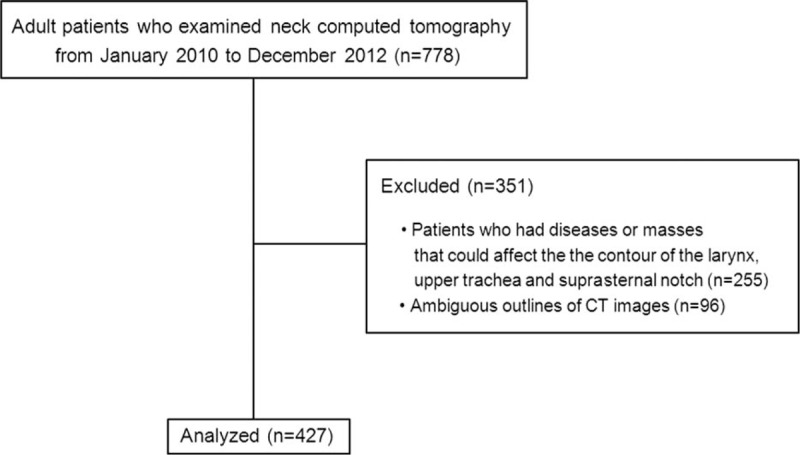
Flow diagram of patient selection for image analysis. Of 778 patients who underwent neck CT, 255 patients were excluded because of diseases or masses that could affect the contour of the larynx, the upper trachea, and/or the suprasternal notch, and 96 patients were also excluded because of the ambiguous outlines in the CT images. Thus, the images of 427 patients were evaluated. CT = computed tomography.
Patient characteristics and the measured VSD-15 and TSD are presented in Table 2. Of the analyzed patients, 47 patients (11.0%) showed a VSD-15 shorter than 45 mm. No significant sex difference was observed in VSD-15. VSD-15 significantly correlated with TSD (r = 0.778, P < 0.001) and height (r = 0.312, P < 0.001), and it was inversely correlated with age (r = −0.321, P < 0.001). However, no correlation was observed between VSD-15 and weight (Fig. 3).
Table 2.
Patient characteristics, VSD-15, and TSD.

Figure 3.

Correlation between VSD-15 and variables. VSD-15 = the distance from 15 mm below the vocal cord to the suprasternal notch, TSD = the distance from the thyroid notch to the suprasternal notch.
In the multiple linear regression models, TSD, height, and age showed statistically significant correlations with VSD-15 (Table 3). From the results, a prediction model for VSD-15 was as follows:
 |
Table 3.
Associations of VSD-15 with independent variables by multiple linear regression analyses.

4. Discussion
Our data suggest that patients with relatively short VSD-15 values may be susceptible to vocal cord injury following ETT placement using the cuff ballottement test. VSD-15 can be predicted from TSD, height, and age.
In general, when the ETT tip is positioned at the level of the mid-trachea, the risk of endobronchial intubation or inadvertent extubation decreases. The trachea in adults extends from the cricoid cartilage at the level of C6 to the carina at the level of T4. The suprasternal notch lies at the vertebral level of T1–2, slightly above the middle trachea, and thus if the TT cuff is detected just above the suprasternal notch during the cuff ballottement test, the tip of the ETT would be positioned at the level of the mid-trachea.[6] According to a previous study, the cuff ballottement test is a reliable method that predicts when the tip of the ETT lies in the desired position, 3 to 7 cm from the carina, at the level of T3–4.[4]
Proper positioning of the ETT has mainly focused on the avoidance of endobronchial intubation or inadvertent extubation, but vocal cord-related complications following tracheal intubation can also be problematic. Hoarseness and sore throat are common postoperative complaints, with incidences between 15% and 49%.[7,8] Furthermore, vocal cord paralysis is one of the most serious complications following tracheal intubation, resulting from mechanical damage or nerve injury.[9–14] A pressurized TT cuff can damage the vocal cord, and this is related to ETT size, cuff pressure, and direct recurrent laryngeal nerve injury.[15] In particular, the anterior ramus of the recurrent laryngeal nerve is placed about 6 to 10 mm below the vocal cords, and is vulnerable to compression between the thyroid cartilage and the ETT cuff.[5,13] Furthermore, the vocal cord is the narrowest portion of the larynx and the infraglottic cavity expands anterolaterally, connecting to the trachea. If the ETT cuff is placed immediately below the vocal cord, the cuff exerts a pressure on the recurrent laryngeal nerve, resulting in sore throat, hoarseness, or vocal cord paralysis. Thus, it has been advocated that the upper end of the ETT cuff should be placed 15 mm below the vocal cord.[5]
When the cuff ballottement test is used, the ETT cuff is placed around the suprasternal notch. In some cases, the major part of the cuff could be placed above the suprasternal notch and immediately below the vocal cord, and patients with a short VSD-15 are susceptible to vocal cord injury. Additionally, newly developed ETT cuffs tend to have a cylindrical shape to provide a large contact area for improving tracheal sealing,[16] but it can induce more pressure on the vocal cord.
To predict VSD-15, the safe proximal margin for ETT cuff placement, we evaluated the correlation between VSD-15 and possible variables, including height, weight, age, and TSD. TSD was chosen as a predictive factor because the vocal cord exits on the posterior surface of the thyroid cartilage; the lower end of the epiglottis is attached to the middle of the posterior surface of the thyroid cartilage in adults; and the thyroid cartilage is readily detected externally. In the present study, VSD-15 was found to be closely correlated with TSD.
We also found that VSD-15 is inversely correlated with age. Although the underlying mechanism is unclear, it is assumed that laryngeal tissues might degenerate and shrink with age. According to a previous study, the risk of vocal cord paralysis was increased threefold in patients age 50 or older.[15] One of their explanations is that the age-degenerated laryngeal system may be more vulnerable to acute inflammation and circulatory insufficiency due to the TT cuff pressure. Additionally, VSD-15 was correlated with height in agreement with previous reports which showed a correlation between airway length and height.[17,18] Thus, height was included in the multiple linear regression models.
In the present study, some patients had VSD-15 values shorter than 45 mm. Based on our findings, in patients with a relatively short VSD-15, the cuff ballottement test may cause the cuff to be placed in the vicinity of the vocal cord, which might cause vocal cord complications. Furthermore, it was found that these patients have a higher risk of endobronchial intubation because the thyrosternal length, which is TSD in our study, has been suggested to predict tracheal length.[18] Thus, we should keep in mind that patients who are predicted to have a short VSD-15 are likely to suffer from vocal cord injury and endobronchial intubation, and a smaller TT with a shorter cuff length could be considered within the clinically acceptable range in these patients.
Our study has several limitations. First, we did not assess the relationship between VSD-15 and the incidence of postoperative sore throat, hoarseness, or vocal cord paralysis. Further studies are needed to evaluate the correlation between the vocal cord-to-suprasternal notch distance and postoperative laryngeal complications. Second, our findings are restricted to Asians, although airway length does not differ between Western and Oriental individuals according to previous studies.[17,19]
In conclusion, the cuff ballottement test should be used cautiously in patients who are predicted to have a relatively short VSD-15. VSD-15 can be predicted from TSD, height, and age. Future clinical evaluations of the relationship between the vocal cord-to-suprasternal notch distance and postoperative vocal cord complications are required.
Acknowledgments
The authors would like to thank Sohee Oh, PhD (Medical Statistician, Department of Biostatistics in SMG-SNU Boramae Medical Center), for statistical advice and the Electronic Medical Record team of our hospital for supporting the data review.
Footnotes
Abbreviations: CT = computed tomography, ETT = endotracheal tube, ICC = intraclass coefficient, TSD = the distance from the thyroid notch to the suprasternal notch, VSD-15 = the distance from 15 mm below the vocal cord to the suprasternal notch.
The authors have no funding and conflicts of interest to disclose.
References
- [1].Owen RL, Cheney FW. Endobronchial intubation: a preventable complication. Anesthesiology 1987;67:255–7. [DOI] [PubMed] [Google Scholar]
- [2].Mehta S. Intubation guide marks for correct tube placement. A clinical study. Anaesthesia 1991;46:306–8. [DOI] [PubMed] [Google Scholar]
- [3].Pollard RJ, Lobato EB. Endotracheal tube location verified reliably by cuff palpation. Anesth Analg 1995;81:135–8. [DOI] [PubMed] [Google Scholar]
- [4].Pattnaik SK, Bodra R. Ballotability of cuff to confirm the correct intratracheal position of the endotracheal tube in the intensive care unit. Eur J Anaesth 2000;17:587–90. [DOI] [PubMed] [Google Scholar]
- [5].Cavo JW., Jr True vocal cord paralysis following intubation. Laryngoscope 1985;95:1352–9. [DOI] [PubMed] [Google Scholar]
- [6].Goodman LR, Conrardy PA, Laing F, et al. Radiographic evaluation of endotracheal tube position. Am J Roentgenol 1976;127:433–4. [DOI] [PubMed] [Google Scholar]
- [7].Bennett MH, Isert PR, Cumming RG. Postoperative sore throat and hoarseness following tracheal intubation using air or saline to inflate the cuff—a randomized controlled trial. Anaesth Intensive Care 2000;28:408–13. [DOI] [PubMed] [Google Scholar]
- [8].Yamanaka H, Hayashi Y, Watanabe Y, et al. Prolonged hoarseness and arytenoid cartilage dislocation after tracheal intubation. Br J Anaesth 2009;103:452–5. [DOI] [PubMed] [Google Scholar]
- [9].Quick CA, Merwin GE. Arytenoid dislocation. Arch Otolaryngol 1978;104:267–70. [DOI] [PubMed] [Google Scholar]
- [10].Salem MR, Wong AY, Barangan VC, et al. Postoperative vocal cord paralysis in paediatric patients. Reports of cases and a review of possible aetiological factors. Br J Anaesth 1971;43:696–700. [DOI] [PubMed] [Google Scholar]
- [11].Cherian A, Balachander H, Nagappa M, et al. Bilateral vocal cord palsy following endotracheal intubation: a case report. J Clin Anesth 2010;22:562–4. [DOI] [PubMed] [Google Scholar]
- [12].Wason R, Gupta P, Gogia AR. Bilateral adductor vocal cord paresis following endotracheal intubation for general anaesthesia. Anaesth Intensive Care 2004;32:417–8. [DOI] [PubMed] [Google Scholar]
- [13].Brandwein M, Abramson AL, Shikowitz MJ. Bilateral vocal cord paralysis following endotracheal intubation. Arch Otolaryngol Head Neck Surg 1986;112:877–82. [DOI] [PubMed] [Google Scholar]
- [14].Hahn FW, Jr, Martin JT, Lillie JC. Vocal-cord paralysis with endotracheal intubation. Arch Otolaryngol 1970;92:226–9. [DOI] [PubMed] [Google Scholar]
- [15].Kikura M, Suzuki K, Itagaki T, et al. Age and comorbidity as risk factors for vocal cord paralysis associated with tracheal intubation. Br J Anaesth 2007;98:524–30. [DOI] [PubMed] [Google Scholar]
- [16].Dullenkopf A, Schmitz A, Frei M, et al. Air leakage around endotracheal tube cuffs. Eur J Anaesthesiol 2004;21:448–53. [DOI] [PubMed] [Google Scholar]
- [17].Cherng CH, Wong CS, Hsu CH, et al. Airway length in adults: estimation of the optimal endotracheal tube length for orotracheal intubation. J Clin Anesth 2002;14:271–4. [DOI] [PubMed] [Google Scholar]
- [18].Chong DY, Greenland KB, Tan ST, et al. The clinical implication of the vocal cords-carina distance in anaesthetized Chinese adults during orotracheal intubation. Br J Anaesth 2006;97:489–95. [DOI] [PubMed] [Google Scholar]
- [19].Eagle CC. The relationship between a person's height and appropriate endotracheal tube length. Anaesth Intensive Care 1992;20:156–60. [DOI] [PubMed] [Google Scholar]