



Abstract
We prove a general theorem that the action of arbitrary classical noise or random unitary channels can not increase the maximum population of any eigenstate of an open quantum system, assuming initial system-environment factorization. Such factorization is the conventional starting point for descriptions of open system dynamics. In particular, our theorem implies that a system can not be ideally cooled down unless it is initially prepared as a pure state. The resultant inequality rigorously constrains the possibility of cooling the system solely through temporal manipulation, i.e., dynamical control over the system Hamiltonian without resorting to measurement based cooling methods. It is a substantial generalization of the no-go theorem claiming that the exact ground state cooling is forbidden given initial system-thermal bath factorization, while here we prove even cooling is impossible under classical noise.
Introduction
Cooling and, more generally, pure-state preparation1–5 of a microscopic or mesoscopic open system (small thermal object)6 is of paramount importance to many intriguing quantum technologies and engineering of low temperature quantum phases, in general. Examples of applications include quantum simulations of many-body physics7 on a variety of platforms such as cold atoms and molecules, trapped ions and nanophotonic systems. Similarly, quantum computers8, the promising quantum adiabatic computing (QAC) paradigm9–12, quantum communication13, dynamically enhanced nuclear polarization14, 15, small quantum devices16, 17 and quantum metrology are merely a few prominent examples of contemporary applications where significant control over quantum states needs to be exercised. More specifically, for perfect realization of quantum logic operations, qubits initially need to be cooled down to the ground state of motion prior to coherent manipulation18. Any cooling scheme, e.g., bang-bang cooling19, single-shot state-swapping cooling20, and sideband cooling21–24, cannot be performed when the system is isolated6.
The quantum adiabatic computation is an interesting paradigm for universal quantum computation. Here the solution to a hard problem is encoded in the ground state of a many-body Hamiltonian, i.e., the computer. To reach the solution, the computer is initialized to the ground state of some Hamiltonian that can be easily prepared. The initial ground state is then transported adiabatically25–30 to the target ground state encoding the solution. In principle, adiabaticity suppresses errors in the preparation of the final ground state by overcoming the problem of energy relaxation31–34 as the system at all times is kept in the ground state of the instantaneous Hamiltonian during evolution. However, the changing-rate of the Hamiltonian control parameters, and so the protocol’s running time, scale inversely with the square of the spectral gap to the lowest excitations. In practice, the system is always excited during the protocol, most seriously because one must generically move through regions in parameter space where the gap is very small or closed completely. Apart from this, the system is never truly isolated from its environment, which also results in excitations. One solution to overcome this problem is to combine the quasi-adiabatic evolution with active cooling to suppress such errors generated via excitations during the running of the protocol.
Addressing feasibility of such schemes motivates the search for a better understanding of the description of cooling effects in open system dynamics, in particular as described below, with classical noise. Cooling setups consist of a small target object (e.g., a mechanical resonator) and an ancillary system (e.g., a qubit) as the entire system which is embedded in a quantum environment. The three entities seem to be equally crucial in a cooling process. The dynamics of the entire system is supposed to be governed by the conventional quantum Markovian master equation. Recently it was interestingly shown that fully quantum-mechanical models under the Born-Markov approximation may be mapped in some situations to a quantum system under classical noise35. On one hand, this inspires the question about whether the Born-Markov approximation generically allows an arbitrary full quantum bath to be equivalent to some corresponding classical noise. If so, can the entire system be cooled by the equivalent classical noise via the quantum Markovian master equation? On the other hand, is it possible that this specific classical-quantum equivalence is fake due to the Born-Markov approximation? These issues are too difficult to be solved in generality with any known analytical and numerical techniques. Therefore, setting up strict quantum bounds is absolutely necessary in studying cooling problems. An example is the recently proposed “counterintuitive” protocols as cooling by heating36, 37 with the help of a high-temperature bath generated by “incoherent thermal quantum noise”, where we know “quantum noise” could be equivalent to a corresponding classical noise as long as the Born-Markov approximation is used. In ref. 36, the authors consider an ancillary system of two optical modes coupled to a mechanical degree of freedom and find the mechanical oscillator can be cooled down to an extent by heating one of the optical modes, i.e., increasing its thermal state population. It is thus interesting to consider the constraints on the types of processes that can be realized under restricted operations such as evolution under classical noise, and to unambiguously identify the origin of such counter-intuitive effects.
Interestingly, a no-go theorem has been recently proved that exact ground state cooling is forbidden when one assumes factorization of the initial state of the system from the bath state38. This is remarkable since initial system-bath product state factorization is a common condition adopted in the derivation of master equations or Kraus operator representations describing open system dynamics6, 39. Here we ask the less stringent question of whether approximate cooling — understood as increasing the ground state population — can be achieved under such system-bath factorization. We consider the case of coupling the system to classical environmental noise which can be thought of as stochastically affecting the control parameters of the system Hamiltonian. We find that under such conditions, even approximate cooling is impossible.
No-go theorem for cooling an open system under classical noise
Classical noise40, 41 corresponds to a special form of the system-environment interaction Hamiltonian , where A j’s are Hermitian operators in the Hilbert space of the system and B j’s are environmental operators, when it can be semi-classically approximated by , where the 〈B j〉’s are now c-numbers (instead of operators) determined by the random states of the environment, time-independent or time-dependent. This yields a stochastic Hamiltonian acting on the system, , where the system bare Hamiltonian H 0(t) is in general time-dependent and might take into account the general possibility of control via external parameters, and in H I(λ) represents a random parameter characterizing a particular realization of the system evolution.
The system evolution determined by the stochastic Hamiltonian H λ(t) corresponding to a particular realization of the stochastic environmental parameters is unitary, , where ρ i is the initial state of the system and K λ(t) is defined as a propagator with . Here the time-ordering symbol accommodates the general situations, in which H λ(t) can be time-dependent. Note this time-ordering propagator applies in the Schrödinger picture instead of the interaction picture. A particular evolution given above is not enough to obtain the real evolution of the open system under noise. The configuration of environmental variables is in general unknown and may be assumed to be described by a probability distribution |p λ|2. The final (evolved) state of the system must be the average over all possible unitary evolutions of the type just described and therefore
| 1 |
with . This is a general expression independent of the details of system Hamiltonian H 0(t). The above equation is a special case of the Kraus operator representation of open system dynamics, which we briefly recap in Method.
With this definition, we introduce the following no-go theorem, whose proof is provided in Method: For any quantum operation process describing uncertainty-induced decoherence defined by Eq. (1), the system can not be completely transferred into a pure state unless it is prepared as one initially.
At a microscopic level, the strong notion of cooling corresponds to demanding that the population of ground state increases during the cooling process. In particular, this is in strict agreement with the phenomenology of cooling when both the initial and final states are Gibbs-ensemble equilibrium states. Ideal cooling is attained when the final state is the system ground state |0〉 〈0|. The no-go theorem shows that cooling even in an approximate sense, i.e., increasing the population of the ground state by an arbitrarily small amount is impossible under solely classical decoherence with the implicit constraint of initial system-environment factorization.
In order to turn this microscopic picture into a macroscopic one, consider the initial and final states to be thermal Gibbs states at two respective temperatures T i and T f. It is simplest to consider a two-level system, although the same arguments hold for a system with many energy levels. For such a system, the initial and final temperatures are given by
| 2 |
where the initial and final energy spacings of the system are ω i,f, and the initial and final populations of the ground state are P 1 and Q 1, respectively. Since Q 1 ≤ P 1 due to our no-go theorem, . Hence to surely cool the system, one must impose ω f > ω i which can only be achieved by doing work on the system resulting in the changing of the spectral properties of the system. However, we are here considering the conventional approach to cooling (in particular to the ground state of) a Hamiltonian which is the same at the initial and final instants. So we have that ω f = ω i and in terms of temperature one obtains T f ≥ T i, i.e., the temperature of the system cannot be reduced.
Classical noise is expected to be the most common source of disturbance in many open quantum systems, such as telegraph noise in ion traps42 or 1/f noise in solid systems43. We note that the specific (implicit) time-dependence of Kraus operators in Eq. (1) depends on the statistical features of the classical noise for the system. When the noise correlation function is proportional to the δ-function, the dynamics of the density matrix is equivalent to that described by the conventional Lindblad master equation. In literatures, this corresponds to white noise or Markovian noise. Otherwise, the system process driven by the noise can be non-Markovian44. We emphasize here that independently of these characteristics, classical noise is always characterised by a group of unitary transformation K λ(t)’s and our discussion holds in general.
Results
The classical noisy Hamiltonian is realised by adding stochastic processes to the system’s Hamiltonian. It is meaningful in various physical situations, where ambient noise is assumed to be additive under a certain probability distribution. The final state or dynamics of the system is then obtained by an ensemble average of the form (1). For instance, it is sufficient to treat the hyperfine interaction between the electron spin and environmental nuclear spin as a classical entity which describes the inhomogeneous broadening process of the electron spin confined in a quantum dot45. We explicitly illustrate the general result (the no-go theorem) through three concrete examples of the action of classical noise on popularly studied systems in quantum control theory.
A single two-level system
Suppose the evolution of a two-level atomic system, initially in the state diag([P 1, P 2]) (assuming P 1 ≥ P 2 without loss of generality), can be described by the Kraus representation
| 3 |
where λ k ≥ 0, and θ k represents the k-th realization of stochastic disturbance. E k describes a general and random unitary transformation characterized by θ k for arbitrary two-level systems. Physically, this random channel can describe an electron spin interacting with a magnetic field subject to small stochastic fluctuations along the z- and x-directions. One can keep in mind that Eq. (3) is a particular realization of Eq. (1), so that here θ k and λ k correspond to λ and |p λ|2, respectively. The diagonal representation of the final state ρ f is given by the populations Q 1 and Q 2 which can be expressed by (1 ± X)/2, where X can be measured by the auxiliary quantity below. We have
According to the condition of Cauchy – Schwarz inequality, the maximal value of Y is attained iff and simultaneously , where c 1 and c 2 are constant numbers independent of k. In this case, λ k must be taken as 1/N, which is independent on k, in order for Y as well as X and Q 1 or Q 2 to achieve the maximum value. Then we have found max {Y} = 1. So that X ≤ 2P 1 − 1, and Q 1, Q 2 ≤ P 1 as advertised.
A mechanical resonator (MR)
Consider a doubly-clamped mechanical resonator embedded in a flux-qubit circuit (serving as an auxiliary qubit), which is composed of superconducting loops with Josephson junctions46, 47. An in-plane magnetic field B induces qubit-MR coupling via a Lorentz force. Upon tuning the tunneling amplitude Δ between the two persistent current states and to be near resonant with the qubit-MR frequency ω m, but much larger than the qubit-MR coupling constant g, it is proper to approximate the Hamiltonian as . Here the σ z,+,− are the Pauli operators in the new basis of ground and excited states, . The Hamiltonian can therefore be diagonalized into , where the dressed eigenstates are |0g〉 and , and , with n ≥ 1. Here . The MR system is assumed to be under the influence of a classical noisy Hamiltonian induced by the random pressure from the phonons of mechanical oscillator. Thus, from a diagonal state , the final state can be obtained by , which is in a block-diagonal formation. For n = 0, ρ 0f = ρ 0i. When n ≥ 1,
| 4 |
where the four elements of each 2 × 2 blocks E k,n are
Suppose in each 2 × 2 block of ρ i, P 1n ≥ P 2n and P 1n + P 2n = P n, . After a straightforward derivation, the two populations Q 1n and Q 2n in the n-th block of ρ f are evaluated as (P n ± X n)/2. The auxiliary quantity that measures the difference between Q 1n and Q 2n is found to be
where , , and . Due to the fact that and the Cauchy – Schwarz inequality, Y n as well as X n, Q 1n or Q 2n achieves the maximum value also iff λ k = 1/N. So that and then Q 1n, Q 2n ≤ P 1n.
A three-level system
Consider the stimulated Raman adiabatic passage (STIRAP)48 in a three-level atomic system, which targets the perfect population transition between |0〉 and |2〉 without disturbing the quasi-stable state |1〉. The system can be adiabatically evolved from |0〉 to −sin θ|2〉 + cos θ|0〉 under a time evolution operator with two parameters49 as,
Physically, this is a standard time-evolution operator used to inversely engineer the STIRAP process. Classical noise would fluctuate the parameters in U(θ, α). One can then let θ → θ k or α → α k, meaning that the parameters are no longer stable but fluctuate due to noise, and then random unitary transformation E k = U(θ k, α) or E k = U(θ, α k) is applied to analysis the effect from two types of classical noise channels on the system.
Substituting the Kraus operator E k into Eq. (3), we calculate ρ f by random chosen probability λ k and then obtain its diagonalized form. In Fig. 1, we compare the numerical results of 200 random generated P 1 and the corresponding Q 1 obtained in different configurations of classical noise. Each Q 1 is ensemble averaged with N = 100 noisy time-evolution operators E k [see Eq. (3)]. We can see for both θ and α, classical noise prevents Q 1 from exceeding P 1. For , certain realization of noise allows Q 1 to be equal to P 1. On the other hand, for , the difference P 1 − Q 1 roughly increases with P 1.
Figure 1.
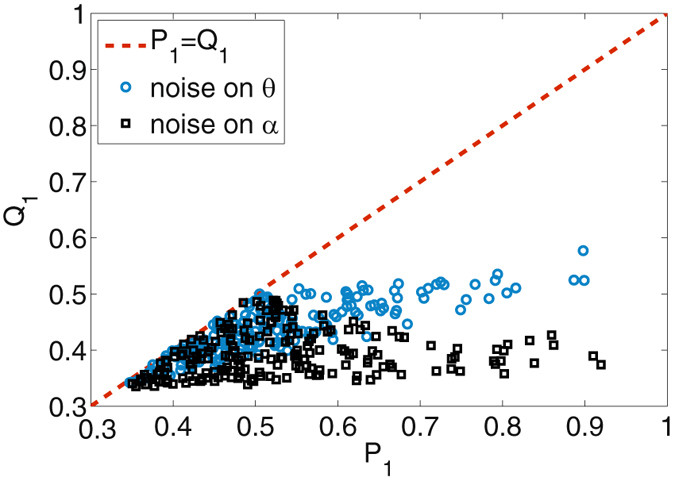
Numerical comparison of the final and initial ground state populations Q 1 vs. P 1 for a three-level system subject to noisy stimulated adiabatic passage. Considered are randomly generated initial states, noise distributions λ k’s, and classical noise affecting the parameter θ (circles, with α fixed as ) and α (squares, with θ fixed as ).
Extension to quantum channels
Our theory on classical noise can be extended to certain channels of quantum systems. One can provide a sufficient condition on the general Kraus representation of the action of noise for even approximate cooling to be impossible. Let , where and indicate the diagonalized ρ i and ρ f, respectively. The individual populations therefore satisfy
| 5 |
where . Now, we notice that if for arbitrary m, , then Q m ≤ P 1, which yields the claimed result Q 1 ≤ P 1. As an illustration for a two-level system, see the following list of Kraus operators that satisfy the normalization condition and are commonly used in the theory of quantum error-correction. The first example is the bit flip channel flips the state of a qubit from |0〉 to |1〉 (and vice versa) with probability 1 − p. It has operation elements:
The second one is the phase flip channel with operation elements
The third one, the bit-phase flip channel is characterized by
The fourth one is the depolarizing channel, which is an important type of quantum noise. To lead the qubit to be depolarized with probability p, the Kraus operation elements are chosen as , , , and , where and σ’s are identity operator and Pauli operators, respectively. For all of the above quantum operations, one can check that for either m = 1 or m = 2, so that Q 1 = P 1, which means no cooling can take place.
Discussion
One could hope that cooling might be realized with minimal resources, such as under the influence of classical noise. Here, we have shown that even approximate cooling to the ground state is impossible under such conditions assuming no work is done on the system. This may be viewed as a fundamental limitation in the theory of open system dynamics, which also manifests the application of the Uhlmann’s theorem on the cooling problem50. In principle it means that cooling methods described in a standard way, using initial system-environment state factorization, must include quantum noise (a finite-temperature quantum environment) and/or feedback mechanisms based on relevant measurements allowing extraction of information from the system. These protocols cannot be generally described in terms of the random channels (1). For example, the dynamics induced by projective measurements is generated by a non-Hermitian operator4, 5. It is noteworthy to state here that our result is independent of system dimension, as illustrated by the examples presented. As a direct application, our no-go theorem implies, e.g., that the exciton energy transfer in light-harvesting complexes at room temperature51 is assisted by non-classicality of the molecular vibrations. The discussion of whether or not this process bears quantum features was an interesting problem brought up in the ref. 51 and was found to be a non-trivial problem to solve.
We believe that it is important to understand constraints on cooling mechanisms under various types of system-environment couplings. We mention here that not all systems can even be cooled quantum-mechanically. In fact the cooling rate and the lowest achievable steady temperatures for optomechanical system2 and micromechanical system52 are determined by the resonator’s quantum fluctuations (photon shot noise). In certain regime when the frequency of the mechanical system is smaller than the decay rate of the cavity, the cooling might fail even with asymmetry in the noise spectrum. We recall that spectral asymmetry – which means that excitation and dexcitation of the system via the environment are inequivalent processes – is the usual condition required to achieve cooling of a quantum system. Similarly, the ground-state cooling is impossible for initial phonon numbers larger than mechanical quality factor. Experimentally52, as the cooling laser power is increased, it is shown that the system will arrive at the quantum backaction limit, with equal sideband heights as the mechanical resonator comes into equilibrium with the optical bath.
Finally, we note that our results offer a different perspective to that provided by existing specific limitations on cooling protocols, such as the recently shown limitation on the amount of steady state entanglement that can be generated when subjecting the system only to local dissipation53. The latter limitation means that systems with sufficiently entangled states cannot be cooled to the ground state under local dissipative processes.
Methods
Kraus representation emerging in the open quantum system dynamics
The time evolution of an open quantum system plus its environment is governed by some joint unitary propagator U(t), which describes the evolution of the joint density matrix ρ(t) from time t = 0 to time t, i.e., . The reduced dynamics of the system is commonly described in terms of a master equation, or equivalently is mathematically described as a quantum channel which technically is a completely positive trace preserving map. The reduced density matrix describing the system can be represented by , where |e k〉 is an orthonormal basis for the environment. It is convenient to choose the environmental basis to be the one that diagonalizes the state of the environment at t = 0, . In general, assumption of initial independence of system and environment, i.e., the factorized form , where ρ i is the state of open system at the initial instant, is necessary for the derivation of the master equation (or quantum channel) describing the dynamics. Under this condition a sum-up representation of the open system evolution can always be expressed in the form , where ’s are so-called Kraus operators which satisfy the normalization condition .
Proof of the no-go theorem
Without loss of generality, both initial and final states for the open system ρ i and ρ f can always be written in their respective diagonal forms as and , respectively. In other words, suppose and , where W and V are unitary operators that diagonalize the initial and final states of the system, respectively, then one can redefine K λ(t) as . Equation (1) can be rewritten as . Throughout this work, we consider the eigenstate populations to be ordered in decreasing order: , and . Using this as well as the normalization conditions and , the following inequality holds,
| 6 |
which implies, in particular, that Q 1 ≤ P 1, i.e., the maximally occupied eigenstate of the final state cannot have a larger population than that of the corresponding initial state. So if P 1 < 1 for a mixed initial state, then Q 1 < 1 and ρ f can not be a pure state.
Acknowledgements
We acknowledge grant support from the National Science Foundation of China No. 11575071, the Science and Technology Development Program of Jilin Province of China (20150519021JH), the Spanish MINECO/FEDER Grants FIS2015-69983-P, the Basque Government Grant IT986-16 and UPV/EHU UFI 11/55.
Author Contributions
J.J. contributed to numerical and physical analysis and prepare the figure and L.-A.W. initiated the project. J.J., R.W.C., and L.-A.W. wrote and reviewed the main manuscript text.
Competing Interests
The authors declare that they have no competing interests.
Footnotes
Publisher's note: Springer Nature remains neutral with regard to jurisdictional claims in published maps and institutional affiliations.
References
- 1.Wilson-Rae I, Nooshi N, Zwerger W, Kippenberg TJ. Theory of Ground State Cooling of a Mechanical Oscillator Using Dynamical Backaction. Phys. Rev. Lett. 2007;99:093901. doi: 10.1103/PhysRevLett.99.093901. [DOI] [PubMed] [Google Scholar]
- 2.Marquardt F, Chen JP, Clerk AA, Girvin SM. Quantum Theory of Cavity-Assisted Sideband Cooling of Mechanical Motion. Phys. Rev. Lett. 2007;99:093902. doi: 10.1103/PhysRevLett.99.093902. [DOI] [PubMed] [Google Scholar]
- 3.Genes C, Vitali D, Tombesi P, Gigan S, Aspelmeyer M. Ground-state cooling of a micromechanical oscillator: Comparing cold damping and cavity-assisted cooling schemes. Phys. Rev. A. 2008;77:033804. doi: 10.1103/PhysRevA.77.033804. [DOI] [Google Scholar]
- 4.Nakazato H, Takazawa T, Yuasa K. Purification through Zeno-Like Measurements. Phys. Rev. Lett. 2003;90:060401. doi: 10.1103/PhysRevLett.90.060401. [DOI] [PubMed] [Google Scholar]
- 5.Li Y, Wu L-A, Wang Y-D, Yang L-P. Nondeterministic ultrafast ground-state cooling of a mechanical resonator. Phys. Rev. B. 2011;84:094502. doi: 10.1103/PhysRevB.84.094502. [DOI] [Google Scholar]
- 6.Breuer, H. P. & Petruccione, F. Theory of Open Quantum Systems, Part III, Ch. 3, 115–119 (Oxford, New York, 2002).
- 7.Lewenstein, M., Sanpera, A. & Ahufinger, V. Ultracold Atoms in Optical Lattices: Simulating quantum many-body systems, Oxford University Press (2012).
- 8.Cirac JI, Zoller P. Quantum Computations with Cold Trapped Ions. Phys. Rev. Lett. 1995;74:4091. doi: 10.1103/PhysRevLett.74.4091. [DOI] [PubMed] [Google Scholar]
- 9.Farhi, E., Goldstone, J., Gutmann, S. & Sipser, M. Quantum Computation by Adiabatic Evolution. Report MIT-CTP-2936, Massachusetts Institute of Technology, arXiv:quant-ph/0001106 (2000).
- 10.Farhi E, et al. A quantum adiabatic evolution algorithm applied to random instances of an NP-complete problem. Science. 2001;292:5516. doi: 10.1126/science.1057726. [DOI] [PubMed] [Google Scholar]
- 11.Aharonov D, et al. Proceedings of the 45th Annual Symposium on the Foundations of Computer Science, Rome, Italy. New York: IEEE Computer Society Press; 2004. [Google Scholar]
- 12.Boixo S, et al. Evidence for quantum annealing with more than one hundred qubits. Nat. Phys. 2014;10:218. doi: 10.1038/nphys2900. [DOI] [Google Scholar]
- 13.Ursin R, et al. Entanglement-based quantum communication over 144 km. Nat. Phys. 2007;3:481. doi: 10.1038/nphys629. [DOI] [Google Scholar]
- 14.Rossini AJ, et al. Dynamic nuclear polarization enhanced NMR spectroscopy for pharmaceutical formulations. J. Am. Chem. Soc. 2014;136:2324. doi: 10.1021/ja4092038. [DOI] [PubMed] [Google Scholar]
- 15.Neder I, Rudner MS, Halperin BI. Theory of coherent dynamic nuclear polarization in quantum dots. Phys. Rev. B. 2014;89:085403. doi: 10.1103/PhysRevB.89.085403. [DOI] [Google Scholar]
- 16.Oh S, Wu L-A, Shim Y-P, Fei J, Friesen M, Hu X. Heisenberg spin bus as a robust transmission line for quantum-state transfer. Phys. Rev. A. 2011;84:022330. doi: 10.1103/PhysRevA.84.022330. [DOI] [Google Scholar]
- 17.Wu L-A, Segal D. Energy flux operator, current conservation and the formal Fourier’s law. J. Phys. A. 2008;42:025302. doi: 10.1088/1751-8113/42/2/025302. [DOI] [Google Scholar]
- 18.Wiseman, H. M. & Milburn, G. J. Quantum measurement and control, Ch. 6, 318–327 (Cambridge University Press, Cambridge, 2009).
- 19.Zhang P, Wang YD, Sun CP. Cooling Mechanism for a Nanomechanical Resonator by Periodic Coupling to a Cooper Pair Box. Phys. Rev. Lett. 2005;95:097204. doi: 10.1103/PhysRevLett.95.097204. [DOI] [PubMed] [Google Scholar]
- 20.Wang X, Vinjanampathy S, Strauch FW, Jacobs K. Ultraefficient Cooling of Resonators: Beating Sideband Cooling with Quantum Control. Phys. Rev. Lett. 2011;107:177204. doi: 10.1103/PhysRevLett.107.177204. [DOI] [PubMed] [Google Scholar]
- 21.Metzger CH, Karrai K. Cavity cooling of a microlever. Nature. 2004;432:1002. doi: 10.1038/nature03118. [DOI] [PubMed] [Google Scholar]
- 22.Arcizet O, Cohadon P-F, Briant T, Pinard M, Heidmann A. Radiation-pressure cooling and optomechanical instability of a micromirror. Nature. 2006;444:71. doi: 10.1038/nature05244. [DOI] [PubMed] [Google Scholar]
- 23.Kippenberg TJ, Vahala KJ. Cavity Opto-Mechanics. Opt. Express. 2007;15:17172. doi: 10.1364/OE.15.017172. [DOI] [PubMed] [Google Scholar]
- 24.Li Y, Wang ZD, Sun CP. Optically-driven cooling for collective atomic excitations. Eur. Phys. J. D. 2011;61:215. doi: 10.1140/epjd/e2010-10353-2. [DOI] [Google Scholar]
- 25.Berry MV. Quantal Phase Factors Accompanying Adiabatic Changes. Proc. R. Soc. Lond. A. 1984;392:45. doi: 10.1098/rspa.1984.0023. [DOI] [Google Scholar]
- 26.Berry MV. Transitionless quantum driving. J. Phys. A. 2009;42:365303. doi: 10.1088/1751-8113/42/36/365303. [DOI] [Google Scholar]
- 27.Zanardi P, Rasetti M. Holonomic Quantum Computation. Phys. Lett. A. 1999;264:94. doi: 10.1016/S0375-9601(99)00803-8. [DOI] [Google Scholar]
- 28.Sarandy MS, Lidar DA. Adiabatic approximation in open quantum systems. Phys. Rev. A. 2005;71:012331. doi: 10.1103/PhysRevA.71.012331. [DOI] [PubMed] [Google Scholar]
- 29.Sarandy MS, Lidar DA. Adiabatic Quantum Computation in Open Systems. Phys. Rev. Lett. 2005;95:250503. doi: 10.1103/PhysRevLett.95.250503. [DOI] [PubMed] [Google Scholar]
- 30.Sarandy MS, Lidar DA. Abelian and non-Abelian geometric phases in adiabatic open quantum systems. Phys. Rev. A. 2006;73:062101. doi: 10.1103/PhysRevA.73.062101. [DOI] [Google Scholar]
- 31.Li G-X, Zhu J-P. Ground-state cooling of a mechanical resonator coupled to two coupled quantum dots. J. Phys. B. 2011;44:195502. doi: 10.1088/0953-4075/44/19/195502. [DOI] [Google Scholar]
- 32.Reiserer A, Nölleke C, Ritter S, Rempe G. Ground-State Cooling of a Single Atom at the Center of an Optical Cavity. Phys. Rev. Lett. 2013;110:223003. doi: 10.1103/PhysRevLett.110.223003. [DOI] [PubMed] [Google Scholar]
- 33.Stadler P, Belzig W, Rastelli G. Ground-State Cooling of a Carbon Nanomechanical Resonator by Spin-Polarized Current. Phys. Rev. Lett. 2014;113:047201. doi: 10.1103/PhysRevLett.113.047201. [DOI] [PubMed] [Google Scholar]
- 34.Jocobs, K. Quantum Measurement Theory and its Applications, Ch. 7, 365–369 (Cambridge University Press, Cambridge, 2014).
- 35.Saira O-P, Bergholm V, Ojanen T, Möttönen M. Equivalent qubit dynamics under classical and quantum noise. Phys. Rev. A. 2007;75:012308. doi: 10.1103/PhysRevA.75.012308. [DOI] [Google Scholar]
- 36.Mari A, Eisert J. Cooling by Heating: Very Hot Thermal Light Can Significantly Cool Quantum Systems. Phys. Rev. Lett. 2012;108:120602. doi: 10.1103/PhysRevLett.108.120602. [DOI] [PubMed] [Google Scholar]
- 37.Cleuren B, Rutten B, Van den Broeck C. Cooling by Heating: Refrigeration Powered by Photons. Phys. Rev. Lett. 2012;108:120603. doi: 10.1103/PhysRevLett.108.120603. [DOI] [PubMed] [Google Scholar]
- 38.Wu L-A, Segal D, Brumer P. No-go theorem for ground state cooling given initial system-thermal bath factorization. Sci. Rep. 2013;3:1824. doi: 10.1038/srep01824. [DOI] [PMC free article] [PubMed] [Google Scholar]
- 39.Anderssona E, Cresserb JD, Hallc MJW. Finding the Kraus decomposition from a master equation and vice versa. J. M. Opt. 2007;54:1695. doi: 10.1080/09500340701352581. [DOI] [Google Scholar]
- 40.Gardiner, C. W. & Zoller, P. Quantum Noise, Ch. 3, 57–59 (Springer-Verlag, Berlin, Heidelberg, 2004).
- 41.Aguilar J-P, Berglund N. The effect of classical noise on a quantum two-level system. J. Math. Phys. 2008;49:102102. doi: 10.1063/1.2988180. [DOI] [Google Scholar]
- 42.Blatt R, Häffner H, Roos CF, Becher C, Schmidt-Kaler F. Ion Trap Quantum Computing with Ca+ Ions. Quant. Inf. Proc. 2004;3:61. doi: 10.1007/s11128-004-3105-1. [DOI] [Google Scholar]
- 43.Paladino E, Galperin YM, Falci G, Altshuler BL. 1/f noise: Implications for solid-state quantum information. Rev. Mod. Phys. 2014;86:361. doi: 10.1103/RevModPhys.86.361. [DOI] [Google Scholar]
- 44.Ridolfi, L., D’Odorico, P. & Laio, F. Noise-Induced Phenomena in the Environmental Sciences, Ch. 2, 46-47 (Cambridge University Press, 2011).
- 45.Cywiński Ł, Witzel WM, Das Sarma S. Pure quantum dephasing of a solid-state electron spin qubit in a large nuclear spin bath coupled by long-range hyperfine-mediated interactions. Phys. Rev. B. 2009;79:245314. doi: 10.1103/PhysRevB.79.245314. [DOI] [Google Scholar]
- 46.Xue F, et al. Controllable coupling between flux qubit and nanomechanical resonator by magnetic field. New. J. Phys. 2007;9:35. doi: 10.1088/1367-2630/9/2/035. [DOI] [Google Scholar]
- 47.Fedorov A, et al. Strong Coupling of a Quantum Oscillator to a Flux Qubit at Its Symmetry Point. Phys. Rev. Lett. 2010;105:060503. doi: 10.1103/PhysRevLett.105.060503. [DOI] [PubMed] [Google Scholar]
- 48.Král P, Thanopulos I, Shapiro M. Coherently controlled adiabatic passage. Rev. Mod. Phys. 2007;79:53. doi: 10.1103/RevModPhys.79.53. [DOI] [Google Scholar]
- 49.Jing J, Wu L-A, Sarandy MS, Muga JG. Inverse engineering control in open quantum systems. Phys. Rev. A. 2013;88:053422. doi: 10.1103/PhysRevA.88.053422. [DOI] [Google Scholar]
- 50.Nielson MA, Vidal G. Majorization and the interconversion of bipartite states. Quant. Inf. Comput. 2001;1:76. [Google Scholar]
- 51.OŔeilly EJ, Olaya-Castro A. Non-classicality of the molecular vibrations assisting exciton energy transfer at room temperature. Nat. Comm. 2014;5:3012. doi: 10.1038/ncomms4012. [DOI] [PMC free article] [PubMed] [Google Scholar]
- 52.Peterson RW, et al. Laser Cooling of a Micromechanical Membrane to the Quantum Backaction Limit. Phys. Rev. Lett. 2016;116:063601. doi: 10.1103/PhysRevLett.116.063601. [DOI] [PubMed] [Google Scholar]
- 53.Žnidarič M. Geometry of local quantum dissipation and fundamental limits to local cooling. Phys. Rev. A. 2015;91:052107. doi: 10.1103/PhysRevA.91.052107. [DOI] [Google Scholar]