



Abstract
Background
Second‐generation drug eluting stents (DES) may reduce costs and improve clinical outcomes compared to first‐generation DES with improved cost‐effectiveness when compared to bare metal stents (BMS). We aimed to conduct an economic evaluation of a cobalt‐chromium everolimus eluting stent (Co‐Cr EES) compared with BMS in percutaneous coronary intervention (PCI).
Objective
To conduct a cost‐effectiveness analysis (CEA) of a cobalt‐chromium everolimus eluting stent (Co‐Cr EES) versus BMS in PCI.
Methods
A Markov state transition model with a 2‐year time horizon was applied from a US Medicare setting with patients undergoing PCI with Co‐Cr EES or BMS. Baseline characteristics, treatment effects, and safety measures were taken from a patient level meta‐analysis of 5 RCTs (n = 4,896). The base‐case analysis evaluated stent‐related outcomes; a secondary analysis considered the broader set of outcomes reported in the meta‐analysis.
Results
The base‐case and secondary analyses reported an additional 0.018 and 0.013 quality‐adjusted life years (QALYs) and cost savings of $236 and $288, respectively with Co‐Cr EES versus BMS. Results were robust to sensitivity analyses and were most sensitive to the price of clopidogrel. In the probabilistic sensitivity analysis, Co‐Cr EES was associated with a greater than 99% chance of being cost saving or cost effective (at a cost per QALY threshold of $50,000) versus BMS.
Conclusions
Using data from a recent patient level meta‐analysis and contemporary cost data, this analysis found that PCI with Co‐Cr EES is more effective and less costly than PCI with BMS. © 2016 The Authors. Catheterization and Cardiovascular Interventions Published by Wiley Periodicals, Inc.
Keywords: drug‐eluting stent, bare metal stent, percutaneous coronary intervention, cost‐effectiveness
INTRODUCTION
As the first major drug‐device combination product for cardiovascular disease, drug‐eluting stents (DES) represented a clinical breakthrough in treatment of patients with coronary artery disease (CAD) 1. The technology continues to evolve, with the recent development of second‐generation DES platforms such as the cobalt chromium (Co‐Cr) everolimus‐eluting stent (EES). These platforms are comprised of permanent polymer coatings, less toxic antiproliferative drugs (e.g., everolimus or zotarolimus), and thin strut stent designs compared with first‐generation DES.
Robust randomized controlled trials (RCTs) and several meta‐analyses of RCTs have shown that Co‐Cr EES is significantly safer and more effective than bare metal stents (BMS), with lower rates of stent thrombosis (ST), myocardial infarction (MI), and cardiac mortality 2, 3, 4, 5, 6, 7, 8. A recent patient level meta‐analysis of 4,896 patients from five RCTs (including three all comer studies) found that patients receiving Co‐Cr EES had significant reductions in cardiac mortality, MI, definite ST, definite or probable ST, and target vessel revascularization (TVR) versus patients receiving BMS 5. There are also some indications that second‐generation DES reduce costs and improve clinical outcomes compared to first‐generation DES 9, with improved cost‐effectiveness versus BMS 10, 11, 12.
The current study leverages the availability of data from the patient level meta‐analysis of RCTs to address the cost effectiveness of Co‐Cr EES compared to BMS.
METHODS
Type of Analysis and Perspective
The cost‐effectiveness analysis (CEA) was conducted for a 2‐year time horizon from the US Medicare perspective 13. A 2‐year time horizon was selected to align with the patient level meta‐analysis 5 and previous cost‐effectiveness studies of DES compared to BMS 10, 14, 15, 16, 17. Costs and outcomes at year 2 were discounted at a rate of 3%.
Study Population
The mean age of patients included in the patient level meta‐analysis was 67 years and the majority of patients included were male (76%). Type 2 diabetes mellitus was present in approximately 19% of patients. Forty‐four percent of all patients received stenting in the setting of primary PCI and more than 87% underwent PCI treatment for an unstable presentation. The methods and results of the meta‐analysis have been reported in detail by Valgimigli et al. 5.
Model Overview
A Markov state transition model was developed in Microsoft Excel 2007 using effectiveness and safety data from the patient level meta‐analysis (Fig. 1) 5. Patients started the model in the “alive” health state, and during each model cycle of 1 year, could transition to deceased. During each 1‐year model cycle, “event‐free” patients could also experience one or more of the following transient events: MI, ST or TVR. Event risks were only available to inform the probability of moving from event‐free to a transient event; data was not available to inform movement between the transient events. The data inputs used in the CEA are summarized in Table 1.
Figure 1.

Overview of the model structure. The model captured both base‐case (i.e., TVR, TVR‐related MI, ST, and cardiac mortality) and secondary analysis (i.e., TVR, MI, ST, all‐cause death) outcomes. MI = myocardial infarction; ST = stent thrombosis; TVR = target vessel revascularization.
Table 1.
Summary of Model Parameters for the Base‐Case and Secondary Analyses
| Input parameter | Intervention | Sources | |
|---|---|---|---|
| Event risks (%) (years 0–2) | Co‐Cr EES | BMS | |
| All‐cause mortalitya | 4.9 | 5.9 | Valgimigli et al. [5] |
| Cardiac‐related mortalityb | 2.7 | 4.1 | |
| TVRa,b | 4.3 | 10.2 | |
| Any MIa | 4.0 | 5.6 | |
| TVR‐related MIb | 0.9 | 1.8 | |
| Definite STa,b | 0.6 | 1.4 | |
| Procedure proportions | Both interventions | ||
| PCI with DES | Medicare claims data 34 | ||
| Inpatient (index procedure) | 64% | ||
| Outpatient (index procedure) | 36% | ||
| Inpatient with MCC; w/o CC or MCC | 18%; 82% | HCUPnet 35 | |
| Outpatient with AMI or CTO; w/o AMI or CTO | 5%; 95% | ||
| PCI with BMS | Medicare claims data 34 | ||
| Inpatient (index procedure) | 64% | ||
| Outpatient (index procedure) | 36% | ||
| Inpatient with MCC; w/o CC or MCC | 25%; 75% | HCUPnet 35 | |
| Outpatient with atherectomy; w/o atherectomy | 0%; 100% | ||
| Unit costs (USD) | Both Interventions | ||
| Procedure reimbursement [36,37] | References 36, 37 | ||
| PCI with DES | |||
| Inpatient with MCC; w/o CC or MCC | $19,009 | DRG 246 | |
| Inpatient w/o CC or MCC | $12,090 | DRG 247 | |
| Outpatient with AMI or CTO | $14, 841 | APC 319 | |
| Outpatient w/o AMI or CTO | $9,624 | APC 229 | |
| PCI with BMS | |||
| Inpatient with MCC | $17,860 | DRG 248 | |
| Inpatient w/o CC or MCC | $11,046 | DRG 249 | |
| Outpatient with atherectomy | $14,841 | APC 319 | |
| Outpatient w/o atherectomy | $9,624 | APC 229 | |
| PCI (no stent) | |||
| Inpatient with MCC | $17,551 | DRG 250 | |
| Inpatient w/o CC or MCC | $11,980 | DRG 251 | |
| Outpatient with PTA | $4,537 | APC 083 | |
| Outpatient w/o PTA | – | ||
| CABG [36], Inpatient market estimator, unpublished data, 2015 | $30,669 | DRG 231–236c | |
| Event costs | |||
| MI [35,36] | $7,814 | DRG 231–236d | |
| TVR‐Treated with CABG | See above | ||
| TVR‐Treated with PCI DES | See above | ||
| TVR‐Treated with PCI no Stent | See above | ||
| DAPT costs and duration | |||
| Generic clopidogrel (75 mg) monthly cost [21] | $23.64 | ||
| Brand clopidogrel (75 mg) monthly cost [23] | $160.00 | ||
| Clopidogrel duration–Co‐Cr EES [5] | 12 months | ||
| Clopidogrel duration–BMS [5] | 6 months | ||
| Health Utilities [18] | Both Interventions | ||
| CAD (no symptoms) | 0.85 | ||
| TVR | |||
| PCI (0–6, 6–12 months) | 0.79 | ||
| CABG (0–6, 6–12 months) | 0.79 | ||
| MI (12 months) | 0.75 | ||
Variables used in base‐case analysis.
Variables used in secondary analysis.
Procedure weights based on Cardiovascular Inpatient Market Estimator.
Procedure weights based on HCUPnet.
AMI = acute myocardial infarction; APC = ambulatory patient classification; CABG = coronary artery bypass graft; CC = complications or comorbidities; CTO = chronic total occlusion; CV = cardiovascular; DAPT = dual antiplatelet therapy; DES = drug eluting stent; DRG = diagnosis‐related group; HCUP = Healthcare Cost Utilization Project; MCC = major complications or comorbidities; MI = myocardial infarction; PCI = percutaneous coronary intervention; PTA = percutaneous transluminal angioplasty; ST = stent thrombosis; TVR = target vessel revascularization; USD = United States dollars; w = with; w/o = without.
Transition Probabilities and Event Risks
The risks of mortality, MI, ST, and TVR were informed by the patient level meta‐analysis 5. The authors of the meta‐analysis provided the number of patients at risk and the number of events for each treatment group, stratified by year 1 and year 2. The authors also provided cause of mortality (i.e., all‐cause or cardiac‐related) and type of MI (i.e., TVR‐related, any MI).
Resource Use and Unit Costs
The focus of the CEA was costs borne by the US Medicare program, including costs associated with the percutaneous coronary intervention (PCI) procedure (including the stent), TVR, MI, and dual antiplatelet therapy (DAPT). Estimates of resource use and unit costs (2015 US dollars) were obtained from the published literature. Additional technology costs associated with DES versus BMS were included in diagnosis‐related group (DRG) payments.
For patients who experienced TVR, re‐intervention could be performed by means of coronary artery bypass graft (CABG) or PCI (with stent or without stent). The proportions of patients receiving CABG (10%) or PCI (90%) were taken from a publication reported by Garg et al. 18. The breakdown of re‐intervention with PCI was assumed to be PCI with DES (56%) and PCI without stent (44%) 18.
In the patient level meta‐analysis, the duration of DAPT (i.e., clopidogrel in addition to aspirin) ranged from 3 months to 24 months for both DES and BMS 5. The European Society of Cardiology (ESC) guidelines recommend a DAPT duration of at least 1 month for BMS and 6 months for DES 19. The ACC guidelines recommended a DAPT duration of 1 month for BMS and 12 months for DES 20. For the base‐case analysis, we assumed a DAPT duration of 6 months for BMS and 12 months for DES. Generic pricing of clopidogrel (75 mg) was based on the wholesale acquisition cost (WAC) published in the US Redbook online pricing database 21. A 20% mark‐up was added to the WAC to be more conservative and to arrive at a total monthly acquisition cost of $23.64 that more closely reflected the average wholesale price (AWP) 22. An alternative monthly DAPT cost of $91.82 (assuming 50% generic and 50% brand clopidogrel) was evaluated in the sensitivity analyses.
Health Utility
Quality of life impacts were included for CAD, MI, and TVR. A health utility value of 0.85 was applied in the model to patients with CAD and no symptoms 18. For patients experiencing TVR a health utility decrement of −0.06 was applied for 1 year following the re‐intervention, irrespective of revascularization with CABG or PCI 18. For patients experiencing MI, a health utility of 0.75 was applied for 1 year following the MI 18.
Analysis
The base‐case analysis included clinical outcomes from the patient level meta‐analysis that were considered to be stent‐related: TVR, TVR‐related MI, definite ST, and cardiac‐related mortality. A secondary analysis was conducted that considered the broader set of clinical outcomes from the meta‐analysis: TVR, all MI, definite ST, and all‐cause mortality.
One‐way sensitivity analyses were conducted in order to test the robustness of the base‐case analysis to alternative assumptions and data inputs related to transition probabilities, risks of events, resource use, DAPT therapy costs, and health utility (Table 2) 20, 23, 24, 25. A probabilistic sensitivity analysis (PSA) was conducted to simultaneously quantify the uncertainty in all key model input parameters.
Table 2.
Summary of Model Inputs for Additional One‐Way Sensitivity Analyses
| Input parameter | Base‐case value(s) | Alternative value(s) | ||
|---|---|---|---|---|
| Co‐Cr EES | BMS | Co‐Cr EES | BMS | |
| DAPT duration | ||||
| Turco 2012 [23] | 12 months | 6 months | 12 months | 12 months |
| 2011 ACC/AHA/SCAI guidelines for PCI [20] | 12 months | 1 month | ||
| 2014 ESC/EACTS guidelines on revascularization [30] | 6 months | 1 month | ||
| Clopidogrel cost (50% generic & 50% brand price) | $23.64 | $91.82 | ||
| Cost of MI | ||||
| Patient receiving CABG [25] | $7,814 | $9,344 | ||
| Patient receiving PCI [25] | $6,230 | |||
| Health utility for MI [24] | 0.75 | 0.72 | ||
| Health utility for TVR (0–6 months, 6–12 months) [24] | 0.79 | 0.75 | ||
| TVR procedure (%)a | CABG = 10; PCI = 90 | CABG = 13.2; PCI = 86.8 | ||
Based on unpublished 2012 data from HCUP.net and MEDPAR data.
ACC = American College of Cardiology; AHA = American Heart Association; CABG = coronary artery bypass graft; DAPT = dual antiplatelet therapy; EACTS = European Association for Cardio‐Thoracic Surgery; ESC = European Society of Cardiology; HCUP = Healthcare Cost Utilization Project; MI = myocardial infarction; PCI = percutaneous coronary intervention; SCAI =Society Cardiovascular Angiography Interventions; TVR = target vessel revascularization.
RESULTS
Base‐Case Analysis
Results of the base‐case analysis (Table 3) demonstrated that Co‐Cr EES was more efficacious than BMS. Patients who received PCI with Co‐Cr EES experienced fewer cardiac‐related deaths, TVR‐related MIs, ST, and TVRs, 0.015 additional life years, and 0.018 additional QALYs compared with patients who received PCI with BMS. PCI with Co‐Cr EES was also associated with cost savings of $236 per patient. The primary drivers of the cost savings were the reduction in TVR and MI rates, which offset the increased costs of the index procedure and DAPT observed with Co‐Cr EES versus BMS.
Table 3.
Model Predicted Results for Base‐Case (A) and Secondary (B) Analyses
| Outcome | Co‐Cr EES | BMS | Difference (Co‐Cr EES‐BMS) |
|---|---|---|---|
| (A) Base‐case analysis | |||
| Cardiac‐related deaths* | 27 | 41 | −14 |
| TVR‐related MI* | 9 | 18 | −9 |
| Definite stent thrombosis* | 6 | 14 | −8 |
| TVR* | 43 | 102 | −59 |
| Life years per patient | 1.935 | 1.920 | 0.015 |
| QALYs/patient | 1.642 | 1.624 | 0.018 |
| Total costs (USD)* | $12,999,798 | $13,235,578 | ‐$235,780 |
| Index procedure* | $12,093,215 | $11,624,320 | $468,895 |
| TVR* | $553,758 | $1,329,344 | ‐$775,586 |
| MI* | $69,145 | $140,074 | ‐$70,929 |
| DAPT* | $283,680 | $141,840 | $141,840 |
| (B) Secondary analysis | |||
| All‐cause deaths* | 49 | 59 | −10 |
| Any MI* | 40 | 56 | −16 |
| Definite stent thrombosis* | 6 | 14 | −8 |
| TVR* | 43 | 102 | −60 |
| Life years per patient | 1.909 | 1.900 | 0.009 |
| QALYs/patient | 1.616 | 1.603 | 0.013 |
| Total costs (USD)* | $13,237,583 | $13,525,567 | ‐$287,984 |
| Index procedure* | $12,093,215 | $11,624,320 | $468,895 |
| TVR* | $551,574 | $1,327,315 | ‐$775,741 |
| MI* | $309,114 | $432,092 | ‐$122,978 |
| DAPTa | $283,680 | $141,840 | $141,840 |
Per cohort of 1,000 patients; model predicted clinical outcome results differ slightly from clinical results reported in the Valgimigli 2014 meta‐analysis due to model calculation and rounding requirements.
DAPT = dual antiplatelet therapy; MI = myocardial infarction; QALYs = quality‐adjusted life years; TVR = target vessel revascularization; USD = United States dollars.
Results of the secondary analysis (not shown) demonstrated similar results to the base‐case analysis. PCI with Co‐Cr EES was both more effective (0.009 additional life years and 0.013 additional QALYs per patient) and less costly (‐$288 per patient) versus BMS.
One‐Way Sensitivity Analysis
The base‐case results were robust to a number of sensitivity analyses. When inputs were varied by ±20%, results remained cost savings for Co‐Cr EES relative to BMS in all cases (not shown). Similarly, when base‐case inputs were varied using alternative values taken from published literature 20, 23, 24, 25, all analyses showed that Co‐Cr EES was more effective and less costly versus BMS, with the exception of the cost of clopidogrel, which resulted in a cost of $9,755 per QALY gained (Table 4).
Table 4.
Results of Sensitivity Analyses Using Alternative Published Values, Reported for the Base‐Case Analysis Only
| Analysis description | Incremental cost (USD) | Incremental QALY | Cost per QALY gained (USD) |
|---|---|---|---|
| Base‐case analysis | −$235.78 | 0.0178 | Cost savings |
| TVR procedures (CABG: 13.2%, PCI: 86.8%) | −$272.77 | 0.0178 | Cost savings |
| DAPT duration (Co‐Cr EES: 12 months, BMS: 12 months) | −$377.62 | 0.0178 | Cost savings |
| DAPT duration (Co‐Cr EES: 12 months, BMS: 1 month) | −$117.58 | 0.0178 | Cost savings |
| DAPT duration (Co‐Cr EES: 6 months, BMS: 1 month) | −$259.42 | 0.0178 | Cost savings |
| Clopidogrel cost (50% generic; 50% brand) | $173.30 | 0.0178 | $9,754.88 |
| Cost of MI (CABG patients) | −$249.67 | 0.0178 | Cost savings |
| Cost of MI (PCI patients) | −$221.40 | 0.0178 | Cost savings |
| Utility for MI (0.72) | −$235.78 | 0.0180 | Cost savings |
| Utility for PCI; 0–6, 6–12 (0.75) | −$235.78 | 0.0199 | Cost savings |
CABG = coronary artery bypass graft; DAPT = dual antiplatelet therapy; MI = myocardial infarction; PCI = percutaneous coronary intervention; TVR = target vessel revascularization; QALY = quality‐adjusted life year; USD = United States dollars.
Probabilistic Sensitivity Analysis
Figure 2 depicts the results of the PSA on the cost‐effectiveness scatter plot for the base‐case analysis (A) and the secondary analysis (B). Each point on each scatterplot represents the incremental QALYs for Co‐Cr EES versus BMS (x‐axis) and the incremental cost of Co‐Cr EES versus BMS (y‐axis) for each of the 1,000 model simulations 26, 27. For the base‐case analysis, 88.5% of the model iterations showed Co‐Cr EES to be cost savings versus BMS. In 10.6% of the model iterations, Co‐Cr EES was more effective and more costly than PCI with BMS. In the remaining model iterations, Co‐Cr EES was less effective 28.
Figure 2.

Results of the probabilistic sensitivity analysis on the cost‐effectiveness scatter plot for the base‐case analysis (A) and the secondary analysis (B) 28. QALY = quality‐adjusted life year; USD = United States dollars.
Very similar results were observed for the secondary analysis; Co‐Cr EES was cost savings versus BMS in 91.1% of the model iterations and Co‐Cr EES was more effective and more costly than BMS in 5.8% of the model iterations.
Figure 3 shows the CEACs for both the base‐case and secondary analyses. At willingness‐to‐pay (WTP) thresholds of $50,000 per QALY, the base‐case PSA predicted that Co‐Cr EES was associated with a 99.5% likelihood of being cost‐savings or cost effective. For the secondary analysis, the PSA predicted that Co‐Cr EES was associated with a 99.2% likelihood of being cost‐savings or cost effective.
Figure 3.
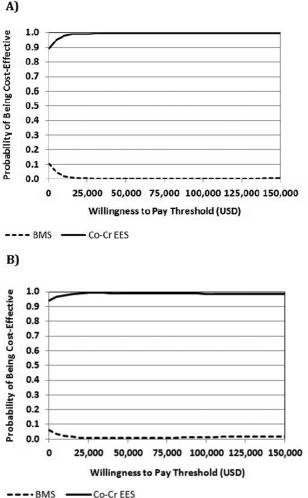
Results of the probabilistic sensitivity analysis using cost‐effectiveness acceptability curves for the base‐case analysis (A) and the secondary analysis (B) 28. BMS = bare‐metal stent; Co‐Cr EES = cobalt chromium everolimus‐eluting stent; USD = United States dollars.
DISCUSSION
Statement of Principal Findings
This 2‐year CEA found that PCI with Co‐Cr EES is more effective and less costly compared with PCI with BMS in contemporary US clinical practice. The base‐case analysis found that a patient who received Co‐Cr EES experienced an additional 0.018 QALYs and cost savings of $236 compared with a patient who received a BMS. The findings were consistent between the base‐case analysis and the secondary analysis that included broader outcomes.
Strengths and Limitations
The evaluation was based on a patient level meta‐analysis of RCTs, a research methodology that is widely regarded as the highest level of evidence and has inherent advantages over individual RCTs and aggregate data meta‐analyses 29, 30, 31. Furthermore, the patient population of the RCTs included in the meta‐analysis is generally reflective of real‐world clinical practice. This analysis was also based on several conservative assumptions, including a short‐term time horizon and the assumption that a high proportion of re‐interventions employed angioplasty only 32. Finally, the results of our analyses were robust across a range of sensitivity analyses.
Uncertainty remains regarding the appropriate duration of DAPT for patients receiving Co‐Cr EES. A recent meta‐analysis of 10 RCTs of DES showed that patients using DAPT for less than 12 months showed lower risk of major bleeding with no significant increase in thrombotic outcomes compared with patients using DAPT for 12 months 33. A 12‐month duration of DAPT for Co‐Cr EES was assumed for the base‐case analysis, and the results were found to be robust to a wide range of alternative assumptions. However, care should be exercised when generalizing the results of the economic evaluation to environments in which practice patterns, resource utilization, and costs differ from those assumed in this analysis.
Comparison With Other Studies
To our knowledge, this CEA is the first to find that Co‐Cr EES is economically dominant versus BMS. Cost savings were driven primarily by significant reductions in MI, ST, and cardiac mortality with Co‐Cr EES relative to BMS. Other key drivers of the analysis include the declining price differential between DES and BMS and the availability of generic clopidogrel.
Other recent economic evaluations have reported conflicting results regarding the economic value of DES. In 2010, Remak et al. 11 reported a CEA of patients treated with the Endeavor DES or BMS over 4 years and reported a low cost per QALY of £3,575. Like our analysis, Remak et al. incorporated a reduction in the risk of MI and death for DES, a smaller price difference between DES and BMS (∼£500), and relatively low cost of generic clopidogrel (∼£35 per month). It is noteworthy that the magnitude of the clinical benefit at 2 years was reported to be lower in the Remak study compared to the current study; however the Remak data extended to 4 years. Schafer et al. 10 reported an economic evaluation of first‐generation DES using 3‐year, real‐world, observational data from the US and reported a high cost per QALY of $87,705 for DES versus BMS. Importantly, Schafer and colleagues did not incorporate a reduction in the risk of MI for DES and assumed a relatively high cost of clopidogrel (i.e., $140 per month). The authors noted that lower generic clopidogrel and DES costs would result in overall cost‐savings for DES versus BMS.
In contrast, Barone‐Rochette et al. 12 reported that DES was not cost‐effective (i.e., at a WTP threshold of €10,000 per revascularization avoided) at a price differential of €1,200 (€2,008), but that it became cost effective at a price differential of €400 (€2,012). No differences in MI, ST, or cardiac mortality were modeled in this analysis. Finally, a 2013 economic evaluation based on Canadian observational data for patients with stable coronary disease also questioned the cost effectiveness of DES and recommended broad use of BMS 24. However, the observational data were based on patients receiving first‐generation stents from 2003 to 2005 and the unit costs of DES vs. BMS (i.e., $2,519 vs. $657, respectively) used in the analysis were also presumably from that timeframe.
Impact on Daily Practice
The findings of this study hold practical importance for payers, policymakers and clinicians evaluating the clinical and economic value of Co‐Cr EES and other cardiovascular innovations. As PCI technology and clinical practice rapidly advanced from first‐generation DES to Co‐Cr EES, it has represented a “moving target” that underscores the importance of updating health technology assessment (HTA) and economic evaluations to reflect changes in economic value over time. In contrast to early analyses involving first‐generation DES, our economic analysis based on the highest level of clinical evidence finds that PCI with Co‐Cr EES is more effective and less costly than PCI with BMS in contemporary US clinical practice.
CONCLUSIONS
Studies assessing the cost effectiveness of DES versus BMS have reported mixed results due to multiple factors including limitations of first‐generation DES. Utilizing the latest data from the US Medicare program and clinical results from a high‐quality, patient level meta‐analysis of RCTs our study finds that Co‐Cr EES is an economically attractive strategy compared with BMS in patients undergoing PCI.
ACKNOWLEDGMENTS
JBH, JTH, and TS conceived the study, and provided input in model development and critical editorial comment on the manuscript. NF and IS were involved in study design, developed the initial model, and drafted the manuscript. IS conducted economic analyses. MV and GF provided the effectiveness data, provided critical input into the model development, and critical editorial comment on the manuscript. MV, MS, CK, SB, JMTH, SG, AC, FE, AB, PS, and GF were involved in the clinical data parameterization and analysis. All authors have reviewed and approved the submitted manuscript. The authors would like to acknowledge Bryanna Tibensky for assisting with the drafting of the manuscript. JBH is no longer working with Abbott Vascular & Abbott Electrophysiology, and is now working with Verily (formerly Google Life Sciences).
This work is an original manuscript, which has not been published or submitted simultaneously for publication elsewhere. The manuscript does not include any tables or illustrations that were previously published elsewhere or any photographs. This work was supported by Abbott Vascular, who provided funding to develop the model, conduct the analysis and prepare the manuscript. The funding organization had no influence on the study design, conduct of the analyses, interpretation of the study results, or the decision to submit for publication.
Conflict of interest: M.V. reports personal fees from AstraZeneca, Medicine Company, Terumo Medical, St Jude Vascular, Alvimedica, Abbott Vascular and Correvio, grants from AstraZeneca, non‐financial support from Medicine Company, and other fees for serving as advisory boards from AstraZeneca and St Jude Vascular, outside the submitted work. J.M.T.H. reports grants from Abbott Vascular, and M.S. reports personal fees from Abbott Vascular, outside the submitted work. C.K. reports grants from the Cardiovascular Research Foundation (Basel, Switzerland), Daiichy Sankyo, and other from Eli Lilly, during the conduct of the study. F.E. reports grants from Abbott Vascular, Biotronik, St Jude Medical, and Terumo, outside the submitted work. S.B. reports grants from AstraZeneca, and personal fees from Abbott, outside the submitted work. T.S., J.B.H., and J.T.H. are employees of Abbott Vascular. N.F. and I.M.S. work as consultants for private sector organizations in the healthcare industry. P.W.S., S.G., G.F., A.B., and A.C., have no conflicts of interest to declare.
REFERENCES
- 1. Windecker S, Juni P. The drug‐eluting stent saga. Circulation 2009; 119:653–656. [DOI] [PubMed] [Google Scholar]
- 2. Sabate M, Raber L, Heg D, Brugaletta S, Kelbaek H, Cequier A, Ostojic M, Iniquez A, Tuller D, Serra A, Baumbach A, von Birgelen C, Hernandez‐Antolin R, Roffi M, Mainar V, Valgimigli M, Serruys PW, Juni P, Windecker S. Comparison of newer‐generation drug‐eluting with bare‐metal stents in patients with acute ST‐segment elevation myocardial infarction: a pooled analysis of the EXAMINATION (clinical Evaluation of the Xience‐V stent in Acute Myocardial INfArcTION) and COMFORTABLE‐AMI (Comparison of Biolimus Eluted From an Erodible Stent Coating With Bare Metal Stents in Acute ST‐Elevation Myocardial Infarction) trials. JACC Cardiovasc Interv 2014; 7:55–63. [DOI] [PubMed] [Google Scholar]
- 3. Palmerini T, Benedetto U, Biondi‐Zoccai G, Della Riva D, Bacchi‐Reggiani L, Smits PC, Vlachojannis GJ, Jensen LO, Christiansen EH, Berencsi K, Valgimigli M, Orlandi C, Petrou M, Rapezzi C, Stone GW. Long‐Term Safety of Drug‐Eluting and Bare‐Metal Stents: Evidence From a Comprehensive Network Meta‐Analysis. J Am Coll Cardiol 2015; 65:2496–2507. [DOI] [PubMed] [Google Scholar]
- 4. Stone GW, Rizvi A, Newman W, Mastali K, Wang JC, Caputo R, Doostzadeh J, Cao S, Simonton CA, Sudhir K, Lansky AJ, Cutlip DE, Kereiakes DJ; SPIRIT IV Investigators. Everolimus‐eluting versus paclitaxel‐eluting stents in coronary artery disease. N Engl J Med 2010; 362:1663–1674. [DOI] [PubMed] [Google Scholar]
- 5. Valgimigli M, Sabaté M, Kaiser C, Brugaletta S, de la Torre Hernandez JM, Galatius S, Cequier A, Eberli F, de Belder A, Serruys PW, Ferrante G. Effects of cobalt‐chromium everolimus eluting stents or bare metal stent on fatal and non‐fatal cardiovascular events: patient level meta‐analysis. BMJ 2014; 349:g6427 [DOI] [PMC free article] [PubMed] [Google Scholar]
- 6. Bangalore S, Toklu B, Amoroso N, Fusaro M, Kumar S, Hannan EL, Faxon DP, Feit F. Bare metal stents, durable polymer drug eluting stents, and biodegradable polymer drug eluting stents for coronary artery disease: mixed treatment comparison meta‐analysis. Bmj 2013; 347:f6625 [DOI] [PMC free article] [PubMed] [Google Scholar]
- 7. Palmerini T, Biondi‐Zoccai G, Della Riva D, Stettler C, Sangiorgi D, D'Ascenzo F, Kimura T, Briquori C, Sabate M, Kim HS, De Waha A, Kedhi E, Smits PC, Kaiser C, Sardella G, Marullo A, Kirtane AJ, Leon MB, Stone GW. Stent thrombosis with drug‐eluting and bare‐metal stents: evidence from a comprehensive network meta‐analysis. Lancet 2012; 379:1393–1402. [DOI] [PubMed] [Google Scholar]
- 8. Bangalore S, Kumar S, Fusaro M, Amoroso N, Kirtane AJ, Byrne RA, Williams DO, Slater J, Cutlip DE, Feit F. Outcomes with various drug eluting or bare metal stents in patients with diabetes mellitus: mixed treatment comparison analysis of 22, 844 patient years of follow‐up from randomised trials. Bmj 2012; 345. [DOI] [PMC free article] [PubMed] [Google Scholar]
- 9. Amin AP, Reynolds MR, Lei Y, Magnuson EA, Vilain K, Durtschi AJ, Simonton CA, Stone GW, Cohen DJ. Cost‐effectiveness of everolimus‐ versus paclitaxel‐eluting stents for patients undergoing percutaneous coronary revascularization (from the SPIRIT‐IV Trial). Am J Cardiol 2012; 110:765–770. [DOI] [PubMed] [Google Scholar]
- 10. Schafer PE, Sacrinty MT, Cohen DJ, Kutcher MA, Gandhi SK, Santos RM, Little WC, Applegate RJ. Cost‐effectiveness of drug‐eluting stents versus bare metal stents in clinical practice. Circ Cardiovasc Qual Outcomes 2011; 4:408–415. [DOI] [PubMed] [Google Scholar]
- 11. Remak E, Manson S, Hutton J, Brasseur P, Olivier E, Gerschlick A. Cost‐effectiveness of the Endeavor stent in de novo native coronary artery lesions updated with contemporary data. EuroIntervention 2010; 5:826–832. [DOI] [PubMed] [Google Scholar]
- 12. Barone‐Rochette G, Machecourt J, Vanzetto G, Foote A, Quesada JL, Castelli C, Danchin N, Combescure C; EVASTENT Investigators. The favorable price evolution between bare metal stents and drug eluting stents increases the cost effectiveness of drug eluting stents. Int J Cardiol 2013; 168:1466–1471. [DOI] [PubMed] [Google Scholar]
- 13.The Official U.S. Government Site for Medicare. Accessed August 5, 2015; Available from: https://www.medicare.gov/.
- 14. Cohen DJ, Bakhai A, Shi C, Githiora L, Lavelle T, Berezin RH, Leon MB, Moses JW, Carrozza JP, Jr , Zidar JP, Kuntz RE; SIRIUS Investigators. Cost‐effectiveness of sirolimus‐eluting stents for treatment of complex coronary stenoses: results from the Sirolimus‐Eluting Balloon Expandable Stent in the Treatment of Patients With De Novo Native Coronary Artery Lesions (SIRIUS) trial. Circulation 2004; 110:508–514. [DOI] [PubMed] [Google Scholar]
- 15. Bischof M, Briel M, Bucher HC, Nordmann A. Cost‐effectiveness of drug‐eluting stents in a US Medicare setting:a cost‐utility analysis with 3‐year clinical follow‐up data. Value Health 2009; 12:649–656. [DOI] [PubMed] [Google Scholar]
- 16. Brunner‐La Rocca HP, Kaiser C, Bernheim A, Zellweger MJ, Jeger R, Buser PT, Osswald S, Pfisterer M; BASKET Investigators. Cost‐effectiveness of drug‐eluting stents in patients at high or low risk of major cardiac events in the Basel Stent KostenEffektivitats Trial (BASKET): an 18‐month analysis. Lancet 2007; 370:1552–1559. [DOI] [PubMed] [Google Scholar]
- 17. Canoui‐Poitrine F, Jeanblanc G, Alberti C, Armoogum P, Cebrian A, Carrie D, Henry P, Teiger E, Slama M, Spaulding C, Durand‐Zaleski I. Cost effectiveness of sirolimus‐eluting stents compared with bare metal stents in acute myocardial infarction: insights from the TYPHOON trial. Appl Health Econ Health Policy 2009; 7:19–29. [DOI] [PubMed] [Google Scholar]
- 18. Garg P, Cohen DJ, Gaziano T, Mauri L. Balancing the risks of restenosis and stent thrombosis in bare‐metal versus drug‐eluting stents: Results of a decision analytic model. J Am Coll Cardiol 2008; 51:1844–1853. [DOI] [PubMed] [Google Scholar]
- 19. Windecker S, Kolh P, Alfonso F, Collet JP, Cremer J, Falk V, Filippatos G, Hamm C, Head SJ, Juni P, Kappetein AP, Kastrati A, Knuuti J, Landmesser U, Laufer G, Neumann FJ, Richter DJ, Schauerte P, Uva MS, Stefanini GG, Taggart DP, Torracca L, Valgimigli M, Wijns W, Witkowski A. 2014 ESC/EACTS Guidelines on myocardial revascularization. Kardiol Pol 2014; 72:1253–1379. [DOI] [PubMed] [Google Scholar]
- 20. Levine GN, Bates ER, Blankenship JC, Bailey SR, Bittl JA, Cercek B, Chambers CE, Ellis SG, Guyton RA, Hollenbreg SM, Khot UN, Lange RA, Mauri L, Mehran R, Moussa ID, Mukherjee D, Nallamothu BK, Ting HH. 2011 ACCF/AHA/SCAI Guideline for Percutaneous Coronary Intervention: a report of the American College of Cardiology Foundation/American Heart Association Task Force on Practice Guidelines and the Society for Cardiovascular Angiography and Interventions. Circulation 2011; 124:e574–e651. [DOI] [PubMed] [Google Scholar]
- 21.Micromedex. U.S. Redbook online pricing database. 2015. Accessed June 22, 2015; Available from: http://www.micromedexsolutions.com/home/dispatch/.
- 22. St Peter WL, Fan Q, Weinhandl E, Liu J. Economic evaluation of sevelamer versus calcium‐based phosphate binders in hemodialysis patients: a secondary analysis using centers for Medicare & Medicaid services data. Clin J Am Soc Nephrol 2009; 4:1954–1961. [DOI] [PMC free article] [PubMed] [Google Scholar]
- 23. Turco MA, Kansal AR, Stern S, Amorosi SL, Underwood PL, Lissovoy GD, Dawkins KD. Economic modeling of new stent platforms to evaluate cost effectiveness: analysis of the TAXUS Liberte versus TAXUS express stents. J Interv Cardiol 2012; 25:353–363. [DOI] [PubMed] [Google Scholar]
- 24. Wijeysundera HC, Tomlinson G, Ko DT, Dzavik V, Krahn MD. Medical therapy v. PCI in stable coronary artery disease: a cost‐effectiveness analysis. Med Decis Making 2013; 33:891–905. [DOI] [PubMed] [Google Scholar]
- 25. Magnuson EA, Farkouh ME, Fuster V, Wang K, Vilain K, Li H, Applewick J, Muratov V, Sleeper LA, Boineau R, Abdallah M, Cohen DJ; FREEDOM Trial Investigators. Cost‐effectiveness of percutaneous coronary intervention with drug eluting stents versus bypass surgery for patients with diabetes mellitus and multivessel coronary artery disease: results from the FREEDOM trial. Circulation 2013; 127:820–831. [DOI] [PMC free article] [PubMed] [Google Scholar]
- 26. Briggs A, Sculpher MJ, Claxton K. Decision Modelling for Health Economic Evaluation. Oxford, UK: Oxford University Press; 237 p. [Google Scholar]
- 27. Briggs A, Sculpher M, Buxton M. Uncertainty in the economic evaluation of health care technologies: the role of sensitivity analysis. Health Econ 1994; 3:95–104. [DOI] [PubMed] [Google Scholar]
- 28. Fenwick E, O'Brien BJ, Briggs A. Cost‐effectiveness acceptability curves–facts, fallacies and frequently asked questions. Health Econ 2004; 13:405–415. [DOI] [PubMed] [Google Scholar]
- 29. Jones AP, Riley RD, Williamson PR, Whitehead A. Meta‐analysis of individual patient data versus aggregate data from longitudinal clinical trials. Clin Trials 2009; 6:16–27. [DOI] [PubMed] [Google Scholar]
- 30. Thomas D, Radji S, Benedetti A. Systematic review of methods for individual patient data meta‐analysis with binary outcomes. BMC Med Res Methodol 2014; 14:79 [DOI] [PMC free article] [PubMed] [Google Scholar]
- 31. Riley RD, Lambert PC, Abo‐Zaid G. Meta‐analysis of individual participant data: rationale, conduct, and reporting. Bmj 2010; 340:c221 [DOI] [PubMed] [Google Scholar]
- 32. Siontis GC, Stefanini GG, Mavridis D, Siontis KC, Alfonso F, Perez‐Vizcayno MJ, Byrne RA, Kastrati A, Meier B, Salanti G, Juni P, Windecker S. Percutaneous coronary interventional strategies for treatment of in‐stent restenosis: a network meta‐analysis. Lancet 2015; 386:655–664. [DOI] [PubMed] [Google Scholar]
- 33. Navarese EP, Andreotti F, Schulze V, Kolodziejczak M, Buffon A, Brouwer M, Costa F, Kowalewski M, Parati G, Lip GY, Kelm M, Valgimigli M. Optimal duration of dual antiplatelet therapy after percutaneous coronary intervention with drug eluting stents: meta‐analysis of randomised controlled trials. Bmj 2015; 350:h1618 [DOI] [PMC free article] [PubMed] [Google Scholar]
- 34.MEDPAR, 2013 MEDPAR data; derived from 2013 MEDPAR file. 2013.
- 35.HCUPnet. Healthcare Cost and Utilization Project (HCUP). 2012. Accessed January 9, 2015; Available from: http://hcupnet.ahrq.gov/.
- 36.Centers for Medicare & Medicaid Services. FY 2015 Hospital Inpatient PPS final rule. 2015. Accessed August 18, 2015; Available from: https://www.cms.gov/Medicare/Medicare-Fee-for-Service-Payment/AcuteInpatientPPS/FY2015-IPPS-Final-Rule-Home-Page.html.
- 37.Centers for Medicare & Medicaid Services. CY 2015 Outpatient PPS Addendum B. 2015. Accessed August 18, 2015; Available from: https://www.cms.gov/Medicare/Medicare-Fee-for-Service-Payment/HospitalOutpatientPPS/Addendum-A-and-Addendum-B-Updates-Items/2015-Jan-Addendum-B.html.