



Abstract
For many adults with dementia, age-related hearing loss is undiagnosed and/or untreated. Untreated hearing loss can exacerbate common dementia-related behavioral symptoms, such as depression, apathy, agitation. Despite the potential benefits to the individual and the family, pursuing and adopting hearing aids for persons with dementia presents with many challenges. As such, this group of vulnerable older adults is well suited for alternative approaches that adopt an interventional audiology framework. This article reviews alternative hearing care models that we have tested when working with older adults with cognitive impairments. We have found that some individuals show improvements in dementia-related problem behaviors and/or in measures of social engagement after brief aural rehabilitation interventions that provide non-custom amplification. We have developed simple training materials to help family and professional caregivers use communication strategies and non-custom amplification. Providing services that can be integrated into the person's broader dementia care has the potential to improve communication and quality of life for individuals and families. There are opportunities in this population to provide basic, simple strategies and make substantial improvements as long as we adopt approaches that bring the services to the people, instead of bringing the people to us in the audiology clinic.
Keywords: Dementia, communication strategies, over-the-counter amplification
Learning Outcomes: As a result of this activity, the participant will be able to (1) describe behavioral challenges related to dementia and exacerbated by untreated age-related hearing loss and; (2) list simple strategies that could be taught to a caregiver that would support communication with a person with dementia and age-related hearing loss.
Ms. B and her daughter come to you for their first appointment. Ms. B is 84 years old, and she has moderate-stage dementia. She lives in a nursing home, and her daughter visits two or three times per week. Ms. B has hearing aids, but the staff at the nursing home refuses to put them on her unless she is supervised because she previously put one of her hearing aids in her juice during breakfast. Ms. B goes to the dining hall for all three meals and spends the day sitting in the activity center—though it seems the staff does not consider these to be supervised activities because no one is working with Ms. B one-on-one. When Ms. B's daughter comes, she usually cannot convince Ms. B to wear the hearing aids. The family wants to know what they should do.
Every clinician who works with older adults has encountered at least one family struggling with hearing loss and dementia whose story is similar to Ms. B's—hearing aids in the juice, in the laundry, in the trash. The challenges for hearing aid uptake and continued use among adults are many, and when dementia is added to the equation, the task becomes more complex. Although there are personal stories of successes and failures with regards to treating hearing loss for adults with dementia in trade journals, there has been little research of tailored approaches that match the unique needs of these patients as well as professional and family caregivers. For all of our patients, and especially this population, sometimes we need to take a step back from best fit and ask the following questions:
How can I support and improve communication given this person's environment?
How can I support and improve communication in the simplest way possible?
How can I support professional and/or family caregivers to adopt good communication approaches for this individual?
The care management of adults with dementia is complex and often involves multiple professional and family caregivers. Using an interventional audiology approach, treating hearing loss in this population affords the opportunity to integrate hearing care services into the broader care management plan for the individual with dementia.
The Challenges of Dementia
Dementia Burden Statistics1
Worldwide, there are 46 million people with dementia.
In the United States, 473,000 new cases of Alzheimer disease occur annually.
The incidence of Alzheimer disease and related dementias is expected to double by 2050.
In 2015, family caregivers provided over 18 billion hours of unpaid care for persons with dementia.
Dementia requires a community approach to care because of its complexity. Persons with dementia have higher rates of hospitalization and higher rates of institutionalization than older adults without dementia.2 Moreover, dementia-related problem behaviors contribute to increased medication use, hospitalizations, and nursing home placement.3 4 5 6 7 Currently, nonpharmacologic approaches to managing dementia-related behaviors focus on activity participation and engagement.4 Supporting good communication is an important component of providing a meaningful, engaging environment for the person with dementia, and recognizing and treating hearing loss is a necessary component of good communication. Managing the progression of dementia-related symptoms for individuals as well as professionals and family caregivers requires an interprofessional approach. Audiologists have an opportunity to be a key member of that team.
There is recognition of the increased communication difficulty associated with age-related hearing loss in the context of dementia care practice guidelines.8 For example, hearing loss is included in the Unmet Needs Model, which is a common theoretical framework used to guide dementia care management.9 The aim of this model is to address the underlying needs that result in inappropriate behaviors, with the most common underlying factors being sensory deprivation, boredom, and loneliness.8
In the context of audiologic care, treating hearing loss with hearing aids has shown evidence of reduced caregiver-identified problem behaviors.10 In a single-subject design study, direct observation of behaviors such as negative statements, forgetting, searching, and pacing showed significant reductions after hearing aid treatment.10 Despite recognition of the importance of hearing loss treatment and the potential benefits regarding symptom management for persons with dementia, traditional audiology services are challenging in this population.11 12 The need for repeat trips to the audiologist, high out-of-pocket costs, and reliance on small, expensive technology result in undue stress for persons with dementia and their family and professional caregivers.13 There is a need to develop accessible and affordable approaches to hearing intervention that reach more older adults with dementia because hearing loss treatment has the potential to reduce behavioral symptoms exacerbated by age-related hearing loss.
Despite broad recognition and some evidence that age-related hearing loss exacerbates negative dementia-related symptoms, there seems to be a disconnect between awareness and action. Hearing aid utilization among adults with cognitive impairment is low, and it seems physicians and families often believe that treating hearing loss (or even diagnosing hearing loss) for persons with dementia is not worth the effort a family must go through.14 There is, however, the clear potential to improve the quality of life for patients with hearing loss and dementia if audiologists partner with care providers and the services offered focus on reducing communication burden and managing dementia-related problem behaviors.
Memory Hears (Hearing Equality and Accessibility Through Research Solutions)
The Baltimore HEARS (Hearing Equality and Accessibility through Research Solutions) program is a community-delivered hearing care intervention designed for low-income, minority seniors in Baltimore, Maryland.15 Recently, through a partnership between otolaryngology, audiology, and geriatric medicine, we modified the community-delivered hearing care intervention to be delivered at a specialty memory disorders clinic.16 The purpose of the intervention was to provide a simple, one-time session that included hearing loss education, communication strategies, and provision of and training with a non-custom amplification device. The intervention was designed to be provided by trained interventionists with an otolaryngologist, audiologist, and geriatrician available as part of the team if the interventionist encountered any special cases or challenges. The goal was to provide basic tips and tools that the family caregiver could implement in daily life to improve communication without the need for multiple visits to another specialist.
Of the utmost concern to providers and families of a person with dementia is managing behaviors such as depression, apathy, agitation, anxiety, and delusions—to name a few. In a recent study by Mamo and colleagues, the primary outcome measures were changes on the Neurospychiatric Profile Inventory-Questionnaire and the Cornell Scale for Depression in Dementia, rather than speech and hearing outcomes.16 Shifting the outcome priorities, we can provide basic, family-centered aural rehabilitation services without fixating on extensive diagnostic testing or gold standard fitting of custom hearing aids. Instead, we focused on communication strategies and the use of a non-custom amplification device as a communication tool, rather than full-time adoption of hearing aids. For about half of the families involved, there were improvements in caregiver ratings of the individual's neuropsychiatric and/or depressive symptoms as well as caregiver reports of improved communication and engagement (see Fig. 1 for one caregiver's comments).
Figure 1.
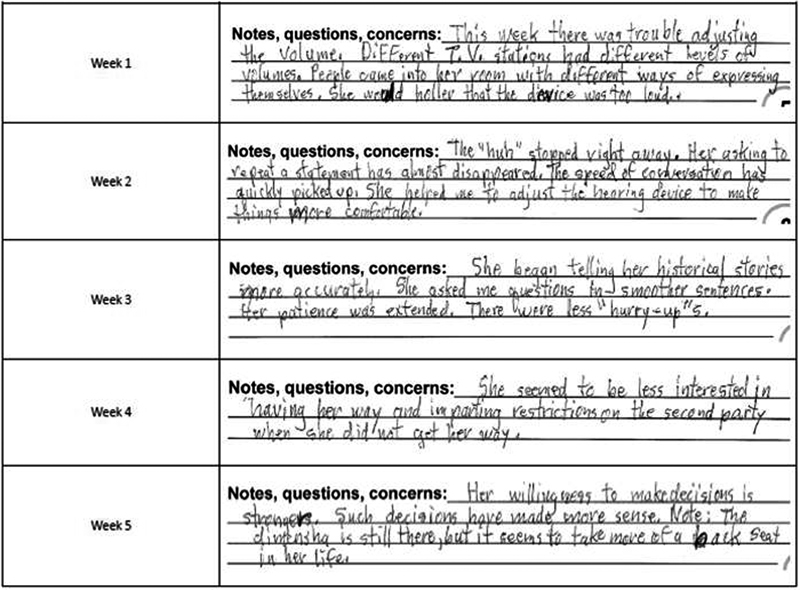
Exemplar feedback from the son-in-law of a 91-year-old woman with moderate dementia.
Program for All-Inclusive Care for the Elderly (PACE) Hears
The Memory HEARS project led to collaboration with the Johns Hopkins ElderPlus Program, which is one of 116 Program for All-Inclusive Care for the Elderly (PACE) sites across the country. This program serves adults who are eligible for nursing homes, but living in the community, and provides comprehensive care, including daily activities and meals at the Day Health Center. Using a similar approach to the Memory HEARS, we worked with professional staff at the Day Health Center to meet their specific communication needs with primary outcomes focused on participation/engagement among individuals with hearing loss and dementia.17
To modify the individualized Memory HEARS intervention, our research team spent time observing in the activity hall, hosting focus groups with professional care providers, and identifying individuals in need of hearing loss treatment with recreation and rehabilitation therapists as well as the medical team. In addition, air conduction thresholds were completed on nearly all Day Health Center attendees by the research audiologist (S.M.) and trained technicians to create a priority list (as well as a cerumen management list) for the on-site medical team. After going through this planning process in partnership with the care center, a three-component intervention was developed that addressed the acoustics in the activity hall, provided a staff training related to communication strategies and use of a non-custom amplifier, and provided target individuals with practice sessions using a non-custom amplifier. This intervention approach focused on the intrinsic (i.e., individual hearing loss) and extrinsic (i.e., physical and social environment) factors contributing to communication and participation in the Day Health Center, with a strong focus on tools that could be implemented by the professional care providers in a busy environment (i.e., communication strategies and non-custom amplifier use).
A Framework for Novel Care Approaches
The Verbrugge and Jette Disablement Model provides a conceptual framework from which to consider the intrinsic and extrinsic factors that contribute to disability.18 The model outlines the progression from pathology to impairment to functional limitation to disability with external risk factors and intra- and extraindividual factors that play on the person's condition. The group care intervention focused on modifiable characteristics of the individual and the environment that have the potential to improve function and participation in activities in a group care environment.19 Table 1 outlines the target factors and outcomes of a recent intervention undertaken in a group care setting for older adults. Specifically, the intervention aimed to facilitate communication and participation for older adults with age-related hearing loss and dementia in the group care environment.
Table 1. Intrinsic and Extrinsic Factors to Be Addressed in the Proposed Intervention to Improve Hearing and Communication for PACE Participants with Hearing Loss and Cognitive Impairment.
| Pathology | Impairment | Modify Intrinsic Factors | Modify Extrinsic Factors | Potential Outcomes (Reduce Disability) |
|---|---|---|---|---|
| Age-related hearing loss | Communication difficulties | • Use non-custom amplification devices | • Improve the SNR in the activity space • Train staff to use non-custom amplification devices |
• Hear conversations • Follow instructions • Attend to activities |
| Cognitive deficits | • Provide practice using non-custom amplification devices | • Reduce the background noise • Train staff to use successful communication strategies |
• Reduce dementia-related problem behaviors |
PACE, Program for All-Inclusive Care for the Elderly; SNR, signal-to-noise ratio.
The purpose of the Verbrugge-Jette model is to close the disability gap from both directions. Interventional audiology can be thought about in the same way. Rather than maximizing all efforts toward the best diagnostic services and hearing aid technology, efforts can be applied to both intrinsic and extrinsic factors to more effectively reduce disability. Depending on the variety of factors each individual/family has (for example, dementia and/or group care environment), treatment strategies can be modified accordingly. Importantly, especially when the individual has dementia, treatment options must be implementable by the individual, family caregivers, and professional care providers. Table 2 outlines four principles associated with implementation of an interventional audiology strategy for patients with dementia.
Table 2. Four Interventional Audiology Principles to Apply to Working with Patients with Dementia.
| Key Principles of Interventional Audiology for Persons with Dementia | |
|---|---|
| Go to the people. | The burden on families living with dementia is beyond what many of us can imagine. Trips to clinical visits rarely feel worth it. Embed your services at their primary care or geriatric care facility or within the home. |
| Perfect is the enemy of good. | The communication and behavioral challenges facing these families rarely require the best technology has to offer. Too many additional tools and costs adds stress to the situation. Ask what they want improved and figure out the easiest way to alleviate that problem. |
| Be part of the team. | Provide guidance, counsel, supervision to the geriatric and rehabilitation providers. Try not to add an extra layer of specialists to the family. Integrate your services into their larger care plan. |
| Support communication in the context of one's environment. | Keep it simple. What can the care providers, whether it's family, a home nurse aide, or a group care medical technician, handle on a daily basis? If all of the caretakers are not prepared to support whatever intervention you have provided, it is unlikely to be implemented at all. |
Summary
These issues are not new, but the time is ripe for change. Nearly 20 years ago, the Canadian Journal of Speech-Language Pathology and Audiology published a special issue on hearing and aging that highlighted four different programs that focused on an ecological model of care to meet the hearing care needs of underserved older adults.20 These projects, although not related to dementia specifically, focused on community-based and on-site audiological care that reached beyond the audiologist to include trained technicians, professional and family caregivers, and trained volunteers who also experienced age-related hearing loss. This is the essence of interventional audiology—meeting the needs of the community by harnessing the power from within the community.
With the rapidly aging population in the United States and around the world, the rising burden and costs of dementia are leading to a public health crisis.21 As evidenced by reports and calls to action by the National Academies of Sciences, Engineering, and Medicine and the Presidential Council of Advisors on Science and Technology, there is new interest among policy makers, industries, and public health experts to extend the reach of audiology services to the majority of older adults in need.22 23 Adults with dementia present a vulnerable subset of older adults that need unique approaches to meet the needs that are most important to them, their families, and care providers.
Audiologists cannot be everywhere. There will never be enough audiologists to provide personalized care to everyone in need of services. However, by integrating hearing services into care already being provided by other geriatric and rehabilitation specialists, we can create audiological services and tools that can be readily implemented in the field. Interventional audiology should be part of the integrated hearing services by extending services beyond the booth using simple approaches that are sustainable in the context of that person's environment.
Acknowledgments
The data collection efforts of Olivia Nirmalasari, Allison Simpson, Dona Occhipinti, Samantha Mayhew, Tess Gao, Alexandra Pletnikova, and Jon Suen are gratefully acknowledged. The work presented in this review was supported by the American Academy of Audiology (S.K.M.), the National Institutes of Health (NIH)/National Institute on Deafness and Other Communication Disorders K23DC011279 (F.R.L.), NIH/National Institute on Aging K23AG043504 (E.S.O.), the Roberts Fund (E.S.O.), the Ossoff Family Fund (E.S.O.), the Eleanor Schwartz Charitable Foundation (F.R.L., S.K.M.), Johns Hopkins Alzheimer's Disease Research Center P50AG005146 (F.R.L., S.K.M.). This publication was made possible, in part, by the Johns Hopkins Institute for Clinical and Translational Research (ICTR), which is funded in part by UL1TR001079 from the National Center for Advancing Translational Sciences (NCATS), a component of the NIH and NIH Roadmap for Medical Research. Its contents are solely the responsibility of the authors and do not necessarily represent the official view of the Johns Hopkins ICTR, NCATS, or NIH.
Footnotes
Financial Disclosures Dr. Mamo reports that meeting expenses were paid for by the Oticon Foundation. Dr. Lin reports being a consultant to Cochlear, on the scientific advisory board for Autifony and Pfizer, and a speaker for Med El and Amplifon.
References
- 1.Alzheimer's Association. 2016 Alzheimer's disease facts and figures Alzheimers Dement 2016124459–509. [DOI] [PubMed] [Google Scholar]
- 2.Benner M Steiner V Pierce L L Family caregivers' reports of hospitalizations and emergency department visits in community-dwelling individuals with dementia Dementia 20161.471301216653537E15[Epub ahead of print] [DOI] [PubMed] [Google Scholar]
- 3.Lyketsos C G, Carrillo M C, Ryan J M. et al. Neuropsychiatric symptoms in Alzheimer's disease. Alzheimers Dement. 2011;7(5):532–539. doi: 10.1016/j.jalz.2011.05.2410. [DOI] [PMC free article] [PubMed] [Google Scholar]
- 4.Gitlin L N, Kales H C, Lyketsos C G. Nonpharmacologic management of behavioral symptoms in dementia. JAMA. 2012;308(19):2020–2029. doi: 10.1001/jama.2012.36918. [DOI] [PMC free article] [PubMed] [Google Scholar]
- 5.Beeri M S, Werner P, Davidson M, Noy S. The cost of behavioral and psychological symptoms of dementia (BPSD) in community dwelling Alzheimer's disease patients. Int J Geriatr Psychiatry. 2002;17(5):403–408. doi: 10.1002/gps.490. [DOI] [PubMed] [Google Scholar]
- 6.Murman D L, Chen Q, Powell M C, Kuo S B, Bradley C J, Colenda C C. The incremental direct costs associated with behavioral symptoms in AD. Neurology. 2002;59(11):1721–1729. doi: 10.1212/01.wnl.0000036904.73393.e4. [DOI] [PubMed] [Google Scholar]
- 7.Fauth E B, Zarit S H, Femia E E, Hofer S M, Stephens M A. Behavioral and psychological symptoms of dementia and caregivers' stress appraisals: intra-individual stability and change over short-term observations. Aging Ment Health. 2006;10(6):563–573. doi: 10.1080/13607860600638107. [DOI] [PubMed] [Google Scholar]
- 8.Cohen-Mansfield J, Dakheel-Ali M, Marx M S, Thein K, Regier N G. Which unmet needs contribute to behavior problems in persons with advanced dementia? Psychiatry Res. 2015;228(1):59–64. doi: 10.1016/j.psychres.2015.03.043. [DOI] [PMC free article] [PubMed] [Google Scholar]
- 9.Cohen-Mansfield J. Nonpharmacologic interventions for inappropriate behaviors in dementia: a review, summary, and critique. Am J Geriatr Psychiatry. 2001;9(4):361–381. [PubMed] [Google Scholar]
- 10.Palmer C V, Adams S W, Bourgeois M, Durrant J, Rossi M. Reduction in caregiver-identified problem behaviors in patients with Alzheimer disease post-hearing-aid fitting. J Speech Lang Hear Res. 1999;42(2):312–328. doi: 10.1044/jslhr.4202.312. [DOI] [PubMed] [Google Scholar]
- 11.Cohen-Mansfield J, Taylor J W. Hearing aid use in nursing homes. Part 1: Prevalence rates of hearing impairment and hearing aid use. J Am Med Dir Assoc. 2004;5(5):283–288. [PubMed] [Google Scholar]
- 12.Cohen-Mansfield J, Infeld D L. Hearing aids for nursing home residents: current policy and future needs. Health Policy. 2006;79(1):49–56. doi: 10.1016/j.healthpol.2005.11.016. [DOI] [PubMed] [Google Scholar]
- 13.Cohen-Mansfield J, Taylor J W. Hearing aid use in nursing homes. Part 2: Barriers to effective utilization of hearing aids. J Am Med Dir Assoc. 2004;5(5):289–296. [PubMed] [Google Scholar]
- 14.Nirmalasari O, Mamo S K, Nieman C L. et al. Age-related hearing loss in older adults with cognitive impairment. Int Psychogeriatr. 2017;29(1):115–121. doi: 10.1017/S1041610216001459. [DOI] [PMC free article] [PubMed] [Google Scholar]
- 15.Nieman C L Marrone N Mamo S K et al. The Baltimore HEARS pilot study: an affordable, accessible, community-delivered hearing care intervention Gerontologist 2016 [Epub ahead of print] [DOI] [PMC free article] [PubMed]
- 16.Mamo S K, Nirmalasari O, Nieman C L. et al. Hearing care intervention for persons with dementia: a pilot study. Am J Geriatr Psychiatry. 2017;25(1):91–101. doi: 10.1016/j.jagp.2016.08.019. [DOI] [PMC free article] [PubMed] [Google Scholar]
- 17.Mamo S K Improving communication for persons with dementia. Paper presented at: Acoustics Week in Canada; September 21, 2016; Vancouver, Canada [Google Scholar]
- 18.Verbrugge L M, Jette A M. The disablement process. Soc Sci Med. 1994;38(1):1–14. doi: 10.1016/0277-9536(94)90294-1. [DOI] [PubMed] [Google Scholar]
- 19.Cohen-Mansfield J, Dakheel-Ali M, Marx M S. Engagement in persons with dementia: the concept and its measurement. Am J Geriatr Psychiatry. 2009;17(4):299–307. doi: 10.1097/JGP.0b013e31818f3a52. [DOI] [PMC free article] [PubMed] [Google Scholar]
- 20.Carson A J, Dillon L M. Being part of the solution: an epilogue commentary. CJSLPA. 1997;21(3):209–211. [Google Scholar]
- 21.Prince MW A Guerchet M Ali G C Wu Y T Prina M World Alzheimer Report 2015: The Global Impact of Dementia2015, London, UK: Alzheimer's Disease International [Google Scholar]
- 22.National Academies of Sciences, Engineering, and Medicine: Hearing Health Care for Adults: Priorities for Improving Access and Affordability 2016, Washington, DC: The National Academies Press; [PubMed] [Google Scholar]
- 23.President's Council of Advisors on Science and Technology. Aging America & Hearing Loss: Imperative of Improved Hearing Technologies 2015, Washington, DC: Executive Office of the President [Google Scholar]