



To the Editor
The occurrence of sex chromosome aneuploidy and fragile X syndrome in the same patient has been noted previously with several subjects having both Klinefelter and fragile X syndromes documented in the literature [Fryns et al., 1983; Deb et al., 1987; Fryns and Van den Berghe, 1988; Chudley, 1990; Kupke et al., 1991]. Additionally, two individuals with 46,XY/47,XYY mosaicism and fragile X syndrome [Bodurtha et al., 1993; Milunsky et al., 1993] and two patients with fragile X syndrome and 45,X/46,XX mosaicism [Shapiro et al., 1994] have been previously reported. Herein, we report the first case of a child with 45,X/46,XY mosaicism and the fragile X syndrome.
The proband was delivered at term to a 28-year-old gravida III para III woman. At birth, he weighed 4.1 kg (90th centile) and his length was 53.3 cm (90th centile). At age 4.5 years, he was referred for genetic evaluation due to developmental delay and a history of a maternal half-sister with fragile X syndrome. On physical examination, his weight, height, and head circumference were 97th, >97th, and 90th centiles, respectively. He had a long face with a prominent nose, large ears measuring 6 cm (90th centile), and a prominent jaw as seen in the fragile X syndrome (Fig. 1). He also had bilateral plantar creases between toes two and three. There was a single café-au-lait spot (3 cm ×4 cm) on his upper left thigh. He had hyperextensibility of the joints and loose skin on the dorsum of his hands. The testicular volume (2 ml) was normal for his age and the genital exam was unremarkable. He had self-injurious behavior manifested by skin picking. Other fragile X syndrome features included hyperactivity, developmental delay, hand flapping, and autistic behavior.
Fig. 1.
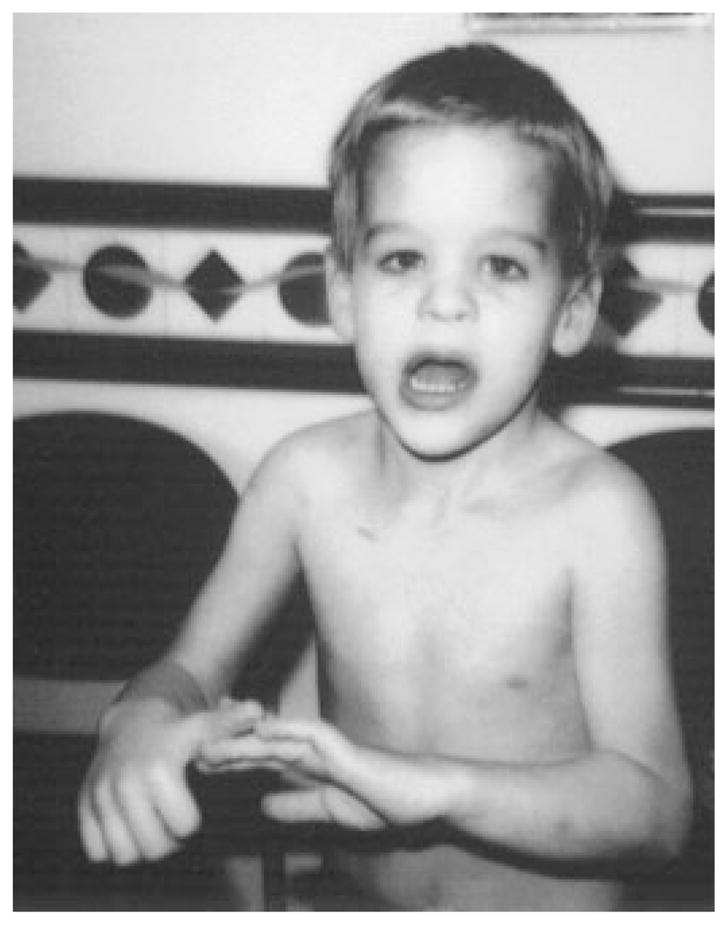
Frontal view of our subject with 45,X/46,XY mosaicism and fragile X syndrome at 4.5 years of age. Note the typical facial features and hand posturing seen in individuals with fragile X syndrome.
The family history was significant for developmental delay. The proband has three full siblings, two with delays (an older sister with learning disabilities and speech delay and a younger brother with developmental delay). As previously noted, there was a maternal half-sister diagnosed with the fragile X syndrome. The proband has three maternal uncles (one described as “slow” and tall). In addition, his maternal grandmother’s sister had four sons described as “slow”.
Routine chromosome analysis on the proband revealed mosaicism (45,X/46,XY). Eight percent of the meta-phase cells (4 of 50) were aneuploid. Routine fragile X molecular genetic testing identified a full mutation in the FMR1 gene. Due to low level of 45,X mosaicism, the features of fragile X syndrome were predominant. Fragile X testing on the mother and her other children was recommended. The family has elected to not pursue further genetic testing.
Based on previously reported subjects with fragile X syndrome and sex chromosome aneuploidy, it is possible that the presence of the FMR1 gene premutation may predispose to nondisjunction. Kupke et al. [1991] suggested this association based on Fryns and Van den Berghe’s [1988] observation of Klinefelter syndrome in 3 of 465 (1:155) males with the fragile X syndrome (a number substantially greater than the 1 in 1,000 incidence of Klinefelter syndrome in the general population). In addition, Milunsky et al. [1993] reported a child with 46,XY/47,XYY and the FMR1 mutation in both cell lines and raised the question of the FMR1 premutation predisposing to either meiotic or mitotic nondisjunction. At this time, unless additional subjects are reported with sex chromosome aneuploidy (both mosaic and nonmosaic) and the FMR1 mutation, we are unable to resolve this issue.
References
- Bodurtha J, Jackson-Cook C, Maddalena A, Piserchio J, Waller R. 46,XY/47,XYY mosaicism and fragile X. Clin Genet. 1993;44:109–110. doi: 10.1111/j.1399-0004.1993.tb03858.x. [DOI] [PubMed] [Google Scholar]
- Chudley A. Sex chromosomal and autosomal aneuploidy in the fragile X syndrome. Birth Defects Orig Artic Ser. 1990;26(4):257–265. [PubMed] [Google Scholar]
- Deb S, Cowie VA, Timberlake C. A case of mosaicism with fragile-X and XXY components. Br J Psychiatry. 1987;150:700–702. doi: 10.1192/bjp.150.5.700. [DOI] [PubMed] [Google Scholar]
- Fryns JP, Van den Berghe H. The concurrence of Klinefelter syndrome and fragile X syndrome. Am J Med Genet. 1988;30:109–113. doi: 10.1002/ajmg.1320300109. [DOI] [PubMed] [Google Scholar]
- Fryns JP, Kleczkowska A, Kubien E, Petit P, Haspeslagh M, Lindemans I, Van den Berghe H. XY/XXY mosaicism and fragile X syndrome. Ann Genet. 1983;26:251–253. [PubMed] [Google Scholar]
- Kupke KG, Soreng AL, Muller U. Origin of the supernumerary X chromosome in a patient with fragile X and Klinefelter syndrome. Am J Med Genet. 1991;38:440–444. doi: 10.1002/ajmg.1320380260. [DOI] [PubMed] [Google Scholar]
- Milunsky A, Huang X, Amos JA, Herskowitz J, Farrer LA, Wyandt HE. 46,XY/47,XYY male with the fragile X syndrome: cytogenetic and molecular studies. Am J Med Genet. 1993;45:589–593. doi: 10.1002/ajmg.1320450514. [DOI] [PubMed] [Google Scholar]
- Shapiro L, Simensen R, Wilmot P, Fisch G, Vibert B, Fenwick R, Tarleton J, Phelan M. Asymmetry of methylation with FMR-1 full mutation in two 45,X/46,XX mosaic females associated with normal intellect. Am J Med Genet. 1994;51:507–508. doi: 10.1002/ajmg.1320510443. [DOI] [PubMed] [Google Scholar]