



Abstract
Adaptive lifespan development involves individuals’ simultaneous coordination of motivational engagement across multiple domains of life. The present study tests this proposition using data from the Midlife in the United States National Longitudinal Study of Health and Well-Being (MIDUS I and II). Results from multilevel model analyses indicate that participants’ engagement with, perceived control over, and reported quality in the domains of work, health, and family relationships follow general trajectories across adulthood that reflect age-graded and socially structured opportunities. Participants’ engagement with each domain of life was associated with more positive reports of life quality and perceived control within these domains. These positive engagement benefits were least prominent in strongly age-graded domains (i.e., health), and most pronounced in less age-graded domains (i.e., work and family relationships). Results further indicate that individuals adaptively managed their engagement across these central domains of adulthood, in that cross-domain associations were positive or at least non-detrimental. While cross-domain engagement benefits were present across all four domains, they were most prominent in naturally facilitative pairings (e.g., relationships with one’s spouse/partner and children). Overall, the results provide support for the proposition of the motivational theory of life-span development that adaptive lifespan development involves individual’s active, simultaneous, and synchronous engagement with central domains of life.
Individuals actively contribute to their development across adulthood through their engagement with central domains of life. Opportunities for engagement within these life domains rise and fall in step with societal scaffolding and age-graded progressions (Heckhausen, 1999). Individuals’ potential to control their own development reflects and directs these societal and biological constraints, as well as their own agentic capacity. Adaptive development thus involves individuals’ capacity to channel their limited motivational resources toward synchronous engagement across multiple domains of life, which takes into account age-graded opportunities (Heckhausen, Wrosch & Schulz, 2010; Wiese, Freund & Baltes, 2000). How individuals adaptively manage their engagement across multiple domains of life remains an understudied area of adult development. The present study seeks to contribute to filling this gap by examining individuals’ engagement with central domains of adulthood, including work, health, and relationships with their children and with their spouse or partner, and the extent to which these engagements have positive within- and across-domain associations throughout adulthood.
Motivational Theory of Life-Span Development
According to our theoretical approach, goal engagement involves individual’s striving to control goal attainment (Heckhausen et al., 2010). These control strivings involve individual’s devotion of time, effort, skills and energy for goal pursuit (selective primary control striving), as well as internally directed volitional strategies such as enhancing the perceived value of and control over a pursued goal (selective secondary control striving). A third aspect of goal engagement involves individual’s procurement and utilization of external resources, such as someone else’s help (compensatory primary control striving). The motivational theory of life-span development further outlines specific propositions regarding how individuals’ adaptively devote motivational resources in their life, and in so doing influence their own development (Heckhausen et al., 2010). Of central interest to the present study is that (1) individuals’ striving to control their own development is beneficial, and (2) the beneficial outcomes of these strivings are dependent upon their fit with age-graded opportunities for development within a given domain, (3) individuals’ ability to adaptively manage inter-domain consequences, and (4) individuals’ synchronous activity across diverse and central domains of life.
Regarding the first two propositions, a consistent and growing body of research illustrates the beneficial effects of individual’s engagement with domains of life, including work (Converse, Pathak, Depaul-Haddock, Gotlib, & Merbedone, 2012; Haase, Heckhausen, & Köeller, 2009; Shane & Heckhausen, 2016), and health (Wrosch & Schulz, 2008; Wrosch, Schulz & Heckhausen, 2002). While these studies support the proposition that engagement is generally adaptive, a further line of research provides additional clarity by illustrating that engagement becomes adaptive when it matches individuals’ degree of control over goal attainment in work (Shane & Heckhausen, 2012), health (Hall, Chipperfield, Heckhausen, & Perry, 2010; Wrosch, Miller, Scheier & Brun de Pontet, 2007), child bearing (Heckhausen, Wrosch, & Fleeson, 2001) and seeking romantic partnership (Wrosch & Heckhausen, 1999).
Balancing Diversity and Inter-Domain Consequences
While broad support has been found for the benefits individuals generally experience through engagement with central domains of life, examination of individuals’ simultaneous engagement with central domains of life is more limited, with the exception of work-family spill-over and sequencing (Freund, Knecht & Wiese, 2014; Wiese et al., 2000; Wiese & Freund, 2000; Wiese & Salmela-Aro, 2008). Research has found a general shift in adults’ goal priority with age, from a focus on education and career goals through the transition to early adulthood, to career and family formation through young and mid-adulthood, and then to health and family in late adulthood (Nurmi, 1992; Heckhausen, 1997; Salmela-Aro, Aunola, & Nurmi, 2007; Settersten & Hägestad, 1996a, 1996b). These general patterns of goal priority reflect age-graded and societally scaffolded opportunities for goal attainment (Havighurst, 1948; Heckhausen, 1999; Neugarten, Moore & Lowe, 1965). Furthermore, these findings highlight the centrality of engagement with work, family relationships, and health domains for many adults’ development.
Of central interest to the current study is individuals’ simultaneous engagement across multiple domains of life. Ideally individuals should strive for synergy across their multiple domains of engagement, and in so doing simultaneously and adaptively develop across these domains (Heckhausen et al., 2010; Riediger & Freund, 2004; Sieber, 1974). However, cross-domain engagement can have facilitative or interfering effects. For example, in the work and family domains, research finds that the influence of cross-domain engagement is reciprocal and can be both positive and negative (Greenhaus & Powell, 2006; Grzywacz & Marks, 2005; Wiese & Salmela-Aro, 2008). Further clarification comes from research on how individuals choose and manage their motivational commitment (Fishbach, Friedman & Kruglanski, 2003; Fishbach & Shah, 2006; Riediger, Freund, & Baltes, 2005; Shah, Friedman & Kruglanski, 2002). In particular, individuals’ tendency to choose goals that enhance their capacity to achieve other important goals increases with age, which in turn allows individuals to more fully commit to these facilitative pursuits (Riediger et al., 2005). Furthermore, individuals demonstrate implicit tendencies toward engaging with long-term goals and avoiding non-facilitative goal pursuits (Fischbach et al., 2003; Fishbach & Shah, 2006; Shah et al., 2002).
Research Questions & Hypotheses
Collectively, the growing body of research described above suggests that individuals have the capacity to simultaneously manage engagement across multiple life-domains in a synergistic and adaptive manner. The present study seeks to add to the literature on inter-domain relations of engagement across adulthood by examining (1) age-graded patterns of individuals’ domain-specific engagement, and domain-specific situation quality and perceived control across adulthood, (2) associations between domain-specific engagement and situation quality and perceived control across adulthood, and (3) inter-domain consequences of engagement.
Based on previous theory and research (see discussion above), we expect that the degree of individuals’ engagement in the domains of work, health, and relationships with their partner/spouse and with their children will change across adulthood, with a shift from focus on work and relationships with family in young and mid-adulthood to health and relationships with family in late-adulthood (Hypothesis 1a). We further expect individuals’ partner/spouse relationship quality and perceived control to remain high across adulthood, individuals’ relationship quality with their children to remain high across adulthood but their perceived control over this relationship to decline across adulthood, individuals’ work-situation quality and perceived control to peak in mid-adulthood, and individuals’ health-situation quality and perceived control to decline across adulthood (Hypothesis 1b). Next, we expect individuals’ domain-specific engagement to be positively related with both their domain-specific situation quality and perceived control (Hypothesis 2). Finally, we expect individuals’ cross-domain engagement to have positive, or at least non-detrimental associations on the relationship between their domain-specific engagement and situation quality and perceived control across adulthood (Hypothesis 3).
Method
Participants and Procedure
Data comes from the Midlife in the United States National Longitudinal Study of Health and Well-Being (MIDUS) (Ryff et al., 2004). MIDUS is a U.S. nationally selected study of individuals across adulthood, with two assessments (MIDUS I, and MIDUS II) separated by an average of nine years. For the present analyses, observations were retained if individuals were over 25, had children, were married or cohabitating, and had complete data on their sex, age, educational attainment, household income, and current work status. As the present paper is focused on engagement across multiple goal domains, the sample was also restricted to participants who had complete data on the domain-specific engagement variables for work, children, partner/spouse, and health. The retained sample from MIDUS I (n = 3,705) had a mean age of 47.46 years (SD = 11.87), was 48.66% Female and 92.98% White, had an average household income of $85,009.99 (SD=62,921.36) with 61.35% reporting some post-secondary education and 63.05% currently working. The retained sample from MIDUS II (n = 2,464) had a mean age of 54.90 years (SD = 11.64), was 50.12% Female and 94.80% White, had an average household income of $83,598.42 (SD=61,162.09) with 66.92% reporting some post-secondary education and 55.24% currently working.
Data were analyzed using multilevel modeling, which allowed participants to contribute 1 or 2 observations to the analyzed dataset depending on whether they met the inclusion criteria described above. This resulted in analyzed samples ranging from 4,140 participants with 6,146 observations to 4,113 participants with 6,083 observations, depending on the outcome being examined.
Measures
Domain-specific engagement
For each domain (work, health, relationship with children, and relationship with partner or spouse), participants responded to the single-item, “Using a 0 to 10 scale where 0 means ‘no thought or effort’ and 10 means ‘very much thought and effort,’ how much thought and effort do you put into your (relevant domain) these days?”
Domain-specific situation quality
For each domain (work, health, relationship with children, and relationship with partner or spouse), participants responded to the single-item, “Using a scale from 0 to 10 where 0 means ‘the worst possible (domain-specific situation)’ and 10 means ‘the best possible (domain-specific situation),’ how would you rate your (domain-specific situation) these days?”
Domain-specific perceived control
For each domain (work, health, relationship with children, and relationship with partner or spouse), participants responded to the single-item, “Using a 0 to 10 scale where 0 means ‘no control at all’ and 10 means ‘very much control,’ how would you rate the amount of control you have over (relevant domain) these days?”
Domain-general engagement and disengagement tendency
Participants’ domain-general engagement tendency was assessed using the five-item Primary Control Persistence in Goal Striving subscale of the Primary and Secondary Control Scale (Wrosch, Heckhausen & Lachman, 2000) (example item, “I rarely give up on something I am doing, even when things get tough”) (α = .77). Participants’ domain-general disengagement tendency was assessed using the five-item Secondary Control Lowering Aspirations subscale of the Primary and Secondary Control Scale (example item, “When my expectations are not being met, I lower my expectations”) (α = .63). Participants indicated the extent to which each item represented themselves using a four-point scale with 1 = a lot and 4 = not at all. The measures were reverse coded so that positive values indicate stronger endorsement of domain-general engagement and disengagement tendency.
Demographic covariates
Participant’s age, sex, education, total household yearly income, and work status were included as covariates. Education was dichotomized so that 1 = some postsecondary education. Total household yearly income had 7 categories: (1) $0 – $10,000; (2) $10,001 – $25,000; (3) $25,001 – $45,000; (4) $45,001 – $75,000; (5) $75,001 – $115,000; (6) $115,001 – $175,000; (7) $175,001 – $300,000. Due to the limited amount of non-White participants, and the racial/ethnic diversity within the non-White participants, race/ethnicity was not used as a covariate in the models.
Analyses
Data were analyzed using multilevel modeling in Stata (Rabe-Hesketh & Skrondal, 2012). Participant’s survey responses (level 1), were nested within participants (level 2). As the assessments were separated by an average of nine years, and participant’s age ranged from 25 to 84 years of age, participant’s age was used as the time variable, resulting in 59 time points, with two observations being the most that any participant contributed to the analyses. All continuous independent variables were grand-mean centered, and age was centered at 25 years of age.
Multilevel models were built in a systematic progression, starting with an unconditional means model that allowed for the baseline calculation of within- and between-person variance. The Intraclass Correlation Coefficient (ICC) indicated that each dependent variable contained enough within-person variance to warrant the inclusion of a participant-specific random intercept in all subsequent models. Next, a series of unconditional growth models were run to find the most appropriate function of time (age), resulting in a cubic age function retained for all subsequent models. Random slopes were examined but not retained for subsequent models, as the random slopes were not reliably different from 0. The next set of models included the cubic age function, and main effects of the covariates (domain-general engagement tendency, domain-general disengagement tendency, sex, education, household income, work status) and the cross-domain engagement items (e.g., when predicting present work-situation quality, the cross-domain engagement items were engagement with partner/spouse, children, and health). The final model included the domain-specific engagement item, and the interaction between the domain-specific engagement item and all other covariates, cross-domain engagement items, and the cubic age function.
The models were run using robust standard errors (Huber, 1967; White, 1980). The bias-corrected bootstrapping approach was used to further examine the robustness of the results (Efron & Tibshirani, 1986), with 10,000 samples drawn with replacement while accounting for the clustered nature of the data.
Results
Descriptive Statistics
Summary statistics and inter-item correlations for domain-specific engagement, perceived control, and situation quality items are presented in Table 1. For ease of interpretation the statistics presented are collapsed across the two assessment time points.
Table 1.
Summary statistics and inter-item correlations.
| Mean (SD) | 1 | 2 | 3 | 4 | 5 | 6 | 7 | 8 | 9 | 10 | 11 | |
|---|---|---|---|---|---|---|---|---|---|---|---|---|
| (1) Work Engagement | 7.96 (2.20) | 1 | ||||||||||
| (2) Health Engagement | 7.30 (1.93) | .16* | 1 | |||||||||
| (3) Partner/Spouse Engagement | 8.22 (1.79) | .18* | .25* | 1 | ||||||||
| (4) Children Engagement | 8.50 (1.73) | .18* | .21* | .36* | 1 | |||||||
| (5) Quality of Work Situation | 7.56 (2.10) | .30* | .13* | .14* | .06* | 1 | ||||||
| (6) Quality of Health Situation | 7.50 (1.52) | .21* | .22* | .14* | .10* | .29* | 1 | |||||
| (7) Quality of Partner/Spouse Situation | 8.22 (1.84) | .09* | .13* | .55* | .13* | .21* | .16* | 1 | ||||
| (8) Quality of Children Situation | 8.66 (1.45) | .09* | .16* | .20* | .48* | .16* | .17* | .27* | 1 | |||
| (9) Perceived Control over Work Situation | 7.39 (2.50) | .30* | .12* | .13* | .07* | .65* | .23* | .18* | .14* | 1 | ||
| (10) Perceived Control over Health Situation | 7.75 (1.74) | .20* | .27* | .15* | .14* | .24* | .58* | .13* | .15* | .25* | 1 | |
| (11) Perceived Control over Partner/Spouse Situation | 7.93 (2.02) | .12* | .25* | .54* | .21* | .17* | .17* | .70* | .24* | .17* | .20* | 1 |
| (12) Perceived Control over Children Situation | 7.68 (2.30) | .12* | .06* | .14* | .47* | .07* | .13* | .12* | .50* | .08* | .16* | .24* |
Notes: Results collapsed across both assessment waves.
p < .05
Hypothesis Testing
Age-graded trajectories of domain-specific engagement, quality, and perceived control
Multilevel modeling using age as the time metric and without additional covariates included in the model were run for each domain-specific engagement, situation quality, and perceived control item. The results are depicted in Figure 1.
Figure 1.


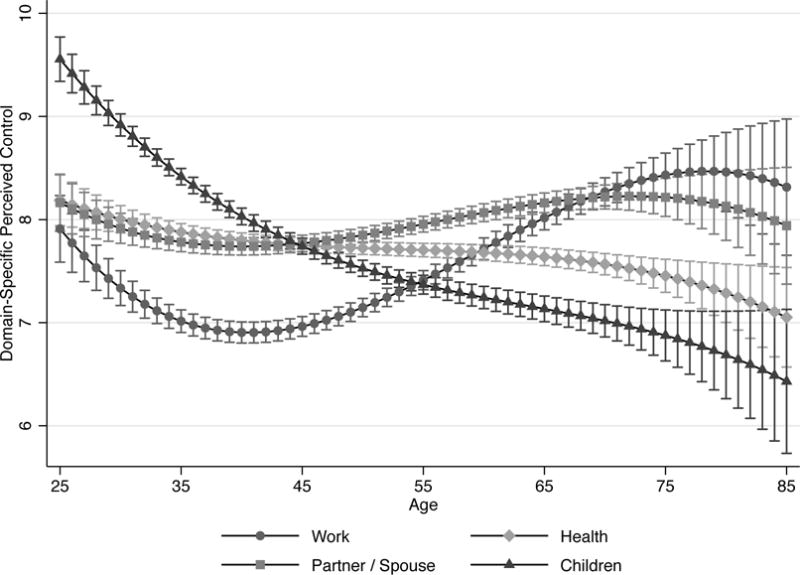
Results from multilevel modeling analyses depicting the association between age and domain-specific engagement, situation quality, and perceived control. Estimates and 95% confidence intervals of estimates presented.
As seen in Figure 1, individuals’ domain-specific engagement within the four domains of life examined followed the hypothesized pattern (Hypothesis 1a). Relationships with partner/spouse and with children remained relatively high across adulthood, and the gradual shift from engagement priority with work to engagement priority with health progressed as expected through mid-adulthood before crossing over around the typical age of retirement. Furthermore, consistent with Hypothesis 1b, the reported quality of individuals’ relationships with their partner/spouse and with their children remained high across adulthood, while individuals’ work-situation quality peaked in late-adulthood and their health-situation quality declined across adulthood. Regarding individuals’ perceived control, the results were similarly consistent with Hypothesis 1b. Participants’ perceived control over their relationship with their partner/spouse remained high across adulthood, their perceived control over their relationship with their children and their health declined throughout adulthood, while their perceived control over their work peaked slightly later than expected in late adulthood.
Associations between domain-specific engagement and domain-specific situation quality and perceived control across adulthood
Results from the final multilevel model predicting individuals’ domain-specific situation quality and perceived control are presented in Tables 2 and 3, and depicted in Figures 2 and 3. The results presented were replicated using bias-corrected bootstrapping of the coefficients and confidence intervals.
Table 2.
Multilevel modeling results for the final models predicting self-reported situation quality in the domains of work, partner/spouse relationship, children relationship, and health.
| Domain-Specific Situation
Quality |
||||
|---|---|---|---|---|
| Work | Partner/Spouse | Children | Health | |
| Intercept | 7.50 [7.21, 7.80] | 8.02 [7.75, 8.28] | 8.98 [8.77, 9.19] | 7.40 [7.18, 7.61] |
| Age | −.10 [−.14, −.07]* | −.03 [−.06, .00] | −.09 [−.12, −.07]* | −.05 [−.07, −.02]* |
| Age2 | .00 [.00, .01]* | .00 [.00, .00]* | .00 [.00, .00]* | .00 [.00, .00]* |
| Age3 | −.00 [−.00, −.00]* | −.00 [−.00, .00] | −.00 [−.00, −.00]* | −.00 [−.00, −.00]* |
| Domain-Specific Engagement | .36 [.16, .56]* | .46 [.27, .65]* | .59 [.40, .78]* | .19 [.07, .31]* |
| X Age | .01 [−.01, .04] | .02 [−.00, .04] | −.00 [−.02, .02] | .00 [−.01, .02] |
| X Age2 | −.00 [−.00, .00] | −.00 [0.00, .00] | −.00 [−.00, .00] | −.00 [−.00, .00] |
| X Age3 | .00 [−.00, .00] | .00 [−.00, .00] | .00 [−.00, .00] | .00 [−.00, .00] |
| X Work Engagement | .00 [−.01, .01] | .02 [.00, .03]* | .01 [−.00, .02] | |
| X Partner Engagement | .01 [−.01, .03] | .03 [.01, .04]* | −.00 [−.02, .01] | |
| X Children Engagement | .02 [.00, .05]* | .03 [.02, .05]* | .01 [−.01, .02] | |
| X Health Engagement | .00 [−.01, .02] | .02 [.00, .04]* | .02 [.00, .03]* | |
| X Domain-General Engagement | −.02 [−.09, .04] | −.02 [−.08, .04] | −.03 [−.08, .02] | .03 [−.01, .07] |
| X Domain-General Disengagement | .01 [−.05, .07] | .03 [−.04, .09] | .04 [−.01, .10] | .04 [.01, .08]* |
| X Male | .04 [−.03, .12] | −.03 [−.10, .03] | .09 [.02, .15]* | −.05 [−.09, −.00]* |
| X Postsecondary education | −.11 [−.18, −.03]* | .03 [−.04, .10] | −.10 [−.16, −.03]* | −.03 [−.08, .01] |
| X Household Income | −.01 [−.03, .02] | −.02 [−.04, .01] | .00 [−.02, .02] | −.00 [−.02, .01] |
| X Working | −.02 [−.09, .06] | .03 [−.04, .10] | −.06 [−.12, .01] | −.01 [−.05, .04] |
| Work Engagement | .01 [−.01, .03] | .01 [−.00, .03] | .07 [.05, .09]* | |
| Partner Engagement | .08 [.04, .11]* | .01 [−.01, .03] | .04 [.01, .06]* | |
| Children Engagement | −.01 [−.04, .02] | −.00 [−.03, .03] | .01 [−.01, .04] | |
| Health Engagement | .02 [−.01, .05] | −.02 [−.04, −.00] | .01 [−.01, .03] | |
| Domain-General Engagement | .27 [.17, .37]* | .22 [.14, .29]* | .16 [.10, .22]* | .41 [.34, .49]* |
| Domain-General Disengagement | −.18 [−.28, −.08]* | −.12 [−.19, −.04]* | −.03 [−.09, .03] | −.13 [−.19, −.06]* |
| Male | −.30 [−.41, −.19]* | .26 [.17, .35]* | −.04 [−.11, .04] | .01 [−.08, .09] |
| Postsecondary education | .26 [.15, .38]* | −.07 [−.16, .02] | .05 [−.02, .12] | .19 [.10, .27]* |
| Household Income | .10 [.06, .13]* | .00 [−.02, .03] | −.00 [−.03, .02] | .07 [.04, .09]* |
| Working | −.18 [−.30, −.05]* | −.09 [−.18, −.00]* | .05 [−.03, .12] | .15 [.07, .23]* |
| Variance Components | ||||
| Between-Person | .77 [.59, .99] | .89 [.76, 1.06] | .55 [.45, .67] | 1.00 [.89, 1.12] |
| Within-Person | 2.92 [2.70, 3.16] | 1.34 [1.19, 1.51] | .93 [.85, 1.03] | 1.04 [.95, 1.13] |
| Sample | ||||
| Participants (Observations) | 4113 (6083) | 4138 (6141) | 4127 (6122) | 4135 (6140) |
Notes: Unstandardized coefficients and 95% confidence intervals of coefficients presented.
p < .05
Table 3.
Multilevel modeling results for the final models predicting self-reported perceived control in the domains of work, partner/spouse relationship, children relationship, and health.
| Domain-Specific Perceived
Control |
||||
|---|---|---|---|---|
| Work | Partner/Spouse | Children | Health | |
| Intercept | 8.05 [7.72, 8.38] | 7.82 [7.54, 8.10] | 8.93 [8.64, 9.21] | 7.84 [7.57, 8.11] |
| Age | −.12 [−.16, −.08]* | −.03 [−.06, .00] | −.13 [−.16, −.09]* | −.05 [−.08, −.02]* |
| Age2 | .00 [.00, .01]* | .00 [.00, .00]* | .00 [.00, .00]* | .00 [−.00, .00] |
| Age3 | −.00 [−.00, −.00] | −.00 [−.00, .00] | −.00 [−.00, −.00]* | −.00 [−.00, .00] |
| Domain-Specific Engagement | .51 [.30, .71]* | .36 [.18, .55]* | .58 [.36, .80]* | .22 [.08, .36]* |
| X Age | .02 [−.00, .05] | .04 [.02, .06]* | .04 [.01, .06]* | .00 [−.02, .02] |
| X Age2 | −.00 [−.00, −.00]* | −.00 [−.00, −.00]* | −.00 [−.00, −.00]* | .00 [−.00, .00] |
| X Age3 | .00 [.00, .00]* | .00 [.00, .00]* | .00 [.00, .00]* | −.00 [−.00, .00] |
| X Work Engagement | .01 [−.01, .03] | .01 [−.01, .02] | .02 [.01, .03]* | |
| X Partner Engagement | .02 [.00, .04]* | .04 [.02, .07]* | −.00 [−.02, .01] | |
| X Children Engagement | .00 [−.02, .02] | .03 [.01, .05]* | .00 [−.01, .02] | |
| X Health Engagement | .01 [−.01, .03] | .02 [.00, .04]* | .02 [−.00, .04] | |
| X Domain-General Engagement | −.07 [−.14, .00] | .00 [−.06, .07] | −.03 [−.10, .04] | .02 [−.03, .07] |
| X Domain-General Disengagement | .03 [−.04, .10] | −.02 [−.08, .04] | .09 [.02, .15]* | .05 [.01, .09]* |
| X Male | −.01 [−.09, .07] | .03 [−.04, .10] | .02 [−.06, .11] | −.00 [−.05, .05] |
| X Postsecondary education | −.18 [−.26, −.09]* | .02 [−.06, .09] | −.16 [−.24, −.07]* | −.01 [−.07, .04] |
| X Household Income | −.02 [−.05, .01] | −.02 [−.05, .00] | −.02 [−.04, .01] | −.02 [−.03, .00] |
| X Working | .00 [−.08, .09] | −.01 [−.08, .06] | −.07 [−.15, .02] | .02 [−.03, .08] |
| Work Engagement | .01 [−.01, .03] | .02 [−.01, .05] | .08 [.05, .10]* | |
| Partner Engagement | .05 [.01, .08]* | −.01 [−.04, .03] | .05 [.02, .08]* | |
| Children Engagement | −.00 [−.04, .04] | .05 [.02, .09]* | .03 [.00, .06]* | |
| Health Engagement | .00 [−.03, .04] | .01 [−.02, .03] | .00 [−.03, .03] | |
| Domain-General Engagement | .49 [.37, .61]* | .23 [.14, .31]* | .16 [.06, .26]* | .39 [.30, .48]* |
| Domain-General Disengagement | −.32 [−.43, −.21]* | −.16 [−.25, −.08]* | −.13 [−.23, −.04]* | −.11 [−.19, −.03]* |
| Male | −.17 [−.29, −.04]* | .12 [.02, .21]* | .24 [.13, .36]* | .06 [−.04, .15] |
| Postsecondary education | .20 [.07, .33]* | −.08 [−.18, .01] | .10 [−.02, .21] | .12 [.03, .22]* |
| Household Income | .08 [.04, .12]* | .02 [−.01, .05] | −.01 [−.05, .03] | .06 [.02, .09]* |
| Working | −.97 [−1.10, −.83] | .10 [.00, .20]* | .16 [.05, .27]* | .18 [.08, .27]* |
| Variance Components | ||||
| Between-Person | 1.22 [.96, 1.54] | .81 [.67, .99] | 1.04 [.83, 1.31] | .85 [.71, 1.01] |
| Within-Person | 3.73 [3.44, 4.05] | 2.01 [1.84, 2.20] | 2.78 [2.53, 3.05] | 1.76 [1.61, 1.91] |
| Sample | ||||
| Participants (Observations) | 4134 (6142) | 4140 (6146) | 4135 (6140) | 4138 (6146) |
Notes: Unstandardized coefficients and 95% confidence intervals of coefficients presented.
p < .05
Figure 2.

Results from multilevel modeling analyses depicting the association between domain-specific engagement and domain-specific situation quality across adulthood. Estimates and 95% confidence intervals of estimates presented.
Figure 3.

Results from multilevel modeling analyses depicting the association between domain-specific engagement and domain-specific perceived control across adulthood. Estimates and 95% confidence intervals of estimates presented.
Domain-specific situation quality
As shown in Table 2 and depicted in Figure 2, support for Hypothesis 2 was found in that participants’ domain-specific engagement was significantly positively associated with their domain-specific situation quality. After accounting for the other covariates, participants’ work-engagement had a significant positive main-effect association with the quality of their work situation (β = .36, 95% CI [.16, .56], p < .001), participants’ partner/spouse engagement had a significant positive main-effect association with the quality of their relationship with their partner/spouse (β = .46, 95% CI [.27, .65], p < .001), participants’ children engagement had a significant positive main-effect association with the quality of their relationship with their children (β = .59, 95% CI [.40, .78], p < .001), and participants’ health engagement had a significant positive main-effect association with the quality of their health situation (β = .19, 95% CI [.07, .31], p = .001).
Domain-specific perceived control
As shown in Table 3 and depicted in Figure 3, support for Hypothesis 2 was found in that participants’ domain-specific engagement was significantly positively associated with their domain-specific perceived control. After accounting for the other covariates, participants’ work-engagement had a significant positive main-effect association with perceived control over their work situation (β = .51, 95% CI [.30, .71], p < .001), participants’ partner/spouse engagement had a significant positive main-effect association with perceived control over their relationship with their partner/spouse (β = .36, 95% CI [.18, .55], p < .001), participants’ children engagement had a significant positive main-effect association with perceived control over their relationship with their children (β = .58, 95% CI [.36, .80], p < .001), and participants’ health engagement had a significant positive main-effect association with perceived control over their health situation (β = .22, 95% CI [.08, .36], p = .001).
Inter-domain consequences of engagement
As shown in Tables 2 and 3, the results support Hypothesis 3 in that participants’ inter-domain engagement had a generally positive or non-detrimental moderating effect on the relationship between their domain-specific engagement and their domain-specific situation quality and perceived control. Indeed, all significant inter-domain moderating effects were positive. The nature of these significant interactions is that inter-domain moderation effects enhanced the positive associations between high levels of participants’ domain-specific engagement and their domain-specific situation quality and perceived control.
Specifically, participants’ work engagement enhanced the positive associations between their children engagement and the quality of their relationship with their children (β = .02, 95% CI [.00, .03], p = .013), and health engagement and perceived control over health situation (β = .02, 95% CI [.01, .03], p = .003). Participants’ partner/spouse engagement enhanced the positive associations between their work engagement and perceived control over their work situation (β = .02, 95% CI [.00, .04], p = .042), and children engagement and the quality of their relationship with their children (β = .03, 95% CI [.01, .04], p = .004) and perceived control over their relationship with their children (β = .04, 95% CI [.02, .07], p < .001). Participants’ health engagement enhanced the positive associations between their partner/spouse engagement and the quality of their relationship with their partner/spouse (β = .02, 95% CI [.00, .04], p = .011) and perceived control over their relationship with their partner/spouse (β = .02, 95% CI [.00, .04], p = .040), and between their children engagement and the quality of their relationship with their children (β = .02, 95% CI [.00, .03], p = .010). Participants’ children engagement enhanced the positive associations between their work engagement and work-situation quality (β = .02, 95% CI [.00, .05], p = .022), and between their partner/spouse engagement and the quality of their relationship with their partner/spouse (β = .03, 95% CI [.02, .05], p < .001) and perceived control over their relationship with their partner/spouse (β = .03, 95% CI [.01, .05], p = .004).
Further support for Hypothesis 3 comes in the form of the main effects of inter-domain engagement on alternate-domain present and expected situation quality. Similar to the moderating effects discussed above, the main-effects were consistently positive or non-significant. Collectively, the results provide strong support for Hypothesis 3, and indicate that participants who are actively engaged across multiple-domains reported positive benefits of this diverse and simultaneous engagement profile.
Discussion
Individuals’ ability to manage their engagement across multiple domains of life is a central mechanism through which they actively contribute to their development across adulthood. The results of the present study illustrate that individuals who have reasons to engage in central life domains (i.e., have children, are married/cohabitating) generally manage their engagement across these life domains in a synergistic and facilitative manner. Furthermore, the priority that individuals give toward engagement within these domains and the benefits of these engagements show patterns consistent with broader developmental ecology factors related to societal expectations and age. Collectively, the results demonstrate that individuals’ can actively and positively contribute to their own development through simultaneous and synergistic engagement with multiple domains of life.
Age-Graded Trajectories of Domain-Specific Engagement, Quality, and Perceived Control
Consistent with prior research examining individuals’ life goals across adulthood (Nurmi, 1992; Salmela-Aro et al., 2007; Settersten & Hägestad, 1996a, 1996b), the present study finds that individuals’ engagement with work, health, and family relationships generally coincides with shifting developmental priorities and opportunities (Havighurst, 1948; Heckhausen, 1999; Neugarten et al., 1965) as they age through adulthood. More specifically, we find that for individuals who have a significant romantic relationship and have children, their engagement with these family relationships retains a central route of engagement expenditure throughout adulthood. Coinciding with these engagement profiles, individuals’ consistently reported high levels of quality with their relationships with their children and quality and perceived control with their relationship with their partner/spouse across adulthood, despite the age-graded progressive loss of perceived control over their relationships with their children.
In line with prior research and theory on work competence and motivation throughout adulthood (Heckhausen, Shane & Kanfer, in press; Kanfer & Ackerman, 2004; Kanfer, Beier & Ackerman, 2013), we find that individuals’ engagement with work peaks roughly two to three decades prior to where perceived work-situation quality and control peaks (see Figure 1). Turning to the health domain, we find a different pattern: Individuals’ reported engagement with their health ramps up across adulthood. Given that health is an indispensible resource for primary control (Heckhausen, Wrosch, & Schulz, 2013; Schulz & Heckhausen, 1996), this increased engagement may stem in part from a need to counteract deteriorating health quality and diminishing control over health.
Within- and Between-Domain Engagement Benefits
Central to the present paper is an investigation of whether individuals’ engagement in a given domain is associated with benefits within that domain, and whether it is facilitative or inhibitive of benefits in other domains. In line with expectations and with motivational and life-span developmental theory and research (see Heckhausen et al., 2010), we find that individuals’ striving for control over their development through the investment of their thought and effort in central domains of adulthood is positively associated with reported quality and perceived control within these domains of work, family relationships, and health.
The general strength of the association between domain engagement and domain quality and control varies substantially across domains and across adulthood. Regarding work and children, we find that the engagement-benefit relationships are generally more prevalent throughout young and mid-adulthood, coinciding with declining opportunities for engagement with these domains at increased ages in the lifespan. For partner/spouse, we find that the engagement-benefit relationships are consistently positive throughout the lifespan, illustrating the greater permanence of opportunity within a pair-bonded relationship regardless of age. For health, we find a small but significant engagement-benefit relationship that is most prevalent through midlife, perhaps due to the general lack of health problems in young adulthood and the increased prevalence of health problems in late adulthood, both of which taken together render midlife a prominent time for preventative health engagement.
While simultaneous engagement across multiple life domains presents sources of conflict and interference, our results are consistent with lifespan developmental theory that stresses individuals’ general capacity to manage these multiple engagements in a synergistic and adaptive manner (Heckhausen et al., 2010; Riediger & Freund, 2004; Sieber, 1974). In particular, our findings are consistent with the motivational theory of life-span development (Heckhausen et al., 2010) propositions that individuals strive to maintain diversity of goal pursuit across important life domains, and to coordinate these multiple engagements so that they facilitate one another. In all domains examined, cross-domain engagements had a positive or non-detrimental effect on the relationship between individuals’ domain-specific engagement and domain-specific quality or perceived control. However, the most beneficial effects of cross-domain engagement appear in naturally facilitative combinations. For example, engagement with one’s partner/spouse enhanced the benefits of engagement with one’s children and visa versa, and engagement with one’s health enhanced the benefits of engagement with one’s partner/spouse. Thus, adaptive development across adulthood involves individuals’ coordinated attempts to simultaneously engage with and develop within multiple domains of life, and individuals demonstrate the ability to do so synergistically with cross-domain engagements facilitating engagement-benefit relationships in other central domains of life, particularly in domains that are naturally associated (e.g., child and partner relations).
Of course these benefits of multi-domain engagement also imply that this study did not capture individuals experiencing excessive demands on their resources, as may be the case when multiple domains pose high challenges simultaneously. With excessive demands individuals would be pushed to enhance their selectivity of engagement to deal with only as much as they can handle at a given time. In line with this, we find that individuals’ engagement produced the weakest benefit in the health domain, perhaps reflecting the strong age-graded constraints that contribute to deteriorating health across adulthood and the need to engage with health when one’s health is deteriorating. However, our findings indicate that in less age-graded domains, individuals with demographic characteristics associated with greater constraints reported greater benefit of engagement within that domain. For example, individuals without postsecondary education reported greater work-related benefits from their engagement with their work situation, and males reported greater children-related benefits from their engagement with their children. Thus, in situations where institutional, social structural or age-normative opportunities are not canalizing growth, individuals benefit from creating opportunities via their own engagement.
Limitations
Despite the relatively large sample analyzed in the present study, the study is limited by the sample being overwhelmingly of White ethnicity, and skewed towards upper-middle class residents of the United States. These sample characteristics limit the generalizability of the study findings, and it remains to be seen if similar patterns would be observed in different societies, or with people from more diverse ethnic and socioeconomic backgrounds. Furthermore, the analyzed sample was restricted to individuals who had a child and were currently married or cohabitating. Thus, the sample includes individuals who had a reason to be engaged in multiple domains and may contain more individuals who are better at managing engagement across multiple domains. Moreover, the results are main effects that are averaged across all subjects in the sample, so potential subgroups of people who are selectively engaged in a given domain at the expense of other domains cannot be identified by the present analyses.
While having participants who ranged in age from 25 to 84 years strengthens the present study, the longitudinal study is limited by having only two assessments separated by roughly nine years. Thus, intra-individual differences are partly masked, and causality cannot be meaningfully examined. This was partly compensated for by using age as the time variable in a multilevel modeling approach that separated between- and within-person variance, and using theoretically grounded justification for variable ordering. However, future research is needed to fully examine causality, how the patterns observed in the present study develop throughout an individual’s lifespan, and to see if the patterns observed vary in a systematic way at different ages in the lifespan. A further limitation of the present study is a reliance on single-item measures. In particular, although the measure of engagement used in the MIDUS does reflect central components of engagement (i.e., thought and effort investment) it does not reflect a focus on a goal, but merely on a broad domain of life. While broad life domains require constant basic engagement, goals in different domains probably may be best pursued if prioritized one at a time.
Conclusion
Individuals actively direct their development across adulthood through their simultaneous and coordinated engagement across central domains of life. The present study finds that individuals not only tend to be highly engaged with family, health, and work domains across adulthood, but also do so in a synergistic way whereby high levels of engagement with other domains of life enhance within-domain engagement benefits.
Future research with more diverse goal pursuits is needed to fully understand the mechanisms that allow people to be more or less successful in managing their inter-domain and inter-goal engagements in various ways. Among these adaptive ways is the pattern we found here, synchronous and mutually facilitative. Other patterns, such as sequential and selective, may be more suitable when individuals’ resources are exhausted, they are trying to achieve something extraordinary (e.g., a world-class excellence), or catch up at an off-time with a missed opportunity (e.g., attend college in midlife). In line with this, future research that explicitly examines constraints to engagement and individual’s motivational response to these constraints across domains and across adulthood would help highlight why and when motivational synchronization or sequencing across goal domains is most beneficial. In this context, future research needs to investigate the role of conscious and deliberate planning as captured in the optimization heuristics addressing cross-domain and short-term/long-term benefits and costs. Such conscious deliberations on the part of the individual agent are all the more needed the less development and life-course progress is canalized by societal institutions and structures (Heckhausen, 1999; Heckhausen, Shane, & Kanfer, in press).
Contributor Information
Jacob Shane, Brooklyn College, The City University of New York.
Jutta Heckhausen, University of California, Irvine.
References
- Converse PD, Pathak J, DePaul-Haddock AM, Gotlib T, Merbedone M. Controlling your environment and yourself: Implications for career success. Journal of Vocational Behavior. 2012;80:148–159. http://dx.doi.org/10.1016/j.jvb.2011.07.003. [Google Scholar]
- Efron B, Tibshirani R. Bootstrap methods for standard errors, confidence intervals, and other measures of statistical accuracy. Statistical Science. 1986;1:54–75. http://dx.doi.org/10.1214/ss/1177013817. [Google Scholar]
- Fishbach A, Friedman RS, Kruglanski AW. Leading us not unto temptation: Momentary allurements elicit overriding goal activation. Journal of Personality and Social Psychology. 2003;84:296–309. http://dx.doi.org/10.1037/0022-3514.84.2.296. [PubMed] [Google Scholar]
- Fishbach A, Shah JY. Self-control in action: Implicit dispositions toward goals and away from temptations. Journal of Personality and Social Psychology. 2006;90:820–832. doi: 10.1037/0022-3514.90.5.820. http://dx.doi.org/10.1037/0022-3514.84.2.296. [DOI] [PubMed] [Google Scholar]
- Freund AM, Knecht M, Wiese BS. Multi-domain engagement and self-reported psychosomatic symptoms in middle-aged women and men. Gerontology. 2014;60:255–262. doi: 10.1159/000358756. http://dx.doi.org/10.1159/000358756. [DOI] [PubMed] [Google Scholar]
- Greenhaus JH, Powell GM. When work and family are allies: A theory of work–family enrichment. Academy of Management Review. 2006;31:72–92. http://dx.doi.org/10.1159/000358756. [Google Scholar]
- Grzywacz JG, Marks NF. Reconceptualizing the work–family interface: An ecological perspective on the correlates of positive and negative spillover between work and family. Journal of Occupational Health Psychology. 2005;5:111–126. doi: 10.1037//1076-8998.5.1.111. http://dx.doi.org/10.1037/1076-8998.5.1.111. [DOI] [PubMed] [Google Scholar]
- Haase C, Heckhausen J, Köller O. Goal engagement during the school–work transition: Beneficial for all, particularly for girls. Journal of Research on Adolescence. 2008;18:671–698. http://dx.doi.org/10.1111/j.1532-7795.2008.00576.x. [Google Scholar]
- Hall NC, Chipperfield JG, Heckhausen J, Perry RP. Control striving in older adults with serious health problems: A 9-year longitudinal study of survival, health, and well-being. Psychology and Aging. 2010;25:432–445. doi: 10.1037/a0019278. http://dx.doi.org/10.1037/a0019278. [DOI] [PubMed] [Google Scholar]
- Havighurst RJ. Developmental tasks and education. Chicago, IL: University of Chicago Press; 1948. [Google Scholar]
- Heckhausen J. Developmental regulation across adulthood: Primary and secondary control of age-related challenges. Developmental Psychology. 1997;33:176–187. doi: 10.1037//0012-1649.33.1.176. http://dx.doi.org/10.1037/0012-1649.33.1.176. [DOI] [PubMed] [Google Scholar]
- Heckhausen J. Developmental regulation in adulthood: Age-normative and sociostructural constraints as adaptive challenges. Cambridge, England: Cambridge University Press; 1999. [Google Scholar]
- Heckhausen J, Shane J, Kanfer R. Competence and motivation at work throughout adulthood: Making the most of changing capacities and opportunities. In: Elliot A, Dweck CS, Yeager D, editors. Handbook of Competence and Motivation: Theory and Application. 2nd. New York, NY: Guilford Press; in press. [Google Scholar]
- Heckhausen J, Wrosch C, Fleeson W. Developmental regulation before and after a developmental deadline: The sample case of “biological clock” for child-bearing. Psychology and Aging. 2001;16:400–413. doi: 10.1037//0882-7974.16.3.400. http://dx.doi.org/10.1037/0882-7974.16.3.400. [DOI] [PubMed] [Google Scholar]
- Heckhausen J, Wrosch C, Schulz R. A motivational theory of life-span development. Psychological Review. 2010;117:32–60. doi: 10.1037/a0017668. http://dx.doi.org/10.1037/a0017668. [DOI] [PMC free article] [PubMed] [Google Scholar]
- Heckhausen J, Wrosch C, Schulz R. A lines-of-defense model for managing health threats. Gerontology. 2013;59:438–447. doi: 10.1159/000351269. http://dx.doi.org/10.1159/000351269. [DOI] [PMC free article] [PubMed] [Google Scholar]
- Huber PJ. Proceedings of the Fifth Berkeley Symposium on Mathematical Statistics and Probability. Vol. 1. Berkeley, CA: University of California Press; 1967. The behavior of maximum likelihood estimates under nonstandard conditions; pp. 221–233. [Google Scholar]
- Kanfer R, Ackerman PL. Aging, adult development, and work motivation. The Academy of Management Review. 2004;29(3):440–458. http://dx.doi.org/10.2307/20159053. [Google Scholar]
- Kanfer R, Beier ME, Ackerman PL. Goals and motivation related to work in later adulthood: An organizing framework. European Journal of Work and Organizational Psychology. 2013;22(3):253–264. http://dx.doi.org/10.1080/1359432x.2012.734298. [Google Scholar]
- Neugarten BL, Moore JW, Lowe JC. Age norms, age constraints, and adult socialization. The American Journal of Sociology. 1965;70(6):710–717. doi: 10.1086/223965. http://dx.doi.org/10.1086/223965. [DOI] [PubMed] [Google Scholar]
- Nurmi JE. Age differences in adult life goals, concerns, and their temporal extension: A life course approach to future-oriented motivation. International Journal of Behavioral Development. 1992;15(4):487–508. http://dx.doi.org/10.1177/016502549201500404. [Google Scholar]
- Rabe-Hesketh S, Skrondal A. Multilevel and longitudinal modeling using Stata: Volume 1: Continuous responses. 3rd. College Station, Texas: Stata Press; 2012. [Google Scholar]
- Riediger M, Freund AM. Interference and facilitation among personal goals: Differential associations with subjective well-being and persistent goal pursuit. Personality and Social Psychology Bulletin. 2004;30:1511–1523. doi: 10.1177/0146167204271184. http://dx.doi.org/10.1177/0146167204271184. [DOI] [PubMed] [Google Scholar]
- Riediger M, Freund AM, Baltes PB. Managing life through personal goals: Intergoal facilitation and intensity of goal pursuit in younger and older adulthood. Journal of Gerontology Series B: Psychological Sciences and Social Sciences. 2005;60:84–91. doi: 10.1093/geronb/60.2.p84. http://dx.doi.org/10.1093/geronb/60.2.p84. [DOI] [PubMed] [Google Scholar]
- Ryff C, Almeida DM, Ayanian JS, Carr DS, Cleary PD, Coe C, Davidson R, Krueger RF, Lachman ME, Marks NF, Mroczek DK, Seeman T, Seltzer MM, Singer BH, Sloan RP, Tun PA, Weinstein M, Williams D. National Survey of Midlife Development in the United States (MIDUS II) Ann Arbor, MI: Inter-University Consortium for Political and Social Research [distributor]; 2004. http://dx.doi.org/10.3886/icpsr04652. [Google Scholar]
- Salmela-Aro K, Aunola K, Nurmi J. Personal goals during emerging adulthood: A 10-year follow up. Journal of Adolescent Research. 2007;22(6):690. http://dx.doi.org/10.1177/0743558407303978. [Google Scholar]
- Schulz R, Heckhausen J. A life-span model of successful aging. American Psychologist. 1996;51:702–714. doi: 10.1037//0003-066x.51.7.702. http://dx.doi.org/10.1037/0003-066x.51.7.702. [DOI] [PubMed] [Google Scholar]
- Settersten RA, Hägestad GO. What’s the latest? Cultural age deadlines for family transitions. Gerontologist. 1996a;36(2):178–188. doi: 10.1093/geront/36.2.178. http://dx.doi.org/10.1093/geront/36.2.178. [DOI] [PubMed] [Google Scholar]
- Settersten RAR, Hagestad GOG. What’s the latest? II. Cultural age deadlines for educational and work transitions. Gerontologist. 1996b;36(5):602–613. doi: 10.1093/geront/36.5.602. http://dx.doi.org/10.1093/geront/36.5.602. [DOI] [PubMed] [Google Scholar]
- Shah JY, Friedman R, Kruglanski AW. Forgetting all else: On the antecedents and consequences of goal shielding. Journal of Personality and Social Psychology. 2002;83:1261–1280. http://dx.doi.org/10.1037/0022-3514.83.6.1261. [PubMed] [Google Scholar]
- Shane J, Heckhausen J. For better or worse: Young adults’ opportunity beliefs and motivational self-regulation during career entry. International Journal of Behavioral Development. 2016;40:107–116. http://dx.doi.org/10.1177/0165025415589389. [Google Scholar]
- Shane J, Heckhausen J. Motivational self-regulation in the work domain: Congruence of individuals’ control striving and the control potential in their developmental ecologies. Research in Human Development. 2012;9:337–357. http://dx.doi.org/10.1080/15427609.2012.729918. [Google Scholar]
- Sieber SD. Toward a theory of role accumulation. American Sociological Review. 1974;39:567–578. http://dx.doi.org/10.2307/2094422. [Google Scholar]
- White H. A heteroskedasticity-consistent covariance matrix estimator and a direct test for heteroskedasticity. Econometrica. 1980;48:817–830. http://dx.doi.org/10.2307/1912934. [Google Scholar]
- Wiese BS, Freund AM. The interplay of work and family in young and middle adulthood. In: Heckhausen J, editor. Motivational psychology of human development: Developing motivation and motivating development. Amsterdam: Elsevier; 2000. pp. 233–249. http://dx.doi.org/10.1016/s0166-4115(00)80014-x. [Google Scholar]
- Wiese BS, Freund AM, Baltes PB. Selection, optimization, and compensation: An action-related approach to work and partnership. Journal of Vocational Behavior. 2000;57:273–300. http://dx.doi.org/10.1006/jvbe.2000.1752. [Google Scholar]
- Wiese BS, Salmela-Aro K. Goal conflict and facilitation as predictors of work–family satisfaction and engagement. Journal of Vocational Behavior. 2008;73:490–497. http://dx.doi.org/10.1016/j.jvb.2008.09.007. [Google Scholar]
- Wrosch C, Heckhausen J. Control processes before and after passing a developmental deadline: Activation and deactivation of intimate relationship goals. Journal of Personality and Social Psychology. 1999;77:415–427. http://dx.doi.org/10.1037/0022-3514.77.2.415. [Google Scholar]
- Wrosch C, Heckhausen J, Lachman ME. Primary and secondary control strategies for managing health and financial stress across adulthood. Psychology and Aging. 2000;15:387–399. doi: 10.1037//0882-7974.15.3.387. http://dx.doi.org/10.1037/0882-7974.15.3.387. [DOI] [PubMed] [Google Scholar]
- Wrosch C, Miller GE, Scheier MF, Brun de Pontet S. Giving up on unattainable goals: Benefits for health? Personality and Social Psychology Bulletin. 2007;33:251–265. doi: 10.1177/0146167206294905. http://dx.doi.org/10.1177/0146167206294905. [DOI] [PubMed] [Google Scholar]
- Wrosch C, Schulz R. Health engagement control strategies and 2-year changes in older adults’ physical health. Psychological Science. 2008;19:536–540. doi: 10.1111/j.1467-9280.2008.02120.x. http://dx.doi.org/10.1111/j.1467-9280.2008.02120.x. [DOI] [PMC free article] [PubMed] [Google Scholar]
- Wrosch C, Schulz R, Heckhausen J. Health stresses and depressive symptomatology in the elderly: The importance of health engagement control strategies. Health Psychology. 2002;21:340–348. doi: 10.1037//0278-6133.21.4.340. http://dx.doi.org/10.1037/0278-6133.21.4.340. [DOI] [PubMed] [Google Scholar]