


Temperature changes alter the relative quality of plant and animal diets for ectotherms. Omnivorous amphibian tadpoles avoid protein-rich diets at higher temperatures simulating heat waves, and two out of three species benefit from this diet shift. Tadpoles may optimize energetic intake by increasing herbivory at higher temperatures.
Recent climate change has unfolded many ecological questions, and the influence of temperature on nutrient acquisition by ectothermic organisms became the focus of several studies, whose results suggest that increasing herbivory should allow ectotherms to cope with the greater nutritional demands of higher temperatures.1 Indeed, under the current climatic projections, a better understanding of temperature and nutrient interactions across ecological organization levels is crucial to realistically predict responses to global change.2 Since most experimental research neglected the importance of discrete weather events as components of climate change, the authors decided to study the effects of heat waves on nutrient acquisition by aquatic omnivorous ectotherms.
Temperature has different scaling effects on the various components of ectotherm metabolism, which may result in a greater assimilation of plant material at higher temperatures through two distinct pathways. First, through a passive effect upon nutrient assimilation, as the imbalanced temperature effects on metabolic processes may positively discriminate plant diets (carbohydrate-rich) at higher temperatures. By promoting a greater increase in feeding and gut passage rates than in assimilation rates at the intestine wall, higher temperatures may hamper the assimilation of slow digestion nutrients such as proteins, and favor the assimilation of smaller and structurally less complex nutrients, thereby increasing the relative assimilation efficiency of carbohydrates. Second, through an active modulation of ectotherm feeding preferences that increases the consumption of plant diets at higher temperatures. Plant diets are rich in carbohydrates, which are fast energy sources that should allow ectotherms to compensate for the lower assimilation efficiency at higher temperatures. Furthermore, high temperatures promote a greater increase in respiration than in growth, increasing the demand for carbon over nitrogen, which could motivate ectotherms to feed selectively and increase the consumption of plant diets at higher temperatures.
The relationship between ectotherm diet and temperature may be of particular relevance in freshwater communities, as these are mainly composed of ectotherm species. Therefore, rising water temperatures resulting from global warming and extreme climatic events such as heat waves may induce generalized shifts in the trophic position of omnivorous ectotherms. This is especially significant because global climatic models project more frequent, intense and longer lasting heat waves in the areas of the globe currently afflicted by these climatic anomalies, such as the basin of the Mediterranean. Under this new regime, ectotherms may be unable to display an immediate and effective response to heat waves, which may severely affect their behavior, physiology or life strategies and change ecological processes, threatening the stability of freshwater communities.
Recent papers showed higher temperatures to increase herbivory in invertebrate ectotherms,3,4 but their potential to change feeding preferences is still under debate. In our paper, the role of temperature on nutrient acquisition by vertebrate ectotherms was assessed for the first time. The study addressed the effects of both the current short heat waves, as well as of long heat waves expected to become more frequent in the future (Fig. 1A), on the assimilation of plant diets in the larvae of three Amphibian species commonly found in Mediterranean temporary ponds (Fig. 1B).1 The proportions of animal and plant material assimilated by tadpoles offered both diets simultaneously were estimated using stable isotopes (13C/12C, 15N/14N), which allow reliable and time-integrated estimates of their diets, despite not directly quantifying consumption.
Figure 1.
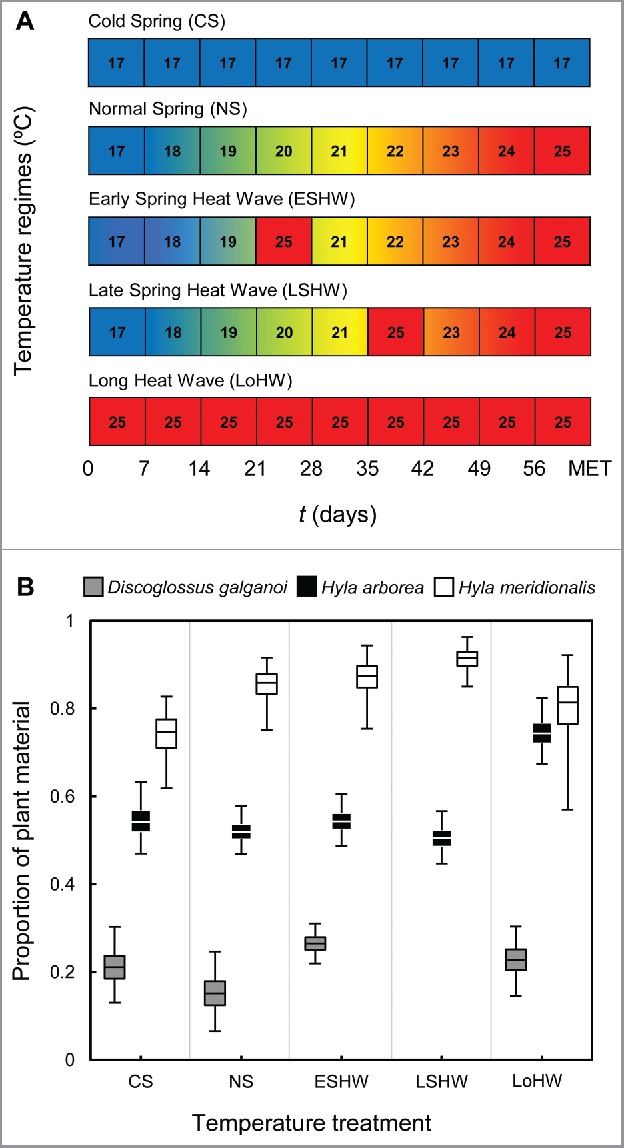
Data obtained and figure modified from ref. 1. Schematic representation of temperature variation over time until tadpoles initiated metamorphosis (MET) in each experimental treatment. (A): Proportion of plant material assimilated by the mixed diet tadpoles of the study species. (B): Cold Spring (CS), Normal Spring (NS), Early Spring Heat Wave (ESHW), Late Spring Heat Wave (LSHW) and Long Heat Wave (LoHW). Boxes show the median and the 25th–75th percentiles; whiskers indicate the 2.5th–97.5th percentiles.
This paper revealed an association between the larval feeding preferences of three anurans and their thermal background—greater carnivory by the species breeding in colder temperatures and greater herbivory by the species breeding at higher temperatures (Fig. 1B). This finding suggests that the influence of temperature on the feeding preferences of ectotherms may be noticeable temporally within the same community, and not only along latitudinal gradients, as discovered in omnivorous fishes.5 The changes in tadpole survival and life-history traits demonstrated that temperature induced changes in the relative quality of diets. While performance on animal diets strongly decreased at higher temperatures, performance on plant diets increased slightly, which may justify the shifts toward a greater assimilation of plant material during the heat waves. Generally, heat waves increased the assimilation of plant material, despite species-specific differences in the type of heat wave and in the magnitude of the shift. Interestingly, the greater assimilation of plant material decreased mass at metamorphosis in Discoglossus galganoi, while drastically reducing the larval period of Hyla arborea. This shows that the adaptive value of the assimilation shifts may vary among species and suggests that it may depend both on the species' trophic position along the trophic gradient and on their trophic plasticity. The proportion of plant material assimilated in the heat waves suggests changes in the feeding preferences of the study species, which regulated diet and optimized energetic intake by increasing herbivory and avoiding protein-rich animal diets at higher temperatures.
In conclusion, the results show that temperature plays an important role in modulating nutrient acquisition in the larvae of omnivorous amphibians—potentially a general temperature effect that may occur across ectotherms. Whether through a passive temperature effect upon nutrient assimilation or an influence in feeding preferences, generally the greater proportion of plant material assimilated helped the omnivorous tadpoles to cope with the challenges imposed by higher temperatures. Even if the trends shown in the study only partly describe the influence of temperature on nutrient acquisition, the awareness of these temperature effects provides additional support for the metabolic theory of ecology and contributes to a better understanding and reassessment of the ecological effects of ongoing climate change. Furthermore, if these patterns hold true for other omnivorous ectotherms, the reduction in the trophic position of these species may trigger changes in the functioning and structure of aquatic communities and food webs. On one side, the hypothetical loss of trophic links should result in loss of functional biodiversity and, consequently a greater vulnerability to cascading effects. On the other side, the potential strengthening of the herbivory trophic link may increase competition among herbivorous species, causing a greater impact on plants followed by bottom-up effects on the food webs.
References
- [1].Carreira BM, Segurado P, Orizaola G, Gonçalves N, Pinto V, Laurila A, Rebelo R. Warm vegetarians? Heat waves and diet shifts in tadpoles. Ecology. 2016;97:2964-74. PMID:27870032; doi: 10.1002/ecy.1541. [DOI] [PubMed] [Google Scholar]
- [2].Cross WF, Hood JM, Benstead JP, Huryn AD, Nelson D. Interactions between temperature and nutrients across levels of ecological organization. Global Change Biol. 2015;21:1025-40. PMID:25400273; doi: 10.1111/gcb.12809. [DOI] [PubMed] [Google Scholar]
- [3].Lee KP, Jang T, Ravzanaadii N, Rho MS. Macronutrient balance modulates the temperature-size rule in an ectotherm. Amer Nat. 2015;186:212-22. PMID:26655150; doi: 10.1086/682072. [DOI] [PubMed] [Google Scholar]
- [4].Boersma M, Mathew KA, Niehoff B, Schoo KL, Franco-Santos RM, Meunier CL. Temperature driven changes in the diet preference of omnivorous copepods: no more meat when it's hot? Ecol Lett. 2016;19:45-53. PMID:27611847; doi: 10.1111/ele.12666. [DOI] [PubMed] [Google Scholar]
- [5].González-Bergonzoni I, Meerhoff M, Davidson TA, Teixeira-de Mello F, Baattrup-Pedersen A, Jeppesen E. Meta-analysis shows a consistent and strong latitudinal pattern in fish omnivory across ecosystems. Ecosystems. 2012;15:492-503. doi: 10.1007/s10021-012-9524-4. [DOI] [Google Scholar]