



Abstract
The medical fitness of the candidates selected for officers' training institutes of three wings of Armed Forces is assessed by special medical boards(SMBs) and appeal medical boards (AMBs). The candidates declared unfit at AMBs arc given one more chance to prove their medical fitness, if they so desire, at an another board, designated as review medical board (RMB). RMB is sanctioned by DGAFMS based on merit of the case and as per the provisions of para 482 of RMSAF -1983. The venue of RMB is either at AFMC Pune or at Army Hospital (R&R) Delhi. RMB documents for the period from 1993–98 were analysed. During this period 338 requests for RMB were received, out of which 173 cases were given sanction (51.69%) for RMB. The average percentage of fitness in RMB among the total requests was 25.73%. There was no significant difference in the percentage of fitness between the RMBs held at AFMC Pune and Army Hospital (R&R) Delhi. Thus the paper goes to prove its usefulnesss to the candidates as well as to services and its fairness.
KEY WORDS: Review Medical Board
Introduction
The candidates who are selected for joining the three wings of the Armed forces and NDA/Naval institute of Engineering through various entry schemes are required to meet the medical standards laid down to be declared medically fit. The medical fitness of the candidates selected for Army and Navy is assessed by the special medical boards (SMB) located at Allahabad, Bangalore and Bhopal, and those who are selected to join the Airforce by Airforce Selection Boards are medically examined at Airforce Central Medical Establishment (AFCME), New Delhi and Institute of Aerospace Medicine (IAM); Bangalore. Those candidates who were found to be medically unfit (Permanent) can undergo another Medical Board, the Appeal Medical Board (AMB), at any of the Command Hospitals, and Base Hospital Delhi Cantt1. For all purposes this is the final medical Board. However, a review medical board (RMB) can be convened by the Director General Armed Forces Medical Services at Pune/Delhi on specific request of service Headquarters or Ministry of Defence when the opinion of a previous medical board is challenged by an individual and the service headquarters concerned and the Ministry of Defence consider that there is some weight in the challenge. In respect of the candidates seeking the RMB the discretion to reject/accept the request was delegated to the DGAFMS. The findings of the review medical will be accepted as final, after approval by the DGAFMS(1). No further appeal will be entertained by Service Headquarters or Ministry of Defence. These boards are chaired by medical officers of highest rank viz. Lt Gen/Surg Vice Admiral / Air Marshal. From this it is clear that the RMB is the last and final appeal. Accordingly the requests for the RMB are required to be scrutinised thoroughly and decided on case by case depending on its own merit.
Aim of the study was to assess whether the existing system was serving the intended purpose of providing natural justice to the candidates seeking entry in the Armed Forces and the outcome of the RMB is free and fair. The study was under taken to understand and evaluate whether the RMB is helping the candidates to their satisfaction and also to evaluate that there is no bias while carrying out the RMB.
Material and Methods
Documents related to the requests received for the years 1993–1998 and their disposal was meticulously maintained in the office of DGAFMS/DG-3A. The present analysis is based on these documents.
Results
From the Table 1 and Fig 1 it can be made out that there had been, on an average, 56 cases requesting for RMB. Of these, on an average, the office DGAFMS had been accepting about 52% of the requests. The rejections (about 48%) were mainly due to conditions in which the verdict of the earlier medical boards was not likely to change inspite of RMB or in conditions where the candidate had undergone some operative treatment to be apparent, in conditions like hernia, CSOM, etc. It is apparent that during the year 1998 there was a quantum jump of requests for RMB. This may be due to increase awareness of the candidates to have one more and final avenue open before they accept their “unfitness” for the service or may be due to increase in number of candidates appearing for the Services Selection Boards consequent to the announcement of Vth Central pay commission.
TABLE 1.
Summary of cases received for RMB during 1993-98
| Year | Total request received | Disposal |
|
|---|---|---|---|
| Accepted for RMB (%) | Rejected for RMB (%) | ||
| 1993 | 44 | 15 (34.09) | 29 (65.91) |
| 1994 | 53 | 25 (47.16) | 28 (52.83) |
| 1995 | 57 | 26 (45.61) | 31 (54.39) |
| 1996 | 35 | 19 (54.29) | 16 (45.71) |
| 1997 | 56 | 33 (58.93) | 23 (41.07) |
| 1998 | 93 | 55 (59.13) | 38 (40.86) |
| Total | 338 | 173 (51.69) | 165 (48.81) |
| Average per year | 56 | 29 (51.79) | 27 (48.21) |
X2 = 8.639, df = 5, (p at 5% level is 11.07)
Fig. 1.

Total number of requests received for RMB (actual numbers – yearwise)
The percentage of acceptance of the requests increased marginally during 1998 (Table 1 and Fig 2).
Fig. 2.

Number of requests rejected, accepted.
From the Table 2, and Fig 3 it is seen that out of the cases accepted for the RMB, about 50% of the candidates were declared fit. However when compared with the total requests received for RMB (including rejected and accepted requests) it was noted that about 25% were declared fit (Table 3 and Fig 4). An exercise was undertaken to see whether there is any difference in the outcome of RMB being carried out by two different boards located at two different institutions. Analysis of data contained in TABLE 4, TABLE 5 and Fig 5 reveal that the difference between the two boards is not significant (p > 0.05)
TABLE 2.
Disposal of cases accepted for RMB
| Year | Fit (%) | Unfit (%) | Absent (%) | Total |
|---|---|---|---|---|
| 1993 | 6 (40.00) | 6 (40.00) | 3 (20.00) | 15 |
| 1994 | 12 (46.15) | 13 (52.00) | 25 | |
| 1995 | 14 (53.85) | 10 (38.46) | 2 (7.69) | 26 |
| 1996 | 8 (42.11) | 8 (42.11) | 3 (15.78) | 19 |
| 1997 | 18 (54.55) | 5 (15.15) | 10 (30.30) | 33 |
| 1998 | 29 (52.72) | 18 (32.72) | 8 (14.55) | 55 |
| Total | 87 (50.00) | 60 (34.68) | 26 (15.02) | 173 |
Fig. 3.
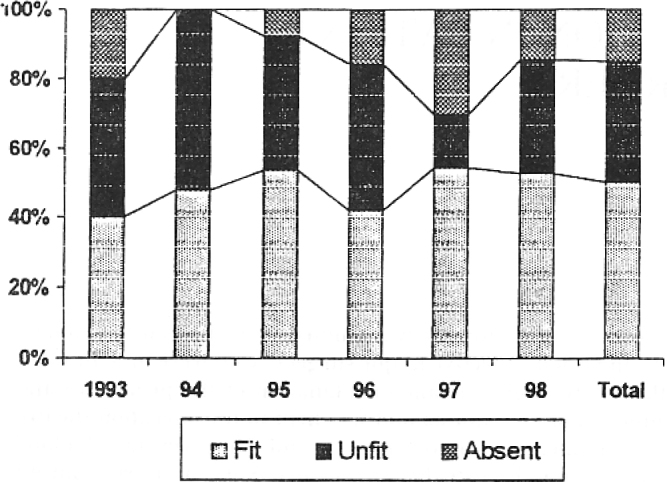
Disposal of cases accepted for RMB
TABLE 3.
Percentage of fitness during RMB: 1993-98
| Year | No. of requests received | No. declared fit |
|---|---|---|
| 1993 | 44 | 06 (13.63) |
| 1994 | 53 | 12 (21.82) |
| 1995 | 57 | 14 (24.56) |
| 1996 | 35 | 8 (22.86) |
| 1997 | 56 | 18 (32.14) |
| 1998 | 93 | 29 (31.18) |
| Total | 338 | 87 (25.73) |
Fig. 4.

Percentage of fitness during RMB out of total requests received – 1993–98
TABLE 4.
Year-wise summary of disposal of cases of RMB by AFMC and AHRR
| 1993 |
1994 |
1995 |
1996 |
1997 |
1998 |
|||||||
|---|---|---|---|---|---|---|---|---|---|---|---|---|
| AFMC | AHRR | AFMC | AHRR | AFMC | AHRR | AFMC | AHRR | AFMC | AHRR | AFMC | AHRR | |
| Total cases sent | 8 | 7 | 17 | 8 | 17 | 9 | 9 | 10 | 23 | 10 | 37 | 18 |
| Declared fit | 3 | 3 | 8 | 4 | 9 | 5 | 5 | 3 | 12 | 6 | 17 | 12 |
| Declared unfit | 3 | 3 | 9 | 4 | 7 | 3 | 2 | 6 | 3 | 2 | 14 | 4 |
| Absent | 2 | 1 | - | - | 1 | 1 | 2 | 1 | 8 | 2 | 6 | 2 |
TABLE 5.
Place-wise details of RMB
| No. of cases | AFMC | AHRR |
|---|---|---|
| Total cases referred for RMB | 111 | 62 |
| Declared fit | 54 (48.64) | 33 (52.23) |
| Declared unfit | 38 (34.23) | 22 (34.92) |
| Absent | 19 (17.11) | 7 (11.29) |
X2 = 0.044, df = 1 (p at 0.05 level is 3.84)
Note: Figures in parenthesis are percentages
Fig. 5.

Disposal of cases as per place of RMB
The available data was analysed to find out the common causes for which the candidates are rejected during the RMB and the causes for which the candidates are becoming fit during the RMB. From Table-6, it is noted that candidates declared unfit at appeal medical board for substandard vision are the ones seeking RMB, being rejected most and also are the ones being declared unfit even during the RMB of those whose requests had been accepted. This was followed by cardiac murmurs and knock knee. This proves that the cases being rejected at RMB are genuine and no bias is being shown. Some of the cases declared fit during RMB were those for which definitive treatment was under taken by the cadets before appearing for RMB eg. DNS, varicocele, hydrocele, etc. and have thus become fit during RMB.
TABLE 6.
Table showing common disabilities asking for RMB and their disposal
| Disability | Request rejected | Accepted and disposed |
Total | |
|---|---|---|---|---|
| Declared fit | Declared unfit | |||
| Substandard vision | 19 | 9 | 2 | 30 |
| Cardiac murmur | 14 | 10 | 4 | 28 |
| Hypertension | 10 | 1 | 7 | 18 |
| Knock knee | 8 | 6 | 3 | 17 |
| C SO M | 7 | 3 | 8 | 18 |
| Scoliosis | 7 | - | 7 | 14 |
| DNS | 2 | 5 | 1 | 8 |
| Sub standard hearing | 4 | 2 | 1 | 7 |
| Bil hallax valgus | 2 | 3 | 2 | 7 |
| Splenomegaly | 4 | 3 | 7 | |
| Cubitus valgus | 3 | 4 | 2 | 9 |
| Flat feet | 5 | 1 | - | 6 |
| Varicocele | 4 | 1 | - | 5 |
| Wax | - | 5 | - | 5 |
| Inguinal hernia | 3 | 1 | 1 | 5 |
| Divergent squint | 3 | 1 | 3 | 7 |
| Hydrocele | 2 | 1 | - | 3 |
| Varicose vein | 1 | 1 | 1 | 3 |
| Bil bubonocele | 1 | 1 | - | 2 |
| Others | 70 | 28 | 15 | 123 |
| Total | 165 | 87 | 86 | 338 |
Review medical boards appear to play an important role in providing natural justice for those candidates seeking entry into Armed Forces and were declared medically unfit during SMB and AMB as was evident from the fact that about 25% of those were declared fit. It was also noted that though the RMB is being held at two different places, there was no statistical variations in the out come of the board irrespective of the place of the RMB. Hence the system of RMB as is being practised appears to be just and should be continued.
Recommendations
-
1.
The analytical study carried out in relation to RMBs would have been more valuable had the info pertaining to SMBs and AMBs been available. Efforts are being made to procure the same.
REFERENCES
- 1.Regulation of Armed Forces Medical Services 1983:93