



Abstract
Background
There is a need for pediatric medical devices that accommodate the unique physiology and anatomy of pediatric patients that is increasingly receiving more attention. However, there is limited literature on the programs within children’s hospitals and academia that can support pediatric device development. We describe our experience with pediatric device design utilizing collaborations between a children’s hospital and two engineering schools.
Methods
Utilizing the academic year as a timeline, unmet pediatric device needs were identified by surgical faculty and matched with an engineering mentor and a team of students within the Capstone Engineering Design programs at two universities. The final prototypes were showcased at the end of the academic year and if appropriate, provisional patent applications were filed.
Results
All twelve teams successfully developed device prototypes, and five teams obtained provisional patents. The prototypes that obtained provisional patents included a non-operative ureteral stent removal system, an evacuation device for small kidney stone fragments, a mechanical leech, an anchoring system of the chorio-amniotic membranes during fetal surgery, and a fetal oxygenation monitor during fetoscopic procedures.
Conclusions
Capstone Engineering Design programs in partnership with surgical faculty at children’s hospitals can play an effective role in the prototype development of novel pediatric medical devices.
Keywords: MeSH Keywords: Medical Devices, Technological Innovations, Pediatrics, Urologic Surgery, Obstetrical Surgery, Fetoscopic Surgery
Keywords: Levels of Evidence: N/A, No clinical subjects or human testing was performed
1. Introduction
Pediatric and adult surgeons often encounter limitations that prohibit more accurate diagnoses and efficient treatments that could be addressed with new or improved medical devices. Current standard of care practices in pediatric medicine often involve the utilization of adult-designed technologies for pediatric applications. According to the Food and Drug Administration (FDA), there is a need for pediatric medical devices specifically designed to accommodate the unique physiology and anatomy of pediatric patients1. The lower pediatric disease incidence, the poor incentives for medical device industry financial return, the high cost of pediatric clinical studies relative to the market size, and the difficulty in enrolling pediatric clinical trial participants2 has caused a significant lag in pediatric device development compared to adult devices1. These limitations have resulted in pediatric surgeons using adult devices for off-label pediatric indications,3–5 with potential legal and ethical ramifications.
In 2007, the passage of the Pediatric Medical Device Safety and Improvement Act (PMDSIA) led to important advances for the pediatric medical device field. This Act mandated the tracking of pediatric devices, the facilitation of pediatric device design, as well as the elimination of previous profit restrictions on humanitarian device exemption (HDE) devices6, and thereby improving the device approval pathway for pediatric diseases associated with low incidence rates that meet HDE requirements (no greater than 4,000 uses annually)7. The other commonly used FDA approval pathway is through premarket approval, which often requires the manufacturer to conduct clinical trials to demonstrate efficacy and safety8. Of note, the FDA recently released guidance on pediatric extrapolation that allows the use of adult clinical data for pediatric device approvals that may improve the developmental pathway for pediatric devices9.
A major component of PMDSIA was the development of the FDA Pediatric Device Consortia Grant program, which created pediatric device consortia at several children’s hospitals and universities across the United States. The goals of the pediatric device consortia are to encourage innovation, mentoring, and collaborations amongst pediatric surgeons, engineers, and industry for pediatric device design6. To date, over 775 pediatric device projects have been supported through the consortia since 2009, including 148 currently active projects and 13 collaborations/multi-consortia projects, with 5 devices in clinical use to date6.
However, besides this description on the Biodesign process and culture that enables pediatric medical technology innovation10, there is limited literature on the programs within children’s hospitals and academia that can support pediatric device development. Pediatric surgeons are ideally placed at the frontline of patient care where they can identify needs for medical technology improvement. Conversely, engineers have the technical expertise to create innovative devices, but may not fully appreciate the clinical needs of pediatric surgeons and their patients. With the goal of creating partnerships between surgeons and engineers toward effective pediatric medical device development, we describe our experience at a major tertiary care children’s hospital with two university Capstone Engineering Design programs in developing pediatric devices through a potentially reproducible pathway.
2. Methods
A call for unmet pediatric device needs was distributed to pediatric surgical faculty members at a major tertiary care children’s hospital with the intent of partnering faculty members with engineering student teams in the Capstone Engineering Design programs at two local engineering schools. These design programs are available in essentially every major city in the U.S., as all Accreditation Board for Engineering and Technology programs at universities are required to incorporate engineering design into their curriculum10.
Through the Capstone Engineering Design programs, pediatric surgical faculty worked in interdisciplinary teams with students in biomedical, mechanical, and/or electrical engineering to develop novel solutions to real-world pediatric clinical challenges. Over the course of an academic year, the teams followed a course-specified engineering design process that included clinical immersion, development of design criteria, thorough market and field analysis, prototype development, user feedback, preliminary prototype testing, and participation in annual engineering showcase events (Figure 1).
Figure 1.
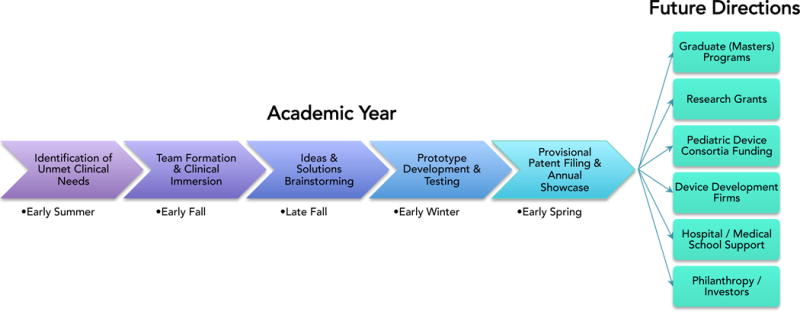
Academic Year Timeline for Capstone Engineering Design Projects
2.1 Identification and Selection of Unmet Pediatric Device Needs
Prior to the start of the academic year [September], pediatric surgical faculty members were invited to identify unmet clinical needs that could potentially be addressed with a pediatric medical device solution. The surgical faculty described their unmet device needs and clinical goals on a one-page Capstone proposal form, but were encouraged to avoid describing solutions at this time, as this would be the focus of the engineering teams’ work during the academic year. Proposals were reviewed by a team of senior engineering faculty with device design experience as well as by experienced surgical faculty to assess which projects could be addressed by an engineering team with the local available resources and expertise.
2.2 Team Formation and Clinical Immersion
During the fall semester, the selected projects were presented to the engineering students in the program, and via a matching process specific to the engineering school, teams were formed consisting of four to five engineering undergraduate students, a senior engineering faculty mentor, and the pediatric surgical faculty member. The senior engineering faculty mentor served as a technical advisor to the team as well as monitored their progress toward completion of the prototype development milestones. Once the teams were formed, the engineering team underwent clinical immersion to expose and familiarize themselves with the clinical problem and identify areas of improvement. This included visits to the operating room, clinics, and hospital rooms. The background research was directed at the historical and modern treatment practices and their technical challenges with the goal of identifying novel engineering solutions. Teams also performed a preliminary market analysis. Building a base of clinical and technical knowledge allowed for ideas and solutions brainstorming amongst the team as they progressed toward prototype development.
2.3 Prototype Development and Testing
During the late fall and winter terms, each team narrowed down a list of proposed designs to a short list for further development and testing. Facilities and resources provided by the Capstone Design programs in the engineering schools allowed for basic prototype creation and refinement, and were facilitated by the software resources for initial design, the machinery required for prototype construction, and the tools to test function, performance, and reliability. From the mid-winter to the early spring period, the teams continued their progress toward working prototypes that underwent several rounds of design, development, and testing. Continuous recommendations from the engineering and clinical mentors helped to ensure technical feasibility and clinical applicability.
2.4 Provisional Patent Filing and Annual Engineering Design Showcases
In the late spring, a final version of the pediatric device prototype was displayed at the annual engineering showcases of the respective engineering schools. Prior to these annual showcases, which constitute a public disclosure, the clinical and engineering faculty evaluated each project to determine whether it had reached a stage where provisional patent application filing would be of benefit. One factor that affected this decision was the current intellectual property (IP) landscape for the particular device. After the provisional patent filing, the team has one year for conversion to a full utility patent application. This filing (provisional or utility) protects the intellectual property associated with the device. Since the students of both engineering schools were not considered employees of the children’s hospital/medical school that provided financial sponsorship for the team, IP ownership was retained by and subject to faculty IP policies of the children’s hospital/medical school. The engineering students and the surgical faculty members were listed as inventors on the patent applications. This policy can vary by institution. At the engineering showcases, critical feedback as well as design awards were given, in addition to continued discussion on the projected feasibility for future clinical implementation.
2.5 Future Directions
By the end of the academic year, all of the projects were considered educational successes for the teams and their faculty mentors, as a new generation of engineers became better prepared to address future unmet medical device needs. However, since the students usually graduated to the next step of their careers, the primary responsibility for the projects returned to the surgical faculty member. With respect to the FDA’s Center for Devices and Radiologic Health’s “Total Product Life Cycle,”6 these projects begin and end in the concept and prototype phases, respectively. They would then enter into the additional phases of development as depicted in “Future Directions” of Figure 1. While pediatric devices usually impact smaller markets than those of adult devices, it was emphasized to the teams that opportunities for funding may exist in the altruistic missions of entities such as children’s hospitals and philanthropists, as well as within the PDC program, that seek to impact in an area of high need, and that the pediatric device market often serves as a niche that avoids the heavy competition in many adult device markets.
3. Results
Prior to the start of the academic year, twelve pediatric surgical faculty members described unmet device needs in their respective clinical areas detailing the specific clinical goals (Table 1). From these descriptions, nine projects were selected for the Capstone Engineering Design Programs at the two local engineering schools. Each team of four to five engineering students met regularly with the engineering faculty mentors, as well as maintained regular weekly or bi-weekly in-person meetings or teleconferences with the pediatric surgical faculty member.
Table 1.
Pediatric Project Needs Descriptions
| Unmet Clinical Need | Pediatric Specialty |
|---|---|
| Non-operative, non-invasive pediatric ureteral stent removal | Urology |
| Evacuation device for small kidney stone fragments | Urology |
| Wearable glucose crash detection | Otolaryngology |
| Mechanical leech | Gynecology |
| Powered sternal lift device for pectus excavatum | General Surgery |
| Reducing bedside monitor “Alarm Fatigue” in the NICU/PICU | General Surgery |
| Monitor of cardiac electrical activity without skin electrodes | Cardiac Surgery |
| Indirect ophthalmoscope for Third World applications | Ophthalmology |
| Hand-held digital imaging system for retinopathy of prematurity | Ophthalmology |
| Extraocular muscle prosthesis for strabismus | Ophthalmology |
| Anchoring/fixation of the chorio-amniotic membranes during fetal surgery | Fetal Surgery/ Maternal Fetal Medicine |
| Fetal oxygenation monitoring during fetal procedures | Fetal Surgery/ Maternal Fetal Medicine |
The nine selected teams successfully developed working prototypes over the course of the academic year with demonstrations at the annual showcases. After consulting with the engineering faculty on the teams’ progress and readiness for IP protection, five teams obtained provisional patent filings for their working prototypes. Currently, all nine teams are continuing their development in collaboration with local device development firms with the goal of Small Business Innovation Research (SBIR) grant funding.
The following are the five Capstone Engineering Design projects from the 2015 – 2016 academic year with provisional patents in place.
3.1 Magnetic Ureteral Stent Removal (Figure 2A)
Figure 2.

Pediatric Device Prototypes Developed in the Capstone Engineering Design Programs
Clinical Problem/Goals
Removal of an internal ureteral stent after kidney stone surgery or robotic pyeloplasty for kidney obstruction requires cystoscopy under general anesthesia. To avoid general anesthesia, the goal was to design a non-operative and non-invasive stent removal system.
Design
After a metallic bead was attached to the dangler string at the end of the stent in the bladder, a novel electromagnet was used to remove the stent (and bead) via the urethra without the need for anesthesia or cystoscopy.
Status
Provisional Patent Filed; Continuation in the Master’s in Engineering program.
Future Directions
SBIR Grant Proposal Submitted
3.2 Fetal Surgery Anchor (Figure 2B)
Clinical Problem/Goals
Fetal surgical access is associated with increased risk of chorio-amniotic membrane rupture and dissociation from the uterus that can lead to leakage of amniotic fluid and premature delivery of the fetus12. Currently, anchoring the chorio-amniotic membranes to the uterus requires a maternal abdominal incision to expose the uterus. The goal was to design a minimally invasive device that would avoid a maternal abdominal incision to anchor the chorio-amniotic membranes during fetal surgery.
Design
An anchoring system was designed that includes two fasteners that were secured with an inter-woven suture between the chorio-amniotic membrane and uterus.
Status
Provisional Patent Filed; Continuation in the Master’s in Engineering program.
Future Directions
SBIR Grant Proposal in Process.
3.3 Mechanical Leech (Figure 2C)
Clinical Problem/Goals
Contemporary leech therapy is used during the postoperative or post-traumatic period when decreased venous outflow compromises arterial inflow. The leeches release the potent anticoagulant hirudin, which decreases venous congestion and can aid in tissue graft survival. However, the use of leeches can cause prolonged bleeding, infection, and/or negative psychological effects13. The goal was to design a 3-D printed mechanical leech for use in children that can precisely deliver an appropriate amount of hirudin as well as extract the local inflammatory exudate to enhance tissue graft survival.
Design
The device contained a mechanical leech head with multiple microneedles, a leech body with a reservoir of hirudin, a separate reservoir into which exudate could drain, and a micro-pump.
Status
Provisional Patent Filed; Continuation in the Master’s in Engineering program
Future Directions
SBIR Grant Proposal in Process.
3.4 Fetal Oxygenation Monitor (Figure 2D)
Clinical Problem/Goals
Fetoscopic procedures have increased risk of procedural fetal hypoxia14. A device does not exist for monitoring fetal oxygenation during these procedures. The goal was to devise a fetal oxygenation monitor that could be passed through a fetoscopic trocar.
Design
After passing through a fetoscopic trocar, a nitinol loop was placed and secured around the limb of a fetal model. Sensors on the loop allowed for continuous blood oxygenation and heart rate measurements.
Status
Provisional Patent Filed; Continuation in the Master’s in Engineering Program.
Future Directions
SBIR Grant Proposal in Process.
3.5 Kidney Stone Evacuator (Figure 2E)
Clinical Problem/Goals
After ureteroscopy with laser lithotripsy for surgical removal of kidney stones, removal of the stone fragments with current wire baskets may require multiple passes of the instrumentation, which can cause ureteral trauma15 and may leave stone fragments in place that could re-appear as future stones. The goal was to design a device that would remove the small stone fragments from the upper urinary tracts quickly and effectively without multiple passes of the instrumentation.
Design
A deformable bulb and collecting chamber was attached to currently available ureteral tubing to dislodge and remove small stone fragments from the upper urinary tracts.
Status
Provisional Patent Filed; Continuation in the Master’s in Engineering program.
Future Directions
SBIR Grant Proposal in Process.
4. Discussion
We provide the first description of an established academic model that was applied exclusively in a pediatric setting that joined the faculty, students, and resources of a major tertiary children’s hospital and medical school with the engineering schools at major research universities to identify unmet pediatric device needs, assemble clinical faculty - engineering design team partnerships, and develop pediatric device prototypes that also fulfilled the educational missions of the universities.
Previous observations by Grant et al. described how pediatric device projects frequently cannot progress through the standard market-based approach that adult device projects follow, as premature exits outside of academia and into industry often lead to early onset of failure16. This emphasizes the need for an extended life cycle of pediatric device projects in the academic setting before exposure to the external market. The Capstone Engineering Design program is one avenue that allows for this with early design work, determination of its clinical and economic feasibility, and early prototype testing within an academic setting that begins to effectively de-risk the project. In addition, the educational aspects of the program for the engineering students (and the faculty members) often fit the educational missions of the medical school and the universities, while requiring a relatively small investment of time and money when compared to other programs. An average of $5,000 – $10,000 was the support level for each team that allowed the sponsor to maintain ownership of the resulting IP, and the bundling of several projects from a single sponsor resulted in the reduction of these costs for the sponsor.
The educational experience of the senior engineering students is a major focus of these programs where the students must face the challenges of device design and team building as an educational exercise that will prepare them for their future careers. It is imperative that the clinical and engineering mentors maintain an active role in the team’s work to ensure steady progress toward a technically feasible and clinically applicable prototype within the program’s timeframe. As another endpoint, the development of a prototype that is deemed ready for provisional patent application is a worthy and reachable goal in the academic year timeframe that also creates potential value for the children’s hospital/medical school and the surgical faculty mentor.
There will be future challenges with pediatric device design that will require solutions from the perspective of the product development cycle and clinical trial implementation. This collaboration provides the children’s hospitals with an intricate understanding of device design, which optimally suits them for clinical trial design and identification of potential trial participants. Conversely, the engineering schools often can attract a manufacturing partner that can incorporate formal design controls into these processes that involve manufacturing, packaging, sterilization, and labeling of the devices. These efforts will also require development of new regulatory policies and strategies, as well as new reimbursement/pricing models for pediatric devices that are produced on demand and not in surplus to suit the unique low volume needs. Other considerations include the need for development and implementation of on demand design and manufacturing for pediatric devices, especially implants and interventional products that ensure that the supply chain for materials, components, sub-systems, and entire systems is established in a cost-effective fashion while meeting the regulatory requirements of safety and efficacy.
For rapid progression in pediatric device development to occur, children’s hospitals and engineering schools will need to continue to collaborate to train future pediatric clinical and engineering innovators. One university demonstrated that early integration of medical and engineering students led to the creation of 24 new start-up companies and 91 new medical devices17. This re-emphasizes the importance of collaboration between the clinical and engineering fields. In addition, one must be cognizant that the field of device design is different than traditional medical research, and often the current benchmarks for academic progression may be difficult to achieve. Zuckerman et. al describes the difficulties that clinical device designers have in the academic field: “The misaligned incentives in academia to reward publications and funding for traditional research will need to be adjusted to include incentives for clinician-innovators and to have greater tolerance of risk because most innovations will fail.”18 Even though the failure rate can be high for most pediatric device projects, the Capstone Engineering Designs programs can provide a pathway for busy pediatric surgeons to participate in and even spearhead pediatric medical device design in an academic setting. Our experience provides evidence that with collaboration and endurance, a new pediatric device idea can start on its developmental pathway within an academic environment with the goal of future clinical implementation.
5. Conclusions
Pediatric surgeons at tertiary care children’s hospitals can play an effective and even leading role in the prototype development of novel pediatric medical devices in partnership with local university Capstone Engineering Design programs. These programs can serve as a low-cost pathway to initiate the development of pediatric device prototypes to address unmet device needs. These partnerships can join pediatric surgeons and engineering teams in an academic setting to develop devices for potential future clinical use and address the current shortage of novel pediatric medical devices.
Acknowledgments
Thank you to the Rice University Brown School of Engineering - Oshman Engineering Design Kitchen (oedk.rice.edu) and Texas A&M University Dwight Look College of Engineering, Department of Biomedical Engineering Senior Design Program (engineering.tamu.edu) for their collaboration and contributions. The work was supported by Texas Children Hospital Department of Surgery funding, the Food & Drug Administration grant #P50 FD004896, and the Denton Cooley Innovation Award of the Texas Children’s Hospital Auxiliary.
Funding: The work was supported by department funds, Food & Drug Administration Grant #P50 FD004896, and the Denton Cooley Innovation Award of the Texas Children’s Hospital Auxiliary.
Abbreviations
- FDA
Food and Drug Administration
- PMDSIA
Pediatric Medical Device Safety and Improvement Act
- HDE
Humanitarian Device Exemption
- IP
Intellectual Property
- SBIR
Small Business Innovation Research
Footnotes
Conflict of Interest: The authors have no conflicts of interest relevant to this article to disclose.
Financial Disclosure: The authors have no financial relationships relevant to this article to disclose
References
- 1.U.S. Department of Health and Human Services. FDA Fiscal Year 2016 Justification of Estimates for Appropriations Committees. 2015 [Google Scholar]
- 2.Joseph PD, Craig JC, Caldwell PH. Clinical trials in children. Br J Clin Pharmacol. 2015;79(3):357–369. doi: 10.1111/bcp.12305. [DOI] [PMC free article] [PubMed] [Google Scholar]
- 3.Dolcimascolo F. Pediatric cardiac devices–an FDA pediatrician’s perspective of the challenges and potential solutions. J Cardiovasc Transl Res. 2009;2(2):147–149. doi: 10.1007/s12265-009-9100-2. [DOI] [PubMed] [Google Scholar]
- 4.Beekman RH, 3rd, Duncan BW, Hagler DJ, et al. Pathways to approval of pediatric cardiac devices in the United States: challenges and solutions. Pediatrics. 2009;124(1):e155–162. doi: 10.1542/peds.2008-3726. [DOI] [PubMed] [Google Scholar]
- 5.Sheha ED, Hammouri Q, Snyder BD, Campbell RM, Jr, Vitale MG, Stanasel I. Off-label use of pediatric orthopaedic devices: important issues for the future. J Bone Joint Surg America. 2014;96(3):e21. doi: 10.2106/JBJS.M.00288. [DOI] [PubMed] [Google Scholar]
- 6.Ulrich LC, Joseph FD, Lewis DY, Koenig RL. FDA’s pediatric device consortia: national program fosters pediatric medical device development. Pediatrics. 2013;131(5):981–985. doi: 10.1542/peds.2012-1534. [DOI] [PubMed] [Google Scholar]
- 7.U.S. Department of Health and Human Services. Guidance for Industry and Food and Drug Administration Staff: Humanitarian Use Device (HUD) and Designations. 2013 [Google Scholar]
- 8.Kramer DB, Xu S, Kesselheim AS. Regulation of medical devices in the United States and European Union. N Engl J Med. 2012;366(9):848–855. doi: 10.1056/NEJMhle1113918. [DOI] [PubMed] [Google Scholar]
- 9.U.S. Department of Health and Human Services. Leveraging Existing Clinical Data for Extrapolation to Pediatric Uses of Medical Devices: Guidance for Industry and Food and Drug Administration Staff. 2016 [Google Scholar]
- 10.ABET. Criteria for Accrediting Engineering Programs. 2014 [Google Scholar]
- 11.Devlieger R, Millar LK, Bryant-Greenwood G, Lewi L, Deprest JA. Fetal membrane healing after spontaneous and iatrogenic membrane rupture: a review of current evidence. Am J Obstet Gynecol. 2006;195(6):1512–1520. doi: 10.1016/j.ajog.2006.01.074. [DOI] [PMC free article] [PubMed] [Google Scholar]
- 12.Spear M. Medicinal Leech Therapy: Friend or Foe. Plast Surg Nurs. 2016;36(3):121–125. doi: 10.1097/PSN.0000000000000152. [DOI] [PubMed] [Google Scholar]
- 13.Saxena KN. Anaesthesia for fetal surgeries. Indian J Anaesth. 2009;53(5):554–559. [PMC free article] [PubMed] [Google Scholar]
- 14.Bader MJ, Gratzke C, Walther S, et al. Efficacy of retrograde ureteropyeloscopic holmium laser lithotripsy for intrarenal calculi >2 cm. Urol Res. 2010;38(5):397–402. doi: 10.1007/s00240-010-0258-5. [DOI] [PubMed] [Google Scholar]
- 15.Grant M, Stanasel I, Koh CJ. Pediatric Medical Device Consortia: A Novel Pathway for Pediatric Device Development for Pediatric Urologists and Other Pediatric Specialists. Urology Practice. 2015;2:206–210. doi: 10.1016/j.urpr.2014.11.002. [DOI] [PubMed] [Google Scholar]
- 16.Loftus PD, Elder CT, D’Ambrosio T, Langell JT. Addressing challenges of training a new generation of clinician-innovators through an interdisciplinary medical technology design program: Bench-to-Bedside. Clin Transl Med. 2015;4:15. doi: 10.1186/s40169-015-0056-3. [DOI] [PMC free article] [PubMed] [Google Scholar]
- 17.Zuckerman B, Margolis PA, Mate KS. Health services innovation: the time is now. JAMA. 2013;309(11):1113–1114. doi: 10.1001/jama.2013.2007. [DOI] [PubMed] [Google Scholar]