



Abstract
The present study examined wear characteristics of A356/melon shell ash particulate composites. Dry-sliding the stainless steel ball against specimen disc revealed the abrasive wear behavior of the composites under loads of 2 and 5N. The composite showed lower wear rate of 2.182 × 10⁻⁴ mm3/Nm at 20 wt% reinforced material under load of 5N. Results showed that wear rate decreased significantly with increasing weight percentage of melon shell ash particles. Microstructural analyses of worn surfaces of the composites reveal evidence of plastic deformation of matrix phase. The wear resistance of A356 increased considerably with percentage reinforcement. In other words, the abrasive mass loss decreased with increasing percentage of reinforcement addition at the both applied loads. The control sample suffered a highest mass loss at 5 N applied load.
Keywords: Materials science, Mechanical engineering
1. Introduction
The speedy advancement in industrial activities, in recent times, has resulted in an increased interest in composites containing low-density and low cost reinforcements. Aluminum matrix composites (AMCs) have unique combination of mechanical, physical and chemical properties which are scarcely attainable with the use of monolithic materials [1, 2]. This has made AMCs a strong competitor to steel in terms of versatility for use in a wide range of engineering applications [3]. AMCs are promising materials for automotive, aerospace and mineral processing industries [4, 5, 6]. In automobile, parts made from AMCs include piston, piston rings, connecting rods, brake drum and cylinder head [7, 8]. Other noticeable advantages of AMCs are the relatively low cost of processing [in comparison to other matrices types]. Also, simple processing techniques (such as casting and powder metallurgy) make the composites superior to other materials [2]. However, one limitation peculiar to most unreinforced aluminium alloys is poor tribological properties. To address this drawback, these alloys are reinforced with some other materials so that their hardness, young’s modulus and abrasion wear resistance are ameliorated [9]. The alloys are mostly reinforced with SiC, B4C, Al2O3, and graphite in order to enhance their wear resistance characteristics [10, 11, 12]. Fly ash has been used as reinforcement as well and the incorporation led to decreasing in the wear rate [13]. Among various discontinuous dispersoids utilized, melon shell ash is one of the most inexpensive and low-density reinforcement available in large quantities as solid waste by-product. Hence, composites with melon shell ash as reinforcement are likely to overcome the cost barrier for widespread applications. Apart from the increase in the wear resistance, incorporating the melon shell ash particles in the aluminum matrix will inevitably promote yet another use of waste and thereby, reducing the cost of aluminum matrix composites. The present investigation is focused on utilizing plentifully available agricultural waste melon shell ash in a useful manner by dispersing it into A356 alloy to produce composites.
2. Materials and methods
2.1. Carbonization of the melon shell
The shell was obtained from the melon of species Citrullus lanatus. This involved collection, drying and grinding of the melon shell (Fig. 1) to form melon shell powder. The powder was packed in a graphite crucible and fired at a temperature range of 400° C −650° C (Fig. 2). The ash was ball milled using ball milling machine and sieved using 75 μm sieve size.
Fig. 1.

Photo of the melon shell.
Fig. 2.
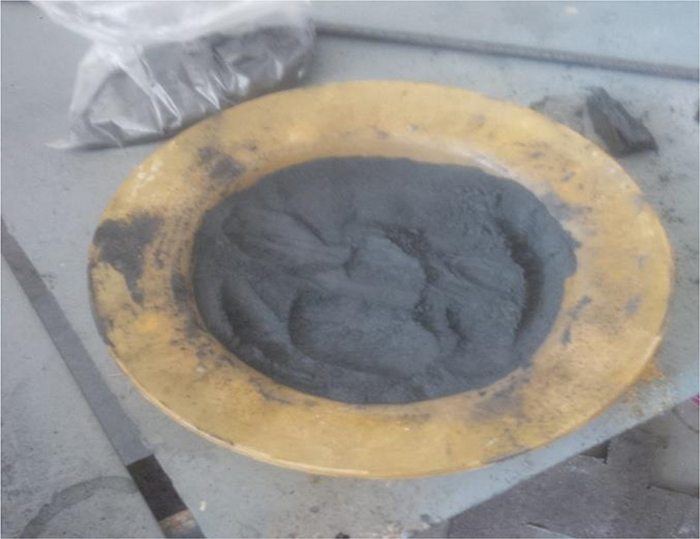
Photo of melon shell ash.
2.2. Production of Al- Si-Mg/Melon shell ash particulate composites
Ingots of A356 alloy was melted by 720 °C in a graphite crucible using an oil fired graphite furnace. After taking off the dross, 5% wt of the preheated melon shell ash was incorporated into the melt at a constant feed rate. The preheat treatment was conducted at 250 °C for 30 min. Simultaneously, mechanical stirrer made up of stainless steel was utilized to ensure thorough mixing. The stirring lasted for 5 min. Afterwards, the mixture was poured into the already prepared sand mould of 30 × 80 mm and allowed to solidify. The same procedure was reiterated for 10, 15 and 20 wt% reinforcement additions.
2.3. Wear analysis
Wear test specimen disc of diameter 25 mm and thickness 5 mm were machined from the as-cast produced composites. The surfaces of each specimen were prepared with 600 grade SiC abrasive papers. A total number of ten specimens were used for the whole experiment, as for each composition two different loads of 2 and 5 N were used.
The wear test was carried out on the surface of the specimens using an Anton Paar TRN Tribometer (as per ASTM G99-95 standards). It used stainless steel ball as the abrasive medium. An applied load of 2 N and 5 N at 153 rev/min wheel speed and a dwell time of 3.26 min were used. The sliding speed used was 2 m/s. Weight loss method was adopted to study the wear behavior. Weight of the specimen before and after each test was measured using digital weigh balance. The mass loss was determined for each specimen by finding the difference between the initial and final mass. Weight loss method was used to calculate the wear rate.
3. Results and discussions
3.1. XRF analysis
Table 1 shows a result of XRF analysis of carbonized melon shell ash (The machine used is Mini pal4 ED-XRF machine, made by Panalytical of Netherlands). The result indicates that silica has the highest percentage composition followed by P2O5 while V2O5 is the least.
Table 1.
Chemical analysis of carbonized melon shell ash.
| Oxides | SiO2 | P2O5 | SO3 | K2O | CaO | TiO2 | V2O5 | MnO | Fe2O3 | ZnO | BaO |
|---|---|---|---|---|---|---|---|---|---|---|---|
| % | 75.3 | 9.87 | 0.63 | 4.70 | 2.11 | 0.16 | 0.006 | 0.367 | 1.30 | 0.476 | 0.098 |
From Fig. 3, it is becoming clear the wear rate of the Al-Si-Mg/melon shell ash particle composite increases when the load changed from 2 to 5N. Similarly, wear resistance increases with the increasing melon shell ash content. This is attributed to the fact that melon shell ash particles act as hard solid particles and improve the wear resistance. However, Fig. 4 shows that least weight loss occurs in the composite containing 20 wt% reinforcement, while the highest weight loss is observed for the unreinforced Al-7Si-0.3Mg alloy. This is similar to the results of Çamet al. [14]
Fig. 3.

Variation of wear rate with percentage reinforcement of melon shell ash particules in Al-7Si-0.3Mg at different applied loads.
Fig. 4.

Variation of weight loss with percentage reinforcement of the melon shell ash particles in Al-7Si-0.3Mg at different applied loads.
3.2. Images of wear traces
Optical micrographs of the worn surfaces represented above were captured using metallurgical microscope (NJF-120A model). Fig. 5 depicts the wear track morphology of the unreinforced Al alloy. The worn surface of the alloy is portrayed by the fairly long and ploughing grooves. α-Al matrix of the alloy is softer and thus the material has been cut severely, resulting to a greater amount of material loss. Larger plastic deformation is noticed on the alloy under load of 5 N compared with 2N. As a result, specimen under load of 5 N experienced greater weight loss compared with that under 2 N (Fig. 4). Further, it can be viewed on the worn surface of Al-7%Si-0.3%Mg alloy/melon shell ash particles composites (Fig. 6, Fig. 7, Fig. 8, Fig. 9) that extent of material removal is not as much as in the Al-7%Si-0.3%Mg alloy. In addition, the wear grooves are smaller along the deformation lines because of incorporating melon shell ash particles. Relatively, slight plastic deformation is observed at the edge of the grooves compared to the worn surface of the unreinforced alloy. This is in line with observations of Shanmughasundaram and Subramanian [15]
Fig. 5.

Optical micrograph of the Al-7% Si-0.3% Mg alloy at the applied load of (a) 2 N (b) 5N.
Fig. 6.

Optical micrograph of the Al-7% Si-0.3% Mg alloy reinforced with 5wt%melon shell ash particles at applied load of (a) 2 N (b) 5N.
Fig. 7.

Optical micrograph of the Al-7% Si-0.3% Mg alloy reinforced with 10 wt% melon shell ash particles at applied load of (a) 2 N (b) 5N.
Fig. 8.

Optical micrograph of the Al-7% Si-0.3% Mg alloy reinforced with 15 wt% melon shell ash particles at applied load of (a)2 N (b) 5N.
Fig. 9.

Optical micrograph of the Al-7% Si-0.3% Mg alloy reinforced with 20 wt% melon shell ash particles at applied load of (a) 2 N (b) 5N.
Further characterization of the worn surface of the composite and the alloy was performed through SEM analysis. The SEM (model Phenom ProX) used is a product of Phenom World Eindhoven, Netherlands. SEM images of the worn samples are presented in Fig. 10. From the SEM images, it is observed that material removal of the prepared specimens occurred through micro cutting and micro chipping process only. Wide range of abrasion (ploughing) marks are seen on the surface of the prepared composite specimen and no deeper cuts took place during the wear process when compared with the unreinforced alloy. SEM images in Fig. 11 illustrates morphology of the melon shell ash particles. The morphology appears rough and irregular thus displaying good bonding with the matrix. This is similar to the claim of Kumar and Balasubramanian [5].
Fig. 10.

SEM image of Al-7%Si-0.3%Mg alloy (a) at applied load of 2 N (b) reinforced with 20 wt% melon shell ash particles at applied load of 5N.
Fig. 11.

SEM image of the melon shell ash at different magnifications.
4. Conclusions
The wear resistance of the unreinforced A356 alloy has been substantially improved on addition of the melon shell ash particles. It is noted that the weight of the base alloy lost under load of 5 N is 2.5 times greater than that for the alloy reinforced with 20 wt% reinforcement. Wear rate of the base alloy on the other hand, is about 1.23 times higher than that for the alloy reinforced with 20 wt% melon shell ash particles. Thus, composite with 20 wt% reinforcement showed better wear resistance compared with all other composites. This could be recommended to be used in tribological areas of application. Thus, the composite can be exploited as a material for brake rotors, pistons and connecting rods in the automobile applications.
Declarations
Author contribution statement
M. Abdulwahab: Conceived and designed the experiments.
A. I. Gebi: Wrote the paper.
R. M. Dodo: Analyzed and interpreted the data.
Y. Suleiman and I. Umar: Performed the experiments; Contributed reagents, materials, analysis tools or data.
Funding statement
This research did not receive any specific grant from funding agencies in the public, commercial, or not-for-profit sectors.
Competing interest statement
The authors declare no conflict of interest.
Additional information
No additional information is available for this paper.
Contributor Information
M. Abdulwahab, Email: mabdulwahab@abu.edu.ng.
R.M. Dodo, Email: rdmamuda@abu.edu.ng.
References
- 1.Christy T.V., Murugan N., Kumar S. A comparative study on the microstructures and mechanical properties of Al 6061 alloy and the MMC Al 6061/TiB2/12p. JMMCE. 2010;9(1):57–65. [Google Scholar]
- 2.Alaneme K.K., Olubambi P.A. Corrosion and wear behaviour of rice husk ash Alumina reinforced Al–Mg–Si alloy matrix hybrid composites. J. Mater. Res. Technol. 2013;2(2):188–194. [Google Scholar]
- 3.Rohatgi P., Schultz B. Light weight metal matrix Nanocomposites-stretching the boundaries of metals. Mater. Matt. 2007;2.4(16) http://www.sigmaaldrich.com/technical-documents/articles/material-matters/lightweight-metal.html [Google Scholar]
- 4.Karami M.B., Cerit S.A.A., Nair F. Surface characteristics of projectiles after frictional interaction with metalmatrix composites under ballistic condition. Wear. 2006;261:738–745. [Google Scholar]
- 5.Kumar S., Balasubramanian V. Developing a mathematical model to evaluate wear rate of AA7075/SiCp powder metallurgy composites. Wear. 2008;264:1026–1034. [Google Scholar]
- 6.Garcia-Cordovilla C., Narciso J., Louis E. Abrasive wear resistance of aluminum alloy/ceramic particulate composites. Wear. 1996;192(1-2):170–177. [Google Scholar]
- 7.Natarajan N., Vijayarangan S., Rajendran I. Fabrication, testing and thermal analysis of metal matrix composite brake drum. Int. J. Veh. Des. 2007;44:339–359. [Google Scholar]
- 8.Prasad S.V., Asthana R. Aluminium metal matrix composites for automotive applications, tribological considerations. Tribol. Lett. 2004;17:445–453. [Google Scholar]
- 9.Sreenivasan A., Paul Vizhian S., Shivakumar N.D., Munirajua M., Raguraman M. A study of microstructure and wear behaviour of TiB2/Al metal matrix composites. Latin American Journal of Solids and Structures. 2011;8(1):1–8. www.lajss.org/index.php/LAJSS/article/view/280/254 [Google Scholar]
- 10.Rohatgi P.K., Liu Y., Asthana R. A map for wear mechanisms in Al alloys. J. Mater. Sci. 1991;26:99–102. [Google Scholar]
- 11.Ipek R. Adhesive wear behaviour of B4C and SiC reinforced 4147 Al matrix composites. J. Mater. Process. Technol. 2005;162-163:71–75. [Google Scholar]
- 12.Radhika N., Subramaniyan R., Venkat Prasat S. Tribological behaviour of Aluminium/Alumina/Graphite Hybrid Metal Matrix Composites using Taguchi’s techniques. Journal of Minerals & Materials Characterization &Engineering. 2011;10(5):427–443. [Google Scholar]
- 13.Udaya Prakash J., Shadiesh Kumar J.S., Moorthy T.V. Wear Behaviour of Aluminium Alloy/Fly Ash Composites. International Journal of Composite Materials and Manufacturing. 2012;2(2):17–27. https://www.researchgate.net/publication/263424784_WEAR_BEHAVIOUR_OF_ALUMINIUM_ALLOY_FLY_ASH_COMPOSITES [Google Scholar]
- 14.Çam S., Demir V., Özyürek D. Wear Behaviour of A356/TiAl3 in Situ Composites Produced by Mechanical Alloying. Metals. 2016;6(34) [Google Scholar]
- 15.Shanmughasundaram P., Subramanian R. Wear Behaviour of Eutectic Al-Si Alloy-Graphite Composites Fabricated by Combined Modified Two-Stage Stir Casting and Squeeze Casting Methods. Advances in Materials Science and Engineering. Hindawi Publishing Corporation. 2013 [Google Scholar]