



Abstract
Statement of Problem:
It is necessary to use irrigation solutions during cleaning and shaping of root canals to efficiently reduce the number of micro organisms. Sodium hypochlorite is used as an effective antibacterial endodontic irrigants. However, the extract of pennyroyal plant has also shown anti-bacterial characteristics comparable with antibacterial drugs.
Objectives:
To compare the anti-bacterial effect of spearmint extract on Enterococcus faecalis bacteria with that of sodium hypochlorite 5.25%.
Materials and Methods:
In this experimental study, Muller Hinton medium, including 5% sheep blood was prepared. The two solutions used including sodium hypochlorite 5.25% and spearmint extracts were put adjacent to Enterococcus faecalis bacteria after preparing. Two groups, each containing 10 samples, with the total of 20 samples were used. The disks, including each solution were placed 2 cm apart on a plate containing Muller Hinton medium and the bacteria. The plate was subsequently incubated at 37°C for 48 hours. After incubation, the mean diameter of the halo around each disk, which represents the lack of bacterial growth, was measured and compared using a ruler. Penicillin disk was used for positive control and a sterile blank disk containing physiologic serum was utilized as the negative control. This process was repeated 10 times for each solution. Data were analyzed in SPSS 17 statistical software using t-test.
Results:
The results showed that the mean diameter of halo in the spearmint extract group was zero and in the sodium hypochlorite group it was 23.7 ± 1.49 mm. There was a significant difference between the mean diameter of the lack of growth halo of the spearmint extract and that of hypochlorite sodium 5.25% on Enterococcus faecalis bacteria (p ≤ 0.001).
Conclusions:
Considering the limitations of an experimental study, it seems that spearmint extract does not have any anti-bacterial effect against Enterococcus faecalis bacteria, in contrast to hypochlorite sodium 5.25%.
Keywords: Hypochlorite Sodium , Spearmint Extract , Root Canal Irrigation , Enterococcus faecalis
Introduction
The role of bacteria and their products has been confirmed as a major factor in the pulp and periapical diseases. As a result, removing these bacterial products is the main purpose of root canal treatment [1]. Mechanical preparation and irrigation of the canal, using an irrigating solution which is compatible with oral and periapical tissue, is a necessary task. The solution should be able to remove the bacteria and neutralize the bacterial products without damaging the host tissue. Therefore, the most suitable irrigating solution is the one that has a high anti-bacterial effect, causing the least damage to the host tissue [2]. Sodium Hypochlorite is used as an effective antibacterial irrigation material in root canal treatment procedures. It was observed that sodium hypochlorite solution can remove organic components of the dentin, without solving inorganic components that could cause dentin friability. Since in high concentrations, it causes removal of healthy tissues in addition to necrotic ones, transferring this solution from the root apex to the periapical area can cause severe complications in this area. We can also point to the unpleasant odor, causing sensitivity to the patient’s eye, corrosion and instruments’ colour change, as the other shortcomings of sodium hypochlorite [3].
Going back to the nature and using drugs with plants’ origin has been done in the present era, where the modern human is faced with the side effects of the chemical drugs despite all the advertisements [4]. Medical properties of the pennyroyal plants have been proved [5]. Menthe pulegium is one of the twenty mint species known as pennyroyal. In medical sciences, the anti-bacterial effects of this plant on gram positive and gram negative bacteria have been proved. It has been shown that pennyroyal has anti-bacterial effect on Helicobacter Pylori, Salmonella, E. coli, Candida albicans and Staphylococcus aureus, compared to other drugs [6]. Entrococcus faecalis exhibits a high level of resistance to a wide range of antimicrobial agents [7] and it is among the few facultative bacteria associated with persistent apical periodontitis [8].
Since the extract of pennyroyal plant has shown anti-bacterial effect, this study aimed to determine whether spearmint extract impact on Entrococcus faecalis is comparable with that of sodium hypochlorite or not. The null hypothesis was that there is no difference between the anti-bacterial effects of those two solutions.
Materials and Methods
In this experimental study, two groups, each containing 10 samples, with the total of 20 samples were used, considering significance level of 5% and test power of 80%, based on s = 0.4 standard deviation of halo diameter, representing the lack of bacterial growth [9]. Based on the standards, Entrococcus faecalis bacteria with ATCC code of 29212 were cultured in rich blood agar medium, containing 5% sheep blood and incubated at 37°C for 24 hours. After the incubation and appearance of the bacterial colonies on the medium, one colony of bacteria was introduced to Tryptic Soy Broth (TSB) medium in the test tube to create bacterial suspension with 5% turbidity, tube of McFarland. To test the antibacterial effect of the solutions, a sample was prepared from bacterial suspension using soap and it was cultured in Muller Hinton medium including 5% sheep blood.
The method of spearmint extract preparation is in this way: after grinding the dried plant, it is kept in 80% ethanol for 48 hours. After filtering, ethanol is removed from the solution by rotary devices, so a pure extract is obtained which can be evaluated. In this study, the extract was prepared by Zarband company. Grouping of all the 20 disks was done between the two groups. The two solutions, sodium hypochlorite 5.25% and Spearmint extract (Zarband Company, Tehran, Iran), were applied on two separate disks. These disks were placed 2cm apart on a plate containing Muller Hinton Medium with 5% sheep blood and the bacteria. The plate was incubated in 37°C for 48 hours. After incubation, the mean diameter of the halo around each disk, which represents the lack of growth, was measured and compared using a ruler. To increase the accuracy, this process was repeated 10 times for each solution and the findings were calculated and compared (Figures 1 & 2).
Figure1.
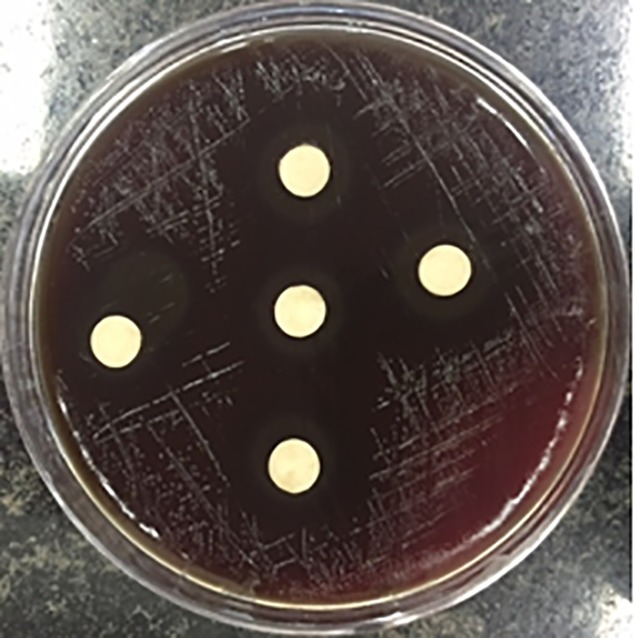
Bacterial growth in the hypochlorite sodium group
Figure2.
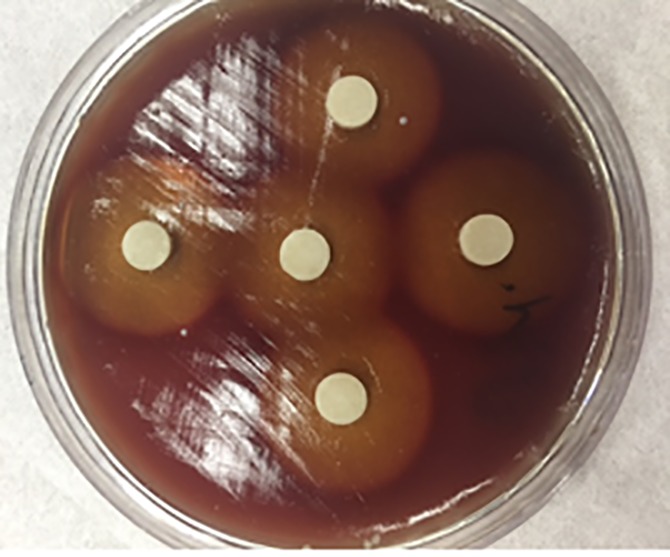
Bacterial growth in the spearmint extract group
Penicillin disk was used for positive control and a blank sterile disk with physiologic serum was used for negative control. In the process of preparing the disks, the blank sterile disk was prepared by pouring 0.01 milliliter of solution using a sampler. The disk was used after the solution was absorbed and dehydrated. This procedure was performed for each solution. Data were analyzed in SPSS 17 software. Mann-Whitney U test was used to compare the diameter of halo between the groups. The significance level was considered as alpha = 0.05.
Results
The results showed that the mean diameter of the halo in the Spearmint extract group was zero and in the sodium hypochlorite group it was 23.7 ± 1.49 mm. A significant statistical difference was observed in the comparison of the mean diameter of the halo in the two study groups based on Mann-Whitney U test ( p < 0.001) (Table 1).
Table 1.
Mean value and standard deviation of halo diameter of lack of microbial growth, (mm) in the two studied groups
| Group | Number | Mean | SD | p-value |
|---|---|---|---|---|
| Hypochlorite sodium | 10 | 23.70 | 1.49 | <0.001 |
| Spearmint extract | 10 | 0 | 0 |
SD: Standard Deviation
Discussion
The purpose of the present study was to investigate the anti-bacterial effect of the spearmint extract in comparison with that of sodium hypochlorite on E.faecalis bacteria which is the main anaerobic gram positive bacteria existing in the root canal with the ability of growth in agar medium [7]. The results showed that the mean diameter of the halo in the Spearmint extract group was zero, and in contrast to sodium hypochlorite, it did not have any effect on E.faecalis bacteria.
Sodium hypochlorite is one of the most common irrigating solutions of root canal during the treatment with the ability of removing biofilms and bacteria [10,11]. In the present study, 5.25% Sodium hypochlorite was selected because based on previous studies this concentration has a high efficacy against E. faecalis [12-15]. Thus, this concentration was used in this study and its antibacterial effect was compared with that of Spearmint extract.
Janzani, et al. reported that Spearmint extract has antibacterial properties due to the presence of Polgoon, Menton, and Neomenton groups in this plant that can cause the destruction of different polysaccharides, fatty acids, and phospholipids of bacteria membrane and subsequently, change the permeability of the bacterial cell membrane and destroy the bacterial wall [9].Results of the study of Bonyadian and Moshtaghi [16] showed that Spearmint extract has antibacterial property against microorganisms such as Salmonella typhimurium, Listeria monocytogenes, Yersinia enterocolitica, Bacillus cereus, Clostridium perfringens, Staphylococcus aureus, Helicobacter pylori, Pseudomonas aeruginosa and Klebsiella pneumonia with the highest anti-bacterial effect against Salmonella typhimurium.
Indeed, we should notice that the antibacterial effect of the Spearmint extract for irrigating the root canal was tested in this study in laboratory conditions and these effects may be different in clinical conditions. Differences between PH of the saline and medium used in laboratory, mouth temperature and incubator temperature and also the presence of blood in the medium and oxidation power and survival in different areas of oral cavity could influence the results [13]. Therefore, compared to laboratory condition, the antimicrobial efficacy of irrigants is decreased in the tooth model. Also, the antimicrobial effects of different solutions are also affected by experimental methods, biological indices and the time duration when the bacteria are subjected to the solutions [17].
In the present study Agar diffusion method was used. One of the Agar diffusion test shortcomings is inability to distinguish between bacteriostatic or bactericidal properties of the studied materials. In addition, due to the need to sufficient time for efficient diffusions of the materials in the agar medium, we cannot distinguish its immediate effects. Also, it is not possible to study long-term effects of materials because they dry after 1 to 2 days.
It is important to notice that in plates including medium, antibacterial solutions were in contact with microbe permanently, but in the oral cavity materials are removed after a few seconds and the factors existing in the mouth neutralize their effect. Therefore, compared to laboratory condition, the antimicrobial efficacy of irrigants is decreased in the tooth model.
Because of the importance of the role of remaining bacteria in the failed root canal treatments and by considering the fact that using medicinal plants is one of the sources of new medicaments, further studies on other medicinal plants are recommended.
Conclusions
The results showed that the mean diameter of the halo of lack of growth in the Spearmint extract group was zero and in contrast to sodium hypochlorite, it did not have any effect on E.faecalis bacteria. Based on the results of this study and considering the constraints of a laboratorial study, it seems that spearmint extract does not have any anti-bacterial effect against Enterococcus faecalis bacteria, in contrast to hypochlorite sodium 5.25%.
Acknowledgement
We would like to thank the Vice-chancellor of Research and Technology, Shahid Sadoughi University of Medical Sciences, who approved this study.
Conflict of Interest:None declared.
References
- 1.Zhang C, Hou BX, Zhao HY, et al. Microbial diversity in failed endodontic root-filled teeth. Chin Med J (Engl) 2012;125:1163–1168. [PubMed] [Google Scholar]
- 2.Yaghooti Khorasani M, Assar S, RezaHoseini O. Comparison of Antimicrobial Effects of Persica and Chlorhexidine with Sodium Hypochlorite on Enterococcus Fecalis and Candida Albicans: An In vitro study. J Mash Dent Sch. 2010;34:153–160. [Google Scholar]
- 3.Mohammadi Z, Shalavi S. Antimicrobial activity of sodium hypochlorite in endodontics. J Mass Dent Soc. 2013;62:28–31. [PubMed] [Google Scholar]
- 4.Rashidi Sh, Farajee H, Jahanbin D, et al. Evaluation of Knowledge, Belief and Operation of Yasouj People Towards Pharmaceutical Plants. J Med Plants. 2012;11:177–184. [Google Scholar]
- 5.Chami N, Chami F, Bennis S, et al. Antifungal treatment with carvacrol and eugenol of oral candidiasis in immunosuppressed rats. Braz J Infect Dis. 2004;8:217–226. doi: 10.1590/s1413-86702004000300005. [DOI] [PubMed] [Google Scholar]
- 6.Lindsay WP, Lamb CJ, Dixon RA. Microbial recognition and activation of plant defense systems. Trends Microbiol. 1993;1:181–187. doi: 10.1016/0966-842x(93)90088-9. [DOI] [PubMed] [Google Scholar]
- 7.Heath CH, Blackmore TK, Gordon DL. Emerging resistance in Enterococcus spp. Med J Aust. 1996;164:116–120. [PubMed] [Google Scholar]
- 8.Haapasalo M, Ranta H, Ranta KT. Facultative gram-negative enteric rods in persistent periapical infections. Acta Odontol Scand. 1983;41:19–22. doi: 10.3109/00016358309162299. [DOI] [PubMed] [Google Scholar]
- 9.Jazani NH, Ghasemnejad Berenji H, Sadeqpoor S. Antibacterial effects of Iranian Mentha pulegium essential oil on isolates of Klebsiella sp. Pak J Biol Sci. 2009;12:183–185. doi: 10.3923/pjbs.2009.183.185. [DOI] [PubMed] [Google Scholar]
- 10.Clegg MS, Vertucci FJ, Walker C, et al. The effect of exposure to irrigant solutions on apical dentin biofilms in vitro. J Endod. 2006;32:434–437. doi: 10.1016/j.joen.2005.07.002. [DOI] [PubMed] [Google Scholar]
- 11.Heling I, Rotstein I, Dinur T, et al. Bactericidal and cytotoxic effects of sodium hypochlorite and sodium dichloroisocyanurate solutions in vitro. J Endod. 2001;27:278–280. doi: 10.1097/00004770-200104000-00009. [DOI] [PubMed] [Google Scholar]
- 12.Berber VB, Gomes BP, Sena NT, et al. Efficacy of various concentrations of NaOCl and instrumentation techniques in reducing Enterococcus faecalis within root canals and dentinal tubules. Int Endod J. 2006;39:10–17. doi: 10.1111/j.1365-2591.2005.01038.x. [DOI] [PubMed] [Google Scholar]
- 13.Kangarloo Haghighi A, Tashfam B, Nasseri M, et al. In-vitro comparison of antibacterial efficacy of a new irrigation solution containing nanosilver with sodium hypochlorite and chlorhexidine. J Dent Sch. 2013;30:261–267. [Google Scholar]
- 14.Retamozo B, Shabahang S, Johnson N, et al. Minimum contact time and concentration of sodium hypochlorite required to eliminate Enterococcus faecalis. J Endod. 2010;36:520–523. doi: 10.1016/j.joen.2009.12.005. [DOI] [PubMed] [Google Scholar]
- 15.Tirali RE, Turan Y, Akal N, et al. In vitro antimicrobial activity of several concentrations of NaOCl and Octenisept in elimination of endodontic pathogens. Oral Surg Oral Med Oral Pathol Oral Radiol Endod. 2009;108:117–120. doi: 10.1016/j.tripleo.2009.07.012. [DOI] [PubMed] [Google Scholar]
- 16.Bonyadian M, Moshtaghi H. Bacteriocidal Activity of Some Plants Essential Oils Against Вacilhis cereus, Salmonella typhimurium, Listeria monocytogenes and Yersinia enterocoliûca. Res J Microbiol. 2008;3:648–653. [Google Scholar]
- 17.Estrela C, Ribeiro RG, Estrela CR, et al. Antimicrobial effect of 2% sodium hypochlorite and 2% chlorhexidine tested by different methods. Braz Dent J. 2003;14:58–62. doi: 10.1590/s0103-64402003000100011. [DOI] [PubMed] [Google Scholar]