



Abstract
Perceivers rapidly process social category information and form stereotypic impressions of unfamiliar others. However, a goal to individuate a target or to accurately predict their behavior can result in individuated impressions. It is unknown how the combination of both accuracy and individuation goals affects perceptual category processing. To explore this, participants were given both the goal to individuate targets and accurately predict behavior. We then recorded event-related brain potentials (ERPs) while participants viewed photos of Black and White males along with four pieces of individuating information in the form of descriptions of past behavior. Even with explicit individuation and accuracy task goals, participants rapidly differentiated targets by race within 200 ms. Importantly, this rapid categorical processing did not influence behavioral outcomes, as participants made individuated predictions. These findings indicate that individuals engage in category processing even when provided with individuation and accuracy goals, but that this processing does not necessarily result in category-based judgments.
Keywords: Race, ERP, Individuation, N200, Social Neuroscience, Prejudice
Perceivers have access to a wealth of information when forming impressions of others, including categorical information (e.g. race, gender, age) as well as more personalized information (e.g. traits, likes, values) (Brewer, 1988; Fiske & Neuberg, 1990). During a typical encounter, perceivers rapidly engage in efficiency-based person perception by attending to categorical information (Ito & Urland, 2003), allowing individuals to quickly draw upon category knowledge when forming impressions of others. In this way, stereotypes and prejudices provide a shortcut to inform behavioral responding and at times create a tradeoff between impression speed and accuracy (Macrae, Milne, & Bodenhausen, 1994). Impression formation is often described as a multi-staged process whereby individuals are initially evaluated in a categorical manner and, given enough time, processing resources, or interest in the target, processing continues in an individuated, person-specific mode. Therefore, in many models of impression formation, initial categorization is described as the first stage of both categorical and individuated impression formation (Brewer, 1988; Fiske & Neuberg, 1990; Greenwald & Banaji, 1995; Hugenberg, Miller, & Claypool, 2007; Macrae & Bodenhausen, 2000; Rhodes, Locke, Ewing, & Evangelista, 2009; Young, Bernstein, & Hugenberg, 2010; Young & Hugenberg, 2012).
Although perceivers quickly process categorical information, it is theorized that category-based impressions can be tempered by both individuation and accuracy goals (Brewer, 1988; Fiske & Neuberg, 1990). However, it remains relatively unclear how a goal to both individuate a target and be accurate influences perceptual processing of social category information. To explore this question, we recorded event-related brain potentials (ERPs) as a temporally sensitive measure of category processing, in this case race, while participants were given both individuation and accuracy instructions to quantify changes in race perception overtime.
ERP Correlates of Categorical and Individuated Impressions
Perceivers process race rapidly, within 200 ms of viewing a face (Ito & Urland, 2003; Kubota & Ito, 2007). To quantify early race processing researchers often turn to ERPs, a temporally sensitive neuroimaging measure of changes in electrical activity over time. Two early ERP components reliably modulated by race are the P200 and N200. The P200, a positive-going component occurring around 180 ms after viewing a face, is typically larger to outgroup faces than ingroup faces (Dickter & Bartholow, 2007; Ito & Urland, 2003, 2005; Kubota & Ito, 2007; Willadsen-Jensen & Ito, 2006, 2008). The P200 is often described as reflecting rudimentary vigilance processing, as P200s are modulated by threatening and/or distinctive stimuli (Ito & Bartholow, 2009).
Although initially perceivers attend to outgroup members at the P200, processing quickly transitions to a focus on ingroup members at the N200. The N200, a negative-going component occurring around 250 ms after viewing a stimulus, is larger to ingroup faces than outgroup faces (Dickter & Bartholow, 2007; Ito & Urland, 2003, 2005; Kubota & Ito, 2007; Willadsen-Jensen & Ito, 2006, 2008), larger to pictures of one’s own face than to others’ faces (Tanaka, Curran, Porterfield, & Collins, 2006), and larger to famous than to unfamiliar faces (Bentin & Deouell, 2000). Processing at the N200 facilitates memory for ingroup faces (Lucas, Chiao, & Paller, 2011), leading researchers to posit that the N200 reflects a type of perceptual individuation that supports deeper encoding of a face (Ito & Bartholow, 2009; Kubota & Ito, 2007; Lucas et al., 2011). These results converge on a hypothesis that the N200 may play a role in individuation.
Given that the P200 and N200 represent very early visual processing of race, these components are ideal for testing how the combination of individuation and accuracy goals affects rapid race processing. There is evidence to suggest that category-based processing occurs under individuation instructions. Ito and Urland (2005) observed race effects at the P200 and N200 when the participants’ goal was to individuate targets by either making personality or food preference judgments (Ito & Urland, 2005), implying that race processing occurs in a similar pattern under individuation instructions as when individuals are asked to explicitly attend to race. However, participants were not given accuracy instructions and additionally were not provided with individuating information. This research represents a first step, but it remains unclear how providing individuals with both a goal to individuate targets and to accurately predict their behavior from detailed behavioral information affects initial categorical processing.
Overview of Present Research
To encourage individuated perception and to explore how emphasizing both individuation and accuracy affects early race perception, we recorded ERPs while participants viewed targets and performed an individuation task. The primary aim of this research was to investigate how these goals affect race perception as measured by P200s and N200s during an individuation task. Additionally, we sought to explore the relationship between P200 and N200 amplitudes and individuated judgments. To address these research aims, we provided participants with a goal to both individuate the targets and to be accurate. During the individuation task, participants viewed Black and White targets paired with person-specific behavioral information while recording ERPs. Participants learned about instances when the targets behaved passively and/or aggressively (individuating information) and were asked to predict the target’s behavior in a passivity-relevant new situation (Beckett & Park, 1995; Blair, Chapleau, & Judd, 2005; Locksley, Hepburn, & Ortiz, 1982). We expected to replicate previous behaivoral findings that under accuracy and individuation instructions participants would make individuated behavioral predictions.
Additionally, we predicted one of three possible affects of accuracy and individuation goals on race perception. First, we could replicate Ito and Urland (2005) and observe rapid social category processing despite explicit individuation and accuracy goals (H1). If this were the case, we would expect P200 and N200 to differentiate between Black and White faces. In contrast, the combination of accuracy and individuation instructions may eliminate race effects at the P200 and N200 (H2). Finally, it was also possible to observe some combination of the two previous effects whereby if categorization and individuation occur in sequence (as predicted by behavioral models of impression formation), then we would expect a dissociation between P200s (a marker of initial selective attention to social category information) and N200s (a hypothesized marker of perceptual individuation), such that we may observe race differences at the P200 but not at the N200 (H3).
In a second task, participants passively viewed new Black and White targets. Our goal for this task was to collect an independent measure of race perception for all participants and to explore possible carryover effects of individuation and accuracy instructions to new novel targets.
Methods
Participants
Twenty-nine White undergraduates enrolled in Introductory Psychology at the University of Colorado Boulder participated in return for partial credit toward their experiment participation requirement. Four participants were excluded from analyses because of ERP recording difficulties that rendered their data unusable, leaving 25 White participants. All participants lived in the United States for more than 10 years and spoke English as their first language. Most were freshmen (Mage=19.48, SD=1.92). Eighteen were female, and seven were male.
Faces
For the individuation task, one hundred and sixteen yearbook photos (54 Black faces and 62 White faces) were piloted by 53 participants and rated for their perceived aggressiveness, ethnicity, and attractiveness. Faces were cropped to eliminate clothing, shown in color, and presented from the neck up. Of the faces piloted, sixty-four faces with neutral expressions were selected for use in the individuation task (32 Black faces and 32 White faces; see Supplementary Materials for piloting information).
In the second task, the passive-viewing task, participants viewed 10 new Black faces, 10 new White faces, and a photo of themselves. The participants’ picture was taken when they first arrived to the laboratory. Their photo was edited to match the Black and White photos in the passive-viewing task in terms of the size of the photo and the background color. Self-faces were included for exploratory reasons and are not discussed further in this manuscript.1
Procedures
Participants were told that the purpose of the project was to determine how impressions are formed and how individuals use past information about behavior when predicting behavior in a subsequent situation. Following ERP fitting, participants were introduced to the individuation task. Participants were told that the targets had participated in a previous experiment and that they self-reported their behavior in these scenarios (see Supplementary Materials).
Participants were then familiarized with five scenarios (a driving scenario, a basketball court scenario, a disagreement with a girlfriend, and a roommate situation; see Supplementary Materials).2 It was stressed to participants that their (the participant’s) prediction of passivity for the 5th situation, involving a disagreement in a bar, would be compared to the target’s actual reported behavior and thus they (the participant) should try to be as accurate as possible. In the bar scenario, a patron intentionally bumps into the target and spills a drink on them. The participants were asked to predict to what degree it was likely that the person behaved passively (ignored the patron) or aggressively (shoved the patron back) in the bar scenario.
During the individuation task, participants first saw a photo of the target (either a Black or a White male) for 350 ms that was presented on the left side of the screen. Then, the four scenario responses appeared on the right side of the screen. The photo and the responses were shown together for 2 seconds. The four responses and face remained on the screen and below them appeared a prompt: “Estimate the likelihood that this individual behaved aggressively in the BAR scenario on a 0 (Non-Aggressive) to 99 (Aggressive) scale”. The picture, four pieces of aggressive information, and the scale remained on the screen until the participant responded. A one second inter-trial interval followed their response (see Figure 1).
Figure 1.
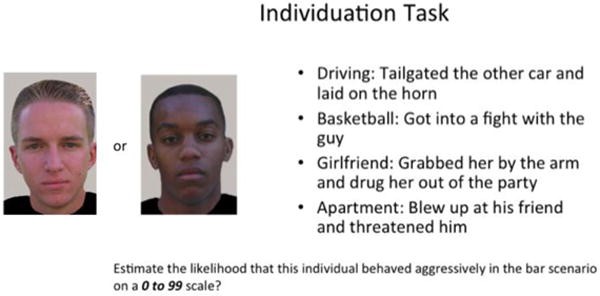
Individuation task used with permission from Blair, Chapleau, and Judd (2005) with two example face stimuli. Note these stimuli were not those used during this experiment. We do not have permission to print the stimuli used during the experiment.
In the individuation task, participants read how that target ostensibly behaved in each of the four scenarios. Each scenario had two possible behavioral reactions: a passive reaction or an aggressive reaction. This allowed for 16 unique combinations of behaviors across the four scenarios. Each combination of scenarios (e.g., passive, passive, aggressive, aggressive) was presented with a new face, and each was presented twice, once with a Black target and once with a White target. There were 32 Black targets and 32 White targets, resulting in 64 total trials. All conditions were intermixed and randomized without replacement.
In the passive-viewing task, participants were asked to attend to each face presented for 350 ms, followed by a 1000 ms ITI. Participants viewed a set of 10 Black and 10 White faces (different faces from those used during the individuation task). Black faces were shown 40 times (i.e. each unique face was shown four times) and White faces were shown 40 times (i.e. each unique face was shown four times), resulting in 80 total trials. In both tasks, all photos were shown in color, presented at 640 × 480, and presented from the neck up.
ERP Data Collection and Reduction
ERP data were recorded with 64 electrodes embedded in a stretch-lycra cap (Electro-Cap International, Eaton, OH), and positioned according to the 10–20 international system (Jasper, 1958). The ground electrode was embedded in the midline between the frontal pole and the frontal site. Electrodes were placed over the left and right mastoid, with scalp data referenced online to the left mastoid. To assess vertical and horizontal eye movement, electrodes were placed on the supra- and sub-orbit of the left eye and on the outer canthi of both the left and right eye. Electrode impedances were below 10 KΩ. Electrode gel was used as the conducting medium. ERP recordings were amplified with a gain of 500 by NeuroScan Synamps (Sterling, VA), with a bandpass of .15–30 Hz, and digitized at 1000 Hz. Offline, data were re-referenced to a computed average of the left and right mastoid.
ERP data were submitted to a regression procedure for correction of eyeblink artifact. Epochs were then created starting at 100 ms pre-stimulus onset and continuing for 1000 ms after stimulus onset, and were baseline-corrected to the mean voltage of the pre-stimulus period. Each trial was then visually inspected for remaining blink or muscle artifact. When artifacts were detected, the trial was removed from analyses. These artifact-free trials were then filtered with a 30 Hz low-pass filter. Waveforms derived from the artifact-free trials were averaged for each participant for the Black faces and the White faces in both the individuation and passive-viewing task, respectively.
ERP amplitudes during the individuation task were submitted to a 2 Target Race (Black, White) × 3 Lateral Sites (Right, Midline, Left) × 3 Sagittal Site (Frontal, Central, Parietal) repeated measures GLM. To explore attention to Black and White targets in the passive-viewing task, all components were analyzed with a 2 Target Race (Black, White) × 3 Lateral Sites (Right, Midline, Left) × 3 Sagittal Site (Frontal, Central, Parietal) repeated measures GLM. All effects for each model with more than one degree of freedom were evaluated using a Greenhouse-Geisser (1959) correction, although uncorrected degrees-of-freedom for these contrasts are reported in the text (Jennings, 1987).
Analyses are reported in three main sections. First, we examine the ERP effects in the individuation task when participants had explicit individuation and accuracy instructions. This allows for an examination of individuation and accuracy goals on race perception. Next, we examine a behavioral measure of the degree to which individuals individuated targets when provided with past behavioral information. This allows for an estimation of the use of individuating information. Then, we examine the ERP effects in the passive-viewing task, allowing for an independent assessment of race perception for each participant as well as a test of generalization of the goals (individuation and accuracy) to new targets. Finally, we examine correlations between the aggression estimates and the ERPs in the individuation and the passive-viewing tasks to explore the relationship between early race processing and individuation.
Results
ERPs During The Individuation Task
During the individuation task, P200 amplitudes were maximal at Fz and peaked at approximately 171 ms and N200 amplitudes were maximal at Cz and peaked at 248 ms. Peak component amplitudes were scored for each participant in each condition at 9 scalp sites (Fz, F3, F4, Cz, C3, C4, Pz, P3, and P4) by locating the maximal positive deflection between 120 – 220 ms (P200) and the maximal negative deflection between 180 – 310 ms (N200). Effects involving the scalp distribution of the electrical activity for all ERP components that do not involve target race are provided in the Supplementary Materials.
P200 Amplitudes
When considering the difference between processing of Black and White faces, there was a significant main effect of Target Race (F(1, 24)=15.56, p<.01, Partial η2=.39). Replicating previous work, P200s were larger to Black faces than White faces (M=4.10 μV, and M=1.69 μV, respectively) (see Figure 2).
Figure 2.

ERPs during the individuation task. Black lines represent Black faces and gray lines represent White faces. Electrodes from the midline are shown at frontal (Fz), central (Cz), and parietal (Pz) locations and lateral electrodes are shown at F3 and F4. Component locations in the waveform are displayed on Cz. X-axis represents time in ms and Y-axis represents amplitude in μV.
N200 Amplitudes
In addition, past race effects were replicated for the N200 with larger (more negative) N200s to White faces than Black faces (M=-4.17 μV and M=-6.91 μV, respectively, F(1, 24)=9.16, p<.01, Partial η2=.28).
These results support H1 and replicate the findings of Ito and Urland (2005). The P200 and N200 differentiated between racial groups despite explicit individuation and accuracy goals.
Behavioral Individuation
Next we assessed participant’s behavioral predictions of target passivity. Each participant provided a probability estimate for each target, yielding 64 estimates of aggression (32 each for Black and White targets). Utilizing multilevel modeling, each probability estimate was regressed on the target’s amount of past aggressive behavior. For the first model, aggressiveness in past behavior was coded using a single predictor reflecting the amount of aggressive behaviors across the four scenarios (i.e. ranging from 0 to 4). The first model treated past aggression as a single continuous variable and resulted in a parameter estimate for the weight given to the targets’ behavior, collapsing across scenario type. Those weights were used to determine the average degree to which past behavior was used to predict behavior in the bar scenario for each participant. As such, Model 1 provides a measure of individuation when collapsing across target race (see Figure 3).
Figure 3.

Estimating Individuation. Panel A represents the hierarchical linear model used to test whether participants use past behavior when predicting subsequent behavior, controlling for normative aggression and attractiveness ratings. Panel B represents the hierarchical linear model used to test whether participants use past behavior when predicting subsequent behavior, controlling for normative aggression and attractiveness ratings, race, and the interaction between race and amount of aggressive information. k represents trial number.
Model 1 was run as a replication of Locksley and colleagues (1982) to establish that the participants in fact used the individuating information when predicting aggression. Although care was taken to select faces with similar normative aggressiveness and attractiveness ratings, there was still variability in these ratings across stimuli. Therefore, normative ratings of aggressiveness and attractiveness were added as covariates. Replicating past work, participants relied on the target’s past aggressive behavior when predicting aggression (M =21.62; t(24)=26.83, p<.01). This indicates that for each additional past aggressive behavior, estimates of aggressive behavior in the future increased by nearly 22 points.
To test whether participants used racial category when predicting passivity, both target race and the interaction between number of aggressive behaviors and race were included in Model 2. Normative ratings of each target’s perceived aggression and attractiveness were also controlled in this analysis (Figure 3). As when past aggressive behavior is modeled in isolation, participants made individuated judgments (M =21.60, t(24)=26.73, p<.01), controlling for race of the target, the interaction between race and aggression, normative aggressiveness ratings, and normative attractiveness ratings (see Table 1). As number of aggressive past behaviors increased, predicted aggression in the fifth scenario increased similarly by 22 points. Target race did not influence aggression judgments above and beyond individuating information.3
Table 1.
|
M
|
SD | t-value | ||
|---|---|---|---|---|
| Mean Aggressive Information | 21.60 | 4.04 | 26.73** | |
| Race | .25 | 1.92 | .65 | |
| Race × Aggression | .42 | 1.33 | 1.59 | |
| Rated Aggressiveness | 1.62 | 3.70 | 2.19* | |
| Rated Attractiveness | −.55 | 2.83 | −.98 |
Predicting use of individuating information from aggressive past information provided (in this case the mean amount which is 2 pieces of aggressive information), race of the target, race by aggression interaction, pilot rated aggressiveness of the face, and pilot rated attractiveness of the face. Mean unstandardized regression coefficient (M ), standard deviations (SD), and t-tests for probability of aggression estimates are included.
p < .01 and
p < .05.
These analyses suggest that after emphasizing individuation and accuracy and providing individuals passivity-relevant information, participants made individuated judgments when predicting how the target behaved in a similar situation, and they did so equally for Black and White targets.
ERPs During The Passive-Viewing Task
During the passive-viewing task, P200 amplitudes were maximal at approximately 150 ms and N200 amplitudes were maximal at 224 ms. Peak component amplitudes were scored for each participant in each condition at 9 scalp sites (Fz, F3, F4, Cz, C3, C4, Pz, P3, and P4) by locating the maximal positive deflection between 100 – 200 ms (P200) and the maximal negative deflection between 180 – 280 ms (N200). Component latency windows closely matched previous research (see Ito & Urland, 2003).
P200 Amplitudes
P200s were maximal at Cz (see Figure 4). There was a significant main effect of Target Race (F(1, 24)=4.54, p<.05, Partial η2=.16). Replicating previous work and similar to the effects observed in the individuation task, P200s were larger to Black faces than White faces (M=5.45 μV, and M=4.42 μV, respectively).
Figure 4.

ERPs during the passive-viewing task. Black lines represent Black faces and gray lines represent White faces. Electrodes from the midline are shown at frontal (Fz), central (Cz), and parietal (Pz) locations and lateral electrodes are shown at F3 and F4. Component locations in the waveform are displayed on Cz. X-axis represents time in ms and Y-axis represents amplitude in μV.
N200 Amplitudes
N200s were maximal at Cz. Race effects were replicated in the N200 with larger (more negative) N200s to White than Black faces (M=-3.69 μV and M=-2.00 μV, respectively, F(1, 24)=9.44, p<.01, Partial η2=.28).
ERP race effects were similar across both tasks, with ERPs slightly delayed when presenting individuating information with the face. Replicating previous research, participants differentiated targets by race at the P200 and N200. At the P200, participants attended more to Black faces than White faces (Ito & Urland, 2003, 2005) and more to White faces than Black faces at the N200 (Ito & Urland, 2003).
Analyses of the Relationship Between P200s, N200s, and Individuation Judgments
Recall that the individuation task produced a parameter estimate for the degree to which each participant used the behavioral information and relied on the target’s racial category when making their passivity judgments. Correlations among the participants’ estimates and the participants’ ERPs (serving as an index of early attention) were conducted.
Parallel contrasts were computed in the ERP components at the electrode site where component amplitudes were maximal. First, the race main effect contrasts in the P200 and N200 were calculated as the difference in processing between Black and White targets for both tasks. Also included in the correlations were the absolute amplitudes across target race at the P200 and N200. The absolute amplitude indicates whether processing at these components across racial groups relates, in general, to individuation.
For the individuation task, the average slope for the use of individuating information (the parameter estimate for overall use of the pieces of aggressive information), the average slope for use of the target’s race when predicting aggression, and the slope of the interaction between use of individuating information and race were included in the bivariate correlation analyses. These estimates were derived from regression Model 2. See Table 2 for the correlations for the individuation task and Table 3 for the correlations for the passive-viewing task.
Table 2.
| Use of Individuating Information | Use of Race | Race by Individuation Interaction | ||
|---|---|---|---|---|
| P200 | ||||
| P200 Overall Amplitude | .03 (.89) | .09 (.68) | −.03 (.90) | |
| P200 (White – Black) | −.18 (.39) | .01 (.98) | −.22 (.29) | |
| N200 | ||||
| N200 Overall Amplitude | −.33 (.11) | −.10 (.67) | .13 (.52) | |
| N200 (White – Black) | .06 (.79) | .14 (.52) | .09 (.66) |
Estimating the relationship between ERPs and individuation. Correlations and p-values are included. Recall that the N200 is a negative-going components so negative correlations represent larger amplitudes.
p < .05.
Table 3.
| Use of Individuating Information | Use of Race | Race by Individuation Interaction | ||
|---|---|---|---|---|
| P200 | ||||
| P200 Overall Amplitude | −.08 (.70) | .06 (.78) | .15 (.48) | |
| P200 (White – Black) | −.11 (.59) | −.02 (.93) | −.26 (.20) | |
| N200 | ||||
| N200 Overall Amplitude | −.42 (.04)* | .07 (.74) | .16 (.45) | |
| N200 (White – Black) | .11 (.60) | .06 (.78) | .06 (.76) |
Estimating the relationship between ERPs and individuation during the passive-viewing task. Correlations and p-values are included. Recall that the N200 is a negative-going component so negative correlations represent larger amplitudes.
p < .05.
From these correlations two main findings appear. First, there was a non-significant trend during the individuation task for larger N200s overall, as indexed by the absolute amplitudes across both Blacks and Whites, to be associated with greater use of individuating information (r(25)=-.33, p=.106). In addition, the greater the participants’ N200s overall during the passive-viewing task, the more participants used individuating information (r(25)=-.42, p<.05). These findings provide tentative evidence that differential deployment of attention that occurs within 200 ms of viewing a person relates to individuated judgments.
General Discussion
To assess how individuation and accuracy goals affect early race perception and individuated behavioral judgments, participants were given four pieces of information about the past behavior of Black and White individuals (individuating information) and asked to predict each individual’s behavior in a fifth situation with instructions to form individuated impressions and to be accurate. Replicating previous research, participants made individuated judgments and relied on the provided past behavior when predicting future behavior for all targets (Beckett & Park, 1995; Blair et al., 2005; Locksley et al., 1982). Additionally, the effects replicated past race differences observed at the P200 and N200 (Ito & Urland, 2003, 2005). P200s were larger to Black than White faces, and N200s were larger to White than Black faces in both tasks. Replicating Ito and Urland (2005) and supporting theoretical stage-based models of impression formation, these findings indicate that individuals engage in category processing even when provided with explicit instructions to both individuate the target and to be accurate. Additionally, even though we observed initial category based processing, participants ultimately made individuated judgments of the targets. These findings imply that individuated judgments do not preclude categorical perception.
Our investigation replicated and extended the effects observed by Ito and Urland (2005) who found that even when participants were asked to make a personality judgment or a food preference judgment, race still modulated P200s and N200s (Ito & Urland, 2005). We extended these finding (2005) by providing participants with both a goal to individuate and a goal to be accurate. Even with these intersecting goals, race perception rapidly occurred. In addition, Ito and Urland observed that focusing attention away from the social nature of the stimuli by having participants attend to the presence or absence of a dot on a face, similarly did not reduce P200 and N200 race differences (Ito & Urland, 2005). Thus, even when the goal is to process at a level deeper than the social category by making an individuated judgment or under accuracy instructions, or when the goal is unrelated to the social nature of the stimuli, race processing is still observed in a similar pattern to when individuals are asked explicitly to attend to social category information.
Individuation is common in many everyday encounters and individuals spontaneously infer traits both when personalized information is available and when it is not available (Uleman, Rim, Adil Saribay, & Kressel, 2012). Therefore, the mere presence of the information may have been sufficient to encourage individuation even without explicit instructions to individuate and be accurate. In this way, the robustness of the individuation behavioral results may be in part a product of experience individuating targets and the relative spontaneity of such inferences rather than based solely on the instructions. Although the instructions may not have been necessary to encourage individuation, previous research has shown that individuation instructions facilitate person-based impressions (Fiske & Neuberg, 2013). In this way, providing both individuation instructions and person knowledge is a robust way to encourage individuation. Importantly, despite providing perceivers with both a goal to individuate and person-specific information, our findings provide additional evidence in support of stage-based models of impression formation and suggest inflexibility in early categorical perception even when encouraged to individuate targets.
The correlation between N200s in the individuation task and individuation estimates failed to reach significance. One possible explanation is that during this involved impression task, early attention as measured by the P200 and N200 may have been a less proximal or robust predictor of behavior. Many psychological processes occur within the timeframe between initial attention and judgment; therefore, in more involved individuation tasks, downstream psychological processes may more strongly predict the actual impression. When we employed an independent measure of spontaneous attention to race in the passive-viewing task, we observed a relationship between individuation and N200s. This is interesting, particularly given that this relationship was explored between viewing one set of targets and individuating another set. Previous models of impression formation suggest that increases in attention to a target relates to individuated processing (Fiske & Neuberg, 1990). The relationship between N200s during processing of faces and individuation indicates that processes that encourage individuation may engage even at the earliest stages of encoding. These results provide tentative initial evidence for a relationship between overall depth of encoding early in perception and use of individuating information, but also insinuate that other downstream psychological processes may more strongly contribute to individuated judgments. The current work also demonstrates a novel link between extremely early devotion of attention to visual aspects of individuals and individuation. Further research is needed to clarify these relationships.
Race And Predicting Aggression
Participants relied on individuating information to an equal degree for Black and White targets. This was the case for all amounts of aggressive information. Even when targets behaved inconsistently, as was the case with two pieces of aggressive and two pieces of non-aggressive information, participants did not rely on race when predicting aggression. This finding on the surface seems like a departure from Blair, Chapleau, and Judd (2005), where participants relied on Afrocentric facial features when predicting aggression. However, unlike Blair and colleagues’ study, in this investigation, participants viewed individuals who were clearly categorically Black or White. Moreover, although participants had both individuation and accuracy instructions in Blair and colleagues’ investigation (2005), in the present research, the salience between category distinctions may have increased motivation to focus only on the information when predicting behavior. This account is consistent with previous research that found that individuals were likely to control racial prejudices and stereotypes when given time and motivation to be accurate (Devine, 1989; Dunton & Fazio, 1997; Fiske & Neuberg, 1990).
The importance of a photograph in this individuation task has been explored in previous research. Beckett and Park (1995) found that when participants were provided with a photo of the target they used gender to predict assertiveness of the target. However, when there was no photo and just a name, participants did not use gender to make their predictions. Our findings again appeared, at first, to be at odds with these findings, given that the ERP effects supported that participants processed the race of the targets from the photos, but participants also relied on the individuating information. One possible explanation for this discrepancy is that participants may have been more concerned about racial stereotyping than gender stereotyping and therefore tuned to the individuating information when they made their predictions.
As a preliminary exploration, however, this study also has limitations. First, because the faces were presented with the information, participants could have focused their attention more or less on either the face or the information. Future research should track participant’s visual attention to the faces and information to quantify how spontaneous individual differences in attention capture to the face or information moderates the results. In addition, although these results indicate that participants processed both race, as evidenced by the P200 and N200 race differences, and the individuating information, as evidenced by their individuated behavioral judgments; individual variability in attention to faces versus the individuating information may have diminished the likelihood of finding a relationship between the N200 and individuation during the individuation task. Future research should explore how presenting the face and information sequentially to allow for focused processing of both affects the ERP and behavioral results. Finally, there was no direct control condition in this research where perceivers were presented with no accuracy or individuation instructions or individualized information. Although, we replicated the race difference observed in other P200 and N200 race research (see Ito & Urland, 2003; 2005; Kubota & Ito, 2007), it may be the case that the race difference observed after accuracy and individuation instructions would be diminished in comparison to a no instructions replication condition where participants just viewed the Black and White faces either with the personalized information or with no information. Future research should explore how these instructions compare to no instructions.
To summarize, our findings support extant models of impression formation that place category processing as the initial stage and underscore posits that even when category processing is initiated, this information does not necessarily guide impressions. It appears that when individuals are motivated to be accurate and individuate targets and when there is no time constraint in the judgment, participants no longer rely on category information, even if this information is initially processed. Finally, this research supports posits by Ito and Urland (2005) that eliminating rapid race-based attention is relatively difficult.
Supplementary Material
Acknowledgments
This research was supported by a Ford Foundation Predoctoral Fellowship to the first author and a National Institute of Mental Health grant R01MH71257 to the second author. The authors would like to thank the CUSP lab at the University of Colorado Boulder and the SJNP lab at the University of Chicago for helpful comments on these projects.
Footnotes
Participants were shown pictures of themselves in this task as an exploratory investigation of the timecourse of processing the self compared with ingroup and outgroup members. Because the focus of this manuscript is on ingroup and outgroup processing only, ERPs to the self are not included in the analyses or figures. The participant’s face was shown 40 times.
Scenarios are identical to those used by Blair, Chapleau, and Judd (2005). We thank Irene Blair for sharing the instructions for the individuation task and the scenarios.
This is true at all amounts of aggressive behaviors provided (i.e. when there was no aggressive information provided, when there were 3 pieces of aggressive information provided, and when all the information provided was aggressive). Additionally, when excluding rated attractiveness and rated aggressiveness, the results do not change.
Contributor Information
Jennifer T. Kubota, University of Chicago
Tiffany Ito, University of Colorado Boulder.
References
- Beckett NE, Park B. Use of Category Versus Individuating Information: Making Base Rates Salient. Personality and Social Psychology Bulletin. 1995;21(1):21–31. [Google Scholar]
- Bentin S, Deouell LY. Structural encoding and identification in face processing: ERP evidence for separate mechanisms. Cognitive Neuropsychology. 2000;17(1–3):35–55. doi: 10.1080/026432900380472. [DOI] [PubMed] [Google Scholar]
- Blair IV, Chapleau KM, Judd CM. The use of Afrocentric features as cues for judgment in the presence of diagnostic information. European Journal of Social Psychology. 2005;35(1):59–68. [Google Scholar]
- Brewer MB. A dual process model of impression formation. In: Srull T, Wyer R, editors. Advances in Social Cognition. 1st. Vol. 1. Hillsdale, NJ: Lawrence Erlbaum Associates; 1988. pp. 1–36. [Google Scholar]
- Correll J, Urland GR, Ito TA. Event-related potentials and the decision to shoot: The role of threat perception and cognitive control. Journal of Experimental Social Psychology. 2006;42(1):120–128. [Google Scholar]
- Devine PG. Stereotypes and prejudice: Their automatic and controlled components. Journal of Personality & Social Psychology. 1989;56(1):5–18. [Google Scholar]
- Dickter CL, Bartholow BD. Racial ingroup and outgroup attention biases revealed by event-related brain potentials. Social Cognitive and Affective Neuroscience. 2007;2(3):189–198. doi: 10.1093/scan/nsm012. http://doi.org/10.1093/scan/nsm012. [DOI] [PMC free article] [PubMed] [Google Scholar]
- Dunton BC, Fazio RH. An individual difference measure of motivation to control prejudiced reactions. 1997;23(2):316–326. [Google Scholar]
- Fiske S, Neuberg SL. A continuum of impression formation, from category-based to individuating processes: Influences of information and motivation on attention and interpretation. In: Zanna MP, editor. Advances in experimental social psychology. 23rd. Vol. 23. New York: Academic Press; 1990. pp. 1–74. [Google Scholar]
- Greenhouse S, Geisser S. On methods in the analysis of profile data. Psychometrika. 1959;24:95–112. [Google Scholar]
- Greenwald AG, Banaji MR. Implicit social cognition: Attitudes, self-esteem, and stereotypes. Psychological Review. 1995;102(1):4–27. doi: 10.1037/0033-295x.102.1.4. [DOI] [PubMed] [Google Scholar]
- Hugenberg K, Miller J, Claypool H. Categorization and individuation in the Cross Race Recognition Deficit: Toward a solution for an insidious problem. Journal of Experimental Social Psychology. 2007;43:334–340. [Google Scholar]
- Ito TA, Bartholow BD. The neural correlates of race. Trends in Cognitive Sciences. 2009;13(12):524–531. doi: 10.1016/j.tics.2009.10.002. [DOI] [PMC free article] [PubMed] [Google Scholar]
- Ito TA, Urland GR. Race and gender on the brain: Electrocortical measures of attention to the race and gender of multiply categorizable individuals. Journal of Personality and Social Psychology. 2003;85(4):616–626. doi: 10.1037/0022-3514.85.4.616. [DOI] [PubMed] [Google Scholar]
- Ito TA, Urland GR. The influence of processing objectives on the perception of faces: An ERP study of race and gender perception. Cognitive, Affective & Behavioral Neuroscience. 2005;5(1):21–36. doi: 10.3758/cabn.5.1.21. [DOI] [PubMed] [Google Scholar]
- Jasper HH. The ten-twenty electrode system of the International Federation. Electroencephalography and Clinical Neurophysiology. 1958;10:371–375. [PubMed] [Google Scholar]
- Jennings JR. Editorial policy on analyses of variance with repeated measures. Psychophysiology. 1987;24(4):474–475. [Google Scholar]
- Kubota JT, Ito TA. Multiple cues in social perception: The time course of processing race and facial expression. Journal of Experimental Social Psychology. 2007;43(5):738–752. doi: 10.1016/j.jesp.2006.10.023. [DOI] [PMC free article] [PubMed] [Google Scholar]
- Locksley A, Hepburn C, Ortiz V. Social stereotypes and judgments of individuals: An instance of the base-rate fallacy. Journal of Experimental Social Psychology. 1982;18(1):23–42. [Google Scholar]
- Lucas HD, Chiao JY, Paller KA. Why some faces won’t be remembered: Brain potentials illuminate successful versus unsuccessful encoding for same-race and other-race faces. Frontiers in Human Neuroscience. 2011;5 doi: 10.3389/fnhum.2011.00020. [DOI] [PMC free article] [PubMed] [Google Scholar]
- Macrae CN, Bodenhausen GV. Social cognition: thinking categorically about others. Annual Review of Psychology. 2000;51:93–120. doi: 10.1146/annurev.psych.51.1.93. [DOI] [PubMed] [Google Scholar]
- Macrae CN, Milne AB, Bodenhausen GV. Stereotypes as energy-saving devices: A peek inside the cognitive toolbox. Journal of Personality and Social Psychology. 1994;66(1):37–47. [Google Scholar]
- Mangun GR. Neural mechanisms of visual selective attention. Psychophysiology. 1995;32(1):4–18. doi: 10.1111/j.1469-8986.1995.tb03400.x. [DOI] [PubMed] [Google Scholar]
- Rhodes G, Locke V, Ewing L, Evangelista E. Race coding and the other-race effect in face recognition. Perception. 2009;38(2):232–241. doi: 10.1068/p6110. [DOI] [PubMed] [Google Scholar]
- Tanaka JW, Curran T, Porterfield AL, Collins D. Activation of preexisting and acquired face representations: the N250 event-related potential as an index of face familiarity. Journal of Cognitive Neuroscience. 2006;18(9):1488–1497. doi: 10.1162/jocn.2006.18.9.1488. [DOI] [PubMed] [Google Scholar]
- Uleman JS, Rim S, Adil Saribay S, Kressel LM. Controversies, questions, and prospects for spontaneous social inferences. Social and Personality Psychology Compass. 2012;6(9):657–673. [Google Scholar]
- Valdes-Sosa M, Bobes MA, Rodriguez V, Pinilla T. Switching Attention without Shifting the Spotlight: Object-Based Attentional Modulation of Brain Potentials. Journal of Cognitive Neuroscience. 1998;10(1):137–151. doi: 10.1162/089892998563743. [DOI] [PubMed] [Google Scholar]
- Willadsen-Jensen EC, Ito TA. Ambiguity and the timecourse of racial perception. Social Cognition. 2006;24(5):580–606. [Google Scholar]
- Willadsen-Jensen EC, Ito TA. A foot in both worlds: Asian Americans’ perceptions of Asian, White, and racially ambiguous faces. Group Processes & Intergroup Relations. 2008;11(2):182–200. [Google Scholar]
- Young S, Bernstein MJ, Hugenberg K. When do own-group biases in face recognition occur ? Encoding versus post-encoding. Social Cognition. 2010;28(2):240–250. [Google Scholar]
- Young SG, Hugenberg K. Individuation motivation and face experience can operate jointly to produce the own-race bias. Social Psychological and Personality Science. 2012;3(1):80–87. [Google Scholar]
Associated Data
This section collects any data citations, data availability statements, or supplementary materials included in this article.