



Abstract
By leaving their engines idling for long periods, drivers contribute unnecessarily to air pollution, waste fuel, and produce noise and fumes that harm the environment. Railway level crossings are sites where many cars idle, many times a day. In this research, testing two psychological theories of influence, we examine the potential to encourage drivers to switch off their ignition while waiting at rail crossings. Two field studies presented different signs at a busy rail crossing site with a 2-min average wait. Inducing public self-focus (via a “Watching Eyes” stimulus) was not effective, even when accompanied by a written behavioral instruction. Instead, cueing a private-self focus (“think of yourself”) was more effective, doubling the level of behavioral compliance. These findings confirm the need to engage the self when trying to instigate self-regulatory action, but that cues evoking self-surveillance may sometimes be more effective than cues that imply external surveillance.
Keywords: psychology, behavior change, driver behavior, self-regulation, watching eyes, pro-environmental behavior, surveillance, private self-focus, visual cues
Road transportation is a major source of air pollution that harms the environment and human health. One of the most potent forms of pollution arises from stationary traffic with idling engines which, as well as wasting fuel, creates an accumulation of particulate matter, carbon monoxide, and nitrogen dioxide in the local environment (Shancita et al., 2014). The detrimental effects for other road users, pedestrians, and residents are exacerbated in many of the United Kingdom’s, and other European, smaller historic towns because streets and sidewalks are narrow and traffic concentrations are high. It is recommended that to reduce pollution, drivers should turn off their car engines when likely to be stationary for more than 1 min (Energy Savings Trust, 2016; Transport for London, 2012). Here, we report the results of two field experiments that test the effectiveness of interventions based on psychological theories of reputational concern and self-regulation to encourage drivers to switch off their engines when waiting at a railway level crossing. Results showed that images of “watching eyes” had no impact, but messages that combined clear instructions with a private self-focusing cue were effective, doubleing the rate of pro environmental behavior.
Behavioral science has demonstrated that human decision making can be strongly affected by the presence of environmental cues that affect their reasoning or motivation. Because people frequently rely on fast and intuitive decision-making strategies, even very minimal cues can sometimes have a powerful influence on behavior (Dolan et al., 2012; Thaler & Sunstein, 2008). A good example is the “watching-eyes effect.” On alternate weeks over a 10-week period, Bateson, Nettle, and Roberts (2006) showed either a picture of eyes or a picture of flowers near to an honesty box for drinks in a staff break room. Staff members paid nearly 3 times as much for their drinks when the picture of eyes was displayed. This is in line with the assumption that humans have evolved to be strongly attuned to cues that their reputation is at stake, because maintaining a reputation as a cooperative person is necessary for survival in a social system (Burnham & Hare, 2007; Haley & Fessler, 2005). Thus, subtle surveillance cues, such as the watching eyes, can induce cooperative behavior. Subsequent research has shown that images of eyes can increase people’s donations to a charity bucket (Powell, Roberts, & Nettle, 2012), their decisions to recycle appropriately (Francey & Bergmuller, 2012), reduce their littering (Bateson, Callow, Holmes, Redmond Roche, & Nettle, 2013; Ernest-Jones, Nettle, & Bateson, 2011), and deter them from stealing from public bicycle racks (Nettle, Nott, & Bateson, 2012). Even eye-like spots displayed on a computer screen have been shown to increase cooperative behavior within economic games (Haley & Fessler, 2005; Rigdon, Ishii, Watabe, & Kitayama, 2009).
In this article, we report two field experiments that examine whether and why surveillance cues have the potential to prompt drivers to turn off their ignitions while waiting. Railway level crossings are sites where many car engines idle, many times a day. Any impact on this behavior, therefore, has clear benefits. The site chosen for the present research was a busy level crossing in Canterbury in Kent, United Kingdom (see Figures 1 and 2). The level crossing is located in the shopping district in the city center on a road lined with shops and cafes. It is part of a major through route to the rail station and to the main city center bus stops. As such, it is heavily congested by both road traffic and pedestrians. During the period in which these experiments were conducted, the annual mean concentration of nitrogen dioxide at our level-crossing site was 39 µg/m3 (Medway Council, 2013) only just meeting the European Commission Air Quality target of 40 µg/m3 (European Commission, 2014). To encourage drivers to turn off their engines while waiting at the level crossing, Canterbury City Council had placed a permanent sign at the crossing (see Figure 3). Although some research suggests that signs alone can change behavior (e.g., McNees, Egli, Marshall, Schnelle, & Risley, 1976; Thurber & Snow, 1980), the message on this sign was designed simply to be an informational request and was not guided by any particular behavioral theory (Canterbury City Council, personal communication, November 3, 2016). Perhaps, owing to the absence of surveillance cues, the existing sign produced low levels of compliance (see baselines). In these experiments, we implemented additional types of surveillance cues in an attempt to increase compliance with the instruction to switch off engines.
Figure 1.
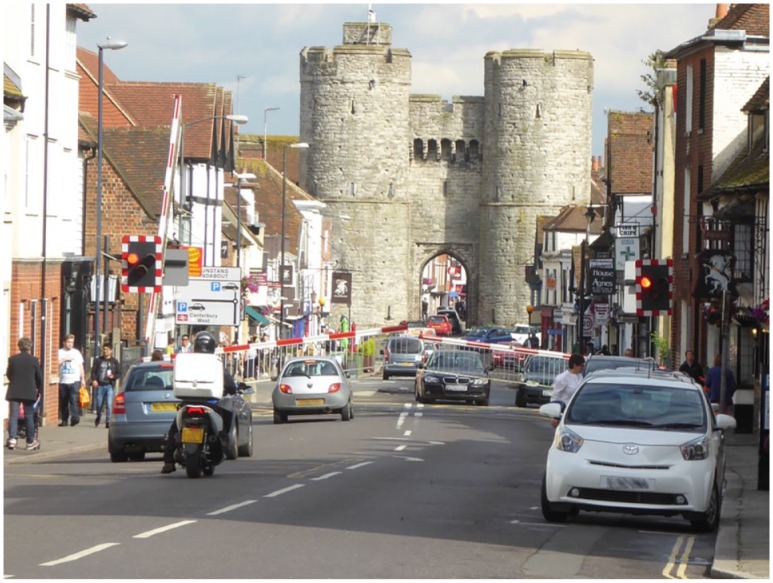
The level crossing and surrounding area.
Figure 2.
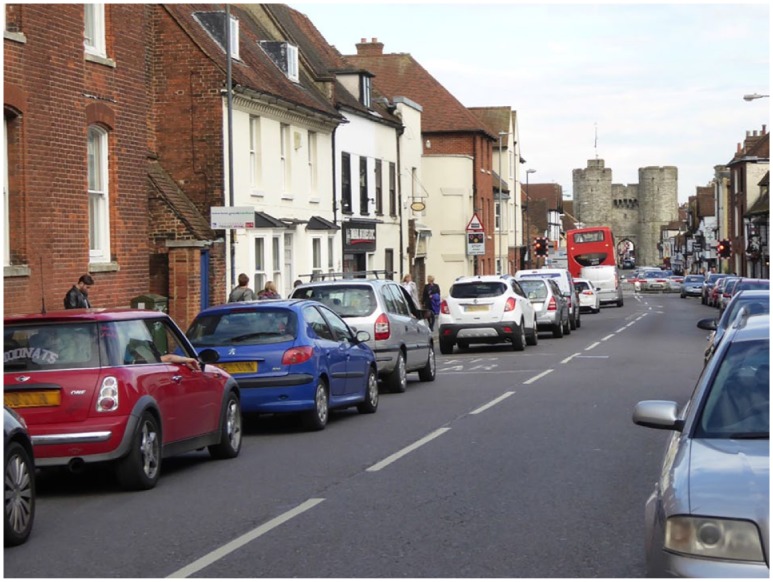
Example of queuing traffic when barriers are down.
Figure 3.

Permanent sign at the level-crossing site, placed by the local council.
Experiment 1
Experiment 1 tested whether the addition of “watching eyes” would increase drivers’ compliance with the existing instruction to turn off their engines while waiting at the level crossing. A black and white picture of a pair of watching eyes was displayed on a clear and visible placard on the approach to the railway level crossing. After the barrier dropped and vehicles were all stationary, research assistants walked along the sidewalk, recording whether each vehicle’s engine was on or off.
Sample and Procedure
The experimental data were collected during a 6-month period (October 2012 to March 2013). The level-crossing barrier drops 4 times per hour throughout the day. Data were collected Mondays to Saturdays and between 8:00 a.m. and 6:00 p.m. Data collection took place in 1 hr blocks in one of three periods: morning, early to mid-afternoon, and late afternoon. We randomly varied the time that data collection took place across days to reduce the chance that the same driver would be sampled more than once (e.g., while making their regular journeys to or from work), and in order that intervention conditions were not confounded with time of testing. Data were only collected during university term time when research assistants were available, and not during the Christmas or New Year period.
Across trials, the barriers were down for a mean of 2.33 min (SD = 0.79 min). An average of 22 cars were sampled in each trial. Vehicles were grouped by barrier drop and assigned to either the baseline or intervention condition. The same condition would be used for all barrier drops within 1 hr. Assignment to condition was random across the time of the trial and the direction of approach to the barrier.
The intervention sign showed a black and white image of a pair of eyes with a direct forward gaze in a photo of a man’s face taken from Bateson et al. (2006; see Figure 4). It was presented on a 420 × 594 mm (A2) (16.5 × 23.4 inch) placard 2 m high at the curbside. The placard was positioned approximately 5 m from the existing council sign, and 75 m before the barrier such that all vehicles would pass the sign on their approach on the level crossing. While the barrier was down and the vehicles were stationary, a single research assistant walked along the sidewalk from the barrier to the sign recording whether each vehicle’s engine was on or off.
Figure 4.

“Watching Eyes” manipulation (Experiment 1).
The outcome measure was binary and was measured discreetly by viewing exhaust activity and listening for engine noise emitted from each vehicle. Interrater reliability of this method was established in a baseline (no placard) sample of 160 vehicles prior to the start of the formal data collection period, and showed that there was high consistency in the on/off codes of independent judges of the same vehicles, χ2(1, N = 160) = 1.48, p = .224, range = 25-33%, switch off engines. Discrepancies were inspected and instructions to observers were modified to eliminate ambiguities in the coding instructions for the experiment.
Traffic included cars, public transportation, taxis, motorcycles, trucks, and delivery vehicles. The experiments focused on the behavior of car drivers because they can be largely assumed to have responsibility for their own vehicles.1 In Experiment 1, data were collected from 216 cars (nbaseline = 112, nintervention = 104). The number of drivers who turned their engine off in the experimental condition was compared with baseline measurements when no image was displayed. Pretest data also confirmed that there was no difference between baseline recordings when no placard was displayed versus when a blank placard was displayed (23% switched off engines, n = 52 baseline, n = 48 blank sign, χ2(6, N = 100) = 7.73, p = .259. To control for variance arising from random factors such as the weather, the duration that the barrier was down (typically for between 2 and 4 min), the number of people in the vehicle (estimated), and time of day of the trial, each of which could potentially affect a driver’s decision, these variables were also recorded and were treated as statistical covariates in the analyses that follow.
Results and Discussion
The data were analyzed with logistic regression. Contrary to expectations, results revealed no significant difference in the proportion of drivers who turned off their ignition in the watching eyes condition (20.2%) and the baseline condition (26.8%), and in fact the trend was opposite to the direction predicted by the reputational concern hypothesis. Neither the experimental condition nor any of the covariates had a significant association with drivers’ decisions to switch off their ignition, χ2(6, N = 216) = 7.61, p = .268, Nagelkerke R2 = .05 (see supplementary materials for full regression model). Experiment 1 failed to find an effect of a watching eyes intervention on the rate of drivers turning off their engine while waiting at a level crossing.2
This is not the first study that has failed to find a watching eyes effect (e.g., Carbon & Hesslinger, 2011; Fehr & Schneider, 2009; Northover, Pedersen, Cohen, & Andrews, 2016). Noting the methodology of prior research, however, we conjectured that it may be necessary to provide meaningful direction in addition to the surveillance cues of watching eyes. Typically, watching eyes are presented with an accompanying written instruction. In our case, the sign instructing drivers to turn off their idling engines (placed by the Council) was independent of the image of the eyes, and so, drivers would not necessarily link the two stimuli.
According to self-regulation theory (Carver & Scheier, 1982), when people are facing a behavioral decision, they will default to past habits unless (a) a different behavioral standard is made salient and (b) their attention is directed to an assessment of whether they are complying with that standard. A powerful method for directing attention in this way is to direct it toward the self. That is, people implicitly ask themselves, “am I doing the right thing?” and to verify this, they check against the available rules or standards in the situation. Watching eyes induce self-focused attention (Pfattheicher & Keller, 2015) directed at the public aspects of self, but it may also be necessary to make a relevant behavioral standard salient. Therefore, we tested whether adding an explicit instruction to the image of the watching eyes (instructive watching eyes) would lead to behavior change.
However, even with a behavioral standard available, there are also reasons why watching eyes may not produce the desired behavior. First, they may induce uncertainty or evaluation apprehension, which is likely to be experienced as general anxiety about being judged by others. This disrupts the regulation of behavior (Abrams & Manstead, 1981; Carver & Scheier, 1982; Pfattheicher & Keller, 2015). Second, drivers may not assume that others can easily detect whether their engine is on or off. This means that they would not regard the behavior as being in the public domain, and therefore, that it was not reputationally relevant. Consequently, an effective intervention should be one that induces self-regulation but that does not confound it with reputational concern. If the watching eyes effect in previous research has depended on participants’ self-regulation to a reputational standard, and its absence in the present research was because that standard is either ambiguous or disruptive for drivers, we reasoned that a more effective approach should be to use a cue that directs attention to the self but does not also create evaluation apprehension. It is possible to direct attention to the “private self” (thoughts, values, or feelings) rather than the public self (public image; Carver & Scheier, 1982). Private self-focus should increase self-regulation without invoking evaluation apprehension or reputational concern. Therefore, in a second experiment, we clarified the standard by making it explicit, and then sought to examine whether reputational concern versus private self-regulation would be the better route for increasing adherence to that standard. Specifically, we tested the effectiveness of a modified (instructive) watching eyes manipulation compared with a private self-attention manipulation as cues to increase the probability that drivers would switch off their engines while waiting at the level crossing.
Experiment 2
Experiment 2 compared the effectiveness of a modified, instructive watching eyes manipulation designed to evoke public self-focus, with a manipulation designed to evoke private self-focus. The latter was achieved simply by asking people to “think of yourself.” We hypothesized that the combination of this private self-focusing cue and the relevant behavioral standard should be effective.
Sample and Procedure
In Experiment 2, data were collected from 325 cars (nbaseline = 99, ninstructive watching eyes = 123, nself-focus = 103). Groups of cars (grouped by barrier drop) were randomly allocated to either the baseline condition, or one of the two experimental interventions. In the instructive watching eyes condition, the same image of eyes used in Experiment 1 was accompanied by the message “When the barriers are down switch off your engine.” In the private self-focused condition, the image of eyes was replaced by text priming self-relevance. The message read “Think of yourself: When barriers are down switch off your engine” (see Figure 5). The size and style of font was held constant across both conditions (font type = Franklin gothic medium, font size = 100 pt). All other aspects of the procedure were identical to that of Experiment 1.
Figure 5.
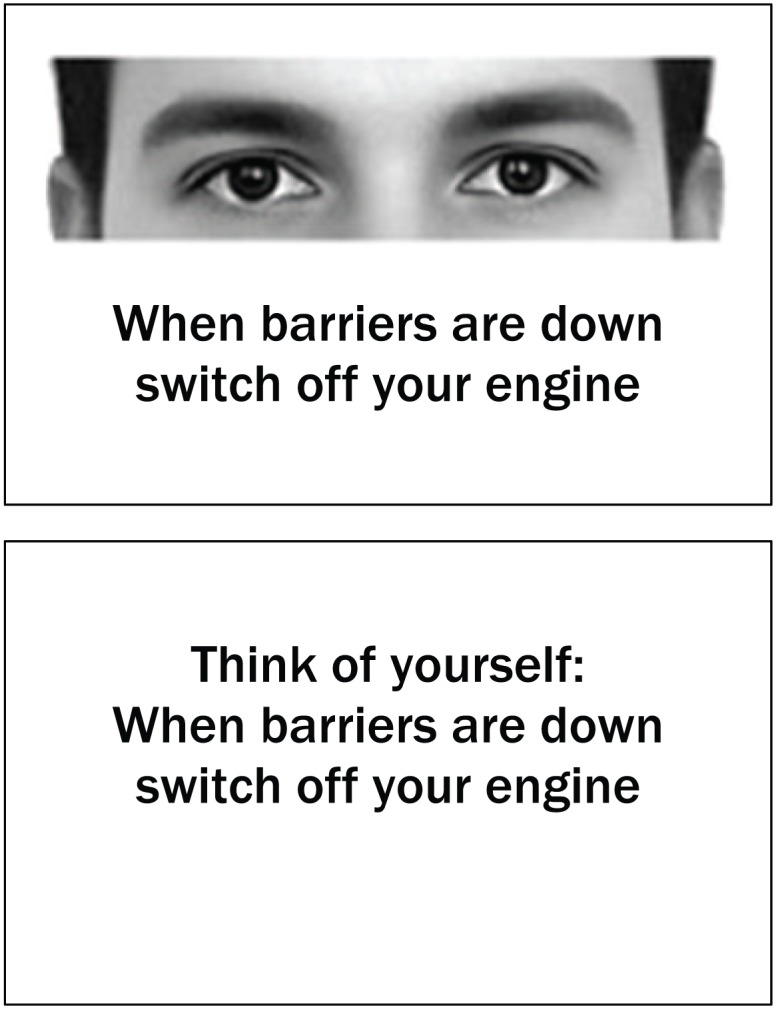
“Instructive Watching Eyes” and “Private Self Focus” manipulations (Experiment 2).
Results and Discussion
The logistic regression analysis revealed a significant omnibus test of model coefficients, χ2(7, N = 325) = 26.55, p < .001, Nagelkerke R2 = .11 (see supplementary materials for full regression model). None of the covariates had significant effects but there was a significant effect of condition (Wald = 14.95, p < .001). Fewer drivers switched off their engines in the baseline (20%) than in the instructive watching eyes condition (30%), B = .60, SE = 0.34, Wald = 3.07, p = .08). Significantly more drivers switched off their engines in the private self-focused condition (51%) than in the baseline condition, B = 1.57, SE = 0.41, Wald = 14.68, p < .001. The odds ratios revealed that drivers were 1.83 times more likely to switch off their engines in the instructive watching eyes condition, and 4.82 times more likely in the private self-focus condition than in the baseline condition (see Figure 6).
Figure 6.

Results across Experiments 1 and 2.
The results of Experiment 2 suggest that the most effective mechanism for encouraging drivers to turn off their ignition at a long wait stop was to cue a form of private self-focus, or self-surveillance. The inclusion of an explicit behavioral instruction with external monitoring cues (watching eyes) did increase the level of behavioral change compared with Experiment 1, but cueing private self-focus was substantially more effective.
General Discussion
This research has revealed four important findings using a real-world test of a highly consequential behavior. We wanted to know how to persuade drivers to switch off their ignition in a situation in which they would potentially, collectively, and substantially pollute the atmosphere of a large number of residents and pedestrians. The destructive behavior in this case lasts, on average, for 2 min, many times per day. Any reduction of this behavior, therefore, has clear benefits for all.
First, the mere presence of a sign about air quality has suboptimal impact. Planners at local and national levels use such signs to encourage better driver behavior. However, without clear evidence of whether and when these messages instigate self-regulatory action, their impact may be far less than could be achieved. In our data, baseline behavior in the presence of the Council sign showed that only 20% to 25% of motorists routinely switched off their ignition when the barriers were down. Some proportion of these will have included vehicles with start–stop systems that did not necessarily require active decisions by drivers.
Second, the presence of “watching eyes” in this context was not sufficient to increase compliance, and indeed, the trend was that compliance was suppressed rather than elevated. However, as we predicted based on self-regulation theory, the watching eyes had a slightly positive effect when presented in conjunction with an explicit behavioral standard (instruction). Even so, the improvement was statistically marginal.
Third, and more important, we showed that the most effective mechanism for encouraging drivers to turn off their ignitions was to induce private self-focus (i.e., self-focus that does not evoke reputational concern). The private self-focus condition had a larger effect than the public self-focus (watching eyes) conditions. This is an important finding because it highlights that, without a clear opportunity to convey reputational information to others, the presence of surveillance cues may distract individuals from complying with requests by inducing uncertainty or evaluation apprehension (Abrams & Manstead, 1981; Carver & Scheier, 1982). These findings reinforce the importance of engaging the self in behavior change, but beyond this suggest that when behavior is not easily publicly observable, it may be most effective to stimulate private rather than public self-focus. Effects may also be related to the different cognitive systems engaged by the interventions. Watching eyes are regarded as an implicit reputational cue, activating automatic, subconscious processing (Burnham & Hare, 2007; Fehr & Schneider, 2009; Haley & Fessler, 2005). The private self-focus instructions, however, prompted a conscious reflection (“think of yourself”) to encourage drivers to switch off their engines. It may be that while the watching eyes intervention implicitly triggers self-awareness, the private self-focus instructions trigger more conscious self-referential processing of the behavioral instructions.
Finally, it is important to note that these effects were not dependent on the presence or absence of other cues that might have demanded drivers’ attention or influenced their decisions to leave their engines running, such as the weather conditions, the presence of passengers, or time of day. The impact of the private self-focus manipulation was to more than double the proportion of drivers who switched off their engines, to 50%. If comparable theory-based interventions were to be implemented in comparable situations in other cities and countries, the potential contribution to reducing air pollution, improving short- and long-term health, and reducing effects on global warming could be substantial.
Limitations
There are some limitations to this research that should be noted. First, because our experiments were conducted in the field, we do not have a measure of whether drivers actually attended to the sign or not. Indeed, it is possible that when the level-crossing barriers are down and drivers must stop, their attention would be captured elsewhere. However, the fact that we found a significant effect of our intervention signs, and indeed a difference between two different variants of the message, suggests that they can have a discernable benefit even if not all drivers attended to the sign.
A number of methodological factors may also explain the small effects observed in the watching eyes conditions. First, the intervention was displayed in the form of a fixed location sign that participants drove past on their approach to the level crossing. Because the watching eyes effect relies on activating the perception of being observed, it could be argued that watching eyes may cease to influence behavior when perceivers are no longer within their gaze. Indeed, findings from Nettle and colleagues (2012) suggest that the principal effect of signs featuring watching eyes may be to displace offending from the immediate vicinity; reductions in bicycle thefts in experimental locations were accompanied by an almost exact increase in surrounding areas. If signs featuring images of watching eyes suggest surveillance only of that specific location, then a sign that remains visible to all drivers while queuing at the level crossing may prove more effective.
Second, driver behavior was measured by a research assistant who walked along the sidewalk recording whether each vehicle’s engine was turned on or off. Every effort was made to ensure that measurements were taken discreetly, but it is conceivable that the presence of the researcher somehow impeded the impact of the watching eyes. The same could be said, but seemed less likely, because of the presence of pedestrians in the environment who, while helping to mask the presence of a researcher, could potentially also observe drivers’ behavior. However, this would only be true of the first few pedestrians who were still walking toward drivers (away from the barriers) as the barriers dropped. Most pedestrians, during the period the barriers were down, were facing away from drivers (toward the barriers), and were looking for an approaching train. It is not known whether a static image of watching eyes is more or less likely to activate reputational concern than transitory and moving people, some of whom might glance in a driver’s direction. It could be argued that, in the presence of real potential observers, the effects of the images of eyes may become either more or less important. A real person is presumably a much stronger cue of social observation than an artificial image. Indeed, the usual pattern of results is for watching eyes interventions to be maximally effective when there are less people in the immediate vicinity (Ekström, 2012; Ernest-Jones et al., 2011; Powell et al., 2012). That being said, Bateson and colleagues (2013) recently found evidence of a nonmonotonic relationship in which watching eyes intervention was also effective when the environment was very crowded and, thus, the social attention paid to any particular individual is low.
Finally, it may be fruitful for future research to test an intervention that pairs a watching eyes cue with private self-focus instructions. In the present investigation, we tested the effects of both interventions independently, but never in combination. If we assume that the watching eyes intervention works by activating a sense of external surveillance, and the private self-focus intervention works by activating a sense of internal self-surveillance, then it may be more effective still to use both cues in conjunction. Future research should consider whether both types of behavioral cues may have additive effects, thereby bolstering behavioral change above the rates observed in the present investigation.
Supplementary Material
Acknowledgments
We acknowledge research assistance with data collection or coding from Andrew Henson, Becky Kent, Nicole Knight-Stevenson, Claire Powell, Kiran Purewal, Sophie Razzel, John Sabo, Estefanea Santos, and Hannah Swift and members of GroupLab.
Author Biographies
Rose Meleady is a lecturer in psychology at the University of East Anglia, United Kingdom. Her research interests include, identity, cooperation, and behavior change.
Dominic Abrams, PhD, is professor of social psychology and director of the Centre for the Study of Group Processes at the University of Kent. Fellow of the British Academy and Academy of Social Sciences and past president of the Society for the Psychological Study of Social Issues, he is editor of Group Processes and Intergroup Relations. His interests are in social identity, self-regulation, social inclusion, and group and intergroup relations.
Julie Van de Vyver, PhD, is a lecturer at the University of Lincoln. Her research focuses on understanding and testing strategies for promoting prosocial and pro-environmental behavior and for reducing prejudice and discrimination.
Tim Hopthrow, PhD, is senior lecturer in psychology at the University of Kent. His interests are in environmental behavior, small group decisions, and cooperation and social influence.
Lynsey Mahmood is a lecturer at City, University of London and doctoral student at the University of Kent. Her research interests include mindfulness, group dynamics, decision making, organizational behavior, leadership, and employability.
Abigail Player, PhD, is a research associate at the University of Kent. Her research interests concern human behavior and experiences in organizations, with a focus on leadership, diversity, and experience improvements in organizations from a social-psychological perspective.
Ruth Lamont, PhD, is an associate research fellow at the University of Exeter. Her research interests include ageism, attitudes to aging, dementia, and well-being.
Ana C. Leite, PhD, is a lecturer at the University of Roehampton and seconded to the University of Kent. Her research focuses on understanding the intergroup and intragroup processes underlying social inclusion, social exclusion, and helping behaviors.
As a result of pilot work, the decision was taken not to analyze the behavior of drivers of buses, taxis, trucks and delivery vehicles, or motorcycles. We learnt that the bus company in the city already instructs drivers to switch off their engines while waiting at the level crossing. As the drivers’ behavior is under their manager’s control, it seemed neither reasonable nor sensible to include them in the sample. For truck and delivery vans, as well as motorcycles, we were unsure of their vision of the intervention sign. Drivers of trucks and delivery vans are at a different height to car drivers and, thus, our signs were below their eye level. Motorcyclists meanwhile, tended to approach the level crossing on the inside (center line) rather than the outside of the road and so, their view of the sign would tend to be obscured by other traffic (see Figure 1). Finally, discussions with taxi drivers indicated that drivers need to keep their engines running to maintain heating/air conditioning and communications systems. For this reason, we deemed that we could not directly compare their behavior with that of car drivers.
Data are available on request from the corresponding author. A sensitivity test conducted with GPower software (Faul, Erdfelder, Lang, & Buchner, 2007) showed that, assuming a baseline proportion of cars turning their engines off of .25, Experiment 1 had .85 power to detect a difference of at least .20 (i.e., from 25%-45% switch off).
Footnotes
Declaration of Conflicting Interests: The author(s) declared no potential conflicts of interest with respect to the research, authorship, and/or publication of this article.
Funding: The author(s) disclosed receipt of the following financial support for the research, authorship, and/or publication of this article: The research was supported by the Economic and Social Research Council [ES/J500148/1]. Data were collected whilst all authors were at the University of Kent.
References
- Abrams D., Manstead A. (1981). A test of theories of social facilitation using a musical task. British Journal of Social Psychology, 20, 271-278. doi: 10.1111/j.2044-8309.1981.tb00497.x [DOI] [Google Scholar]
- Bateson M., Callow L., Holmes J. R., Redmond Roche M. L., Nettle D. (2013). Do images of “watching eyes” induce behavior that is more pro-social or more normative? A field experiment on littering. PLoS ONE, 8, e82055. doi: 10.1371/journal.pone.0082055 [DOI] [PMC free article] [PubMed] [Google Scholar]
- Bateson M., Nettle D., Roberts G. (2006). Cues of being watched enhance cooperation in a real-world setting. Biology Letters, 2, 412-414. doi: 10.1098/rsbl.2006.0509 [DOI] [PMC free article] [PubMed] [Google Scholar]
- Burnham T., Hare B. (2007). Engineering human cooperation: Does involuntary neural activation increase public goods contribution? Human Nature, 18, 88-108. doi: 10.1007/s12110-007-9012-2 [DOI] [PubMed] [Google Scholar]
- Carbon C. C., Hesslinger V. M. (2011). Bateson et al.’s (2006) cues-of-being-watched paradigm revisited. Swiss Journal of Psychology, 70, 203-210. doi: 10.1024/1421-0185/a000058 [DOI] [Google Scholar]
- Carver C. S., Scheier M. F. (1982). Control theory: A useful conceptual framework for personality–social, clinical, and health psychology. Psychological Bulletin, 92, 111-135. doi: 10.1037/0033-2909.92.1.111 [DOI] [PubMed] [Google Scholar]
- Dolan P., Hallsworth M., Halpern D., King D., Metcalfe R., Vlaev I. (2012). Influencing behavior: The mindspace way. Journal of Economic Psychology, 33, 264-277. doi: 10.1016/j.joep.2011.10.00 [DOI] [Google Scholar]
- Ekström M. (2012). Do watching eyes affect charitable giving? Evidence from a field experiment. Experimental Economics, 15, 530-546. doi: 10.1007/s10683-011-9312-6 [DOI] [Google Scholar]
- Energy Savings Trust. (2016). Driving advice. Retrieved from http://www.energysavingtrust.org.uk/travel/driving-advice
- Ernest-Jones M., Nettle D., Bateson M. (2011). Effects of eye images on everyday cooperative behavior: A field experiment. Evolution and Human Behavior, 32, 172-178. doi: 10.1016/j.evolhumbehav.2010.10.006 [DOI] [Google Scholar]
- European Commission. (2014). Air quality standards. Retrieved from http://ec.europa.eu/environment/air/quality/standards.htm
- Faul F., Erdfelder E., Lang A.-G., Buchner A. (2007). G*Power 3: A flexible statistical power analysis program for social, behavioral, and biomedical sciences. Behavior Research Methods, 39, 175-191. doi: 10.3758/BF03193146 [DOI] [PubMed] [Google Scholar]
- Fehr E., Schneider F. (2009). Eyes are on us, but nobody cares: Are eye cues relevant for strong reciprocity? Proceedings of the Royal Society B, 277, 1315-1323. doi: 10.1098/rspb.2009.1900 [DOI] [PMC free article] [PubMed] [Google Scholar]
- Francey D., Bergmuller R. (2012). Images of eyes enhance investments in a real life public good. PLoS ONE, 7, e37397. doi: 10.1371/journal.pone.0037397 [DOI] [PMC free article] [PubMed] [Google Scholar]
- Haley K. J., Fessler D. M. T. (2005). Nobody’s watching? Subtle cues affect generosity in an anonymous economic game. Evolution and Human Behavior, 26, 245-256. doi: 10.1016/j.evolhumbehav.2005.01.002 [DOI] [Google Scholar]
- McNees M. P., Egli D. S., Marshall R. S., Schnelle J. F., Risley T. R. (1976). Shoplifting prevention: Providing information through signs. Journal of Applied Behavior Analysis, 9, 399-405. doi: 10.1901/jaba.1976.9-399 [DOI] [PMC free article] [PubMed] [Google Scholar]
- Medway Council. (2013). Kent and Medway air quality monitoring network, annual review 2012. Retrieved from http://www.kentair.org.uk/documents/KMAQMN_2012%20Annual_Report_Final_Issue_1.pdf
- Nettle D., Nott K., Bateson M. (2012). “Cycle thieves, we are watching you:” Impact of simple signage intervention against bicycle theft. PLoS ONE, 7, e51738. doi: 10.1371/journal.pone.0051738 [DOI] [PMC free article] [PubMed] [Google Scholar]
- Northover S. B., Pedersen W. C., Cohen A. B., Andrews P. W. (2016). Artificial surveillance cues do not increase generosity: Two meta-analyses. Evolution and Human Behavior, 38, 144-153. doi: 10.1016/j.evolhumbehav.2016.07.001. [DOI] [Google Scholar]
- Pfattheicher S., Keller J. (2015). The watching eyes phenomenon: The role of a sense of being seen and public self-awareness. European Journal of Social Psychology, 45, 560-566. doi: 10.1002/ejsp.2122 [DOI] [Google Scholar]
- Powell K. L., Roberts G., Nettle D. (2012). Eyes images increase charitable donations: Evidence from an opportunistic field experiment in a supermarket. Ethology, 118, 1-6. doi: 10.1111/eth.12011 [DOI] [Google Scholar]
- Rigdon M., Ishii K., Watabe M., Kitayama S. (2009). Minimal social cues in the dictator game. Journal of Economic Psychology, 30, 358-367. doi: 10.1016/j.joep.2009.02.002 [DOI] [Google Scholar]
- Shancita I., Masjuki H. H., Kalam M. A., Rizwanul Fattah I. M., Rashed M. M., Rashedul H. K. (2014). A review of idling reduction strategies to improve fuel economy and reduce exhaust emission of transport vehicles. Energy Conversion and Management, 88, 794-807. doi: 10.1016/j.enconman.2014.09.036 [DOI] [Google Scholar]
- Thaler R. H., Sunstein C. R. (2008). Nudge: Improving decisions about health, wealth and happiness. New Haven, CT: Yale University Press. [Google Scholar]
- Thurber S., Snow M. (1980). Signs may prompt antisocial behavior. The Journal of Social Psychology, 112, 309-310. doi: 10.1080/00224545.1980.9924336 [DOI] [PubMed] [Google Scholar]
- Transport for London. (2012). Switch off your engine. Retrieved from https://tfl.gov.uk/tfl-templates/switch-off-engine/switch-off-your-engine-infographic.pdf
Associated Data
This section collects any data citations, data availability statements, or supplementary materials included in this article.