



Abstract
Understanding the effects of an assistive device on dynamic balance is crucial, particularly for robotic leg prostheses. Analyses of dynamic balance commonly evaluate the range of whole-body angular momentum (H). However, the contributions of individual body segments to overall H throughout gait may yield futher insights, specifically for people with transtibial amputation using powered prostheses. We evaluated segment contributions to H using Statistical Parametric Mapping to assess the effects of prosthesis type (powered vs passive) and ramp angle on segmental coordination. The slope main effect was significant in all segments, the prosthesis main effect was significant in the prosthetic leg (device and residuum) and trunk, and the slope by prosthesis interaction effect was significant in the prosthetic leg and trunk. The magnitude of contributions to sagittal-plane H from the prosthetic leg was larger when using the powered prosthesis. The trunk contributed more positive (backward) H after prosthetic leg toe-off when using the powered prosthesis on inclines, similar to the soleus muscle. However, trunk contributions to H on declines were similar when using a powered and passive prosthesis, suggesting that the powered prosthesis may not replicate soleus function when walking downhill. Our novel assessment method evaluated robotic leg prostheses not only based on local joint mechanics, but also considering whole-body biomechanics.
I. Introduction
Regulation of whole-body angular momentum (H) is a fundamental aspect of maintaining dynamic balance in human locomotion. H is tightly regulated during level-ground walking [1], but this regulation is affected by different walking tasks, such as sloped walking [2], and by neuromotor or musculoskeletal impairments, such as leg amputation [3]–[6], stroke [7], [8], and vestibular balance impairment [9]. However, current analyses of dynamic balance using H often incorporate two common practices. First, summary statistics are frequently computed using the range of frontal- or sagittal-plane H [3]–[5], which correlates with other measures of balance and is useful for identifying coordination strategies that may increase the likelihood of a fall. However, the range of H may not capture changes in the timing and magnitude of H throughout gait. Second, while some studies have analyzed individual body segment contributions to H [1], [10], analysis of segment contributions is less common in studies of H in pathological gait [3], [4], [7]. Changes in segment momenta may reveal clinically relevant information about specific coordination patterns that adversely affect balance during ramp walking. This information could help design assistive devices, such as robotic leg prostheses, which attempt to restore muscular functions and improve regulation of balance.
Statistical Parametric Mapping (SPM), originally developed for brain imaging [11], is a method for rigorously analyzing multi-dimensional data. SPM uses random field theory to analyze entire data trajectories to evaluate not only spatial but also temporal differences. Thus, SPM may reveal differences in segment contributions to sagittal-plane H throughout gait that are important for further optimizing assistive device design.
Analysis of segment contributions to H using SPM can be especially useful for evaluating the effects of different prostheses on dynamic balance in people with transtibial amputation (TTA). TTA results in functional loss of the ankle plantarflexor muscles, including the uniarticular soleus and the biarticular gastrocnemius. These two muscles perform different biomechanical functions during walking despite their similar anatomical location, with the soleus contributing primarily to trunk propulsion and the gastrocnemius generating energy to the leg [12]. Powered ankle-foot prostheses have primarily used a combination of parallel and series elastic elements in conjunction with a motorized ankle joint to attempt to replicate the function of the ankle musculature [13], [14]. Devices with this physical structure can replicate the function of the soleus, but do not provide active assistance at the knee joint, which is delivered by the gastrocnemius in a biological leg. Thus, the addition of prosthetic ankle power may primarily affect the trunk. The contributions of powered and passive prostheses to segment momenta may also be affected by ramp walking. The function of the gastrocnemius is largely unchanged across slopes, but the soleus transitions from generating energy to the trunk on inclines to absorbing energy from the trunk on declines [15]. Replicating these different functional roles with a prosthetic device is challenging, and understanding the relationship between the structure of an assistive device and its resulting biomechanical function could aid in design of future devices.
Thus, our goal in this study was to apply SPM to evaluate data first reported in [3], that originally compared the range of sagittal-plane H (Fig. 2). In the current study, we evaluated how the segment contributions to sagittal-plane H vary across slope and between passive and powered prostheses. We hypothesized that there would be significant differences in the contributions to H from the prosthetic leg during mid-stance and mid-swing when using the powered compared to passive prosthesis [3]. We also hypothesized that there would be an interaction effect between prosthesis and slope in the trunk contributions to H. Our hypotheses were based on the powered prosthesis anatomically emulating the uniarticular soleus muscle, and prior work demonstrating that the soleus absorbs energy from the trunk when walking downhill but generates energy to the trunk when walking uphill [15].
Figure 2.

Sagittal-plane whole-body angular momentum (H) in people with transtibial amputation using a passive and powered prosthesis when walking at ramp angles of 0°, ±5°, and ±10°, reproduced from [3]. Positive values indicate backward angular momentum, negative values indicate forward momentum.
II. Methods
A. Experimental Protocol
We analyzed data from eight individuals with TTA (7M/1F, 96±8 kg, 1.8±0.1 m, 31±5 years), which were collected in a previous study [3]. These participants were selected because they had four complete trials for each experimental condition. The individuals walked up and down a 16-ft ramp (Fig. 1) inclined at 0°, ±5°, and ±10°. An auditory cue was used to control horizontal walking velocity at a speed based on leg length (Froude number of 0.16, resulting in a mean velocity of 1.28±0.11 m/s). Each participant first completed the protocol wearing their clinically prescribed passive prosthesis. The protocol was then repeated with the BiOM (BiOM, Inc.) powered prosthesis after an average acclimation period of 43±18 days, in which participants were given instructions on how to practice sloped walking. We collected whole-body kinematics (Motion Analysis Corp.) from a set of 57 retroreflective markers [16].
Figure 1.

Adjustable ramp used for data collection at the Center for the Intrepid, Ft. Sam Houston, TX, USA.
B. Data Processing
The kinematic marker trajectories were low-pass filtered with a 4th-order Butterworth filter with a cutoff frequency of 6 Hz. We created 13-segment models of each participant using Visual3D (C-Motion, Inc.). The BiOM was assumed to have the same mass and inertial properties as a biological shank and foot [13]. The passive prosthesis was modeled by reducing the shank mass by 30% and moving the shank center of mass 30% proximal [17]. For each segment i, we calculated Hi as
| (1) |
Here ri and rbody are the vector locations of the center of mass of segment i and the whole-body, respectively, vi and vbody are the 3D vector velocities of segment i and the whole-body, respectively, mi and Ii are the mass and inertia of segment i, respectively, and ωi is the angular velocity of segment i. Each segment contribution Hi was normalized by the participant’s body mass, height, and average horizontal walking velocity. We summed the contributions Hi of the left and right legs (foot, shank, thigh), left and right arms (upper and lower arm), and trunk (head, torso, pelvis).
C. Statistical Analysis
An SPM software package (spm1d, [18], [19]) was used to perform separate two-way repeated measures ANOVAs on the contributions of each segment (arms, legs, trunk) to sagittal-plane H, for a total of 5 ANOVAs. Each ANOVA tested the main and interaction effects of slope angle and prosthesis type. The significance level for each ANOVA was set at α=0.05. When significant main or interaction effects were found, post hoc paired t-tests were performed. A Bonferroni adjustment was used for a family of 45 total pairwise comparisons (5 slopes, 2 prostheses), resulting in a threshold of pcritical=0.0011. Note that this critical significance level was then adjusted by spm1d according to random field theory [18].
III. Results
A. Slope Main Effect
There were significant slope main effects (p<0.001) throughout most of the gait cycle for the legs and trunk (Fig. 3). The arms had significant slope main effects during swing and early stance of the corresponding leg (e.g., 0–10% and 60–90% prosthetic leg gait cycle for the prosthetic side arm), but in mid- to late-stance there were no significant differences.
Figure 3.

SPM two-way, repeated measures ANOVA results. Rows correspond to main and interaction effects, and columns correspond to a different body segment: the prosthetic (residuum and prosthesis) and intact leg, prosthetic side and intact side arm, and trunk. The SPM {F} values are the F-scores of the ANOVA as a function of time. The dashed red line indicates the critical F-score needed to achieve significance, and is computed using Random Field Theory to maintain α=0.05 [18]. Regions of significant differences are shaded grey.
B. Prosthesis Main Effect
There were substantial periods of significant prosthesis main effects (p<0.006) in the prosthetic leg (10–35% and 65–85% prosthetic leg gait cycle) and trunk (45–50% and 65–80% prosthetic leg gait cycle), and a smaller but significant (p=0.019) effect in the arm on the prosthetic side (at approximately 70% prosthetic leg gait cycle).
C. Slope by Prosthesis Interaction Effect, Pairwise Comparisons
There was a significant interaction effect in the trunk contribution, HTrunk, at approximately 70–75% of the prosthetic leg gait cycle (p=0.011), and a brief period of significant interaction in the prosthetic leg (p=0.046). Post hoc pairwise comparisons (Figs. 4 and 5) show the results of selected pairwise comparisons for the prosthetic leg and trunk, respectively. There was a smaller magnitude of negative HLeg,Prosthetic (forward rotational momentum) when using the passive prosthesis compared to the powered prosthesis during approximately 5% to 45% of the gait cycle on all slopes (Fig.4, p<0.001). There was also a smaller magnitude of positive HLeg,Prosthetic (backward rotational momentum) during swing (approximately 60–100% gait cycle) on all slopes except −10° when using the passive compared to powered prosthesis. Also, when using the passive prosthesis, the trunk contributed a lower magnitude of positive (backward) HTrunk during late stance and swing, around 65–80% of the prosthetic leg gait cycle (Fig. 5). The period of significant difference was brief when walking on the −5° decline, but became more pronounced at +5° and +10° inclines.
Figure 4.
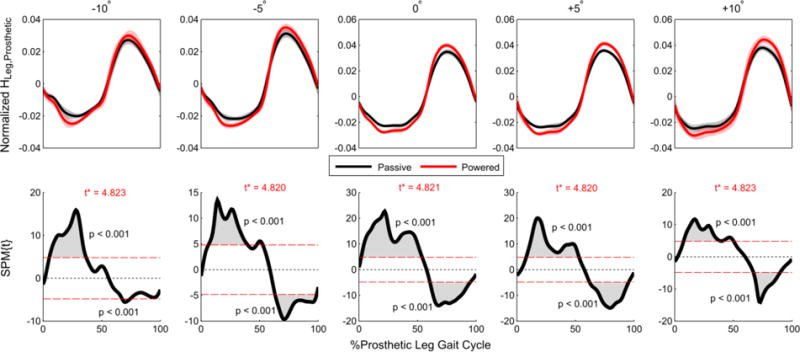
SPM pairwise comparisons of the sagittal-plane angular momentum contributions of the prosthetic leg (residuum and prosthesis), HLeg,Prosthetic, when using the powered compared to passive prosthesis. Each column is a different slope. Top row shows the mean (±SD) of normalized HLeg,Prosthetic when using the passive (black line) and powered (red line) prosthesis. Bottom row shows SPM{t}, the t-value as a function of time. Dashed red lines show the critical threshold for significance, calculated using Random Field Theory. Shaded regions indicate significant differences.
Figure 5.

SPM pairwise comparisons of the trunk contributions to H when using the powered compared to passive prosthesis. Each column is a different slope. Top row shows the mean and standard deviation of normalized contribution to H when using the passive (black line) and powered (red line) prosthesis. Bottom row shows the SPM{t}, which is the t-value as a function of time. Dashed red lines show the critical threshold for significance, calculated using Random Field Theory. Regions where significant differences were found are shaded grey.
IV. Discussion
Our first hypothesis, that there would be significant differences in the prosthetic leg contributions HLeg,Prosthetic during mid-stance and mid-swing, was supported by the SPM analysis. There was a lower magnitude of HLeg,Prosthetic during both of these portions of the gait cycle, likely due to the reduced mass of the passive prosthesis compared to the heavier powered prosthesis. However, the reduction in magnitude of contributions from the prosthetic leg when using the passive prosthesis contributes to the increased overall range of sagittal-plane H (Fig. 2), which may adversely affect dynamic balance [3]. This result highlights the importance of segment contributions to dynamic balance, which may not be captured by other measures, such as those based on an inverted pendulum model of the body [20].
Our second hypothesis, that there would be a significant slope by prosthesis interaction effect in HTrunk, was also supported (Fig. 3). There was little or no difference in HTrunk on declines, but on inclines there was a significant difference (p<0.001) from approximately 65–80% of the prosthetic leg gait cycle (Fig. 5), which is just after toe-off of the prosthetic leg. This finding supports the concept that the powered prosthesis replicates the biomechanical function of the soleus muscle. Our results suggest that on inclines the powered prosthesis generates positive (backward) H in the trunk during prosthetic leg push-off, similar to the biomechanical function of the soleus muscle. However, our results also suggest that neither prosthesis replicates soleus function on declines, as there was little or no difference between the passive and powered prostheses at −5° and −10° (Fig. 5).
Our findings are also consistent with previous musculoskeletal simulation studies that found the soleus contributes to positive sagittal-plane H in late stance [21]. Although the gastrocnemius also contributes to positive H in late stance, it does so by absorbing energy from the trunk and generating energy to the leg [12], [15]. Our findings suggest that restoring ankle push-off power with a powered prosthesis increases the amount of energy and momentum in the trunk, consistent with the functional role of the soleus.
Our results may also help explain why people with TTA prefer devices that deliver more ankle power than passive prostheses, despite evidence that the increased ankle push-off work does not necessarily reduce metabolic cost [22] and suggesting an alternative objective pertaining to balance [23]. Our results indicate that the powered prosthesis contributes a larger magnitude of HTrunk than a passive prosthesis, which should aid in walking and reduce metabolic cost. However, if the prosthesis is functioning like a soleus muscle, then it would also absorb energy from the prosthetic leg. Thus, the increased momentum in the prosthetic leg must be generated by the person, not the device. People with transtibial amputation may compensate for the lack of gastrocnemius function using the hip extensors, which contribute to positive H [21] and generate energy to the contralateral leg to help initiate swing [15]. Future simulation studies of powered prosthesis function on slopes would help further investigate this possibility.
V. Limitations and Future Work
Our study design has multivariate dependent variables Hi as well as multiple independent variables (slope and prosthesis type). The current implementation of spm1d does not support this type of design. Thus, we elected to perform multiple separate ANOVAs, which does not account for correlation between dependent variables. We also did not compare to non-amputee participants, which may yield deeper insight into the biomechanical function of the prostheses. In future work, we will use a mixed effects generalized linear model that allows more flexibility.
In addition, we did not explicitly account for certain specific differences between individuals that may influence H, such as the inertial properties of each prosthesis. While it is possible to do so [17], it is difficult to obtain accurate inertial properties for the residual leg. Analysis of the time histories of segmental contributions to H may be more sensitive to inertial properties than an analysis of range, so these potential sources of error should be considered when interpreting the results of this study.
Furthermore, we did not account for differences in passive prosthesis properties (e.g., stiffness) or BiOM tuning parameters that likely affect H. However, while the BiOM increased the mechanical power generated by the prosthetic ankle during push-off [3], this resulted in relatively small changes in H. Thus, our results highlight the importance of considering whole-body dynamics when designing assistive devices rather than only focusing on local joint mechanics. Currently, powered prosthesis tuning attempts to produce ankle biomechanics (e.g., moment or work) similar to a biological ankle. However, restoring ankle biomechanics may not yield normative whole-body biomechanics due to other changes in the mechanical system, such as the loss of gastrocnemius function. Future studies should investigate whether a powered prosthesis can be tuned to produce normative H trajectories rather than matching biological ankle mechanics. In designing robotic rehabilitation devices, such as prostheses, it is important to consider not only mechanical design and control algorithms but also the effects of the device on segmental coordination of balance.
VI. Conclusions
We used a novel assessment method to identify that the key differences in H between passive and powered prostheses occur in the prosthetic leg and trunk during ramp walking. Our analysis highlights the importance of identifying specific coordination patterns that contribute to overall changes in H that may detrimentally affect dynamic balance. The method can be easily applied to studying the effects of assistive devices balance coordination in a wide range of populations.
Acknowledgments
The authors acknowledge Jennifer Aldridge Whitehead, Kelly Ohm, and Audrey Westbrook for their help. This work was supported by NIH NICHD Award No. R03HD075946, DoD award No. W81K00-09-P-1129, and discretionary research funds of Dr. Fey. The views expressed herein are those of the authors and do not reflect the official policy or position of Brooke Army Medical Center, the U.S. Army Medical Dept., the U.S. Army Office of the Surgeon General, the Dept. of the Army, Dept. of Defense, or the U.S. Gov’t.
Contributor Information
Nathaniel T. Pickle, The University of Texas at Dallas, Richardson, TX 75080 USA, phone: 972-883-7279
Anne K. Silverman, Department of Mechanical Engineering, Colorado School of Mines, Golden, CO 80401 USA
Jason M. Wilken, Center for the Intrepid at Brooke Army Medical Center and the Extremity Trauma and Amputation Center of Excellence, JBSA Ft. Sam Houston, TX 78234
Nicholas P. Fey, Departments of Bioengineering and Mechanical Engineering, The University of Texas at Dallas, Richarson, TX 75080. He is also with the Department of Physical Medicine and Rehabilitation atThe University of Texas Southwestern Medical Center, Dallas, TX 75390, and the VA North Dallas Health Care System, Dallas, TX 75216.
References
- 1.Herr HM, Popovic M. Angular momentum in human walking. J Exp Biol. 2008 Feb;211(Pt 4):467–81. doi: 10.1242/jeb.008573. [DOI] [PubMed] [Google Scholar]
- 2.Silverman AK, Wilken JM, Sinitski EH, Neptune RR. Whole-body angular momentum in incline and decline walking. J Biomech. 2012 Apr;45(6):965–71. doi: 10.1016/j.jbiomech.2012.01.012. [DOI] [PubMed] [Google Scholar]
- 3.Pickle NT, Wilken JM, Aldridge Whitehead JM, Silverman AK. Whole-Body Angular Momentum During Sloped Walking Using Passive and Powered Lower-Limb Prostheses. J Biomech. 2016;49(14):3397–3406. doi: 10.1016/j.jbiomech.2016.09.010. [DOI] [PMC free article] [PubMed] [Google Scholar]
- 4.Pickle NT, Wilken JM, Aldridge JM, Neptune RR, Silverman AK. Whole-body angular momentum during stair walking using passive and powered lower-limb prostheses. J Biomech. 2014;47(13):3380–9. doi: 10.1016/j.jbiomech.2014.08.001. [DOI] [PubMed] [Google Scholar]
- 5.Silverman AK, Neptune RR. Differences in whole-body angular momentum between below-knee amputees and non-amputees across walking speeds. J Biomech. 2011;44:379–385. doi: 10.1016/j.jbiomech.2010.10.027. [DOI] [PubMed] [Google Scholar]
- 6.D’Andrea S, Wilhelm N, Silverman AK, Grabowski AM. Does Use of a Powered Ankle-foot Prosthesis Restore Whole-body Angular Momentum During Walking at Different Speeds? Clin Orthop Relat Res. 2014;472(10):3044–3054. doi: 10.1007/s11999-014-3647-1. [DOI] [PMC free article] [PubMed] [Google Scholar]
- 7.Vistamehr A, Kautz SA, Bowden MG, Neptune RR. Correlations between measures of dynamic balance in individuals with post-stroke hemiparesis. J Biomech. 2016;49(3):396–400. doi: 10.1016/j.jbiomech.2015.12.047. [DOI] [PMC free article] [PubMed] [Google Scholar]
- 8.Nott CR, Neptune RR, Kautz Sa. Relationships between frontal-plane angular momentum and clinical balance measures during post-stroke hemiparetic walking. Gait Posture. 2014;39(1):129–134. doi: 10.1016/j.gaitpost.2013.06.008. [DOI] [PMC free article] [PubMed] [Google Scholar]
- 9.Kaya BK, Krebs DE, Riley PO. Dynamic stability in elders: momentum control in locomotor ADL. J Gerontol A Biol Sci Med Sci. 1998 Mar;53(2):M126–34. doi: 10.1093/gerona/53a.2.m126. [DOI] [PubMed] [Google Scholar]
- 10.Bennett BC, Russell SD, Sheth P, Abel MF. Angular momentum of walking at different speeds. Hum Mov Sci. 2010 Feb;29(1):114–24. doi: 10.1016/j.humov.2009.07.011. [DOI] [PubMed] [Google Scholar]
- 11.Friston K, Stephan K. Modelling brain responses Elsevier Inc. 2007 [Google Scholar]
- 12.Neptune RR, Kautz SA, Zajac FE. Contributions of the individual ankle plantar flexors to support, forward progression and swing initiation during walking. J Biomech. 2001 Nov;34(11):1387–98. doi: 10.1016/s0021-9290(01)00105-1. [DOI] [PubMed] [Google Scholar]
- 13.Au SK, Weber J, Herr HM. Biomechanical Design of Powered Ankle-Foot Prosthesis,” in. 2007 IEEE 10th International Conference on Rehabilitation Robotics. 2007;0(c):298–303. [Google Scholar]
- 14.Herr HM, Grabowski AM. Bionic ankle-foot prosthesis normalizes walking gait for persons with leg amputation. Proc Biol Sci. 2012 Feb;279(1728):457–64. doi: 10.1098/rspb.2011.1194. [DOI] [PMC free article] [PubMed] [Google Scholar]
- 15.Pickle NT, Grabowski AM, Auyang AG, Silverman AK. The Functional Roles of Muscles During Sloped Walking. J Biomech. 2016;49(14):3244–3251. doi: 10.1016/j.jbiomech.2016.08.004. [DOI] [PMC free article] [PubMed] [Google Scholar]
- 16.Wilken JM, Rodriguez KM, Brawner M, Darter BJ. Reliability and Minimal Detectible Change values for gait kinematics and kinetics in healthy adults. Gait Posture. 2012 Feb;35(2):301–7. doi: 10.1016/j.gaitpost.2011.09.105. [DOI] [PubMed] [Google Scholar]
- 17.Smith JD, Ferris AE, Heise GD, Hinrichs RN, Martin PE. Oscillation and reaction board techniques for estimating inertial properties of a below-knee prosthesis. J Vis Exp. 2014;(87):1–16. doi: 10.3791/50977. [DOI] [PMC free article] [PubMed] [Google Scholar]
- 18.Pataky TC, Robinson MA, Vanrenterghem J. Vector field statistical analysis of kinematic and force trajectories. J Biomech. 2013;46(14):2394–2401. doi: 10.1016/j.jbiomech.2013.07.031. [DOI] [PubMed] [Google Scholar]
- 19.Donnelly CJ, Alexander C, Pataky TC, Stannage K, Reid S, Robinson MA. Vector-field statistics for the analysis of time varying clinical gait data. Clin Biomech. 2016 doi: 10.1016/j.clinbiomech.2016.11.008. [DOI] [PubMed] [Google Scholar]
- 20.Hof AL, Gazendam MGJ, Sinke WE. The condition for dynamic stability. J Biomech. 2005 Jan;38(1):1–8. doi: 10.1016/j.jbiomech.2004.03.025. [DOI] [PubMed] [Google Scholar]
- 21.Neptune RR, McGowan CP. Muscle contributions to whole-body sagittal plane angular momentum during walking. J Biomech. 2011 Jan;44(1):6–12. doi: 10.1016/j.jbiomech.2010.08.015. [DOI] [PMC free article] [PubMed] [Google Scholar]
- 22.Quesada RE, Caputo JM, Collins SH. Increasing ankle push-off work with a powered prosthesis does not necessarily reduce metabolic rate for transtibial amputees. J Biomech. 2016;49(14):3452–3459. doi: 10.1016/j.jbiomech.2016.09.015. [DOI] [PubMed] [Google Scholar]
- 23.Major MJ, Fey NP. Considering passive mechanical properties and patient user motor performance in lower-limb prosthesis design optimization to enhance rehabilitation outcomes. Phys Ther Rev. doi: 10.1080/10833196.2017.1346033. In Press. [DOI] [PMC free article] [PubMed] [Google Scholar]