



Abstract
Background
In most regions worldwide, caesarean section (CS) rates are increasing. In these settings, new strategies are needed to reduce CS rates.
Objectives
To identify, critically appraise and synthesise studies using the Robson classification as a system to categorise and analyse data in clinical audit cycles to reduce CS rates.
Search strategy
Medline, Embase, CINAHL and LILACS were searched from 2001 to 2016.
Selection criteria
Studies reporting use of the Robson classification to categorise and analyse data in clinical audit cycles to reduce CS rates.
Data collection
Data on study design, interventions used, CS rates, and perinatal outcomes were extracted.
Results
Of 385 citations, 30 were assessed for full text review and six studies, conducted in Brazil, Chile, Italy and Sweden, were included. All studies measured initial CS rates, provided feedback and monitored performance using the Robson classification. In two studies, the audit cycle consisted exclusively of feedback using the Robson classification; the other four used audit and feedback as part of a multifaceted intervention. Baseline CS rates ranged from 20 to 36.8%; after the intervention, CS rates ranged from 3.1 to 21.2%. No studies were randomised or controlled and all had a high risk of bias.
Conclusion
We identified six studies using the Robson classification within clinical audit cycles to reduce CS rates. All six report reductions in CS rates; however, results should be interpreted with caution because of limited methodological quality. Future trials are needed to evaluate the role of the Robson classification within audit cycles aimed at reducing CS rates.
Tweetable abstract
Use of the Robson classification in clinical audit cycles to reduce caesarean rates.
Keywords: Audit and feedback, caesarean section, clinical audit cycle, Robson classification, systematic review, ten‐group classification
Tweetable abstract
Use of the Robson classification in clinical audit cycles to reduce caesarean rates.
Introduction
Recent data indicate that one in five women undergo caesarean section (CS), and in most regions of the world, CS rates continue to rise.1 Concern over increasing CS rates has motivated research to identify effective interventions that can safely reduce CS rates in settings with overuse. Despite this effort, most tested interventions have shown only limited success.2, 3
The clinical audit cycle has been defined as a ‘quality improvement process that seeks to improve patient care and outcomes through systematic review of care against explicit criteria and the implementation of change'.4 Key components of the cycle include (1) measuring care against criteria, (2) taking action to improve care and (3) monitoring to sustain improvement.4 Audit and feedback is a variation of the clinical audit cycle where, after initial measurement, the key action is fed back to a health professional or unit as a strategy to modify behaviour. The clinical audit cycle and, in particular, audit and feedback have been used to change behaviour in a variety of clinical contexts including the reduction of CS rates, with mixed results.2, 5, 6 Often, the methods used to implement the cycle have varied.2, 5 This makes comparability and replicability between studies challenging.
The Robson classification system uses basic obstetric characteristics to categorise all women admitted for delivery into one of ten mutually exclusive and totally inclusive groups (Figure 1).7 Unlike other CS classification systems (e.g. based on indications for CS), the Robson classification has gained widespread acceptance in a diverse range of settings.8, 9 The World Health Organization (WHO) and the International Federation of Gynecology and Obstetrics (FIGO) recommend the Robson classification as a global standard for assessing, monitoring and comparing CS rates within heath care facilities, over time and between facilities.10, 11
Figure 1.
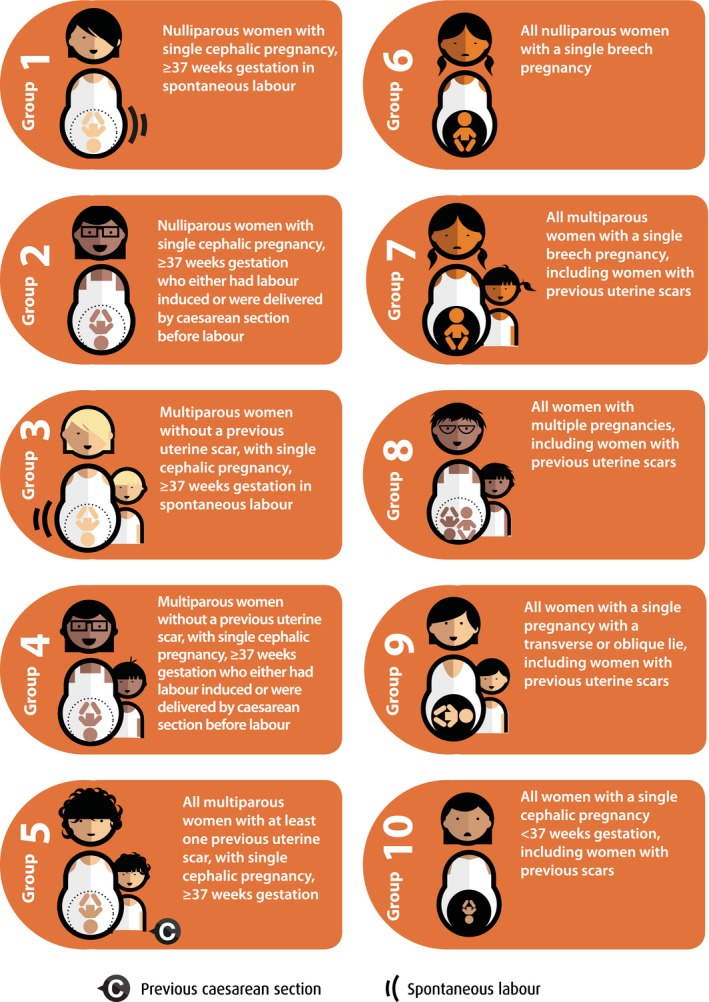
Robson classification system. Reproduced with permission from World Health Organization. WHO Statement on Caesarean Section Rates WHO/RHR/15.02. 2015.
As a prospective, objective, and replicable classification system, the Robson classification is well suited to help with the three core components of the clinical audit cycle. Its widespread adoption presents an opportunity to compare studies using a similar and standard method to categorise and analyse data within clinical audit cycles targeted at reducing CS rates.
We conducted a systematic review of the literature to identify, critically appraise and synthesise the studies that included the Robson classification as a system to categorise and analyse data in clinical audit cycles used alone or as part of multifaceted interventions, to reduce CS rates.
Methods
This systematic review was conducted following a protocol specifically designed for this purpose (PROSPERO registration number: CRD42016034099) and reported according to the recommendations of the PRISMA and MOOSE statements.12, 13
Types of studies
Any study, regardless of its design, that used the Robson classification within clinical audit cycles (including but not limited to strategies using audit and feedback) either alone or in multifaceted interventions to reduce CS rate, was eligible for inclusion. Studies using variations of the classification (e.g. splitting groups or lumping groups together) were eligible for inclusion as long as the modifications were reported with sufficient clarity to be able to relate them to the original Robson system. Studies had to report the rate of CS as one of the outcomes, regardless of the primary objective. We included studies of any sample size, conducted for any period of time, and in any type of setting (e.g. nationwide, facility‐based).
Type of participants
Any professionals who reported experiences on the use of the Robson classification system within clinical audit cycles to reduce CS rates were eligible for inclusion, including public health officials, policymakers, administrators and/or clinicians in any type of setting (single facility or group care, public or private).
Exclusion criteria
We excluded studies that did not provide any numerical data on the effects of the use of the clinical audit cycle. We also excluded studies that did not explicitly use the Robson classification as part of their clinical audit cycles or did not present the intervention in enough detail to allow a clear understanding of what was done.
Search strategy
With the assistance of a librarian experienced in electronic search strategies for systematic reviews, four electronic databases (MEDLINE, Embase, CINAHL and LILACS) were searched for studies published between January 2001 and January 2016 (Supporting Information Appendix S1: Search Strategy). There were no language restrictions. The electronic search was complemented by screening the references of all articles chosen for full‐text evaluation.
Process of study identification, selection and data extraction
All citations identified from the electronic searches were downloaded into ENDNOTE software (version X7.7.1, Thomson Reuters™) and duplicates deleted. Two investigators (M.R.T., A.P.B.) independently screened the titles and abstracts to select potentially relevant citations for full‐text reading. These were independently read by two reviewers (F.C., A.P.B.) and studies meeting selection criteria were included in the review. Data extraction was performed by at least two reviewers (A.A.B., F.C., A.P.B.) independently and in duplicate using a standardised data‐extraction template specially designed for this review. Disagreements in any stage of this process were resolved by discussion until full agreement was reached, consulting with a fourth reviewer if necessary (M.R.T.).
Information captured for each article included: (1) study design; (2) study objectives; (3) country, year, setting, type of institution, time period when the classification was used; (4) number and type of women/deliveries included; (5) completeness and source of data; (6) detailed description of the intervention and its components; (7) CS rates prior to, during and after the implementation of the intervention(s); (8) conclusions according to the author; (9) other results reported such as perinatal outcomes (e.g. Apgar scores, perinatal mortality), patient or care provider satisfaction; (10) observations, comments or criticisms on the use of the classification system. Authors of included articles were contacted to clarify study details or request additional information if necessary.
Quality assessment of the studies
Quality was assessed using the quality assessment tool for quantitative studies developed by the Effective Public Health Practice Project (EPHPP) in Canada for use in systematic reviews.14, 15 Assessment included eight domains: selection bias, study design, confounders, blinding, data collection, follow up, intervention integrity and analysis (Supporting Information Table S3). Each domain received a grading of ‘strong’, ‘moderate’ or ‘weak’. Studies with no ‘weak’ ratings received an overall rating of ‘strong’, those with one ‘weak’ domain received an overall rating of ‘moderate’, and those with two or more ‘weak’ domains received an overall rating of ‘weak’. Rating was performed independently by two reviewers (A.A.B. and A.P.B.) with discussion until consensus was reached. We did not exclude studies based on their quality.
Data synthesis
The findings of each study are presented descriptively. We classified included studies as randomised controlled trials (RCTs), before‐and‐after (controlled), before‐and‐after (uncontrolled), and interrupted time series studies. For studies with similar designs and utilising the Robson classification in a similar fashion, we intended to pool the effects of the intervention on CS rate.
Results
Our electronic search yielded 385 unique citations; 30 were selected for full‐text evaluation and six studies were included in the review (Supporting Information Figure S1). The studies were from four different countries: Brazil (1), Chile (1), Italy (3) and Sweden (1).16, 17, 18, 19, 20, 21 Three studies were published as full peer‐reviewed manuscripts16, 18, 21 and the other three were congress abstracts.17, 19, 20 We contacted the authors of these abstracts to obtain more details and were successful in all cases.
Supporting Information Table S1 presents the main study characteristics. All studies were facility‐based, five were based in tertiary care or teaching hospitals16, 17, 18, 20, 21 and one in birth centres attached to hospitals.19 All six studies were classified as prospective, before‐and‐after (uncontrolled) studies. All measured and reported CS rates in their hospitals continuously over a period of time that included the roll out of an intervention.
Supporting Information Table S2 summarises the interventions described in the studies, how study interventions align with the core components of the clinical audit cycle and study outcomes. All six studies used the Robson classification for initial measurement of baseline performance—the first key component of the clinical audit cycle. Three studies16, 18, 19 used all 10 Robson groups, two studies20, 21 used Robson groups 1 and 2, and the sixth study used Robson groups 1–4.17 One study21 also used instrumental delivery rates and perinatal and maternal outcomes as measurement criteria. In two studies16, 20 feedback and discussion using the Robson classification was the only strategy to improve outcomes. In the other four studies17, 18, 19, 21 feedback with the Robson classification was used along with other multifaceted components (Table S2).
All studies included low Apgar score at 5 minutes as an outcome measure. In three studies16, 19, 20 changes in this rate were formally tested and reported, and no statistically significant differences were found. Other outcomes measured in studies included perinatal mortality,19, 20 operative delivery,17, 19, 21 umbilical cord pH, hypoxic‐ischaemic encephalopathy and patient satisfaction,21 neonatal intubation,19 neonatal asphyxia,16 use of oxytocin and amniotomy.17
Quality assessment
All six studies were rated as ‘weak’ using the EPHPP framework (Supporting Information Table S3).15 All of the included studies used prospective uncontrolled before‐and‐after designs and none accounted for confounding, blinding or intervention integrity, i.e. the degree to which the participants received the intervention, and consistency of the intervention. Similarly, it is unclear whether there were any withdrawals or drop‐outs of participants in the studies. One study reports an interrupted time series analysis;16 however, the preferred statistical analyses for this design—time series regressions or ARIMA—were not used.22
Study interventions
In Brazil, Aguiar et al.20 describe an audit and feedback intervention where monthly reports of the Robson classification tables were distributed and discussed with clinical staff. During the 10‐month intervention period, CS rates in Robson groups 1 and 2 together showed a decrease from 34.6 to 13.5%. The authors reported no changes in Apgar score less than seven at 5 minutes and perinatal mortality over the 10‐month period. There were no other changes in clinical practice or local policies during the intervention period that could explain the decrease in CS; however, no control group was described.
In Sweden, Blomberg et al.21 describe a nine‐item list of organisational and cultural changes introduced along with training to reduce unnecessary interventions including CS. The Robson classification was used to identify the target group—term, nulliparous women in spontaneous labor (group 1)—and to provide feedback to staff on a monthly basis for all term nulliparous women (groups 1 and 2). Other aspects of the multifaceted intervention are shown in Table S2. Following implementation, they report decreases in the CS rate in group 1, from 10.1% in 2006 to 3.1% in 2015. No changes were seen in neonatal outcomes, and patient satisfaction was reported as high in 2015, although no information on satisfaction in the previous years is reported.
In Chile, Scarella et al.16 evaluated the effectiveness of audit and feedback using the Robson classification in an uncontrolled before‐and‐after study. Clinical staff received letters with monthly audits using the Robson classification, and attended in depth medical‐midwifery staff meetings every 3 months where results and outcomes were discussed. Staff were also ranked by duty shift from worst to best according to CS rates in the Robson groups of interest (Groups 1, 2a, 5a and 10). The overall CS rate was 36.8% at baseline (3‐month average), 26.5% during the intervention phase (9‐month average) and 31.8% during the post‐intervention phase (9‐month average). Authors report a reduction in the CS rate between phase one and phase two in all groups, reaching statistical significance in Groups 1, 5a and 10. A re‐analysis of this published data using time series regression models found no significant change in the CS rate at the time of the intervention (11.0, 95% CI −23.2, 1.2%, P = 0.098). There were no significant differences in the rates of neonatal asphyxia and low Apgar scores at 5 minutes in the three phases.
Svelato et al.17 performed a before‐and‐after study in Italy in 2012–2013 to test the effectiveness of a multifaceted intervention to reduce CS rates in Robson Groups 1–4 without increasing maternal and newborn morbidity. The Robson classification was used to analyse data prior to the initiation of the study and as a tool for daily feedback and discussion with staff during the intervention phase. The strategy also included other non‐clinical and clinical components (see Table S2 for details). The authors report a statistically significant reduction in the CS rate for Robson Groups 1–4 from 17.2% during the baseline period to 11% during implementation, and 10.3% during the 6‐month post‐intervention period. When analyzed individually, the reduction in CS rates was statistically significant only in Robson group 2 (52.7% to 36.4% to 39.4%). There were no statistically significant changes in other outcome measures including Apgar score less than seven at 5 minutes (0.7% in all phases) or rate of instrumental (vacuum) deliveries (3.6, 5 and 3.8%, respectively).
Piffer et al.19 report on the use of the Robson classification within a clinical audit to reduce CS rates in seven maternity units in northern Italy. A retrospective review using the Robson classification was carried out between 2004 and 2007 to establish baseline data in the seven maternity units and to allow comparisons in CS rates with peer tertiary university institutions that had comparable numbers of deliveries but lower CS rates. Comparisons were then used to identify strategies for clinical management changes to reduce the CS rate. Following this assessment, a prospective audit cycle was implemented in 2008–2009 where CS rates in Groups 1, 2 and 5 were tracked and reported to staff in meetings. The authors report a statistically significant reduction in overall CS rates from 28.8% prior to intervention to 25% following implementation. No significant changes in Apgar score or stillbirth rate were seen, and the rate of neonatal intubation declined significantly.
Maneschi et al.18 describe the use of the Robson classification to maintain a target CS rate in a single hospital in Rome, Italy. In 2006, the Robson classification was used to conduct a review of deliveries that was analysed and used to set a target overall CS rate of 30% and a baseline for the composition and contribution of the Robson groups. From 2007, data were prospectively collected and analysed using the Robson classification. In 2008, a plan was made to conduct an additional audit should the overall CS rate rise above 30% for three consecutive months. The planned audit would assess indications for CS in the Robson groups that differed the most from 2006 baseline rates. The authors report an increase in CS rate above 30% in the first 5 months of 2010. This triggered the audit of Groups 1 and 2. Results were used to guide changes in practice. This led to a drop in the CS rates in these groups (numbers not reported) and, ultimately, maintenance of the CS rate at 30.5% throughout 2010. Retrospective comparison of rates between 2001 and 2006, and between 2006 and 2010 demonstrated a rise in the first period (27.5 to 31.1%) versus maintenance of overall rates in the second period (31.1–30.5%).
Discussion
Main findings
This review found six studies that used the Robson classification system as a tool to provide audit and feedback to providers in clinical audit cycles used to reduce caesarean section rates. Five of these studies were performed in countries with some of the highest CS rates seen globally (Brazil, Chile and Italy).1 All the studies reported a reduction or maintenance in CS rates without concomitant increases in neonatal morbidity or other adverse outcomes. However, all of the studies used an uncontrolled before‐and‐after methodology. As this type of study design has inherent limitations in inferring causation, the positive results reported should be viewed with caution and warrant further well designed controlled studies.
Strengths and limitations
Strengths of this review include its originality, as it is the first systematic review focusing on one consistent system (the Robson classification) to categorise and analyse data on CS rates within clinical audit cycles.
This review has several limitations. It is possible that unpublished reports were missed because we did not perform an extensive search for grey literature. Additionally, four of the six studies used multifaceted inventions in addition to audit and feedback. These included different strategies such as physician ranking, peer tutoring, modification of clinical management protocols and attention to women's psychological wellbeing. Due to the multifaceted nature of some interventions, it was not possible to disentangle the contribution of each component to the overall effect. Also, the effectiveness of the interventions in the included studies could not be pooled or compared because of the differences in study design.
Several methodological weaknesses also limit the interpretation and applicability of the results in the six studies included in this review. The uncontrolled designs prevent establishing cause and effect. More robust methodology such as interrupted time series analyses and a controlled before‐and‐after design could improve the quality of the primary studies. In an interrupted time series analysis, data are collected at multiple instances before and after an intervention. Time series regression models or autoregressive integrated moving average models are then used to assess differences in rates before and after the intervention.22 A controlled before‐and‐after design requires a control group for comparison with a group or groups receiving the intervention.23 In this case‐context this could be a select group of patients within the same hospital, e.g. private patients with different providers compared with public service patients or, at the health system level, a hospital with similar characteristics and patient demographics where the intervention is not conducted. In both of these study designs, the statistical models and the presence of a control group help reduce bias that might occur due to secular trends, seasonal or cyclical effects, duration of the intervention, and random fluctuations that are inherent in uncontrolled before‐and‐after models.
Interpretation
In all six studies, the Robson classification system offered a stable framework for categorising and analysing data within the clinical audit cycle either alone or in concert with other approaches. Previous reports analysing clinical audit cycles or components of it to reduce CS rates have reported mixed results.2 Two randomised trials comparing audit and feedback to an opinion leader, or no intervention to reduce CS found no difference in rates.24, 25 On the other hand, several controlled before‐and‐after studies and a metanalysis have suggested that audit and feedback can reduce CS rates.5, 26, 27, 28, 29 In the metanalysis, which included five studies involving 734 321 women, audit and feedback alone was moderately effective in reducing CS rate and more effective when used in combination with other interventions.5 Of note, the framework used to perform audit and feedback differed among all the primary studies described. This variation in method may account for some of the heterogeneity seen in the efficacy of this strategy.6
Strategies to reduce CS rates must also assess changes in both maternal and perinatal outcomes. All six studies included in our review included Apgar score assessment as one of their outcome measures, although this was reported formally in only three studies.16, 19, 20 Though Apgar scores are useful in providing an initial assessment of newborn status, other measures of neonatal and maternal morbidity should also be considered in future studies to ensure that reduction of CS rates results in equal or better outcomes for both mother and baby.
Conclusion
The Robson classification allows standardised comparisons of CS rates across time and settings and the prospective identification of specific groups of women which most contribute to the overall CS rate. This makes the Robson classification an appealing tool within audit and feedback cycles. Rising CS rates in most high and middle‐income countries demand evidence‐based strategies safely to reduce unnecessary CS. This review suggests that the Robson classification could be useful within clinical audit cycles targeting such reductions. Further studies are necessary to understand the role of this classification system in CS audit cycles.
Disclosure of interests
None declared. Completed disclosure of interests form available to view online as supporting information.
Contribution to authorship
FC, MRT, APB conceived and designed the experiment. AAB, FC, MRT, APB performed the review. AAB, FC, MRT, APB analysed the data. AAB and APB drafted the manuscript. AAB, FC, MRT, APB contributed to the interpretation of the results and critically commented and provided revisions to the manuscript. All authors read and approved the final manuscript.
Details of ethics approval
Ethics approval was not required for this review.
Funding
There was no specific funding support for this systematic review.
Supporting information
Figure S1. Search results.
Table S1. Main characteristics of included studies.
Table S2. Description of the intervention, outcomes and conclusions of included studies.
Table S3. Components of quality assessment.
Appendix S1. Detailed search strategy.
Acknowledgements
None.
Boatin AA, Cullinane F, Torloni MR, Betrán AP. Audit and feedback using the Robson classification to reduce caesarean section rates: a systematic review. BJOG 2018; 125:36–42.
Registration: This Systematic Review is registered under PROSPERO Reg. Number: 2016:CRD42016034099.
References
- 1. Betran AP, Ye J, Moller AB, Zhang J, Gulmezoglu AM, Torloni MR. The Increasing trend in caesarean section rates: global, regional and national estimates: 1990–2014. PLoS ONE 2016;11:e0148343. [DOI] [PMC free article] [PubMed] [Google Scholar]
- 2. Khunpradit S, Tavender E, Lumbiganon P, Laopaiboon M, Wasiak J, Gruen RL. Non‐clinical interventions for reducing unnecessary caesarean section. Cochrane Database Syst Rev 2011;(6):CD005528. [DOI] [PubMed] [Google Scholar]
- 3. Hartmann KE, Andrews JC, Jerome RN, Lewis RM, Likis FE, McKoy JN, et al. Strategies to reduce cesarean birth in low‐risk women. AHRQ Publication No. 12(13)‐EHC128‐EF2012. [PubMed]
- 4. Shaw D. National Institute for Clinical Excellence. Principles for Best Practice in Clinical Audit. Abingdon: Radcliffe Publishing, 2002. [Google Scholar]
- 5. Chaillet N, Dumont A. Evidence‐based strategies for reducing cesarean section rates: a meta‐analysis. Birth 2007;34:53–64. [DOI] [PubMed] [Google Scholar]
- 6. Ivers N, Jamtvedt G, Flottorp S, Young JM, Odgaard‐Jensen J, French SD, et al. Audit and feedback: effects on professional practice and healthcare outcomes. Cochrane Database Syst Rev 2012;(6):CD000259. [DOI] [PMC free article] [PubMed] [Google Scholar]
- 7. Robson M. Classification of caesarean sections. Fetal Maternal Med Rev 2001;12:23–39. [Google Scholar]
- 8. Betran AP, Vindevoghel N, Souza JP, Gulmezoglu AM, Torloni MR. A systematic review of the Robson classification for caesarean section: what works, doesn't work and how to improve it. PLoS ONE 2014;9:e97769. [DOI] [PMC free article] [PubMed] [Google Scholar]
- 9. Torloni MR, Betran AP, Souza JP, Widmer M, Allen T, Gulmezoglu M, et al. Classifications for cesarean section: a systematic review. PLoS ONE 2011;6:e14566. [DOI] [PMC free article] [PubMed] [Google Scholar]
- 10. World Health Organization . WHO Statement on Caesarean Section Rates. WHO/RHR/15.02; 2015.
- 11. FIGO Working Group on Challenges in Care of Mothers and Infants during Labour and Delivery . Best practice advice on the 10‐group classification system for cesarean deliveries. Int J Gynaecol Obstet 2016;135:232–3. [DOI] [PubMed] [Google Scholar]
- 12. Moher D, Liberati A, Tetzlaff J, Altman DG, Group P . Preferred reporting items for systematic reviews and meta‐analyses: the PRISMA statement. Ann Intern Med 2009;151:264–9, W64. [DOI] [PubMed] [Google Scholar]
- 13. Stroup DF, Berlin JA, Morton SC, Olkin I, Williamson GD, Rennie D, et al. Meta‐analysis of observational studies in epidemiology: a proposal for reporting. Meta‐analysis of Observational Studies in Epidemiology (MOOSE) group. JAMA 2000;283:2008–12. [DOI] [PubMed] [Google Scholar]
- 14. Deeks JJ, Dinnes J, D'Amico R, Sowden AJ, Sakarovitch C, Song F, et al. Evaluating non‐randomised intervention studies. Health Technol Assess 2003;7:iii–x 1–173. [DOI] [PubMed] [Google Scholar]
- 15. Effective Public Health Practice Project . Quality Assessment Tool of Quantitative Studies [http://www.ephpp.ca/tools.html]. Accessed 11 March 2016.
- 16. Scarella A, Chamy V, Sepulveda M, Belizan JM. Medical audit using the Ten Group Classification System and its impact on the cesarean section rate. Eur J Obstet Gynecol Reprod Biol 2011;154:136–40. [DOI] [PubMed] [Google Scholar]
- 17. Svelato A, Meroni MG, Poli M, Perino A, Spinoso R, Ragusa A. How to reduce caesarean sections in first four Robson's Classes. BJOG 2014;121:91. [Google Scholar]
- 18. Maneschi F, Algieri M, Perrone S, Nale R, Sarno M. Cesarean 10‐group classification: a tool for clinical management of the delivery ward. Minerva Ginecol 2015;67:389–95. [PubMed] [Google Scholar]
- 19. Piffer S, Pederzini F, Tenaglia F, Paoli A, Nicolodi F, Luewink A. The Robson ten group classification of cesarean section in 7 alpine maternity units in an homogenous area. Eur J Epidemiol 2012;27:S122–3. [Google Scholar]
- 20. Aguiar RAP, Gaspar J, Reis ZSN, Santos MR Jr, Correa MD Jr. Implementation of the Caesarean Births Review using the ten group Robson‘s classification and its immediate effects on the rate of caesareans, at a university hospital. Poster presented at the international congress Birth: Clinical Challenges in Labor and Delivery, March 5‐7 2015, Fortaleza, Brazil; p21. [Google Scholar]
- 21. Blomberg M. Avoiding the first cesarean section—results of structured organizational and cultural changes. Acta Obstet Gynecol Scand 2016;95:580–6. [DOI] [PubMed] [Google Scholar]
- 22. Ramsay CR, Matowe L, Grilli R, Grimshaw JM, Thomas RE. Interrupted time series designs in health technology assessment: lessons from two systematic reviews of behavior change strategies. Int J Technol Assess Health Care 2003;19:613–23. [DOI] [PubMed] [Google Scholar]
- 23. Cook TD, Shadish WR, Wong VC. Three conditions under which experiments and observational studies produce comparable causal estimates: new findings from within‐study comparisons. J Policy Analysis Manage 2008;27:724–50. [Google Scholar]
- 24. Lomas J, Enkin M, Anderson GM, Hannah WJ, Vayda E, Singer J. Opinion leaders vs audit and feedback to implement practice guidelines. Delivery after previous cesarean section. JAMA 1991;265:2202–7. [PubMed] [Google Scholar]
- 25. Elferink‐Stinkens PM, Brand R, Amelink‐Verburg MP, Merkus JM, den Ouden AL, Van Hemel OJ. Randomised clinical trial on the effect of the Dutch obstetric peer review system. Eur J Obstet Gynecol Reprod Biol 2002;102:21–30. [DOI] [PubMed] [Google Scholar]
- 26. Kiwanuka AI, Moore WMO. Influence of audit and feedback on use of caesarean section in a geographically‐defined population. Eur J Obstet Gynecol Reprod Biol 1993;50:59–64. [DOI] [PubMed] [Google Scholar]
- 27. Kazandjian VA, Lied TR. Cesarean section rates: effects of participation in a performance measurement project. Jt Comm J Qual Improv 1998;24:187–96. [DOI] [PubMed] [Google Scholar]
- 28. Main EK. Reducing cesarean birth rates with data‐driven quality improvement activities. Pediatrics 1999;103(1 Suppl E):374–83. [PubMed] [Google Scholar]
- 29. Tay SK, Tsakok FH, Ng CS. The use of intradepartmental audit to contain cesarean section rate. Int J Gynaecol Obstet 1992;39:99–103. [DOI] [PubMed] [Google Scholar]
Associated Data
This section collects any data citations, data availability statements, or supplementary materials included in this article.
Supplementary Materials
Figure S1. Search results.
Table S1. Main characteristics of included studies.
Table S2. Description of the intervention, outcomes and conclusions of included studies.
Table S3. Components of quality assessment.
Appendix S1. Detailed search strategy.