



Abstract
People living a subsistence lifestyle in the Arctic are highly exposed to persistent organic pollutants, including polychlorinated biphenyls (PCBs). Formerly Used Defense (FUD) sites are point sources of PCB pollution; the Arctic contains thousands of FUD sites, many co-located with indigenous villages. We investigated PCB profiles and biological effects in freshwater fish (Alaska blackfish [Dallia pectoralis] and ninespine stickleback [Pungitius pungitius]) living upstream and downstream of the Northeast Cape FUD site on St. Lawrence Island in the Bering Sea. Despite extensive site remediation, fish remained contaminated with PCBs. Vitellogenin concentrations in males indicated exposure to estrogenic contaminants, and some fish were hypothyroid. Downstream fish showed altered DNA methylation in gonads and altered gene expression related to DNA replication, response to DNA damage, and cell signaling. This study demonstrates that, even after site remediation, contaminants from Cold War FUD sites in remote regions of the Arctic remain a potential health threat to local residents – in this case, Yupik people who had no influence over site selection and use by the United States military.
Keywords: Bering Sea, formerly used defense site, FUD site, global distillation, polychlorinated biphenyls, Yupik
Graphical Abstract

Introduction
Arctic Indigenous Peoples are among the world’s most highly exposed populations to certain persistent organic pollutants (POPs) (Ayotte et al., 1996; Ayotte et al., 1997; Blais, 2005; Dewailly et al., 1999; Dewailly et al., 1989; Walker et al., 2003). The Arctic acts as a “cold trap” and is a hemispheric sink for certain POPs that are transported from lower latitudes through atmospheric global distillation (Blais, 2005; Wania and Mackay, 1993, 1996). Once POPs enter the Arctic, their deterioration slows due to low temperatures and low intensity sunlight, which makes them available for long-term incorporation into biological systems (Bard, 1999; Wania and Mackay, 1993). POPs bioaccumulate and biomagnify in the lipid-rich arctic food webs, some to toxic levels (Bard, 1999; Wania and Mackay, 1993). Arctic Indigenous Peoples often subsist on high trophic level, long-lived animals, and thus may ingest levels of POPs that lead to adverse health outcomes, such as thyroid disorders, developmental disorders, and certain cancers (Ayotte et al., 1995; Wania and Mackay, 1993). These findings prompted the inclusion of concern about exposure to POPs by Arctic Indigenous Peoples in the Stockholm Convention on Persistent Organic Pollutants, which bans or restricts some of the world’s most toxic POPs, including polychlorinated biphenyls (PCBs) (UNEP, 2001).
PCBs disrupt several endocrine pathways, including the thyroid and sex steroid axes, and, depending upon the particular congener, display estrogenic or anti-estrogenic effects (Brown et al., 2014b; Cooke et al., 2001; Letcher et al., 2010; Schell et al., 2014; Schell et al., 2008). PCB exposure in humans induces numerous adverse effects, including low birth weight, slow growth, reduced immunocompetence, cancer, reproductive impairment, neurological impairment, and reduced intelligence (Ayotte et al., 2003; Boucher et al., 2009; Carpenter, 2006; Dallaire et al., 2006; Dallaire et al., 2014; Lauby-Secretan et al., 2013; Schantz et al., 2003; Weisglas-Kuperus, 1998; WHO, 2016).
Global distillation is not the only source of POPs in the Arctic. Many locally contaminated sites also contribute POPs to the arctic environment with implications for the health of people and wildlife (Brown et al., 2014a). For example, Alaska has approximately 600 formerly used defense (FUD) sites dating from World War II and the Cold War, many of which are located adjacent to Alaska Native villages in remote parts of the state (Scrudato et al., 2012; von Hippel et al., 2016). When the U.S. military abandoned these sites at the end of the Cold War, a legacy of contaminants, including PCBs, remained. Given that the village residents did not elect to use chemicals at the FUD sites or benefit from them, and yet likely suffer the consequences of exposure, these sites present cases of environmental injustice (Rechtschaffen et al., 2009).
A multitude of factors determines the environmental fate of PCBs (Gioia et al., 2013; Lammel and Stemmler, 2012; Macdonald et al., 2005; Scheringer, 2009; Wania and Mackay, 1993). Global distillation results in a shift to a greater mass fraction of lightly- to intermediately-chlorinated PCBs with higher latitude because heavier PCBs are less volatile and condense out of the atmosphere closer to their emission source (Iwata et al., 1993; Scheringer, 2009; Wania, 2003; Wania and Mackay, 1993, 1996). This latitudinal fractionation enriches arctic environments with less chlorinated PCBs (Iwata et al., 1994; Wania and Mackay, 1993). For example, atmospheric deposition results in tri-chlorinated congeners predominating in surface sediments of the Bering Sea (contributing 47–92% of total PCBs), followed by penta-chlorinated and hexa-chlorinated congeners (Hong et al., 2012). Conversely, PCBs derived from point sources such as FUD sites are more likely to be heavier congeners (Muir et al., 2000). Differentiating contamination due to atmospheric deposition vs. local sources is important for site characterization and remediation. For example, PCB contamination due strictly to global distillation could not be ameliorated via removal of materials from a FUD site. On the other hand, detection of PCB contamination from a FUD site could justify the initiation or extension of site clean-up.
The most expensive clean-up of an Alaskan FUD site to date occurred at Northeast Cape on St. Lawrence Island (SLI; Fig. S1). SLI is the largest island in the Bering Sea and has a population of ca. 1600 Siberian Yupik Alaska Natives who live a mostly subsistence lifestyle in two extant villages: Gambell and Savoonga. Northeast Cape is the site of a former Yupik village that the residents of Gambell and Savoonga would like to reestablish; it is actively used for subsistence activities (USATSDR, 2015). The U.S. Air Force acquired the lands at Northeast Cape in 1952 under Public Land Order 790 and established an Aircraft Control and Warning Station (AC&WS) in 1957 (ADEC, 2013b; USBLM, 2015). The Northeast Cape facility operated until 1972 as a surveillance station, first as an AC&WS, then as a White Alice (Alaska Integrated Communications and Electronics) site to detect and provide early warning of enemy aircraft and missile attacks during the Cold War (ADEC, 2013b). At least 30 contaminated locations occur in a 19 km2 area (ADEC, 2013b). Contamination of soils, surface waters, groundwater, and biota at Northeast Cape derives from fuel spills and releases of PCBs, pesticides, solvents, and metals (ADEC, 2013b; Byrne et al., 2015; Scrudato et al., 2012). Between 1985 and 2014, $120 million was spent on remediation of the FUD site at Northeast Cape, including the removal of structures, storage tanks and drums, and various contaminated wastes, soil and sediments (ADEC, 2013a; USACE, 2012). In 2014, the U.S. Army Corps of Engineers determined that sufficient cleanup occurred to cease active remediation activities.
SLI residents have concentrations of PCBs in their blood serum that are about six times higher, on average, than found in people who live in other U.S. states (Carpenter et al., 2005). Additionally, residents of Savoonga who also use Northeast Cape for subsistence activities have higher levels of PCBs in their blood serum than SLI residents who are not associated with Northeast Cape (Carpenter et al., 2005). Together, these findings suggest that atmospheric deposition of PCBs in the Arctic coupled with biomagnification into subsistence foods results in elevated PCBs in SLI residents (Welfinger-Smith et al., 2011), while some residents experience added exposure from military contamination at Northeast Cape (Carpenter et al., 2005).
From the slopes of the Kinipaghulghat Mountains above Northeast Cape, the Suqitughneq River flows north through the coastal tundra and the FUD site into the Bering Sea (Fig. S1). Freshwater habitats accumulate contaminants from their watershed (Luoma and Rainbow, 2008; Sumpter and Jobling, 1995) and fish have excellent utility as sentinels of the aquatic environment (Tierney et al., 2014). Therefore, at the request of SLI residents, we examined congener-specific profiles of PCBs and biological responses in fish collected from the Suqitughneq River to determine: 1) if remaining contamination is due primarily to the FUD site or to atmospheric deposition, 2) if biologically relevant levels of PCBs remain in fish at the conclusion of site remediation, and 3) if health findings in fish have implications for the health of the Yupik people on SLI. We examined two native fish species that commonly inhabit contaminated and clean freshwater sites on SLI: Alaska blackfish (Dallia pectoralis) and ninespine stickleback (Pungitius pungitius; hereafter ‘stickleback’). We previously demonstrated that concentrations of numerous POPs in stickleback tissues closely mirror concentrations in the blood serum of SLI residents, indicating that stickleback are an effective sentinel species on the island (Byrne et al., 2015; Byrne et al., 2017).
Materials & Methods
Fish Collection and Processing
Ninespine stickleback and Alaska blackfish were collected in June 2012 and June–July 2013 from the Suqitughneq River at Northeast Cape (Fig. S1), the Tapisaggak River at Northeast Cape (a nearby reference site located in a separate drainage; stickleback only), and Troutman Lake in the village of Gambell (stickleback only). Fish were sampled from the different sites on the same days and were processed with the same protocols. Fish were collected using unbaited 0.32 cm and 0.64 cm wire-mesh minnow traps and therefore represent the sizes that cannot escape through the mesh. Fish were euthanized with an overdose of MS-222 fish anesthetic.
For gene expression studies, in the field we dissected off the head of the fish, cutting directly posterior of the pectoral fins, and isolated the trunk by removing the caudal portion of the fish posterior to the anus, preserving head and trunk immediately in RNAlater, which had access to internal tissues in the trunk from both cut ends. The caudal peduncle and caudal fin were preserved in 95% undenatured ethanol in the field. Other fish were held on ice in the field and then stored at −80°C until analysis of concentration of PCBs, thyroxine (T4), and vitellogenin (VTG). Fin clips from many fish were preserved in 95% undenatured ethanol for DNA extraction. All research protocols were approved by the University of Alaska Anchorage Institutional Animal Care and Use Committee (IACUC #159870-20 and 439949-1) and the University of Oregon Institutional Animal Care and Use Committee (IACUC #13-12R4).
Quantification of PCBs
For stickleback we analyzed PCB concentrations in adults only due to their small size, while for blackfish we analyzed PCB concentrations for subadults and adults (masses for each fish are presented in the Supplemental Data File). PCB quantification was conducted on whole-body homogenates by Axys Analytical Services Ltd. (Sidney, British Columbia, Canada) using EPA Method 1668A/C (Axys Method MLA-010 Rev 11). Laboratory personnel were unaware of the meaning of site designations and had never visited SLI; therefore, their analytical results could not reasonably be biased by location information. We present uncorrected concentrations because method blanks indicated no meaningful laboratory contamination and mean percent lipid in both Alaska blackfish and stickleback collected upstream and downstream of the FUD site did not significantly differ by location (blackfish: F1,27 = 0.06, p = 0.807; stickleback: F1,45 = 0.30, p = 0.585). All PCB analytical results are available in the Supplemental Data File.
Ninespine Stickleback Vitellogenin Assay
To extract VTG, we used the head and tail extraction protocol, which avoids the sites of VTG origin (liver) and sink (gonads), as described in the OECD Guideline for the Testing of Chemicals (OECD, 2011). Extracts were stored at −80°C until the day of the assay. VTG levels were determined using a ninespine stickleback VTG enzyme-linked immunosorbant assay (ELISA) that we developed and optimized (von Hippel et al., 2016). Laboratory personnel were familiar with the SLI research sites and were therefore not blind to treatment for the VTG assay, as well as for the following assays.
Ninespine Stickleback Thyroid Hormone Assay
Whole stickleback were homogenized and T4 was extracted as described in Peterson et al. (2015) and Gardell et al. (2015; 2017). A commercially available ELISA kit (Total T4, MP Biomedicals, Santa Ana, CA) was validated for use with ninespine stickleback using tests of parallelism and accuracy. Samples were resuspended in enzyme immunoassay buffer (0.1M PBS, 0.15 NaCl, 0.1% BSA, pH 7.4) and assayed in duplicate. Absorbance was measured on a plate reader at 450 nm (SpectraMax 340PC, Molecular Devices, Sunnyvale, CA). The intra- and inter-assay variability were 5% and 26%, respectively.
Ninespine Stickleback DNA Methylation Assay
DNA was extracted from fish tissue (gonad, kidney, liver, spleen and thyroid) using the DNeasy Blood and Tissue Kit (Qiagen, Maryland, USA). Methylation was quantified with the 5-mC DNA ELISA Kit (Zymo Research, California, USA) using 100 ng of extracted DNA. The intra- and inter-assay variability were 5.6% and 4.0%, respectively.
Ninespine Stickleback RNAseq
Stickleback were partially dissected in the field with cuts just behind the pectoral fins and just behind the anus; the trunk portion was fixed in RNAlater, while the caudal portion posterior to the anus was fixed in 95% undenatured ethanol for DNA analyses. Samples were returned to the laboratory and stored at −20C. To control for differences between sexes, individuals were sexed by PCR genotyping from fin tissue following Shapiro et al. (http://www.ncbi.nlm.nih.gov/nuccore/229076868). A 2 mm cross-section perpendicular to the anterior/posterior axis was removed from the trunk immediately posterior of the pectoral fins and homogenized in 200ul Trizol. Total RNA was extracted following Amores et al. (2009). Total RNA was enriched for mRNA using Dynabeads® Oligo(dt)25 (ThermoFisher).
We constructed cDNA sequencing libraries using the NEXTflex™ qRNA-seq kit (BIOO Scientific). Library concentrations were quantified using a Qubit® fluorometer (Life Technologies) and by quantitative real-time PCR using the Kapa Library Quantification Kit (Kapa Biosystems). Indexed libraries were normalized to a concentration of 2.3nM and multiplexed for either single-end 101 bp or paired-end 150 bp sequencing on an Illumina HiSeq 2500.
All reads were trimmed to the lowest common denominator of 101nt. For paired-end reads, only R1 was considered in this analysis. Cutadapt version 1.11 (Martin, 2011) was used with parameters ′-e .1 -O 3′ to trim 3′ adapters from all reads. Reads were then processed by Trimmomatic version 0.33 with parameters ‘SLIDINGWINDOW:5:20’ (Bolger et al., 2014). Reads shorter than 34nt were then removed. The remaining reads were aligned to the sequenced threespine stickleback (Gasterosteus aculeatus) genome (Gasterosteus_aculeatus.BROADS1.dna.toplevel.fa) retrieved from Ensembl using GSNAP version 2014-12-28 (Wu and Nacu, 2010) with parameters ‘–barcode-length=9 -k 15 -m .2’. Only uniquely aligned reads were considered. Alignment files were then sorted by position using samtools version 0.1.18 (Huang et al., 2009).
Two reads were considered PCR duplicates if both reads: 1) aligned to the reference with the same alignment start, taking 5′ (with respect to the read) soft-clipping into consideration, 2) aligned to the same strand, and 3) had the same molecular index for sample origin (first 8nt of the read). If two or more reads met all of these criteria, a random read from the set was retained, and all other (presumed PCR) duplicates were removed. If the first 8nt of any read did not exactly match one of the 96 molecular indices, that read was removed during this process.
Read counts per gene were attained using HTSeq-count (Anders et al., 2015) with parameters ‘–stranded=no -m intersection-strict’ and using the Ensembl GTF file Gasterosteus_aculeatus.BROADS1.79.gtf. All non-protein coding genes were removed, and gene counts were input to DESeq2 version 1.6.3 following the standard workflow described in the DESeq2 manual (Love et al., 2014). Genes with adjusted p-value <0.1 were considered significantly differentially expressed. Genes that were significantly differentially expressed were annotated to zebrafish (Danio rario) ENSEMBL assembly GRCz10 and human GRCh37.p13, and grouped into functionally related gene ontology clusters using DAVID (Huang et al., 2009). PCR genotyping revealed only two males in each of the two treatment groups, whereas RNAseq data were available for four females from each group. Because of the small sample size for males, and in order to control for differences between sexes in high and low contaminated sites, differential expression was analyzed for females only.
Statistics
Statistical analyses were conducted in R version 3.4.1 and IBM SPSS Statistics version 24. Analysis of variance (ANOVA) was used to compare PCB concentrations and percent lipid between groups. However, due to small sample sizes per group for some comparisons, PCB concentrations were also analyzed with the non-parametric Mann-Whitney U test and the nonparametric Kruskal-Wallis test. For multiple comparisons, significance values were Bonferroni corrected. The Kruskal-Wallis test was also used to compare estrogenic and dioxin-like PCBs between groups due to small samples sizes. The chi-square test was used to compare the frequency of induction (induced vs. not induced) for VTG between males collected in the Suqitughneq River vs. males collected at two other sites on the island (the Tapisaggak River and Troutman Lake). Similarly, a t-test was used to compare the concentration of VTG in induced males from the Suqitughneq River vs. induced males from the Tapisaggak River and Troutman Lake combined. Because of non-homogeneity of variance of VTG values, this analysis was repeated with the non-parametric Mann-Whitney U test. ANOVA was used to compare stickleback T4 concentrations between sites in the Suqitughneq River, the Tapisaggak River and Troutman Lake. Due to small sample size, the Mann-Whitney U test was used to compare DNA methylation in upstream vs. downstream stickleback.
Results & Discussion
Despite fish mobility that makes site-based differences in contaminant load harder to detect, those fish collected at the intersection of the Suqitughneq River and streamlets that drain the FUD site had elevated PCB concentrations (Fig. 1). Stickleback and Alaska blackfish are low trophic level fish, yet their total PCB levels in the Suqitughneq River were above U.S. Environmental Protection Agency (EPA) guidelines for human consumption (cancer risk for human consumption of fish: for stickleback within the 1–3 meals/month consumption safety range; for blackfish within the 0–2 meals/month consumption safety range (EPA, 1999)). PCB congeners with three or fewer chlorine atoms showed no pattern of higher or lower concentrations in fish caught upstream vs. downstream of the FUD site, as expected for lighter congeners deposited from the atmosphere (Wania and Mackay, 1996). In contrast, all heavier congener groups appeared at significantly higher concentrations in downstream fish (Fig. 2), as predicted for PCBs deposited locally. Additionally, most of the PCB contamination of Suqitughneq River fish is of the heavier congeners (Fig. S2), indicating a preponderance of PCBs that originated from the FUD site. Similarly, a comparison of PCB concentrations in stickleback collected from the Suqitughneq River with stickleback collected from the nearby Tapisaggak River reveals that Suqitughneq River stickleback have higher concentrations of the heaviest PCB congeners (Fig. S3).
Figure 1.
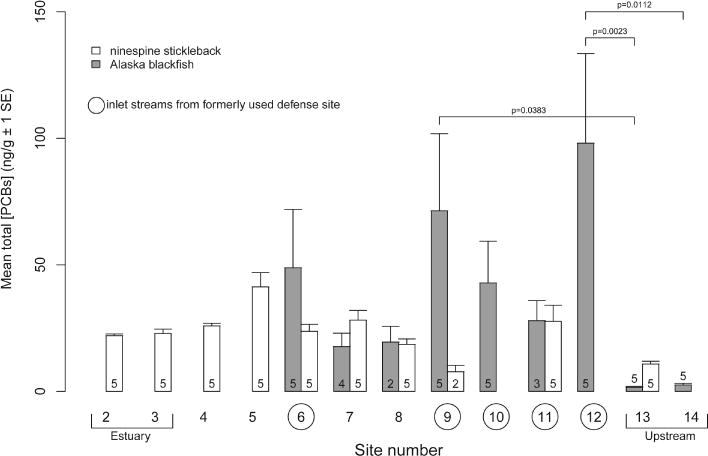
Total PCB concentrations (per wet weight) of ninespine stickleback and Alaska blackfish at study sites along the Suqitughneq River at Northeast Cape, St. Lawrence Island (see Fig. S1 for a remote image of the sites). Sites 13 and 14 are located upstream of the FUD site, while all other sites are downstream of it. Site 12 is at the confluence of the Suqitughneq River and the streamlet draining the former barrel-storage area and main operations center. Blackfish were not caught at Sites 2–5 and stickleback were not caught at Sites 10, 12, and 14 during the sampling period represented by these data (2012–2013). Site was a significant predictor of total [PCB] for blackfish (ANOVA F8,30 = 2.468, p = 0.0347) but not for stickleback. Because data were not normally distributed, and individual sites had small sample sizes, we also analyzed the data with the non-parametric Kruskal-Wallis test. Again, site was a significant predictor of total [PCB] for blackfish (KW = 26.62, p = 0.0008). Blackfish collected at site 12 had significantly higher total [PCB] than blackfish collected at sites 13 and 14 (Dunn’s multiple comparisons test, p = 0.0023 and 0.0112, respectively). Additionally, blackfish collected at site 9 had significantly higher total [PCB] than blackfish collected at site 13 (p = 0.0383).
Figure 2.
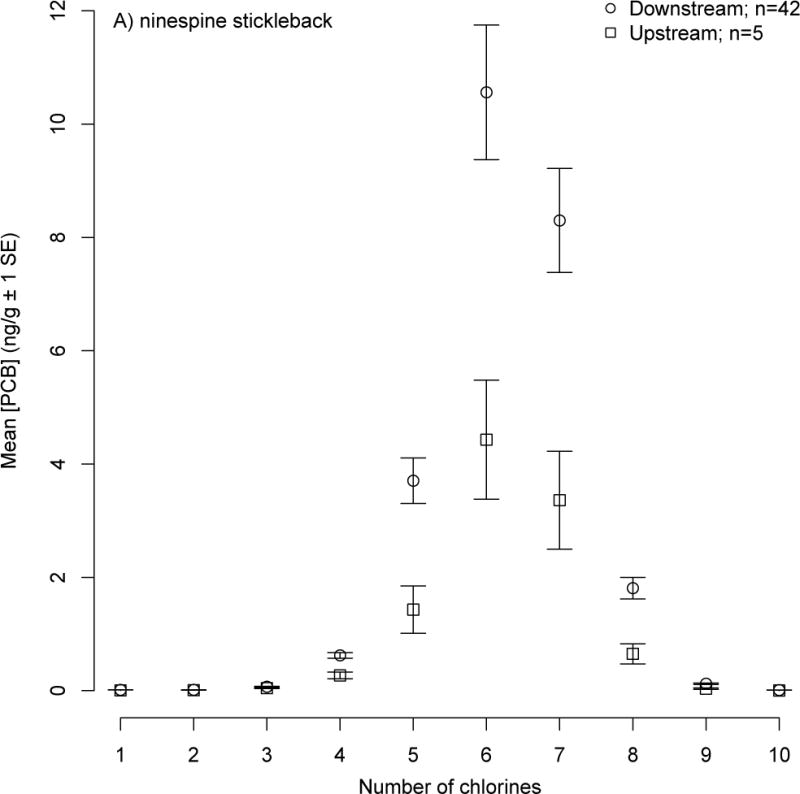
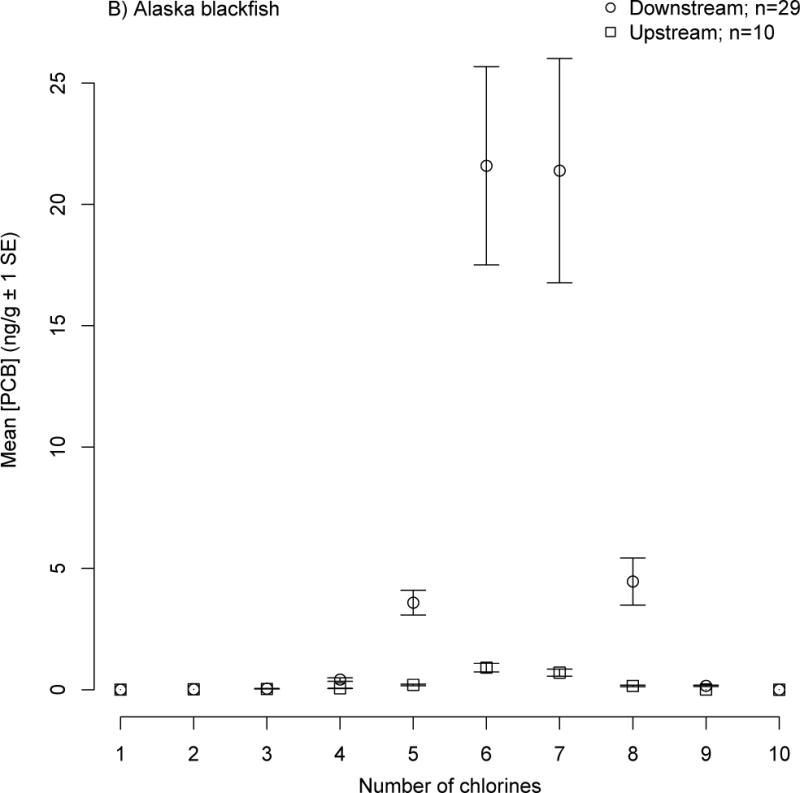
Difference in [PCB] for each PCB class (based on the number of chlorines in the molecule, and arranged along the horizontal axis from one to ten chlorines) between fish collected downstream vs. upstream of the FUD site at Northeast Cape, St. Lawrence Island for both ninespine stickleback (Panel A; n = 5 upstream fish and 42 downstream fish) and Alaska blackfish (Panel B; n = 10 upstream fish and 29 downstream fish). The concentration of lighter PCBs (those containing three or fewer chlorines) were not significantly higher or lower in upstream vs. downstream sites, a finding consistent with atmospheric deposition of these congeners. For blackfish, concentrations of all PCB classes with four or more chlorine atoms, as well as total PCBs, were significantly higher in fish collected downstream of the FUD site, suggesting that these congeners originated at the site (Mann-Whitney U tests, U = 0–4, p = 0.001–0.004; p values Bonferroni corrected; all statistics presented in Suppl. Table 1). For stickleback, concentration differences were significant only for PCBs containing 5, 9 or 10 chlorines (Mann-Whitney U tests, U = 7–27.5, p = 0.013 – 0.046; p values Bonferroni corrected; all statistics presented in Suppl. Table 1). Heavy PCB congeners, especially those containing 8 or more chlorines, are not readily transported in the atmosphere (Wania and Mackay, 1996) and therefore their presence indicates a local source.
Previous work on plants and sediment cores also concluded that most of the PCB contamination in the Suqitughneq River watershed originated at the FUD site (Miller et al., 2013; Scrudato et al., 2012). Evidence that PCBs in sediment cores originated at the FUD site includes concentration profiles with depth, spatial gradients, comparisons of the FUD site (>550 µg/kg total PCBs) to background concentrations elsewhere on SLI and the region (a few µg/kg), compositional variation (highly chlorinated at the FUD site), and associated military contaminants (Scrudato et al., 2012).
Are the levels of PCBs in the Suqitughneq River affecting the health of resident fish? We examined this question by using VTG as a biomarker of exposure to xenobiotic estrogens, by measuring thyroid hormone levels to detect disruption of the thyroid axis, by gene expression analysis to infer mechanisms of action, and by measuring total methylation of DNA in key tissues.
Environmental estrogens are associated with increased risk of developmental disorders and certain cancers in humans and wildlife (Norris and Carr, 2006). VTG is the egg-yolk precursor protein normally synthesized and secreted by female liver cells following induction by ovarian estrogens (Sumpter and Jobling, 1995). Because endogenous circulating estrogen levels in males are insufficient to activate expression of the VTG gene, VTG is a commonly used biomarker for xenobiotic estrogen exposure in oviparous vertebrates (Sumpter and Jobling, 1995). We developed a ninespine stickleback VTG assay for this study (von Hippel et al., 2016). Mean VTG concentrations of male stickleback caught in the Suqitughneq River indicate exposure to estrogenic contaminants (Fig. 3), consistent with exposure to PCBs or certain other pollutants (Nomiyama et al., 2010; Sumpter and Jobling, 1995; Tierney et al., 2014). The frequency of non-zero values of VTG in male stickleback from the Suqitughneq River was significantly higher than for two other sites on the island, and the concentration of VTG in induced Suqitughneq River males was significantly higher than that of induced males from the two other sites (Fig. 3). Consistent with these results, we found higher concentrations of estrogenic PCB congeners (Cooke et al., 2001) in fish caught downstream of the FUD site than in upstream fish (Fig. S4). The same pattern also holds true for dioxin-like PCBs (Fig. S5) (Van den Berg et al., 2006), which are associated with elevated risk of cancer (WHO, 2016).
Figure 3.
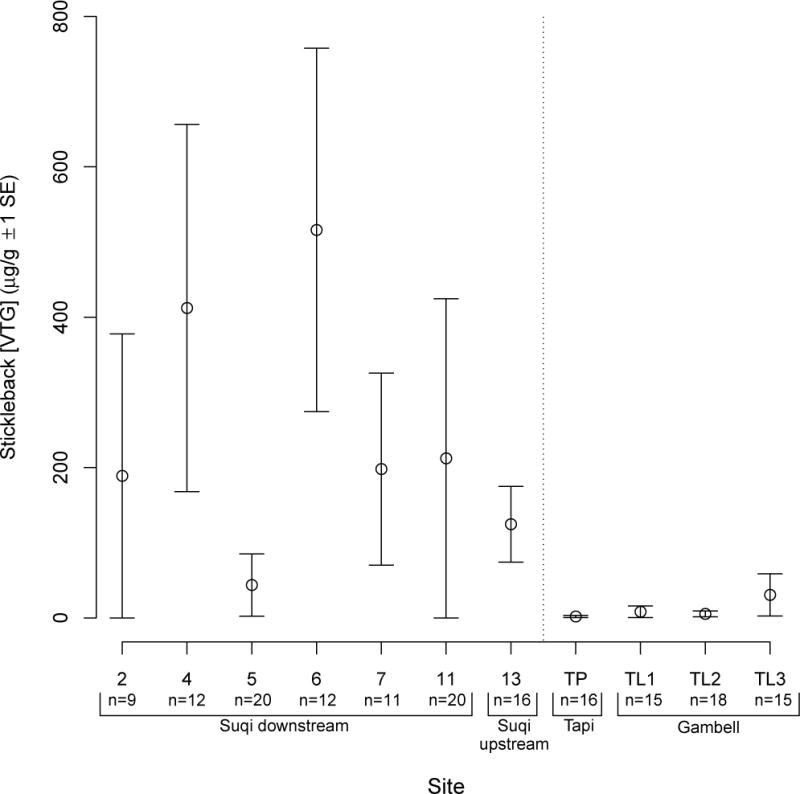
Mean vitellogenin (VTG) concentrations of male ninespine stickleback collected from Suqitughneq River (Suqi) sites 2, 4, 5, 6, 7, 11 and 13, from the Tapisaggak River (Tapi; TP) located east of the Suqitughneq River in a separate drainage, and from Troutman Lake (TL) sites 1, 2 and 3 in the village of Gambell on the western side of St. Lawrence Island. Suqitughneq sites 2–11 are located downstream of the FUD site, while Suqitughneq site 13 is located upstream. Genotypic sex was confirmed using sex-specific primers in a PCR assay. Many males in the Suqitughneq River are abnormally induced for VTG production, indicating exposure to estrogenic contaminants. The frequency of VTG induction in Suqitughneq River males (induced vs. not induced) is significantly higher than in males from the Tapisaggak River or Troutman Lake (chi-square test, χ2 = 7.01, df = 2, p < 0.05). Comparing only males with non-zero values of VTG (only induced males), concentrations are significantly higher in Suqitughneq River males than in combined males from the Tapisaggak River and Troutman Lake (Welch-corrected t = 3.368, df = 38.53, p = 0.0017). Given a lack of homogeneity of variance, we also compared VTG concentrations in induced Suqitughneq River males with induced males from the other two sites using the non-parametric Mann-Whitney U test, and results were similar (U = 109, p = 0.0246). Variation in male VTG concentration is high in the Suqitughneq River, likely because fish move around between more and less contaminated reaches. To the best of our knowledge, these are the first VTG data ever collected for ninespine stickleback in the wild.
Because PCBs are known to cause hypothyroid conditions (Schell et al., 2008), we optimized a thyroid hormone (thyroxine; T4) assay for the ninespine stickleback (von Hippel et al., 2016). Stickleback in some parts of the Suqitughneq River had significantly lower levels of T4 than stickleback in other parts of the Suqitughneq River or in two other sampled locations on SLI (Fig. 4), consistent with disrupted endocrine function.
Figure 4.
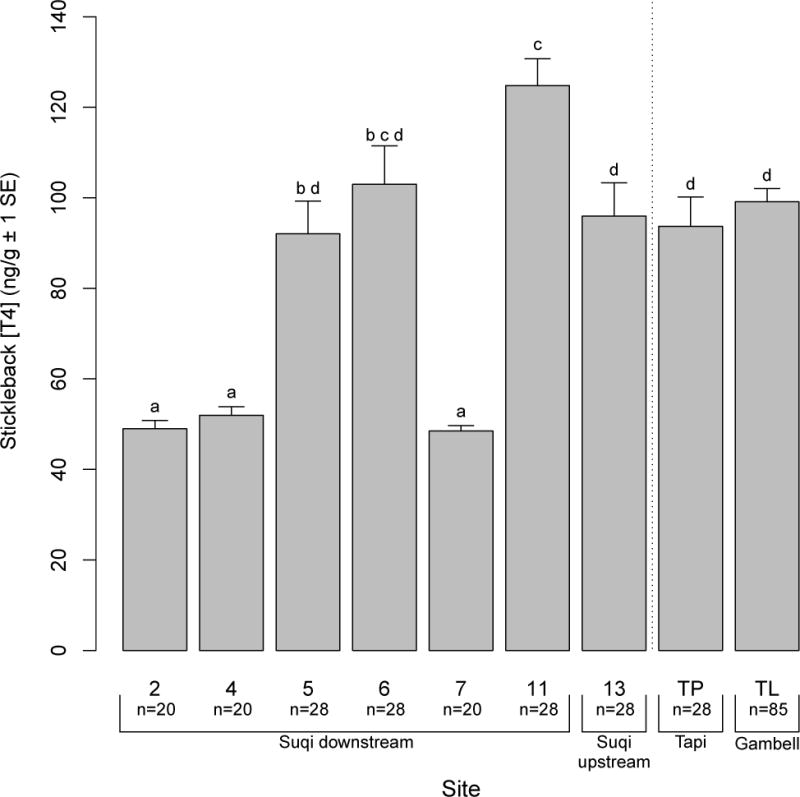
Thyroid hormone (thyroxine; T4) concentrations in whole-body homogenates of ninespine stickleback collected in the Suqitughneq River sites 2, 4, 5, 6, 7, 11 and 13, in the Tapisaggak River (Tapi, TP) located east of the Suqitughneq River in a separate drainage, and in Troutman Lake (TL) in the village of Gambell on the western side of St. Lawrence Island. T4 concentration significantly differed by site (ANOVA, F8,275 = 18.29, p < 0.001), with stickleback collected at Suqitughneq River sites 2, 4 and 7 having significantly lower T4 concentrations than stickleback collected at other Suqitughneq River sites or in the Tapisaggak River or Troutman Lake (Tukey’s post hoc test, indicated by letters over SE error bars showing which groups significantly differ from each other).
To query disrupted gene pathways, we evaluated differential gene expression by RNA-seq. We limited our analysis to females because insufficient males were available from contaminated and control sites for statistical analysis. We combined stickleback from sites 5 and 7 into a single “highly contaminated” treatment group, and stickleback from sites 9 and 13 into a “slightly contaminated” treatment group based on the large differences in PCB concentrations at these sites (Fig. 1). RNA-seq reads were aligned to the sequenced genome of the closely related threespine stickleback. One female from site 7 was excluded after sequencing because it had low correlation with biological replicates, likely due to degradation in the field. Differential gene expression analysis by DESeq2 identified 2,514 genes with significant differential expression. Of these differentially expressed genes, 1,709 were annotated to zebrafish ENSEMBL assembly GRCz10, and 1,900 were annotated to human ENSEMBL assembly GRCh37.p13.
The use of DAVID (Huang et al., 2009) provided gene ontology (GO) clustering and informed functional relationships. Clustering of differentially expressed genes annotated to human resulted in Annotation Cluster 1 (enrichment score = 15.17) containing 145 genes that function in cell cycle and cell division, including DNA replication and checkpoint regulation. These genes were downregulated in fish from the highly contaminated sites. This result suggests that fish in contaminated sites likely had reduced abilities to undergo normal cell division. Annotation Cluster 2 (enrichment score = 11.74) contained 55 genes that function in DNA replication and G1/S transition in mitotic cell division, and these genes were also downregulated in fish from the highly contaminated sites, consistent with the downregulation of cell repair. Annotation Cluster 3 (enrichment score = 6.94) included 76 genes that function in DNA damage response and DNA repair, and nearly all of these genes exhibited lower expression in individuals from the highly contaminated sites, indicating that contaminated animals would be more sensitive to DNA damaging agents. Together, down regulation of cell division, cell signaling, and DNA repair pathways suggest that stickleback from contaminated sites at Northeast Cape have decreased capacity to respond to cellular damage through replication, checkpoint regulation, and DNA repair.
In addition to the unbiased way of examining the data offered by DAVID analysis, we used a hypothesis driven approach. The aryl hydrocarbon receptor pathway provides a major response to xenobiotic stress in many fishes by regulating xenobiotic metabolizing enzymes such as cyp1a1 (reviewed in Whyte et al., 2000). Our results showed that cyp1a was upregulated three-fold (padj=0.006) in stickleback from highly contaminated sites, a result consistent with expression differences in other species of fish exposed to PCBs (Brinkmann et al., 2016; Reid et al., 2016). We also found a 2.5-fold increase in expression of liver glycogen phosphorylase (pygl; padj=0.08) in highly contaminated sites, mimicking the upregulation observed in roaches (Rutilus rutilus; (Brinkmann et al., 2016)), a result consistent with increased metabolic stress from sublethal PCB exposure in rainbow trout (Oncorhynchus mykiss; (Bellehumeur et al., 2016).
The pregnane X receptor (PXR, NR1I2) and the constitutive androstane receptor (CAR, NR1I3) can bind many types of xenobiotic ligands (Bainy et al., 2013; Ekins et al., 2008; Kretschmer and Baldwin, 2005). Most teleost fish have a single copy of nr1i2, but the threespine stickleback genome (http://uswest.ensembl.org/Gasterosteus_aculeatus/Info/Index) has apparently lost this gene (http://www.ensembl.org/Homo_sapiens/Gene/Compara_Tree?g=ENSG00000144852;r=3:119780484-119818485;collapse=7470820,7470892,7470877,7470803,7471050,7470933,7470666,7470912,7470890,7469626,7469380,7471049,7470807), and no teleosts have any annotated ortholog of NR1I3. Nevertheless, our expression data showed that targets of the constitutive androstane receptor (CAR, NR1I3), including mycb (the stickleback ortholog of human MYC) and foxm1 (Blanco-Bose et al., 2008) were both downregulated in ninespine stickleback from highly contaminated sites to about a third of the level observed in animals from less contaminated sites (padj=0.011 and 0.017, respectively). The fish gene abcb4, which encodes the teleost ortholog of the CAR target ABCB1, was upregulated over three fold (padj=0.08) in stickleback from the highly contaminated sites. These data show that, while teleost genomes have variably disrupted components of the nr1i gene family (sequenced teleosts genomes, including threespine stickleback, have two copies of nr1i1, the vitamin D receptor), the expression of some downstream targets of the androstane receptor pathway was nevertheless disrupted in ninespine stickleback from more contaminated sites.
Because PCBs can impact DNA methylation (Itoh et al., 2014; Kim et al., 2010; Rusiecki et al., 2008; Sales et al., 2013), we performed a total methylation assay on liver, kidney, gonad, thyroid and spleen from Suqitughneq River stickleback collected upstream vs. downstream of the FUD site. Gonads from fish collected downstream of the PCB point source showed significantly more DNA methylation than gonads from upstream fish (Fig. 5; differences were not significant for other tested tissues). This result is predicted by the hypothesis that contaminants disrupt the balance of methylation and demethylation that normally occurs as gametes mature (Dean, 2014).
Figure 5.
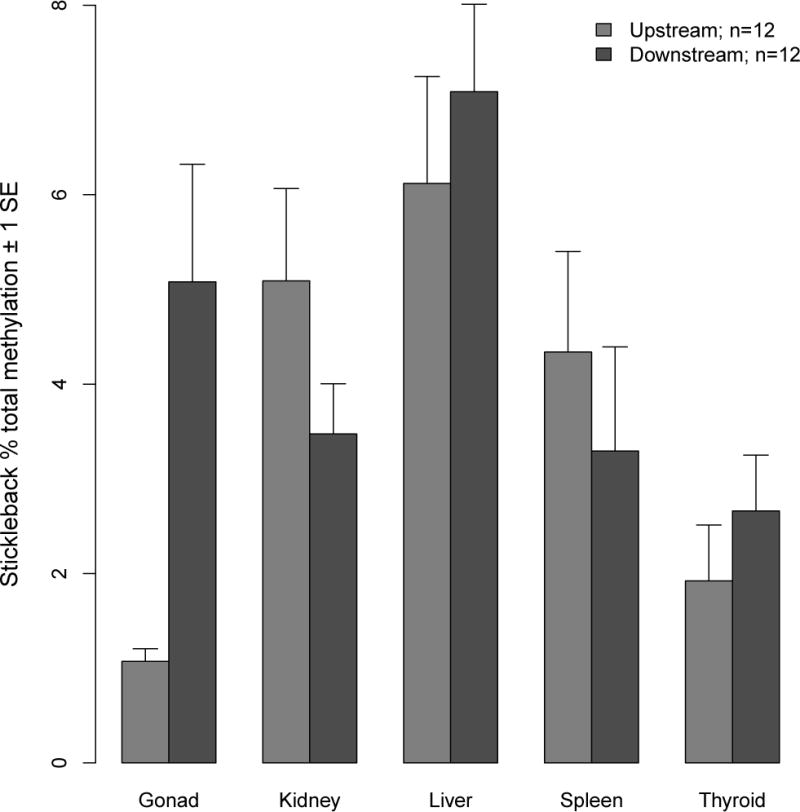
Percent total methylation of gonad, kidney, liver, spleen and thyroid of ninespine stickleback collected upstream (n = 12) vs. downstream (n = 12) of the FUD site in the Suqitughneq River at Northeast Cape, St. Lawrence Island (sample size exceptions: downstream gonad n = 9, upstream spleen n = 11, downstream spleen n = 9, downstream thyroid n = 11). Only gonads differed significantly between upstream and downstream fish (Mann Whitney U test, U = 23, p = 0.0278). Males and females showed the same pattern for gonads, but were analyzed together because of low sample size.
Conclusions
Despite extensive remediation at Northeast Cape, short-lived, lower trophic level fish in the Suqitughneq River remain contaminated with high levels of PCBs. Furthermore, most of the contamination originated from the FUD site. PCBs may have been liberated from sediments during site remediation, causing contamination of resident animals (Scrudato et al., 2012), a phenomenon seen in some other PCB remediation projects (Voie et al., 2002). Alternatively, or in addition, PCBs may have migrated down gradient during the decades prior to site remediation, implying that additional sources of PCBs remain sequestered in the soils and sediments of Northeast Cape, including in the Suqitughneq River. Regardless, our results suggest that remediation of the site is incomplete.
Levels of PCBs found in fish resident at Northeast Cape are biologically relevant. Male stickleback in the Suqitughneq River showed high levels of vitellogenin induction, indicating exposure to estrogenic contaminants such as PCBs. Total methylation of DNA from gonads significantly differed between upstream and downstream stickleback. Stickleback collected from certain sites along the Suqitughneq River also showed hypothyroid conditions, based on significantly lower levels of thyroid hormone. Furthermore, stickleback collected at more contaminated reaches of the Suqitughneq River expressed numerous genes differentially compared to fish collected at less contaminated reaches, including genes relevant to DNA replication, response to DNA damage, and cell signaling. Decreased expression of DNA repair genes could increase the accumulation of mutations and intensify the potential for carcinogenesis. Reduced cell signaling might exacerbate the risk of carcinogenesis by decreasing normal pathways of cell cycle arrest and apoptosis for genetically damaged cells. The vertebrate endocrine system and genome are highly conserved (Sumpter and Jobling, 1995); for example, 82% of human disease-related genes have unambiguous orthologs in zebrafish (Howe et al., 2013). Therefore, our findings of endocrine disruption and altered gene expression in Suqitughneq River fish indicate potential health risks for SLI residents associated with Northeast Cape. Our data also imply that biological effects on resident species should be incorporated into decisions on site remediation and closure, rather than relying solely on criteria such as contaminant levels in water and sediments.
This study demonstrates that, even after site remediation, contaminants from Cold War legacy FUD sites in remote regions of the Arctic remain a potential health threat to local residents – in this case, indigenous people who had no influence over site selection and use by the United States military. Given that thousands of such Cold War remnants exist throughout the Arctic in Alaska, Canada, Greenland, Scandinavia and Russia (von Hippel et al., 2016), and often in close proximity to indigenous villages, such health disruption may be widespread and contribute to the health disparities experienced by Arctic Indigenous Peoples.
Supplementary Material
Figure S1. Image of the Suqitughneq River drainage with fish sampling sites numbered. Sites 2–12 are located downstream of the Northeast Cape FUD site, while sites 13 and 14 are located upstream. Site 1 was washed away by a tidal surge when sea ice broke free of the river mouth, and hence is not included on the map. MOC = main operations center of the FUD site.
Figure S2. Percent of sum PCBs for all congeners that contributed at least 1% to the total PCB concentration in ninespine stickleback and Alaska blackfish collected upstream (A) or downstream (B) of the FUD site at Northeast Cape, St. Lawrence Island. The lightest PCBs to contribute at least 1% to the total PCB concentration belong to the class of PCBs with 5 chlorines, while the heaviest belong to the PCB class with 8 chlorines. Although PCB concentrations were significantly higher in fish collected downstream of the FUD site (Figs. 1–2), the relative contribution of different congeners were broadly similar upstream and downstream. Exceptions were PCB 179 and PCB 190 (only exceeded 1% threshold in upstream fish), and PCB 196 (only exceeded 1% threshold in downstream fish).
Figure S3. Percent of sum PCBs for all congeners that contributed at least 1% to the total PCB concentration in ninespine stickleback collected from the Suqitughneq River (n = 47) vs. ninespine stickleback collected from the nearby Tapisaggak River (n = 20). An ANOVA revealed that river was not a significant factor in the model (p = 0.2952), but the number of chlorines in the PCB was (p = 0.0001), as was the interaction between river and number of chlorines (p = 0.0405). This was due to significantly higher concentrations of PCBs with 7 chlorines in the Suqitughneq River fish (F4,330= 2.53, p = 0.0113), while for PCBs with 8 chlorines, only Suqitughneq River fish had contributions to total PCBs exceeding 1%.
Figure S4. Concentrations of estrogenic PCB congeners (PCB 52, 70, 95, 99, 101, 110, 153)(Cooke et al., 2001) in ninespine stickleback (A) and Alaska blackfish (B) collected downstream and upstream of the FUD site at Northeast Cape, St. Lawrence Island. Note the difference in scale of the y axis between the two graphs. Site was a significant predictor of concentration of estrogenic PCBs for blackfish (Kruskal-Wallis test, KW = 26.24, p = 0.0010). Site 12, which drains the former barrel storage area and main operations center, has significantly higher concentrations of estrogenic PCBs in blackfish than sites 13 and 14 (Dunn’s multiple comparisons test, p = 0.0023 and 0.0101, respectively). Site was not a significant predictor of concentration of estrogenic PCBs for stickleback (Kruskall-Wallis test, KW = 15.92, p = 0.0685). Stickleback were not caught at site 12 and blackfish were not caught at sites 2–5 during the sampling period represented by these data (2012–2013).
Figure S5. Concentrations of dioxin-like PCB congeners (PCB 77, 81, 105, 114, 118, 123, 126, 156, 157, 167, 189)(Van den Berg et al., 2006) in ninespine stickleback (A) and Alaska blackfish (B) collected downstream and upstream of the FUD site at Northeast Cape, St. Lawrence Island. Note the difference in scale of the y axis between the two graphs. Site was a significant predictor of concentration of dioxin-like PCBs for blackfish (Kruskal-Wallis test, KW = 25.36, p = 0.0013). Blackfish collected from site 12, which drains the former barrel storage area and main operations center, had significantly higher concentrations of total dioxin-like PCBs than blackfish collected from sites 13 and 14 (Dunn’s multiple comparison test, p = 0.0023 and 0.0139, respectively). Site was also a significant predictor of concentration of dioxin-like PCBs for stickleback (Kuskal-Wallis test, KW = 18.65, p = 0.0283), though individual comparisons between sites were not significant. Stickleback were not caught at site 12 and blackfish were not caught at sites 2–5 during the sampling period represented by these data (2012–2013).
Capsule.
Legacy contaminants from Cold War military sites in the Arctic remain a health threat to Arctic Indigenous Peoples.
Highlights.
Formerly Used Defense (FUD) sites in the Arctic are point sources of PCB pollution.
The Arctic contains thousands of FUD sites, many co-located with indigenous villages.
Fish collected at a FUD site on St. Lawrence Island were contaminated with PCBs.
Fish showed endocrine disruption, and altered DNA methylation and gene expression.
Contaminants from FUD sites in the Arctic remain a health threat to local residents.
Acknowledgments
Research reported in this publication was supported by the National Institute of General Medical Sciences of the National Institutes of Health under Award Number P20GM103395. The content is solely the responsibility of the authors and does not necessarily represent the official views of the National Institutes of Health. Funding was also provided by the National Institute of Environmental Health Sciences (NIEHS grant numbers 1RO1ES019620 and 2RO1ES019620), the University of Alaska Anchorage (UAA) College of Arts and Sciences, and UAA’s Environment and Natural Resources Institute. Fish were collected under Alaska Department of Fish and Game permits SF-2012-053 and SF2013-164. We thank Jesse Gologergen, Heidi Zimmer and Madelyn Peterson for assistance in the field and Victoria M. Carroll for assistance in the lab. We thank Sharon Rudolph for making Figure S1. We thank Elise Adams for drawing the graphical abstract. We thank the three anonymous reviewers and the Associate Editor for thoughtful comments on the manuscript. We thank the communities of St. Lawrence Island for their support and collaboration, and the members of the St. Lawrence Island Working Group for their valuable guidance of this research.
Footnotes
Publisher's Disclaimer: This is a PDF file of an unedited manuscript that has been accepted for publication. As a service to our customers we are providing this early version of the manuscript. The manuscript will undergo copyediting, typesetting, and review of the resulting proof before it is published in its final citable form. Please note that during the production process errors may be discovered which could affect the content, and all legal disclaimers that apply to the journal pertain.
Conflicts of interest: none.
References
- ADEC. Site report for Northeast Cape. St. Lawrence Island Alaska: Alaska Department of Environmental Conservation Division of Spill Prevention and Response Contaminated Sites Program; 2013a. http://146.63.9.103/Applications/SPAR/PublicMVC/CSP/SiteReport/207. [Google Scholar]
- ADEC. Site summary for Northeast Cape formerly used defense site. Alaska Department of Environmental Conservation Division of Spill Prevention and Response Contaminated Sites Program; 2013b. http://dec.alaska.gov/spar/csp/sites/stlawrence.htm. [Google Scholar]
- Amores A, Catchen J, Ferrara A, Fontenot Q, Postlethwait JH. Genome evolution and meiotic maps by massively parallel DNA sequencing: spotted gar, an outgroup for the teleost genome duplication. Genetics. 2009;188:799–808. doi: 10.1534/genetics.111.127324. [DOI] [PMC free article] [PubMed] [Google Scholar]
- Anders S, Pyl PT, Huber W. HTSeq–A Python framework to work with high-throughput sequencing data. Bioinformatics. 2015;31:166–169. doi: 10.1093/bioinformatics/btu638. [DOI] [PMC free article] [PubMed] [Google Scholar]
- Ayotte P, Carrier G, Dewailly E. Health risk assessment for Inuit newborns exposed to dioxin-like compounds through breast feeding. Chemosphere. 1996;32:531–542. doi: 10.1016/0045-6535(96)00003-3. [DOI] [PubMed] [Google Scholar]
- Ayotte P, Dewailly E, Bruneau S, Careau H, Vézina A. Arctic air pollution and human health: what effects should be expected? The Science of the Total Environment. 1995;160/161:529–537. doi: 10.1016/0048-9697(95)04387-g. [DOI] [PubMed] [Google Scholar]
- Ayotte P, Dewailly E, Ryan JJ, Bruneau S, Lebel G. PCBs and dioxin-like compounds in plasma of adult Inuit living in Nunavik (arctic Quebec) Chemosphere. 1997;34:1459–1468. doi: 10.1016/s0045-6535(97)00442-6. [DOI] [PubMed] [Google Scholar]
- Ayotte P, Muckle G, Jacobson JL, Jocobson SW, Dewailly E. Assessment of pre- and postnatal exposure to polychlorinated biphenyls: lessons from the Inuit Cohort Study. Environmental Health Perspectives. 2003;111:1253–1258. doi: 10.1289/ehp.6054. [DOI] [PMC free article] [PubMed] [Google Scholar]
- Bainy AC, Kubota A, Goldstone JV, Lille-Langøy R, Karchner SI, Celander MC, Hahn ME, Goksøyr A, Stegeman JJ. Functional characterization of a full length pregnane X receptor, expression in vivo, and identification of PXR alleles, in zebrafish (Danio rerio) Aquatic Toxicology. 2013;142–143:447–457. doi: 10.1016/j.aquatox.2013.09.014. [DOI] [PMC free article] [PubMed] [Google Scholar]
- Bard SM. Global transport of anthropogenic contaminants and the consequences for the arctic marine ecosystem. Marine Pollution Bulletin. 1999;38:356–379. [Google Scholar]
- Bellehumeur K, Lapointe D, Cooke SJ, Moon TW. Exposure to sublethal levels of PCB-126 impacts fuel metabolism and swimming performance in rainbow trout. Comparative Biochemistry and Physiology, Part B. 2016;199:97–104. doi: 10.1016/j.cbpb.2016.01.005. [DOI] [PubMed] [Google Scholar]
- Blais JM. Biogeochemistry of persistent bioaccumulative toxicants: processes affecting the transport of contaminants to remote areas. Canadian Journal of Fisheries and Aquatic Sciences. 2005;62:236–243. [Google Scholar]
- Blanco-Bose WE, Murphy MJ, Ehninger A, Offner S, Dubey C, Huang W, Moore DD, Trumpp A. C-Myc and its target FoxM1 are critical downstream effectors of constitutive androstane receptor (CAR) mediated direct liver hyperplasia. Hepatology. 2008;48:1302–1311. doi: 10.1002/hep.22475. [DOI] [PubMed] [Google Scholar]
- Bolger AM, Lohse M, Usadel B. Trimmomatic: a flexible trimmer for Illumina sequence data. Bioinformatics btu. 2014;170 doi: 10.1093/bioinformatics/btu170. [DOI] [PMC free article] [PubMed] [Google Scholar]
- Boucher O, Muckle G, Bastien CH. Prenatal exposure to polychlorinated biphenyls: a neuropsychologic analysis. Environmental Health Perspectives. 2009;117:7–16. doi: 10.1289/ehp.11294. [DOI] [PMC free article] [PubMed] [Google Scholar]
- Brinkmann M, Koglin S, Eisner B, Wiseman S, Hecker M, Eichbaum K, Thalmann B, Buchinger S, Reifferscheid G, Hollert H. Characterisation of transcriptional responses to dioxins and dioxin-like contaminants in roach (Rutilus rutilus) using whole transcriptome analysis. Science of the Total Environment. 2016;541:412–423. doi: 10.1016/j.scitotenv.2015.09.087. [DOI] [PubMed] [Google Scholar]
- Brown TM, Fisk AT, Helbing CC, Reimer KJ. Polychlorinated biphenyl profiles in ringed seals (Pusa hispida) reveal historical contamination by a military radar station in Labrador, Canada. Environmental Toxicology and Chemistry. 2014a;33:592–601. doi: 10.1002/etc.2468. [DOI] [PubMed] [Google Scholar]
- Brown TM, Ross PS, Reimer KJ, Veldhoen N, Dangerfield NJ, Fisk AT, Helbing CC. PCB related effects thresholds as derived through gene transcript profiles in locally contaminated ringed seals (Pusa hispida) Environmental Science & Technology. 2014b;48:12952–12961. doi: 10.1021/es5032294. [DOI] [PubMed] [Google Scholar]
- Byrne S, Miller PK, Waghiyi V, Buck CL, von Hippel FA, Carpenter DO. Persistent organochlorine pesticide exposure related to a formerly used defense site on St. Lawrence Island, Alaska: data from sentinel fish and human sera. Journal of Toxicology and Environmental Health, Part A. 2015;78:976–992. doi: 10.1080/15287394.2015.1037412. [DOI] [PMC free article] [PubMed] [Google Scholar]
- Byrne S, Seguinot-Medina S, Waghiyi V, Miller PK, Buck C, von Hippel FA, Carpenter D. Exposure to polybrominated diphenyl ethers and perfluoroalkyl substances in a remote population of Alaska Natives. Environmental Pollution. 2017;231:387–395. doi: 10.1016/j.envpol.2017.08.020. [DOI] [PMC free article] [PubMed] [Google Scholar]
- Carpenter DO. Polychlorinated biphenyls (PCBs): routes of exposure and effects on human health. Reviews on Environmental Health. 2006;21:1–23. doi: 10.1515/reveh.2006.21.1.1. [DOI] [PubMed] [Google Scholar]
- Carpenter DO, DeCaprio AP, O’Hehir D, Akhtar F, Johnson G, Scrudato RJ, Apatiki L, Kava J, Gologergen J, Miller PK, Eckstein L. Polychlorinated biphenyls in serum of the Siberian Yupik people from St. Lawrence Island, Alaska. International Journal of Cicumpolar Health. 2005;64:322–335. doi: 10.3402/ijch.v64i4.18010. [DOI] [PubMed] [Google Scholar]
- Cooke PS, Sato T, Buchanan DL. Disruption of steroid hormone signaling by PCBs. In: Robertson LW, Hansen LG, editors. PCBs recent advances in environmental toxicology and health effects. University Press of Kentucky; Louisville, KY: 2001. pp. 257–263. [Google Scholar]
- Dallaire F, Dewailly E, Vézina C, Muckle G, Weber JP, Bruneau S, Ayotte P. Effect of prenatal exposure to polychlorinated biphenyls on incidence of acute respiratory infections in preschool Inuit children. Environmental Health Perspectives. 2006;114:1301–1305. doi: 10.1289/ehp.8683. [DOI] [PMC free article] [PubMed] [Google Scholar]
- Dallaire R, Dewailly E, Ayotte P, Forget-Dubois N, Jacobson SW, Jocobson JL, Muckle G. Growth in Inuit children exposed to polychlorinated biphenyls and lead during fetal development and childhood. Environmental Research. 2014;134:17–23. doi: 10.1016/j.envres.2014.06.023. [DOI] [PMC free article] [PubMed] [Google Scholar]
- Dean W. DNA methylation and demethylation: a pathway to gametogenesis and development. Molecular Reproduction & Development. 2014;81:113–125. doi: 10.1002/mrd.22280. [DOI] [PubMed] [Google Scholar]
- Dewailly E, Mulvad G, Pedersen HS, Ayotte P, Demers A, Weber JP, Hansen JC. Concentration of organochlorines in human brain, liver, and adipose tissue autopsy samples from Greenland. Environmental Health Perspectives. 1999;107:823–828. doi: 10.1289/ehp.99107823. [DOI] [PMC free article] [PubMed] [Google Scholar]
- Dewailly E, Nantel A, Weber JP, Meyer F. High levels of PCBs in breast milk of Inuit women from arctic Quebec. Bulletin of Environmental Contamination and Toxicology. 1989;43:641–646. doi: 10.1007/BF01701981. [DOI] [PubMed] [Google Scholar]
- Ekins S, Reschly EJ, Hagey LR, Krasowski MD. Evolution of pharmacologic specificity in the pregnane X receptor. BMC Evol Biol. 2008;8:103. doi: 10.1186/1471-2148-8-103. [DOI] [PMC free article] [PubMed] [Google Scholar]
- EPA. Polychlorinated biphenyls (PCBs) update: impact on fish advisories. United States Environmental Protection Agency; 1999. EPA-823-F-99-019. [Google Scholar]
- Gardell AM, Dillon DM, Smayda LC, von Hippel FA, Cresko WA, Postlethwait JH, Buck CL. Perchlorate exposure does not modulate temporal variation on whole-body thyroid and androgen hormone content in threespine stickleback. General and Comparative Endocrinology. 2015;219:45–52. doi: 10.1016/j.ygcen.2015.02.014. [DOI] [PMC free article] [PubMed] [Google Scholar]
- Gardell AM, von Hippel FA, Adams EM, Dillon DM, Petersen AM, Postlethwait JH, Cresko WA, Buck CL. Exogenous iodide ameliorates perchlorate-induced thyroid phenotypes in threespine stickleback. General and Comparative Endocrinology. 2017;243:60–69. doi: 10.1016/j.ygcen.2016.10.014. [DOI] [PMC free article] [PubMed] [Google Scholar]
- Gioia R, Dachs J, Nizzetto L, Lohmann R, Jones KC. Atmospheric transport, cycling and dynamics of polychlorinated biphenyls (PCBs) from source regions to remote oceanic areas. In: McConnell L, Dachs J, Hapeman CJ, editors. Occurrence, fate and impact of atmospheric pollutants on environmental and human health. American Chemical Society; Washington, DC: 2013. pp. 3–18. [Google Scholar]
- Hong Q, Wang Y, Luo X, Chen S, Chen J, Cai M, Cai M, Mai B. Occurrence of polychlorinated biphenyles (PCBs) together with sediment properties in the surface sediments of the Bering Sea, Chuckchi Sea and Canada Basin. Chemosphere. 2012;88:1340–1345. doi: 10.1016/j.chemosphere.2012.05.033. [DOI] [PubMed] [Google Scholar]
- Howe K, Clark MD, Torroya CF, Torrance J, Berthelot C, Muffato M, Collins JE, Humphray S, McLaren K, Matthews L, McLaren S, Sealy I, Caccamo M, Churcher C, Scott C, Barrett JC, Koch R, Rauch GJ, White S, Chow W, Kilian B, Quintais LT, Guerra-Assuncao JA, Zhou Y, Gu Y, Yen J, Vogel JH, Eyre T, Redmond S, Banerjee R, Chi J, Fu B, Langley E, Maguire SF, Laird GK, Lloyd D, Kenyon E, Donaldson S, Sehra H, Almeida-King J, Loveland J, Trevanion S, Jones M, Quail M, Willey D, Hunt A, Burton J, Sims S, McLay K, Plumb B, Davis J, Clee C, Oliver K, Clark R, Riddle C, Eliott D, Threadgold G, Harden G. The zebrafish reference genome sequence and its relationship to the human genome. Nature. 2013;496:498–503. doi: 10.1038/nature12111. [DOI] [PMC free article] [PubMed] [Google Scholar]
- Huang DW, Sherman BT, Lempicki RA. Systematic and integrative analysis of large gene lists using DAVID bioinformatics resources. Nature Protocols. 2009;4:44–57. doi: 10.1038/nprot.2008.211. [DOI] [PubMed] [Google Scholar]
- Itoh H, Iwasaki M, Kasuga Y, Yokoyama S, Onuma H, Nishimura H, Kusama R, Yoshida T, Yokoyama K, Tsugane S. Association between serum organochlorines and global methylation level of leukocyte DNA among Japanese women: a cross-sectional study. Science of the Total Environment. 2014;490:603–609. doi: 10.1016/j.scitotenv.2014.05.035. [DOI] [PubMed] [Google Scholar]
- Iwata H, Tanabe S, Aramoto M, Sakal N, Tatsukawa R. Persistent organochlorine residues in sediments from the Chukchi Sea, Bering Sea and Gulf of Alaska. Marine Pollution Bulletin. 1994;28:746–753. [Google Scholar]
- Iwata H, Tanabe S, Sakal N, Tatsukawa R. Distribution of persistent organochlorines in the oceanic air and surface seawater and the role of ocean on their global transport and fate. Environmental Science & Technology. 1993;27:1080–1098. [Google Scholar]
- Kim K, Kim D, Lee S, Lee I, Kang J, Chang Y, Jacobs DRJ, Steffes M, Lee D. Association of low-dose exposure to persistent organic pollutants with global DNA hypomethylation in healthy Koreans. Environmental Health Perspectives. 2010;118:370–374. doi: 10.1289/ehp.0901131. [DOI] [PMC free article] [PubMed] [Google Scholar]
- Kretschmer XC, Baldwin WS. CAR and PXR: xenosensors of endocrine disrupters? Chem Biol Interact. 2005;155:111–128. doi: 10.1016/j.cbi.2005.06.003. [DOI] [PubMed] [Google Scholar]
- Lammel G, Stemmler I. Fractionation and current time trends of PCB congeners: evolvement of distributions 1950–2010 studied using a global atmosphere-ocean general circulation model. Atmospheric Chemistry and Physics. 2012;12:7199–7213. [Google Scholar]
- Lauby-Secretan B, Loomis D, Grosse Y, El Ghissassi F, Bouvard V, Benbrahim-Tallaa L, Guha N, Baan R, Mattock H, Straif K. Carcinocenicity of polychlorinated biphenyls and polybrominated biphenyls. Lancet Oncology. 2013;14:287–288. doi: 10.1016/S1470-2045(13)70104-9. [DOI] [PubMed] [Google Scholar]
- Letcher RJ, Bustnes JO, Dietz R, Jenssen BM, Jorgensen EH, Sonne C, Verreault J, Vijayan MM, Gabrielsen GW. Exposure and effects assessment of persistent organohalogen contaminants in arctic wildlife and fish. Science of the Total Environment. 2010;408:2995–3043. doi: 10.1016/j.scitotenv.2009.10.038. [DOI] [PubMed] [Google Scholar]
- Love MI, Huber W, Anders S. Moderated estimation of fold change and dispersion for RNA-seq data with DESeq2. Genome Biology. 2014;15:550. doi: 10.1186/s13059-014-0550-8. [DOI] [PMC free article] [PubMed] [Google Scholar]
- Luoma SN, Rainbow PS. Metal Contamination in Aquatic Environments - Science and Lateral Management. Cambridge University Press; Cambridge: 2008. [Google Scholar]
- Macdonald RW, Harner T, Fyfe J. Recent climate change in the Arctic and its impact on contaminant pathways and interpretation of temporal trend data. Science of the Total Environment. 2005;342:5–86. doi: 10.1016/j.scitotenv.2004.12.059. [DOI] [PubMed] [Google Scholar]
- Martin M. Cutadapt removes adapter sequences from high-throughput sequencing reads. EMBnet journal. 2011;17:10–12. [Google Scholar]
- Miller PK, Waghiyi V, Welfinger-Smith G, Byrne SC, Kava J, Gologergen J, Eckstein L, Scrudato RJ, Chiarenzelli J, Carpenter DO, Seguinot-Medina S. Community-based participatory research projects and policy engagement to protect environmental health on St. Lawrence Island, Alaska. International Journal of Cicumpolar Health. 2013;72:21656. doi: 10.3402/ijch.v72i0.21656. [DOI] [PMC free article] [PubMed] [Google Scholar]
- Muir D, Riget F, Cleemann M, Skaare J, Kleivane L, Nakata H, Dietz R, Severinsen T, Tanabe S. Circumpolar trends of PCBs and organochlorine pesticides in the arctic marine environment inferred from levels in ringed seals. Environmental Science & Technology. 2000;34:2431–2438. [Google Scholar]
- Nomiyama K, Nomura Y, Takahashi T, Uchiyama Y, Arizono K, Shinohara R. Hydroxylated polychlorinated biphenyls (OH-PCBs) induce vitellogenin through estrogenic activity in primary-cultured hepatocytes of the Xenopus laevis. Chemosphere. 2010;78:800–806. doi: 10.1016/j.chemosphere.2009.12.018. [DOI] [PubMed] [Google Scholar]
- Norris DO, Carr JA. Endocrine Disruption. Oxford University Press; Oxford: 2006. [Google Scholar]
- OECD. Organisation for Economic Co-operation and Development Test Guideline 234: Fish Sexual Development Test. 2011 http://www.oecd-ilibrary.org/environment/test-no-234-fish-sexual-development-test_9789264122369-en.
- Petersen AM, Dillon D, Bernhardt RA, Torunsky R, Postlethwait JH, von Hippel FA, Buck CL, Cresko WA. Perchlorate disrupts embryonic androgen synthesis and reproductive development in threespine stickleback without changing whole-body levels of thyroid hormone. General and Comparative Endocrinology. 2015;210:130–144. doi: 10.1016/j.ygcen.2014.10.015. [DOI] [PMC free article] [PubMed] [Google Scholar]
- Rechtschaffen C, Gauna E, O’Neill CA. Environmental Justice - Law, Policy & Regulation. Second. Carolina Academic Press; Durham, North Carolina: 2009. [Google Scholar]
- Reid NM, Proestou DA, Clark BW, Warren WC, Colbourne JK, Shaw JR, Karchner SI, Hahn ME, Nacci D, Oleksiak MF, Crawford DL, Whitehead A. The genomic landscape of rapid repeated evolutionary adaptation to toxic pollution in wild fish. Science. 2016;354:1305–1308. doi: 10.1126/science.aah4993. [DOI] [PMC free article] [PubMed] [Google Scholar]
- Rusiecki JA, Baccarelli A, Bollati V, Tarantini L, Moore LE, Bonefeld-Jorgensen EC. Global DNA hypomethylation is associated with high serum-persistent organic pollutants in Greenlandic Inuit. Environmental Health Perspectives. 2008;116:1547–1552. doi: 10.1289/ehp.11338. [DOI] [PMC free article] [PubMed] [Google Scholar]
- Sales LB, Kamstra JH, Cenijn PH, van Rijt LS, Hamers T, Legler J. Effects of endocrine disrupting chemicals on in vitro global DNA methylation and adipocyte differentiation. Toxicology in Vitro. 2013;27:1634–1643. doi: 10.1016/j.tiv.2013.04.005. [DOI] [PubMed] [Google Scholar]
- Schantz SL, Widholm JJ, Rice DC. Effects of PCB exposure on neuropsychological function in children. Environmental Health Perspectives. 2003;111:357–376. doi: 10.1289/ehp.5461. [DOI] [PMC free article] [PubMed] [Google Scholar]
- Schell LM, Gallo MV, Deane GD, Nelder KR, DeCaprio AP, Jacobs A. Relationships of polychlorinated biphenyls and dichlorodiphenyl-dichloroethylene (p,p′-DDE) with testosterone levels in adolescent males. Environmental Health Perspectives. 2014;122:304–309. doi: 10.1289/ehp.1205984. [DOI] [PMC free article] [PubMed] [Google Scholar]
- Schell LM, Gallo MV, Denham M, Ravenscroft J, DeCaprio AP, Carpenter DO. Relationship of thyroid hormone levels to levels of polychlorinated biphenlys, lead, p,p′-DDE, and other toxicants in Akwasasne Mohawk youth. Environmental Health Perspectives. 2008;116:806–813. doi: 10.1289/ehp.10490. [DOI] [PMC free article] [PubMed] [Google Scholar]
- Scheringer M. Long-range transport of organic chemicals in the environment. Environmental Toxicology and Chemistry. 2009;28:677–690. doi: 10.1897/08-324R.1. [DOI] [PubMed] [Google Scholar]
- Scrudato RJ, Chiarenzelli J, Miller PK, Alexander CR, Arnason J, Zamzow K, Zweifel K, Gologergen J, Kava J, Waghiyi V, Carpenter DO. Contaminants at arctic formerly used defense sites. Journal of Local and Global Health Science. 2012;2:1–12. [Google Scholar]
- Sumpter JP, Jobling S. Vitellogenesis as a biomarker for estrogenic contamination of the aquatic environment. Environmental Health Perspectives. 1995;103:173–178. doi: 10.1289/ehp.95103s7173. [DOI] [PMC free article] [PubMed] [Google Scholar]
- Tierney KB, Farrell AP, Brauner CJ. Organic Chemical Toxicology of Fishes. Academic Press; Amsterdam: 2014. [Google Scholar]
- UNEP. The Stockholm Convention on Persistent Organic Pollutants. United Nations Environment Programme; 2001. 2256 UNTS 119; 40 ILM 532 (2001) [Google Scholar]
- USACE. Northeast Cape HTRW Remedial Actions Report. Northeast Cape, St. Lawrence Island Alaska: U.S. Army Corps of Engineers; 2012. Contract Number W911KB-12-C-003, FUDs Number F10AK0969-03. [Google Scholar]
- USATSDR. Health consultation. Northeast Cape St. Lawrence Island, Alaska: U.S. Agency for Toxic Substances and Disease Registry; 2015. [Google Scholar]
- USBLM. Orders affecting public lands in Alaska. U.S. Bureau of Land Management; 2015. [Google Scholar]
- Van den Berg M, Birnbaum LS, Denison M, De Vito M, Farland W, Feeley M, Fiedler H, Hakansson H, Hanberg A, Haws L, Rose M, Safe S, Schrenk D, Tohyama C, Tritscher A, Tuomisto J, Tysklind M, Walker N, Peterson RE. The 2005 World Health Organization reevaluation of human and mammalian toxic equivalency factors for dioxins and dioxin-like compounds. Toxicological Sciences. 2006;93:223–241. doi: 10.1093/toxsci/kfl055. [DOI] [PMC free article] [PubMed] [Google Scholar]
- Voie ØA, Johnsen A, Rossland HK. Why biota still accumulate high levels of PCB after removal of PCB contaminated sediments in a Norwegian fjord. Chemosphere. 2002;46:1367–1372. doi: 10.1016/s0045-6535(01)00257-0. [DOI] [PubMed] [Google Scholar]
- von Hippel FA, Trammell EJ, Merilä J, Sanders MB, Schwarz T, Postlethwait JH, Titus TA, Buck CL, Katsiadaki I. The ninespine stickleback as a model organism in arctic ecotoxicology. Evolutionary Ecology Research. 2016;17:487–504. [Google Scholar]
- Walker JB, Seddon L, McMullen E, Houseman J, Tofflemire K, Corriveau A, Weber JP, Mills C, S S, van Oostdam J. Organochlorine levels in maternal and umbilical cord blood plasma in arctic Canada. The Science of the Total Environment. 2003;302:27–52. doi: 10.1016/s0048-9697(02)00319-4. [DOI] [PubMed] [Google Scholar]
- Wania F. Assessing the potential of persistent organic chemicals for long-range transport and accumulation in polar regions. Environmental Science & Technology. 2003;37:1344–1351. [Google Scholar]
- Wania F, Mackay D. Global fractionation and cold condensation of low volatility organochlorine compounds in polar regions. Ambio. 1993;22:10–18. [Google Scholar]
- Wania F, Mackay D. Tracking the distribution of persistent organic pollutants. Environmental Science & Technology. 1996;30:390–396. doi: 10.1021/es962399q. [DOI] [PubMed] [Google Scholar]
- Weisglas-Kuperus N. Neurodevelopmental, immunological and endocrinological indices of perinatal human exposure to PCBs and dioxins. Chemosphere. 1998;37:1845–1853. doi: 10.1016/s0045-6535(98)00250-1. [DOI] [PubMed] [Google Scholar]
- Welfinger-Smith G, Minholz JL, Byrne S, Waghiyi V, Gologergen J, Kava J, Apatiki L, Ungott E, Miller PK, Arnason J, Carpenter DO. Organochlorine and metal contaminants in traditional foods from St. Lawrence Island, Alaska. Journal of Toxicology and Environmental Health, Part A. 2011;74:1195–1214. doi: 10.1080/15287394.2011.590099. [DOI] [PubMed] [Google Scholar]
- WHO. Plychlorinated biphenyls and polybrominated biphenyls. World Health Organization; Lyon, France: 2016. [Google Scholar]
- Whyte JJ, Jung RE, Schmitt CJ, Tillitt DE. Ethoxyresorufin-O-deethylase (EROD) activity in fish as a biomarker of chemical exposure. Crit Rev Toxicol. 2000;30:347–570. doi: 10.1080/10408440091159239. [DOI] [PubMed] [Google Scholar]
- Wu TD, Nacu S. Fast and SNP-tolerant detection of complex variants and splicing in short reads. Bioinformatics. 2010;26:873–881. doi: 10.1093/bioinformatics/btq057. [DOI] [PMC free article] [PubMed] [Google Scholar]
Associated Data
This section collects any data citations, data availability statements, or supplementary materials included in this article.
Supplementary Materials
Figure S1. Image of the Suqitughneq River drainage with fish sampling sites numbered. Sites 2–12 are located downstream of the Northeast Cape FUD site, while sites 13 and 14 are located upstream. Site 1 was washed away by a tidal surge when sea ice broke free of the river mouth, and hence is not included on the map. MOC = main operations center of the FUD site.
Figure S2. Percent of sum PCBs for all congeners that contributed at least 1% to the total PCB concentration in ninespine stickleback and Alaska blackfish collected upstream (A) or downstream (B) of the FUD site at Northeast Cape, St. Lawrence Island. The lightest PCBs to contribute at least 1% to the total PCB concentration belong to the class of PCBs with 5 chlorines, while the heaviest belong to the PCB class with 8 chlorines. Although PCB concentrations were significantly higher in fish collected downstream of the FUD site (Figs. 1–2), the relative contribution of different congeners were broadly similar upstream and downstream. Exceptions were PCB 179 and PCB 190 (only exceeded 1% threshold in upstream fish), and PCB 196 (only exceeded 1% threshold in downstream fish).
Figure S3. Percent of sum PCBs for all congeners that contributed at least 1% to the total PCB concentration in ninespine stickleback collected from the Suqitughneq River (n = 47) vs. ninespine stickleback collected from the nearby Tapisaggak River (n = 20). An ANOVA revealed that river was not a significant factor in the model (p = 0.2952), but the number of chlorines in the PCB was (p = 0.0001), as was the interaction between river and number of chlorines (p = 0.0405). This was due to significantly higher concentrations of PCBs with 7 chlorines in the Suqitughneq River fish (F4,330= 2.53, p = 0.0113), while for PCBs with 8 chlorines, only Suqitughneq River fish had contributions to total PCBs exceeding 1%.
Figure S4. Concentrations of estrogenic PCB congeners (PCB 52, 70, 95, 99, 101, 110, 153)(Cooke et al., 2001) in ninespine stickleback (A) and Alaska blackfish (B) collected downstream and upstream of the FUD site at Northeast Cape, St. Lawrence Island. Note the difference in scale of the y axis between the two graphs. Site was a significant predictor of concentration of estrogenic PCBs for blackfish (Kruskal-Wallis test, KW = 26.24, p = 0.0010). Site 12, which drains the former barrel storage area and main operations center, has significantly higher concentrations of estrogenic PCBs in blackfish than sites 13 and 14 (Dunn’s multiple comparisons test, p = 0.0023 and 0.0101, respectively). Site was not a significant predictor of concentration of estrogenic PCBs for stickleback (Kruskall-Wallis test, KW = 15.92, p = 0.0685). Stickleback were not caught at site 12 and blackfish were not caught at sites 2–5 during the sampling period represented by these data (2012–2013).
Figure S5. Concentrations of dioxin-like PCB congeners (PCB 77, 81, 105, 114, 118, 123, 126, 156, 157, 167, 189)(Van den Berg et al., 2006) in ninespine stickleback (A) and Alaska blackfish (B) collected downstream and upstream of the FUD site at Northeast Cape, St. Lawrence Island. Note the difference in scale of the y axis between the two graphs. Site was a significant predictor of concentration of dioxin-like PCBs for blackfish (Kruskal-Wallis test, KW = 25.36, p = 0.0013). Blackfish collected from site 12, which drains the former barrel storage area and main operations center, had significantly higher concentrations of total dioxin-like PCBs than blackfish collected from sites 13 and 14 (Dunn’s multiple comparison test, p = 0.0023 and 0.0139, respectively). Site was also a significant predictor of concentration of dioxin-like PCBs for stickleback (Kuskal-Wallis test, KW = 18.65, p = 0.0283), though individual comparisons between sites were not significant. Stickleback were not caught at site 12 and blackfish were not caught at sites 2–5 during the sampling period represented by these data (2012–2013).