



Abstract
Study Design:
Systematic review.
Objectives:
Degenerative disc disease and spondylosis resulting in radiculopathy and retrodiscal myelopathy are among the most frequently encountered cervical spinal disorders. Traditionally, anterior cervical discectomy and fusion (ACDF) has successfully achieved neural decompression and restored intradiscal height in these conditions. Unfortunately, nonunion and iatrogenic adjacent segment pathology associated with fusion procedures in the cervical spine has led to an interest in motion-preserving procedures. Cervical disc arthroplasty (CDA) was developed in hopes of preserving cervical biomechanics while mitigating the complications associated with ACDF. Through a systematic review of both published and ongoing studies on single- and multilevel CDA, and hybrid surgeries, we aim to provide evidence for their safety and efficacy in the treatment of various cervical pathologies.
Methods:
A systematic search of several large databases, including Cochrane Central, PubMed, ClinicalTrials.gov, and the World Health Organization International Clinical Trials Registry was conducted to identify published studies and ongoing clinical trials on CDA and hybrid surgery.
Results:
Among the relevant studies reviewed, 3 were randomized controlled trials, 2 systematic reviews, as well as multiple prospective case series, biomechanical studies, and meta-analyses.
Conclusion:
Over the past decade, multiple high-quality studies have shown that single-level CDA can offer equivalent clinical outcomes with a reduction in secondary procedures and total cost when compared to ACDF. However, more recently there has been an increasing prevalence of 2-level CDA and hybrid surgery. Although the data regarding these multilevel procedures is less robust, it appears that they may be as effective as their single-level counterparts.
Keywords: cervical disc arthroplasy, hybrid surgery, ACDF, multilevel
The vast majority of radiculopathy and myelopathy in the cervical spine occurs as a result of spondylosis and degenerative disc disease. For years, anterior cervical discectomy and fusion (ACDF) has been the gold standard treatment for symptomatic cervical disease. The ACDF procedure is a reliable method for achieving wide neural decompression, spinal stabilization, and excellent clinical outcomes.1 Unfortunately, the elimination of motion through fusion may lead to increased stress across adjacent disc spaces, thereby contributing to adjacent segment pathology.2,3
Theoretically, continued motion at the disc space may decrease the stress at adjacent levels, as compared with a fusion, and consequently reduce iatrogenic adjacent segment degeneration. Over the past decade, cervical disc arthroplasty (CDA) has become increasingly regarded as an acceptable surgical treatment for cervical radiculopathy and retrodiscal myelopathy. CDA was developed to preserve subaxial cervical spine biomechanics and natural segmental motion without fusion. The hope was to avoid the complications of nonunion and accelerated adjacent segment pathology associated with ACDF.
Cervical kinematics encompasses both the quantity and quality of cervical range of motion (ROM). Normal ROM of the cervical spine in flexion/extension, lateral bending, and axial rotation is 68° to 76° (range 24°-114°), 45° (range 22°-81°), and 139° to 145° (range 80°-200°), respectively.4 Cervical spine motion decreases linearly with age in all 3 planes, with extension showing the largest loss. CDA implants attempt to maintain segmental cervical motion with the various prostheses capable of 15° to 20° of flexion-extension, 7° to 10° of lateral bending, and 20° to 360° of rotation.
The center of rotation (COR) about each disc space of the subaxial cervical spine is defined by several parameters. Traditionally, the COR axis is referenced at the midline of the superior end plate of the subjacent vertebral body in the sagittal plane.5 Braakman et al6 described the axis of C2 to be in the posterocaudal body of C3 but as one progresses further down the subaxial spine the axis travels cranially and anteriorly. With this in mind, the axis of C6 is found centrally in the upper end-plate of C7. Motion about the cervical spine is coupled. Flexion is closely associated with anterior translation, and axial rotation occurs concurrently with lateral bending.4 With respect to both lateral bending and rotation, the center of rotation is located in the anterior portion of the body of the moving vertebra and in the sagittal plane.1 Ishii et al7 utilized cervical spine magnetic resonance images in 10 healthy volunteers to demonstrate motion coupling between axial rotation with lateral bending and flexion-extension in the subaxial spine.7 When the superior cervical vertebra rotates to the left, the left inferior articular process translates anteriorly and cranially on the superior process of the lower vertebra while the contralateral inferior articular process translates posteriorly and caudally resulting in lateral bending to the side of rotation. The identical process occurs with contralateral cervical rotation. Anderst et al8 described the instant center of rotation (ICR), which accounts for the change in location of the center of rotation about each cervical segment as dynamic motion occurs about the cervical spine. Progressing caudally, the ICR location moves superiorly during flexion and extension, and the anterior-posterior change in ICR location decreases at each successive motion segment. Various CDA implants attempt to mimic this coupling and reapproximate the native motion of the cervical spine.9,10
On introduction to the market, the indications for CDA were stringent: single-level, myelopathic, or radiculopathic cervical disease between C3 and C7 in a symptomatic patient after failing 6 weeks of conservative management (Figure 1). Osteoporosis, significant kyphosis, instability, greater than 50% loss of disc height, facet arthropathy, ossification of the posterior longitudinal ligament, inflammatory arthropathy, and multilevel disease were exclusion criteria in the initial prospective randomized controlled trial investigational device exemption (IDE) studies. Within this specific patient population, there is quite a large body of literature supporting the use of CDA over discectomy and fusion. A recent Cochrane review found that, although small in magnitude, results are consistently and statistically in favor of arthroplasty in single level disease, with regard to arm pain, neck pain, neck-related function, and global health status.11 At 7-year follow-up of the prospective randomized US Food and Drug Administration (FDA) IDE Study of ProDisc-C total disc replacement, there were more than 400% more revision procedures in the ACDF group compared with the CDA group (P = .0099).12 Furthermore, ProDisc-C disc replacement resulted in mean savings of $12 789 and quality-adjusted life year (QALY) gains of 0.16 compared with ACDF over this same 7-year period.13
Figure 1.
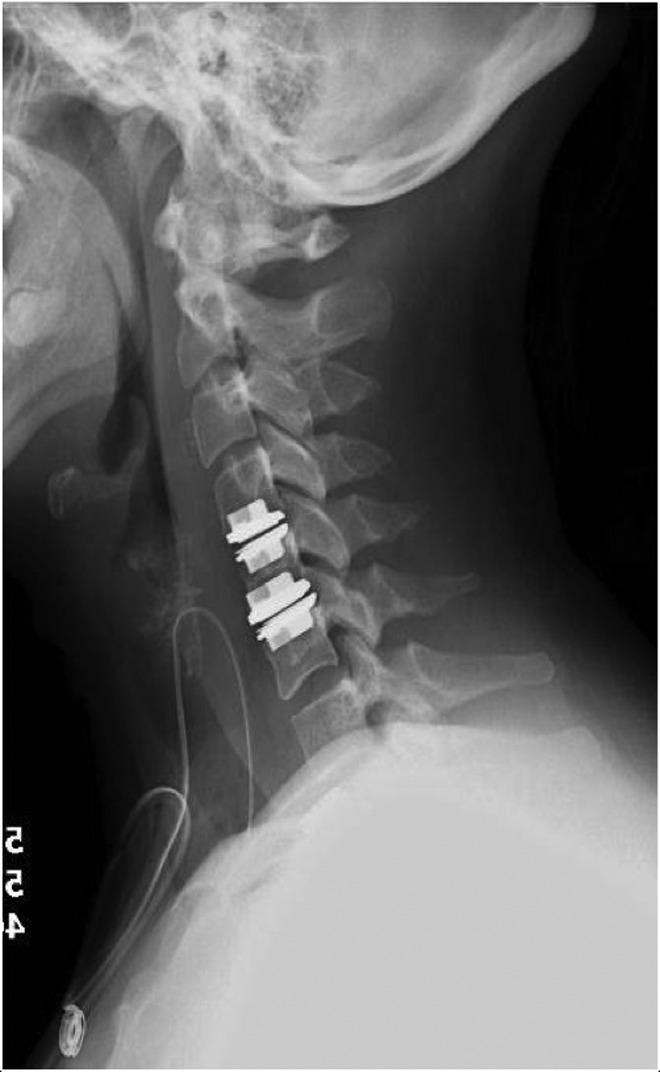
Two-level cervical disc arthroplasty.
As the number of contiguous levels treated increases, the availability of quality clinical data comparing ACDF and CDA diminishes. Single-level ACDF procedures done in the CDA IDE studies restricted segmental cervical ROM by approximately 7°.14 Two-level fusion procedures invariably restrict greater subaxial cervical spine ROM, likely resulting in heightened intradiscal pressures, the induction of significantly greater hypermobility and accelerated degeneration at adjacent levels.15
Postarthrodesis adjacent segment degeneration and adjacent segment disease have 2 distinct definitions. Hilibrand and Robbins16 defined the latter as the presence of new symptomatic degenerative changes adjacent to the level of fusion. Symptoms may include neck pain in the setting of instability, or symptoms of radiculopathy and/or myelopathy. Adjacent segment disease occurs with an annual incidence of approximately 3% of patients, and prevalence of approximately 25% in the initial 10 years postfusion.17 In contrast, adjacent segment degeneration refers to the development of new postfusion radiographic degenerative changes without symptom onset. In 2012, the term adjacent segment pathology was proposed to describe the degenerative changes that occur next to a level that had been operated upon (Terminology. Spine. Volume 37, Number 22S, pp S8-S9). “Radiographic adjacent segment pathology” (RASP) was proposed to describe adjacent segment radiological changes and “clinical adjacent segment pathology” (CASP) was proposed to describe adjacent segment related clinical symptoms and signs.
Risk factors for the development of adjacent segment pathology include fusion constructs adjacent to C5 through C7, preexisting cervical degeneration, and age less than 60 years at the time of ACDF.
Adjacent to cervical fusion, intradiscal pressure increases by approximately 50% in the proximal adjacent level and 125% in the distal adjacent level.18 When comparing CDA with ACDF, most studies with minimum 2-year follow-up have not found a significant difference between adjacent segment pathology.19,20 A study by Coric et al,21 however, did find a significant increase in RASP in their single level ACDF group compared with the CDA group, 24.8% versus 9% (P < .0001), at 2-year follow-up. Matsunaga et al2 suggest that the development of CASP is related to increased shear strain at levels next to the fusion constructs, which is amplified in multilevel fusions. Similarly, Dang et al22 reported significantly increased adjacent segment strain after 2-level fusion constructs compared to single level fusion. Unfortunately, there is a paucity of evidence regarding the exact biomechanical effects of multilevel CDA.
Fay et al23 studied the differences between arthroplasty and anterior cervical fusion in 2-level degenerative disease. Cervical arthroplasty preserved mobility at the operative levels and provided similar clinical outcomes as ACDF at nearly 40 months’ follow-up from surgery.23 In a prospective randomized multicenter comparison of 2-level total disc replacement with the Mobi-C cervical prosthesis versus ACDF, 4-year results revealed a significantly greater improvement in neck disability index (NDI) scores, patient satisfaction, and overall success in the CDA group. Moreover, the ACDF patients experienced a higher rate of subsequent surgery (15.2% vs 4%) and radiographic adjacent disc degeneration. In this study the rate of RASP was found to be 86% in the ACDF group compared with 42% in the CDA group. Also, the Mobi-C disc replacement patients maintained the segmental ROM at index levels through 48 months’ follow-up.24 Similarly, in a recent 5-year prospective randomized controlled multicenter clinical trial, Radcliff and colleagues25 reported significantly greater improvement in NDI scores, Short Form–12 physical component summary, and overall satisfaction at final follow-up in patients treated with a 2-level CDA (Mobi-C) for contiguous cervical spondylosis compared to a 2-level ACDF. Furthermore, the reoperation rate in this study was significantly lower for the CDA group (4%) compared with the ACDF group (16%) at the index level, and at adjacent levels (3.1% vs 11.4%). Adverse event rates were similar between the groups. Zou et al26 conducted a meta-analysis that included 6 randomized controlled trials for CDA versus ACDF for 2 contiguous levels of cervical disc degenerative disease and found significant superiorities in NDI, adjacent segment degeneration, reoperation, and mean blood loss in the CDA group.
A recent meta-analysis analyzed studies comparing multilevel versus single-level CDA. Regardless of the number of arthroplasty levels, the authors found equivalent outcomes and functional recovery, without an increased rate of reoperation.27 Furthermore, Ament et al28 showed that CDA is a highly cost-effective procedure in comparison with ACDF in 2-level cervical disease. Biomechanically, 2-level CDA was shown to maintain near normal mobility at both levels without destabilization of adjacent segment motion.29 A recent prospective multicenter trial of the Bryan Cervical Disc Prosthesis showed adequate clinical results with preservation of motion at intermediate follow-up after both single- and 2-level CDA.30
Hybrid surgery (HS), which involves the combination of ACDF and CDA, has been increasingly utilized for patients with multi-level cervical degenerative disc disease (DDD) (Figures 2 and 3). It has been suggested that patients with multilevel DDD have a different grade of degeneration affecting each level, which may not be appropriate for solely fusion or arthroplasty at every level. The combination of fusion and nonfusion can be tailored to each level allowing segmental motion preservation at the index levels and minimizing hypermobility at adjacent levels. Subsequently, long-fusion constructs and their corresponding adjacent segment pathologies may be avoided. A meta-analysis of several studies on the biomechanical and clinical efficacy of HS has shown a benefit to motion preservation at the index levels and less adverse effects at adjacent levels compared with ACDF or CDA alone. Additionally, postoperative assessments, functional scores, and complication rates were in favor or similar when compared to ACDF or CDA.31 In general, biomechanical studies found that ROM was decreased at the arthrodesis level yet increased at the arthroplasty level, resulting in an overall construct similar to that of an intact spine. The location of the arthroplasty above or below the level of the fusion did not have a significant impact on motion, adjacent intradiscal pressure or facet joint forces. Unfortunately, consistent results were not found with regard to operation time and blood loss when comparing HS with ACDF in several studies.
Figure 2.
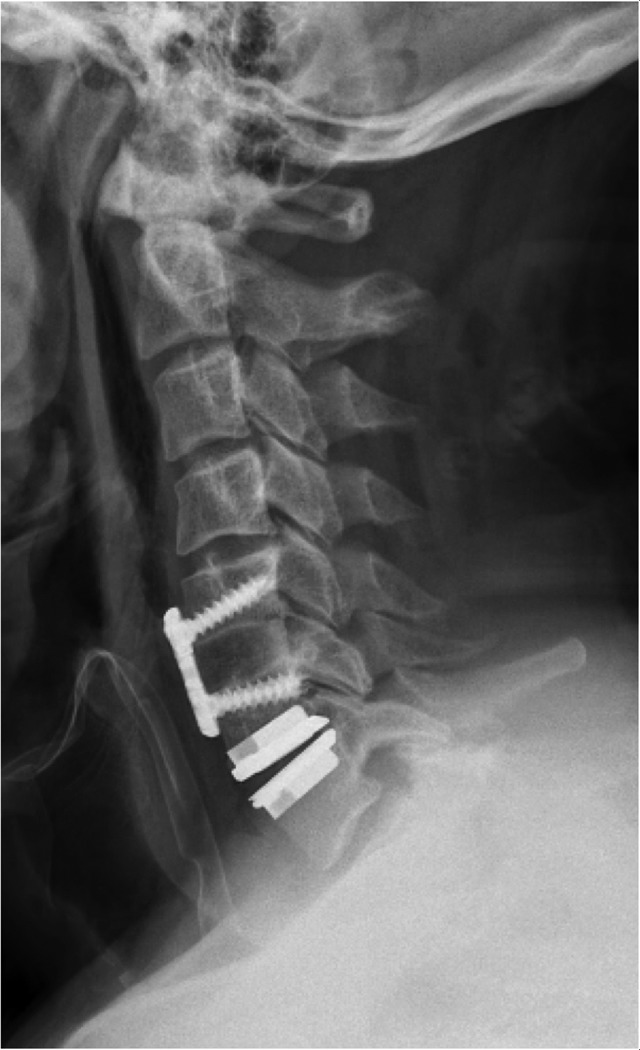
Hybrid construct with anterior cervical discectomy and fusion (ACDF) superjacent to cervical disc arthroplasty (CDA).
Figure 3.
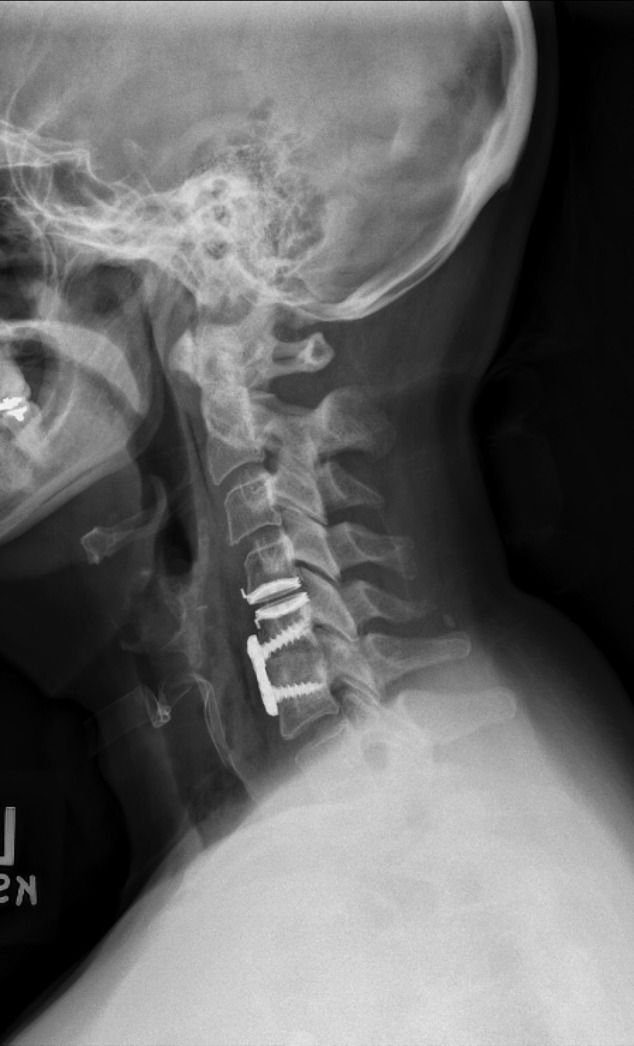
Hybrid construct with anterior cervical discectomy and fusion (ACDF) subjacent to cervical disc arthroplasty (CDA).
Cho et al32 conducted a biomechanical analysis of cervical ROM following a 2-level CDA versus ACDF versus hybrid construct at the C5 through C7 level. At the index levels, 2-level ACDF led to decreased overall ROM, whereas cervical motion was increased with CDA. In the hybrid construct, cervical ROM was not significantly altered. In contrast, at adjacent levels above and below the construct, motion was increased significantly in the ACDF group but unchanged in the CDA and hybrid groups.32
Hypermobility at the adjacent levels may be the source of accelerated degenerative changes in the nonfused segments. In a similar study by Gandhi et al,33 arthroplasty was found to preserve motion at the index level while maintaining normal motion at the adjacent levels. However, fusion resulted in a significant decrease in motion at the fused level and subsequent increase at adjacent levels. The hybrid group preserved motion at the level of the arthroplasty, reducing the stress at adjacent levels.33
The instantaneous center of rotation (ICR) is a measure used to detect abnormal cervical spine mobility. A recent biomechanical analysis on full cadaveric specimens by Liu et al34 showed that both hybrid surgery and CDA in 2-level reconstructions did not alter ROM and minimally changed the ICR at levels adjacent to the construct when compared with fusion alone. Both the hybrid and CDA constructs preserved not only quantitative motion but also qualitative motion by maintaining a near native ICR.34 There still remains a lack of high-quality evidence in favor of arthroplasty, ACDF, or HS for the treatment of multilevel DDD.
Several concerns have been arisen with regard to multilevel CDA constructs, including: development of heterotopic ossification (HO), longer surgical times, increased blood loss, spinal unit malalignment, osteolysis, vertebral body fracture, implant displacement, metal hypersensitivity reaction, and loss of lordosis and/or disc space.21,34 HO is a well-recognized complication following total disc replacements, with an incidence of 16% to 63% occurrence at treated levels postoperatively.24,35 HO development has a significant impact on cervical motion especially when there is bridging ossification across the disc space. The long-term effect of HO on clinical and functional outcomes remains unclear.
A recent retrospective study utilizing the Nationwide Inpatient Sample (NIS) to compare revision surgeries for 1- to 2-level CDA and ACDF demonstrated significantly greater incidences of health care costs, hospital length of stay, and perioperative wound infection with CDA revision.36 The proportion of revision surgeries after CDA compared with ACDF were 7.7% and 2.0%, respectively. Worse outcomes for revision CDA were attributed to a more extensive and invasive exposure necessary for removal of the arthroplasty implant.
Dysphagia following anterior cervical procedures is another well-known complication, with an incidence as high as 21% at 2 years.37 In multilevel fusions, the incidence of dysphagia occurs in 33% to 40% of patients.38 In a prospective randomized trial, the rate of postoperative dysphagia following CDA was half that following ACDF.39 The decreased incidence of dysphagia following disc arthroplasty may be secondary to a reduced anterior profile of the implant when compared with ACDF, as well as decreased retraction required during instrumentation.39,40 Increased esophageal pressure arises from increased retraction during exposure and the requirement for screw placement in ACDF.
Through a generous decompression of neural elements and restoration of intradiscal height, both ACDF and CDA are successful in the treatment of radiculopathy and myelopathy. Unlike fusion, disc arthroplasty preserves motion at the index levels and appears to have less deleterious effects at adjacent disc levels. Though CDA does not prevent adjacent segment pathology, it appears to be decreased, as compared to ACDF, perhaps through preservation of cervical biomechanics.24 In single-level disease, CDA offers equivalent clinical outcomes and a significant reduction in secondary procedures and total healthcare cost.13 Early reports reveal that mutlilevel CDA is as safe and effective as the single-level intervention.27 Additionally, significant improvements in clinical outcomes and lower incidence of index level and adjacent-level reoperations have been demonstrated in midterm studies of 2-level CDA when compared with 2-level ACDF in properly indicated patients. Nevertheless, more high quality evidence with large patient populations is necessary to accurately and critically assess the utility of multilevel CDA and HS.
Footnotes
Declaration of Conflicting Interests: The author(s) declared the following potential conflicts of interest with respect to the research, authorship, and/or publication of this article: Dr Riew reports personal fees from AOSpine, various universities for visiting professorships, personal fees from Biomet, Medtronic, other support from Expanding Orthopaedics, personal fees from Expert Testimony, grants from Medtronic, other support from Amedica, Benvenue, Nexgen Spine, Paradigm Spine, Spinal Kinetics, Spineology, Vertiflex, and outside the submitted work.
Funding: The author(s) received no financial support for the research, authorship, and/or publication of this article.
References
- 1. Kaiser MG, Haid RW, Subach BR, Barnes B, Rodts GE. Anterior cervical plating enhances arthrodesis after discectomy and fusion with cortical allograft. Neurosurgery. 2002;50:229–236. doi:10.1097/00006123-200202000-00001. [DOI] [PubMed] [Google Scholar]
- 2. Matsunaga S, Kabayama S, Yamamoto T, Yone K, Sakou T, Nakanishi K. Strain on intervertebral discs after anterior cervical decompression and fusion. Spine (Phila Pa 1976). 1999;24:670–675. doi:10.1097/00007632-199904010-00011. [DOI] [PubMed] [Google Scholar]
- 3. Robertson JT, Papadopoulos SM, Traynelis VC. Assessment of adjacent-segment disease in patients treated with cervical fusion or arthroplasty: a prospective 2-year study. J Neurosurg Spine. 2005;3:417–423. doi:10.3171/spi.2005.3.6.0417. [DOI] [PubMed] [Google Scholar]
- 4. Lind B, Sihlbom H, Nordwall A, Malchau H. Normal range of motion of the cervical spine. Arch Phys Med Rehabil. 1989;70:692–695. [PubMed] [Google Scholar]
- 5. Lysell E. Motion in the cervical spine: an experimental study on autopsy specimens. Acta Orthop. 1969;40(suppl 123):1–61. doi:10.3109/ort.1969.40.suppl-123.01. [DOI] [PubMed] [Google Scholar]
- 6. Braakman R, Penning L. The hyperflexion sprain of the cervical spine. Radiol Clin Biol. 1968;37:309–320. [PubMed] [Google Scholar]
- 7. Ishii T, Mukai Y, Hosono N, et al. Kinematics of the subaxial cervical spine in rotation in vivo three-dimensional analysis. Spine (Phila Pa 1976). 2004;29:2826–2831. doi:10.1097/01.brs.0000147806.31675.6b. [DOI] [PubMed] [Google Scholar]
- 8. Anderst W, Baillargeon E, Donaldson W, Lee J, Kang J. Motion path of the instant center of rotation in the cervical spine during in vivo dynamic flexion-extension: implications for artificial disc design and evaluation of motion quality after arthrodesis. Spine (Phila Pa 1976). 2013;38:E594–601. doi:10.1097/BRS.0b013e31828ca5c7. [DOI] [PMC free article] [PubMed] [Google Scholar]
- 9. Powell JW, Sasso RC, Metcalf NH, Anderson PA, Hipp JA. Quality of spinal motion with cervical disk arthroplasty: computer-aided radiographic analysis. J Spinal Disord Tech. 2010;23:89–95. doi:10.1097/BSD.0b013e3181991413. [DOI] [PubMed] [Google Scholar]
- 10. Park DK, Lin EL, Phillips FM. Index and adjacent level kinematics after cervical disc replacement and anterior fusion. Spine (Phila Pa 1976). 2011;36:721–730. doi:10.1097/BRS.0b013e3181df10fc. [DOI] [PubMed] [Google Scholar]
- 11. Boselie TF, Willems PC, van Mameren H, de Bie RA, Benzel EC, van Santbrink H. Arthroplasty versus fusion in single-level cervical degenerative disc disease: a Cochrane review. Spine (Phila Pa 1976). 2013;38:E1096–E1107. doi:10.1097/BRS.0b013e3182994a32. [DOI] [PubMed] [Google Scholar]
- 12. Janssen ME, Zigler JE, Spivak JM, Delamarter RB, Darden BV, 2nd, Kopjar B. ProDisc-C total disc replacement versus anterior cervical discectomy and fusion for single-level symptomatic cervical disc disease: seven-year follow-up of the prospective randomized U.S. Food and Drug Administration Investigational Device Exemption Study. J Bone Joint Surg Am. 2015;97:1738–1747. doi:10.2106/JBJS.N.01186. [DOI] [PubMed] [Google Scholar]
- 13. Radcliff K, Lerner J, Yang C, Bernard T, Zigler JE. Seven-year cost-effectiveness of ProDisc-C total disc replacement: results from investigational device exemption and post-approval studies. J Neurosurg Spine. 2016;24:760–768. doi:10.3171/2015.10.SPINE15505. [DOI] [PubMed] [Google Scholar]
- 14. Park JH, Roh KH, Cho JY, Ra YS, Rhim SC, Noh SW. Comparative analysis of cervical arthroplasty using Mobi-C® and anterior cervical discectomy and fusion using the Solis®-cage. J Korean Neurosurg Soc. 2008;44:217–221. doi:10.3340/jkns.2008.44.4.217. [DOI] [PMC free article] [PubMed] [Google Scholar]
- 15. Elsawaf A, Mastronardi L, Roperto R, Bozzao A, Caroli M, Ferrante L. Effect of cervical dynamics on adjacent segment degeneration after anterior cervical fusion with cages. Neurosurg Rev. 2009;32:215–224. doi:10.1007/s10143-008-0164-2. [DOI] [PubMed] [Google Scholar]
- 16. Hilibrand AS, Robbins M. Adjacent segment degeneration and adjacent segment disease: The consequences of spinal fusion? Spine J. 2004;4(6 suppl):190S–194S. doi:10.1016/j.spinee.2004.07.007. [DOI] [PubMed] [Google Scholar]
- 17. Cho SK, Riew KD. Adjacent segment disease following cervical spine surgery. J Am Acad Orthop Surg. 2013;21:3–11. doi:10.5435/jaaos-21-01-3. [DOI] [PubMed] [Google Scholar]
- 18. Dmitriev AE, Cunningham BW, Hu N, Sell G, Vigna F, McAfee PC. Adjacent level intradiscal pressure and segmental kinematics following a cervical total disc arthroplasty: an in vitro human cadaveric model. Spine (Phila Pa 1976). 2005;30:1165–1172. doi:10.1097/01.brs.0000162441.23824.95. [DOI] [PubMed] [Google Scholar]
- 19. Nunley PD, Jawahar A, Kerr EJ, 3rd, et al. Factors affecting the incidence of symptomatic adjacent-level disease in cervical spine after total disc arthroplasty: 2- to 4-year follow-up of 3 prospective randomized trials. Spine (Phila Pa 1976). 2012;37:445–451. doi:10.1097/BRS.0b013e31822174b3. [DOI] [PubMed] [Google Scholar]
- 20. Maldonado CV, Paz RD, Martin CB. Adjacent-level degeneration after cervical disc arthroplasty versus fusion. Eur Spine J. 2011;20(suppl 3):S403–S407. doi:10.1007/s00586-011-1916-1. [DOI] [PMC free article] [PubMed] [Google Scholar]
- 21. Coric D, Nunley PD, Guyer RD, et al. Prospective, randomized, multicenter study of cervical arthroplasty: 269 patients from the Kineflex|C artificial disc investigational device exemption study with a minimum 2-year follow-up: clinical article. J Neurosurg Spine. 2011;15:348–358. doi:10.3171/2011.5.SPINE10769. [DOI] [PubMed] [Google Scholar]
- 22. Dang ABC, Hu SS, Tay BK-B. Biomechanics of the anterior longitudinal ligament during 8 g whiplash simulation following single- and contiguous two-level fusion: a finite element study. Spine (Phila Pa 1976). 2008;33:607–611. doi:10.1097/BRS.0b013e318166e01d. [DOI] [PubMed] [Google Scholar]
- 23. Fay LY, Huang WC, Tsai TY, et al. Differences between arthroplasty and anterior cervical fusion in two-level cervical degenerative disc disease. Eur Spine J. 2014;23:627–634. doi:10.1007/s00586-013-3123-8. [DOI] [PMC free article] [PubMed] [Google Scholar]
- 24. Davis RJ, Nunley PD, Kim KD, et al. Two-level total disc replacement with Mobi-C cervical artificial disc versus anterior discectomy and fusion: a prospective, randomized, controlled multicenter clinical trial with 4-year follow-up results. J Neurosurg Spine. 2015;22:15–25. doi:10.3171/2014.7.SPINE13953. [DOI] [PubMed] [Google Scholar]
- 25. Radcliff K, Coric D, Albert T. Five-year clinical results of cervical total disc replacement compared with anterior discectomy and fusion for treatment of 2-level symptomatic degenerative disc disease: a prospective, randomized, controlled, multicenter investigational device exemption clinical trial. 2016;25:213–224. doi:10.3171/2016.3.SPINE15824a. [DOI] [PubMed] [Google Scholar]
- 26. Zou S, Gao J, Xu B, Lu X, Han Y, Meng H. Anterior cervical discectomy and fusion (ACDF) versus cervical disc arthroplasty (CDA) for two contiguous levels cervical disc degenerative disease: a meta-analysis of randomized controlled trials [published online June 17, 2016]. Eur Spine J. doi:10.1007/s00586-016-4655-5. [DOI] [PubMed] [Google Scholar]
- 27. Zhao H, Cheng L, Hou Y, et al. Multi-level cervical disc arthroplasty (CDA) versus single-level CDA for the treatment of cervical disc diseases: a meta-analysis. Eur Spine J. 2015;24:101–112. doi:10.1007/s00586-014-3429-1. [DOI] [PubMed] [Google Scholar]
- 28. Ament JD, Yang Z, Nunley P, Stone MB, Kim KD. Cost-effectiveness of cervical total disc replacement vs fusion for the treatment of 2-level symptomatic degenerative disc disease. JAMA Surg. 2014;149:1231–1239. doi:10.1001/jamasurg.2014.716. [DOI] [PubMed] [Google Scholar]
- 29. Phillips FM, Tzermiadianos MN, Voronov LI, et al. Effect of two-level total disc replacement on cervical spine kinematics. Spine (Phila Pa 1976). 2009;34:E794–E799. doi:10.1097/BRS.0b013e3181afe4bb. [DOI] [PubMed] [Google Scholar]
- 30. Goffin J, Van Calenbergh F, van Loon J, et al. Intermediate follow-up after treatment of degenerative disc disease with the Bryan Cervical Disc Prosthesis: single-level and bi-level. Spine (Phila Pa 1976). 2003;28:2673–2678. doi:10.1097/01.BRS.0000099392.90849.AA. [DOI] [PubMed] [Google Scholar]
- 31. Jia Z, Mo Z, Ding F, He Q, Fan Y, Ruan D. Hybrid surgery for multilevel cervical degenerative disc diseases: a systematic review of biomechanical and clinical evidence. Eur Spine J. 2014;23:1619–1632. doi:10.1007/s00586-014-3389-5. [DOI] [PubMed] [Google Scholar]
- 32. Cho BY, Lim J, Sim HB, Park J. Biomechanical analysis of the range of motion after placement of a two-level cervical ProDisc-C versus hybrid construct. Spine (Phila Pa 1976). 2010;35:1769–1776. doi:10.1097/BRS.0b013e3181c225fa. [DOI] [PubMed] [Google Scholar]
- 33. Gandhi AA, Kode S, DeVries NA, et al. Biomechanical analysis of cervical disc replacement and fusion using single level, two level and hybrid constructs. Spine (Phila Pa 1976). 2015;40:1578–1585. doi:10.1097/BRS.0000000000001044. [DOI] [PubMed] [Google Scholar]
- 34. Wu B. Comparison of hybrid constructs with 2-level artificial disc replacement and 2-level anterior cervical discectomy and fusion for surgical reconstruction of the cervical spine: a kinematic study in whole cadavers. Med Sci Monit. 2015;21:1031–1037. doi:10.12659/MSM.892712. [DOI] [PMC free article] [PubMed] [Google Scholar]
- 35. Suchomel P, Jurak L, Benes V, 3rd, Brabec R, Bradac O, Elgawhary S. Clinical results and development of heterotopic ossification in total cervical disc replacement during a 4-year follow-up. Eur Spine J. 2010;19:307–315. doi:10.1007/s00586-009-1259-3. [DOI] [PMC free article] [PubMed] [Google Scholar]
- 36. Nandyala SV, Marquez-Lara A, Fineberg SJ, Singh K. Comparison of revision surgeries for one- to two-level cervical TDR and ACDF from 2002 to 2011. Spine J. 2014;14:2841–2846. doi:10.1016/j.spinee.2014.03.037. [DOI] [PubMed] [Google Scholar]
- 37. Riley LH, 3rd, Skolasky RL, Albert TJ, Vaccaro AR, Heller JG. Dysphagia after anterior cervical decompression and fusion: prevalence and risk factors from a longitudinal cohort study. Spine (Phila Pa 1976). 2005;30:2564–2569. [DOI] [PubMed] [Google Scholar]
- 38. Pimenta L, McAfee PC, Cappuccino A, Cunningham BW, Diaz R, Coutinho E. Superiority of multilevel cervical arthroplasty outcomes versus single-level outcomes: 229 consecutive PCM prostheses. Spine (Phila Pa 1976). 2007;32:1337–1344. doi:10.1097/BRS.0b013e318059af12. [DOI] [PubMed] [Google Scholar]
- 39. Segebarth B, Datta JC, Darden B, et al. Incidence of dysphagia comparing cervical arthroplasty and ACDF. SAS J. 2010;4:3–8. doi:10.1016/j.esas.2009.12.001. [DOI] [PMC free article] [PubMed] [Google Scholar]
- 40. Villavicencio AT, Pushchak E, Burneikiene S, Thramann JJ. The safety of instrumented outpatient anterior cervical discectomy and fusion. Spine J. 2007;7:148–153. doi:10.1016/j.spinee.2006.04.009. [DOI] [PubMed] [Google Scholar]