



Abstract
Introduction
Angina pectoris is the most prevalent symptomatic manifestation of ischemic heart disease, frequently leads to a poor quality of life, and is a major cause of medical resource consumption. Since the early descriptions of nitrite and nitrate in the 19th century, there has been considerable advancement in the pharmacologic management of angina.
Areas covered
Management of chronic angina is often challenging for clinicians. Despite introduction of several pharmacological agents in last few decades, a significant proportion of patients continue to experience symptoms (i.e., refractory angina) with subsequent disability. For the purpose of this review, we searched PubMed and Cochrane databases from inception to August 2016 for the most clinically relevant publications that guide current practice in angina therapy and its development. In this article, we briefly review the pathophysiology of angina and mechanism-based classification of current therapy. This is followed by evidence-based insight into the traditional and novel pharmacotherapeutic agents, highlighting their clinical usefulness.
Expert opinion
Considering the wide array of available therapies with different mechanism efficacy and limiting factors, a personalized approach is essential, particularly for patients with refractory angina. Ongoing research with novel pharmacologic modalities is likely to provide new options for management of angina.
Keywords: angina, coronary artery disease, ischemia, pharmacotherapy
1. Introduction
Angina (or angina pectoris) classically refers to a pressure-like substernal chest discomfort that is precipitated by physical or emotional stress and relieved by rest or nitroglycerin (often referred to as “typical angina”). It has been considered the cardinal symptom of ischemic heart disease. However, very similar symptoms (e.g., typical angina) may also be encountered in patients without ischemia (esophageal diseases, gastric disease, bronchopulmonary disease, etc.). Additionally, many diseases/disorders like hypersensitive heart syndrome, pulmonary hypertension, severe aortic or mitral stenosis, and others result in similar symptoms and may or may not be associated with cardiac ischemia. Angina may be either acute in onset, as in an acute coronary syndrome (e.g., unstable angina), or chronic (recurring) as in chronic stable angina. The limitation in myocardial oxygen supply may result from a limitation in coronary blood flow due to obstructive atherosclerotic plaque, coronary artery spasm, coronary microvascular dysfunction, or a non-coronary issue like severe anemia or hypotension. It may also result from an excessive increase in myocardial oxygen demand. This may be due to an increase in heart rate (HR), the result of supraventricular tachycardia (atrial fibrillation or flutter, etc.), hyperthyroidism, and so on. Also, this increase in oxygen demand may occur with or without an increase in HR as in, for example, aortic stenosis, systemic hypertension, or emotional stress. Most often, multiple factors operate in concert to limit myocardial oxygen supply (e.g., obstructive plaque) and increase myocardial oxygen demand (e.g., physical exertion) to cause myocardial ischemia and angina [1].
Angina is highly prevalent worldwide. In the United States alone, it is estimated that more than 8.2 million patients have angina [2]. Importantly, it is a major cause of poor quality of life, disability, and heath resource consumption.
Since the first descriptions of “on the use of nitrite of amyl in angina pectoris” and “nitro-glycerine as a remedy for chest pain” by Brunton and Murrell, respectively, in the 19th century [3], there has been considerable advancement in the pharmacologic management of angina. However, a large number of patients remain limited by angina as it is often under-managed. In a study from 25 United States outpatient clinics, angina was found to be under-recognized and strongly associated with lack of treatment escalation [4]. Use of validated and reliable tools such as Seattle Angina Questionnaire (SAQ), Framingham Heart study questionnaire, or World Health Organization angina questionnaire is recommended to assess the satisfaction level of patients with their therapy [5–7].
2. Angina pathophysiology
Angina is usually a symptom provoked by myocardial ischemia, which occurs secondary to mismatch of myocardial oxygen supply and need. Oxygenated blood is delivered to the myocardium via epicardial coronary arteries that branch into arterioles. Arterioles further branch into a network of capillaries. Typically, epicardial coronary arteries are a low resistance system. Auto regulation is mainly offered by changes in the tone of arterioles. When there is increase in myocardial oxygen demand, arterioles dilate in response to nitric oxide, prostaglandins, carbon dioxide, hydrogen ion, adenosine, and other nucleotides [8]. Via this autoregulation, blood flow to normal myocardium can be augmented four- to five-fold. This is termed coronary flow reserve or myocardial perfusion reserve. Atherosclerotic plaques increase the resistance of the epicardial coronary arteries. Cross sectional stenosis is a major determinant of blood supply through coronary arteries. With the development of coronary stenosis, arterioles dilate to maintain myocardial blood flow. In the presence of an epicardial coronary stenosis >70%, there might be inadequate blood supply even at rest, resulting in ischemia and angina [9, 10].
Myocardial oxygen supply also depends on certain other factors such as collateral blood flow, left-ventricular end diastolic pressure (which can reduce the perfusion pressure from epicardium to endocardium capillaries), and diastolic-perfusion time (related to the HR and aortic diastolic pressure-product), since myocardial perfusion mostly occurs during diastole. Oxygen is the critical cardiomyocyte substrate for energy production in the form of adenosine triphosphate (ATP). Myocardial oxygen requirement depends on myocardial wall stress (a marker of pre-load), myocardial contractility, systolic blood pressure (a marker for afterload), and HR. In addition, myocardial energy need depends on the systolic wall stress and left-ventricular mass. For example, the myocardial energy need may increase up to four-fold in aortic stenosis and three-fold in essential hypertension [11].
Angina pectoris is a visceral pain. The specific underlying mechanisms responsible for generation of this pain are incompletely understood. Myocardial ischemia leads to acidosis and loss of normal ATP sodium-potassium pump and membrane integrity. Release of substances such as adenosine, lactate, serotonin, bradykinin, histamine, and reactive oxygen species stimulate chemo-sensitive receptors (Figure). Stimulation of afferent sympathetic fibers in the upper thoracic spinothalamic tract leads to chest and arm pain symptoms, and stimulation of vagal afferent fibers leading to excitation of cervical spinothalamic tracts may result in neck and/or jaw pain symptoms.
Figure 1. Schematic presentation of mechanisms and pathways involved in cardiac chest pain.
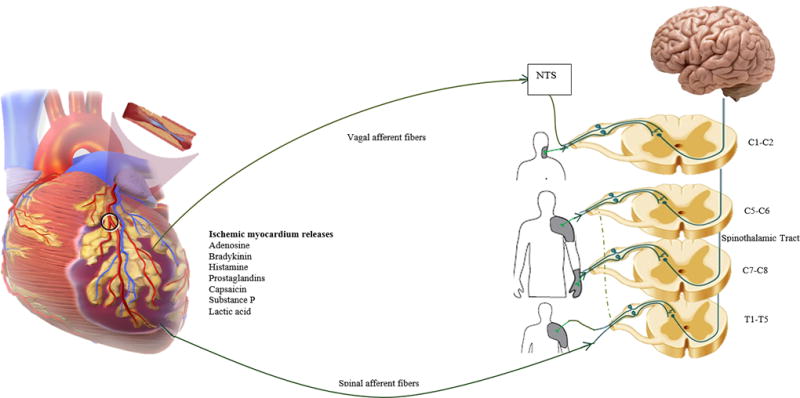
Ischemic myocardium releases nociceptive mediators that stimulate excitatory spinal and vagal afferent fibers. Somatic fibers also converge on upper thoracic and cervical spinal segments as shown, leading to referred pain. NTS = Nucleus Tractus Solitarius.
3. Management of angina
3.1. General principles
The general care and management of the patient with angina traditionally has been directed toward reducing the myocardial oxygen need through HR reduction, and increasing the coronary blood flow via vascular smooth muscle relaxation.
Nothing should undermine the importance of the management of risk factors for progression of atherosclerosis and adverse outcomes. Lifestyle modification and prevention of progression of underlying atherosclerosis must be a mainstay of management. All patients are encouraged to attempt to increase their daily activities. Moderate intensity exercise, such as brisk walking, for 30–60 minutes per day, 5–7 days per week should be strongly encouraged. For patients with orthopedic limitations, alternate exercise activities should be sought (e.g., recumbent bike, walking in a pool). Multiple studies evaluating the role of regular exercise have documented reduction in angina and improvement in endothelial dysfunction, myocardial perfusion, and physical work capacity with regression of coronary artery plaque [12, 13]. Weight management with goal BMI 18.5–24.9 kg/m2, smoking cessation, meticulous management of blood pressure (systolic <120 mmHg) [14], and reduction of LDL-cholesterol and euglycemia have been shown to improve overall cardiovascular outcomes and mortality [15]. In a prospective trial of 300 patients randomized to either usual care or multifactor risk reduction (low-fat and -cholesterol diet, exercise, weight loss, smoking cessation, and medications to favorably alter lipoprotein profiles), the multifactor risk reduction group had 47% reduction in rate of narrowing of diseased coronary artery segments and fewer hospitalizations for cardiac-related events [16].
Revascularization by either coronary artery bypass grafting or percutaneous coronary intervention does not reduce the risk of myocardial infarction or death from coronary artery disease in patients with chronic stable angina and preserved ejection fraction unless they have diabetes or certain anatomic disease. However, it should be considered in patients with quality-of-life–limiting angina despite guideline-directed medical therapy or in patients at high risk such as those with proximal left anterior descending or left main disease, multi-vessel disease in diabetic patients, large ischemic burden on stress testing, or systolic heart failure [17]. More detailed discussion on revascularization is beyond the scope of this presentation.
Some herbal therapies are widely used in certain parts of the world, especially China. Salvia miltiorrhiza is one such adjunct therapy present in Danshen, Danhong, and Guanxinshutong injections. Some evidence suggests that these injections may be effective in improving angina [18]. Danshen has been shown to have protective effects with anti-lipid peroxidation, positive inotropic and negative chronotropic effects, and coronary artery dilation [19]. Similarly, Guanxinshuong has been shown to decrease inflammatory cytokines and inhibit apoptosis suggesting cardioprotection from reperfusion injury and limiting infarct size [20]. Salvianolic acid B is a bioactive compound isolated from Salvia miltiorrhiza that is suggested to protect endothelial cells from peroxide injury [21]. The results of two ongoing trials [NCT01681316 and NCT02280850] will likely provide additional information regarding efficacy and safety of these therapies. However, it is important to understand that these preparations vary widely in their composition, as no standards are widely recognized to assure the production of uniform treatment products.
3.2. Traditional / first line antianginal pharmacotherapy
3.2.1. Beta-adrenergic blockers (BBs)
There are three types of beta receptors. B1 receptors are found primarily in the heart, and their activation leads to increased contractility and increased HR. B2 receptors are primarily located in the bronchial and peripheral smooth muscle. Their activation results in vasodilation and bronchodilation. B3 receptors are mainly found in adipose tissue but also in the heart, and their activation helps with thermoregulation and decrease myocardial contractility [22, 23]. BBs decrease myocardial oxygen need by reducing HR, myocardial contractility, and blood pressure. They also increase the time for coronary perfusion by decreasing HR and increasing diastolic time, thus favorably altering the determinants of collateral perfusion.
The beta blocking drugs can be classified according to the adrenergic receptors that they block. Drugs that principally block B1 receptors, preferentially to B2 or B3, are commonly referred to as “relatively” cardio-selective, at higher doses the selectivity may at least be partially lost [24]. The non-selective BB propranolol was first introduced for clinical use and was shown to reduce angina episodes by more than 50% compared with placebo [25]. Carvedilol is another commonly used, though not approved for angina, non-selective BB with α-1 receptor blocking properties. In a multicenter randomized trial, carvedilol compared to metoprolol showed improved time to 1-mm ST-segment depression, risk ratio 1.386 (95% confidence interval 1.045 to 1.839, p <0.05), and greater decrease in myocardial oxygen consumption, with no change in total exercise time [26]. In another trial comparing carvedilol versus atenolol by improvement of time to 1-mm ST-segment depression during treadmill exercise, the angina stability scores and frequency after 6 months of treatment were similar between groups with greater decrease in total cholesterol in the carvedilol group despite comparable statin use in both groups [27].
Subsequently, cardio-selective BBs such as atenolol and metoprolol were shown to be as effective in improving exercise tolerance and decreasing angina, with a favorable side effect profile compared with the other non-selective agents like propranolol [28–30]. A multicenter, randomized, double-blind, placebo-controlled study involving 306 patients with asymptomatic ischemia on stress testing showed that atenolol (dose 100 mg per day) for 4 weeks reduced the number of ischemic episodes and their duration on 48-hour ambulatory electrocardiography monitoring. Also there was reduction in the first occurrence of death, resuscitation from ventricular arrhythmia, myocardial infarction, hospitalization for unstable angina, aggravation of angina requiring known therapy, or need for coronary revascularization [31]. These cardioselective BBs (i.e., metoprolol and atenolol) are considered the first line therapy for angina.
Another newer BB Nebivolol is a selective B1 antagonist with vasodilator effect via nitric oxide production [32] which has been shown to have favorable effect on vascular stiffness and anti-oxidative properties[33]. In a placebo controlled trial on 16 patients Nebivolol (5mg/day) treatment arm had significantly prolonged time to 1mm ST depression 555 ± 37 sec to 667.5 ± 49 sec (p<0.05) and anginal threshold was increased from 697 ± 51 sec to 767 ± 64 sec (p<0.05) [34]. Nebivolol is also being investigated for microvascular angina relief in women in an ongoing trial [NCT01665508]. It is important to note that nebivolol has not been approved as an angina therapy.
BBs are recommended as first-line therapy for patients with angina as they not only improve angina, but also reduce the risk of re-infarction, sudden cardiac death, and all-cause mortality in post-myocardial infarction and systolic heart failure patients [35] especially metoprolol succinate and carvedilol [35, 36]. BBs as such are widely used and generally are well tolerated. Common adverse effects encountered in clinical practice being depression, fatigue, sexual dysfunction, facilitation of hypoglycemia and weight gain. The benefits of BBs are thought to be dose-dependent [37, 38]. The American guidelines recommend up-titration of the dose of BBs to achieve a HR goal of 55–60 beats/min [17].
In the modern era the role of BBs in reducing objective outcomes in patients with chronic stable ischemic heart disease is debated. Studies by Dargie et al. and Rehnqvist et al. demonstrated no mortality benefit with either BB, CA or the combination of both [39, 40]. Furthermore, in a meta-analysis by Shu et al., BBs did not reduce the risk of death or acute myocardial infarction in patients with stable ischemic heart disease [41]. A large longitudinal, observational analysis of 44,708 patients divided into three cohorts, those with known prior myocardial infarction, those with known coronary artery disease without myocardial infarction, and those with coronary artery disease risk factors only, found that the use of BBs was not associated with a lower risk of cardiovascular death, nonfatal MI, or nonfatal stroke. In those patients with recent myocardial infarction (≤1 year), BBs were associated with a lower incidence of the hospitalization for atherothrombotic events or a revascularization procedure [42]. In patients with low resting HR, BBs with intrinsic sympathetic activity can be used. One study compared pindolol with propranolol [43] and another study compared epanolol with metoprolol [44]; in both studies BBs with intrinsic sympathomimetic activity reduced angina symptoms as effectively as other BBs, albeit with higher resting HR.
3.2.2. Calcium channel blockers (CCBs)
Calcium ion entry into cardiomyocytes triggers intracellular release of calcium, which facilitates the interaction between myofibrils, leading to contraction of muscle fiber. CCBs block the entry of calcium into the cells. This effect in myocardium, conduction system, and atrioventricular node leads to HR reduction and decreased myocardial contractility. In vascular smooth muscle, this effect causes relaxation (e.g., vasodilation, blood pressure reduction). Traditionally CCBs are classified by their chemical class as either dihydropyridines (i.e., nifedipine, amlodipine, and nicardipine) and non-dihydropyridines (i.e., verapamil and diltiazem). Dihydropyridines have relatively more effect on vascular smooth muscle than cardiomyocytes. This results in vasodilation including the coronary arteries; however, they elicit reflex adrenergic stimulation of the heart and thus do not lead to significant depressant effects on myocardial contractility or HR. Non-dihydropyridines preferentially act on the cardiac calcium channels, resulting in relatively more coronary vasodilation, compared with decrease in contractility and HR.
Compared with placebo, CCBs are more effective in relieving angina and increasing exercise tolerance [45, 46]. The International Multicenter Angina Exercise trial compared metoprolol (controlled release 200 mg daily) with nifedipine (retard 20 mg two times a day) and showed that both are equally effective in reducing angina frequency and improving exercise tolerance. In patients with baseline low exercise tolerance improvement in time to 1 mm ST depression was better in metoprolol group (68 sec Vs 42 sec p<0.05) [47]. Non-dihydropyridines are more effective than dihydropyridines with fewer adverse effects [48–50]. Studies have shown that verapamil and diltiazem are as effective in preventing angina and improving exercise tolerance as BBs [51–54]. The combination of BBs and CCBs may be somewhat more effective than either alone, however this effect does not appear to be additive [55–57]. The combination of non-dihydropyridines with BBs is more effective, however is associated with a higher risk of adverse effects like bradycardia, palpitations, syncope, and gastrointestinal intolerance [55, 58]. In general, non-dihydropyridines are considered as an alternate therapy in patients who are intolerant to BBs. Dihydropyridines can be added to medical regimens of patients who continue to experience angina symptoms despite the maximally tolerated dose of BB. CCBs are considered the agents of choice in patients with vasospastic angina [59].
3.2.3. Nitrates
Nitric oxide is the final product of nitrate metabolism once it enters the smooth muscle cells. Nitric oxide stimulates the enzyme guanylate cyclase, which increases the production of cyclic guanosine monophosphate and causes venodilation at very low doses, arterial dilation at low to moderate doses, and arteriolar dilation at higher doses [60, 61]. In a meta-analysis of 51 studies that evaluated the role of nitrates for stable angina, this study showed that both intermittent and continuous regimens of nitrate therapy are more effective than placebo. Pooled results of both regimens showed that chronic administration of nitrates improved exercise duration by 38 seconds (95%CI 18.92 to 57.77, p=0.0001), increased time to onset of angina or 1 mm ST-segment depression during exercise by 52 seconds (95%CI 19.69 to 84.32 s, p=0.002), and reduced the frequency of angina attack by 2.45 episodes weekly (95%CI 0.86 to 4.04 episodes per week, p = 0.003), however, it did not improve quality of life. The most common adverse effect noted was headache, which occurred in 51% of patients [62]. Nitrate tolerance is a major problem with long-term use. Intermittent therapy reduces the risk for development of nitrate tolerance but poses the theoretical risk of increased frequency of angina in the drug-free interval (i.e., rebound effect) [63]. However, these concerns have not been proven for any clinical importance, especially in patients already receiving background of antianginal therapy with BBs or CA [64–66]. Recently, the safety of long acting nitrates has been questioned. Long-term use of nitrates has been linked to induction of oxidative stress, increase in sympathetic activation leading to endothelial dysfunction [67]. A study from Japan including 1429 patients with vasospastic angina showed increased risk of adverse cardiovascular events when long acting nitrates were added to CA therapy [68].
In our experience, most patients can be “acclimated” to tolerate nitrate therapy by starting with very small doses. We ask headache-sensitive patients to begin with a small dose of nitroglycerin spray to their outer lip and self-titrate by touching the sprayed area with their tongue. Eventually, they will be able to tolerate the lowest oral dose (e.g., 15 mg isosorbide mononitrate) and then slowly titrate up.
3.3. Second-line pharmacotherapy for angina
3.3.1. Inhibitors of the late Na channel
Ranolazine reduces calcium overload in the ischemic cardiomyocyte through inhibition of the late sodium current (INa) [69, 70]. One randomized, controlled trial involving 823 patients with coronary artery disease and taking BBs and CCBs as antianginal therapy demonstrated that the addition of ranolazine 750 mg or 1000 mg two times per day decreased the frequency of anginal attacks, reduced nitroglycerin use, and increased exercise capacity [71]. Two other small, randomized controlled trials demonstrated a reduction in angina frequency and improvement in exercise duration [72, 73]. One trial compared 500, 1000, and 1500 mg twice daily dosing and demonstrated a dose-related benefit with exercise capacity [72]. In a large, multicenter, randomized, controlled trial enrolling patients with chronic angina who had incomplete revascularization, ranolazine failed to reduce the risk of the composite outcome of ischemia-driven revascularization or hospitalization for angina [74]. Ranolazine is considered as an effective choice as add on antianginal therapy on background of BBs, CCBs or nitrates and also can be uses as first line in patients with absolute or relative contraindication for BBs, CCBs or nitrates [75]. Caution is to be taken while used with other QT prolonging medications. Cost is the major prohibitive factor in some countries for its wider use at this time.
3.3.2. Direct sinus node inhibitor
Ivabradine is the only approved drug in this class. It reduces HR by inhibiting the so-called “funny” channels (f-channels) in sinus node. Several observational studies showed an association of elevated HR with increased risk of adverse cardiovascular events in patients with stable ischemic heart disease [76–79]. In patients with heart failure with reduced ejection fraction, ivabradine reduces the risk of heart failure related hospitalizations and death [80]. However, a more recent, randomized, double-blind, placebo-controlled trial failed to show similar benefit in the stable coronary artery disease patient population. This trial enrolled 19,102 patients with stable coronary artery disease without heart failure who had resting HR >70 per min. Ivabradine lowered the HR by 10 points or more. In patients with Canadian Cardiovascular Society (CCS) angina class II or higher, there was statistically significant improvement in the angina class (24.0% versus 18.8%; P= 0.01). However, ivabradine was associated with a higher incidence of the primary outcome (death from cardiovascular causes or nonfatal myocardial infarction) [81].
3.3.3. Metabolic modulation
Trimetazidine increases cellular tolerance to ischemia by inhibiting fatty acid metabolism and, secondarily, stimulating glucose metabolism. One randomized controlled trial demonstrated that addition of trimetazidine to metoprolol reduced nitroglycerin consumption by 46%, reduced the number of angina attacks by 47%, and improved exercise capacity by 15% [82]. A meta-analysis of 23 studies demonstrated that trimetazidine significantly reduced frequency of angina pain, reduced nitroglycerin tablets use, and increased time to 1 mm ST-segment depression, whether used as monotherapy or combined with other antianginal agents [83]. Trimetazidine is recommended as a second-line agent by the European guidelines [84].
3.3.4. Nicorandil
Nicorandil exerts its vasodilator effect through stimulation of the potassium channels. In the Impact of Nicorandil in Angina randomized trial, 5126 patients with angina on standard antianginal therapy were randomly assigned to 20 mg nicorandil twice daily or placebo. Nicorandil was associated with a reduction in the risk of the composite primary endpoint of cardiovascular death, nonfatal myocardial infarction, or unplanned hospital admission for cardiac chest pain (hazard ratio 0.83, 95% CI 0.72–0.97; p=0.014). This effect was primarily due to a reduction in the risk of angina requiring hospital admission [85]. Nicorandil is recommended as a second-line agent in the European guidelines, however it is not available in the United States [84].
3.4. Less commonly used / experimental antianginal pharmacotherapy
3.4.1. Amiodarone/dronedarone
Amiodarone, approved as an anti-arrhythmic agent, was initially introduced as an antianginal therapy. In a randomized double blind trial of 63 patients with angina refractory to other therapy amiodarone group showed significantly greater increase in bicycle exercise time 6.7 +/− 2.2 minutes versus 6.3 +/− 2.2 minutes at 1 month and 7.5 +/− 2.1 minutes versus 6.2 +/− 1.7 minutes at 2 months (p < 0.05) [86]. Due to its side effects profile with long-term use, amiodarone is not widely used as a therapy for angina. However, in elderly patients with treatment resistant angina, we have found that it can be very effective when added to their current antianginal drugs at low doses (50–100 mg/d). Dronedarone, which is an iodine-free derivative of amiodarone, with a lesser side effect profile, has not been evaluated as therapeutic agent for angina. However, an analysis of patients with coronary artery disease enrolled in the ATHENA trial showed that dronedarone reduced the risk of all cause mortality or first cardiovascular hospitalization for patients with atrial fibrillation and coronary heart disease (hazard ratio = 0.73; 95% CI= 0.62 to 0.86; P = 0.0002) [87].
3.4.2. Fasudil
Fasudil is among the class of rho kinase inhibitors, and the only one currently approved for use (Japan and China). Rho kinase inhibitors result in vascular smooth muscle relaxation through manipulation of the Rho-associated protein kinase (ROCK) pathway, thus they reduce blood pressure. In a small randomized trial of 84 subjects with angina, fasudil improved the time to peak ST depression compared with placebo (172.1 s vs. 44.0 s, p = 0.001 at peak blood level) [88]. However, several newer members of this class are currently under evaluation. An experimental rho kinase inhibitor, DW1865, has been shown to result in dose-related blood pressure reduction. To our knowledge, this agent has not been tested as an angina therapy.
3.4.3. Molsidomine
Molsidomine is a vascular smooth muscle relaxation agent that exerts its effect by donation of nitric oxide. In a randomized trial of 172 patients with stable angina, molsidomine reduced the level of soluble ICAM-1 (which is a marker for the severity of atherosclerosis) [89]. However, molsidomine was not associated with improved endothelial function in patients with significant coronary artery disease undergoing percutaneous coronary intervention [90]. Studies on indirect nitric oxide donors have shown them to cause oxygen free radicals mediated endothelial dysfunction [91, 92]. Use of molsidomine as antianginal therapy needs further careful evaluation.
3.4.4. Phosphodiesterase inhibitors
Like amiodarone, phosphodiesterase inhibitors were designed to be a therapy for angina; however, earlier studies with this therapy as an antianginal agent were not promising. Phosphodiesterase inhibitors are mainly used as agents to manage erectile dysfunction. Raubach et al conducted a randomized double-blind parallel investigation comparing Trapidil to Isosorbide dinitrate on 95 patients. After 12 weeks of therapy, exercise time on modified bruce protocol has increased by 50% (P < 0.01) and without an observed change in resting HR or blood pressure [93]. This was followed by another investigation by Meinertz et al who randomized 645 patients to either Trapidil or isosorbide dinitrate in a double blinded fashion and found no difference in exercise capacity at 12 weeks [94]. There is growing evidence of improved coronary flow with other phosphodiesterase inhibitors like dipyridamole and cilostazol [95].
3.4.5. Mildronate
Mildronate is a fatty acid oxidation inhibitor. In animal models, mildronate reduced myocardial infarct size [96]. In one prospective randomized control trial of 512 patients with stable angina, mildronate improved total exercise time versus placebo by (35.18 seconds ± 53.29, P=0.002). This benefit was observed at higher doses (i.e.,1000 and 3000 mg), but not at lower doses (i.e., 100 and 300 mg) [97]. This medication has been investigated only in Eastern Europe.
3.4.6. Perhexiline
Perhexiline is a fatty acid oxidation inhibitor that has been studied for angina in the past by one of us (CJP) [98, 99] and shown to improve exercise and tachycardia (atrial pacing) induced angina. It was introduced in France in the early 1970s and was remarkable effective at preventing angina and a large scale outcomes trial was underway when the manufacturer was acquired by another company. However, further evaluation was halted due to peripheral neuropathy and hepatotoxicity [100]. It was then recognized that these adverse effects were directly related to high blood/tissue levels in poor metabolizers. Few studies in recent years have evaluated perhexiline as an antianginal therapy. Notable is a double blind, randomized, placebo controlled crossover trial by Cole et al on 19 patients with refractory angina already on background therapy of BB, CCBs and nitrates. Of patients in the perhexiline group, 65% reported improvement in angina vs none in the placebo group (p<0.005); 63% patients in perhexiline group had improvement in bicycle ergometer performance vs 18% in placebo phase (p<0.05). With regard to safety, 5 of 17 patients completing the study had adverse effects including transient ataxia (n=4), nausea (2 episodes), dizziness (one episode), and Beau’s lines in nail bed (n=1). All developing adverse effects had drug blood levels >600 ng/ml. These side effects occurred in slow or “poor” metabolizers of the drug, indicating that they could be eliminated or reduced in frequency/severity by monitoring plasma levels [101]. Attention to perhexiline's elimination in individual patients permits safe use of this novel highly effective antianginal agent in patients already receiving maximal antianginal therapy who have no revascularization options.
Perhexiline is metabolized, mostly by cytochrome P450 2D6, an enzyme encoded by the CYP2D6 gene, and tests are now available in many hospitals to identify patients with variations in the CYP2D6 allele since this is an important pathway for many drugs; 7& to 10% of Caucasians are “CYP2D6 poor metabolizers” [102]. Currently perhexiline is unavailable in United States however is commercially available in several European and South American countries, New Zealand and Australia.
3.5. Miscellaneous agents
3.5.1. Allopurinol/febuxostat
Allopurinol is a xanthine oxidase inhibitor, an enzyme that produces uric acid. This agent can result in direct decrease in uric acid and an indirect decrease in purine synthesis by feedback inhibition of amidophosphoribosyltransferase, a rate-limiting enzyme. A placebo-controlled randomized trial of 65 patients with stable angina found that high dose allopurinol (600 mg/day), compared with placebo, increased the time to ST depression by (43 seconds, 95% CI 31–58 P < 0.001) and the total exercise time by (58 seconds, 95% CI 45–77, P < 0.001) [103]. The exact mechanism of this anti-ischemic effect of allopurinol is unclear, but xanthine oxidase inhibition can reduce oxidative stress. In a study of 80 patients with stable coronary artery disease on optimal medical therapy who were randomly assigned to either allopurinol (600 mg/day) or placebo, the drug significantly improved measures of endothelium-dependent vasodilation and completely abolished oxidative stress [104]. The evidence to support this therapy is small and inadequate to be recommended by guidelines; however, enthusiasm is growing. Allopurinol is often well tolerated, but can have serious side effects that include cytopenia and toxic epidermal necrolysis, particularly among patients with chronic kidney disease.
Febuxostat is a potent non–purine-selective inhibitor of xanthine oxidase that reduces formation of uric acid. In contrast to allopurinol, febuxostat provides more selective and potent inhibition of xanthine oxidase and thus more persistent enzyme inhibition and greater hypouricemic activity. Like allopurinol, febuxostat can also reduce oxidative stress and hence angina, but there is no clinical evidence supporting its use. An ongoing double-blind randomized trial evaluating the effect of febuxostat on coronary artery flow in patients with coronary artery disease will help clarify the role of febuxostat as an antiangina therapy [105].
3.5.2. Testosterone
Testosterone results in coronary artery dilation and increases coronary blood flow in humans. The mechanism appears to be related to ion channels on vascular smooth muscles [106]. Men with coronary artery disease have lower androgen levels compared with men with normal coronary angiograms [107, 108]. There is some evidence that testosterone improves endothelial dysfunction and may be an effective antianginal agent [109]. Several small studies have reported the beneficial anti-ischemic effect of testosterone delivered via transdermal [110], intramuscular [111], and oral [112] therapy. A study by Webb et al. demonstrated increased coronary artery diameter and coronary blood flow in male patients with coronary artery disease with intracoronary infusion of testosterone, confirming its coronary vasodilation effect [113]. The Endocrine Society and the Food and Drug Administration have issued statements alerting clinicians to potential concerns regarding testosterone therapy and cardiovascular safety. Testosterone can increase red blood cells, which increases thrombosis risk. Studies have suggested that increased risk of nonfatal myocardial infarction and adverse cardiovascular events may occur following testosterone therapy [114–116], but other studies reported no excess adverse cardiovascular events with testosterone use [117, 118]. The usefulness of testosterone replacement for angina remains an important knowledge gap.
3.6. Therapeutic angiogenesis
Regeneration of dysfunctional or damaged coronary microvasculature is a novel strategy for treating refractory angina currently under investigation. Despite advances in medical and revascularization management of angina, some patients remain refractory to therapy, and/or are not suitable candidates for revascularization [119]. Therapeutic angiogenesis, by enhancing neovascularization, may potentially raise the threshold for ischemia and hence improve angina [120]. Two promising options are genetic therapy and stem cell therapy. The challenges in these fields are numerous: isolation of key genes and cells, identifying the relevant intracellular signaling processes, development of compounds that alter genetic expression, autologous extraction and isolation of effective progenitor cells, identifying the optimal route and timing for delivery of active compounds/cells, the presence of co-morbid conditions (diabetes, atherosclerosis, etc) that can inhibit angiogenic signaling [121], advanced patient age [122]. Finally, it is possible that choosing the "no-option" population for these trials results in selection of patients with genetic defects preventing new vessel formation. Potential targets for angiogenesis include vascular endothelial growth factor, platelet derived growth factors, and fibroblast growth factor, but none of these factors have been shown to have clinical utility. The results of available studies to date are divergent, mostly showing subjective improvement, but limited, if any, proof of change in myocardial perfusion. There are a number of potential complications associated with therapeutic angiogenesis, such as aberrant vascular proliferation in adjacent and perhaps distant non-targeted tissues, triggering the growth of coexisting neoplasms or the development of de novo tumors; hazards associated with viral vectors; and hazards associated with direct myocardial delivery of angiogenic factors. Despite these potential complications, only few significant complications have been observed in angiogenesis trials to date. There are multiple clinical trials with different agents and varied results, so we will limit our summary to a few that we believe are noteworthy.
The first major, randomized, controlled study to assess efficacy of intramyocardial delivery of an adenoviral vector encoding for an angiogenic factor as therapy in refractory angina patients was the Randomized Evaluation of VEGF for Angiogenesis (REVASC). AdVEGF121 significantly increased exercise time to 1 mm ST-segment depression, with improvements in various quality of life measures (SAQ, CCS angina class). Gene transfer was by direct intramyocardial delivery of a replication-deficient adenovirus containing vascular endothelial growth factor (Ad-VEGF121). No significant adverse events were observed [123].
We participated in the AGENT-3 and 4 trials with VEGF in a randomized, double-blind, placebo-controlled fashion, but these trials were stopped when an interim analysis indicated that the primary end point (e.g., change from baseline in exercise time at 12 weeks) did not reach significance [124]. However, the effect of placebo was large and not different from VEGF in men, but the placebo effect in women was negligible and the VEGF effect was significantly greater than placebo. This observed “gender specific” beneficial effect in women of Ad5FGF-4 was on total exercise time, time to 1 mm ST-segment depression, time to angina, and CCS class. The potential importance of this observed gender-specific angiogenic response in treatment of refractory angina is substantial and deserves further investigation.
Therapeutic angiogenesis with VEGFs appears to be a promising approach for the treatment of angina, however, the early clinical trials with VEGF vector constructs resulted in only limited or no benefit [125]. Second generation VEGF-based gene therapy phase I/II studies will attempt better transfection efficiency and more targeted effects in patients with angina.
Cell-based therapies for treatment-refractory or persistent angina are also yielding encouraging results. The most promising came from 4 trials with autologous bone marrow derived CD34+ cells given to patients with refractory angina. In the Intramyocardial Transplantation of Autologous CD34+ Stem Cells for Intractable Angina: Phase 1/2a double- blind randomized trial [126], after 3 and 6 months, cell treated patients had trends toward improvement in angina frequency, nitroglycerin use, CCS class, and exercise time versus placebo treated patients. The sample size was only 24 “no option” patients [104]. In the Prospective Randomized Trial of Direct Endomyocardial Bone Marrow Cells for Severe CAD (PROTECT-CAD, n=28) [127], after 6 months, CD34 cell treated patients had improved exercise, ejection fraction, and functional class versus placebo patients. The Intramyocardial Bone Marrow Cell Injection for Chronic Myocardial Ischemia randomized trial (n=50) [128] found that, after 3 and 6 months, CD34+ cell treated patients had improved perfusion, ejection fraction, quality of life, and CCS class vs. placebo patients. Then the Intramyocardial Autologous CD34+ Cell Therapy for Refractory Angina trial (ACT-34, n=162) observed that weekly angina frequency (primary outcome) was lower in the low-dose CD34 group vs placebo at both 6 months (6.8±1.1 versus 10.9±1.2, P<0.02) and 12 months (6.3±1.2 vs 11.0±1.2, P<0.035). Exercise time more than doubled in cell versus placebo treated patients (6 months: 139±151 vs 69±122 secs, P<0.014; 12 months: 140±171 vs 58±146 secs, P<0.017) [129]. There were also beneficial trends in major adverse cardiac events at 12 months follow-up in favor of the CD34+ cells.
These were encouraging findings considering that currently available antianginal therapy relies on drugs developed about 50 years ago (nitrates, BBs, and CCBs) and approval of ranolazine, the newest agent for angina, was based on improvement in exercise time of only 20–40 seconds and a decrease in angina frequency of 2 episodes per week. This led to the RENEW study, the first phase III, randomized, cell-based therapy trial in refractory angina planning to enroll 444 patients, randomized to autologous CD34+ cells, control, or standard of care. Unfortunately, after about 200 patients were enrolled, the study was halted by the sponsor (BAXTER) for business reasons. Thus we are lacking important data on cell-based treatments for angina [130].
3.7. Other novel therapies
3.7.1. Lipoprotein apheresis
Recently, lipoprotein apheresis resulted in significant improvements compared to sham therapy in patients with refractory angina who had elevated lipoprotein Lp(a). One study randomized 20 patients with refractory angina and Lp(a) levels >500mg/L to weekly lipoprotein apheresis or sham treatments for 3-months and then crossed over for another 3- months, with a 1-month washout period. The primary outcome was myocardial perfusion reserve measured with cardiac magnetic resonance imaging. The myocardial perfusion reserve increased from 1.45 to 1.93 with apheresis (P<0.001), and was unchanged after sham. Carotid wall volume and dispensability were also improved after apheresis but not sham, as were exercise capacity, angina, and quality of life scores [131].
These results provide the first evidence suggesting that reducing Lp(a) leads to improvement among refractory angina patients. However, the small sample size requires that these results be viewed as preliminary findings. It is also important to mention that other approaches to reducing Lp(a) are under investigation. For example, the PCSK9 inhibitors, many hormones, and nicotinic acid (2–4 g/day) reduce Lp(a) by 30% or more, but whether this is enough to improve angina is unknown. Nicotinic acid has been available for decades and is not known to improve angina.
3.7.2. Coronary sinus reduction
In a prospective open label trial by Banai et al, coronary sinus reduction stent was shown to improve angina scores in 12 of 14 patients. Mean Canadian cardiovascular society score improved from 3.07 at baseline to 1.64 (p=0.004) [132]. In another randomized controlled trial, coronary sinus reduction resulted in 35% of patients (18 of 52 patients), as compared with 15% in the control group (8 of 52), with improvement of at least two CCS angina classes at 6 months (P=0.02) [133]. Coronary sinus reduction seems promising in the future for patients with refractory angina who are not candidates for revascularization.
3.7.3. External counterpulsation (ECP)
In the MUST study, the ECP group had increased time to >1mm ST segment depression compared to baseline (379 versus 337 seconds) while no change was observed in the placebo group [134]. In another study of 363 patients 72% patients in ECP group improved from severe angina to no or mild angina and benefits were maintained at two years [135]. Currently the American Heart Association guidelines have a class IIB recommendation for ECP, stating ECP may be considered for relief of refractory angina in patients with stable ischemic heart disease.
3.7.4. Spinal cord stimulation (SCS)
In the ESBY trial, the mean angina attack frequency decreased in the SCS group from mean 14.6 to 4.4 attacks per week and in coronary artery bypass group decreased from mean 16.2 to 5.2 attacks per week (p<0.0001 for both groups) with no difference between groups [136]. However, coronary artery bypass grafting led to increased exercise capacity and decreased ST-segment depression at follow-up compared with SCS. In another study in 10 patients with “cardiac syndrome X”, SCS reduced frequency, duration and severity of anginal episodes [136]. SCS is effective therapy and can be considered for patients with refractory angina who are deemed poor surgical candidates secondary to increased risk of complications.
3.7.5. Transmyocardial laser revascularization (TMLR)
Transmural channels are created in region of the ischemic myocardium using laser ablation in attempt to restore myocardial perfusion directly from the left-ventricular cavity. This notion is derived from the anatomy of alligators where sinusoids in left-ventricular myocardium communicate directly with the left-ventricular cavity. In a prospective controlled multicenter trial 91 patients underwent TMLR compared with 101 patients who received medical management. At 12 months, 72% patients in the TMLR group and 13% in medical management group showed improvement in angina symptoms by at least two CCS classes (p<0.001) [137]. The DIRECT trial is the only large blinded trial involving 298 patients, but TMLR failed to show any benefit over medical management [138]. TMLR needs additional high quality evidence before it can be recommended. Additionally its use will be limited secondary to availability and expertise.
4. Conclusion
Targeted pharmacological therapies for angina aim at correcting the mismatch between perfusion and workload. The most reliable and heavily studied therapies are BB, calcium channel blockers, and nitrates, however, mostly they do not seem to have a mortality benefit. Approaches that are more recent target cellular processes to alter metabolism or promote angiogenesis, and thus result in a sustainable benefit that can improve mortality. Research is fertile in this field and breakthroughs are eagerly anticipated.
5. Expert opinion
Despite the advances in conventional medical therapy and revascularization techniques, poorly controlled angina remains a major concern in a substantial proportion of patients with ischemic heart disease. Among the conventional medical therapies, the BBs are the most studied and the only antianginal drug with some evidence for survival benefit. But this mortality benefit is limited to those with recent myocardial infarction or severe systolic left-ventricular dysfunction. The CCBs and nitrates provide symptom relief without survival benefit but are better tolerated than the BBs. Amongst the second line agents, ranolazine is effective at reducing angina and improving exercise capacity, when added to standard antianginal therapy. In patients who cannot tolerate first line agents, ranolazine can also be useful alone. In patients with microvascular angina, ranolazine and statins might be beneficial given their pleotropic effects. In patients with CCS angina class >2, despite being on guideline based therapy, ivabradine improves angina, however there are concerns about an increase in the risk of cardiovascular death and nonfatal myocardial infarction, thus at this time there is limited evidence to support ivabradine in angina patients without heart failure.
Fatty acid oxidation inhibitors, like trimetazidine, have been available in Europe, though the evidence is still uncertain and this agent is not approved in the USA. Nicorandil and fasudil appear promising but definitive evidence regarding their efficacy in angina is lacking. Several older drugs like amiodarone and sildenafil are being re-evaluated for antianginal properties. Anti-inflammatory properties of allopurinol and febuxostat are promising, and future studies will clarify their antianginal role.
Therapeutic angiogenesis, although promising, continues to be challenging, but newer studies with VEGF are on the horizon. Although important progress is occurring in the use of stem cells, the most optimal stem cell(s) for treatment of patients with angina, along with the route and vector for administration, have not yet been determined and require identification. The current work with autologous CD34+ cells is very promising.
Future and ongoing clinical trials on the above therapies will help bridge our knowledge gaps. In addition, future medical care may require advanced drug delivery systems such as an implantable drug delivery device using micro- and nano-electromechanical systems–based technology which can address the unmet medical needs related to dosing due to current suboptimal drug delivery mechanisms.
Article highlights.
-
-
Angina is a manifestation of oxygen demand-supply imbalance with common derangement of both processes simultaneously.
-
-
Reduced myocardial workload can be achieved using beta blockers, calcium channel blockers, or ivabradine.
-
-
Nitrates are the prototype of a vasodilator therapy. Phosphodiesterase inhibitors, fasudil, and molsidomine belong to this group, none of which have shown superiority.
-
-
Metabolism modification is the newest addition to our armamentarium. This includes ranolazine, trimetazidine, mildronate, perhexiline, allopurinol, and febuxostat. However, supporting evidence for these agents remains limited.
-
-
Active research targets tissue repair mechanisms, hoping for a sustainable response with low adverse effects toll.
Acknowledgments
Funding
CJ Pepine reports funding from the National Institutes of Health (NIH)/National Heart, Lung and Blood Institute–sponsored Women's Ischemia Syndrome Evaluation (WISE), U01 HLO64829, and WISE Coronary Vascular Dysfunction, HL090957; the Patient-Centered Outcomes Research Institute (PCORI) OneFlorda Clinical Research Consortium; and the NIH/National Center for Advancing Translational Sciences award UL1TR001427.
Declaration of interest
Dr. Pepine receives educational grant support to the University of Florida from Amgen, AstraZeneca, Bayer HealthCare, Boehringer Ingelheim, Daiichi Sankyo, Gilead Sciences, Pfizer, and United Therapeutics; research grant support to the University of Florida from Bayer HealthCare, Baxter Healthcare, Capricor Inc., Cytori Therapeutics, Florida Health Equity Research Institute, Gilead Sciences, inVentive Health Clinical LLC, and Sanofi-Aventis; and is a consultant for Amgen, AstraZeneca, Bayer HealthCare, FACT (Foundation for the Accreditation of Cellular Therapy), Gilead, Merck, and SLACK Inc.
Footnotes
Author Contributions
All authors had access to all the data and contributed in writing the manuscript.
References
- 1.Elgendy IY, Winchester DE, Pepine CJ. Experimental and early investigational drugs for angina pectoris. Expert Opin Invest Drugs. 2016;25(12):1413–21. doi: 10.1080/13543784.2016.1254617. [DOI] [PMC free article] [PubMed] [Google Scholar]
- 2.Mozaffarian D, Benjamin EJ, Go AS, et al. Heart Disease and Stroke Statistics-2016 Update: A report from the American Heart Association. Circulation. 2016;133(4):e38–60. doi: 10.1161/CIR.0000000000000350. *Recent statistics on cardiovascular disease in America. [DOI] [PubMed] [Google Scholar]
- 3.Marsh N, Marsh A. A short history of nitroglycerine and nitric oxide in pharmacology and physiology. Clin Exp Pharmacol Physiol. 2000;27(4):313–9. doi: 10.1046/j.1440-1681.2000.03240.x. [DOI] [PubMed] [Google Scholar]
- 4.Qintar M, Spertus JA, Gosch KL, et al. Effect of angina under-recognition on treatment in outpatients with stable ischaemic heart disease. Eur Heart J Qual Care Clin Outcomes. 2016;2(3):208–14. doi: 10.1093/ehjqcco/qcw016. **This study shows that angina in outpatient clinics is under-recognized and not adequately managed. Also it advocates for using standardized tools to evaluate angina control. [DOI] [PMC free article] [PubMed] [Google Scholar]
- 5.Spertus JA, Winder JA, Dewhurst TA, et al. Development and evaluation of the Seattle Angina Questionnaire: a new functional status measure for coronary artery disease. J Am Coll Cardiol. 1995;25(2):333–41. doi: 10.1016/0735-1097(94)00397-9. [DOI] [PubMed] [Google Scholar]
- 6.Murabito JM, Anderson KM, Kannel WB, et al. Risk of coronary heart disease in subjects with chest discomfort: the Framingham Heart Study. American J Med. 1990;89(3):297–302. doi: 10.1016/0002-9343(90)90341-a. [DOI] [PubMed] [Google Scholar]
- 7.Rose GA, Blackburn H. Cardiovascular survey methods. Monogr Ser World Health Organ. 1968;56:1–188. [PubMed] [Google Scholar]
- 8.Duncker DJ, Bache RJ. Regulation of coronary blood flow during exercise. Physiol Rev. 2008;88(3):1009–86. doi: 10.1152/physrev.00045.2006. [DOI] [PubMed] [Google Scholar]
- 9.Epstein SE, Cannon RO, 3rd, Talbot TL. Hemodynamic principles in the control of coronary blood flow. Am J Cardiol. 1985;56(9):4e–10e. doi: 10.1016/0002-9149(85)91169-5. [DOI] [PubMed] [Google Scholar]
- 10.Talbert RL. Chapter 6. Ischemic Heart Disease. In: DiPiro JT, Talbert RL, Yee GC, Matzke GR, Wells BG, Posey LM, editors. Pharmacotherapy: A Pathophysiologic Approach, 9e. New York, NY: The McGraw-Hill Companies; 2014. [Google Scholar]
- 11.Strauer BE. Myocardial oxygen consumption in chronic heart disease: role of wall stress, hypertrophy and coronary reserve. Am J Cardiol. 1979;44(4):730–40. doi: 10.1016/0002-9149(79)90295-9. [DOI] [PubMed] [Google Scholar]
- 12.Gielen S, Schuler G, Hambrecht R. Exercise training in coronary artery disease and coronary vasomotion. Circulation. 2001;103(1):E1–6. doi: 10.1161/01.cir.103.1.e1. [DOI] [PubMed] [Google Scholar]
- 13.Schuler G, Hambrecht R. Regression and non-progression of coronary artery disease with exercise. J Cardiovasc Risk. 1996;3(2):176–82. [PubMed] [Google Scholar]
- 14.Elgendy IY, Bavry AA, Gong Y, et al. Long-term mortality in hypertensive patients with coronary artery disease: results from the US Cohort of the International Verapamil (SR)/Trandolapril Study. Hypertension. 2016;68(5):1110–14. doi: 10.1161/HYPERTENSIONAHA.116.07854. [DOI] [PMC free article] [PubMed] [Google Scholar]
- 15.Smith SC, Jr, Benjamin EJ, Bonow RO, et al. AHA/ACCF Secondary Prevention and Risk Reduction Therapy for Patients with Coronary and other Atherosclerotic Vascular Disease: 2011 update: a guideline from the American Heart Association and American College of Cardiology Foundation. Circulation. 2011;124(22):2458–73. doi: 10.1161/CIR.0b013e318235eb4d. *AHA guidelines for secondary prevention of cardiovascular disease. [DOI] [PubMed] [Google Scholar]
- 16.Haskell WL, Alderman EL, Fair JM, et al. Effects of intensive multiple risk factor reduction on coronary atherosclerosis and clinical cardiac events in men and women with coronary artery disease. The Stanford Coronary Risk Intervention Project (SCRIP) Circulation. 1994;89(3):975–90. doi: 10.1161/01.cir.89.3.975. [DOI] [PubMed] [Google Scholar]
- 17.Fihn SD, Gardin JM, Abrams J, et al. 2012 ACCF/AHA/ACP/AATS/PCNA/SCAI/STS Guideline for the diagnosis and management of patients with stable ischemic heart disease: a report of the American College of Cardiology Foundation/American Heart Association Task Force on Practice Guidelines, and the American College of Physicians, American Association for Thoracic Surgery, Preventive Cardiovascular Nurses Association, Society for Cardiovascular Angiography and Interventions, and Society of Thoracic Surgeons. J Am Coll Cardiol. 2012;60(24):e44–e164. doi: 10.1016/j.jacc.2012.07.013. *AHA task force guidelines for management of stable ischemic heart disease. [DOI] [PubMed] [Google Scholar]
- 18.Zhang X, Wang H, Chang Y, et al. An overview of meta-analyses of danhong injection for unstable angina. Evid Based Complement Alternat Med. 2015;2015:358028. doi: 10.1155/2015/358028. [DOI] [PMC free article] [PubMed] [Google Scholar]
- 19.Zhou L, Zuo Z, Chow MS. Danshen: an overview of its chemistry, pharmacology, pharmacokinetics, and clinical use. J Clin Pharmacol. 2005;45(12):1345–59. doi: 10.1177/0091270005282630. [DOI] [PubMed] [Google Scholar]
- 20.Liang Z, Liu LF, Yao TM, et al. Cardioprotective effects of Guanxinshutong (GXST) against myocardial ischemia/ reperfusion injury in rats. J Geriatr Cardiol. 2012;9(2):130–6. doi: 10.3724/SP.J.1263.2011.11261. [DOI] [PMC free article] [PubMed] [Google Scholar]
- 21.Liu CL, Xie LX, Li M, et al. Salvianolic acid B inhibits hydrogen peroxide-induced endothelial cell apoptosis through regulating PI3K/Akt signaling. PloS One. 2007;2(12):e1321. doi: 10.1371/journal.pone.0001321. [DOI] [PMC free article] [PubMed] [Google Scholar]
- 22.Gauthier C, Tavernier G, Charpentier F, et al. Functional beta3-adrenoceptor in the human heart. J Clin Invest. 1996;98(2):556–62. doi: 10.1172/JCI118823. [DOI] [PMC free article] [PubMed] [Google Scholar]
- 23.Elgendy IY, Mahmoud A, Conti CR. Beta-blockers in the management of coronary artery disease: are we on the verge of a new paradigm shift? Recent Pat Cardiovasc Drug Discov. 2014;9(1):11–21. doi: 10.2174/1574890109666140901144210. [DOI] [PubMed] [Google Scholar]
- 24.Lertora JJ, Mark AL, Johannsen J, et al. Selective beta-1 receptor blockade with oral practolol in man. A dose-related phenomenon. J Clin Invest. 1975;56(3):719–24. doi: 10.1172/JCI108143. [DOI] [PMC free article] [PubMed] [Google Scholar]
- 25.Warren SG, Brewer DL, Orgain ES. Long-term propranolol therapy for angina pectoris. Am J Cardiol. 1976;37(3):420–6. doi: 10.1016/0002-9149(76)90293-9. *First study showing benefit of BBs in management of angina pectoris. [DOI] [PubMed] [Google Scholar]
- 26.van der Does R, Hauf-Zachariou U, Pfarr E, et al. Comparison of safety and efficacy of carvedilol and metoprolol in stable angina pectoris. Am J Cardiol. 1999;83(5):643–9. doi: 10.1016/s0002-9149(98)00960-6. [DOI] [PubMed] [Google Scholar]
- 27.Oh PC, Kang WC, Moon J, et al. Anti-anginal and metabolic effects of carvedilol and atenolol in patients with stable angina pectoris: a prospective, randomized, parallel, open-label study. Am J Cardiovasc Drugs. 2016;16(3):221–8. doi: 10.1007/s40256-016-0168-1. [DOI] [PubMed] [Google Scholar]
- 28.Furberg B, Dahlqvist A, Raak A, et al. Comparison of the new beta-adrenoceptor antagonist, nadolol, and propranolol in the treatment of angina pectoris. Curr Med Res Opin. 1978;5(5):388–93. doi: 10.1185/03007997809111903. [DOI] [PubMed] [Google Scholar]
- 29.Jackson G, Harry JD, Robinson C, et al. Comparison of atenolol with propranolol in the treatment of angina pectoris with special reference to once daily administration of atenolol. Br Heart J. 1978;40(9):998–1004. doi: 10.1136/hrt.40.9.998. [DOI] [PMC free article] [PubMed] [Google Scholar]
- 30.Borer JS, Comerford MB, Sowton E. Assessment of metoprolol, a cardioselective beta-blocking agent, during chronic therapy in patients with angina pectoris. J Int Med Res. 1976;4(1):15–22. doi: 10.1177/030006057600400102. [DOI] [PubMed] [Google Scholar]
- 31.Pepine CJ, Cohn PF, Deedwania PC, et al. Effects of treatment on outcome in mildly symptomatic patients with ischemia during daily life. The Atenolol Silent Ischemia Study (ASIST) Circulation. 1994;90(2):762–8. doi: 10.1161/01.cir.90.2.762. [DOI] [PubMed] [Google Scholar]
- 32.Kobusiak-Prokopowicz M, Jolda-Mydlowska B, Zubkiewicz A, et al. Impact of nebivolol on levels of serum nitric oxide, plasma von Willebrand factor and exercise stress testing parameters in hypertensive and ischemic heart disease patients. Cardiol J. 2008;15(2):162–8. [PubMed] [Google Scholar]
- 33.Weiss R. Nebivolol: a novel beta-blocker with nitric oxide-induced vasodilatation. Vasc Health Risk Manag. 2006;2(3):303–8. doi: 10.2147/vhrm.2006.2.3.303. [DOI] [PMC free article] [PubMed] [Google Scholar]
- 34.Cherchi A, Lai C, Pirisi R, et al. Antianginal and anti-ischaemic activity of nebivolol in stable angina of effort. Drug Investigation. 1991;3(1):86–96. [Google Scholar]
- 35.Packer M, Bristow MR, Cohn JN, et al. The effect of carvedilol on morbidity and mortality in patients with chronic heart failure. U.S. Carvedilol Heart Failure Study Group. N Engl J Med. 1996;334(21):1349–55. doi: 10.1056/NEJM199605233342101. *Landmark trial showing reduction of mortality and rehospitalization with carvedilol use in heart failure patients with reduced ejection fraction. [DOI] [PubMed] [Google Scholar]
- 36.Goldstein S, Fagerberg B, Hjalmarson A, et al. Metoprolol controlled release/extended release in patients with severe heart failure: analysis of the experience in the MERIT-HF study. J Am Coll Cardiol. 2001;38(4):932–8. doi: 10.1016/s0735-1097(01)01516-9. *Landmark trial showing reduction of mortality and rehospitalization with metoprolol succinate use in heart failure patients with reduced ejection fraction. [DOI] [PubMed] [Google Scholar]
- 37.Jackson G, Schwartz J, Kates RE, et al. Atenolol: once-daily cardioselective beta blockade for angina pectoris. Circulation. 1980;61(3):555–60. doi: 10.1161/01.cir.61.3.555. [DOI] [PubMed] [Google Scholar]
- 38.Alderman EL, Davies RO, Crowley JJ, et al. Dose response effectiveness of propranolol for the treatment of angina pectoris. Circulation. 1975;51(6):964–75. doi: 10.1161/01.cir.51.6.964. [DOI] [PubMed] [Google Scholar]
- 39.Dargie HJ, Ford I, Fox KM. Total Ischaemic Burden European Trial (TIBET). Effects of ischaemia and treatment with atenolol, nifedipine SR and their combination on outcome in patients with chronic stable angina. The TIBET Study Group. Eur Heart J. 1996;17(1):104–12. doi: 10.1093/oxfordjournals.eurheartj.a014668. [DOI] [PubMed] [Google Scholar]
- 40.Rehnqvist N, Hjemdahl P, Billing E, et al. Effects of metoprolol vs verapamil in patients with stable angina pectoris. The Angina Prognosis Study in Stockholm (APSIS) Eur Heart J. 1996;17(1):76–81. doi: 10.1093/oxfordjournals.eurheartj.a014695. [DOI] [PubMed] [Google Scholar]
- 41.Shu de F, Dong BR, Lin XF, et al. Long-term beta blockers for stable angina: systematic review and meta-analysis. Eur J Prev Cardiol. 2012;19(3):330–41. doi: 10.1177/1741826711409325. [DOI] [PubMed] [Google Scholar]
- 42.Bangalore S, Steg G, Deedwania P, et al. beta-Blocker use and clinical outcomes in stable outpatients with and without coronary artery disease. JAMA. 2012;308(13):1340–9. doi: 10.1001/jama.2012.12559. **Large observational study of patients with either CAD risk factors only, known prior MI, or known CAD without MI demonstrated that the use of β-blockers was not associated with a lower risk of composite cardiovascular events. [DOI] [PubMed] [Google Scholar]
- 43.Kostis JB, Frishman W, Hosler MH, et al. Treatment of angina pectoris with pindolol: the significance of intrinsic sympathomimetic activity of beta blockers. Am Heart J. 1982;104(2 Pt 2):496–504. doi: 10.1016/0002-8703(82)90146-6. [DOI] [PubMed] [Google Scholar]
- 44.Ryden L. Efficacy of epanolol versus metoprolol in angina pectoris: report from a Swedish multicentre study of exercise tolerance. J Intern Med. 1992;231(1):7–11. doi: 10.1111/j.1365-2796.1992.tb00491.x. [DOI] [PubMed] [Google Scholar]
- 45.Krikler DM. Calcium antagonists for chronic stable angina pectoris. Am J Cardiol. 1987;59(3):95b–100b. doi: 10.1016/0002-9149(87)90088-9. [DOI] [PubMed] [Google Scholar]
- 46.Taylor SH. Usefulness of amlodipine for angina pectoris. Am J Cardiol. 1994;73(3):28a–33a. doi: 10.1016/0002-9149(94)90271-2. [DOI] [PubMed] [Google Scholar]
- 47.Ardissino D, Savonitto S, Egstrup K, et al. Selection of medical treatment in stable angina pectoris: results of the International Multicenter Angina Exercise (IMAGE) Study. J Am Coll Cardiol. 1995;25(7):1516–21. doi: 10.1016/0735-1097(95)00042-3. [DOI] [PubMed] [Google Scholar]
- 48.Subramanian VB, Bowles MJ, Khurmi NS, et al. Randomized double-blind comparison of verapamil and nifedipine in chronic stable angina. Am J Cardiol. 1982;50(4):696–703. doi: 10.1016/0002-9149(82)91221-8. [DOI] [PubMed] [Google Scholar]
- 49.Wallace WA, Wellington KL, Murphy GW, et al. Comparison of antianginal efficacies and exercise hemodynamic effects of nifedipine and diltiazem in stable angina pectoris. Am J Cardiol. 1989;63(7):414–8. doi: 10.1016/0002-9149(89)90310-x. [DOI] [PubMed] [Google Scholar]
- 50.Klinke WP, Kvill L, Dempsey EE, et al. A randomized double-blind comparison of diltiazem and nifedipine in stable angina. J Am Coll Cardiol. 1988;12(6):1562–7. doi: 10.1016/s0735-1097(88)80026-3. [DOI] [PubMed] [Google Scholar]
- 51.Frishman WH, Klein NA, Klein P, et al. Comparison of oral propranolol and verapamil for combined systemic hypertension and angina pectoris. A placebo-controlled double-blind randomized crossover trial. Am J Cardiol. 1982;50(5):1164–72. doi: 10.1016/0002-9149(82)90438-6. [DOI] [PubMed] [Google Scholar]
- 52.Subramanian VB, Bowles MJ, Davies AB, et al. Calcium channel blockade as primary therapy for stable angina pectoris. A double-blind placebo-controlled comparison of verapamil and propranolol. Am J Cardiol. 1982;50(5):1158–63. doi: 10.1016/0002-9149(82)90437-4. [DOI] [PubMed] [Google Scholar]
- 53.Johnson SM, Mauritson DR, Corbett JR, et al. Double-blind, randomized, placebo-controlled comparison of propranolol and verapamil in the treatment of patients with stable angina pectoris. Am J Med. 1981;71(3):443–51. doi: 10.1016/0002-9343(81)90180-7. [DOI] [PubMed] [Google Scholar]
- 54.van Dijk RB, Lie KI, Crijns HJ. Diltiazem in comparison with metoprolol in stable angina pectoris. Eur Heart J. 1988;9(11):1194–9. doi: 10.1093/oxfordjournals.eurheartj.a062429. [DOI] [PubMed] [Google Scholar]
- 55.Strauss WE, Parisi AF. Superiority of combined diltiazem and propranolol therapy for angina pectoris. Circulation. 1985;71(5):951–7. doi: 10.1161/01.cir.71.5.951. [DOI] [PubMed] [Google Scholar]
- 56.Dunselman P, Liem AH, Verdel G, et al. Addition of felodipine to metoprolol vs replacement of metoprolol by felodipine in patients with angina pectoris despite adequate beta-blockade. Results of the Felodipine ER and Metoprolol CR in Angina (FEMINA) Study. Working Group on Cardiovascular Research, The Netherlands (WCN) Eur Heart J. 1997;18(11):1755–64. doi: 10.1093/oxfordjournals.eurheartj.a015170. [DOI] [PubMed] [Google Scholar]
- 57.Leon MB, Rosing DR, Bonow RO, et al. Combination therapy with calcium-channel blockers and beta blockers for chronic stable angina pectoris. Am J Cardiol. 1985;55(3):69b–80b. doi: 10.1016/0002-9149(85)90615-0. [DOI] [PubMed] [Google Scholar]
- 58.Knight CJ, Fox KM. Amlodipine versus diltiazem as additional antianginal treatment to atenolol. Centralised European Studies in Angina Research (CESAR) Investigators. Am J Cardiol. 1998;81(2):133–6. doi: 10.1016/s0002-9149(97)00893-x. [DOI] [PubMed] [Google Scholar]
- 59.Harris JR, Hale GM, Dasari TW, et al. Pharmacotherapy of vasospastic angina. J Cardiovasc Pharmacol Ther. 2016;21(5):439–51. doi: 10.1177/1074248416640161. [DOI] [PubMed] [Google Scholar]
- 60.Abrams J. Hemodynamic effects of nitroglycerin and long-acting nitrates. Am Heart J. 1985;110(1 Pt 2):216–24. [PubMed] [Google Scholar]
- 61.Abrams J. Mechanisms of action of the organic nitrates in the treatment of myocardial ischemia. Am J Cardiol. 1992;70(8):30b–42b. doi: 10.1016/0002-9149(92)90592-m. [DOI] [PubMed] [Google Scholar]
- 62.Wei J, Wu T, Yang Q, et al. Nitrates for stable angina: a systematic review and meta-analysis of randomized clinical trials. Int J Cardiol. 2011;146(1):4–12. doi: 10.1016/j.ijcard.2010.05.019. [DOI] [PubMed] [Google Scholar]
- 63.Parker JD, Parker AB, Farrell B, et al. Intermittent transdermal nitroglycerin therapy. Decreased anginal threshold during the nitrate-free interval. Circulation. 1995;91(4):973–8. doi: 10.1161/01.cir.91.4.973. [DOI] [PubMed] [Google Scholar]
- 64.Freedman SB, Daxini BV, Noyce D, et al. Intermittent transdermal nitrates do not improve ischemia in patients taking beta-blockers or calcium antagonists: potential role of rebound ischemia during the nitrate-free period. J Am Coll Cardiol. 1995;25(2):349–55. doi: 10.1016/0735-1097(94)00416-n. [DOI] [PubMed] [Google Scholar]
- 65.Parker JO, Amies MH, Hawkinson RW, et al. Intermittent transdermal nitroglycerin therapy in angina pectoris. Clinically effective without tolerance or rebound. Minitran Efficacy Study Group. Circulation. 1995;91(5):1368–74. doi: 10.1161/01.cir.91.5.1368. [DOI] [PubMed] [Google Scholar]
- 66.Thadani U, Maranda CR, Amsterdam E, et al. Lack of pharmacologic tolerance and rebound angina pectoris during twice-daily therapy with isosorbide-5-mononitrate. Ann Intern Med. 1994;120(5):353–9. doi: 10.7326/0003-4819-120-5-199403010-00001. [DOI] [PubMed] [Google Scholar]
- 67.Giuseppe C, Paul J, Hans-Ulrich I. Use of nitrates in ischemic heart disease. Expert Opin Pharmacother. 2015;16(11):1567–72. doi: 10.1517/14656566.2015.1052742. [DOI] [PubMed] [Google Scholar]
- 68.Takahashi J, Nihei T, Takagi Y, et al. Prognostic impact of chronic nitrate therapy in patients with vasospastic angina: multicentre registry study of the Japanese coronary spasm association. Eur Heart J. 2015;36(4):228–37. doi: 10.1093/eurheartj/ehu313. [DOI] [PubMed] [Google Scholar]
- 69.Chaitman BR. Ranolazine for the treatment of chronic angina and potential use in other cardiovascular conditions. Circulation. 2006;113(20):2462–72. doi: 10.1161/CIRCULATIONAHA.105.597500. [DOI] [PubMed] [Google Scholar]
- 70.Saad M, Mahmoud A, Elgendy IY, et al. Ranolazine in cardiac arrhythmia. Clin Cardiol. 2016;39(3):170–8. doi: 10.1002/clc.22476. [DOI] [PMC free article] [PubMed] [Google Scholar]
- 71.Chaitman BR, Pepine CJ, Parker JO, et al. Effects of ranolazine with atenolol, amlodipine, or diltiazem on exercise tolerance and angina frequency in patients with severe chronic angina: a randomized controlled trial. JAMA. 2004;291(3):309–16. doi: 10.1001/jama.291.3.309. [DOI] [PubMed] [Google Scholar]
- 72.Chaitman BR, Skettino SL, Parker JO, et al. Anti-ischemic effects and long-term survival during ranolazine monotherapy in patients with chronic severe angina. J Am Coll Cardiol. 2004;43(8):1375–82. doi: 10.1016/j.jacc.2003.11.045. [DOI] [PubMed] [Google Scholar]
- 73.Stone PH, Gratsiansky NA, Blokhin A, et al. Antianginal efficacy of ranolazine when added to treatment with amlodipine: the ERICA (Efficacy of Ranolazine in Chronic Angina) trial. J Am Coll Cardiol. 2006;48(3):566–75. doi: 10.1016/j.jacc.2006.05.044. [DOI] [PubMed] [Google Scholar]
- 74.Weisz G, Genereux P, Iniguez A, et al. Ranolazine in patients with incomplete revascularisation after percutaneous coronary intervention (RIVER-PCI): a multicentre, randomised, double-blind, placebo-controlled trial. Lancet. 2016;387(10014):136–45. doi: 10.1016/S0140-6736(15)00459-6. [DOI] [PubMed] [Google Scholar]
- 75.Cocco G. Management of myocardial ischemia. Is ranolazine needed? For all or some patients with myocardial ischemia? Expert Opin Pharmacother. 2012;13(17):2429–32. doi: 10.1517/14656566.2012.741592. [DOI] [PubMed] [Google Scholar]
- 76.Diaz A, Bourassa MG, Guertin MC, et al. Long-term prognostic value of resting heart rate in patients with suspected or proven coronary artery disease. Eur Heart J. 2005;26(10):967–74. doi: 10.1093/eurheartj/ehi190. [DOI] [PubMed] [Google Scholar]
- 77.Kannel WB, Kannel C, Paffenbarger RS, Jr, et al. Heart rate and cardiovascular mortality: the Framingham Study. Am Heart J. 1987;113(6):1489–94. doi: 10.1016/0002-8703(87)90666-1. [DOI] [PubMed] [Google Scholar]
- 78.Fox K, Ford I, Steg PG, et al. Heart rate as a prognostic risk factor in patients with coronary artery disease and left-ventricular systolic dysfunction (BEAUTIFUL): a subgroup analysis of a randomised controlled trial. Lancet. 2008;372(9641):817–21. doi: 10.1016/S0140-6736(08)61171-X. [DOI] [PubMed] [Google Scholar]
- 79.Kolloch R, Legler UF, Champion A, et al. Impact of resting heart rate on outcomes in hypertensive patients with coronary artery disease: findings from the INternational VErapamil-SR/trandolapril STudy (INVEST) Eur Heart J. 2008;29(10):1327–34. doi: 10.1093/eurheartj/ehn123. [DOI] [PMC free article] [PubMed] [Google Scholar]
- 80.Swedberg K, Komajda M, Bohm M, et al. Ivabradine and outcomes in chronic heart failure (SHIFT): a randomised placebo-controlled study. Lancet. 2010;376(9744):875–85. doi: 10.1016/S0140-6736(10)61198-1. **Landmark trial which showed that in patients with systolic heart failure, ivabradine reduces the risk of heart failure related hospitalizations and death. [DOI] [PubMed] [Google Scholar]
- 81.Fox K, Ford I, Steg PG, et al. Ivabradine in stable coronary artery disease without clinical heart failure. New Engl J Med. 2014;371(12):1091–9. doi: 10.1056/NEJMoa1406430. [DOI] [PubMed] [Google Scholar]
- 82.Szwed H, Sadowski Z, Elikowski W, et al. Combination treatment in stable effort angina using trimetazidine and metoprolol: results of a randomized, double-blind, multicentre study (TRIMPOL II). TRIMetazidine in POLand. Eur Heart J. 2001;22(24):2267–74. doi: 10.1053/euhj.2001.2896. [DOI] [PubMed] [Google Scholar]
- 83.Ciapponi A, Pizarro R, Harrison J. Trimetazidine for stable angina. Cochrane Database Syst Rev. 2005;(4):Cd003614. doi: 10.1002/14651858.CD003614.pub2. [DOI] [PubMed] [Google Scholar]
- 84.Montalescot G, Sechtem U, Achenbach S, et al. 2013 ESC guidelines on the management of stable coronary artery disease: the Task Force on the management of stable coronary artery disease of the European Society of Cardiology. Eur Heart J. 2013;34(38):2949–3003. doi: 10.1093/eurheartj/eht296. *European Society of Cardiology guidelines on management of stable coronary artery disease. [DOI] [PubMed] [Google Scholar]
- 85.Effect of nicorandil on coronary events in patients with stable angina: the Impact Of Nicorandil in Angina (IONA) randomised trial. Lancet. 2002;359(9314):1269–75. doi: 10.1016/S0140-6736(02)08265-X. [DOI] [PubMed] [Google Scholar]
- 86.Meyer BJ, Amann FW. Additional antianginal efficacy of amiodarone in patients with limiting angina pectoris. Am Heart J. 1993;125(4):996–1001. doi: 10.1016/0002-8703(93)90106-j. *First study to evaluate the anti-anaginal role of amiodarone in stable ischemic heart disease patients. [DOI] [PubMed] [Google Scholar]
- 87.Pisters R, Hohnloser SH, Connolly SJ, et al. Effect of dronedarone on clinical end points in patients with atrial fibrillation and coronary heart disease: insights from the ATHENA trial. Europace. 2014;16(2):174–81. doi: 10.1093/europace/eut293. [DOI] [PMC free article] [PubMed] [Google Scholar]
- 88.Vicari RM, Chaitman B, Keefe D, et al. Efficacy and safety of fasudil in patients with stable angina: a double-blind, placebo-controlled, phase 2 trial. J Am Coll Cardiol. 2005;46(10):1803–11. doi: 10.1016/j.jacc.2005.07.047. [DOI] [PubMed] [Google Scholar]
- 89.Van Hove C, Carreer-Bruhwyler F, Geczy J, et al. Long-term treatment with the NO-donor molsidomine reduces circulating ICAM-1 levels in patients with stable angina. Atherosclerosis. 2005;180(2):399–405. doi: 10.1016/j.atherosclerosis.2004.12.018. [DOI] [PubMed] [Google Scholar]
- 90.Barbato E, Herman A, Benit E, et al. Long-term effect of molsidomine, a direct nitric oxide donor, as an add-on treatment, on endothelial dysfunction in patients with stable angina pectoris undergoing percutaneous coronary intervention: results of the MEDCOR trial. Atherosclerosis. 2015;240(2):351–4. doi: 10.1016/j.atherosclerosis.2015.03.045. [DOI] [PubMed] [Google Scholar]
- 91.Thomas GR, DiFabio JM, Gori T, et al. Once daily therapy with isosorbide-5-mononitrate causes endothelial dysfunction in humans: evidence of a free-radical-mediated mechanism. J Am Coll Cardiol. 2007;49(12):1289–95. doi: 10.1016/j.jacc.2006.10.074. [DOI] [PubMed] [Google Scholar]
- 92.Gori T, Mak SS, Kelly S, et al. Evidence supporting abnormalities in nitric oxide synthase function induced by nitroglycerin in humans. J Am Coll Cardiol. 2001;38(4):1096–101. doi: 10.1016/s0735-1097(01)01510-8. [DOI] [PubMed] [Google Scholar]
- 93.Raubach KH, Vlahov V, Wolter K, et al. Double-blind randomized multicenter study on the efficacy of trapidil versus isosorbide dinitrate in stable angina pectoris. Clin Cardiol. 1997;20(5):483–8. doi: 10.1002/clc.4960200516. [DOI] [PMC free article] [PubMed] [Google Scholar]
- 94.Meinertz T, Lehmacher W. Trapidil is as effective as isosorbide-dinitrate for treating stable angina pectoris: a multinational, multicenter, double-blind, randomized study. Clin Res Cardiol. 2006;95(4):217–23. doi: 10.1007/s00392-006-0367-x. [DOI] [PubMed] [Google Scholar]
- 95.Jagathesan R, Rosen SD, Foale RA, et al. Effects of long-term oral dipyridamole treatment on coronary microcirculatory function in patients with chronic stable angina: A substudy of the persantine in stable angina (PISA) study. J Cardiovasc Pharmacol. 2006;48(3):110–6. doi: 10.1097/01.fjc.0000245404.20922.9f. [DOI] [PubMed] [Google Scholar]
- 96.Sesti C, Simkhovich BZ, Kalvinsh I, et al. Mildronate, a novel fatty acid oxidation inhibitor and antianginal agent, reduces myocardial infarct size without affecting hemodynamics. J Cardiovasc Pharmacol. 2006;47(3):493–9. doi: 10.1097/01.fjc.0000211732.76668.d2. [DOI] [PubMed] [Google Scholar]
- 97.Dzerve V. A dose-dependent improvement in exercise tolerance in patients with stable angina treated with mildronate: a clinical trial "MILSS I". Medicina (Kaunas) 2011;47(10):544–51. [PubMed] [Google Scholar]
- 98.Pepine CJ, Schang SJ, Bemiller CR. Effects of perhexiline on coronary hemodynamic and myocardial metabolic responses to tachycardia. Circulation. 1974;49(5):887–93. doi: 10.1161/01.cir.49.5.887. [DOI] [PubMed] [Google Scholar]
- 99.Pepine CJ, Schang SJ, Bemiller CR. Effects of perhexiline on symptomatic and hemodynamic responses to exercise in patients with angina pectoris. Am J Cardiol. 1974;33(6):806–12. doi: 10.1016/0002-9149(74)90226-4. [DOI] [PubMed] [Google Scholar]
- 100.Killalea SM, Krum H. Systematic review of the efficacy and safety of perhexiline in the treatment of ischemic heart disease. Am J Cardiovasc Drugs. 2001;1(3):193–204. doi: 10.2165/00129784-200101030-00005. [DOI] [PubMed] [Google Scholar]
- 101.Cole PL, Beamer AD, McGowan N, et al. Efficacy and safety of perhexiline maleate in refractory angina. A double-blind placebo-controlled clinical trial of a novel antianginal agent. Circulation. 1990;81(4):1260–70. doi: 10.1161/01.cir.81.4.1260. [DOI] [PubMed] [Google Scholar]
- 102.Ashrafian H, Horowitz JD, Frenneaux MP. Perhexiline. Cardiovasc Drug Rev. 2007;25(1):76–97. doi: 10.1111/j.1527-3466.2007.00006.x. [DOI] [PubMed] [Google Scholar]
- 103.Noman A, Ang DS, Ogston S, et al. Effect of high-dose allopurinol on exercise in patients with chronic stable angina: a randomised, placebo controlled crossover trial. Lancet. 2010;375(9732):2161–7. doi: 10.1016/S0140-6736(10)60391-1. [DOI] [PMC free article] [PubMed] [Google Scholar]
- 104.Rajendra NS, Ireland S, George J, et al. Mechanistic insights into the therapeutic use of high-dose allopurinol in angina pectoris. J Am Coll Cardiol. 2011;58(8):820–8. doi: 10.1016/j.jacc.2010.12.052. [DOI] [PubMed] [Google Scholar]
- 105.The Influence of Febuxostat on Coronary Artery Endothelial Dysfunction in Participants With Chronic Stable Angina. ClinicalTrials.gov. [Last accessed 30 January 2017]; Available at: https://clinicaltrials.gov/ct2/show/NCT01763996.
- 106.Chou TM, Sudhir K, Hutchison SJ, et al. Testosterone induces dilation of canine coronary conductance and resistance arteries in vivo. Circulation. 1996;94(10):2614–9. doi: 10.1161/01.cir.94.10.2614. [DOI] [PubMed] [Google Scholar]
- 107.English KM, Mandour O, Steeds RP, et al. Men with coronary artery disease have lower levels of androgens than men with normal coronary angiograms. Eur Heart J. 2000;21(11):890–4. doi: 10.1053/euhj.1999.1873. [DOI] [PubMed] [Google Scholar]
- 108.Alexandersen P, Haarbo J, Christiansen C. The relationship of natural androgens to coronary heart disease in males: a review. Atherosclerosis. 1996;125(1):1–13. doi: 10.1016/0021-9150(96)05864-9. [DOI] [PubMed] [Google Scholar]
- 109.Rosano GM, Leonardo F, Pagnotta P, et al. Acute anti-ischemic effect of testosterone in men with coronary artery disease. Circulation. 1999;99(13):1666–70. doi: 10.1161/01.cir.99.13.1666. [DOI] [PubMed] [Google Scholar]
- 110.English KM, Steeds RP, Jones TH, et al. Low-dose transdermal testosterone therapy improves angina threshold in men with chronic stable angina: A randomized, double-blind, placebo-controlled study. Circulation. 2000;102(16):1906–11. doi: 10.1161/01.cir.102.16.1906. [DOI] [PubMed] [Google Scholar]
- 111.Jaffe MD. Effect of testosterone cypionate on postexercise ST segment depression. Br Heart J. 1977;39(11):1217–22. doi: 10.1136/hrt.39.11.1217. [DOI] [PMC free article] [PubMed] [Google Scholar]
- 112.Wu SZ, Weng XZ. Therapeutic effects of an androgenic preparation on myocardial ischemia and cardiac function in 62 elderly male coronary heart disease patients. Chin Med J (Engl) 1993;106(6):415–8. [PubMed] [Google Scholar]
- 113.Webb CM, McNeill JG, Hayward CS, et al. Effects of testosterone on coronary vasomotor regulation in men with coronary heart disease. Circulation. 1999;100(16):1690–6. doi: 10.1161/01.cir.100.16.1690. [DOI] [PubMed] [Google Scholar]
- 114.Finkle WD, Greenland S, Ridgeway GK, et al. Increased risk of non-fatal myocardial infarction following testosterone therapy prescription in men. PLoS ONE. 2014;9(1):e85805. doi: 10.1371/journal.pone.0085805. [DOI] [PMC free article] [PubMed] [Google Scholar]
- 115.Basaria S, Coviello AD, Travison TG, et al. Adverse events associated with testosterone administration. N Engl J Med. 2010;363(2):109–22. doi: 10.1056/NEJMoa1000485. [DOI] [PMC free article] [PubMed] [Google Scholar]
- 116.Vigen R, O'Donnell CI, Baron AE, et al. Association of testosterone therapy with mortality, myocardial infarction, and stroke in men with low testosterone levels. JAMA. 2013;310(17):1829–36. doi: 10.1001/jama.2013.280386. [DOI] [PubMed] [Google Scholar]
- 117.Srinivas-Shankar U, Roberts SA, Connolly MJ, et al. Effects of testosterone on muscle strength, physical function, body composition, and quality of life in intermediate-frail and frail elderly men: a randomized, double-blind, placebo-controlled study. J Clin Endocrinol Metab. 2010;95(2):639–50. doi: 10.1210/jc.2009-1251. [DOI] [PubMed] [Google Scholar]
- 118.Shores MM, Smith NL, Forsberg CW, et al. Testosterone treatment and mortality in men with low testosterone levels. J Clin Endocrinol Metab. 2012;97(6):2050–8. doi: 10.1210/jc.2011-2591. [DOI] [PubMed] [Google Scholar]
- 119.Mukherjee D, Comella K, Bhatt DL, et al. Clinical outcome of a cohort of patients eligible for therapeutic angiogenesis or transmyocardial revascularization. Am Heart J. 2001;142(1):72–4. doi: 10.1067/mhj.2001.115786. [DOI] [PubMed] [Google Scholar]
- 120.Carmeliet P. Mechanisms of angiogenesis and arteriogenesis. Nat Med. 2000;6(4):389–95. doi: 10.1038/74651. [DOI] [PubMed] [Google Scholar]
- 121.Simons M. Diabetic monocyte and vascular endothelial growth factor signaling impairment. Circulation. 2009;120(2):104–5. doi: 10.1161/CIRCULATIONAHA.109.873794. [DOI] [PMC free article] [PubMed] [Google Scholar]
- 122.Tirziu D, Simons M. Angiogenesis in the human heart: gene and cell therapy. Angiogenesis. 2005;8(3):241–51. doi: 10.1007/s10456-005-9011-z. [DOI] [PubMed] [Google Scholar]
- 123.Stewart DJ, Hilton JD, Arnold JM, et al. Angiogenic gene therapy in patients with nonrevascularizable ischemic heart disease: a phase 2 randomized, controlled trial of AdVEGF(121) (AdVEGF121) versus maximum medical treatment. Gene Ther. 2006;13(21):1503–11. doi: 10.1038/sj.gt.3302802. [DOI] [PubMed] [Google Scholar]
- 124.Henry TD, Grines CL, Watkins MW, et al. Effects of Ad5FGF-4 in patients with angina: an analysis of pooled data from the AGENT-3 and AGENT-4 trials. J Am Coll Cardiol. 2007;50(11):1038–46. doi: 10.1016/j.jacc.2007.06.010. [DOI] [PubMed] [Google Scholar]
- 125.Stewart DJ, Kutryk MJ, Fitchett D, et al. VEGF gene therapy fails to improve perfusion of ischemic myocardium in patients with advanced coronary disease: results of the NORTHERN trial. Mol Ther. 2009;17(6):1109–15. doi: 10.1038/mt.2009.70. [DOI] [PMC free article] [PubMed] [Google Scholar]
- 126.Losordo DW, Schatz RA, White CJ, et al. Intramyocardial transplantation of autologous CD34+ stem cells for intractable angina: a phase I/IIa double-blind, randomized controlled trial. Circulation. 2007;115(25):3165–72. doi: 10.1161/CIRCULATIONAHA.106.687376. [DOI] [PubMed] [Google Scholar]
- 127.Tse HF, Thambar S, Kwong YL, et al. Prospective randomized trial of direct endomyocardial implantation of bone marrow cells for treatment of severe coronary artery diseases (PROTECT-CAD trial) Eur Heart J. 2007;28(24):2998–3005. doi: 10.1093/eurheartj/ehm485. [DOI] [PubMed] [Google Scholar]
- 128.van Ramshorst J, Bax JJ, Beeres SL, et al. Intramyocardial bone marrow cell injection for chronic myocardial ischemia: a randomized controlled trial. JAMA. 2009;301(19):1997–2004. doi: 10.1001/jama.2009.685. [DOI] [PubMed] [Google Scholar]
- 129.Losordo DW, Henry TD, Davidson C, et al. Intramyocardial, autologous CD34+ cell therapy for refractory angina. Circ Res. 2011;109(4):428–36. doi: 10.1161/CIRCRESAHA.111.245993. [DOI] [PMC free article] [PubMed] [Google Scholar]
- 130.Povsic TJ, Henry TD, Traverse JH, et al. The RENEW Trial: Efficacy and safety of intramyocardial autologous CD34(+) cell administration in patients with refractory angina. JACC Cardiovasc Interv. 2016;9(15):1576–85. doi: 10.1016/j.jcin.2016.05.003. [DOI] [PubMed] [Google Scholar]
- 131.Khan T. European Society of Cardiology Congress 2016. Rome: Aug 27–31, 2016. Apheresis as novel treatment for refractory angina with raised lipoprotein(a): a randomised controlled trial. Abstract 3170. [Google Scholar]
- 132.Banai S, Ben Muvhar S, Parikh KH, et al. Coronary sinus reducer stent for the treatment of chronic refractory angina pectoris: a prospective, open-label, multicenter, safety feasibility first-in-man study. J Am Coll Cardiol. 2007;49(17):1783–9. doi: 10.1016/j.jacc.2007.01.061. [DOI] [PubMed] [Google Scholar]
- 133.Verheye S, Jolicoeur EM, Behan MW, et al. Efficacy of a device to narrow the coronary sinus in refractory angina. N Engl J Med. 2015;372(6):519–27. doi: 10.1056/NEJMoa1402556. [DOI] [PMC free article] [PubMed] [Google Scholar]
- 134.Arora RR, Chou TM, Jain D, et al. The multicenter study of enhanced external counterpulsation (MUST-EECP): effect of EECP on exercise-induced myocardial ischemia and anginal episodes. J Am Coll Cardiol. 1999;33(7):1833–40. doi: 10.1016/s0735-1097(99)00140-0. [DOI] [PubMed] [Google Scholar]
- 135.Soran O, Kennard ED, Kfoury AG, et al. Two-year clinical outcomes after enhanced external counterpulsation (EECP) therapy in patients with refractory angina pectoris and left ventricular dysfunction (report from The International EECP Patient Registry) Am J Cardiol. 2006;97(1):17–20. doi: 10.1016/j.amjcard.2005.07.122. [DOI] [PubMed] [Google Scholar]
- 136.Mannheimer C, Eliasson T, Augustinsson LE, et al. Electrical stimulation versus coronary artery bypass surgery in severe angina pectoris: the ESBY study. Circulation. 1998;97(12):1157–63. doi: 10.1161/01.cir.97.12.1157. [DOI] [PubMed] [Google Scholar]
- 137.Frazier OH, March RJ, Horvath KA. Transmyocardial revascularization with a carbon dioxide laser in patients with end-stage coronary artery disease. N Engl J Med. 1999;341(14):1021–8. doi: 10.1056/NEJM199909303411402. [DOI] [PubMed] [Google Scholar]
- 138.Rana JS, Mannam A, Donnell-Fink L, et al. Longevity of the placebo effect in the therapeutic angiogenesis and laser myocardial revascularization trials in patients with coronary heart disease. Am J Cardiol. 2005;95(12):1456–9. doi: 10.1016/j.amjcard.2005.02.013. [DOI] [PubMed] [Google Scholar]