



Abstract
Background
Pain is common in older adults, but it is often underreported or undertreated partly because many consider pain to be a normal consequence of aging. Among the plethora of available self-report pain assessment tools, there is no synthetized evidence which tools are indicated for use among cognitively intact older adults.
Purpose of the Study
To understand documented self-report pain assessment tools that have been used among cognitively intact older adults, and to describe their characteristics including overall performance as well as studies demonstrating their use.
Methods
A systematic search of the indexed databases Pubmed, PsycINFO, and Cumulative Index to Nursing and Allied Health Literature (CINAHL Plus) was conducted to identify documented self-report pain assessment tools through peer-reviewed papers, including citations from January 1990 to December 2015. Thirty-five percent of abstracts were independently evaluated by two raters according to specific criteria.
Results
Among identified tools, the Iowa Pain Thermometer, the 6-point Verbal Descriptor Scale, the Numeric Rating Scale, the short form Brief Pain Inventory and the Geriatric Pain Measure (GPM) may be suitable tools for self-reported pain by cognitively intact older adults based on the statement of the literature. Only two self-report tools (the GPM and the Geriatric Painful Events Inventory) were designed specifically for older adults.
Conclusions
More studies are needed to evaluate pain measures’ psychometric performance across different settings, racial/ethnic groups and disease categories. Since 80% of older adults have at least one chronic disease, multidimensional tools such as the GPM may need to be used more often for accurate self-report of pain.
Introduction
It is predicted that the prevalence of pain will rise as the aging population continues to increase globally (Butchart, Kerr, Heisler, Piette, & Krein, 2009; Fine, 2009; Hanks-Bell, Halvey, & Paice, 2004; Reid, Eccleston, & Pillemer, 2015). About half of those over the age of 65 experience pain, while the incidence of pain among older individuals more than doubles for each decade over the age of 60 (Cavalieri, 2005; Hanks-Bell et al., 2004; Patel, Guralnik, Dansie, & Turk, 2013; Reid et al., 2015; Tracy & Sean Morrison, 2013). Studies in community-dwelling older adults demonstrate that between half, and 85% of patients reported moderate or worse pain experiences within the past month (Brown, Kirkpatrick, Swanson, & McKenzie, 2011; Shega, Tiedt, Grant, & Dale, 2014). In addition, 46% of hospitalized elders reported pain (Desbiens, Mueller-Rizner, Connors, Hamel, & Wenger, 1997; Schofield, 2014).
Although pain is associated with a negative impact on health-related issues and poor quality of life among older adults, patients often underreport pain because they consider it to be part of normal age-related physical declines (Butchart et al., 2009; Catananti & Gambassi, 2010; Chai & Horton, 2010; Clough-Gorr et al., 2008; Hanks-Bell et al., 2004; Harmon, Higgins, Summons, & Bellchambers, 2012; Kaye, Baluch, & Scott, 2010; Makris, Abrams, Gurland, & Reid, 2014; Molton & Terrill, 2014; Tracy & Sean Morrison, 2013). Consequently, their pain is often under-assessed by clinicians and may remain under- or un-treated (Booker & Herr, 2015; Cavalieri, 2005; Chibnall & Tait, 2001; Clough-Gorr et al., 2008; Hanks-Bell et al., 2004; Malec & Shega, 2015; Royal College of Physicians, 2007). This leads to a negative impact on quality of life as well as substantial morbidity (Cavalieri, 2005; Fine, 2009; Gregory, 2015; K. Herr, 2011; Malec & Shega, 2015; Molton & Terrill, 2014; Patel et al., 2013; Rastogi & Meek, 2013; Reid et al., 2015; Simmons et al., 2015).
Inadequate pain assessment is one factor associated with under-treatment of pain, with many clinicians facing unique challenges in effectively assessing and managing pain in older adults (Catananti & Gambassi, 2010; Gregory, 2015; K. Herr, 2010; Li, Herr, & Chen, 2009; Pereira, Pereira Gde, Moura, & Fernandes, 2015; Reid et al., 2015). Adequate pain assessment is fundamental to optimal management, with the goal of ultimately improving patient outcomes (K. Herr, 2010; Malec & Shega, 2015; Rastogi & Meek, 2013). To achieve more effective pain management among older adults, it would be desirable to use standardized and validated pain assessment tools specific to this population (Cavalieri, 2005; Hanks-Bell et al., 2004).
There is evidence that pain assessment and management methods, as well as pain perception and self-report scores, differ among older adults compared to younger adults (Catananti & Gambassi, 2010; Chai & Horton, 2010; K. Herr, Spratt, Garand, & Li, 2007; K. Herr, 2010; K. A. Herr, Spratt, Mobily, & Richardson, 2004; Mitchell, 2001; Molton & Terrill, 2014; Schofield, 2014; van Dijk, Kappen, van Wijck, Kalkman, & Schuurmans, 2012). There is also evidence that pain assessment tools have various degrees of usefulness when applied to cognitively intact vs. cognitively impaired older adults (Catananti & Gambassi, 2010; MacSorley et al., 2014; Mitchell, 2001; Taylor, Harris, Epps, & Herr, 2005). Populations that need special care (i.e., patients receiving cancer treatment, palliative care, or who are non-verbal and/or have cognitive or communication impairments) may need different pain assessment approaches regardless of their age.
Since the gold standard for assessing pain intensity is typically verbal self-report, which is not amenable to objective measures such as biomarkers, using a validated tool for self-report during pain assessment is critical (Brown et al., 2011; Gregory, 2015; Hadjistavropoulos et al., 2007; K. Herr, 2010; Kamel, Phlavan, Malekgoudarzi, Gogel, & Morley, 2001). Among the plethora of self-report pain assessment tools, there have been tools suggested for use among cognitively intact older adults. However, there have been conflicting findings regarding which tools ought to be preferred for use in this population in previous reviews (Catananti & Gambassi, 2010; Fine, 2009; Flaherty, 2008; K. A. Herr & Mobily, 1993; Hjermstad et al., 2011). Thus, this integrative review will describe documented self-report pain assessment tools for use among cognitively intact older adults to provide an understanding of the available tools. We will also describe these tools’ characteristics including their overall performance as well as studies demonstrating their use.
Methods
Search strategy
We reviewed relevant publications that described pain assessment instruments that have been used among cognitively intact older adults. An extensive search strategy and review were conducted using the Pubmed, PsycINFO, and Cumulative Index to Nursing and Allied Health Literature (CINAHL Plus) databases from January 1990 to December 2015 (see Figure 1). We chose 1990 as the start year of our search as this was the year that the report on pain management after surgery by the Royal College of Surgeons and Royal College of Anesthetists was released. This report raised awareness of pain issues and may have contributed to the documented increase of acute pain services in the nineties (Royal College of Surgeons & Royal College of Anaesthetists, 1990; Williamson & Hoggart, 2005). Our search was designed to cover a comprehensive set of self-report pain assessment tools.
Figure 1.
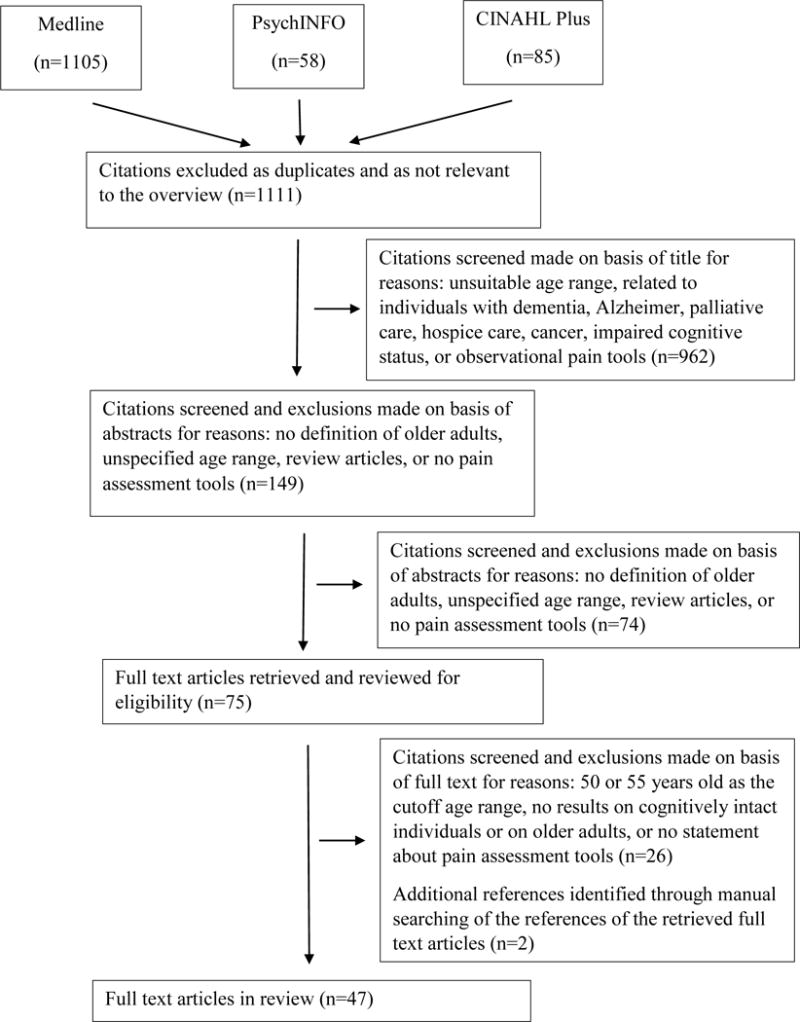
Results of the literature search
Searches in the PubMed, the PsycINFO and CINAHL Plus were limited to peer-reviewed articles describing studies engaging human subjects published in English, using the following combinations of Mesh terms and keywords: in PubMed, “Pain Measurement”[Mesh] AND “aged”[MeSH Terms] AND English[lang] AND “pain management”[MeSH Terms] OR “pain assessment tools”[All Fields] OR “pain instrument”[All Fields] AND “loattrfull text”[sb] NOT (“review”[Publication Type] OR “review literature as topic”[MeSH Terms] OR “older adults”[All Fields]) AND (“1990/01/01”[PDAT] : “2015/12/31”[PDAT]); in PsychINFO and CINAHL Plus, “pain assessment tools” AND “age” OR “older adults.” The search strategy was reviewed and validated by a librarian.
Studies were included if they: (1) specified that subjects were “older adults”, “elderly”, or “geriatric”; (2) used one or more pain assessment tools; and (3) included specified any definition of older adults, such as geriatric or elderly. Studies were excluded if they did not report results for cognitively intact older adults, were not published in English or if they targeted only patients with dementia, mild, moderate or severe cognitive/communication impairments, cancer, or those receiving palliative care or hospice.
Two raters (YK, GD) independently evaluated 35 % of abstracts according to the eligibility criteria. The level of agreement between the two raters was nearly 77%. All discrepancies in ratings were resolved after the evaluation of the published evidence. The full-text papers were reviewed if the presence of the inclusion criteria was unclear. Seventy-six full-text articles underwent more detailed evaluation, and the reference lists of the included articles were evaluated for additional relevant peer-reviewed articles meeting the inclusion criteria.
The review of the final full articles led to the identification of pain assessment tools. Three different types of pain assessment tools were extracted. The articles were reviewed again to describe overview of the studies including the purpose of the study, settings/recruitment, self-report pain assessment tools, and other tools used in the study. After completing the description of each study in a table format, characteristics of each tool were reviewed and evaluated as reported in the studies.
Results
This review identified one non-dimensional, 17 uni-dimensional, and six multi- dimensional tools (see Table 1) used for self-report of pain among cognitively intact older adults. There were 47 articles that used standardized pain assessment tools (see Table 2). The cut-off age for defining older adults varies across studies from 58 to 70.
Table 1.
Characteristics of the tools
| Self-report pain assessment tools | Scales stated in the articles | Overall performance stated in the article |
|---|---|---|
| Non-dimension | ||
| Verbal Rating Scale (VRS) | VRS: pain rating scale based on verbal report. | |
| 5-point VRS: o=no pain, 1=slight pain, 2=moderate pain, 3=severe pain, 4=unbearable pain |
The highest successful rates on the first day after tracheal extubation (86%) and in older adults aged 75 years or older among cardiac surgery patients (81%) (Pesonen et al., 2008) | |
| 5-point VRS-no pain (VRS 0), little pain (VRS 1), painful but bearable (VRS 2), considerable pain (VRS 3), terrible pain (VRS 4) | – | |
| 5-point VRS from the McGill Pain Questionnaire (MPQ): mild, discomforting, distressing, horrible, or excruciating corresponding to the numeric scales from 1 to 5 | – | |
| 6-point VRS (or Graphical Rating Scale) ranging from no pain to mild, moderate, moderately severe, severe, unbearable | – | |
| 1 to 10 Pain Rating Scale- verbally raging from one to ten corresponding to “no pain” and “pain as bad as it could be” | Hardest and least accurate tool among women older adults in a rural area (only 10% of the participants indicated that this tool was easy and accurate) (Benesh et al., 1997) | |
| 11 point VRS (0–10) | – | |
| 5-point VRS (no descriptors stated in the article) | – | |
| Uni-dimension | ||
| Behavioral Rating Scale (BRS-6) | A six-point unidimensional scale from “no pain” to “pain present, cannot be ignored, rest or bedrest required” to assess pain intensity in terms of its behavioral effects | The lowest failure rate :8.7% (Gagliese et al., 2005) |
| Bodily pain subscale from SF-36 Health Survey Questionnaire | A subscale from SF-36 Health Survey Questionnaire and ranges from 1 to 100 | – |
| Box Scale | Gracely Box Scale (GBS-Intensity, GBS-Unpleasantness): 21 boxes vertically on a scale of 0 to 20 and verbal descriptors attached to 13 out of 21 boxes on a scale of low to high pain intensity (GBS-I)/unpleasantness (GBS-U). The question for intensity was “how strong the pain feels,” the question for unpleasant was “how disturbing the pain is for you” | – |
| Box-11: has 11 boxes in a horizontal row labeling from 0 (no pain) to 10 (worst pain imaginable) | The highest factor loading :0.99 (Peters et al., 2007) | |
| Box-21 (21 boxes horizontally labeled from 0 (no pain) to 100 (worst pain imaginable) using five-point intervals | – | |
| Vertical 21-point (0–20) box scale measuring pain intensity and pain unpleasant | – | |
| Colored Analogue Scale (CAS) | The different scale marks are shown by different colors on front of the CAS, in which the numeric value indicating the person’s pain score on the back of the CAS matches the chosen scale mark from the bottom (no pain) to the top (maximum pain) | Comprehend rate:100% (Scherder & Bouma, 2000) |
| EQ5D three-level pain subscale | No pain or discomfort, moderate pain or discomfort, extreme pain or discomfort | – |
| FACES | The FACES developed by Wong&Baker consists of six cartoon facial expresses ranging from 0 (very happy smiling face representing “no hurt”) to 5 (sad tearful face representing “hurts worst”) | – |
| Faces Pain Scale (FPS) | 7-point FPS (1–7) developed by Bieri, et al., 1990 (Bieri, Reeve, Champion, Addicoat, & Ziegler, 1990): seven line-drawn faces corresponding to the numeric value of 0 to 6 | Strongest reliability coefficients:0.79 (Taylor & Herr, 2003) The most preferred by African Americans:62.5% (Taylor & Herr, 2003) Failure rate: 0% (K. A. Herr et al., 2004) Comprehend rate:100% (Scherder & Bouma, 2000) |
| Revised FPS (FPS-R) : a numeric scale (i.e., either 0,2,4,6,8, and 10 or 0,1,2,3,4,5) with six facial expressions presented in a horizontal format to measure the level of pain. The numbers on the scale are invisible to the patient |
The range of test-retest reliability coefficients:0.44 to 0.70 (Miro et al., 2005) | |
| 11 face modified version of the McGrath nine face FPS | – | |
| The McGrath nine face FPS was modified into 11-point scale compared to a 11-point NRS | – | |
| Facial Affective Scale (FAS) | This tool has line drawings of nine facial expressions ranging from no pain (very happy) to most severe pain (very painful) on the front of the FAS, while the numerical value indicating the person’s pain score is on the back of the FAS | Comprehend rate: 75% (Scherder & Bouma, 2000) |
| Geriatric Painful Events Inventory (GPEI) | This is a modified version of the Painful Events Inventory with seven different hypothetical painful situations. The GPEI is considered as unidimensional tool with five situations reporting “how much pain do you feel when”: you burn your hand with hot oil?;you cut your finger with a knife?;you stub your toe on something?;you bite your tongue?;you have a splinter? | Cronbach alpha coefficient:0.7; the retest reliability coefficient for the full scale; 0.62 (p, 0.01) (Miro et al., 2005) |
| Memorial Pain Card (MPAC) | It consists of eight descriptors and a numeric value from 0 (no pain) to 7 (excruciating) | |
| Numeric Rating Scale (NRS) | 10-point NRS: scale of 1 to 10 | |
| 11-point NRS: scale of 0 to 10 | ||
| 1.11-point NRS with two words (“no pain: and “worst pain” or “worst pain imaginable” or “the most intense pain imaginable”) | Failure rate:0% (K. A. Herr et al., 2004) Strongest face validity (presented in graph): the most frequently used, easiest, most accurate and most preferred (Gagliese et al., 2005) |
|
| 2.11-point NRS ranging from no pain (0), to moderate pain in the middle of the scale, to the worst possible pain (10) at the other end of the scale | Strongest test-retest reliability coefficient: 0.87; the most preferred tool: 33% of cognitively intact older minority adults (Ware et al., 2006) | |
| 20-point NRS : a VAS calibrated with a vertically numeric scale from one to 20 corresponding to “no pain (0)” on the bottom of the scale and “pain as bad as it could be (20)” on the top of the scale |
The incorrect responding by the mean age of 76 (K. A. Herr & Mobily, 1993) | |
| 21-point NRS : numeric scale ranging from 0 to 20 |
The most preferred scale:35.3% (K. A. Herr et al., 2004) | |
| Pain intensity from the Brief Pain Inventory (BPI) | A subscale of the BPI : there is no scoring algorithm, and the range of self-reported pain intensity is from “0” (no pain) to “10” (pain as bad as you can imagine) |
– |
| Pain Thermometer (PT) | PT: a verbal descriptor positioned along with a picture of a thermometer | |
| 1.7-point of no pain, slight, mild, moderate, severe, extreme pain, and pain as bad as it could be | The easiest and the most accurate tool to reflect pain intensity:47.5% of participants (Benesh et al., 1997) Preferred by 43.8% of female; preferred by hose with a high school degree and higher (K. A. Herr & Mobily, 1993) |
|
| 2. A scale of from “no pain” to “very much pain” corresponding to the numbers from 0 to 10 along with a 17cm long diagram of a thermometer | – | |
| 3. Iowa PT (IPT) :modified VDS with seven pain descriptors (i.e., no pain, slight pain, mild pain, moderate pain, severe pain, very severe pain, and the most intense pain imaginable) along with a diagram of a thermometer and the range of the score from 0 to 12 |
The most preferred :54.7% of participants (Li et al., 2009) | |
| 4. Revised IPT (IPT-R) : 11-point ranging of score from 0 to 10 with five pain descriptors: no pain (0), mild pain (1–3), moderate pain (4–6), and most intense pain imaginable (7–10) |
The most preferred:57% of the cognitively intact group; test-retest reliability coefficient:.80 (Ware et al., 2015) | |
| The 50cm Red Wedge Scale (RWS) | The RWS is a visual 50cm red-colored horizontal wedge scale | – |
| The Rand coop chart (COOP) | Five cartoon characterizations of bodies: no pain (upright posture) to severe pain (stooped over the character) | – |
| Verbal Descriptor Scale (VDS) | VDS: a scale where a patient describes their pain using verbal descriptors with/without a numeric scale | |
| 6-point VDS corresponding with numbers of 0 to 5:no pain (0), mild pain (1), moderate pain (2), severe pain (3), extreme pain (4) and most intense pain imaginable (5) | The strongest test-retest reliability coefficient: 0.67: the most preferred: 17.3% (Taylor et al., 2005) Failure rate:0%; the most sensitive (K. A. Herr et al., 2004) |
|
| The Present Pain Intensity (PPI). The PPI is a subscale of the McGill Pain Questionnaire and is considered as a kind of six-point VDS. It consists of word and numeric scale: no pain (0), mild (1), discomforting (2), distressing (3), horrible (4), and excruciating (5) | Easiest to compete:40% of participants: best describing the pain:40.7%; the most preferred :38.5%; the incorrect responding by the ages of 85; preferred by 60% of male; less preferred by those with a high school degree or less (K. A. Herr & Mobily, 1993) The lowest error rate: 1.6% (Gagliese et al., 2005) |
|
| The six-level verbal descriptor scale adopted from the SF-36 labeled from top to bottom: none, very mild, mild, moderate, severe, and very severe at four different time points: right now, at its worst last week, at its least last week, and on average last week | The most preferred by patients aged 75 and older :42.9% (Peters et al., 2007) | |
| 7-point VDS with numbers (0–6): no pain (0), slight pain (1), mild (2), moderate pain (3), severe pain (4), extreme pain (5) and most intense pain imaginable (6) | Recommend to dichotomize the pain intensity at the moderate scale and greater, if researchers are interested in pain measurement as an outcome (Shega et al., 2014) | |
| 7-point VDS without numbers - no pain, slight, mild, moderate, severe, extreme and pain as bad as it could be | The second easiest and most accurate tool (Benesh et al., 1997) | |
| Visual Analog Scale (VAS) | VAS: a straight either 10cm or 100mm line anchored with two verbal descriptors | Highest failure rate: 15.4 % at pre injection and 21.3% at post injection (K. Herr et al., 2007) |
| Horizontal VAS (h-VAS) :a horizontally continuous linear scale of 100mm running from “no pain” on the left end to “worst pain imaginable” on the right end without divisions and descriptive words between them |
The highest failure rate:18.3% (Gagliese et al., 2005) The least preferred by oldest participants (aged 75 or older):11.4% (Peters et al., 2007) The highest incomplete rate: 11% (Bergh et al., 2000) The highest incomplete rate: 23% (Bergh et al., 2001) |
|
| Vertical VAS (v-VAS) :a straight vertical 100mm line labeled “no pain” on the bottom and “pain as bad as it could be” on the top of the line |
The incorrect responding by the age of 65 (K. A. Herr et al., 2004) The highest failure rate: 6.7% (K. A. Herr et al., 2004) The highest incorrect rate :10.8% (Peters et al., 2007) |
|
| VAS-Resting (VAS-R) : 10 cm horizontal line labeled “no pain” on the left end to “worst possible pain” on the right end. This version was called the VAS-R because the VAS was used when the participants were at rest |
Raise limitations (Gagliese & Katz, 2003) | |
| VAS- Mobilizing (VAS-M) : same scale as the VAS-R. This version was called the VAS-M because the VAS was used when the participants after mobilizing and taking two maximal inspirations |
Raise limitations (Gagliese & Katz, 2003) | |
| 10cm VAS-no numbers or no words. 10cm horizontally straight line. :this version is described as 10cm horizontally straight line without either numbers or no words | Not suitable in cardiac surgery (Pesonen et al., 2008) | |
| Multi-dimension | ||
| Brief Pain Inventory (BPI) | BPI-Short Form (SF) : 15 items assessing pain intensity, pain location, and the effect of pain on mood and daily activities |
High reliability:.87 (McDonald, 2009) |
| BPI Spanish version In this version, pain intensity ranged from 0 to 10 corresponding to “no pain” and “pain as bad as one can imagine”; pain intensity was assessed with worst, least, average, and pain now. Assessing for general activity, mood, walking, work, relations with others, sleep, and enjoyment of life; the range was from 0 to 10 corresponding to “no interfere” and “completely interfere” |
– | |
| Pain interference :the range of activity-interfering pain was from 0 (“does not interfere”) to 10 (“very certain”) |
– | |
| Pain interference : 6-point scale of pain interference subscale from the BPI ranging from 0 (does not interfere) to 5 (completely interferes) |
– | |
| Pain interference Korean version : the range of activity-interfering pain was from 0 (“does not interfere”) to 10 (“very certain”) |
– | |
| Geriatric Pain Measure (GPM) | GPM / GPM-Self Administered-24 1.A 24-item tool that five subscales: pain intensity, disengagement because of pain, pain with ambulation, pain with strenuous activities, and pain with other activities 2. Among 24 items, 22 items are yes/no question, and two items request ratings on a scale of 0 to 10 |
Reliability coefficient: 0.91 (Clough-Gorr et al., 2008) Reliability coefficient: .945 (Ferrell et al., 2000) |
| GPM-Korean version | Reliability coefficient:.918 (Kim & Buschmann, 2006) | |
| GPM-12 :A 12-item tool that three pain subscales: pain intensity, pain with ambulation, disengagement because of pain |
Reliable in community-dwelling older adults in clinical and research setting as well as in Europe and in the US (Blozik et al., 2007) | |
| McCaffery and Pasero’s Initial Pain Assessment Tool | Three questions :location of pain, what makes the pain better, what makes the pain worse |
– |
| McGill Pain Questionnaire (MPQ) | MPQ : 20 categories of questions regarding the quality of the subjects’ pain, including verbal descriptors about sensory, affective and evaluative components |
– |
| MPQ-SF : 11 sensory and four affective areas with four potential ratings: none (0), mild (1), moderate (2), and severe (3) |
May be a suitable tool for use in older adults (Gagliese & Melzack, 1997) | |
| The Present Pain Intensity (PPI) :the six-level verbal descriptor scale from “no pain” to “excruciating” |
– | |
| Total Pain Index | A pain rating for each body location, frequency, severity and duration over the last three months using a scale of 0 to 10. Specifically, for each body location, the instrument asks, “In the past three months, how often did you have pain in [each body location]?” (i.e., none of the time, a slight bit of time, some of the time, most of the time, and all of the time) | – |
| West Haven-Yale Multidimensional Pain Inventory | Assessment of psychosocial characteristics related to the experience of persistent pain | Adequate values of construct validity between the NRS and Pain Severity and Affective Distress sub-scales (Wood, Nicholas, Blyth, Asghari, & Gibson, 2010) |
Table 2.
Overview of the studies in review
| First author | Study purpose | Settings/recruitment | Self- report pain assessment tools | Other tools used in the study |
|---|---|---|---|---|
| Non-dimension&Uni-dimension | ||||
| Pesonen, 2008* | To compare the Visual Analogue Scale (VAS) and Verbal Rating Scale (VRS) with the 50cm Red Wedge Scale (RWS) and the Facial Pain Scale (FPS) among cardiac surgical older patients | Hospital | 10cm VAS, 5-point VRS, RWS, 7-point FPS | |
| Dijk, 2012* | To assess the diagnostic value of the Numeric Rating Scale (NRS) through comparisons of a VRS among surgical older adults | University Medical center | 11-point NRS, 5-point VRS | |
| Mak, 2015 | To examine pain intensity within five to seven days after hip fracture surgery among older adults | Hospital | 11-point VRS while resting, 3-level EQ5D subscale | Functional Comorbidity Index, EQ5D, Mini-Mental State Eamination (MMSE), Clock-Drawing tests |
| Uni-dimension | ||||
| Herr, 1993*$ | 1. To examine the correlation between pain scores on a Verbal Descriptor Scale (VDS) and a VAS asking about leg pain during phase 1 2. To examine the correlation among scores on a VDS, a horizontal-Visual Analog Scale (h-VAS), a vertical VAS (v-VAS), an NRS, and a pain thermometer (PT) |
Senior citizen centers | h-VAS, VDS, v-VAS, PT, 11-point NRS | |
| Benesh., 1997*$□ | To identify the pain intensity assessment tool in rural women older adult | Community | VAS, 6-point VDS, PT, 1-to-10 Pain Rating Scale | MMSE |
| Herr, 1998*$□ | To determine the psychometric properties of the FPS for use in older adults | Local senior citizen centers, church groups, and senior retirement centers | 7-point FPS | Cognitive Capacity Screening Examination (CCSE) |
| Scherder, 2000$+ | To investigate whether: 1) older adults with and without dementia comprehend the purpose of Colored Analogue Scale (CAS), FPS, Facial Affective Scale (FAS) | Not stated | CAS, 7-point FPS by Brier, FAS | Global Deterioration Scale, MMSE |
| Manz, 2000*$+ | To determine the pain assessment tools for quantifying pain among older adults across different levels of cognitive functioning | Skilled Nursing Facility | Wong-Baker FACES Pain Scale, COOP, PPI, 11-point NRS, Memorial Pain Card | Short Portable Mental Status Questionnaire |
| Bergh, 2000* | To examine the applicability of the VAS, the Graphic Rating Scale (GRS) and the NRS | Geriatric units at a university hospital | VAS, GRS, 10-point NRS | |
| Bergh, 2001* | To compare individuals’ verbally reported effect of analgesics with the changes in pain experience using four different tools among older adults with non-pathological fractures | Geriatric units at a university hospital | VAS, GRS, 10-point NRS | Pain Relief Scale |
| Chibnall, 2001*$+ | To compare the psychometric properties of four pain scales among hospitalized older adults without and with cognitive impairment | Subacute care facility | 5-point VRS, 7-point FPS by Bieri, a modified 21-point Box scale, Gracely Box Scale | MMSE |
| Taylor, 2003*$+□ | To compare the FPS, VDS, NRS, and the Iowa PT (IPT) in cognitively intact and cognitively impaired African-American older adults | Assisted living facilities | 7-point FPS by Bieri, 7-point VDS, 11-point NRS, IPT | MMSE |
| Miro, 2004*□ | To assess the psychometric properties of the Spanish version of the Faces Pain Scale-revised (FPS-R) among older adults | Nursing homes and primary care | FPS-R, PT Geriatric Painful Events Inventory | Positive and Negative Affect Schedule, MMSE |
| Herr, 2004*$√□ | To assess the psychometric properties of five pain assessment scales used with younger (age 25–55) and older adults (age 65–94) | Recruited through college bulletin board displays, community faith centers, senior-citizen centers, senior-housing, and long-term care facilities | v-VAS, 21-point NRS, 7-point VDS corresponding with numbers of 0 to 6, 11-point NRS, and FPS by Bieri | CCSE |
| Bayar, 2004*$ | To evaluate the validity and reliability of the Functional Rating Index in cognitively intact older adults with low back pain | Aging center registry of community-dwelling older adults | NRS (no specified scale) | |
| Taylor, 2005*$+□ | To examine the psychometric properties of the FPS, the VDS, the NRS, and the IPT at present and 2 weeks later among cognitively intact and cognitively impaired adults | Assisted living facilities | 7-point FPS, 6-point VDS, 11-point NRS, IPT | MMSE |
| Kim, 2006*+ | To examine the construct validity, construct validity, and test-retest reliability of an 11 face modified version of the McGrath nine face FPS among Korean older adults | Senior citizen centers, general hospital and an oriental medical hospital | 11 face modified version of the McGrath nine face FPS, 11-point NRS, VAS | MMSE |
| Ware, 2006*$+□ | To determine the reliability and validity of the revised FPS (FPS-R), VDS, NRS and IPT in older minority adults including African American, Hispanic, and Asian | Acute care facilities | 7-point VDS, 11-point NRS, IPT, FPS-R | MMSE |
| Peters, 2007*$√ | To determine the psychometric properties and preferences for five pain intensity scales in younger and older adults | Outpatient pain facility | h-VAS, v-VAS, Box-11, Box-21 and 6-point VDS | |
| Herr, 2007*$√□ | To evaluate the sensitivity and utility of the Iowa Pain Thermometer, NRS, VNS, FPS, and VAS in younger and older adults | Rheumatology clinics | IPT, 21-point NRS, 11-point NRS, 7-point FPS by Bieri, VAS | CCSE |
| Li., 2009* | To assess the psychometric properties of the FPS-R, NRS, and the IPT among Chinese surgical older adults | University-affiliated teaching hospital | FPS-R, IPT, 11-point NRS (without descriptors) | American Society of Anesthesiology score |
| Liu., 2010* | To compare four observational pain tools during different activity levels among older adults with osteoarthritic pain | Nursing homes | 5-point VRS, and Wong-Baker FACES Pain Scale | Observational pain tools: Pain Assessment IN Advanced Dementia Scale, Abby Pain Scale, Pain Assessment to Communicate, Discomfort Scale-Dementia of Alzheimer Type, MMSE |
| Nicholas, 2013 (Nicholas et al., 2013)* | To examine the effectiveness of a pain self-management intervention in terms of improving pain | Pain Management and Research Centre | 11 point NRS for: 1) Pain intensity, ranging from 0 (no pain) to 10 (pain as bad as it could be) 2) Pain distress, ranging from 0 (not at all distressing) to 10 (pain as distressing as it could be) |
|
| Shega, 2014$ | To describe the rationale for pain presence, intensity, and location among community-dwelling older adults | Community | 7-point VDS | Pain map |
| Park, 2014 | To determine the usefulness of the arthritis-related health belief instrument across diverse ethnic groups | Community | 10-point NRS for eligibility criteria | 14 item arthritis-related health belief instrument (AHBI), MMSE |
| Guo, 2014* (Guo, Li, Liu, & Herr, 2015) | To evaluate psychometric properties of the Pain Assessment in Advanced Dementia Scale and the Checklist of Nonverbal Pain Indicators in Chinese surgical older adults during the anesthesia recovery period | Hospital | 11-point NRS was used at the first and third postop day to recall postoperative pain intensity in the PACU | Pain Assessment in Advanced Dementia Scale Checklist of Nonverbal Pain Indicators |
| Simmons, 2015$ | To examine the prevalence of pain, and new onset of moderate and severe pain among older patients during the transition to skilled nursing care after hospital discharge | Skilled nursing care facilities | 11-point NRS | |
| Ware, 2015*$ | To evaluate the psychometric properties of the Revised Iowa Pain Thermometer (IPT-R) among older adults | Acute care hospitals | IPT-R, IPT, 11-point NRS | |
| Multi-dimension | ||||
| Ferrell, 2000*$ | To determine the psychometric properties of the Geriatric Pain Measure (GPM) among older adults | Ambulatory geriatric clinic | GPM, MPQ | ,Kartz ADLs, Lawton IADLs, Tinnetti Gait and Balance scale, Geriatric Depression Scale |
| Blozik, 2007*$ | To develop and evaluate a short form of the 24-item GPM (GPM-12) among community -dwelling older adults in European countries and in the US | Primary care clinic | GPM-12 | |
| Park, 2008* | To develop the Korean version of the GPM (GPM-K). | Elders’ education center | GPM-K | |
| Clough-Gorr, 2008* | To determine the feasibility and psychometric properties of the self-administered version of the 24-item GPM (GPM-SA) among community-dwelling older adults in three European countries | Living at home | GPM-SA | |
| Ersek, 2008$ | To assess the efficacy of a pain self-management training group | Retirement facilities | Two subscales (pain intensity and pain interference during the past week) from the BPI | The Roland Morris Disability Questionnaire, Geriatric Depression Scale, The 8-item Arthritis Self-Efficacy Scale, The Coping Strategies Questionnaire, Chronic Pain Coping Inventory, MMSE |
| McDonald, 2008$ | To test the use of the BPI-SF affecting pain communication between community-dwelling patients with osteoarthritis pain and practitioners | Community | BPI-SF was used as an intervention Provided picture of the tool |
|
| McCarthy, 2009$+ | To examine the prevalence of chronic pain and the relationship between pain level and body mass index | Computer-Assisted Telephone Interview | Total Pain Index | The telephone Blessed Information-Memory-Concentration score, the Memory Impairment Screen |
| McDonald, 2009*$ | To describe pain descriptors of community-dwelling older adults with osteoarthritis pain | Living at home or independent-living housing | SF-BPI | |
| McDonald, 2009*$ | To test how pain communication of practitioners affected the pain information reported by older adults | Living at home or independent congregate living housing | SF-BPI | |
| Iliffe, 2009 | To explore risk factors for depression among community-dwelling older adults with pain | Group practices | GPM | |
| Shea, 2011$ | To identify risk factors for increased pain communication by older adults with osteoarthritis pain | Living at home or independent congregate living housing | BPI-SF | |
| McDonald, 2011$ | To assess the effectiveness of a virtual practitioner pain communication coach among community-dwelling older adults with osteoarthritis pain | independent congregate living housing | SF-BPI | |
| McDonald, 2012, Spanish version$ | To assess the effects of a virtual pain coach among Spanish-speaking older adults with osteoarthritis | Ambulatory medical care within a large medical center | SF-BPI Spanish version 11-point NRS for eligibility criteria |
|
| McDonald, 2013$ | To assess the effects of a pain communication plus virtual pain coach intervention among community-dwelling older adults | Urban ambulatory care clinic of a large university-affiliated hospital | SF-BPI Beck Depression Inventory II (BD II) 11-point NRS for eligibility criteria |
|
| Uni &Multi dimension | ||||
| Gagliese 1997*$√ | To assess age differences in chronic pain by using three unidimensional and one multidimensional tools among adults with rheumatoid arthritis | Community setting. Recruited from the membership rosters of the Arthritis Society of Quebec. |
VAS, 6-point VDS, Behavioral Rating Scale (BRS-6), SF-MPQ (subscales of sensory and affective), Beck Depression Inventory | |
| Wood, 2010* | To assess pain intensity and pain stress using the Numeric Rating Scale (NRS) at three different time points: 1) pain at this moment; 2) usual- level pain in past week; 3) average pain distress in past week | Pain Management and Research Centre | 11-point NRS for: 1) Pain intensity, ranging from 0 (no pain) to 10 (worst pain imaginable); 2) Pain distress, ranging from 0 (not at all distressing) to 10 (pain as distressing as it could be) West Haven-Yale Multidimensional Pain Inventory (MPI) SF-36 Health Survey Questionnaire (four subscales including Bodily pain ranging from 1 to 100) |
Depression Anxiety and Stress Scales (21-item) |
| Gagliese and Katz, 2003*$ | To assess age differences in postoperative pain among surgical younger and older adults >62) | Hospital setting | McGill Pain Questionnaire (MPQ), Present pain intensity (PPI), VAS: VAS-R (pain intensity at rest) and VAS-M (standard mobilization exercise) |
American Society of Anesthesiology score |
| Gagliese, 2005*$□ | To compare the feasibility and validity of the NRS, VDS, h-VAS, and v-VAS in younger and older surgical patients | The Toronto General Hospital, University Health Network and Mount Sinai Hospital. | 11-point NRS, 6-point VDS, h-VAS, v-VAS, and McGill Pain Questionnaire | American Society of Anesthesiology score |
| Brown, 2011$ | To describe the pain experience of community-dwelling older adults | Living at home or assisted living residences | PPI from MPQ-SF, one item from BPI, McCaffery and Pasero’s Initial Pain Assessment Tool | |
Note:
numeric psychometric values reported in the study population:
study conducted in the United States;
compare younger adults to older adults;
compare cognitively intact and impaired older adults;
considered design
Non-dimensional tools are defined if they are non-linear based on verbal report. Uni-dimensional tools are defined if they assess only pain intensity using single-item numeric scales and/or words. Multi-dimensional tools are defined if they assess other dimensions such as pain interferences in addition to pain intensity (Stolee et al., 2005). In other words, these tools comprehensively measure pain by including items regarding pain location, intensity, qualities, and sensation as well as other symptoms. For a consistent description of suitable tools for older adults in this review, if the articles rated tools as being “acceptable,” “proper,” “suitable,” “appropriate,” or “effective,” we described the instrument as being “suitable” for use among older adults.
This review identified sixteen articles that reported studies conducted outside of the United States (US). The community was the most common setting, followed by hospital (i.e. postoperative recovery setting), outpatient settings including ambulatory care, and long-term care settings including skilled nursing facilities and nursing homes.
A few studies in this review mentioned visual characteristics of the tools such as font size and type, that are of significance for an older adult audience with potential visual limitations: two studies that defined older adults for 65 and older and older, used 14-point bold type face and printed on buff colored paper (Benesh, Szigeti, Ferraro, & Gullicks, 1997; K. Herr et al., 2007);one study that defined older adults for 60 and older, used 16-point Times New Roman font (Gagliese, Weizblit, Ellis, & Chan, 2005); four studies that defined older adults for 58, 60, and 65 and older, mentioned that they increased the height of the facial pictures in the Faces Pain Scale (FPS) (K. A. Herr, Mobily, Kohout, & Wagenaar, 1998; Taylor & Herr, 2003; Taylor et al., 2005; Ware, Epps, Herr, & Packard, 2006); and one study that defined older adults for 65 and older, mentioned that they used a picture of a 17cm colored thermometer (Miro, Huguet, Nieto, Paredes, & Baos, 2005).
Non-dimensional pain assessment tool
There were seven different kinds of the Verbal Rating Scale (VRS) including different scales and different descriptors. For example, one version of 5 verbal rating scale includes “no pain,” ‘slight,” “moderate,” “severe,” “unbearable pain.”; the other version includes “no pain,” “little,” “painful,” “considerable,” and “terrible.” This review identified that the VRS was not used as frequent as uni-dimensional tools.
Uni-dimensional pain assessment tools
Four tools have been commonly used and have been compared with each other: 12 articles with Faces Pain Scale (FPS), 22 articles with Numerical Rating Scale (NRS), 12 articles with Visual Analog Scale (VAS), and 12 articles with Verbal Descriptor Scale (VDS). This review identified ten tools as infrequently used tools across the articles: Behavioral Rating Scale (BRS-6), Bodily Pain subscale from the SF-36 Health Survey Questionnaire, Colored Analogue Scale (CAS), Rand coop chart (COOP), FACES, Facial Affective Scale (FAS), Geriatric Painful Events Inventory (GPEI), Memorial Pain Card (MPAC), Pain Intensity subscale from the Brief Pain Inventory, and the 50cm Red Wedge Scale (RWS). The Bodily Pain subscale from the Short Form (SF)-36 Health Survey Questionnaire, Box Scale (BS), FPS, NRS, Pain Thermometer (PT), VAS, and VDS have multiple versions using different scales and verbal descriptors.
Tools without multiple versions
Those tools have been used not as frequently as those with multiple versions. The GPEI was developed for the specific study in older adults in Spain (Miro et al., 2005).
Tools with multiple versions
Box Scale (BS)
This tool was modified from the NRS, and had four different versions.
Faces Pain Scale (FPS)
Although this scale was initially developed for use in pediatrics, it has been tested for reliability and validity in older adults worldwide (Kim & Buschmann, 2006; Miro et al., 2005). The highest number of studies used the seven-point FPS version, with five studies reporting positive statements in different areas of psychometric performance. In particular, the FPS-R was identified more frequently in articles published in 2009 instead of the FPS.
Numeric Rating Scale (NRS)
Among the NRS tools including 10-, 11-, 20-, and 21 point, the 11-point NRS corresponding to two or three descriptors indicating the severity of pain was the most frequently used. A few studies stated that the 11-point NRS has become the gold standard for self-report of pain in clinical settings as well as an outcome measure in clinical trials of chronic pain treatments (Dworkin et al., 2005; K. Herr et al., 2007; Kim & Buschmann, 2006). A recent study used an adapted 11-point NRS with two descriptors (0-no pain to 10-worst pain imaginable) to assess pain among older adults during the transition from the acute care setting to skilled nursing care (Simmons et al., 2015).
Pain Thermometer (PT)
In this review, we described PT separately from the VDS even though it is considered a vertical verbal descriptor tool (K. A. Herr & Mobily, 1993). The Iowa PT (IPT) was originally developed for research purposes (Ware et al., 2015). However, in one study, most participants said that having a picture of a thermometer was not necessary (K. Herr et al., 2007). The Revised IPT (IPT-R) was adapted from the 13-point (0–12) IPT because the use of the 13-point IPT in clinical settings was challenging due to lack of alignment with pain scoring metrics that used an 11-point scale (Ware et al., 2015).
Verbal Descriptor Scale (VDS)
There were three different versions of the six-point Likert VDS based on different descriptors. In particular, the version of the VDS using the descriptor “excruciating” was developed as a subscale of the McGill Pain Questionnaire is called the Present Pain Intensity (PPI) (Gagliese & Melzack, 1997; K. A. Herr et al., 2004; Malec & Shega, 2015). A seven-point VDS with numbers was recommended for dichotomizing pain intensity at the moderate level or greater (e.g., no, slight, mild vs moderate, severe, extreme, most intense pain imaginable), if researchers were interested in pain assessment as an outcome (Shega et al., 2014).
Visual Analog Scale (VAS)
A study using both the VAS at rest (VAS-R) and VAS after mobilizing (VAS-M) identified that they were not sensitive enough to detect age differences in pain intensity (Gagliese & Katz, 2003). Thus, this study suggested that using the VAS in older adults may not be advisable in future studies (Gagliese & Katz, 2003).
Multi-dimensional pain assessment tools
The Brief Pain Inventory (BPI)
The BPI is a multidimensional tool assessing pain intensity, activity-interfering pain, pain location(s), pain type(s), current pain medications, and degree of pain relief experienced in the past week. Due to the length of the BPI, the Short Form of the BPI (BPI-SF) was developed (McDonald et al., 2008; McDonald, 2009; McDonald, Shea, Rose, & Fedo, 2009; McDonald, Walsh, Vergara, & Gifford, 2013; Shea & McDonald, 2011). One randomized controlled trial examining the efficacy of a chronic pain management program used two subscales from the BPI (i.e., pain intensity and pain interference) (Ersek, Turner, Cain, & Kemp, 2008).
Geriatric Pain Measure (GPM)
The GPM was originally developed in 2000 as a 24-item multidimensional pain assessment tool for use in those aged 65 and older in the ambulatory care setting in the US (Clough-Gorr et al., 2008; Ferrell, Stein, & Beck, 2000; Park, Cho, Paek, Kwon, & Yoo, 2009). In this review, three versions of the GPM were identified using different languages and/or administration methods (Clough-Gorr et al., 2008; Ferrell et al., 2000; Iliffe et al., 2009; Park et al., 2009). The GPM short form (GPM-12) was developed in 2007 as a 12-item version of the GPM. It was evaluated specifically for use in community-dwelling older adults in Europe and in the U.S (Blozik et al., 2007).
McCaffery and Pasero’s Initial Pain Assessment Tool
This tool was used to address the location of pain, what makes the pain better, and what makes the pain worse (Brown et al., 2011). There were no details of properties such as reliability and validity and was no attached copy of this tool.
McGill Pain Questionnaire (MPQ)
The Short Form McGill (MPQ-SF) was developed from the original MPQ narrowing descriptors (Brown et al., 2011; Gagliese & Melzack, 1997). In patients with rheumatoid arthritis, the subscales of the MPQ-SF were correlated with each other but not with ratings on the VAS or VDS (Gagliese & Melzack, 1997).
The Total Pain Index
This tool was used to address pain location, frequency, severity and duration in the study that examined the prevalence of chronic pain in older adults and its relationship with obesity (McCarthy, Bigal, Katz, Derby, & Lipton, 2009). This study did not report reliability and validity and did not provide a copy of this tool.
The West Haven-Yale Multidimensional Pain Inventory
One study used two subscales (i.e., Pain Severity and Affective Distress) of this tool, which consist of 61 items rated on a scale of zero to six (Wood, Nicholas, Blyth, Asghari, & Gibson, 2010).
Overall performance stated in the studies
Non-dimensional tools
The One to Ten Pain Rating Scale was found to be the hardest for older women adults in a rural area to use and resulted in the least accurate reports of pain intensity (Benesh et al., 1997). The study, that used the 5-point VRS without descriptors reported, stated concern about the use of the VRS among older adults with low literacy level (Liu, Briggs, & Closs, 2010). Another study reported that one of the five-point VRSs had the highest successful rates among older adults aged 75 and older among cardiac surgery patients (Pesonen, Suojaranta-Ylinen, Tarkkila, & Rosenberg, 2008).
Uni-dimensional tools
Regardless of the different versions, the NRS and VDS were reported as either the most preferred or the most reliable tools (Gagliese et al., 2005; K. A. Herr & Mobily, 1993; K. A. Herr et al., 2004; Taylor et al., 2005; Ware et al., 2006). One study also stated that the NRS, VDS, and VAS were the most frequently used tools (Peters, Patijn, & Lame, 2007). In particular, this review identified that the NRS was the most commonly used tools.
For the 11-point NRS with three descriptors, one study reported that this tool had the strongest reliability, and was a preferred tool among costively intact older minority adults (Ware et al., 2006); a couple of studies assessing the psychometric properties of pain intensity scales for use in older adults selected this scale as most appropriate for older adults because it would be less challenging for them to use, since it provided fewer options than other scales (K. A. Herr et al., 2004; Taylor et al., 2005). However, one study found that the11-point Verbal NRS (VNS) was less preferred by older adults compared to younger adults (K. A. Herr et al., 2004).
In this review, most studies that used the VDS provided positive comments on the VDS. One study chose the VDS because positive evidence has been provided for it as a preferred and/or highly reliable tool (Shega et al., 2014). The VDS with descriptors ranging from” no pain” to “pain as bad as it could be” had adequate reliability and was a suitable tool for use in older adults, although the article did not specified details of the verbal scale (Benesh et al., 1997). One study using a version with the words “most intense pain imaginable” found that it was the most preferred tool among three other tools (IPT, NRS, seven-point FPS), had the strongest reliability, and was easy to use and understand (Taylor et al., 2005). One study stated that even less educated participants had no problems with completing the VDS (K. A. Herr et al., 2004). Similarly, another study reported that the PPI was the most preferred tool among those with a high school level of education or less as well as a more reliable tool than the NRS, PT or VAS because of its low failure rate (K. A. Herr & Mobily, 1993).
In addition to the NRS and VDS, different versions of the PT and the BS were also reported as preferred tools. Benesh et al., (1997) concluded that the PT was the easiest to use and the most accurate tool to reflect pain intensity among women older adults in a rural area. IPT was validated among older adults with arthritis and was preferred in that population (K. Herr et al., 2007). One study found that the IPT was still considered an easy tool to use and understand (Taylor et al., 2005). The IPT-R was particularly identified as the most preferred and reliable tool in a recent study (Ware et al., 2015). One study reported that the BS was a reliable and valid tool (Chibnall & Tait, 2001); another study that did not specify a label for the rating of 100 in the Box-21 reported that this was preferred tool by older adults (Peters et al., 2007).
The seven-point FPS version had the strongest reliability coefficient, and was preferred by African-American older adults (Taylor & Herr, 2003); and it was a suitable tool for use in older adults (K. A. Herr et al., 1998). The six Likert-type FPS and the 11-point FPS had acceptable reliability and validity (K. A. Herr et al., 1998; Kim & Buschmann, 2006). Kim et al. (2006) suggested that the 11-point FPS was suitable to assess pain intensity for older adults in the clinical setting.
Among the uni-dimensional tools in this review, the one with the negative statements was the VAS, although the VAS was found to be one of the frequently used tools (Bergh, Sjostrom, Oden, & Steen, 2000; Bergh, Sjostrom, Oden, & Steen, 2001; Gagliese & Katz, 2003; Gagliese et al., 2005; K. Herr et al., 2007; Pesonen et al., 2008; Peters et al., 2007). One study identified that older adults were less likely to respond correctly to the VAS than younger adults (K. Herr et al., 2007). After two studies published in 2007 confirmed that the VAS would not be suitable for assessing pain intensity among older adults in research and/or clinical settings, the use of the VAS significantly declined (K. Herr et al., 2007; Peters et al., 2007).
Among the three studies that used both the h- and the v-VAS (Gagliese et al., 2005; K. A. Herr & Mobily, 1993; Peters et al., 2007), one study presented that both VASs had the highest failure rate (K. A. Herr & Mobily, 1993). Another study concluded that the both VASs were difficult to complete, were the least preferred and least accurate tools (Gagliese et al., 2005). Peter et al. (2007) also reported that the h-VAS was the least preferred tool by the oldest study participants (75 and older), and the v-VAS was also problematic in that group. In addition, one study comparing the h- and v-VAS found that the v-VAS might be the better option because of the ease of completion (K. A. Herr & Mobily, 1993).
This review also identifies that some of the tools without multiple versions may be suitable for use among cognitively intact older adults. In the study using the CAS, all of the participants reported good comprehension of the tool (Scherder & Bouma, 2000)(Scherder & Bouma, 2000)(Scherder & Bouma, 2000)(Scherder & Bouma, 2000). The BRS-6, COOP, FACES, GPEI, and MAPC were reported as suitable tools for use in older adults (Manz, Mosier, Nusser-Gerlach, Bergstrom, & Agrawal, 2000; Miro et al., 2005). One study presented the 50cm Red Wedge Scale (RWS) as the second-most preferred tool, which was developed for pain assessment among immediate post-operative patients who received general anesthesia (Pesonen et al., 2008).
Multi-dimensional tools
Multi-dimensional tools have not been used as often as uni-dimensional tools, and fewer studies have been evaluated their sub-scales. Among multi-dimensional tools, three have been frequently used in the last decade: BPI-SF, the GPM, and the MPQ. All of the studies assessing the BPI-SF had adequate values of Cronbach’s alpha, indicating reliability in the relevant study populations (McDonald, 2009; McDonald, 2009; Shea & McDonald, 2011). The GPM was specifically designed for older adults in the US, and it has demonstrated good reliability and validity even in different language (Ferrell et al., 2000; Park et al., 2009). For example, the GPM was validated and identified as a useful instrument for pain assessment in Korean older adults (Park et al., 2009). Two studies also reported that the GPM had high reliability (Clough-Gorr et al., 2008; Ferrell et al., 2000). In particular, one study suggests that the GPM-12 may be a promising multidimensional instrument as an easy self-administered tool for older adults to target adequate interventions and to monitor pain in clinical and research settings (Blozik et al., 2007). One study reported that the MPQ had moderate validity in post-operative patients (Gagliese et al., 2005).
In summary, uni-dimensional tools have been the most frequently used among cognitively intact older adults across different settings. Based on the frequency of tools used in published studies and their properties and overall performance as reported in the literature, this integrative review identified the NRS, and three different types of the 6-point VDS, the BPI-SF, the GPM, and the IPT as potentially suitable tools for use in cognitively intact older adults (whereas the VAS may not be as suitable).
Discussion
Given current evidence documented in the literature, the Brief Pain Inventory Short-Form (BPI-SF), the Geriatric Pain Measure (GPM), the Iowa Pain Thermometer (IPT), the Numeric Rating Scale (NRS), and the 6-point Verbal Descriptor Scale (VDS) may be suitable tools for use in cognitively intact older adults; the Visual Analog Scale (VAS) may not be suitable. For the last few decades, evidence has demonstrated that the VAS is the most difficult to use in clinical setting (K. A. Herr & Garand, 2001; Jensen, Karoly, & Braver, 1986; Kremer, Atkinson, & Ignelzi, 1981; Williamson & Hoggart, 2005). A recent study recommended two multi-dimensional tools (i.e., the BPI-SF and the GPM) for routine use among older adults in practice (Reid et al., 2015). The finding about the NRS and the 6-point VDS reflects the literature in which the NRS, VDS and Faces Pain Scale (FPS)/Revised FPS (FPS-R) have been widely used among older adults across health care settings, including home health care settings (Flaherty, 2008; Taylor et al., 2005). National guidelines from the United Kingdom (UK) particularly listed the NRS as a useful tool in cognitively intact older adults (Royal College of Physicians, 2007).
In terms of the different versions of NRS, previous work that recommended the 11- point and 21-point NRS for the assessment of pain intensity in clinical settings aligns with the findings of this review (American Geriatric Society, 2002; American Geriatrics Society Panel on Pharmacological Management of Persistent Pain in Older Persons, 2009; Hadjistavropoulos et al., 2007; K. A. Herr et al., 2004; Kim & Buschmann, 2006; Li et al., 2009; Taylor et al., 2005).
Among the entire tools evaluated in this review, only the GPM, developed in the US, and the Geriatric Painful Events Inventory (GPEI), developed in Spain, have been specifically designed for assessment of pain in older adults (Miro et al., 2005). However, the GPEI does not capture pain severity and it relies on individual memory of prior pain experiences (Miro et al., 2005), future research is warranted to use different language versions of the GPM in the US. In terms of nursing practice, for more appropriate pain assessment for specific racial and ethnic populations, further evaluation of its psychometric properties and preference for sub-group of older adults may be essential to obtaining accurate pain assessments.
Since pain is multifaceted and a complex phenomenon that associates with multiple health issues such as chronic diseases (Brown et al., 2011), multi-dimensional pain assessment tools may need to be used more frequently in research and in practice. For example, one review study suggested that assessing both pain intensity and pain location might improve pain assessment among older adults (Catananti & Gambassi, 2010). Another study suggested that incorporating uni-dimensional tools assessing only pain experience of older adults into multi-dimensional tools including other measures such as behavioral and psychosocial factors (K. A. Herr & Mobily, 1993).
In particular, given that 80% of older adults have at least one chronic disease, it would be ideal to comprehensively assess pain in older adults with chronic diseases in association with multi-dimensional tools. In addition, using other instruments measuring behavioral and psychosocial factors, such as the Function Rating Index, Pain Relief Scale, Geriatric Depression Scale, Kartz Activities of Daily Living (ADL)s and Lawton Instrumental Activities of Daily Living IADLs may be helpful for comprehensive assessment. Identification of the causes of pain, and how it affects older individuals’ daily activities and psychosocial status, are critical (Catananti & Gambassi, 2010; Gregory, 2015; Stolee et al., 2005).
In terms of the design and the visualization, several conditions may be considered, such as word choice, positioning, font size, and the use of pictures and/or color. For example, older adults may benefit from using tools with the vertical position because evidence has demonstrated that that position may be easier for older adults to use or understand (K. A. Herr & Mobily, 1993; K. A. Herr et al., 2004). Only nine articles (19%) in this review mentioned the consideration of the visual design such as using the bigger font size and adding color to the pictures and the descriptors. However, adding colors may not be helpful for correct interpretation (Peters et al., 2007), although one study in this review reported that all participants comprehended the CAS (Scherder & Bouma, 2000). One study had the version of Pain Thermometer (PT) with a picture of a 17 cm colored thermometer (Miro et al., 2005). Since many older adults have poorer vision as a part of aging (K. A. Herr et al., 2004), the types of font, font size, picture size, and unnecessary figures such as thermometer in PT and IPT may need to be considered. Thus, future research may need to consider modifying the design of the tools for better visualization for older adults.
In this review, some evidence suggests that the FPS and the NRS are preferred by African-American and Asian older adults (K. Herr, 2011b; Taylor & Herr, 2003; Taylor et al., 2005; Ware et al., 2006). In addition, another evidence shows that there are different preferences and responses by different age categories (K. A. Herr & Mobily, 1993; Peters et al., 2007). One review study stated that there were some differences in pain experiences by different factors such as culture, religion and ethnicity (Catananti & Gambassi, 2010). Thus, one recent review study suggested assessing cultural differences in pain assessment across diverse older adults (Booker & Herr, 2015).
Considering appropriate design and interpretive differences based on race/ethnicity and socioeconomic characteristics may be helpful for researchers and clinicians in selecting the right tool for the phenomenon of interest. Further research is also warranted to assess the psychometric properties of the tools identified in this review based on disease sub-types in the community setting among cognitively intact older adults. Ultimately, these avenues of research would support assessments that could enable older adults to perform better pain self-management at home and more accurate communication with their providers.
Strengths and limitations of the review methodology
This integrative review summarizes comprehensive pain assessment tools used among cognitively intact older adults by synthesizing knowledge in the literature in order for health care providers and researchers to apply this knowledge to practice. Our review criteria enabled us to focus on cognitively intact older adults and was defined but still extensive and comprehensive. We utilized two raters to address reliability and documented the properties of all available tools. The selection of only major scientific databases can be considered a limitation to this review, since articles addressing the topic maybe found in other outlets not covered by databases included in this review, or there may be instruments used in settings without a peer reviewed publication documenting their testing or use, causing the potential for selection bias. However, our coverage of related databases is common for these types of integrative reviews in health sciences literature.
Conclusions
Physiological changes related to aging further complicate accurate pain assessment strategies, and pain perception differs between older and younger adults. A lack of appropriate pain assessment might be barriers to clinicians seeking to select an appropriate pain assessment tool for the research and clinical settings. Based on the findings of this review, the Numeric Rating Scale (NRS), the 6-point Verbal Descriptor Scale (VDS), the Brief Pain Inventory Short-Form (BPI-SF), the Geriatric Pain Measure (GPM), and the Iowa Pain Thermometer (IPT) may be suitable tools for assessment of pain in cognitively intact older adults because they have been most frequently recognized as suitable tools in the literature. Also, design consideration for older adults may be necessary because of their vision problems. Future research is warranted to study psychometric performance of the tools among sub-groups of older adults in different clinical settings, different racial-ethnic groups, and different diagnoses.
Summary statement of implications for practice.
- What does this research add to existing knowledge in gerontology?
- Providing detailed characteristics of the tools will allow gerontology researchers to advance pain research for older adults and for gerontology nurses to better identify suitable tools in clinical care specifically for cognitively intact older adults.
- Examining usability and performance of pain assessment tools inform the assessment of existing and the development of new suitable tools for sub-groups of older adults.
- What are the implications of this new knowledge for nursing care with older people?
- Examining the psychometric properties of comprehensive self-report pain assessment tools informs recommendations for the selection of tools to be used in clinical practice
- Recognizing benefits and challenges associated with the use of each of the available pain assessment tools will support tailored and personalized care and pain management for older adults.
- How could the findings be used to influence policy or practice or research or education?
- The findings of this study inform education of pain management approaches for older adults and policy initiatives pertaining to protocols for pain assessment in various clinical and community settings.
- The findings of this study demonstrate the need for further research in the design and testing of pain assessment tools for older adults and for tailoring pain assessment to address the needs of specific older adult groups or populations.
Acknowledgments
This work was supported in part by the National Institute of Nursing Research Aging and Informatics Training Program at the University of Washington School of Nursing (Grant Number. T32NR014833).
Footnotes
DR. YOUJEONG KANG (Orcid ID : 0000-0002-6229-4142)
Contributor Information
Youjeong Kang, University of Washington, School of Nursing, Seattle, WA, USA.
George Demiris, University of Washington, School of Nursing & School of Medicine, Seattle, WA, USA.
References
- American Geriatric Society. The management of persistent pain in older persons. Journal of the American Geriatrics Society. 2002;50(6 Suppl):s205–s224. doi: 10.1046/j.1532-5415.50.6s.1.x. [DOI] [PubMed] [Google Scholar]
- American Geriatrics Society Panel on Pharmacological Management of Persistent Pain in Older Persons. Pharmacological management of persistent pain in older persons. Journal of the American Geriatrics Society. 2009;57(8):1331–1346. doi: 10.1111/j.1532-5415.2009.02376.x. [doi] [DOI] [PubMed] [Google Scholar]
- Benesh LR, Szigeti E, Ferraro FR, Gullicks JN. Tools for assessing chronic pain in rural elderly women. Home Healthcare Nurse. 1997;15(3):207–211. doi: 10.1097/00004045-199703000-00009. [DOI] [PubMed] [Google Scholar]
- Bergh I, Sjostrom B, Oden A, Steen B. An application of pain rating scales in geriatric patients. Aging (Milan, Italy) 2000;12(5):380–387. doi: 10.1007/BF03339864. [DOI] [PubMed] [Google Scholar]
- Bergh I, Sjostrom B, Oden A, Steen B. Assessing pain and pain relief in geriatric patients with non-pathological fractures with different rating scales. Aging (Milan, Italy) 2001;13(5):355–361. doi: 10.1007/BF03351503. [DOI] [PubMed] [Google Scholar]
- Bieri D, Reeve RA, Champion GD, Addicoat L, Ziegler JB. The faces pain scale for the self-assessment of the severity of pain experienced by children: Development, initial validation, and preliminary investigation for ratio scale properties. Pain. 1990;41(2):139–150. doi: 10.1016/0304-3959(90)90018-9. doi:0304-3959(90)90018-9 [pii] [DOI] [PubMed] [Google Scholar]
- Blozik E, Stuck AE, Niemann S, Ferrell BA, Harari D, von Renteln-Kruse W, Clough-Gorr KM. Geriatric pain measure short form: Development and initial evaluation. Journal of the American Geriatrics Society. 2007;55(12):2045–2050. doi: 10.1111/j.1532-5415.2007.01474.x. doi:JGS1474 [pii] [DOI] [PubMed] [Google Scholar]
- Booker SS, Herr K. The state-of-“cultural validity” of self-report pain assessment tools in diverse older adults. Pain Medicine (Malden, Mass) 2015;16(2):232–239. doi: 10.1111/pme.12496. [doi] [DOI] [PubMed] [Google Scholar]
- Brown ST, Kirkpatrick MK, Swanson MS, McKenzie IL. Pain experience of the elderly. Pain Management Nursing : Official Journal of the American Society of Pain Management Nurses. 2011;12(4):190–196. doi: 10.1016/j.pmn.2010.05.004. [doi] [DOI] [PubMed] [Google Scholar]
- Butchart A, Kerr EA, Heisler M, Piette JD, Krein SL. Experience and management of chronic pain among patients with other complex chronic conditions. The Clinical Journal of Pain. 2009;25(4):293–298. doi: 10.1097/AJP.0b013e31818bf574. [doi] [DOI] [PMC free article] [PubMed] [Google Scholar]
- Catananti C, Gambassi G. Pain assessment in the elderly. Surgical Oncology. 2010;19(3):140–148. doi: 10.1016/j.suronc.2009.11.010. [doi] [DOI] [PubMed] [Google Scholar]
- Cavalieri TA. Management of pain in older adults. The Journal of the American Osteopathic Association. 2005;105(3 Suppl 1):S12–7. [PubMed] [Google Scholar]
- Chai E, Horton JR. Managing pain in the elderly population: Pearls and pitfalls. Current Pain and Headache Reports. 2010;14(6):409–417. doi: 10.1007/s11916-010-0148-0. [doi] [DOI] [PubMed] [Google Scholar]
- Chibnall JT, Tait RC. Pain assessment in cognitively impaired and unimpaired older adults: A comparison of four scales. Pain. 2001;92(1–2):173–186. doi: 10.1016/s0304-3959(00)00485-1. http://dx.doi.org/10.1016/S0304-3959(00)00485-1. [DOI] [PubMed] [Google Scholar]
- Clough-Gorr KM, Blozik E, Gillmann G, Beck JC, Ferrell BA, Anders J, Stuck AE. The self-administered 24-item geriatric pain measure (GPM-24-SA): Psychometric properties in three european populations of community-dwelling older adults. Pain Medicine (Malden, Mass) 2008;9(6):695–709. doi: 10.1111/j.1526-4637.2008.00497.x. [doi] [DOI] [PubMed] [Google Scholar]
- Desbiens NA, Mueller-Rizner N, Connors AF, Jr, Hamel MB, Wenger NS. Pain in the oldest-old during hospitalization and up to one year later. HELP investigators. hospitalized elderly longitudinal project. Journal of the American Geriatrics Society. 1997;45(10):1167–1172. doi: 10.1111/j.1532-5415.1997.tb03765.x. [DOI] [PubMed] [Google Scholar]
- Dworkin RH, Turk DC, Farrar JT, Haythornthwaite JA, Jensen MP, Katz NP, IMMPACT Core outcome measures for chronic pain clinical trials: IMMPACT recommendations. Pain. 2005;113(1–2):9–19. doi: 10.1016/j.pain.2004.09.012. doi:S0304-3959(04)00440-3 [pii] [DOI] [PubMed] [Google Scholar]
- Ersek M, Turner JA, Cain KC, Kemp CA. Results of a randomized controlled trial to examine the efficacy of a chronic pain self-management group for older adults [ISRCTN11899548. Pain. 2008;138(1):29–40. doi: 10.1016/j.pain.2007.11.003. doi:S0304-3959(07)00653-7 [pii] [DOI] [PMC free article] [PubMed] [Google Scholar]
- Ferrell BA, Stein WM, Beck JC. The geriatric pain measure: Validity, reliability and factor analysis. Journal of the American Geriatrics Society. 2000;48(12):1669–1673. doi: 10.1111/j.1532-5415.2000.tb03881.x. [DOI] [PubMed] [Google Scholar]
- Fine PG. Chronic pain management in older adults: Special considerations. Journal of Pain and Symptom Management. 2009;38(2 Suppl):S4–S14. doi: 10.1016/j.jpainsymman.2009.05.002. [doi] [DOI] [PubMed] [Google Scholar]
- Flaherty E. Using pain-rating scales with older adults. The American Journal of Nursing. 2008;108(6):40–7. doi: 10.1097/01.NAJ.0000324375.02027.9f. quiz 48. [doi] [DOI] [PubMed] [Google Scholar]
- Gagliese L, Katz J. Age differences in postoperative pain are scale dependent: A comparison of measures of pain intensity and quality in younger and older surgical patients. Pain. 2003;103(1–2):11–20. doi: 10.1016/s0304-3959(02)00327-5. doi:S0304395902003275 [pii] [DOI] [PubMed] [Google Scholar]
- Gagliese L, Melzack R. Age differences in the quality of chronic pain : A preliminary study. Pain Research and Management. 1997;2(3) [Google Scholar]
- Gagliese L, Weizblit N, Ellis W, Chan VW. The measurement of postoperative pain: A comparison of intensity scales in younger and older surgical patients. Pain. 2005;117(3):412–420. doi: 10.1016/j.pain.2005.07.004. doi:S0304-3959(05)00360-X [pii] [DOI] [PubMed] [Google Scholar]
- Gregory J. The complexity of pain assessment in older people. Nursing Older People. 2015;27(8):16–21. doi: 10.7748/nop.27.8.16.e738. [doi] [DOI] [PubMed] [Google Scholar]
- Guo LL, Li L, Liu YW, Herr K. Evaluation of two observational pain assessment scales during the anaesthesia recovery period in chinese surgical older adults. Journal of Clinical Nursing. 2015;24(1–2):212–221. doi: 10.1111/jocn.12677. [doi] [DOI] [PubMed] [Google Scholar]
- Hadjistavropoulos T, Herr K, Turk DC, Fine PG, Dworkin RH, Helme R, Williams J. An interdisciplinary expert consensus statement on assessment of pain in older persons. The Clinical Journal of Pain. 2007;23(1 Suppl):S1–43. doi: 10.1097/AJP.0b013e31802be869. [doi] [DOI] [PubMed] [Google Scholar]
- Hanks-Bell MA, Halvey K, Paice J. Pain assessment and management in aging. Online Journal of Issues in Nursing [Electronic Resource] 2004;9(3):8. [PubMed] [Google Scholar]
- Harmon JR, Higgins I, Summons P, Bellchambers H. Efficacy of the use of evidence-based algorithmic guidelines in the acute care setting for pain assessment and management in older people: A critical review of the literature. International Journal of Older People Nursing. 2012;7(2):127–140. doi: 10.1111/j.1748-3743.2010.00261.x. [doi] [DOI] [PubMed] [Google Scholar]
- Herr K. Pain in the older adult: An imperative across all health care settings. Pain Management Nursing : Official Journal of the American Society of Pain Management Nurses. 2010;11(2 Suppl):S1–10. doi: 10.1016/j.pmn.2010.03.005. [doi] [DOI] [PubMed] [Google Scholar]
- Herr K. Pain assessment strategies in older patients. The Journal of Pain : Official Journal of the American Pain Society. 2011;12(3 Suppl 1):S3–S13. doi: 10.1016/j.jpain.2010.11.011. [doi] [DOI] [PubMed] [Google Scholar]
- Herr K, Spratt KF, Garand L, Li L. Evaluation of the iowa pain thermometer and other selected pain intensity scales in younger and older adult cohorts using controlled clinical pain: A preliminary study. Pain Medicine (Malden, Mass) 2007;8(7):585–600. doi: 10.1111/j.1526-4637.2007.00316.x. doi:PME316 [pii] [DOI] [PMC free article] [PubMed] [Google Scholar]
- Herr KA, Garand L. Assessment and measurement of pain in older adults. Clinics in Geriatric Medicine. 2001;17(3):457–78. vi. doi: 10.1016/s0749-0690(05)70080-x. [DOI] [PMC free article] [PubMed] [Google Scholar]
- Herr KA, Mobily PR. Comparison of selected pain assessment tools for use with the elderly. Applied Nursing Research : ANR. 1993;6(1):39–46. doi: 10.1016/s0897-1897(05)80041-2. [DOI] [PubMed] [Google Scholar]
- Herr KA, Mobily PR, Kohout FJ, Wagenaar D. Evaluation of the faces pain scale for use with the elderly. The Clinical Journal of Pain. 1998;14(1):29–38. doi: 10.1097/00002508-199803000-00005. [DOI] [PubMed] [Google Scholar]
- Herr KA, Spratt K, Mobily PR, Richardson G. Pain intensity assessment in older adults: Use of experimental pain to compare psychometric properties and usability of selected pain scales with younger adults. The Clinical Journal of Pain. 2004;20(4):207–219. doi: 10.1097/00002508-200407000-00002. doi:00002508-200407000-00002 [pii] [DOI] [PubMed] [Google Scholar]
- Hjermstad MJ, Fayers PM, Haugen DF, Caraceni A, Hanks GW, Loge JH, European Palliative Care Research Collaborative (EPCRC) Studies comparing numerical rating scales, verbal rating scales, and visual analogue scales for assessment of pain intensity in adults: A systematic literature review. Journal of Pain and Symptom Management. 2011;41(6):1073–1093. doi: 10.1016/j.jpainsymman.2010.08.016. [doi] [DOI] [PubMed] [Google Scholar]
- Iliffe S, Kharicha K, Carmaciu C, Harari D, Swift C, Gillman G, Stuck AE. The relationship between pain intensity and severity and depression in older people: Exploratory study.(research article)(clinical report) BMC Family Practice. 2009;10:54. doi: 10.1186/1471-2296-10-54. [DOI] [PMC free article] [PubMed] [Google Scholar]
- Jensen MP, Karoly P, Braver S. The measurement of clinical pain intensity: A comparison of six methods. Pain. 1986;27(1):117–126. doi: 10.1016/0304-3959(86)90228-9. doi:0304-3959(86)90228-9 [pii] [DOI] [PubMed] [Google Scholar]
- Kamel HK, Phlavan M, Malekgoudarzi B, Gogel P, Morley JE. Utilizing pain assessment scales increases the frequency of diagnosing pain among elderly nursing home residents. Journal of Pain and Symptom Management. 2001;21(6):450–455. doi: 10.1016/s0885-3924(01)00287-1. doi:S0885392401002871 [pii] [DOI] [PubMed] [Google Scholar]
- Kaye AD, Baluch A, Scott JT. Pain management in the elderly population: A review. The Ochsner Journal. 2010;10(3):179–187. [PMC free article] [PubMed] [Google Scholar]
- Kim EJ, Buschmann MT. Reliability and validity of the faces pain scale with older adults. International Journal of Nursing Studies. 2006;43(4):447–456. doi: 10.1016/j.ijnurstu.2006.01.001. doi:S0020-7489(06)00030-7 [pii] [DOI] [PubMed] [Google Scholar]
- Kremer E, Atkinson JH, Ignelzi RJ. Measurement of pain: Patient preference does not confound pain measurement. Pain. 1981;10(2):241–248. doi: 10.1016/0304-3959(81)90199-8. [DOI] [PubMed] [Google Scholar]
- Li L, Herr K, Chen P. Postoperative pain assessment with three intensity scales in chinese elders. Journal of Nursing Scholarship : An Official Publication of Sigma Theta Tau International Honor Society of Nursing / Sigma Theta Tau. 2009;41(3):241–249. doi: 10.1111/j.1547-5069.2009.01280.x. [doi] [DOI] [PubMed] [Google Scholar]
- Liu JY, Briggs M, Closs SJ. The psychometric qualities of four observational pain tools (OPTs) for the assessment of pain in elderly people with osteoarthritic pain. Journal of Pain and Symptom Management. 2010;40(4):582–598. doi: 10.1016/j.jpainsymman.2010.02.022. [doi] [DOI] [PubMed] [Google Scholar]
- MacSorley R, White J, Conerly VH, Walker JT, Lofton S, Ragland G, Robertson A. Pain assessment and management strategies for elderly patients. Home Healthcare Nurse. 2014;32(5):272–85. doi: 10.1097/NHH.0000000000000065. quiz 287. [doi] [DOI] [PubMed] [Google Scholar]
- Makris UE, Abrams RC, Gurland B, Reid MC. Management of persistent pain in the older patient: A clinical review. Jama. 2014;312(8):825–836. doi: 10.1001/jama.2014.9405. [doi] [DOI] [PMC free article] [PubMed] [Google Scholar]
- Malec M, Shega JW. Pain management in the elderly. The Medical Clinics of North America. 2015;99(2):337–350. doi: 10.1016/j.mcna.2014.11.007. [doi] [DOI] [PubMed] [Google Scholar]
- Manz BD, Mosier R, Nusser-Gerlach MA, Bergstrom N, Agrawal S. Pain assessment in the cognitively impaired and unimpaired elderly. Pain Management Nursing : Official Journal of the American Society of Pain Management Nurses. 2000;1(4):106–115. doi: 10.1053/jpmn.2000.19332. doi:S1524-9042(00)25440-4 [pii] [DOI] [PubMed] [Google Scholar]
- McCarthy LH, Bigal ME, Katz M, Derby C, Lipton RB. Chronic pain and obesity in elderly people: Results from the einstein aging study. Journal of the American Geriatrics Society. 2009;57(1):115–119. doi: 10.1111/j.1532-5415.2008.02089.x. [doi] [DOI] [PMC free article] [PubMed] [Google Scholar]
- McDonald DD. Older adults’ pain descriptions. Pain Management Nursing : Official. Journal of the American Society of Pain Management Nurses. 2009;10(3):142–148. doi: 10.1016/j.pmn.2008.09.004. [doi] [DOI] [PMC free article] [PubMed] [Google Scholar]
- McDonald DD, Shea M, Fedo J, Rose L, Bacon K, Noble K, Stewart J. Older adult pain communication and the brief pain inventory short form. Pain Management Nursing : Official Journal of the American Society of Pain Management Nurses. 2008;9(4):154–9. 159.e1–2. doi: 10.1016/j.pmn.2008.03.001. [doi] [DOI] [PubMed] [Google Scholar]
- McDonald DD, Shea M, Rose L, Fedo J. The effect of pain question phrasing on older adult pain information. Journal of Pain and Symptom Management. 2009;37(6):1050–1060. doi: 10.1016/j.jpainsymman.2008.06.008. [doi] [DOI] [PMC free article] [PubMed] [Google Scholar]
- McDonald DD, Walsh S, Vergara C, Gifford T. Effect of a virtual pain coach on pain management discussions: A pilot study. Pain Management Nursing : Official Journal of the American Society of Pain Management Nurses. 2013;14(4):200–209. doi: 10.1016/j.pmn.2011.03.004. [doi] [DOI] [PubMed] [Google Scholar]
- Miro J, Huguet A, Nieto R, Paredes S, Baos J. Evaluation of reliability, validity, and preference for a pain intensity scale for use with the elderly. The Journal of Pain : Official Journal of the American Pain Society. 2005;6(11):727–735. doi: 10.1016/j.jpain.2005.06.005. doi:S1526-5900(05)00734-0 [pii] [DOI] [PubMed] [Google Scholar]
- Mitchell C. Assessment and management of chronic pain in elderly people. British Journal of Nursing (Mark Allen Publishing) 2001;10(5):296–304. doi: 10.12968/bjon.2001.10.5.5357. [doi] [DOI] [PubMed] [Google Scholar]
- Molton IR, Terrill AL. Overview of persistent pain in older adults. The American Psychologist. 2014;69(2):197–207. doi: 10.1037/a0035794. [doi] [DOI] [PubMed] [Google Scholar]
- Nicholas MK, Asghari A, Blyth FM, Wood BM, Murray R, McCabe R, Overton S. Self-management intervention for chronic pain in older adults: A randomised controlled trial. Pain. 2013;154(6):824–835. doi: 10.1016/j.pain.2013.02.009. [doi] [DOI] [PubMed] [Google Scholar]
- Park J, Cho B, Paek Y, Kwon H, Yoo S. Development of a pain assessment tool for the older adults in korea: The validity and reliability of a korean version of the geriatric pain measure (GPM-K) Archives of Gerontology and Geriatrics. 2009;49(2):199–203. doi: 10.1016/j.archger.2008.07.010. [doi] [DOI] [PubMed] [Google Scholar]
- Patel KV, Guralnik JM, Dansie EJ, Turk DC. Prevalence and impact of pain among older adults in the united states: Findings from the 2011 national health and aging trends study. Pain. 2013;154(12):2649–2657. doi: 10.1016/j.pain.2013.07.029. [doi] [DOI] [PMC free article] [PubMed] [Google Scholar]
- Pereira LV, Pereira Gde A, Moura LA, Fernandes RR. Pain intensity among institutionalized elderly: A comparison between numerical scales and verbal descriptors. Revista Da Escola De Enfermagem Da U S P. 2015;49(5):804–810. doi: 10.1590/S0080-623420150000500014. [doi] [DOI] [PubMed] [Google Scholar]
- Pesonen A, Suojaranta-Ylinen R, Tarkkila P, Rosenberg PH. Applicability of tools to assess pain in elderly patients after cardiac surgery. Acta Anaesthesiologica Scandinavica. 2008;52(2):267–273. doi: 10.1111/j.1399-6576.2007.01480.x. doi:AAS1480 [pii] [DOI] [PubMed] [Google Scholar]
- Peters ML, Patijn J, Lame I. Pain assessment in younger and older pain patients: Psychometric properties and patient preference of five commonly used measures of pain intensity. Pain Medicine (Malden, Mass) 2007;8(7):601–610. doi: 10.1111/j.1526-4637.2007.00311.x. doi:PME311 [pii] [DOI] [PubMed] [Google Scholar]
- Rastogi R, Meek BD. Management of chronic pain in elderly, frail patients: Finding a suitable, personalized method of control. Clinical Interventions in Aging. 2013;8:37–46. doi: 10.2147/CIA.S30165. [doi] [DOI] [PMC free article] [PubMed] [Google Scholar]
- Reid MC, Eccleston C, Pillemer K. Management of chronic pain in older adults. BMJ (Clinical Research Ed) 2015;350:h532. doi: 10.1136/bmj.h532. [doi] [DOI] [PMC free article] [PubMed] [Google Scholar]
- Royal College of Physicians. Concise guidance to good practice :The pain assessment of pain older people. 2007 Retrieved from https://www.rcplondon.ac.uk/resources/concise-guidelines-assessment-pain-older-people.
- Royal College of Surgeons & Royal College of Anaesthetists. Commission on the provision of surgical services: Report of the working party on pain after surgery. London: Royal College of Surgeons and Royal College of Anaesthetists; 1990. [Google Scholar]
- Scherder EJ, Bouma A. Visual analogue scales for pain assessment in alzheimer’s disease. Gerontology. 2000;46(1):47–53. doi: 10.1159/000022133. doi:22133 [pii] [DOI] [PubMed] [Google Scholar]
- Schofield PA. The assessment and management of peri-operative pain in older adults. Anaesthesia. 2014;69(Suppl 1):54–60. doi: 10.1111/anae.12520. [doi] [DOI] [PubMed] [Google Scholar]
- Shea M, McDonald DD. Factors associated with increased pain communication by older adults. Western Journal of Nursing Research. 2011;33(2):196–206. doi: 10.1177/0193945910372775. [doi] [DOI] [PMC free article] [PubMed] [Google Scholar]
- Shega JW, Tiedt AD, Grant K, Dale W. Pain measurement in the national social life, health, and aging project: Presence, intensity, and location. The Journals of Gerontology Series B, Psychological Sciences and Social Sciences. 2014;69(Suppl 2):S191–7. doi: 10.1093/geronb/gbu101. [doi] [DOI] [PMC free article] [PubMed] [Google Scholar]
- Simmons SF, Schnelle JF, Saraf AA, Simon Coelho C, Jacobsen JM, Kripalani S, Vasilevskis EE. Pain and satisfaction with pain management among older patients during the transition from acute to skilled nursing care. The Gerontologist. 2015 doi: 10.1093/geront/gnv058. doi:gnv058 [pii] [DOI] [PMC free article] [PubMed] [Google Scholar]
- Stolee P, Hillier LM, Esbaugh J, Bol N, McKellar L, Gauthier N. Instruments for the assessment of pain in older persons with cognitive impairment. Journal of the American Geriatrics Society. 2005;53(2):319–326. doi: 10.1111/j.1532-5415.2005.53121.x. doi:JGS53121 [pii] [DOI] [PubMed] [Google Scholar]
- Taylor LJ, Harris J, Epps CD, Herr K. Psychometric evaluation of selected pain intensity scales for use with cognitively impaired and cognitively intact older adults. Rehabilitation Nursing : The Official Journal of the Association of Rehabilitation Nurses. 2005;30(2):55–61. doi: 10.1002/j.2048-7940.2005.tb00360.x. [DOI] [PubMed] [Google Scholar]
- Taylor LJ, Herr K. Pain intensity assessment: A comparison of selected pain intensity scales for use in cognitively intact and cognitively impaired african american older adults. Pain Management Nursing : Official Journal of the American Society of Pain Management Nurses. 2003;4(2):87–95. doi: 10.1016/s1524-9042(02)54210-7. doi:S1524904202542107 [pii] [DOI] [PubMed] [Google Scholar]
- Tracy B, Sean Morrison R. Pain management in older adults. Clinical Therapeutics. 2013;35(11):1659–1668. doi: 10.1016/j.clinthera.2013.09.026. [doi] [DOI] [PubMed] [Google Scholar]
- van Dijk JF, Kappen TH, van Wijck AJ, Kalkman CJ, Schuurmans MJ. The diagnostic value of the numeric pain rating scale in older postoperative patients. Journal of Clinical Nursing. 2012;21(21–22):3018–3024. doi: 10.1111/j.1365-2702.2012.04288.x. [doi] [DOI] [PubMed] [Google Scholar]
- Ware LJ, Epps CD, Herr K, Packard A. Evaluation of the revised faces pain scale, verbal descriptor scale, numeric rating scale, and iowa pain thermometer in older minority adults. Pain Management Nursing : Official Journal of the American Society of Pain Management Nurses. 2006;7(3):117–125. doi: 10.1016/j.pmn.2006.06.005. doi:S1524-9042(06)00088-9 [pii] [DOI] [PubMed] [Google Scholar]
- Ware LJ, Herr KA, Booker SS, Dotson K, Key J, Poindexter N, Packard A. Psychometric evaluation of the revised iowa pain thermometer (IPT-R) in a sample of diverse cognitively intact and impaired older adults: A pilot study. Pain Management Nursing : Official Journal of the American Society of Pain Management Nurses. 2015;16(4):475–482. doi: 10.1016/j.pmn.2014.09.004. [doi] [DOI] [PubMed] [Google Scholar]
- Williamson A, Hoggart B. Pain: A review of three commonly used pain rating scales. Journal of Clinical Nursing. 2005;14(7):798–804. doi: 10.1111/j.1365-2702.2005.01121.x. doi:JCN1121 [pii] [DOI] [PubMed] [Google Scholar]
- Wood BM, Nicholas MK, Blyth F, Asghari A, Gibson S. Assessing pain in older people with persistent pain: The NRS is valid but only provides part of the picture. The Journal of Pain : Official Journal of the American Pain Society. 2010;11(12):1259–1266. doi: 10.1016/j.jpain.2010.02.025. [doi] [DOI] [PubMed] [Google Scholar]