



Abstract
Aim:
The purpose of this study was evaluation and comparison of the contact angle of new root canal sealers – Hybrid Root Seal, mineral trioxide aggregate (MTA) Plus, and the conventional AH Plus sealer with dentin and gutta-percha.
Materials and Methods:
Two groups (Group D – dentin and Group G – gutta-percha) of 18 samples each were further randomly divided into 3 subgroups based on the type of sealer used, that is, AH Plus, Hybrid Root Seal, and MTA Plus. Contact angle measurement device (Phoenix 300) was used to measure the contact angle of the sealers on both dentin and gutta-percha. The results thus obtained were analyzed using one-way analysis of variance and Student's t-test.
Results:
MTA Plus recorded significantly higher values of contact angle on both the substrates, that is, dentin and gutta-percha when compared to AH Plus and Hybrid root canal sealer. The lowest value of contact angle in gutta-percha and dentin was shown by Hybrid root canal sealer and AH Plus, respectively.
Conclusion:
Both AH Plus and Hybrid Root Seal exhibited lower contact angle values, and hence, better wettability on both dentin and gutta-percha as compared to MTA Plus.
Keywords: Contact angle, dentin, gutta-percha
INTRODUCTION
Root canal sealers are used in addition to the core-filling material in obturation of the root canal so as to attain a hermetic seal and to seal the spaces and irregularities between dentinal wall and the core obturating material.[1] An ideal root canal sealer should provide an excellent seal after setting; should be dimensionally stable; should provide sufficient working time, insoluble in tissue fluid, adhesion with dentin; and should be biocompatible;[2] however, a sealer cannot work efficiently, unless it has good wetting ability. Wetting is a result of the attractive forces between molecules of adherent and adhesive which depends on two factors, that is, the cleanliness and surface energy of the adherend.[3]
The wettability of a solid surface for a liquid is reflected by the relative surface free energy of a solid which is measured and expressed in terms of a contact angle formed by the liquid to the solid surface. The contact angle has an inverse relationship with surface free energy.[3,4,5] In endodontics, a contact angle formed by a sealer (liquid) to a dentine surface (solid) or gutta-percha is crucial.
Contact angle is an angle of intersection between a solid and liquid surface which can be measured from the solid surface through the liquid to the liquid/vapor tangent line originating at the terminus of the liquid/solid interface.[3]
Wetting behavior of any liquid can be analyzed by its contact angle measurement. Wetting ability of a sealer can be measured by evaluating its contact angle. High contact angle values indicate poor wetting, whereas low contact angle values indicate better wetting.
This study aimed at evaluation and comparison of the contact angle formed by the conventional AH Plus sealer and the newer Hybrid Root Seal and mineral trioxide aggregate (MTA) Plus sealer with dentin and gutta-percha.
MATERIALS AND METHODS
This study was conducted on two groups on the basis of type of substrate – Group D (dentin) and Group G (Gutta-percha).
Dentin disks preparation (Group D)
Nine intact human single-rooted premolars were collected, rinsed thoroughly with tap water, and placed in saline until further use. The storage period was < 3 months.
Teeth were decoronated at or below the cementoenamel junction using diamond disk under water coolant to standardize the length of the specimens to 18 mm. A #10 file was passed through root canal and observed at the apex. The length of the file was measured, from which 0.5 mm was reduced so as to obtain the working length. Root canal preparation was carried out by the standardized crown-down technique using ProTaper Universal Hand Files (Dentsply Maillefer, Switzerland) up to F4 size. Subsequently, diamond discs were used so as to section each root longitudinally to form two parallel dentin slices. Eighteen dentin slices thus formed were ground smooth through 400, 600, 800, and 1200 grit polishing papers under distilled water to remove any surface irregularities. The samples were treated with 3% NaOCl (Amble Healthcare Private Limited, Delhi, India) for 3 min followed by 17% ethylenediaminetetraacetic acid (EDTA) (17% disodium EDTA buffered solution, AMMDENT Pvt. Ltd, Delhi, India) for 3 min. Final rinsing was done with 5-ml distilled water.
Gutta-percha disks preparation (Group G)
Thermoplasticized gutta-percha was dispensed on a clean glass plate using Calamus Obturation System (DENTSPLY Tulsa Dental Specialties, Tulsa, Okla, USA). The preset values of temperature (180°C) and flow rate (60%) were used.
The gutta-percha cartridge was heated to the desired temperature. On reaching the target temperature, activation cuff of the flow handpiece was pressed, and gutta-percha was extruded on the glass plate and was further pressed by another clean glass slab to prepare 18 gutta-percha flat smooth surfaces.
On the basis of root canal sealers used, Group D and Group G were further subdivided into 3 subgroups D1; D2; D3 and G1; G2; G3, where:
AH Plus (Dentsply De Trey GmbH, Konstanz, Germany), paste A and paste B were mixed as recommended by the manufacturers
Hybrid Root Seal (Sun Medical, Tokyo, Japan), powder and liquid of Hybrid Root Seal were mixed according to the manufacturer's instructions
MTA Plus (Avalon Biomed Inc. Bradenton, FL, USA), powder and liquid of MTA Plus were mixed according to the manufacturer's instructions.
The sealers were loaded in an insulin syringe, and controlled volume (0.1 mL) of each sealer was placed on dentin disks and gutta-percha surfaces. The specimens of each group were mounted on a plain glass surface in the contact angle measuring device (Phoenix 300). Images of droplets of each sealer were digitalized by scanner [Figures 1-3]. Subsequently, the height (h) and width of the base (b) of each droplet was measured with the device. The measured units were used for the calculation of contact angle equation (a = 2 arc [cos 2 h/b]) and were subjected to statistical analysis by one-way analysis of variance and Student's t- test.
Figure 1.

Contact angle formed by AH Plus on (a) dentin (b) gutta-percha
Figure 3.

Contact angle formed by mineral trioxide aggregate Plus on (a) dentin (b) gutta-percha
Figure 2.

Contact angle formed by Hybrid Root Seal on (a) dentin (b) gutta-percha
RESULTS
The measured contact angle values for each sealer on both dentin and gutta-percha disks are shown in Table 1.
Table 1.
Mean and standard deviation of contact angle of AH Plus, Hybrid Root Seal, mineral trioxide aggregate Plus on dentin and gutta-percha disks
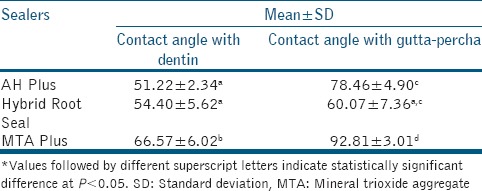
On dentin disk, the contact angle formed by Group D3 (66.57 ± 6.02) was significantly higher (P < 0.001) as compared to Group D1 (51.22 ± 2.34) and D2 (54.40 ± 5.62). The difference between Group D1 and D2 was statistically nonsignificant (P > 0.005).
Similarly, on gutta-percha surface, Group G1 (78.46 ± 4.90) and G2 (60.07 ± 7.36) showed a significantly lower value of contact angle as compared to Group G3 (92.81 ± 3.01). The difference between Groups G1 and G2 was statistically significant (P < 0.001).
The contact angle of sealers on gutta-percha was found higher as compared to dentin in all the groups. However, Hybrid Root Sealer showed a nonsignificant difference (P > 0.005).
DISCUSSION
The experimental procedure under which the present study was conducted has been found to be highly reliable in previous tested studies.[6] It has been seen that temperature and humidity influences contact angle, hence all the experimental procedures in this study had been performed under standard environmental conditions.[7,8] All the root canal sealers tested in the present study, that is, AH Plus, Hybrid Root Seal, and MTA Plus were manipulated conforming to the instructions provided by manufacturers. Controlled volume (0.1 mL) of each sealer was used as in previous studies have cited that any volumetric change can affect the contact angle.[7,9]
The dentin disks were polished by different grits of 400, 600, 800, and 1200 paper so as to impart a smooth surface as in the previous study; it has been seen that roughness influences contact angle.[10]
The contact angle can also be affected by the level of hydration,[11] hence to render the dentin surface sufficiently hydrated, the specimens were finally blot dried after rinsing with saline. Kim et al.[12] reported that irrigants like EDTA can influence the dentin surface tension, thus influencing the contact angle; however, we followed the irrigation protocol so as to simulate the clinical conditions. The irrigant used in the study, that is, NaOCl had been selected as it is the most frequently used irrigant for disinfection in root canal treatment. In addition, it also removes collagen resulting in dentine surfaces similar to that of etched enamel. An increase in wettability after NaOCl treatment has been observed as it causes deproteination leading to a hydrophilic surface.[10]
The mean contact angle for AH Plus in this study was 51.2° which was comparable to the study done by Kaushik et al.[13] where AH Plus exhibited a contact angle of 47.9°.
MTA Plus showed lesser wettability as compared to AH Plus and Hybrid Root Seal in both dentin and gutta-percha surfaces. The difference in the composition might have influenced the wettability outcome as MTA Plus is a calcium silicate-based sealer, whereas Hybrid Root Seal is a methacrylate resin-based sealer which has 4-META monomer in its composition, which in turn has a hydrophilic radical that bonds to dentine and a hydrophobic radical that bonds to the solid filling material.[14] According to Van Landuyt et al.,[15] the composition of this sealer shows attachment of two carboxylic groups to the aromatic group which produces an acidification leading to a demineralized surface which subsequently enhances wetting.
AH Plus is an epoxy resin-based sealer which although being hydrophobic exhibited superior wetting of root dentin surface when compared to Hybrid Root Seal, although the difference was statistically nonsignificant. The possible explanation may be due to the ability of AH Plus to penetrate into microirregularities due to its high creep capacity.[16] One of the reasons may be that EDTA exposes collagen fibers with low surface free energy by demineralizing the dentin surface, hence enhancing the spreading of these hydrophobic-like materials.[17,18] The higher pushout strength of AH Plus as compared to MTA Plus as shown by Sönmez et al.[16] also supports the result of the present study.
The contact angles of sealers on gutta-percha were seen to be higher as compared to dentin in all the groups. Gutta-percha being hydrophobic may have caused the sealer to pull away from gutta-percha surface on setting.[20] Dentin shows better wetting with all the sealers as compared to gutta-percha indicating that dentin exhibits a relatively higher surface free energy as compared to gutta-percha.
However, there were certain limitations in the study. A sealer may behave differently in the presence of pressure which is created during lateral or vertical compaction; however, no load had been applied while measuring the contact angle of the sealers in this study. Furthermore, the contact angle of the sealers had been measured for a single period only.
CONCLUSION
All the experimented sealers showed better wettability on dentin when compared to gutta-percha. Hybrid Root Seal and AH Plus have better wettability compared to MTA Plus on both dentin and gutta-percha.
Financial support and sponsorship
Nil.
Conflicts of interest
There are no conflicts of interest.
REFERENCES
- 1.Branstetter J, von Fraunhofer JA. The physical properties and sealing action of endodontic sealer cements: A review of the literature. J Endod. 1982;8:312–6. doi: 10.1016/S0099-2399(82)80280-X. [DOI] [PubMed] [Google Scholar]
- 2.Grossman LI. Endodontic Practice. 10th ed. Philadelphia: Henry Kimpton Publishers; 1981. p. 297. [Google Scholar]
- 3.Anusavice KJ, Shen C, Rawls HR. Philip′s Science of Dental Materials. 12th ed. St. Louis: Saunders, Elsevier; 2013. [Google Scholar]
- 4.de Assis DF, Prado Md, Simão RA. Evaluation of the interaction between endodontic sealers and dentin treated with different irrigant solutions. J Endod. 2011;37:1550–2. doi: 10.1016/j.joen.2011.08.014. [DOI] [PubMed] [Google Scholar]
- 5.Ballal NV, Tweeny A, Khechen K, Prabhu KN, Satyanarayan, Tay FR, et al. Wettability of root canal sealers on intraradicular dentine treated with different irrigating solutions. J Dent. 2013;41:556–60. doi: 10.1016/j.jdent.2013.04.005. [DOI] [PubMed] [Google Scholar]
- 6.de Jong HP, van Pelt AW, Arends J. Contact angle measurements on human enamel - an in vitro study of influence of pellicle and storage period. J Dent Res. 1982;61:11–3. doi: 10.1177/00220345820610010101. [DOI] [PubMed] [Google Scholar]
- 7.Kontakiotis EG, Tzanetakis GN, Loizides AL. A comparative study of contact angles of four different root canal sealers. J Endod. 2007;33:299–302. doi: 10.1016/j.joen.2006.11.016. [DOI] [PubMed] [Google Scholar]
- 8.Newmann AW. Contact angles and their temperature dependence. Adv Colloid Interface Sci. 1974;4:105–91. [Google Scholar]
- 9.Good RJ, Koo MN. The effect of drop size on contact angle. J Colloid Interface Sci. 1979;71:283–92. [Google Scholar]
- 10.Hu X, Ling J, Gao Y. Effects of irrigation solutions on dentin wettability and roughness. J Endod. 2010;36:1064–7. doi: 10.1016/j.joen.2010.03.007. [DOI] [PubMed] [Google Scholar]
- 11.Tummala M, Chandrasekhar V, Rashmi AS, Kundabala M, Ballal V. Assessment of the wetting behavior of three different root canal sealers on root canal dentin. J Conserv Dent. 2012;15:109–12. doi: 10.4103/0972-0707.94573. [DOI] [PMC free article] [PubMed] [Google Scholar]
- 12.Kim HJ, Park SJ, Park SH, Hwang YC, Yu MK, Min KS, et al. Efficacy of flowable gel-type EDTA at removing the smear layer and inorganic debris under manual dynamic activation. J Endod. 2013;39:910–4. doi: 10.1016/j.joen.2013.04.018. [DOI] [PubMed] [Google Scholar]
- 13.Kaushik M, Sheoran K, Reddy P, Roshni, Narwal P. Comparison of the effect of three different irrigants on the contact angle of an epoxy resin sealer with intraradicular dentin. Saudi Endod J. 2015;5:166–70. [Google Scholar]
- 14.Chang JC, Hurst TL, Hart DA. Estey AW 4-META use in dentistry: A literature review. J Prosthet Dent. 2002;87:216–24. doi: 10.1067/mpr.2002.121584. [DOI] [PubMed] [Google Scholar]
- 15.Van Landuyt KL, Snauwaert J, De Munck J, Peumans M, Yoshida Y, Poitevin A, et al. Systematic review of the chemical composition of contemporary dental adhesives. Biomaterials. 2007;28:3757–85. doi: 10.1016/j.biomaterials.2007.04.044. [DOI] [PubMed] [Google Scholar]
- 16.Chadha R, Taneja S, Kumar M, Sharma M. An in vitro comparative evaluation of fracture resistance of endodontically treated teeth obturated with different materials. Contemp Clin Dent. 2010;1:70–2. doi: 10.4103/0976-237X.68590. [DOI] [PMC free article] [PubMed] [Google Scholar]
- 17.Hashem AA, Ghoneim AG, Lutfy RA, Fouda MY. The effect of different irrigating solutions on bond strength of two root canal-filling systems. J Endod. 2009;35:537–40. doi: 10.1016/j.joen.2009.01.003. [DOI] [PubMed] [Google Scholar]
- 18.Zehnder M. Root canal irrigants. J Endod. 2006;32:389–98. doi: 10.1016/j.joen.2005.09.014. [DOI] [PubMed] [Google Scholar]
- 19.Sönmez IS, Sönmez D, Almaz ME. Evaluation of push-out bond strength of a new MTA-based sealer. Eur Arch Paediatr Dent. 2013;14:161–6. doi: 10.1007/s40368-013-0039-2. [DOI] [PubMed] [Google Scholar]
- 20.Hegde V, Arora S. Sealing ability of a novel hydrophilic vs.Conventional hydrophobic obturation systems: A bacterial leakage study. J Conserv Dent. 2015;18:62–5. doi: 10.4103/0972-0707.148898. [DOI] [PMC free article] [PubMed] [Google Scholar]
