



Abstract
The growth of hopper crystals is observed for many substances, but the mechanism of their formation remains ill understood. Here we investigate their growth by performing evaporation experiments on small volumes of salt solutions. We show that sodium chloride crystals that grow very fast from a highly supersaturated solution form a peculiar form of hopper crystal consisting of a series of connected miniature versions of the original cubic crystal. The transition between cubic and such hopper growth happens at a well-defined supersaturation where the growth rate of the cubic crystal reaches a maximum (∼6.5 ± 1.8 μm/s). Above this threshold, the growth rate varies as the third power of supersaturation, showing that a new mechanism, controlled by the maximum speed of surface integration of new molecules, induces the hopper growth of cubic crystals in cascade.
The beauty of snowflakes is partly due to the amazing variety of shapes they come in. Yet, the underlying crystalline structure of snow is always the same: the thermodynamic equilibrium shape is hexagonal. The variety of shapes is due to the kinetics of ice growth that is clearly more important in determining the snowflake shape than the equilibrium shape dictated by the crystal structure and surface energy. In nature, crystals generally are rarely found only in their equilibrium state; instead, many minerals and salts appear as clusters of interconnected crystalline regions known as hopper crystals. The latter results from an anisotropic growth in which the edges of a crystal grow faster than the centers of its faces.
The morphology of such hopper crystals is common to many substances and minerals, such as bismuth, quartz (called skeletal or fenster crystals), gold, calcite, and halite (NaCl). Also here, it is suspected that the kinetics of growth is an important factor in determining the overall shape, but so far, little fundamental work has been done to understand hopper crystal shapes. In general, the conditions under which crystal growth occurs, i.e., parameters such as supersaturation, volume, and homogeneity of the solution, remain largely unknown. Understanding how crystal shapes come about is nonetheless of considerable importance in applications such as weathering of rocks and historical monuments,1−3 pharmacology,4,5 glaciology, and for the food industry.6 For the latter, as crystal morphology dictates the dissolution speed of crystals, the control over the crystal structure is an important variable to consider as a strategy to reduce sodium intake while maintaining salt intensity and saltiness perception. Here, we study hopper crystals formed from solution crystallization of the most common salt on earth: sodium chloride (NaCl). Sodium chloride is a key factor in many industrial and geological processes, e.g., in the food industry, oil well drilling, CO2 sequestration, erosion of rocks, sodification of soils, and weathering of historical monuments. Equilibrium NaCl crystals are well-known to have a cubic shape because the underlying crystal lattice has a cubic close-packed (CCP) structure; however, both in nature and in laboratory experiments, hoppered shapes are often encountered (Figure 1). Most of the reported hopper forms of sodium chloride in the literature are hollow cubes or pyramid shapes,7−9 and very few experiments on skeletal hopper growth have been reported10−12 (Figure 1) .
Figure 1.

Different crystalline appearances of NaCl close to the metastability limit S ≈ 1.6 :(a) hollow pyramide in a droplet, (b) hollow cube in bulk, and (c) skeletal growth as interconnected cubes in small volumes.
Recently, it was reported that the metastability limit for the precipitation of NaCl from an aqueous salt solution is almost twice the saturation concentration.10,13 One of the striking consequences of this is that it appears to lead to the precipitation of a collection of interconnected cubes, a hopper form called “skeletal growth”. Because of the singular importance of the salt, its atomistic pathways of crystal nucleation14−17 and the subsequent kinetics of cubic growth of NaCl have been extensively investigated.18−26 Nonetheless, although hopper growth has been reported for different salts, little is known experimentally about the transition from cubic to hoppered growth.9,16,27
In this Letter, we report the primary nucleation and growth
of
NaCl crystals in small volumes at different supersaturations. We show
that there is a specific supersaturation above which the transition
from cubic to hopper growth is observed. We demonstrate experimentally
that this supersaturation corresponds to the maximum growth rate of
the cubic crystal and explain why above this concentration hopper
morphologies appear in the form of interconnected cubes. The experiments
are performed under controlled evaporation (T = 23
± 1 °C and RH = 50%) of small volumes (∼10–2–10–3 μL) of an initially undersaturated
NaCl solution (Sigma-Aldrich purity > 99.9%, at initial concentration m0 = 4.9 mol/kg) in microcapillaries (100–200
μm). The evaporation rate is measured by recording the displacement
of the two menisci of the entrapped salt solution using a CCD camera
connected to an optical microscope. The concentration at the moment
of precipitation is determined from the volume difference (V0 – Vt) between
the initially introduced volume (V0) and
the solution’s volume at the onset of crystallization (Vt). For each experiment, the supersaturation
at the onset of crystallization in the solution is defined as  , where mt and m0 are the molal concentrations when the crystal
precipitates and at equilibrium, respectively. We use small volumes
because the Peclet number (the ratio of advection due to the evaporative
flux and diffusion) is small and the bulk solution is therefore homogeneous:
in such small volumes, the Peclet number is on the order of 10–2 close to the meniscus.10
, where mt and m0 are the molal concentrations when the crystal
precipitates and at equilibrium, respectively. We use small volumes
because the Peclet number (the ratio of advection due to the evaporative
flux and diffusion) is small and the bulk solution is therefore homogeneous:
in such small volumes, the Peclet number is on the order of 10–2 close to the meniscus.10
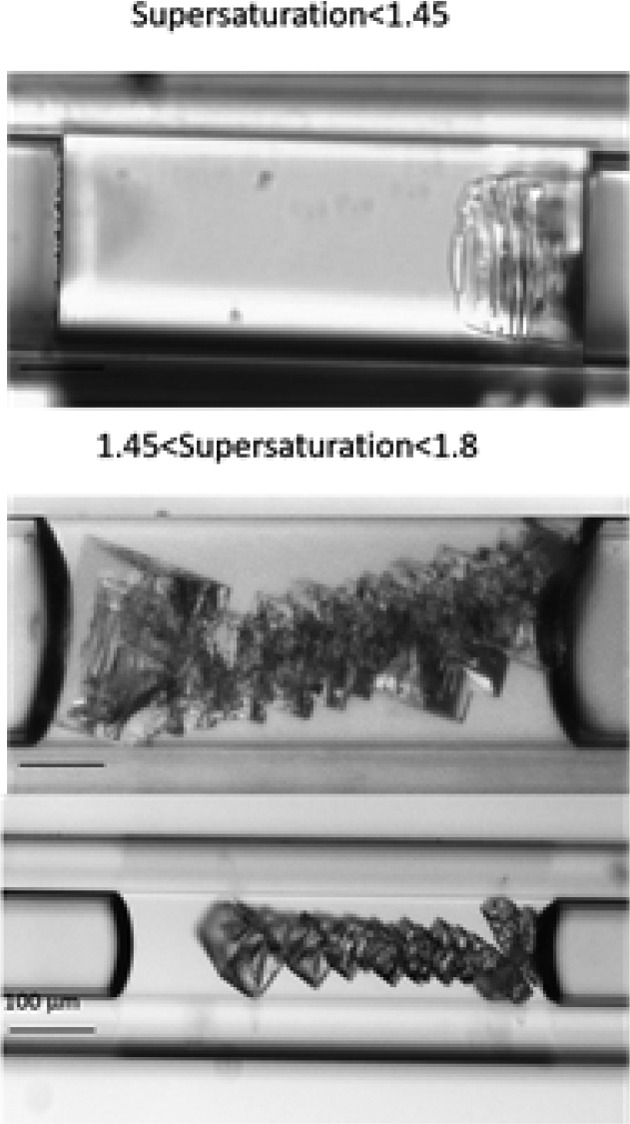
In all of our experiments, only one crystal was observed to precipitate; this is because the nucleation rate depends very steeply on the concentration,10 and in small volumes, the probability of the growth of other nuclei becomes very low.28 Due to the statistical nature of nucleation, the first formation of a crystal is observed for a range of supersaturations up to the metastability limit of 1.6 ± 0.2. The key observation is that for supersaturations of S < 1.45 we clearly see the growth of simple cubic crystals. These take a rectangular shape due to the confinement, i.e., walls of the microcapillary; the faces of the cube are crystallographically equivalent (1 0 0) faces. However, for supersaturations higher than S > 1.45 ± 0.05, hopper crystals rapidly appear in the form of a chain-like structure of cubic crystals: the higher the supersaturation at the onset of precipitation, the larger the number of interconnected cubic crystals and the number of branches of the hopper morphology (Figure 2).
Figure 2.

Top: NaCl crystallization at different supersaturations at the onset of crystal precipitation. (a) Sm = mt/m0 ≈ 1.35: cubic growth; (b) Sm ≈ 1.45: hopper growth with two connected cubes; (c) Sm ≈ 1.55: hopper growth with two branches of interconnected cubes; (d) Sm ≈ 1.65: hopper growth with four branches. Bottom: Measurement of the crystal growth (a) along one face for cubic crystals (LF) and (b) along the diagonal for one branch for hopper crystals (LD). (c) Hopper crystal with several branches.
To quantify the growth speed,
the size of growing crystals is measured
as a function of time. For the cubic crystals, the measurements are
done along one side (Figure 2). In the case of the hopper morphology, the growth of the
face of a single cubic unit is measured as well as the length of each
branch (LD) and total length (LT) by summing up the number of branches. As
can be observed in Figure 3, the hopper crystals grow with a rate that can be more than
10 times higher than that of the cubic crystal. For both forms, cubic
and hopper, the crystal length grows linearly with time near the onset
of precipitation (i.e., t < 20 s). The growth
of the crystal subsequently slows down due to the consumption of ions
and the concomitant decrease of the supersaturation in the surrounding
salt solution. The kinetics of growth is then limited by the arrival
of molecules from the bulk to the surface and is hence governed by
diffusion. This is evident from Figure 3, where we compare the growth kinetics to the expected  behavior when bulk diffusion
is the rate-limiting
step for crystal growth. As can be observed in Figure 3, the diffusive growth rate depends on the
shape of the crystal. However, a full theoretical treatment of this
difference is very difficult because it necessitates solving the Laplace
equation (for the diffusion) with the appropriate boundary conditions.
This is impossible if the boundary is of arbitrary shape and in addition
is moving except in some special cases; this is beyond the scope of
this paper. The agreement with simple diffusive dynamics is excellent
for all but the shortest times (t < 20 s). At
very short times, the growth is more rapid than predicted by simple
bulk diffusion, and hence, another mechanism must be at play.29 This is because at the onset of crystal precipitation
the supersaturation is high and consequently the transport of the
ions from the bulk to the crystal surface is not the limiting factor
for growth. It is rather the incorporation of molecules into the surface
of the critical nucleus that limits the growth at the early stage
of growth.
behavior when bulk diffusion
is the rate-limiting
step for crystal growth. As can be observed in Figure 3, the diffusive growth rate depends on the
shape of the crystal. However, a full theoretical treatment of this
difference is very difficult because it necessitates solving the Laplace
equation (for the diffusion) with the appropriate boundary conditions.
This is impossible if the boundary is of arbitrary shape and in addition
is moving except in some special cases; this is beyond the scope of
this paper. The agreement with simple diffusive dynamics is excellent
for all but the shortest times (t < 20 s). At
very short times, the growth is more rapid than predicted by simple
bulk diffusion, and hence, another mechanism must be at play.29 This is because at the onset of crystal precipitation
the supersaturation is high and consequently the transport of the
ions from the bulk to the crystal surface is not the limiting factor
for growth. It is rather the incorporation of molecules into the surface
of the critical nucleus that limits the growth at the early stage
of growth.
Figure 3.

Growth of NaCl crystals in time: (a) growth of the cubic crystal (LF, open circles) and (b) hopper growth (LT, red squares) as a function of the square root of time. The straight continuous lines indicate the diffusion-limited growth and describe the data well for times > 20 s. The inset shows the same data for short times in a linear plot. For times t < 20 s, the growth is linear in time with coefficients, (a) y = 6.2x, R2 = 0.958 and (b) y = 20x, R2 = 0.814.
For the cubic growth, looking at the initial growth behavior at t < 20 s, we find that it is characterized by a constant growth rate dLF/dt; this rate increases linearly with supersaturation up to Sm ≈ 1.45, but surprisingly, above this threshold, it reaches a maximum value of about 6.5 ± 1.8 μm/s (see Figure 4). This suggests that in the presence of a large excess of ions, the incorporation of ions into the growing crystal becomes the rate-limiting step. However, our results show that there is also a maximum speed with which this can happen; for the highest supersaturations, the growth rate in Figure 4a levels off. This coincides exactly with the onset of growth of the hopper morphology, suggesting that when the maximum growth speed of the cubic crystal is attained and the supersaturation is still very high the hopper crystals result from a change in growth mechanism.
Figure 4.

(a) Growth rates during the first 20 s after crystallization for separate experiments (black squares) as a function of relative supersaturation (Sm – 1) at the onset of precipitation. A linear fit (solid line) was made for relative supersaturations below 0.5, excluding the outlier data point at 7.3 μm/s. The gray zone represents the region of the maximum growth rate: for each decile starting from Sm – 1 ≥ 0.55, the average value is given (red diamonds) with its spread in relative supersaturation (min–max range) and the standard deviation of the growth rate. The gray zone corresponds to the average ± standard deviation (6.5 ± 1.8 μm/s) of the experiments at relative supersaturations above 0.5. (b) Arrhenius plot of the overall crystal growth coefficients. The error bars correspond to the spread in 1/T (min–max range) and the standard error in K.
The classical Burton–Cabreba–Frank (BCF) theory of crystal growth when the rate-limiting step for the growth of a crystal is the incorporation of molecules in the crystal lattice describes the experimental data in a satisfactory manner (see the SI). We therefore investigate the process for surface integration, which is given by the overall growth rate order g that characterizes how the growth rate depends on the supersaturation as30,31
 |
1 |
with K being the overall crystal growth coefficient. The linear behavior (g = 1) observed for Sm < 1.45 in Figure 4a confirms that indeed in this regime the growth of a cubic crystal is limited by the incorporation of ions into the crystal.
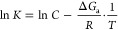
The overall growth rate coefficient K obtained from our experimental data is about 9.4 μm/s. The latter together with some measured K values for cubic growth reported in the literature (see the SI) is plotted in Figure 4b as a function of the inverse temperature to establish an Arrhenius behavior
 |
2 |
with C a constant and ΔGa the activation energy of the growth process. Our results obtained at much higher supersaturation are in line with those published for much lower concentrations ((10–4 < Sm – 1 < 10–2). The combined data yield an activation energy ΔGa of ∼21.5 ± 2.9 kJ/mol. Previously found activation energies are usually around 20 kJ/mol,32 very close to our finding.
We have also plotted the total growth rate of the hopper crystals dLT/dt as a function of the supersaturation for experiments where Sm – 1 > 0.45 (Figure 5). The results can be fitted with a power law with an exponent of 3 showing that the overall growth rate order in eq 1 is g = 3. This result underlines that above Sm > 1.45 the limiting step for the growth of NaCl crystals is the total amount of (cubic) surface area. Because cubic growth is limited by the incorporation of ions into the surface, in these range of supersaturation, the only way to incorporate more ions from the supersaturated solution is to create new surfaces by forming a chain of several cubic crystals making the hopper morphology; the edges of the first cubic nucleus point in three directions into a highly supersaturated solution, and they can grow faster than the flat centers of its faces. In this way, they will serve as a point for the secondary nucleation of a new cubic crystal with its maximum growth rate, which will result in the “staircase of crystals” observed in Figure 2; the higher the supersaturation, the larger the number of interconnected cubic crystals. This creates a lot of surface area, which is thermodynamically unfavorable. The hopper growth is thus a kinetic effect, induced by the very high supersaturations that makes that the crystals find other ways to grow than the simple cubic single crystal.
Figure 5.
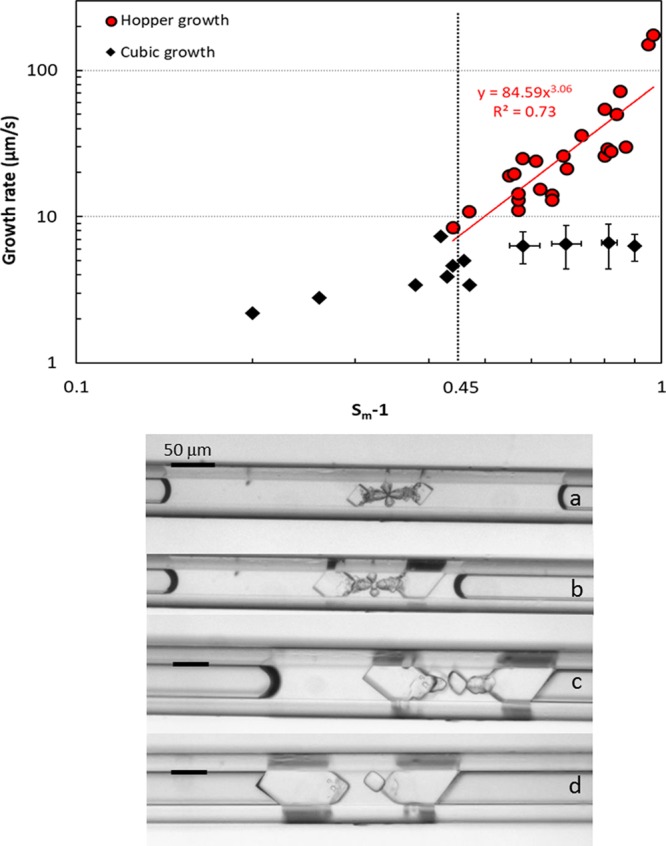
Top: Log–log plot of the growth rate of cubic and hopper crystals (dLT/dt) as a function of the supersaturation. The hopper morphology is observed for relative supersaturations Sm – 1 > 0.45. (Bottom) Evolution of Hopper morphology with time: (a) t = 10 s after precipitation at Sm ≈ 1.68; (b) t = 9 min; (c) t = 39 min; (d) t = 43 min.
Such sudden precipitation of interconnected cubes in small volumes leads to a sharp decrease of the local supersaturation, concomitant with the abrupt change of the growth rate measured for hopper branches (Figure 3). The kinetics of growth becomes then diffusion-limited, and if the volume of the surrounding salt solution is large enough to still supply the crystal with ions for a very long time, the hopper morphology will subsequently evolve toward the polyhedral growth of its extreme cubic units until complete evaporation (Figure 5).
In summary, we report on the mechanism of hopper formation of sodium choride crystals as skeletal growth of interconnected miniature cubes in controlled evaporation experiments of small volumes of salt solution up to its metastbility limit. Although such hopper growth has been reported for different salts, the mechanism behind hopper formation had not been elucidated experimentally before. We find a well-defined supersaturation at which the transition from cubic to hopper growth is observed: Sm ≈ 1.45 ± 0.05. This concentration corresponds to the point where the growth speed of the cubic crystal, which was increasing linearly with increasing supersaturation, reaches a maximum of ∼6.5 ± 1.8 μm/s. Up to this threshold, the mechanism of cubic growth is well described by BCF theory; by gathering the available growth rate parameters reported in the literature and combining with our data, an activation energy of 21.5 kJ/mole is found. Above this threshold, because cubic growth is limited by the incorporation of ions into the surface, the only way to incorporate more ions from the supersaturated solution is then to create new surfaces. Because the edges of the first cubic nucleus point in three directions into a highly supersaturated solution, they can grow faster than the flat centers of its faces. In this way, they will serve as a point for the secondary nucleation of a new cubic crystal. The dynamics of hopper growth then shows up as an assembly of interconnected cubes leading to rapid consumption of the supersaturation in a very short time. The overall growth rate order of the hopper morphology is found to be 3, confirming the surface-integration control of the process. Understanding the growth mechanisms of crystals and the importance of parameters such as the volume and supersaturation helps to gain better control over the crystal structure and can have a significant impact on wide range of applications.
Acknowledgments
This research was supported partly by The Netherlands Organisation for scientific research (NWO).
Supporting Information Available
The Supporting Information is available free of charge on the ACS Publications website at DOI: 10.1021/acs.jpclett.8b01082.
Supersaturation definition, analysis of the literature data on the overall growth rate coefficient K, and classical Burton–Cabrera–Frank (BCF) theory of crystal growth (PDF)
Author Present Address
§ J.D.: Getty Conservation Institute, 1200 Getty Center Drive, Suite 700, Los Angeles, California 90049, U.S.A.
Author Contributions
# J.D. and H.D. contributed equally.
The authors declare no competing financial interest.
Supplementary Material
References
- Desarnaud J.; Bonn D.; Shahidzadeh N. The Pressure Induced by Salt Crystallization in Confinement. Sci. Rep. 2016, 6, 30856. 10.1038/srep30856. [DOI] [PMC free article] [PubMed] [Google Scholar]
- Desarnaud J.; Derluyn H.; Molari L.; de Miranda S.; Cnudde V.; Shahidzadeh N. Drying of Salt Contaminated Porous Media: Effect of Primary and Secondary Nucleation. J. Appl. Phys. 2015, 118 (11), 114901. 10.1063/1.4930292. [DOI] [Google Scholar]
- Shahidzadeh-Bonn N.; Desarnaud J.; Bertrand F.; Chateau X.; Bonn D. Damage in Porous Media Due to Salt Crystallization. Phys. Rev. E 2010, 81 (6), 1–6. 10.1103/PhysRevE.81.066110. [DOI] [PubMed] [Google Scholar]
- Braga D.; Grepioni F.; Maini L.; Polito M.. Crystal Polymorphism and Multiple Crystal Forms. In Molecular Networks. Structure and Bonding; Hosseini M., Ed.; Springer: Berlin, Heidelberg, 2009; Vol. 132, pp 87–95. [Google Scholar]
- Rasenack N.; Müller B. W. Crystal Habit and Tableting Behavior. Int. J. Pharm. 2002, 244, 45–57. 10.1016/S0378-5173(02)00296-X. [DOI] [PubMed] [Google Scholar]
- Quilaqueo M.; Duizer L.; Aguilera J. M. The Morphology of Salt Crystals Affects the Perception of Saltiness. Food Res. Int. 2015, 76, 675–681. 10.1016/j.foodres.2015.07.004. [DOI] [PubMed] [Google Scholar]
- Zhang J.; Zhang S.; Wang Z.; Zhang Z.; Wang S.; Wang S. Hopper-like Single Crystals of Sodium Chloride Grown at the Interface of Metastable Water Droplets. Angew. Chem., Int. Ed. 2011, 50 (27), 6044–6047. 10.1002/anie.201101704. [DOI] [PubMed] [Google Scholar]
- Fontana P.; Pettit D.; Cristoforetti S. Sodium Chloride Crystallization from Thin Liquid Sheets, Thick Layers, and Sessile Drops in Microgravity. J. Cryst. Growth 2015, 428, 80–85. 10.1016/j.jcrysgro.2015.07.026. [DOI] [Google Scholar]
- Fontana P.Die Vielfalt Der Salzkristalle; R + A Print, 2013. [Google Scholar]
- Desarnaud J.; Derluyn H.; Carmeliet J.; Bonn D.; Shahidzadeh N. Metastability Limit for the Nucleation of NaCl Crystals in Confinement. J. Phys. Chem. Lett. 2014, 5, 890–895. 10.1021/jz500090x. [DOI] [PubMed] [Google Scholar]
- Shahidzadeh N.; Schut M. F. L.; Desarnaud J.; Prat M.; Bonn D. Salt Stains from Evaporating Droplets. Sci. Rep. 2015, 5, 10335. 10.1038/srep10335. [DOI] [PMC free article] [PubMed] [Google Scholar]
- Qazi M. J.; Liefferink R. W.; Schlegel S. J.; Backus E. H. G.; Bonn D.; Shahidzadeh N. Influence of Surfactants on Sodium Chloride Crystallization in Confinement. Langmuir 2017, 33 (17), 4260–4268. 10.1021/acs.langmuir.7b00244. [DOI] [PMC free article] [PubMed] [Google Scholar]
- Naillon A.; Duru P.; Marcoux M.; Prat M. Evaporation with Sodium Chloride Crystallization in a Capillary Tube. J. Cryst. Growth 2015, 422, 52–61. 10.1016/j.jcrysgro.2015.04.010. [DOI] [Google Scholar]
- Zahn D. Atomistic Mechanism of NaCl Nucleation from an Aqueous Solution. Phys. Rev. Lett. 2004, 92 (4), 1–4. 10.1103/PhysRevLett.92.040801. [DOI] [PubMed] [Google Scholar]
- Mucha M.; Jungwirth P. Salt Crystallization from an Evaporating Aqueous Solution by Molecular Dynamics Simulations. J. Phys. Chem. B 2003, 107 (33), 8271–8274. 10.1021/jp034461t. [DOI] [Google Scholar]
- Chakraborty D.; Patey G. N. How Crystals Nucleate and Grow in Aqueous NaCl Solution. J. Phys. Chem. Lett. 2013, 4, 573–578. 10.1021/jz302065w. [DOI] [PubMed] [Google Scholar]
- Chakraborty D.; Patey G. N. Evidence That Crystal Nucleation in Aqueous NaCl Solution Occurs by the Two-Step Mechanism. Chem. Phys. Lett. 2013, 587, 25–29. 10.1016/j.cplett.2013.09.054. [DOI] [Google Scholar]
- Rumford F.; Bain J. The Controlled Crystallization of Sodium Chloride. Trans. Inst. Chem. Eng. 1960, 38, 10–20. [Google Scholar]
- Sunagawa I.; Tsukamoto K. Growth Spirals on NaCl and KCl Crystals Grown from Solution. J. Cryst. Growth 1972, 15, 73–78. 10.1016/0022-0248(72)90322-3. [DOI] [Google Scholar]
- Scrutton A.; Grootscholten P. A. M. A Study on the Dissolution and Growth of Sodium Chloride Crystals. Trans. Inst. Chem. Eng. 1981, 59, 238–246. [Google Scholar]
- Ulrich J.; Mohameed H.; Zhang S.-B.; Yuan J.-J. Effect of Additives on the Crystal Growth Rates: Case Study NaCl. Bull. Soc. Sea Water Sci. Japan 1997, 51 (2), 73–77. [Google Scholar]
- Kubota N.; Otosaka H.; Doki N.; Yokota M.; Sato A. Effect of Lead(II) Impurity on the Growth of Sodium Chloride Crystals. J. Cryst. Growth 2000, 220, 135–139. 10.1016/S0022-0248(00)00772-7. [DOI] [Google Scholar]
- Al-Jibbouri S.; Ulrich J. The Growth and Dissolution of Sodium Chloride in a Fluidized Bed Crystallizer. J. Cryst. Growth 2002, 234, 237–246. 10.1016/S0022-0248(01)01656-6. [DOI] [Google Scholar]
- Linnikov O. D. Spontaneous Crystallization of Sodium Chloride from Aqueous-Ethanol Solutions. Part 1: Kinetics and Mechanism of the Crystallization Process. Cryst. Res. Technol. 2006, 41 (1), 10–17. 10.1002/crat.200410522. [DOI] [Google Scholar]
- Zhao J.; Miao H.; Duan L.; Kang Q.; He L. The Mass Transfer Process and the Growth Rate of NaCl Crystal Growth by Evaporation Based on Temporal Phase Evaluation. Opt. Lasers Eng. 2012, 50 (4), 540–546. 10.1016/j.optlaseng.2011.07.013. [DOI] [Google Scholar]
- Ulrich J.; Kruse M.; Stepanski M.. On The Growth Behaviour of NaCl Crystals With and Without Additives. In Seventh Symposium on Salt; Elsevier Science Publishers B.V.: Amsterdam, The Netherlands, 1993; Vol. II, pp 209–212. [Google Scholar]
- Okada I.; Namiki Y.; Uchida H.; Aizawa M.; Itatani K. MD Simulation of Crystal Growth of NaCl from Its Supersaturated Aqueous Solution. J. Mol. Liq. 2005, 118, 131–139. 10.1016/j.molliq.2004.07.028. [DOI] [Google Scholar]
- Grossier R.; Veesler S. Reaching One Single and Stable Critical Cluster through Finite-Sized Systems. Cryst. Growth Des. 2009, 9 (4), 1917–1922. 10.1021/cg801165b. [DOI] [Google Scholar]
- Naillon A.; Joseph P.; Prat M. Sodium Chloride Precipitation Reaction Coefficient from Crystallization Experiment in a Microfluidic Device. J. Cryst. Growth 2017, 463, 201–210. 10.1016/j.jcrysgro.2017.01.058. [DOI] [Google Scholar]
- Nielsen A. E.; Toft J. M. Electrolyte Crystal Growth Kinetics. J. Cryst. Growth 1984, 67, 278–288. 10.1016/0022-0248(84)90188-X. [DOI] [Google Scholar]
- Nielsen A. E. Electrolyte Crystal Growth Mechanisms. J. Cryst. Growth 1984, 67, 289–310. 10.1016/0022-0248(84)90189-1. [DOI] [Google Scholar]
- Mullin J. W.Crystallization, 4th ed.; Butterworth-Heinemann: Oxford, 2001. [Google Scholar]
Associated Data
This section collects any data citations, data availability statements, or supplementary materials included in this article.