



Abstract
Objective
Prior studies suggest the initial Emergency Department (ED) lactate concentration may be an important prognostic indicator for in-hospital mortality from acute drug poisoning. We conducted this cohort study to formally validate the prognostic utility of the initial lactate concentration in a larger, distinct patient population with acute drug overdose.
Methods
This observational, prospective, cohort study was conducted over 5-years at two urban teaching hospitals. Consecutive adult ED patients with acute drug overdose had serum lactate drawn as part of clinical care. The primary outcome was inpatient fatality. Receiver operating characteristics (ROC) were plotted to determine optimal cutpoints, test characteristics, area under the curve (AUC), odds ratios (OR), and 95% confidence intervals (CI).
Results
Of 3739 patients screened, 1406 patients were analyzed (56% female, mean age 43.1 years)and 24 died (1.7%). The difference in mean initial lactate concentration was 5.9 mmol/L (CI 3.4–8.1) higher in fatalities compared to survivors. The AUC for prediction of fatality was 0.85 (CI 0.73–0.95). The optimal lactate cutpoint for fatality was ≥5.0 (OR 34.2, CI 13.7–84.2, 94.7% specificity). Drug classes for which lactate had the highest utility were salicylates, sympathomimetics, acetaminophen, and opioids (all AUC ≥0.97); lowest utility was for diuretics and ACE inhibitors.
Conclusions
Initial lactate concentration is a useful biomarker for early clinical decision-making in ED patients with acute drug overdose. Studies of lactate-tailored management for these patient populations are warranted.
Keywords: drug overdose, fatality, poisoning, lactate, biomarker
Introduction
Importance
Drug poisoning has been the leading cause of injury-related fatality in the U.S. since 2008.1 For the first time ever, drug overdose deaths surpassed 50,000 in a single year in 2015.2 There were over 2.7 million exposures reported to Poison Centers in the U.S. in 2016,3 which substantially underestimates the true exposure prevalence.4 Thus clinical research on drug overdose screening and assessment is necessary to curtail the rising drug overdose epidemic, especially in frontline health care settings such as the emergency department (ED). There are currently no existing vital sign parameters or clinical risk scores proven to predict in-hospital mortality in poisoned patients. Recently, it was shown that cardiac biomarkers may predict overdose mortality;5 however, only a limited subset of this population are routinely tested with such biomarkers.
Background
Lactate is a metabolic byproduct of anaerobic metabolism and is therefore is produced by most tissues in the human body. Lactate is rapidly cleared by the liver with some additional clearance by the kidneys under normal conditions.6 Elevated concentrations of serum lactate occur in conditions that cause tissue hypoxia/hypoperfusion (type A) as well as other pathophysiologic conditions (type B) not related to tissue hypoxia. Regardless of the etiology of elevated serum lactate concentration, it is a useful prognostic indicator in a variety of clinical circumstances.7–10 However, there are conflicting reports about the utility of lactate specifically in the setting of acute drug overdose,11–12 which leaves the prognostic indicator utility of lactate an open question. Furthermore, there are no current guidelines for the use of lactate-tailored therapy to guide management of poisoned patients. We conducted a longitudinal analysis on a larger distinct sample of patients to formally confirm and validate the prognostic utility of the initial lactate concentration in patients with acute drug overdose.
Goals of this Investigation
We aimed to assess the prognostic utility for the initial serum lactate concentration to predict inpatient mortality in ED patients with acute drug overdose. We anticipated that precise cutpoints would have clinical utility to provide high predictive value for in-hospital mortality. Furthermore, we hypothesized that initial serum lactate concentration would be significantly higher in fatalities, and would have variable utility with different optimal cutpoints for specific drug classes.
Materials and Methods
Study Design and Setting
This observational, prospective, cohort study was performed over 5-years (2009–13) at two urban teaching hospitals. The EDs at these hospitals have a combined annual visit volume in excess of 150,000 and are staffed 24 hours per day with board certified emergency physicians and intensivists. The study protocol was approved by the Institutional Review Board for all participating institutions with a waiver of informed consent.
Selection of Participants
The study population was consecutive adults who present to the ED with acute drug overdose. The screening, inclusion, and exclusion criteria are previously described.13–14 Briefly, patients were included who met both of the following criteria: (A) acute presentation (within 24 hours of exposure); and (B) suspected overdose (i.e., drug dose sufficient to cause symptoms or any prescription drug exposure greater than its therapeutic dose). Exclusion criteria were the following: alternative diagnosis (e.g., trauma or infection), chronic presentation (i.e., not meeting acute criteria above), non-drug overdose (e.g., plant), exposures limited to dermal or inhalational routes only (i.e., trivial exposures), prisoners, age <18 years, anaphylaxis, patients with incomplete data (i.e., left against medical advice, transferred to an outside institution, or otherwise eloped from the hospital), pre-hospital cardiac arrest, and patients with do-not-resuscitate orders. Furthermore, patients without lactate data (i.e., for whom clinicians did not draw serum lactate as part of routine care) were excluded from data analysis.
Measurements
Data collection from the medical chart occurred in accordance with accepted guidelines for valid medical chart abstraction, including training of abstractors blinded to study objectives and formal interrater reliability of a random sampling of ten test charts prior to mass data abstraction (initial ED lactate concentration and in-hospital mortality assessed, 100% agreement, Cohen’s ĸ=1.0).15 Clinical data included demographics, drug exposures involved in overdose, vasopressor administration in-hospital, and initial serum bicarbonate concentration, all of which were obtained from medical records and de-identified. Serum toxicology (acetaminophen, salicylate, ethanol, and rarely, selected drug concentrations on an individual basis) and urine toxicology screens (most commonly included cannabinoids, amphetamines, opioids, benzodiazepines, cocaine metabolite, barbiturates, phencyclidine, tricyclics) were performed according to clinician judgment as part of routine clinical management. In addition, exposures were separated into clinically relevant drug classes by two of the authors (initials blinded) with board certification in medical toxicology. Of note, beta adrenergic antagonists and Ca-channel blockers were consolidated for lactate analysis since the prognosis, antidotal therapy, and lactate pathophysiology are essentially the same for these two groups.
A venous serum lactate concentration was drawn at the bedside for all control patients. The decision to measure serum lactate concentration was made at the discretion of the treating physician as part of clinical care, and results were readily available to the clinicians in real-time. Only the initial ED lactate concentration was used in the analysis for ROC analysis; as such, subsequent lactate concentrations even if changed or abnormal were not included in the analysis. Serum was analyzed using ampero-metric electrodes with enzymatic membranes, and run using Radiometer ABLTM 700 analyzers. According to the manufacturer, the range of normal values for venous serum lactate concentration is 1.0–2.5 mmol/L.
Outcomes
The primary outcome was in-hospital (i.e., ED or inpatient) all-cause fatality. As outlined above, patients with do-not-resuscitate orders were excluded from analysis. The secondary outcome was the occurrence of shock, defined as treatment with vasopressors (i.e., not defined by vital signs) at any point during the ED or hospital stay.
Study Protocol
The study protocol was previously described.13–14 Briefly, subjects were prospectively followed to hospital discharge with data collection from included electronic medical records, paper medical records, and consult records. Hospital medical record follow-up for all patients was performed by research assistants trained in medical abstraction and recorded using standardized data collection forms according to established guidelines.15 Results (from electronic physician notes, laboratory records, and discharge summaries) were prospectively available to the study investigators. Patients discharged from the hospital had no further follow-up.
Analysis
Sample size was fixed a priori based on prior enrollment of the parent studies.13–15 Receiver operating characteristics (ROC) were plotted to determine optimal lactate cutpoints along with test characteristics (sensitivity/specificity), area under the curve (AUC), odds ratios (OR), and 95% confidence intervals (CI). The AUC of the ROC curve reflects the overall accuracy and the separation performance of lactate as a biomarker, and can be readily used to compare different biomarker combinations or models. When appropriate, chi-squared (with two-tailed Fisher’s exact test when appropriate) and t-test were calculated for categorical and continuous variables, respectively, with 5% alpha (2-tailed). Collinearity between bicarbonate and lactate was assessed using the variance inflation factor (VIF) with a cutoff >5 signaling multicollinearity. Sensitivity analysis of only single drug exposures was performed in which medians and interquartile range of lactates was compared. All statistical analysis was performed using SPSS version 22.0 software (IBM, Chicago, IL).
Results
Characteristics of Study Patients
Of 3739 patients screened, 2333 met exclusion criteria, leaving 1406 patients for analysis. Patients were excluded for the following reasons: missing lactate (1487), children <18 years (376), missing outcomes (278), alternate diagnoses (141), non-drugs (37), prehospital cardiac arrest (14). Patients were predominantly female (56%) with mean age 43.1 years; 58.2% White, 19.8% Black, 6.5% Asian, and 15.5% other; ethnically, patients were 28.9% Latino/Hispanic. In the 1406 patients who were analyzed, the primary outcome occurred in 24 (1.7%), and the secondary outcome in 54 (3.9%). Of 1487 patients with missing lactate data, there were 2 (0.13%) primary outcomes and 4 (0.26%) secondary outcomes.
Main Results
Out of 1406 patients analyzed, there were 24 fatalities (1.7%). Mean (SE) initial lactate concentration (mmol/L) was 2.31 (0.09) overall, 8.1 (1.6) in fatalities and 2.21 (0.08) for survivors (t-test p<0.001). The AUC for prediction of fatality was 0.85 (CI 0.73–0.97). The optimal lactate concentration cutpoint for fatality was 5.0 mmol/L (OR 34.2, CI 13.7–84.2), which was 70.8% sensitive (CI 69–73) and 94.7% specific (CI 93–96); the optimal cutpoint for the occurrence of both primary and secondary outcomes combined (i.e., shock or death) was 2.7 mmol/L (OR 7.9, CI 4.5–13.9). An initial lactate concentration of 7.5 mmol/L or greater had 23.8% positive predictive value (CI 14–36) and <2.0 mmol/L had 99.5% negative predictive value (CI 98.8–99.9). Table 1 outlines the drug exposures and lactates of all 24 deaths.
Table 1.
Drug exposures and initial lactate in 24 fatalities.
| Fatality* | Decade of Life** | Sex | Lactate (mmol/L) | Drug Exposures | Days† |
|---|---|---|---|---|---|
| A | 2 | F | 21.0 | Flurazepam, diazepam, marijuana, escitalopram | 1 |
| B | 7+ | F | 18.3 | Nifedipine | 1 |
| C | 6 | F | 18.1 | Digoxin | 3 |
| D | 3 | F | 15.2 | APAP, hydromorphone, Ibuprofen, pregabalin, benzodiazepines | 5 |
| E | 3 | F | 10.3 | Oxycodone, APAP, ethanol | 8 |
| F | 5 | F | 9.9 | Cocaine, heroin, methadone | 2 |
| G | 7+ | M | 9.8 | Cocaine, benzodiazepines | 5 |
| H | 5 | M | 9.7 | Methadone, oxycodone, trazodone, benzodiazepines | 2 |
| I | 6 | M | 9.4 | Methadone | 2 |
| J | 2 | M | 9.2 | Desomorphine, isopropanol, ethanol | 1 |
| K | 5 | M | 8.9 | Ethanol, benzodiazepines | 9 |
| L | 2 | F | 8.6 | Diltiazem | 1 |
| M | 3 | M | 7.9 | Heroin, cocaine, labetalol | 22 |
| N | 7+ | M | 7.7 | Bicalutimide, cilostazol, digoxin, salicylates | 18 |
| O | 7+ | F | 7.5 | Diltiazem, atenolol | 6 |
| P | 7+ | F | 6.2 | APAP, ethanol, unknown pills | 5 |
| Q | 6 | F | 5.0 | Digoxin | 3 |
| R | 4 | F | 3.2 | Oxycodone, benzodiazepines | 71 |
| S | 5 | M | 3.1 | Valproic acid, escitalopram, sertraline, quetiapine | 5 |
| T | 7+ | M | 2.5 | Metoprolol, hydrochlorothiazide, digoxin | 9 |
| U | 3 | M | 1.9 | Unknown pills | 53 |
| V | 6 | F | 1.2 | Nortriptyline, amlodipine, clonazepam, paroxetine, hydrochlorothiazide | 1 |
| W | 7+ | F | 0.9 | Amlodipine, carvedilol, olmesartan, ezetimibe | 14 |
| X | 7+ | F | 0.3 | Lorazepam, ethanol | 7 |
Fatalities organized in descending order of initial lactate measurement.
Decade of life >7 was grouped as 7+ to preserve patient confidentiality.
Hospital day death occurred with date of ED presentation defined as hospital day 1. Abbreviations: APAP = acetaminophen; mmol/L = millimoles per liter.
Drug Class Analysis
Of 1406 patients analyzed, 715 (51%) had some type of positive drug screen as confirmation of exposure. There were three drug classes that were significantly associated with fatality, in descending order of incidence: digoxin (21.1%, OR 18.2, p<0.001); diuretics (16.7%, OR 12.4; p=0.017), and beta adrenergic antagonists and calcium-channel blockers combined (11.9%, OR 10.5, p<0.001). The highest utility for prediction of fatality by the initial lactate concentration occurred in these drug classes: salicylates (AUC=0.98, CI 0.90–1.0, cutpoint=6.0), sympathomimetics (AUC=0.98, CI 0.95–0.99, cutpoint=7.8), acetaminophen (AUC=0.98, CI 0.95–1.0, cutpoint=10.0), opioids (AUC=0.97, CI 0.94–0.99, cutpoint=3.1), digoxin (AUC=0.92, CI 0.78–1.0, cutpoint=2.4), anti-convulsants (AUC=0.91, CI 0.76–1.0, cutpoint=3.0); lactate concentration had lowest utility for beta adrenergic antagonists and Ca-channel blockers (AUC=0.73, CI 0.49–0.97, cutpoint=7.1), diuretics (AUC=0.55, CI 0.20–0.89, cutpoint=1.1), and ACE inhibitors (AUC=0.16, CI 0.01–0.31, cutpoint=0.9). Performing separate analyses for beta adrenergic antagonists (mean lactate difference 2.36, p=NS) and Ca-channel blockers (mean lactate difference 4.01, p=NS) separately did not improve utility of lactate in either group (AUC 0.71 and 0.66, respectively). The utility of a lactate concentration could not be assessed for the following drug classes due to absence of deaths in the cohort: lithium, metformin, and statin drugs. The full drug class analysis of the prognostic utility of initial lactate concentration for overdose fatality is summarized in Table 2. A sensitivity analysis of lactate utility among 377 single drug overdoses is included in the Supplementary Table.
Table 2.
Prognostic Utility of The Initial Lactate Concentration for Overdose Fatality, Based on Drug Class
| Drug Class† | AUC* (CI) | Cutpoint Sensitivity (CI) | Cutpoint Specificity (CI) | Optimal Cutpoint** (mmol/L) | N (death/total) |
|---|---|---|---|---|---|
|
| |||||
| Acetaminophen | 0.98 (0.95–1.0) |
100 (29–100) |
95.3 (90–98) |
10.0 | 3/131 |
| Salicylates | 0.98 (0.90–1.0) |
100 (3–100) |
96.7 (83–100) |
6.0 | 1/31 |
| Sympathomimetics | 0.98 (0.95–0.99) |
100 (29–100) |
96.3 (94–98) |
7.8 | 3/381 |
| Opioids | 0.97 (0.94–0.99) |
100 (63–100) |
86.5 (81–88) |
3.1 | 8/392 |
| Digoxin/Cardioactive Steroids | 0.92 (0.78–1.0) |
100 (40–100) |
86.7 (66–100) |
2.4 | 4/19 |
| Anticonvulsants | 0.91 (0.76–1.0) |
100 (16–100) |
80.4 (69–87) |
3.0 | 2/94 |
| Antipsychotics | 0.83 (0.77–0.90) |
100 (3–100) |
83.2 (76–89) |
3.0 | 1/132 |
| Antidepressants | 0.79 (0.52–1.0) |
75 (19–99) |
80.9 (72–86) |
3.0 | 4/140 |
| Benzodiazepines | 0.78 (0.53–1.0) |
62.5 (24–91) |
98.5 (97–100) |
8.7 | 8/348 |
| BB/CCB | 0.73 (0.49–0.97) |
57.1 (16–84) |
94.2 (84–99) |
7.1 | 7/59 |
| Diuretics | 0.55 (0.20–0.89) |
100 (16–100) |
40.0 (12–74) |
1.1 | 2/12 |
| ACE inhibitor or ARB | 0.16 (0.01–0.31) |
100 (3–100) |
12.0 (3–31) |
0.9 | 1/26 |
| Total Combined | 0.85 | 70.8 | 93.3 | 5.0 | 24/1406§ |
Drug class is arranged in descending order of AUC. Clinically relevant drug classes were determined by two board-certified medical toxicologists. Drug classes without any primary outcomes (e.g., biguanides/metformin, lithium, statins) are not listed.
Based on ROC analysis
Defined by the Youden Index as the concentration that maximizes the sum of sensitivity plus specificity.26
Column totals add up to much greater than 1406 due to drug class co-exposures
Abbreviations: ACE = angiotensin converting enzyme; ARB = angiotensin receptor blocker; AUC = area under the curve; BB/CCB = Beta Adrenergic Antagonists and Ca-channel blockers; Ca = calcium; mmol/L = millimoles per liter; N = number
Secondary Outcome
The incidence of shock was 3.9% (N=54) in the cohort. There were 3 drug classes significantly associated with development of shock, in descending order of incidence: digoxin (36.8%, OR 16.6, p<0.001), diuretics (33%, OR 13.4, p<0.001), and beta adrenergic antagonists or calcium-channel blockers (27.1%, OR 12.8, p<0.001). Sympathomimetics had a significant association with lower incidence of shock (1.6%, OR 0.33, p<0.01). The mean lactate concentration was significantly higher in patients who developed shock (6.6 vs. 2.3, t-test p<0.001). The AUC overall for lactate to predict occurrence of shock was 0.77. Test characteristics of an abnormal lactate concentration (defined as >2.5 mmol/L) was 68.5% sensitive, 76.3% specific, and an initial lactate concentration >5.0 mmol/L was 46.3% sensitive, 93.9% specific.
Bicarbonate vs. Lactate Sub-Analysis
To determine the relative prognostic value of lactate versus the serum bicarbonate, a more routinely ordered laboratory test, we compared the AUC and diagnostic test characteristics for the initial bicarbonate vs. the initial lactate. The AUC for bicarbonate (0.83, CI 0.73–0.94) was lower than that of lactate, and the optimal bicarbonate cutpoint (≥ 22.9 mmol/L) based on ROC analysis was less specific (78.3%) than that of lactate (94.7%). In addition, post-hoc testing for collinearity between lactate and bicarbonate was negative (VIF <5).
Limitations
Many patients were excluded due to absence of an ED serum lactate concentration, which may have biased the lactate cutpoint data; however, this would probably bias towards the null hypothesis since clinicians are typically more likely to draw lactate in more severely ill patients. Another consideration is the study setting, as the study was performed at two urban tertiary referral centers in a single region. The bicarbonate subgroup analysis may be limited if laboratory testing measures bicarbonate as a calculated value from the Henderson-Hasselbalch equation, rather than the true serum bicarbonate concentration via photometric enzymatic method with measurement of the rate reaction; however, given the value used in this study was generally used by the clinician, it probably represents the real world scenario. From a statistical standpoint, the infrequency of the primary outcome may have inflated the calculated specificities and AUCs. And finally, time to the obtaining serum lactate concentration was not recorded, which may limit interpretation of our data.
Discussion
In this large prospective validation cohort of patients with acute drug overdose, we found that the initial ED lactate concentration had excellent prognostic utility for the in-hospital occurrence of both shock and fatality. The optimal lactate cutpoint for fatality was 5.0 mmol/L, which may allow lactate to be used as a biomarker for early decision-making in ED patients with acute drug overdose even if specific drug exposures are unknown. Additionally, prognostic utility of lactate was highly drug specific such that in cases with known exposures, drug-specific lactate cut points were calculated and should be used. Drug classes for which lactate had the highest prognostic utility (i.e., highest area under the ROC curve) were salicylates, sympathomimetics, acetaminophen, and opioids. Conversely, lactate had minimal-to-no utility for drug overdoses involving beta adrenergic antagonist and calcium-channel blockers, diuretics, and ACE inhibitors.
This study successfully validates our previous report that the initial ED lactate concentration has prognostic utility for in-hospital mortality from acute drug poisoning. In that retrospective case-control study, the optimal lactate cutpoint was 3.0 mmol/L (84% sensitivity, 75% specificity), which conferred a 15.8-fold increase in odds of fatality.11 However, the previous study was limited by smaller sample size, validity of poison center telephone data collection, and inability to perform drug class subgroup analysis.
To our knowledge, no previous study has specifically shown the prognostic utility of lactate in the setting of drug poisoning from either opioid or sympathomimetic drug overdose. The association of hyperlactatemia and acidosis with sympathomimetic poisoning likely represents a pathophysiologic response to catecholamines, which may be similar to that during exercise and therapeutic infusion in shock states,16–17 and likely reflects the transition from oxidative to partially anaerobic metabolism. Similarly, hyperlactatemia in the setting of opioid poisoning may represent Type A hyperlactatemia due to tissue hypoxia and subsequent anaerobic metabolism. Patients with opioid or sympathomimetic poisoning may have added prognostic utility with a lactate concentration sent as part of the routine ED workup to aid medical decision making.
These data are consistent with prior studies examining the utility of lactate as a biomarker for the management of beta adrenergic antagonist poisoning. It was previously shown in beta adrenergic antagonist poisoning that lactate concentration rises only modestly despite the presence of significant hypotension and shock on admission. Mégarbane et al. found that 4 of 9 patients with fatal beta adrenergic antagonist poisoning had lactate concentrations below 3.0 mmol/L.12 Similarly, in the present study, beta adrenergic antagonist poisoning was significantly associated with shock and fatality; however, the prognostic utility of the lactate concentration was poor for both beta adrenergic antagonist and calcium channel blockers. However, in the sensitivity analysis (Supplementary Table) there was clearly elevated lactate in deaths (median 13.3, IQR 8.6–13.3) compared with survivors (median 1.5, IQR 0.8–2.8). Thus, the initial lactate concentration may still be useful for clinical decision making to guide therapy of patients with isolated beta adrenergic antagonist or calcium channel blocker poisoning. Clinicians should be aware that its utility diminishes in polydrug overdoses with this drug class in particular.
It has previously been shown that for patients with acetaminophen poisoning, the lactate concentration has prognostic utility for outcome.18 The data from the present study demonstrate prognostic utility for prediction of fatality following acetaminophen overdose with an optimal cutpoint of 10.0 mmol/L. Since circulating lactate is metabolized mainly by the liver, hyperlactatemia may reflect decreases in clearance secondary to impaired hepatic function.19 The injured liver may itself also act as a source of lactate.20
Recently, an association was found between the initial ED lactate concentration and severe outcome in patients with acute salicylate poisoning.21 The data from the present study demonstrate prognostic utility for fatality following salicylate overdose with an optimal cutpoint of 6.0 mmol/L. This may be representative of the toxicity exerted by uncoupled oxidative phosphorylation as well as increased work of breathing.
Despite the well-documented association between metformin/biguanide poisoning and hyperlactatemia,22 the present study was unable to demonstrate an association in this subgroup due to the absence of deaths from metformin poisoning. For the same reason, no conclusions can be drawn about the utility of the initial lactate concentration for the prediction of fatality due to lithium or statin drug poisoning. This underscores the lack of utility for routine lactate measurement in these patients and for patients with good prognosis in general.
Clinically, the results of the present study suggest that the initial serum lactate concentration in selected patients with acute drug overdose may aid medical decision-making for the initial disposition from the ED. While we did not test whether routine testing of lactate concentration in overdose patients will improve care, potential merits of testing may extend most highly to those with limited exposure information and lack of other available testing (e.g., no serum drug concentration available, inability to apply a particular nomogram, etc.). Additionally, hyperlactatemia in patients with acute drug overdose may warrant bedside medical toxicology consultation, if available.
One group of authors recommended that the routine approach to a patient with an unknown overdose should not include measuring serum lactate concentration.23 However, if the initial lactate concentration can predict mortality early in the patient’s course, it may be crucial for the direction of patient care. Given that the optimal lactate cutpoint for fatality is 5.0 mmol/L, this threshold identifies patients for whom ICU admission is warranted or should at least be seriously considered, unless application of a drug-specific cutpoint is possible. Furthermore, a lactate concentration <2.0 mmol/L has outstanding negative predictive value for mortality and may identify a low risk subset of patients for medical clearance in the absence of a clinical toxidrome or other concerning clinical findings. Given the drug-specific prognostic utility for lactate, this biomarker should be interpreted with the aid of medical toxicology consultation. Conversely, lactate does not appear to be useful for medical decision making for patients with isolated drug poisoning from a diuretic, or ACE inhibitor.
While drug-specific causes of fatality cannot be proven by this study, there was an association found between diuretics and a 12-fold increased odds of mortality (OR 12.4; p=0.017). The explanation for the diuretic phenomenon observed in this study is likely that association does not prove causation (i.e., that diuretic overdose itself was the cause of death). Presumably, diuretics are a confounder in the relationship between a patient’s overdose and resultant fatality. The data corroborate this interpretation, since lactate was not a useful biomarker in patients with diuretic overdose.
Further study should evaluate lactate-tailored management. In critically ill patients, lactate guided therapy and early lactate clearance has been associated with improved outcome.24–25 Early lactate clearance may indicate a reduction in overall injury caused by prolonged hypoperfusion or hypoxia. Threshold lactate concentrations may aid providers in decisions to administer more aggressive extracorporeal therapies or antidotes, and may provide better ability to gauge response to therapeutic interventions. Additionally, multi-biomarker approaches may have incremental value over lactate alone for the assessment of acute drug overdose.
In conclusion, the initial ED lactate concentration may have prognostic utility for in-hospital fatality from acute drug overdose. These data demonstrate that the initial ED lactate concentration might be used as a biomarker that can aid early decision-making. Based on the variable utility of the initial lactate concentration for specific poisonings, studies of lactate-tailored management for specific drug classes are warranted.
Supplementary Material
Figure 1. ROC Curve for Prediction of Drug Overdose Fatality using The Initial ED Lactate Concentration.
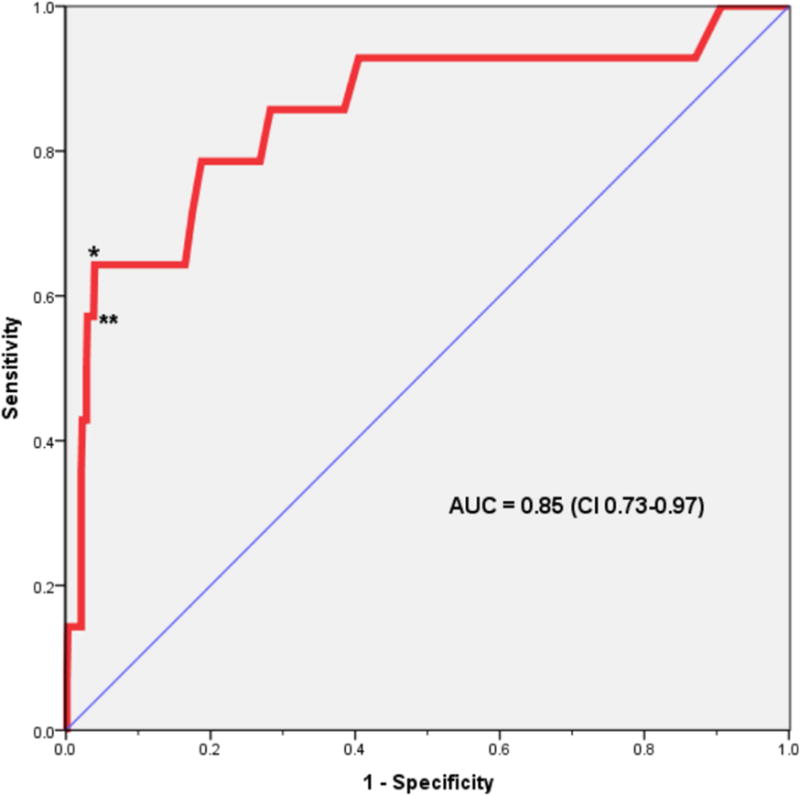
This figure demonstrates the ROC curve of initial ED serum lactate concentration to predict in-hospital mortality. The AUC of 0.85 was statistically and clinically significant. The cutpoint that maximized the sum of sensitivity and specificity was ≥5.0 mmol/L (arrow). *Optimal cutpoint ≥5 mmol/L based on Youden Index.26 **Cutpoint <2.5 mmol/L had 99.5% NPV.
Abbreviations: AUC = area under the curve; CI = confidence intervals; ED = emergency department: OCP = optimal cutpoint; ROC = receiver operating characteristics.
Acknowledgments
None
Funding: This study was made possible by grant DA026476 (PI: AFM) from the National Institute on Drug Abuse (NIDA) in the National Institutes of Health (NIH) and Dr. Manini is currently supported by grant DA037317. This content is solely the responsibility of the authors and does not necessarily represent the official views of NIDA or the NIH. Neither NIDA nor NIH had any direct role in the design, conduct, or reporting of this study.
Footnotes
Publisher's Disclaimer: This is a PDF file of an unedited manuscript that has been accepted for publication. As a service to our customers we are providing this early version of the manuscript. The manuscript will undergo copyediting, typesetting, and review of the resulting proof before it is published in its final citable form. Please note that during the production process errors may be discovered which could affect the content, and all legal disclaimers that apply to the journal pertain.
Presentations: This study was presented in abstract form at the Annual Scientific Meeting of the American College of Medical Toxicology in March 2017 at San Juan, Puerto Rico.
Author Contributions: AM conceived and obtained funding for the study. AM and RC coordinated acquisition of data. AM, RH, and DV were involved in the analysis and interpretation of data. AM and RC drafted the manuscript and all authors revised it critically for intellectual content. All authors gave final approval of the version to be published. AM is accountable for all aspects of the work as a whole.
Conflicts of Interest: The authors report no commercial conflicts of interest.
References
- 1.Warner M, Chen LH, Makuc DM, et al. Drug poisoning deaths in the United States, 1980–2008. Hyattsville, MD: National Center for Health Statistics; 2011. (NCHS data brief, no 81). [PubMed] [Google Scholar]
- 2.Rudd RA, Seth P, David F, et al. Increases in Drug and Opioid-Involved Overdose Deaths – United States, 2010–2015. MMWR Morb Mortal Wkly Rep. 2016;65(5051):1445–1452. doi: 10.15585/mmwr.mm655051e1. [DOI] [PubMed] [Google Scholar]
- 3.Gummin DD, Mowry JB, Spyker DA, et al. 2016 Annual Report of the American Association of Poison Control Centers’ National Poison Data System (NPDS): 34th Annual Report. Clin Toxicol (Phila) 2017;55:1072–1252. doi: 10.1080/15563650.2017.1388087. [DOI] [PubMed] [Google Scholar]
- 4.Manini AF, Nelson LS, Olsen D, et al. Medical examiner and medical toxicologist agreement on cause of death. Forensic Sci Int. 2011;206(1–3):71–6. doi: 10.1016/j.forsciint.2010.06.021. [DOI] [PMC free article] [PubMed] [Google Scholar]
- 5.Manini AF, Stimmel B, Hoffman RS, et al. Utility of cardiac troponin to predict drug overdose mortality. Cardiovasc Toxicol. 2016;16(4):355–60. doi: 10.1007/s12012-015-9345-8. [DOI] [PMC free article] [PubMed] [Google Scholar]
- 6.Consoli A, Nurjhan N, Reilly J, et al. Contribution of liver and skeletal muscle to alanine and lactate metabolism in humans. Am J Physiol. 1990;259(5 Pt 1):E677–684. doi: 10.1152/ajpendo.1990.259.5.E677. [DOI] [PubMed] [Google Scholar]
- 7.Nichol A, Bailey M, Egi M, et al. Dynamic lactate indices as predictors of outcome in critically ill patients. Crit Care. 2011;15(5):R242. doi: 10.1186/cc10497. [DOI] [PMC free article] [PubMed] [Google Scholar]
- 8.Mikkelsen ME, Miltiades AN, Gaieski DF, et al. Serum lactate is associated with mortality in severe sepsis independent of organ failure and shock. Crit Care Med. 2009;37:1670–77. doi: 10.1097/CCM.0b013e31819fcf68. [DOI] [PubMed] [Google Scholar]
- 9.Shah A, Chisolm-Straker M, Alexander A, et al. Prognostic use of lactate to predict inpatient mortality in acute gastrointestinal hemorrhage. Am J Emerg Med. 2014;32(7):752–5. doi: 10.1016/j.ajem.2014.02.010. [DOI] [PubMed] [Google Scholar]
- 10.del Portal DA, Shofer F, Mikkelsen ME, et al. Emergency department lactate is associated with mortality in older adults admitted with and without infections. Acad Emerg Med. 2010;17(3):260–8. doi: 10.1111/j.1553-2712.2010.00681.x. [DOI] [PubMed] [Google Scholar]
- 11.Manini AF, Kumar A, Olsen D, et al. Utility of serum lactate to predict drug-overdose fatality. Clin Toxicol (Phila) 2010;48(7):730–736. doi: 10.3109/15563650.2010.504187. [DOI] [PMC free article] [PubMed] [Google Scholar]
- 12.Mégarbane B, Deye N, Malissin I, et al. Usefulness of the serum lactate concentration for predicting mortality in acute beta-blocker poisoning. Clin Toxicol (Phila) 2010;48(10):974–978. doi: 10.3109/15563650.2010.534483. [DOI] [PubMed] [Google Scholar]
- 13.Manini AF, Nelson LS, Stimmel B, et al. Incidence of adverse cardiovascular events in adults following drug overdose. Acad Emerg Med. 2012;19(7):843–9. doi: 10.1111/j.1553-2712.2012.01397.x. [DOI] [PMC free article] [PubMed] [Google Scholar]
- 14.Manini AF, Hoffman RS, Stimmel B, et al. Clinical risk factors for in-hospital adverse cardiovascular events after acute drug overdose. Acad Emerg Med. 2015;22(5):499–507. doi: 10.1111/acem.12658. [DOI] [PMC free article] [PubMed] [Google Scholar]
- 15.Kaji AH, Schriger D, Green S. Looking through the retrospectoscope: reducing bias in emergency medicine chart review studies. Ann Emerg Med. 2014;64(3):292–8. doi: 10.1016/j.annemergmed.2014.03.025. [DOI] [PubMed] [Google Scholar]
- 16.Hamann JJ, Kelley KM, Gladden LB. Effect of epinephrine on net lactate uptake by contracting skeletal muscle. J Appl Physiol. 2001;91:2635–2641. doi: 10.1152/jappl.2001.91.6.2635. [DOI] [PubMed] [Google Scholar]
- 17.Barth E, Albuszies G, Baumgart K, et al. Glucose metabolism and catecholamines. Crit Care Med. 2007;35:S508–S518. doi: 10.1097/01.CCM.0000278047.06965.20. [DOI] [PubMed] [Google Scholar]
- 18.Bernal W, Donaldson N, Wyncoll D, et al. Blood lactate as an early predictor of outcome in paracetamol induced acute liver failure: a cohort study. Lancet. 2002;359:558–63. doi: 10.1016/S0140-6736(02)07743-7. [DOI] [PubMed] [Google Scholar]
- 19.Record C, Chase R, Williams R, et al. Disturbances in lactate metabolism in patients with liver damage due to paracetamol overdose. Metabolism. 1981;30:638–43. doi: 10.1016/0026-0495(81)90076-7. [DOI] [PubMed] [Google Scholar]
- 20.Clemmesen J, Hoy C, Kondrup J, et al. Splanchnic metabolism of fuel substrates in acute liver failure. J Hepatol. 2000;33:941–48. doi: 10.1016/s0168-8278(00)80126-9. [DOI] [PubMed] [Google Scholar]
- 21.Shively RM, Hoffman RS, Manini AF. Acute salicylate poisoning: risk factors for severe outcome. Clin Toxicol (Phila) 2017;55(3):175–180. doi: 10.1080/15563650.2016.1271127. [DOI] [PMC free article] [PubMed] [Google Scholar]
- 22.Boucaud-Maitre D, Ropers J, Porokhov B, et al. Lactic acidosis: relationship between metformin levels, lactate concentration and mortality. Diabet Med. 2016;33(11):1536–1543. doi: 10.1111/dme.13098. [DOI] [PubMed] [Google Scholar]
- 23.Erickson TB, Thompson TM, Lu JJ. The approach to the patient with an unknown overdose. Emerg Med Clin North Am. 2007;25:249–281. doi: 10.1016/j.emc.2007.02.004. [DOI] [PubMed] [Google Scholar]
- 24.Nguyen HB, Rivers EP, Knoblich BP, et al. Early lactate clearance is associated with improved outcome in severe sepsis and septic shock. Crit Care Med. 2004;32:1637–1642. doi: 10.1097/01.ccm.0000132904.35713.a7. [DOI] [PubMed] [Google Scholar]
- 25.Jansen TC, van Bommel J, Schoonderbeek FJ, et al. Early lactate-guided therapy in intensive care unit patients: a multicenter, open-label randomized controlled trial. Am J Resp Crit Care Med. 2010;182(6):752–761. doi: 10.1164/rccm.200912-1918OC. [DOI] [PubMed] [Google Scholar]
- 26.Youden WJ. Index for rating diagnostic tests. Cancer. 1950;3(1):32–5. doi: 10.1002/1097-0142(1950)3:1<32::aid-cncr2820030106>3.0.co;2-3. [DOI] [PubMed] [Google Scholar]
Associated Data
This section collects any data citations, data availability statements, or supplementary materials included in this article.