



Abstract
One of the biggest challenges in volcanic hazard assessment is to understand how and why eruptive style changes within the same eruptive period or even from one eruption to the next at a given volcano. This review evaluates the competing processes that lead to explosive and effusive eruptions of silicic magmas. Eruptive style depends on a set of feedback involving interrelated magmatic properties and processes. Foremost of these are magma viscosity, gas loss and external properties such as conduit geometry. Ultimately, these parameters control the speed at which magmas ascend, decompress and outgas en route to the surface, and thus determine eruptive style and evolution.
Eruptive styles at a single volcano may transition from explosive to effusive behaviour (or vice versa) at any given time. This review examines the underlying controls on eruptive styles such as magma viscosity, degassing and conduit geometry at volcanoes with silicic compositions.
Introduction
With the increasing global population and stress on natural resources, volcanoes threaten more lives every day. Explosive volcanic eruptions can have devastating societal impacts on nearby populations, covering entire countries in ash, ruining crops, killing livestock and causing a huge loss of human life. These eruptions can also have global effects, with the potential to impact air traffic, air quality, global temperatures and biogeochemical cycles. Conversely, lava flow or dome-forming (effusive) eruptions are generally less hazardous, with impacts focused in the area immediately surrounding the volcano, although eruptions of large mafic lava flows can destroy property and may have adverse effects on regional air quality1. Therefore, the style of volcanism dictates the types of hazards posed by a volcano. An important problem is that any one volcano can erupt either explosively or effusively, and a single eruptive episode may include multiple and rapid changes in eruptive style2. Out of the 106 eruptions greater than or equal to Volcano Explosivity Index (VEI) 3 since 2000, 61% of these comprised both effusive and explosive activity (Global Volcanism Program, 20133). Additionally, our current understanding of the geophysical, geodetic and geochemical signals detected by volcano monitoring does not provide either an adequate framework to reliably forecast the initial eruption style and size, or the temporal evolution of eruptive activity. This ambiguity limits the ability of authorities to prepare for and mitigate against volcanic hazards. It is thus critical to understand the factors that control whether a volcano erupts effusively or explosively, and to integrate this information into models that provide realistic eruption scenarios. This goal is considered to be one of the three grand challenges in volcano science4.
In this review, we focus on the shall-owest parts of the magmatic system, from the subvolcanic magma storage to conduit flow and surface events (upper ~10 km; Fig. 1 and Table 1). In this low pressure environment, processes such as crystal and bubble growth (Fig. 1b) affect the permeability, rheology, extent of outgassing, and fragmentation depth and mechanisms (Fig. 1b and Table 1) of the magma in the plumbing system. Furthermore, even processes that occur at the surface such as dome collapse, earthquakes, ice melting or landslides can exert pressure changes that may propagate downwards altering the stress fields and affecting the decompression rate (Fig. 1 and Table 1). Albeit not discussed in detail, processes occurring deeper in the crust (below ~10 km) can also exert important controls on properties and parameters such as magma production rate, density, buoyancy, composition, volatile contents and viscosity. We stress that these properties can vary during storage and ascent (for instance, through the process of magma crystallization and differentiation, when the silica content of the magma, viscosity of the melt and residual volatile contents increase) and may play non-trivial roles in controlling eruptive styles. Indeed, processes with roots in the mid-to-upper crust, such as magma recharge (inducing mixing/mingling) and crustal assimilation, may significantly alter many of the critical magma (intrinsic) properties or parameters, including temperature, rheology, volatile solubility, magmatic overpressure, dissolved and exsolved gas content, bubble and crystal content, and magma ascent rate (Table 1). This contribution focuses on intermediate to more silicic compositions, i.e., high viscosity magmas. A caveat to this approach is that whole-rock compositional classifications can be misleading in the frame of eruptive style, since crystal-rich magmas, even of mafic compositions (basalts and andesites), may have more silicic ‘melt’ compositions, and taken with their crystal-rich assemblage, can make these magmas more rheologically analogous to silicic magmas5,6.
Fig. 1.

Annotated volcano schematic, illustrating the range of processes that can affect eruptive style from storage to surface, prior to or during volcanic eruptions. a Shows how fragmentation is a function of the melt viscosity and strain rate. Fast strain rates (i.e., high decompression rates) favour brittle fragmentation as it passes the glass transition for a given viscosity. At slow strain rates, magma generally behaves as a liquid. Figure adapted from Gonnermann and Manga105. b Shows the cycle of volatile outgassing, from nucleation, coalescence to densification from permeability and porosity data in Rust and Cashman80, figure reproduced from Cashman and Sparks5, under fair usage terms
Table 1.
Here, various magma properties (intrinsic) or extrinsic parameters (highlighted in bold) are given, which have been suggested to affect volcano explosivity. Their controls are given along with brief explanations of how this can affect eruptive style. Not all these references will be discussed in the text, but this serves as a reference table for the reader to seek out more detail. Deeper controls on eruptive style, not addressed in this table, include magma composition, buoyancy, and magma production rate
| Properties/parameters | What controls this? | How does this affect eruptive style? |
|---|---|---|
| Tectonic regime/stress field | Regional faulting, edifice load, pressure differential between magma and surface | Alterations to the stress field such as unloading via flank/dome collapse can alter magma ascent rates40,225, e.g., rapid decompression from 12 MPa at Mt St Helens leads to explosive fragmentation54 |
| Magma ascent rate | Stress field, magma buoyancy, volatiles, conduit geometry, chamber overpressure, viscosity | Faster ascent (e.g., >0.1 m/s per second), thus less time for outgassing, generally promotes explosive eruption37,65,136,182 (See supplementary data 1 and Fig. 5) |
| Dissolved and exsolved volatile content | Magma petrogenesis &composition, pressure/depth solubility, saturation degree, gas and magma influx | When volatiles are coupled to the magma, they increase buoyancy and ascent speed, if not lost during ascent25,26,28,37,133,143,145,226,227 |
| Magma rheology/viscosity | Magma and volatile composition, temperature, crystal and bubble content, strain rates | High viscosity inhibits release of volatiles promoting closed-system degassing8,41,228. Small changes of viscosity by ~0.5 (log Pa/s), may dictate whether an eruption becomes effusive or explosive18,21 |
| Magma chamber overpressure | Magma production rate, dome growth/collapse, magma recharge, exsolved volatiles | High overpressures (typically, 0–20 MPa137) may drive faster ascent speeds15,38,73, but this parameter is not well constrained |
| Magma temperature | Magma composition, magmatic injections, shear in conduit, time in storage/ascent, latent heat of exsolution and crystallization | Affects the magma viscosity, crystal content and volatile solubility can promote more open-system degassing and effusive8,71,229. These studies showed that changes as small as 80 °C can lead to changes between effusive and explosive eruption |
| Rate of decompression | When coupled, the magma ascent rate, speed of release of pressure, unloading events, stress field | Same effects as magma ascent rate, these are normally coupled. However, fast decompression via unloading can lead to rapid downward-propagating fragmentation wave52,54. Typical decompression rates of explosive eruptions are: 1 MPa/s and typical effusive rates (0.0001 MPa/s) (Supplemental data 1 and Fig. 5) |
| Crustal properties (e.g., conduit wall permeability) | Regional geology, stress field, fracture networks, anisotropy, discontinuities. | More permeable crust (and isotropic) leads to open-system degassing and thus generally less explosive36,73,117. However, the rate of outgassing through conduit walls is several orders of magnitude lower than vertical outgassing loss through conduit shear zones230 |
| Porosity and permeability of magma | Brittle deformation, fractures, bubble connectivity, bubble number density, decompression rate, viscosity, crystal content. | Higher porosity and permeability promote more of outgassing and alters fragmentation56,75,83,88,181,231. Magma must reach percolation threshold for efficient gas permeability, which ranges from 30 to 78% in vesiculating systems87. Magmas may repeatedly fracture and heal thus varying permeability and outgassing58,77,97,112,232 |
| Crystal and bubble content | Magma composition and rheology, magma ascent rate, P-T conditions on ascent, hetero vs homogenous bubble nucleation, crystal fractionation and assimilation, magma and gas influx | Affects the viscosity, permeability and efficiency of outgassing83,88,133–135,137,233. Buoyancy-driven outgassing is efficient (40–50% volatiles outgas) where crystallinities are between 40–70%135. Homogeneous nucleation leads to delayed disequilibrium degassing48,50. High bubble number densities leads to less outgassing and more explosive eruptions, e.g., ~1015 m−3 for Mt St Helens explosive eruptions234, and ~5 orders of magnitude less for effusive Soufriere Hills lava dome eruptions83,197 |
| Conduit and vent geometry | Erosion during explosions, magma accretion on walls, magma rheology, crustal structure and properties | Can affect the ascent speed and the magma extrusion rate at the surface122,123,235. Modelling shows that doubling conduit radius from 10 to 20 m increases ascent rate 4 times45 |
| External assimilation (e.g., surface water, carbonates) | Regional geology, hydrothermal system, geographic setting (e.g., glacial regions) | Explosive expansion and fragmentation of silicate glass68. Experiments on rhyolites show higher kinetic energy release by wet compared to dry experiments (>100 m/s different in ejection velocity)236. Additional volatiles may come from carbonates, experiments show, carbonate can completely breakdown in <10 min within melts at temperatures of 1200 C and 0.5 GPa66 |
| Magma depth/pressure | Density and buoyancy contrast between crust and magma, crustal structure/discontinuities | Affects solubility of different volatiles, buoyancy and affects local stress field, thus altering ascent138. Explosive phonolite eruptions derived from magma source from 1–6 km depth and water saturated35 |
An important distinction to make when discussing eruptive style transitions is the time scale over which these occur. Transitions between effusive and explosive volcanism can occur during a single eruptive phase, e.g., during dome growth and collapse episodes, and Vulcanian explosions. Transitions in eruptive style at the same volcano can also occur over several eruptions, e.g., a lava flow and a Plinian eruption separated by a repose interval. Here we highlight that the first type of transition (within single eruptive phase) is dominantly affected by shallow processes (within the conduit <3 km), whereas the second type may also be controlled by conditions and processes within the magma reservoir and early ascent in the conduit (>3–10 km).
The explosive versus effusive issue in volcano forecasting has been approached by many different fields and disciplines, including petrology, geochemistry, fluid dynamics, numerical modelling, gas geochemistry and rock deformation. Recent and often multidisciplinary breakthroughs in this research, however, attribute the controls on eruptive styles to different volcano properties (Table 1). Therefore, we aim to reconcile this complex body of research and to frame discussions of eruptive style for a wide audience. The review describes different causes and feedbacks involved in both explosive and effusive silicic eruptions. We provide data synthesis of magma ascent and decompression rates, we collate the parameters and properties that play a role in eruptive style and include statistics regarding the abundance and timing of effusive–explosive transitions. This review aims to not only to summarize the recent literature, but also to provide ideas for potential new research directions, including ways that the community can link to this body of research to volcano monitoring with the goal of improving the forecasting of explosive and effusive behaviour.
Factors promoting explosive volcanism
The various properties or parameters that influence volcano explosivity may affect eruptive style in contradictory ways (Table 1). For instance, the injection of magma into the storage reservoir (Fig. 1) may lead to either explosive or effusive eruptions7,8. These contradictions exist because there is no single way to generate an explosive eruption. This section describes the processes that may lead to explosive activity, which is reviewed in this section from storage to surface.
Effusive–explosive transitions between eruptive episodes
Where transitions in eruptive style at the same volcano occur over several eruptions, these changes may be closely linked to the mechanism that triggered the eruption. A common example of eruptive activity driven by processes at depth involves injection of new magma into a subvolcanic reservoir9–12. Explosive eruptions can be triggered under these conditions by either heating, which causes convection and vesiculation9 or mobilizes crystal-rich magmas13,14; addition of volume, which increases the overpressure of the magma system on the confining walls15; and/or fluxing of volatiles that increases buoyancy7,12,16. However, magma injection may also lead to effusive volcanism, by decreasing the viscosity of the system through heating and resorption of crystals which lower viscosity8,17 and reducing the water content, if the influxing magma is water-poor18. Reduced viscosity can change the nature of fragmentation (Fig. 1a), inhibiting brittle failure and enhancing non-explosive loss of volatiles. The process of magma mixing is therefore complex and its effect on volcano explosivity is likely dependent on the degree of mixing, presence of exsolved volatiles, extent of volatile and heat transfer and time between mixing and eruption15. In these examples, where the same volcano exhibits different styles of eruptions, the explosive eruptions occur when there is limited8 or no magma injections18,19. Instead, cooling and crystallization of dominantly anhydrous crystals, leading to second boiling20 can promote overpressurization in the reservoir, driving faster magma ascent and more explosive activity. Even subtle changes in viscosity alone (~0.5 log Pa/s) in these instances as a result of heating, crystallization or compositional changes may determine the eruptive style21.
Effusive–explosive transitions within single eruptive episodes
Where both eruptive styles exist with a single eruption phase, a common eruptive trend is from explosive to effusive activity (Fig. 2). A plot using the known durations of eruptive periods and occurrence of a climactic eruption (VEI ≥ 4 in this instance), within these periods (containing dome growth and smaller explosions) from the Domehaz database22, shows that almost 70% of climactic Plinian eruptions occur within the first quarter of an eruptive period (Fig. 2). The remaining 30% of the climactic eruptions occur in the latter half of their respective eruptive period, showing that there are many instances where large explosions occur during, or after dome growth (e.g., Pinatubo, Philippines, 1991, Mt Mazama, USA 2850 BC). The most common eruptive transition from explosive to effusive has been previously attributed to volatile gradients, where the first explosive phases tap the volatile-rich top of the magma body23 and the latter phases sample drier, degassed magmas at the bottom. However, volatile contents from melt inclusions generally show no discernible difference between effusive and explosive eruptions17. Higher dissolved volatile contents (in particular H2O) should promote faster ascent through exsolution-driven expansion24, as is sometimes the case18,25–28. However, similarly high-water contents can also lead to slow ascent rates and effusive eruptions17,29–31. This issue is compounded by the difficulty in gaining accurate dissolved volatile data for magmas32–34. Nevertheless, as volatile measurement techniques improve, the relative importance of the different volatiles (e.g., CO2 versus H2O), as well as tracking volatile saturation evolution in affecting eruptive style may prove to be insightful19,35.
Fig. 2.
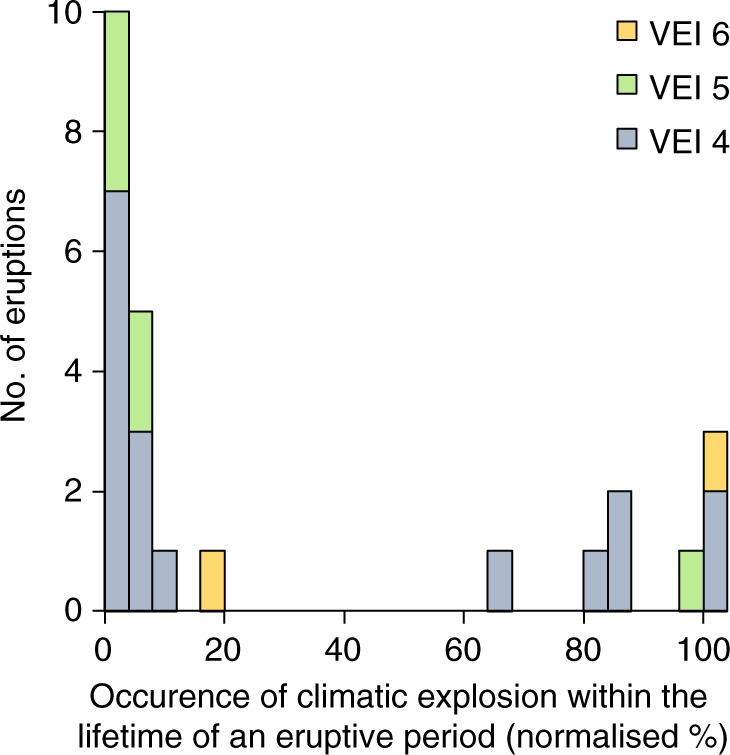
Graph of known eruptive time periods with both climactic explosions (VEI ≥ 4) and dome growth (including crypto-domes) from the Domehaz database22. All eruptive time periods (which includes smaller explosions, dome extrusion) have been normalized. Two-thirds of the climactic eruptions occur at the start of their eruptive period (first quarter), irrespective of VEI. However, ~1/3 of climactic eruptions occur in the latter half of an eruptive cycle
As dissolved volatile contents do not appear to be the dominant control, the explosive to effusive transition within single eruptive episodes has been attributed to differences in degassing regimes (closed- versus open-system degassing; Fig. 3)36. The changes in degassing behaviour are related to magma ascent, which controls how efficiently gas is lost from the magma37. In this instance, the first explosive eruptions are driven by fast ascent speeds leading to closed-system degassing. Fast magma ascent leads to explosive fragmentation, potentially through both volatile overpressure in bubbles and high-strain rates due to rapid acceleration. Following this, lava extrusion occurs as a result of open-system degassing related to the slower ascent of the magma as the overpressure declines38,39. For explosive Plinian eruptions, Scandone et al.40 suggest that these require the development of a fully connected conduit. When this happens, magma ascent rates will depend on the decompression rate, which in turn is a function of the pressure within the magma reservoir, the location of the fragmentation surface, the viscosity, and the geometry of the conduit41. All four parameters will change with time. For this reason, large explosive eruptions exhibit steady Plinian behaviour for only limited periods of time (typically hours, where ‘Plinian’ is a term used for towering volcanic plumes erupted from a single vent). Plinian eruptions commonly transition to ignimbrite-forming eruptions as the shallow vent widens; alternatively, if the pressure differential driving the eruption decreases rapidly, then the eruption may become effusive or cease altogether40. Fluctuations between effusive and explosive behaviour during the course of eruptions can be entirely modulated by stress changes caused by the eruption, for instance, decompression during the eruption has been known to tap deeper magma bodies (e.g., Eyjafjallajokull, Iceland42). Further insights into this transition can also be gained from direct observations. For instance, during the 2011 rhyolitic eruptions of Cordon Caulle, Chile, the initial Plinian episode was followed by ‘effusive’ lava flows, which were in fact accompanied by mild explosive activity43,44. This explosive to effusive transition however does not always occur, as evidenced by the cluster of climactic explosive eruptions at the end of an eruptive period (Fig. 2), showing that there are other ways to cause transitions into explosive behaviour. This may make future eruptive activity difficult to predict in our current state of knowledge, as demonstrated by the ongoing (2017–2018) activity at Agung volcano, Indonesia.
Fig. 3.
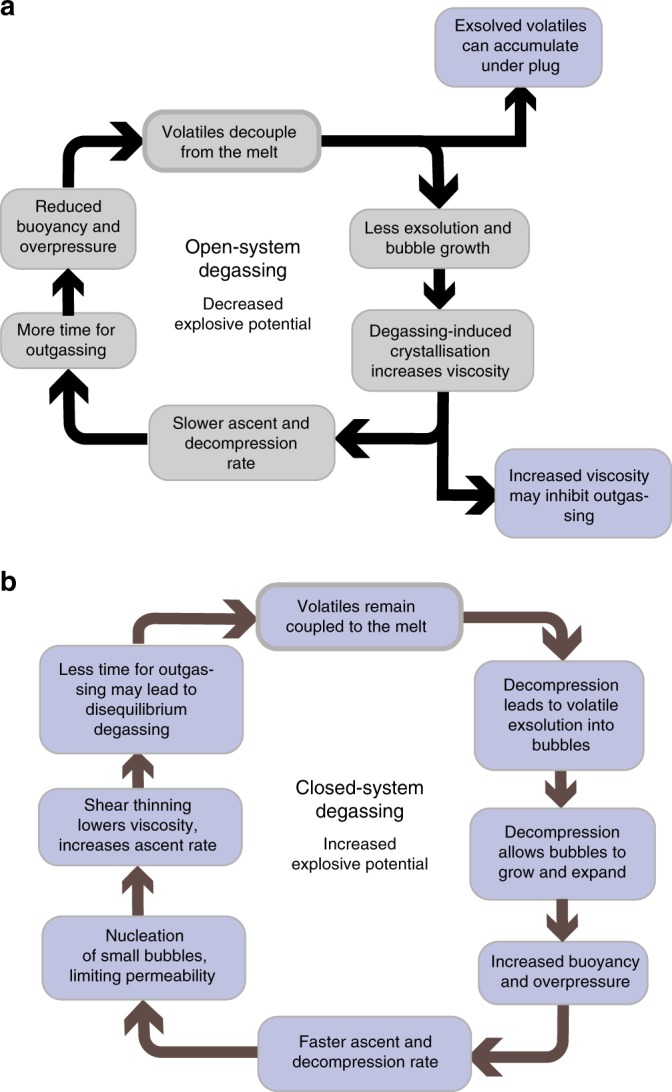
Open- and closed-system degassing feedbacks have a strong control magma ascent and eruptive style. a For open-system degassing, the release of volatiles will decrease the buoyancy and overpressure of the magma, leading to slower ascent and allowing more time for equilibrium degassing and outgassing. Crystallization and viscosity increase enhance this positive feedback and left unchecked, this will normally lead to slow decompression rate, thus diminishing the likelihood of overpressure building up and leading to effusive eruptions36,73,121. However, negative feedbacks can also occur (purple boxes in a), to counteract the loss of volatiles which may lead to more explosive eruptions. b The added buoyancy from volatile exsolution and bubble expansion will drive faster ascent, making outgassing less efficient179–181, which may lead to disequilibrium degassing48. This positive feedback is further enhanced by nucleation of small bubbles, which may limit bubble coalescence83. In addition, for more silicic magmas or when decompression rates are high enough, decompression-induced crystallization will be suppressed182. This may have two effects, first it keeps the viscosity low to enable faster ascent and second, it provides less bubble nucleation sites and thus less potential for outgassing. For some non-Newtonian magmas excess deformation of leads to shear thinning behaviour183,184 decreasing viscosity185 and thus further increasing ascent rate186. These feedbacks promote more explosive behaviour
Magma ascent and decompression
Magma ascent and decompression rates (mostly coupled) are perhaps the most critical parameters controlling volcanic style37. In Fig. 4, we simplify magma ascent into fast and slow, referring to an average velocity from the storage system to the surface. In reality, magma ascent rate will vary considerably from the reservoir to the surface depending on the relative changes in vesicularity (buoyancy), exsolved and dissolved volatile content, overpressure at depth relative to surface, magma rheology and conduit geometry. We mostly refer to magma ascent rather than decompression here as magma ascent rate is more meaningful for volcano monitoring purposes.
Fig. 4.

Event tree diagram showing the different processes/conditions that may lead to explosive eruptions. Slow ascent scenarios often involve transitions between explosive and effusive activity. Speed of ascent may fluctuate during an eruptive phase, this diagram refers to the average ascent rate from storage to the surface
Despite a range of different techniques used to estimate these ascent or decompression rates (Fig. 5 and Supplementary data 1), there is a distinction between rates of effusive versus explosive eruptions. This divide seems to occur around 0.001 MPa/s, 0.1 m/s (Fig. 5); however, this is not a strong divisional boundary, but a gradational range of rates (e.g., 0.0001–0.005 MPa/s, and 0.005–0.25 m/s), where transitional and pulsatory effusive and explosive activity is more likely. For example, there are numerous places where ascent rates for explosive eruptions are low (e.g., associated with small Vulcanian eruptions at Chaparrastique, El Salvador and Colima, Mexico) and effusive ascent rates are high (e.g., rapid dome growth at Chaiten, Chile, following initial Plinian eruption). There is likely a weak correlation with composition, where lower viscosity basaltic andesites reach faster ascent rates compared to rhyolites, but this requires further investigation. We must also point out several caveats to this data set, (1) these are syn-eruptive rates and do not necessarily show magma ascent prior to eruption, (2) these are average rates, whereas magma ascent and decompression are dynamic processes, which evolve from storage to surface, (3) the plot comprises many different types of eruptions of differing scales, e.g., small Vulcanian eruptions plotted along with large voluminous Plinian eruptions of Taupo. Nevertheless, it shows that syn-eruptive magma ascent and decompression rates have a strong control on eruptive style, due to their role in governing open- versus closed-system degassing feedback cycles, which influence the extent of outgassing prior to, and during an eruption (Fig. 3).
Fig. 5.

Comparison of all syn-eruptive ascent rates estimates, from multiple volcanoes ranging from basaltic andesite to rhyolites (Supplementary data 1). This plot collects ascent and decompression rate data from a range of different techniques, including microlite crystallinity, bubble number density, experiments, hornblende rims, seismicity, extrusion rate and diffusion rates. Where decompression rates were not given, these were calculated from the ascent rates using an assumed lithostatic pressure gradient of 0.025 MPa/m. Magma ascent and decompression rates are from the following sources, from left to right: Volcan de Fuego, Guatemala187; Izu-Oshima, Japan188,189; Chaparrastique volcano, El Salvador190; Arenal, Costa Rica191; Tungurahua, Ecuador192; Vesuvius, Italy193; Mt Pelee, Martinique194; Soufriere Hills, Montserrat195–198; Colima, Mexico65,199; Sakurajima, Japan200; Santiaguito/Santa Maria, Guatemala201,202; Pinatubo, Philippines189,203,204; Novarupta, USA90; Unzen, Japan205–207; Black Butte, USA208; Towada, Japan189; Mt St Helens, USA189,209–213; Inyo domes, USA52; Chaiten, Chile136,214; Cordon Caulle, Chile215; Tokachi–Ishizawa, Japan216; Taupo, New Zealand217–219; Yellowstone, USA220,221; and Bishop tuff, USA222
Although the controls on magma ascent and decompression rate can be broadly identified, their relative importance is not yet clear. Sparks and Melnik41 suggested that magmatic ascent at Soufrière Hills volcano was linked directly to magma chamber overpressure. The magma chamber and conduit acted as energy capacitors, storing energy from elastic deformation of the wall rock, until the pressure overcame a threshold, which then drove fast ascent and explosive eruptions. Thomas and Neuberg45 used a suite of conduit flow models to determine the dominant factors controlling magma ascent, based on the Soufrière Hills volcano. In this study, conduit diameter and excess pressure in the magma chamber were among the dominant controlling variables, but the single most important parameter was the volatile content (dissolved + exsolved and assumed as only water). This is because volatiles lower the melt viscosity and also lead to greater exsolution and production of exsolved volatiles, thereby increasing magma buoyancy. Meanwhile, other parameters such as density and the external stress field, simulated by varying the pressure at the surface, were deemed to be less important, the latter becoming more influential at shallower levels. This is consistent with the observations that eruptions from deep magma storage, where the pressure difference between the source and the surface is highest, do not always produce explosive eruptions, and that many eruptions sourced from shallow magmas can be very explosive. Furthermore, in the cases where pressure at the surface is confined, e.g., for subglacial eruptions, explosive eruptions can also occur46.
Explosive eruptions are modulated in part by the conditions of bubble formation (vesiculation), which require both nucleation and growth. The exsolution of volatiles within a magma is controlled by the decompression rate, the degree of volatile saturation, availability of nucleation sites, surface tension and viscosity of the magma47. Therefore, when the decompression rate is high, the volatiles may not be able to degas from the magma in equilibrium with their relative solubilities. This is termed disequilibrium degassing and it may lead to volatile supersaturation and high overpressures (>100 MPa), so that when vesiculation does occur, it occurs at higher rates than equilibrium degassing and thus may increase ascent speeds and volcano explosivity48. Disequilibrium degassing is more common in silicic magmas, due to their higher viscosities and lower diffusivities that tend to resist bubble nucleation. Nucleation directly from silicic melt (termed 'homogeneous' nucleation) requires supersaturation pressures that are high enough to overcome the high melt-vapour surface tension (>120–350 MPa48,49), depending on the melt viscosity. Such supersaturation pressures are unrealistically high (often higher than inferred storage pressures (see recent review by Shea50) and the evidence for homogenous bubble nucleation in natural magmas is limited. In many cases, a component of 'heterogeneous' nucleation (nucleation of crystal surfaces) may be required. Clearly further studies are necessary here, such as careful petrological work along with numerical models to investigate the role of disequilibrium degassing and crystallization on ascent dynamics51.
Slower magma ascent leading to explosive eruptions
Fast ascent (e.g., >0.1 m/s), where melt and exsolved gas remain coupled, will almost always lead to explosive eruptions (Fig. 5). However, the contrary is not true, as slowly ascending magmas (e.g., <0.01 m/s), can also cause explosive eruptions (e.g., Inyo volcanic chain, USA52). An extreme example of the explosive potential of slowly ascending magmas is provided by the 1980 eruption of Mt. St. Helens, USA. Here, 2 months before the explosive eruption, magma ascended at a rate of ~0.01 m/s into the shallow system, creating a cryptodome40,53. The eruption was eventually triggered by failure of the edifice because of pressure from the growing cryptodome54. This rapid unloading event created a downward-propagating decompression wave that caused a runaway effect of gas expansion, rapid ascent, and fragmentation of deeper-seated magma whereby a fully connected conduit was established between the surface and the deep-seated magma reservoir40. The Mt St Helens example demonstrates both of the two main types of fragmentation mechanisms, rapid decompression. The sustained Plinian phase of the eruption results from the other type of fragmentation that arises from the rapid acceleration of gas-rich magma. In this instance, vesiculation and bubble growth create high strain rates to cause brittle fracturing of the magma as it goes through the glass transition55 (Fig. 1a), the higher porosity from rapid vesiculation also helps to lower the fragmentation threshold, i.e., the pressure drop required to fragment the material56.
Explosive eruptions from slowly ascending magmas may also be pulsatory and modulated by competition between slow magma ascent and build-up of overpressure beneath a viscous lava plug at the top of the magma columns leading to transitions in explosive activity. Sparks and Melnik41 show that feedbacks between degassing and crystallization during slow ascent can increase viscosity and thus cause pressurization of the magma in the upper parts of the conduit during dome growth; this model was calibrated using patterns in tilt and seismic signals at the Soufriere Hills volcano, Montserrat. Slow ascent, coupled with sealing of pores by lava, pyroclasts, or cristobalite57–59 also allow exsolved volcanic gases to accumulate at shallow levels. Under these conditions, gas pressurization can be contained by the elastic deformation of the wall rocks until this overpressure exceeds the strength of the confining rock60–62. Failure of the capping plug causes high-intensity explosions known as Vulcanian eruptions; downward-propagating decompression waves following plug failure can rapidly evacuate the volcanic conduit to depths of a few km63,64. Subsequent slow re-filling of this conduit re-starts the Vulcanian eruption cycle. Confirmation of this heuristic model is provided by measurements of emitted volatiles, particularly SO2, where gas exhalations can be correlated with the repose times between eruptions65.
External forces
Transitions in explosivity may be influenced by external factors independent of other magmatic variables (Fig. 4 and Table 1). These usually occur at the shallow level (<1 km) or at the surface. Rapid changes to the edifice such as sector collapses can trigger top-down fragmentation as discussed in the Mt St. Helens eruption above. Another example is the assimilation of external materials such as carbonate, which can also promote explosive volcanism through the formation and rapid expansion of CO2 bubbles, these exsolved volatiles, when coupled to the melt may drive faster ascent and thus increase explosivity at volcanoes such as Merapi, Popocatepetl and Vesuvius (Table 166,67). Sudden explosive activity can also be caused by external water and magma interaction, driven primarily by the volumetric expansion as the water is superheated, leading to explosive fragmentation68. At the most explosive end, more than 30% of the available thermal energy can be converted into mechanical energy, most of which is emitted as shock waves, which may enhance fragmentation within the conduit and vent69.
Keeping magma from erupting explosively
The acceleration, fragmentation and explosive eruption of magma are powered by the exsolution of volatiles dissolved in the melt and the expansion of these gases once they form bubbles70. Exsolution accompanies ascent and decompression because the solubility of volatiles decreases with decreasing pressure, though increases in temperature caused by deformation71 or recharge may also lead to exsolution8. Key to preventing explosive eruption is thus to keep pressure within bubbles from getting so high that the melt around bubbles ruptures72 or to remove gases from ascending magma73.
The escape of gas from rising silicic (high viscosity) magmas requires that the magma is permeable. Over the past decades, great progress has been made in measuring and modelling permeability, and more recently recognizing that permeability is a highly transient property74–79. Prior to fragmentation or brittle failure, magmas become permeable as bubbles become connected. Permeability is an evolving quantity, increasing as bubbles grow and coalesce and the magma deforms, and decreasing as gas loss causes bubbles to collapse (Fig. 3b36,80–83). Permeability development is moderately sensitive to decompression rate, but strongly affected by variations in melt composition (viscosity) and crystallinity84,85. The signatures of bubble growth and gas loss are recorded in the textures of volcanic rocks86. Extensive measurements of permeability on quenched magmas87 suggest that magma permeability exerts a leading order control on whether magma is able degas fast enough during ascent to avoid fragmenting88.
A combination of slow ascent or decompression, and efficient gas loss (high permeability) promote effusive activity89,90. Figure 6 shows the consequences of degassing by porous gas flow on magma ascent and properties within the conduit. Ascent is computed using the equations presented in Degruyter et al.83 (see methods). The model solves for the one-dimensional two-phase vertical flow of magma and gas, assumes equilibrium exsolution, includes a model for the dependence of permeability on bubble size and gas volume fraction, and accounts for the pressure dependence of water solubility and the effect of dissolved water and crystals on melt viscosity. We assume there is no critical porosity (percolation threshold) to initiate gas flow. Further details and model parameters are summarized in the figure caption. Effusive eruption is promoted by a lower number density of bubbles that leads to larger bubbles (Fig. 6c) and hence higher permeability and greater gas velocity (Fig. 6b) and loss (Fig. 6e). Higher viscosity, in the examples shown in Fig. 6 provided by higher crystallinity, leads to slower magma ascent and hence permits more time for gas to escape from the rising magma. Pressure decreases during ascent, and the rate of pressure decrease is controlled by the resistance to ascent, which involves feedbacks between exsolution, viscosity and gas escape ('outgassing'). Once magma fragments, it leads to lower pressures at a given depth within the conduit (in the fragmented magma) and thus exsolution and higher melt viscosities.
Fig. 6.

Comparing the properties during ascent of hydrous leucogranite with different bubble number densities (Nb) and crystal contents (X). The model simulates magma ascent and gas escape, computed using the steady one-dimensional model of Degruyter et al83., showing how a pressure, b melt (solid curves) and gas (dashed curves) velocities, c bubble radius and d magma viscosity evolve during ascent; e shows how vesicularity varies with pressure. Also, included vesicularity and the inferred pre-eruptive depth of clasts evacuated from the conduit during the 1997 Vulcanian eruptions at Soufrière Hills Volcano, Montserrat223,224. These samples are thought to capture conditions during ascent for the dome-forming eruptions224. Errors bars from Burgisser et al.224 account for uncertainty in measured water content (pressure) and vesicularity. Note that the volume fraction of exsolved gas in the clasts is lower than expected when gas is allowed to escape from the rising magma. The effect of crystal fraction on viscosity is based on the model of Costa178 and the melt viscosity model is that of Hess and Dingwell177. Fragmentation occurs at a gas volume fraction of 85%. In the model, crystals do not grow, and Nb does not change during ascent. Homogeneous bubble nucleation and equilibrium degassing are assumed. Volatile content at depth is 4 weight %. Temperature is 886 °C. The percolation threshold for gas flow through the magma is zero, tortuosity factor is 3, bubble throat to radius ratio is 1, and the friction coefficient for gas flow through the magma is 10, values as used in Degruyter et al.83
Permeability is an even more dynamic quantity after magma undergoes brittle failure. High strain rates can also fracture magma54,55 and this fracturing can promote further nucleation91. Fractures can be transient in viscous magma because viscous deformation allows cracks to anneal and heal92–94 but strain is not immediately localized to fractures, permitting efficient outgassing95. Transient fractures, can also create temporary pathways that can transport ash, in addition to gas. A signature of these transient processes is preserved in fragment-filled veins called 'tuffisites43,58,96–98' or texturally banded rocks in lava domes99–101. Weak venting through such pathways can also accompany otherwise effusive eruptions44,102. Magma fracture may occur preferentially at the margins of conduits where strain rates are highest103,104 and can be magnified by shear heating and strain localization77,105–110. Magma fracture and welding is commonly preserved at the microscale in the form of fractured crystals, cuspate vesicles and xenocrystic (foreign) material111–113. Accounting for feedbacks between fracturing and degassing in models such as that shown in Fig. 6 is complicated by our limited understanding of permeability and welding, processes that are time dependent and sensitive to the poorly constrained fragment size distributions114,115.
Gas escape is further enhanced if the surrounding country rock is permeable, a property ignored in Fig. 6, in which case the degassing efficiency is controlled by both the permeability anisotropy, which controls the directionality of gas escape, the wall rock permeability, and the ambient pressure in the wall rock, e.g., lithostatic, hydrostatic or atmospheric73,116–118. The deformation that accompanies magma ascent can promote failure in the surrounding rocks and hence gas escape119, delivering gases to the hydrothermal systems surrounding magma bodies120. The transport of gases, and their interaction with the surrounding rock or domes that cap conduits, create minerals that act to seal cracks so that country rock and dome permeability will also be transient116,121.
Although conduit geometry, permeability and crustal properties are clearly important factors in controlling magma ascent and outgassing, due to the difficultly in constraining these, only relatively few studies exist and these mostly focus on modelling122,123. Conduit wall permeability can alter significantly when progressively heated by reducing open porosity and thus limiting outgassing during ascent117. Conduit geometry has a fundamental effect on magma ascent, and the conduit may widen to accommodate higher magmatic overpressures, discharge rates and higher viscosity magma, and thus may contribute to the positive feedback mechanism to increase magma ascent rate124,125. However, more integrated field studies on exposed volcanic conduits, along with petrology and numerical simulations would be beneficial in this area96,126,127.
The interacting processes described above involve both positive and negative feedbacks between magma ascent and gas loss. Positive feedbacks occur when faster ascent enhances bubble nucleation, which in turn produces smaller bubbles and reduced permeability83, and shear deformation that causes heating and vesiculation71. Negative feedbacks include the sealing of melt, dome and country rock fractures as a result of gas loss59,128; heating of the wall rock to create a viscous 'brake' by inhibiting frictional slides109,129; deformation during ascent that increases permeability and gas loss by promoting bubble coalescence; and crystallization driven by gas loss that increases magma viscosity and slows ascent. The combination of positive and negative feedbacks is one way to generate episodicity or even periodicity in eruption rate130.
Visualizing the controls on eruptive styles
Despite the range of different properties (Table 1), processes (Figs. 1 and 3), and scenarios (Fig. 4), controls on silicic eruption styles can, we propose, be characterized more simply, by combining some variables schematically: Fig. 7 shows changes in ascent rate from storage to surface as a function of outgassing efficiency. The ascent rate is largely a product of the overpressure, crustal stress field, conduit radius, viscosity and buoyancy (driven by volatile exsolution and decompression) of the magma, while outgassing efficiency is dominantly controlled by the viscosity, pressure or solubility, time (linked inherently to ascent rate), bubble nucleation/coalescence, permeability of magma and conduit wall rock, and fragmentation processes . The graded distinction between effusive and explosive regimes in Fig. 7 combines most of the properties laid out in Table 1 and highlights that some magmas will inherently be able to outgas efficiently. For example, a low viscosity or permeable magma will require faster ascent or decompression rates to generate an explosive eruption, as faster decompression inhibits outgassing prior to, and during an eruption. In contrast, for a magma that has a low outgassing efficiency, such as a high-viscosity rhyolite, an explosive eruption may occur at slower ascent speeds relative to lower viscosity magmas, since it is likely that the volatiles will be retained within the magma during closed-system degassing (Fig. 7). This is reflected in the different starting positions on the outgassing efficiency axis for the various eruptive scenarios (A-D). Andesite melts are inherently more efficient at outgassing due to their lower viscosity relative to rhyolites, and they also commonly contain more crystals, which may help to channelize exsolved volatiles to further enhance outgassing efficiency via veining and capillary fracturing85,131,132. However, magmas rich in crystals have also been proposed to reduce outgassing133,134, and there is likely a ‘sweet-spot’ of enhanced buoyancy-driven volatile outgassing (40–50% volatiles outgas) when crystallinities are between 40–70%135.
Fig. 7.

Schematic plot, where an diffuse threshold distinguishes effusive from explosive eruptions. Points a–d represent different eruptive scenarios: a = Ascent controlled (bottom-up), b = Viscosity controlled, c = Exsolved gas accumulation and plug controlled, and d = Decompression-wave controlled. The red lines are pre-eruptive ascent paths and do not represent transitions between effusive and explosive behaviour, where the eruption photo represents a magma reaching the surface. The starting position on the outgassing efficiency axis depends on the magma rheology (composition and crystallinity) and permeability. Note that this figure is schematic, the ascent rates are based on Fig. 3 (syn-eruptive averages). However, currently no data exists on how ascent and decompression rates evolve during transit from storage to surface. In addition, due to the complex and variable nature of magmatic outgassing, and how this changes with crystallization, viscosity and bubble nucleation during ascent, data on this parameter are currently lacking. Nevertheless, quantifying these parameters during the magma’s transit from storage to surface in the future, may prove crucial for understanding the controls on eruptive style and where in the crust these controls are most important. Eruption photos in this figure are sourced from Chaiten in 2008 (Daniel Basualto), Soufrière Hills, 1997, Volcan de Colima (Mike Cassidy) and Mt St. Helens in 1980
Also plotted are the different explosive eruption scenarios (as referred to in Fig. 4), each with their dominant control. All ascent paths for the different scenarios begin from a stationary magma body in storage and continue to the point of eruption at the surface (eruption photo on Fig. 7). For eruptive scenarios that endure closed-system degassing during magma decompression and volatile exsolution, the exsolved volatiles remain coupled to the melt (Scenario A). Uninterrupted, this closed-system degassing feedback (Fig. 3b), driven from the ‘bottom-up’ may lead to a runaway process that ultimately leads to explosive fragmentation in a Plinian eruption (e.g., Chaiten, 2008; Scenario A or ‘Ascent controlled’136. Where open-system degassing occurs, such as at the start of Scenarios B and C (Fig. 7), the opposite feedback will occur (Fig. 3a), making an effusive silicic eruption more likely (section 3). However, this cycle can be broken in two ways: either the viscosity increases, via decompression crystallization and volatile exsolution, thereby dramatically reducing the outgassing efficiency (e.g., Vulcanian and sub-Plinian eruptions of Soufrière Hills volcano; Scenario B or ‘Viscosity controlled’137); or the exsolved volatiles become sealed, accumulate, and then experience high decompression rates once the plug is broken (e.g., Scenario C or ‘Exsolved gas accumulation and plug control,’ e.g., Galeras60). These scenarios are common in dome-forming volcanoes that have frequent Vulcanian or sub-Plinian eruptions and where activity can rapidly fluctuate and transition between effusive–explosive eruptions (dashed lines in Fig. 7), or even occur contemporaneously44. Scenario D highlights the ‘top-down’ process (Scenario D or ‘Decompression wave-controlled’ in Fig. 7) which can be largely independent of ascent rate and solely controlled by decompression, via a downward-propagating decompression wave, triggering explosive fragmentation (yellow dotted lines in Fig. 7) (e.g., Mt. St. Helens54).
These eruptive scenarios and type examples show that there is a fine balance between open- and closed-system degassing at the start of magma ascent from storage. Once one mode of degassing is preferred at this early stage this may, in some instances, trigger the aforementioned feedbacks and thus dictate the style of the initial eruption phase. Closed-system degassing could occur either when early outgassing is inhibited by high viscosity or low degrees of melt/vapour segregation138 thus increasing magma ascent rate, or alternatively when fast initial magma ascent (driven by overpressure, buoyancy, decompression, etc41) limits outgassing. This ‘chicken or the egg’ situation is often governed by processes and conditions at depth and thus it is particularly important to constrain the magmatic storage conditions. This includes the properties, and processes at the deep storage level, such as the rheology, overpressure, initial outgassing mechanisms, exsolved plus dissolved volatile contents and the role of wall rocks, as these may be critical for driving the initial feedbacks and thus governing eruptive behaviour.
Remaining knowledge gaps
This review highlights recent progress in understanding the dominant factors that control volcano explosivity. However, because of interactions between complex processes and multiple interrelated parameters, open questions remain. In this section, processes and parameters that are poorly understood will be discussed, along with where potential future research should be directed. We then highlight how the most important parameters can be monitored to enable eruptive style to be forecast.
Of the different explosive eruption scenarios displayed in Fig. 7, some are better understood than others. For instance, decompression waves (top-down eruptions) have been replicated in the lab139, while moderate sized eruptions (VEI 2-3) occur relatively frequently and thus have benefited from direct observations and measurement (e.g., Soufrière Hills140). However, the least well understood are the most explosive, the Plinian eruptions (driven from the bottom-up). The fact that the climactic Plinian eruptions do not only occur at the start of an eruptive period, but also at the end (Fig. 2), highlights that these eruptions are not simply driven by larger gas accumulation and plug-controlled eruptions, but are more complex, likely driven by a combination of different processes141. This means that numerical conduit flow models used to simulate Plinian eruptions are still limited142. Most conduit flow models assume isothermal, equilibrium degassing, steady-state flow with constant conduit geometry, inlet pressure, and neglect mechanical and thermal feedbacks with the surrounding crust142. These assumptions, despite being partly unrealistic, are used because the processes that govern conduit evolution are complex and cannot always be formulated into a set of equations with known parameters. This is an area where a new generation of models coupled to magma reservoir processes are required, together with better constraints on physical processes and parameters involved in the models.
The presence of exsolved volatiles (gas bubbles) in the magma is known to increase buoyancy and ascent speed143, factors that may lead to higher explosivity144. However, Degruyter et al.145 suggest that during recharge events the presence of exsolved volatiles in the magma reservoir may lower explosivity. They attribute this to an increase in magma reservoir compressibility, dampening pressurization, which allows for a significant amount of recharge and heating before eruption, thus enhancing conduit outgassing and slowing down ascent. Evidently the role of exsolved volatiles requires further testing and constraining to understand its role in ascent dynamics, using volcanic gas measurements30, analogue and petrological experiments to develop petrological indicators133,143, and numerical modelling145.
Forecasting eruptive style
Understanding the dominant parameters and processes that affect eruptive style and striving to measure these by volcano monitoring, may be the most promising way to improve forecasts of eruption style and explosivity. However, we face a number of challenges highlighted in the following paragaraphs.
Eruptive transitions that occur within a single phase (e.g., scenarios B, C and D; Fig. 7), are inherently difficult to forecast via monitoring. In these instances, changes can be fast (minutes to hours) and they can be modified by shallow-conduit and vent dominated processes such as conduit shear, development of anisotropy, permeable outgassing, dome collapses and the formation of tuffisites. Here, new work on degassing and time-dependent evolution of permeability and strength during deformation may help in forecasting time intervals where overpressure may build to generate explosions146. Shallow processes such as these may be related to short deformation cycles, and long-period and hybrid seismicity thought to be related to excess fluid pressure137.
Eruption transitions that occur across different eruptions at the same volcano (e.g., scenario A, Fig. 7) are dominantly governed from the bottom-up and can be linked to processes occuring within the magmatic plumbing system, and thus offer more promise in forecasting volcanic behaviour. Seismicity, deformation and gas measurements may be used to interpret conditions in the magma plumbing system. For instance, long period earthquakes, seismic velocity changes and ‘drumbeat’ seismicity have been used to detect magmatic ascent109,119,147; pre-eruptive, InSAR and tilt data were linked to the rate of pressure change and resulting explosivity of an eruption148,149; and increases in CO2 relative to SO2 phases have been recorded before some explosive eruptions150,151. However, those monitoring techniques require much refinement before volcanologists can, in near real-time predict future behaviours of a given volcano. Combining these measurements with constraints from petrology, fieldwork and modelling will be key to diagnosing the future dominant eruptive styles for each volcano.
Under most circumstances, rapid magma ascent requires a pre-existing pathway, or conduit. Conduit formation and evolution are challenging to study. The duration of shallow seismicity weeks to months prior to many volcanic eruptions suggest that this is in part related to conduit creation, although various other processes can create seismicity (e.g., White and McCausland152 and references therein). The data compilation by White and McCausland152 reveals that the onset of eruptive activity is commonly phreatic and is closely followed by a magmatic eruption. The type of pre-eruptive seismicity is also key as earthquake type may change from high frequency (rock breakage) to low frequency (involvement of fluids) as the eruption initiation is approached153. These patterns form the basis of the Failure Forecast Method for predicting eruptive activity, which is predicated on patterns of exponentially increasing rates of seismicity as a failure threshold is approached154–156. Despite the conceptual appeal of the model, successful applications of the technique have been limited, in part because of the material complexity of volcanic edifices157. A modified approach has been suggested by Bell et al.158, which includes appropriate error distributions to the forecast method. In addition to seismicity, magma overpressure can be monitored geodetically159 and degassing efficiency can be assessed using pre- and post-eruptive volatile emissions121. Together these observations suggest that under many conditions, each new eruption requires construction of a new conduit, and may involve interaction with shallow hydrothermal systems, and that the actual trigger for explosive eruption is often difficult to identify.
Multiple existing monitoring datasets have shown that explosive eruptions are often preceded by short but intense periods of unrest, with increased rates and magnitudes of both seismicity and deformation160. Hence, future efforts will benefit from real-time multi-parameter modelling and hazard alert systems. Once an eruption has started, constraining lava effusion rate and volume of mass erupted using thermal imagery, radar and aerial photogrammetry has proven to be useful in monitoring and forecasting changes in explosivity104,161,162. Future studies such as these, along with integrated studies linking monitoring data with geological, petrological, and numerical modelling163–165 will improve explosivity forecasting. In addition, drilling upper magmatic reservoirs and adjacent wall rocks will provide in situ information that can be linked directly to geophysical measurements166–170.
Finally, collating previous eruptive records22,171 and the development and analysis of large volcanic monitoring datasets, with the co-operation of multiple observatories around the world, e.g., WovoDat172 and Global Volcanism Program3, will be critical if we are to more accurately forecast whether an impending eruption will be effusive or explosive.
Methods
Equations describing magma ascent in the conduit
We treat magma as two distinct phases: gas and melt + crystals (the latter hereafter called magma). These two phases can move with respect to each other and are coupled through drag forces and equations of state. The formulation of the governing equations and closure models are summarized in Degruyter et al.83 that in turn builds on models developed by Kozono and Koyaguchi173,174 (Fig. 6).
Conservation of mass for the melt and gas are, respectively,
| 1 |
and
| 2 |
Subscripts m and g denote the magma and gas phases respectively, ρ is density, ϕ is the gas volume fraction and n the gas mass fraction, q is the total mass flux, u is velocity and z is the vertical coordinate.
Conservation of momentum for the gas and melt are, respectively,
| 3 |
and
| 4 |
where P is pressure (assumed the same in both phases), g is gravity, Fmg is the friction between gas and magma, Fmw and Fgw are the friction between the magma and gas and the conduit walls, respectively.
We neglect energy conservation, though temperature T will enter through its effects of material properties such as gas density and melt viscosity.
The magma phase is assumed to be incompressible and the gas density is computed from the ideal gas law
| 5 |
where R is the specific gas constant. Solubility is approximated by
| 6 |
where c0 is the initial (dissolved) water content of the magma, and s is the saturation constant.
Closure of the conservation of mass and momentum equations requires models for the friction terms. Prior to fragmentation, we assume resistance to ascent is governed by Stokes flow and hence
| 7 |
and Fmw = 0 for ϕ > ϕf where ϕf is the gas volume fraction at fragmentation, rcis the conduit radius, and μm is the magma viscosity. In contrast, Fgw = 0 for ϕ ≤ ϕf and
| 8 |
where λ is a drag coefficient controlled by the roughness of the conduit.
The gas-magma coupling described by Fmg is more complex as it depends on the geometry of the pore space and pressure gradients prior to fragmentation, and how particles are coupled to the gas after fragmentation. Here we use the model of Yoshida and Koyaguchi175 to smooth the transition between non-fragmented and fragmented magma over an interval and :
| 9 |
where CD is a drag coefficient and ra the size of fragments after fragmentation. k1 and k2 are the Darcian k1 and inertial k2 permeabilities, respectively, in Forcheimer’s law
| 10 |
For the permeabilities, we use the model of Degruyter et al.176
| 11 |
and
| 12 |
where rb is the bubbles radius and ftb is the ratio of the throat radius connecting adjacent bubbles to the bubble radius, and ϕc is the connected porosity that we relate to the tortuosity τ using Archie’s law
| 13 |
where m is a fitting constant. The bubble radius is calculated from the number of bubbles per unit volume Nd and gas volume fraction100
| 14 |
For the magma viscosity we combined a model for the effects of temperature and dissolved water on melt viscosity μ (C,T)177 with a model for the effects of crystals θ (χ)178, where χ is the crystal volume fraction
| 15 |
Electronic supplementary material
Description of Additional Supplementary Files
Acknowledgements
M.C. is supported by a NERC Independent Research Fellowship (NE/N014286/1), M.M. is supported by NSF-1521855 Hazard SEES, K.C. acknowledges an AXA Research Fund and a Royal Society Wolfson Merit Award, O.B. received funding support from Swiss SNF #200021_178928
Footnotes
Electronic supplementary material
Supplementary Information accompanies this paper at 10.1038/s41467-018-05293-3.
Publisher's note: Springer Nature remains neutral with regard to jurisdictional claims in published maps and institutional affiliations.
References
- 1.Brown, S. K., Jenkins, S. F., Sparks, R. S. J., Odbert, H. & Auker, M. R. Volcanic fatalities database: analysis of volcanic threat with distance and victim classification. J. Appl. Volcanol. 6, 15 (2017).
- 2.Cionia R, Bertagnini A, Santacroce R, Andronico D. Explosive activity and eruption scenarios at Somma-Vesuvius (Italy): towards a new classification scheme. J. Volcanol. Geotherm. Res. 2008;178:331–346. doi: 10.1016/j.jvolgeores.2008.04.024. [DOI] [Google Scholar]
- 3.Venzke, E. (Ed). Global Volcanism Program | Volcanoes of the World (VOTW) Database Information v. 4.6.6 (Smithsonian Institution, Washington, DC, 2013). Available at: http://volcano.si.edu/gvp_votw.cfm.
- 4.National Academies of Sciences, E. and M. Volcanic Eruptions and Their Repose, Unrest, Precursors, and Timing (National Academies Press, Washington, DC, 2017). 10.17226/24650.
- 5.Cashman KV, Stephen R, Sparks J. How volcanoes work: a 25 year perspective. Bull. Geol. Soc. Am. 2013;125:664–690. doi: 10.1130/B30720.1. [DOI] [Google Scholar]
- 6.Cassidy M, Edmonds M, Watt SFL, Palmer MR, Gernon TM. Origin of basalts by hybridization in andesite-dominated arcs. J. Petrol. 2015;56:325–346. doi: 10.1093/petrology/egv002. [DOI] [Google Scholar]
- 7.Costa F, Andreastuti S, Bouvet de Maisonneuve C, Pallister JS. Petrological insights into the storage conditions, and magmatic processes that yielded the centennial 2010 Merapi explosive eruption. J. Volcanol. Geotherm. Res. 2013;261:209–235. doi: 10.1016/j.jvolgeores.2012.12.025. [DOI] [Google Scholar]
- 8.Ruprecht P, Bachmann O. Pre-eruptive reheating during magma mixing at Quizapu volcano and the implications for the explosiveness of silicic arc volcanoes. Geology. 2010;38:919–922. doi: 10.1130/G31110.1. [DOI] [Google Scholar]
- 9.Sparks SRJ, Sigurdsson H, Wilson L. Magma mixing: a mechanism for triggering acid explosive eruptions. Nature. 1977;267:315–318. doi: 10.1038/267315a0. [DOI] [Google Scholar]
- 10.Pallister JS, Hoblitt RP, Reyes AG. A basalt trigger for the 1991 eruptions of Pinatubo volcano? Nature. 1992;356:426–428. doi: 10.1038/356426a0. [DOI] [Google Scholar]
- 11.Larsen, J. F. et al. Petrology and Geochemistry of the 2006 Eruption of Augustine Volcano. Professional Paper (U.S. Geological Survey, Alaska, 2010).
- 12.Williamson BJ, Di Muro A, Horwell CJ, Spieler O, Llewellin EW. Injection of vesicular magma into an andesitic dome at the effusive–explosive transition. Earth Planet. Sci. Lett. 2010;295:83–90. doi: 10.1016/j.epsl.2010.03.027. [DOI] [Google Scholar]
- 13.Burgisser A, Bergantz GW. A rapid mechanism to remobilize and homogenize highly crystalline magma bodies. Nature. 2011;471:212–215. doi: 10.1038/nature09799. [DOI] [PubMed] [Google Scholar]
- 14.Andrews BJ, Manga M. Thermal and rheological controls on the formation of mafic enclaves or banded pumice. Contrib. Mineral. Petrol. 2014;167:961. doi: 10.1007/s00410-013-0961-7. [DOI] [Google Scholar]
- 15.Degruyter W, Huber C, Bachmann O, Cooper KM, Kent AJR. Magma reservoir response to transient recharge events: the case of Santorini volcano (Greece) Geology. 2016;44:23–26. doi: 10.1130/G37333.1. [DOI] [Google Scholar]
- 16.Parmigiani A, Faroughi S, Huber C, Bachmann O, Su Y. Bubble accumulation and its role in the evolution of magma reservoirs in the upper crust. Nature. 2016;532:492–495. doi: 10.1038/nature17401. [DOI] [PubMed] [Google Scholar]
- 17.Koleszar AM, Kent AJR, Wallace PJ, Scott WE. Controls on long-term low explosivity at andesitic arc volcanoes: insights from Mount Hood, Oregon. J. Volcanol. Geotherm. Res. 2012;219–220:1–14. doi: 10.1016/j.jvolgeores.2012.01.003. [DOI] [Google Scholar]
- 18.Cassidy M, et al. Volatile dilution during magma injections and implications for volcano explosivity. Geology. 2016;44:1027–1030. doi: 10.1130/G38411.1. [DOI] [Google Scholar]
- 19.Stock MJ, Humphreys MCS, Smith VC, Isaia R, Pyle DM. Late-stage volatile saturation as a potential trigger for explosive volcanic eruptions. Nat. Geosci. 2016;9:249–254. doi: 10.1038/ngeo2639. [DOI] [Google Scholar]
- 20.Tait S, Jaupart C, Vergniolle S. Pressure, gas content and eruption periodicity of a shallow, crystallising magma chamber. Earth Planet. Sci. Lett. 1989;92:107–123. doi: 10.1016/0012-821X(89)90025-3. [DOI] [Google Scholar]
- 21.Di Genova D, et al. A compositional tipping point governing the mobilization and eruption style of rhyolitic magma. Nature. 2017;552:235–238. doi: 10.1038/nature24488. [DOI] [PubMed] [Google Scholar]
- 22.Ogburn, S. E., Loughlin, S. C. & Calder, E. S. The association of lava dome growth with major explosive activity (VEI ≥ 4): DomeHaz, a global dataset. Bull. Volcanol. 77, 40 (2015).
- 23.Eichelberger JC, Westrich HR. Magmatic volatiles in explosive rhyolitic eruptions. Geophys. Res. Lett. 1981;8:757–760. doi: 10.1029/GL008i007p00757. [DOI] [Google Scholar]
- 24.Wilson L. Relationships between pressure, volatile content and ejecta velocity in three types of volcanic explosion. J. Volcanol. Geotherm. Res. 1980;8:297–313. doi: 10.1016/0377-0273(80)90110-9. [DOI] [Google Scholar]
- 25.Roggensack K. Explosive basaltic volcanism from Cerro Negro volcano: influence of volatiles on eruptive style. Science. 1997;277:1639–1642. doi: 10.1126/science.277.5332.1639. [DOI] [Google Scholar]
- 26.Huppert HE, Woods AW. The role of volatiles in magma chamber dynamics. Nature. 2002;420:493–495. doi: 10.1038/nature01211. [DOI] [PubMed] [Google Scholar]
- 27.Scaillet B, Pichavant M, Cioni R. Upward migration of Vesuvius magma chamber over the past 20,000 years. Nature. 2008;455:216–219. doi: 10.1038/nature07232. [DOI] [PubMed] [Google Scholar]
- 28.Owen J, Tuffen H, McGarvie DW. Explosive subglacial rhyolitic eruptions in Iceland are fuelled by high magmatic H2O and closed-system degassing. Geology. 2013;41:251–254. doi: 10.1130/G33647.1. [DOI] [Google Scholar]
- 29.Nishimura K, Kawamoto T, Kobayashi T, Sugimoto T, Yamashita S. Melt inclusion analysis of the Unzen 1991–1995 dacite: implications for crystallization processes of dacite magma. Bull. Volcanol. 2005;67:648–662. doi: 10.1007/s00445-004-0400-8. [DOI] [Google Scholar]
- 30.Edmonds M, et al. Pre-eruptive vapour and its role in controlling eruption style and longevity at Soufriere Hills Volcano. Geol. Soc. Lond. Mem. 2014;39:291–315. doi: 10.1144/M39.16. [DOI] [Google Scholar]
- 31.Plank T, Kelley KA, Zimmer MM, Hauri EH, Wallace PJ. Why do mafic arc magmas contain similar to 4 wt% water on average? Earth Planet. Sci. Lett. 2013;364:168–179. doi: 10.1016/j.epsl.2012.11.044. [DOI] [Google Scholar]
- 32.Kent AJR. Melt inclusions in basaltic and related volcanic rocks. Rev. Mineral. Geochem. 2008;69:273–331. doi: 10.2138/rmg.2008.69.8. [DOI] [Google Scholar]
- 33.Gaetani GA, O’Leary JA, Shimizu N, Bucholz CE, Newville M. Rapid reequilibration of H2O and oxygen fugacity in olivine-hosted melt inclusions. Geology. 2012;40:915–918. doi: 10.1130/G32992.1. [DOI] [Google Scholar]
- 34.Wallace P, Kamenetsky V, Cervantes P. Melt inclusion CO2 contents, pressures of olivine crystallization, and the problem of shrinkage bubbles. Am. Mineral. 2015;100:787–794. doi: 10.2138/am-2015-5029. [DOI] [Google Scholar]
- 35.Andújar J, Scaillet B. Experimental constraints on parameters controlling the difference in the eruptive dynamics of phonolitic magmas: the case of tenerife (Canary islands) J. Petrol. 2012;53:1777–1806. doi: 10.1093/petrology/egs033. [DOI] [Google Scholar]
- 36.Eichelberger JC, Carrigan CR, Westrich HR, Price RH. Non-explosive silicic volcanism. Nature. 1986;323:598–602. doi: 10.1038/323598a0. [DOI] [Google Scholar]
- 37.Gonnermann HM, Manga M. The fluid mechanics inside a volcano. Annu. Rev. Fluid Mech. 2007;39:321–356. doi: 10.1146/annurev.fluid.39.050905.110207. [DOI] [Google Scholar]
- 38.Woods AW, Koyaguchi T. Transitions between explosive and effusive eruptions of silicic magmas. Nature. 1994;370:641–644. doi: 10.1038/370641a0. [DOI] [Google Scholar]
- 39.Martel C, Iacono-Marziano G. Timescales of bubble coalescence, outgassing, and foam collapse in decompressed rhyolitic melts. Earth Planet. Sci. Lett. 2015;412:173–185. doi: 10.1016/j.epsl.2014.12.010. [DOI] [Google Scholar]
- 40.Scandone R, Cashman KV, Malone SD. Magma supply, magma ascent and the style of volcanic eruptions. Earth Planet. Sci. Lett. 2007;253:513–529. doi: 10.1016/j.epsl.2006.11.016. [DOI] [Google Scholar]
- 41.Sparks RSJ, Melnik O. Nonlinear dynamics of lava dome extrusion. Nature. 1999;402:37–41. doi: 10.1038/46950. [DOI] [Google Scholar]
- 42.Tarasewicz J, White RS, Woods AW, Brandsdóttir B, Gudmundsson MT. Magma mobilization by downward-propagating decompression of the Eyjafjallajkull volcanic plumbing system. Geophys. Res. Lett. 2012;39:1–5. doi: 10.1029/2012GL053518. [DOI] [Google Scholar]
- 43.Castro JM, Bindeman IN, Tuffen H, Ian Schipper C. Explosive origin of silicic lava: textural and δD-H2O evidence for pyroclastic degassing during rhyolite effusion. Earth Planet. Sci. Lett. 2014;405:52–61. doi: 10.1016/j.epsl.2014.08.012. [DOI] [Google Scholar]
- 44.Schipper CI, Castro JM, Tuffen H, James MR, How P. Shallow vent architecture during hybrid explosive-effusive activity at Cordon Caulle (Chile, 2011-12): evidence from direct observations and pyroclast textures. J. Volcanol. Geotherm. Res. 2013;262:25–37. doi: 10.1016/j.jvolgeores.2013.06.005. [DOI] [Google Scholar]
- 45.Thomas ME, Neuberg JW. Understanding which parameters control shallow ascent of silicic effusive magma. Geochem. Geophys. Geosyst. 2014;15:4481–4506. doi: 10.1002/2014GC005529. [DOI] [Google Scholar]
- 46.Stevenson JA, Gilbert JS, McGarvie DW, Smellie JL. Explosive rhyolite tuya formation: classic examples from Kerlingarfjöll, Iceland. Quat. Sci. Rev. 2011;30:192–209. doi: 10.1016/j.quascirev.2010.10.011. [DOI] [Google Scholar]
- 47.Mangan MT, Sisson TW, Hankins WB. Decompression experiments identify kinetic controls on explosive silicic eruptions. Geophys. Res. Lett. 2004;31:1–5. doi: 10.1029/2004GL019509. [DOI] [Google Scholar]
- 48.Mangan M, Sisson T. Delayed, disequilibrium degassing in rhyolite magma: decompression experiments and implications for explosive volcanism. Earth Planet. Sci. Lett. 2000;183:441–455. doi: 10.1016/S0012-821X(00)00299-5. [DOI] [Google Scholar]
- 49.Mourtada-Bonnefoi CC, Laporte D. Experimental study of homogeneous bubble nucleation in rhyolitic magmas. Geophys. Res. Lett. 1999;26:3505–3508. doi: 10.1029/1999GL008368. [DOI] [Google Scholar]
- 50.Shea T. Bubble nucleation in magmas: a dominantly heterogeneous process? J. Volcanol. Geotherm. Res. 2017;343:155–170. doi: 10.1016/j.jvolgeores.2017.06.025. [DOI] [Google Scholar]
- 51.La Spina G, de' Michieli Vitturi M, Clarke AB. Transient numerical model of magma ascent dynamics: application to the explosive eruptions at the Soufrière Hills Volcano. J. Volcanol. Geotherm. Res. 2017;336:118–139. doi: 10.1016/j.jvolgeores.2017.02.013. [DOI] [Google Scholar]
- 52.Castro JM, Gardner JE. Did magma ascent rate control the explosive-effusive transition at the Inyo volcanic chain, California? Geology. 2008;36:279–282. doi: 10.1130/G24453A.1. [DOI] [Google Scholar]
- 53.Endo, E., Malone, S., Noson, L. & Weaver, C. The 1980 Eruptions of Mount St. Helens, Washington 93–108, professional paper 1250 (U.S. G.P.O., Washington, DC, 1981).
- 54.Alidibirov M, Dingwell DB. Magma fragmentation by rapid decompression. Nature. 1996;380:146–148. doi: 10.1038/380146a0. [DOI] [Google Scholar]
- 55.Dingwell DB. Volcanic dilemma: flow or blow? Science. 1996;273:1054–1055. doi: 10.1126/science.273.5278.1054. [DOI] [Google Scholar]
- 56.Mueller S, Scheu B, Spieler O, Dingwell DB. Permeability control on magma fragmentation. Geology. 2008;36:399. doi: 10.1130/G24605A.1. [DOI] [Google Scholar]
- 57.Horwell CJ, Williamson BJ, Llewellin EW, Damby DE, Le Blond JS. The nature and formation of cristobalite at the Soufrière Hills volcano, Montserrat: implications for the petrology and stability of silicic lava domes. Bull. Volcanol. 2013;75:1–19. doi: 10.1007/s00445-013-0696-3. [DOI] [Google Scholar]
- 58.Kendrick JE, et al. Blowing off steam: tuffisite formation as a regulator for lava dome eruptions. Front. Earth Sci. 2016;4:41. doi: 10.3389/feart.2016.00041. [DOI] [Google Scholar]
- 59.Boudon G, Balcone-Boissard H, Villemant B, Morgan DJ. What factors control superficial lava dome explosivity? Sci. Rep. 2015;5:14551. doi: 10.1038/srep14551. [DOI] [PMC free article] [PubMed] [Google Scholar]
- 60.Gloria Patricia Cortés J, et al. A model of vulcanian eruptions at Galeras volcano, Colombia. J. Volcanol. Geotherm. Res. 1997;77:285–303. doi: 10.1016/S0377-0273(96)00100-X. [DOI] [Google Scholar]
- 61.Barmin A, Melnik O, S. RSJ. Periodic behavior in lava dome eruptions. Earth Planet. Sci. Lett. 2002;199:173–184. doi: 10.1016/S0012-821X(02)00557-5. [DOI] [Google Scholar]
- 62.Lavallée Y, et al. Magmatic architecture of dome-building eruptions at Volcán de Colima, Mexico. Bull. Volcanol. 2012;74:249–260. doi: 10.1007/s00445-011-0518-4. [DOI] [Google Scholar]
- 63.Wright HMN, Cashman KV, Rosi M, Cioni R. Breadcrust bombs as indicators of Vulcanian eruption dynamics at Guagua Pichincha volcano, Ecuador. Bull. Volcanol. 2006;69:281–300. doi: 10.1007/s00445-006-0073-6. [DOI] [Google Scholar]
- 64.Druitt, T. H. & Kokelaar, B. P. The eruption of Soufrière Hills volcano, Montserrat, from 1995 to 1999. Geol. Soc. Lond.Mem.29, 1–40 (2004).
- 65.Cassidy M, et al. Rapid and slow: varying magma ascent rates as a mechanism for Vulcanian explosions. Earth Planet. Sci. Lett. 2015;420:73–84. doi: 10.1016/j.epsl.2015.03.025. [DOI] [Google Scholar]
- 66.Deegan FM, et al. Magma–carbonate interaction processes and associated CO2 release at Merapi volcano, Indonesia: insights from experimental petrology. J. Petrol. 2010;51:1027–1051. doi: 10.1093/petrology/egq010. [DOI] [Google Scholar]
- 67.Troll VR, et al. Crustal CO 2 liberation during the 2006 eruption and earthquake events at Merapi volcano, Indonesia. Geophys. Res. Lett. 2012;39:n/a–n/a. doi: 10.1029/2012GL051307. [DOI] [Google Scholar]
- 68.Zimanowski, B., Büttner, R., Dellino, P., White, J. D. L. & Wohletz, K. H. in The Encyclopedia of Volcanoes 2nd edn (eds Sigurdsson, H. et al.) 473–484 (Academic Press, San Diego, CA, 2015).
- 69.Büttner R, Zimanowski B, Mohrholz CO, Kümmel R. Analysis of thermohydraulic explosion energetics. J. Appl. Phys. 2005;98:043524. doi: 10.1063/1.2033149. [DOI] [Google Scholar]
- 70.Sparks RSJ. The dynamics of bubble formation and growth in magmas: a review and analysis. J. Volcanol. Geotherm. Res. 1978;3:1–37. doi: 10.1016/0377-0273(78)90002-1. [DOI] [Google Scholar]
- 71.Lavallée Y, et al. Thermal vesiculation during volcanic eruptions. Nature. 2015;528:544–547. doi: 10.1038/nature16153. [DOI] [PubMed] [Google Scholar]
- 72.Zhang Y. A criterion for the fragmentation of bubbly magma based on brittle failure theory. Nature. 1999;402:648–650. doi: 10.1038/45210. [DOI] [Google Scholar]
- 73.Jaupart C, Allègre CJ. Gas content, eruption rate and instabilities of eruption regime in silicic volcanoes. Earth Planet. Sci. Lett. 1991;102:413–429. doi: 10.1016/0012-821X(91)90032-D. [DOI] [Google Scholar]
- 74.Saar MO, Manga M. Permeability-porosity relationship in vesicular basalts. Geophys. Res. Lett. 1999;26:111–114. doi: 10.1029/1998GL900256. [DOI] [Google Scholar]
- 75.Mueller S, Melnik O, Spieler O, Scheu B, Dingwell DB. Permeability and degassing of dome lavas undergoing rapid decompression: an experimental determination. Bull. Volcanol. 2005;67:526–538. doi: 10.1007/s00445-004-0392-4. [DOI] [Google Scholar]
- 76.Takeuchi S, Nakashima S, Tomiya A. Permeability measurements of natural and experimental volcanic materials with a simple permeameter: toward an understanding of magmatic degassing processes. J. Volcanol. Geotherm. Res. 2008;177:329–339. doi: 10.1016/j.jvolgeores.2008.05.010. [DOI] [Google Scholar]
- 77.Okumura, S., Nakamura, M., Nakano, T., Uesugi, K. & Tsuchiyama, A. Shear deformation experiments on vesicular rhyolite: implications for brittle fracturing, degassing, and compaction of magmas in volcanic conduits. J. Geophys. Res. Solid Earth115, B06201 (2010).
- 78.Farquharson J, Heap MJ, Varley NR, Baud P, Reuschlé T. Permeability and porosity relationships of edifice-forming andesites: a combined field and laboratory study. J. Volcanol. Geotherm. Res. 2015;297:52–68. doi: 10.1016/j.jvolgeores.2015.03.016. [DOI] [Google Scholar]
- 79.Colombier M, et al. The evolution of pore connectivity in volcanic rocks. Earth Planet. Sci. Lett. 2017;462:99–109. doi: 10.1016/j.epsl.2017.01.011. [DOI] [Google Scholar]
- 80.Rust AC, Cashman KV. Permeability of vesicular silicic magma: inertial and hysteresis effects. Earth Planet. Sci. Lett. 2004;228:93–107. doi: 10.1016/j.epsl.2004.09.025. [DOI] [Google Scholar]
- 81.Okumura S, et al. Magma deformation may induce non-explosive volcanism via degassing through bubble networks. Earth Planet. Sci. Lett. 2009;281:267–274. doi: 10.1016/j.epsl.2009.02.036. [DOI] [Google Scholar]
- 82.Castro JM, Burgisser A, Schipper CI, Mancini S. Mechanisms of bubble coalescence in silicic magmas. Bull. Volcanol. 2012;74:2339–2352. doi: 10.1007/s00445-012-0666-1. [DOI] [Google Scholar]
- 83.Degruyter W, Bachmann O, Burgisser A, Manga M. The effects of outgassing on the transition between effusive and explosive silicic eruptions. Earth Planet. Sci. Lett. 2012;349–350:161–170. doi: 10.1016/j.epsl.2012.06.056. [DOI] [Google Scholar]
- 84.Lindoo A, Larsen JF, Cashman KV, Dunn AL, Neill OK. An experimental study of permeability development as a function of crystal-free melt viscosity. Earth Planet. Sci. Lett. 2016;435:45–54. doi: 10.1016/j.epsl.2015.11.035. [DOI] [Google Scholar]
- 85.Lindoo A, Larsen JF, Cashman KV, Oppenheimer J. Crystal controls on permeability development and degassing in basaltic andesite magma. Geology. 2017;45:831–834. doi: 10.1130/G39157.1. [DOI] [Google Scholar]
- 86.Shea T, et al. Textural studies of vesicles in volcanic rocks: an integrated methodology. J. Volcanol. Geotherm. Res. 2010;190:271–289. doi: 10.1016/j.jvolgeores.2009.12.003. [DOI] [Google Scholar]
- 87.Burgisser A, Chevalier L, Gardner JE, Castro JM. The percolation threshold and permeability evolution of ascending magmas. Earth Planet. Sci. Lett. 2017;470:37–47. doi: 10.1016/j.epsl.2017.04.023. [DOI] [Google Scholar]
- 88.Rust AC, Cashman KV. Permeability controls on expansion and size distributions of pyroclasts. J. Geophys. Res. Solid Earth. 2011;116:1–17. doi: 10.1029/2011JB008494. [DOI] [Google Scholar]
- 89.Takeuchi S, Tomiya A, Shinohara H. Degassing conditions for permeable silicic magmas: implications from decompression experiments with constant rates. Earth Planet. Sci. Lett. 2009;283:101–110. doi: 10.1016/j.epsl.2009.04.001. [DOI] [Google Scholar]
- 90.Nguyen CT, Gonnermann HM, Houghton BF. Explosive to effusive transition during the largest volcanic eruption of the 20th century (Novarupta 1912, Alaska) Geology. 2014;42:703–706. doi: 10.1130/G35593.1. [DOI] [Google Scholar]
- 91.Kameda M, et al. Advancement of magma fragmentation by inhomogeneous bubble distribution. Sci. Rep. 2017;7:16755. doi: 10.1038/s41598-017-16941-x. [DOI] [PMC free article] [PubMed] [Google Scholar]
- 92.Yoshimura S, Nakamura M. Fracture healing in a magma: an experimental approach and implications for volcanic seismicity and degassing. J. Geophys. Res. 2010;115:B09209. [Google Scholar]
- 93.Cabrera A, Weinberg RF, Wright HMN, Zlotnik S, Cas RAF. Melt fracturing and healing: a mechanism for degassing and origin of silicic obsidian. Geology. 2011;39:67–70. doi: 10.1130/G31355.1. [DOI] [Google Scholar]
- 94.Okumura S, Sasaki O. Permeability reduction of fractured rhyolite in volcanic conduits and its control on eruption cyclicity. Geology. 2014;42:843–846. doi: 10.1130/G35855.1. [DOI] [Google Scholar]
- 95.Kushnir ARL, Martel C, Champallier R, Arbaret L. In situ confirmation of permeability development in shearing bubble-bearing melts and implications for volcanic outgassing. Earth Planet. Sci. Lett. 2017;458:315–326. doi: 10.1016/j.epsl.2016.10.053. [DOI] [Google Scholar]
- 96.Stasiuk MV, et al. Degassing during magma ascent in the Mule Creek vent (USA) Bull. Volcanol. 1996;58:117–130. doi: 10.1007/s004450050130. [DOI] [Google Scholar]
- 97.Tuffen H, Dingwell DB, Pinkerton H. Repeated fracture and healing of silicic magma generate flow banding and earthquakes? Geology. 2003;31:1089–1092. doi: 10.1130/G19777.1. [DOI] [Google Scholar]
- 98.Kolzenburg S, et al. Strength and permeability recovery of tuffisite-bearing andesite. Solid Earth. 2012;3:191–198. doi: 10.5194/se-3-191-2012. [DOI] [Google Scholar]
- 99.Tuffen H, Dingwell D. Fault textures in volcanic conduits: evidence for seismic trigger mechanisms during silicic eruptions. Bull. Volcanol. 2005;67:370–387. doi: 10.1007/s00445-004-0383-5. [DOI] [Google Scholar]
- 100.Gonnermann HM, Manga M. Flow banding in obsidian: a record of evolving textural heterogeneity during magma deformation. Earth Planet. Sci. Lett. 2005;236:135–147. doi: 10.1016/j.epsl.2005.04.031. [DOI] [Google Scholar]
- 101.Farquharson JI, Heap MJ, Lavallée Y, Varley NR, Baud P. Evidence for the development of permeability anisotropy in lava domes and volcanic conduits. J. Volcanol. Geotherm. Res. 2016;323:163–185. doi: 10.1016/j.jvolgeores.2016.05.007. [DOI] [Google Scholar]
- 102.Black, B. A., Manga, M. & Andrews, B. Ash production and dispersal from sustained low-intensity Mono-Inyo eruptions. Bull. Volcanol. 78, 57 (2016).
- 103.Cashman, K. V., Thornber, C. & Pallister, J. S. From Dome to Dust: Shallow Crystallization and Fragmentation of Conduit Magma During the 2004–2006 Dome Extrusion of Mount St. Helens, Washington. A Volcano Rekindled Renewed Erupt. Mt. St. Helens, 2004–2006. pp. 387–413. Professional paper 1750-19 (U.S. Geological Survey, Reston, VA, 2008).
- 104.Pallister JS, et al. Merapi 2010 eruption-chronology and extrusion rates monitored with satellite radar and used in eruption forecasting. J. Volcanol. Geotherm. Res. 2013;261:144–152. doi: 10.1016/j.jvolgeores.2012.07.012. [DOI] [Google Scholar]
- 105.Gonnermann HM, Manga M. Explosive volcanism may not be an inevitable consequence of magma fragmentation. Nature. 2003;426:432–435. doi: 10.1038/nature02138. [DOI] [PubMed] [Google Scholar]
- 106.Hale AJ, Wadge G, Mühlhaus HB. The influence of viscous and latent heating on crystal-rich magma flow in a conduit. Geophys. J. Int. 2007;171:1406–1429. doi: 10.1111/j.1365-246X.2007.03593.x. [DOI] [Google Scholar]
- 107.De Angelis, S. & Henton, S. M. On the feasibility of magma fracture within volcanic conduits: constraints from earthquake data and empirical modelling of magma viscosity. Geophys. Res. Lett. 38, L19310 (2011).
- 108.Holland ASP, Watson IM, Phillips JC, Caricchi L, Dalton MP. Degassing processes during lava dome growth: Insights from Santiaguito lava dome, Guatemala. J. Volcanol. Geotherm. Res. 2011;202:153–166. doi: 10.1016/j.jvolgeores.2011.02.004. [DOI] [Google Scholar]
- 109.Kendrick JE, et al. Volcanic drumbeat seismicity caused by stick-slip motion and magmatic frictional melting. Nat. Geosci. 2014;7:438–442. doi: 10.1038/ngeo2146. [DOI] [Google Scholar]
- 110.Heap MJ, Violay M, Wadsworth FB, Vasseur J. From rock to magma and back again: the evolution of temperature and deformation mechanism in conduit margin zones. Earth Planet. Sci. Lett. 2017;463:92–100. doi: 10.1016/j.epsl.2017.01.021. [DOI] [Google Scholar]
- 111.Rust AC, Cashman KV. Multiple origins of obsidian pyroclasts and implications for changes in the dynamics of the 1300 B.P. eruption of Newberry Volcano, USA. Bull. Volcanol. 2007;69:825–845. doi: 10.1007/s00445-006-0111-4. [DOI] [Google Scholar]
- 112.Cordonnier B, et al. The viscous-brittle transition of crystal-bearing silicic melt: direct observation of magma rupture and healing. Geology. 2012;40:611–614. doi: 10.1130/G3914.1. [DOI] [Google Scholar]
- 113.Gardner JE, Llewellin EW, Watkins JM, Befus KS. Formation of obsidian pyroclasts by sintering of ash particles in the volcanic conduit. Earth Planet. Sci. Lett. 2017;459:252–263. doi: 10.1016/j.epsl.2016.11.037. [DOI] [Google Scholar]
- 114.Vasseur J, Wadsworth FB, Lavallée Y, Hess KU, Dingwell DB. Volcanic sintering: timescales of viscous densification and strength recovery. Geophys. Res. Lett. 2013;40:5658–5664. doi: 10.1002/2013GL058105. [DOI] [PMC free article] [PubMed] [Google Scholar]
- 115.Wadsworth FB, et al. Nonisothermal viscous sintering of volcanic ash. J. Geophys. Res. Solid Earth. 2014;119:8792–8804. doi: 10.1002/2014JB011453. [DOI] [Google Scholar]
- 116.Collinson ASD, Neuberg JW. Gas storage, transport and pressure changes in an evolving permeable volcanic edifice. J. Volcanol. Geotherm. Res. 2012;243–244:1–13. doi: 10.1016/j.jvolgeores.2012.06.027. [DOI] [Google Scholar]
- 117.Kennedy BM, Jellinek AM, Russell JK, Nichols ARL, Vigouroux N. Time-and temperature-dependent conduit wall porosity: a key control on degassing and explosivity at Tarawera volcano, New Zealand. Earth Planet. Sci. Lett. 2010;299:126–137. doi: 10.1016/j.epsl.2010.08.028. [DOI] [Google Scholar]
- 118.Schneider A, Rempel AW, Cashman KV. Conduit degassing and thermal controls on eruption styles at Mount St. Helens. Earth Planet. Sci. Lett. 2012;357–358:347–354. doi: 10.1016/j.epsl.2012.09.045. [DOI] [Google Scholar]
- 119.Lamb OD, et al. Seismic and experimental insights into eruption precursors at Volcán de Colima. Geophys. Res. Lett. 2017;44:6092–6100. doi: 10.1002/2017GL073350. [DOI] [PMC free article] [PubMed] [Google Scholar]
- 120.Ball JL, Stauffer PH, Calder ES, Valentine GA. The hydrothermal alteration of cooling lava domes. Bull. Volcanol. 2015;77:1–16. doi: 10.1007/s00445-015-0986-z. [DOI] [Google Scholar]
- 121.Edmonds M, Herd RA, Galle B, Oppenheimer CM. Automated, high time-resolution measurements of SO2 flux at Soufriere Hills Volcano, Montserrat. Bull. Volcanol. 2003;65:578–586. doi: 10.1007/s00445-003-0286-x. [DOI] [Google Scholar]
- 122.de’ Michieli Vitturi M, Clarke AB, Neri A, Voight B. Effects of conduit geometry on magma ascent dynamics in dome-forming eruptions. Earth Planet. Sci. Lett. 2008;272:567–578. doi: 10.1016/j.epsl.2008.05.025. [DOI] [Google Scholar]
- 123.de’ Michieli Vitturi M, Clarke AB, Neri A, Voight B. Transient effects of magma ascent dynamics along a geometrically variable dome-feeding conduit. Earth Planet. Sci. Lett. 2010;295:541–553. doi: 10.1016/j.epsl.2010.04.029. [DOI] [Google Scholar]
- 124.Costa A, Sparks RSJ, Macedonio G, Melnik O. Effects of wall-rock elasticity on magma flow in dykes during explosive eruptions. Earth Planet. Sci. Lett. 2009;288:455–462. doi: 10.1016/j.epsl.2009.10.006. [DOI] [Google Scholar]
- 125.Aravena Aacute, de’ Michieli Vitturi M, Cioni R, Neri A. Stability of volcanic conduits during explosive eruptions. J. Volcanol. Geotherm. Res. 2017;339:52–62. doi: 10.1016/j.jvolgeores.2017.05.003. [DOI] [Google Scholar]
- 126.Bachmann O, Dungan MA, Lipman PW. Voluminous lava-like precursor to a major ash-flow tuff: low-column pyroclastic eruption of the Pagosa Peak Dacite, San Juan volcanic field, Colorado. J. Volcanol. Geotherm. Res. 2000;98:153–171. doi: 10.1016/S0377-0273(99)00185-7. [DOI] [Google Scholar]
- 127.Michel J, Baumgartner L, Putlitz B, Schaltegger U, Ovtcharova M. Incremental growth of the Patagonian Torres del Paine laccolith over 90 k.y. Geology. 2008;36:459–462. doi: 10.1130/G24546A.1. [DOI] [Google Scholar]
- 128.Wright HMN, Weinberg RF. Strain localization in vesicular magma: Implications for rheology and fragmentation. Geology. 2009;37:1023–1026. doi: 10.1130/G30199A.1. [DOI] [Google Scholar]
- 129.Okumura S, Uesugi K, Nakamura M, Sasaki O. Rheological transitions in high-temperature volcanic fault zones. J. Geophys. Res. Solid Earth. 2015;120:2974–2987. doi: 10.1002/2014JB011532. [DOI] [Google Scholar]
- 130.Barmin A, Melnik O, Sparks RSJ. Periodic behavior in lava dome eruptions. Earth Planet. Sci. Lett. 2002;199:173–184. doi: 10.1016/S0012-821X(02)00557-5. [DOI] [Google Scholar]
- 131.Parmigiani A, Huber C, Bachmann O, Chopard B. Pore-scale mass and reactant transport in multiphase porous media flows. J. Fluid Mech. 2011;686:40–76. doi: 10.1017/jfm.2011.268. [DOI] [Google Scholar]
- 132.Oppenheimer J, Rust AC, Cashman KV, Sandnes B. Gas migration regimes and outgassing in particle-rich suspensions. Front. Phys. 2015;3:1–13. doi: 10.3389/fphy.2015.00060. [DOI] [Google Scholar]
- 133.Pistone M, Caricchi L, Fife JL, Mader K, Ulmer P. In situ X-ray tomographic microscopy observations of vesiculation of bubble-free and bubble-bearing magmas. Bull. Volcanol. 2015;77:1–15. doi: 10.1007/s00445-015-0992-1. [DOI] [Google Scholar]
- 134.Pistone, M., Whittington, A. G., Andrews, B. J. & Cottrell, E. Crystal-rich lava dome extrusion during vesiculation: an experimental study. J. Volcanol. Geotherm. Res. (2017). 10.1016/j.jvolgeores.2017.06.018
- 135.Parmigiani A, Degruyter W, Leclaire S, Huber C, Bachmann O. The mechanics of shallow magma reservoir outgassing. Geochem. Geophys. Geosyst. 2017;18:2887–2905. doi: 10.1002/2017GC006912. [DOI] [Google Scholar]
- 136.Castro JM, Dingwell DB. Rapid ascent of rhyolitic magma at Chaitén volcano, Chile. Nature. 2009;461:780–783. doi: 10.1038/nature08458. [DOI] [PubMed] [Google Scholar]
- 137.Sparks RSJ. Causes and consequences of pressurisation in lava dome eruptions. Earth Planet. Sci. Lett. 1997;150:177–189. doi: 10.1016/S0012-821X(97)00109-X. [DOI] [Google Scholar]
- 138.Edmonds M. New geochemical insights into volcanic degassing. Philos. Trans. R. Soc. A Math. Phys. Eng. Sci. 2008;366:4559–4579. doi: 10.1098/rsta.2008.0185. [DOI] [PubMed] [Google Scholar]
- 139.Spieler O, Dingwell DB, Alidibirov M. Magma fragmentation speed: an experimental determination. J. Volcanol. Geotherm. Res. 2004;129:109–123. doi: 10.1016/S0377-0273(03)00235-X. [DOI] [Google Scholar]
- 140.Wadge G, et al. An overview of the eruption of Soufriere Hills Volcano, Montserrat from 2000 to 2010. Geol. Soc. Lond. Mem. 2014;39:1–40. [Google Scholar]
- 141.Cioni, R., Pistolesi, M. & Rosi, M. in The Encyclopedia of Volcanoes 2nd edn (eds Sigurdsson, H., Houghton, B., McNutt, S.R., Rymer, H. & Stix, J.) 519–535 (Academic Press, London, 2015).
- 142.Burgisser, A. & Degruyter, W. in The Encyclopedia of Volcanoes 2nd edn (eds Sigurdsson, H., Houghton, B., McNutt, S.R., Rymer, H. & Stix, J.) 225–236 (Academic Press, London, 2015).
- 143.Gardner JE. The impact of pre-existing gas on the ascent of explosively erupted magma. Bull. Volcanol. 2009;71:835–844. doi: 10.1007/s00445-009-0276-8. [DOI] [Google Scholar]
- 144.Winson, A. E. G., Newhall, C. G. & Costa Rodriguez, F. Is there a recipe for Plinian eruptions? Evidence from past events and analogous volcanoes. Am. Geophys. UnionFall Meet. (2014); abstr. #V41B-4819 (2014).
- 145.Degruyter W, Huber C, Bachmann O, Cooper KM, Kent AJR. Influence of exsolved volatiles on reheating silicic magmas by recharge and consequences for eruptive style at Volcán Quizapu (Chile) Geochem. Geophys. Geosyst. 2017;18:4123–4135. doi: 10.1002/2017GC007219. [DOI] [Google Scholar]
- 146.Farquharson JI, Wadsworth FB, Heap MJ, Baud P. Time-dependent permeability evolution in compacting volcanic fracture systems and implications for gas overpressure. J. Volcanol. Geotherm. Res. 2017;339:81–97. doi: 10.1016/j.jvolgeores.2017.04.025. [DOI] [Google Scholar]
- 147.Thomas ME, Neuberg J. What makes a volcano tick-A first explanation of deep multiple seismic sources in ascending magma. Geology. 2012;40:351–354. doi: 10.1130/G32868.1. [DOI] [Google Scholar]
- 148.Hreinsdóttir S, et al. Volcanic plume height correlated with magma-pressure change at Grímsvötn Volcano, Iceland. Nat. Geosci. 2014;7:214–218. doi: 10.1038/ngeo2044. [DOI] [Google Scholar]
- 149.Bato MG, Pinel V, Yan Y. Assimilation of deformation data for eruption forecasting: potentiality assessment based on synthetic cases. Front. Earth Sci. 2017;5:1–23. doi: 10.3389/feart.2017.00048. [DOI] [Google Scholar]
- 150.Surono, et al. The 2010 explosive eruption of Java’s Merapi volcano-A ‘100-year’ event. J. Volcanol. Geotherm. Res. 2012;241–242:121–135. doi: 10.1016/j.jvolgeores.2012.06.018. [DOI] [Google Scholar]
- 151.Moor, J. M. et al. Turmoil at Turrialba volcano (Costa Rica): degassing and eruptive processes inferred from high-frequency gas monitoring. J. Geophys. Res. Solid Earth 1–15. 10.1002/2016JB013150 (2016). [DOI] [PMC free article] [PubMed]
- 152.White R, McCausland W. Volcano-tectonic earthquakes: a new tool for estimating intrusive volumes and forecasting eruptions. J. Volcanol. Geotherm. Res. 2016;309:139–155. doi: 10.1016/j.jvolgeores.2015.10.020. [DOI] [Google Scholar]
- 153.McNutt, S. R. in Monitoring and Mitigation of Volcano Hazards 99–146. 10.1007/978-3-642-80087-0_3 (1996).
- 154.Voight B. A method for prediction of volcanic eruptions. Nature. 1988;332:125–130. doi: 10.1038/332125a0. [DOI] [Google Scholar]
- 155.Kilburn CRJ. Multiscale fracturing as a key to forecasting volcanic eruptions. J. Volcanol. Geotherm. Res. 2003;125:271–289. doi: 10.1016/S0377-0273(03)00117-3. [DOI] [Google Scholar]
- 156.Chastin SFM, Main IG. Statistical analysis of daily seismic event rate as a precursor to volcanic eruptions. Geophys. Res. Lett. 2003;30:1–4. doi: 10.1029/2003GL016900. [DOI] [Google Scholar]
- 157.Vasseur J, et al. Heterogeneity: the key to failure forecasting. Sci. Rep. 2015;5:13259. doi: 10.1038/srep13259. [DOI] [PMC free article] [PubMed] [Google Scholar]
- 158.Bell, A. F., Naylor, M., Heap, M. J. & Main, I. G. Forecasting volcanic eruptions and other material failure phenomena: an evaluation of the failure forecast method. Geophys. Res. Lett. 38, L15304 (2011).
- 159.Segall P. Volcano deformation and eruption forecasting. Geol. Soc. Lond. Spec. Publ. 2013;380:85–106. doi: 10.1144/SP380.4. [DOI] [Google Scholar]
- 160.Pallister, J. & McNutt, S. R. in The Encyclopedia of Volcanoes 2nd edn (eds Sigurdsson, H., Houghton, B., McNutt, S.R., Rymer, H. & Stix, J.) 1151–1171 (Academic Press, London, 2015).
- 161.Wooster M, Kaneko T, Nakada S, Shimizu H. Discrimination of lava dome activity styles using satellite-derived thermal structures. J. Volcanol. Geotherm. Res. 2000;102:97–118. doi: 10.1016/S0377-0273(00)00183-9. [DOI] [Google Scholar]
- 162.Diefenbach AK, Bull KF, Wessels RL, McGimsey RG. Photogrammetric monitoring of lava dome growth during the 2009 eruption of Redoubt Volcano. J. Volcanol. Geotherm. Res. 2013;259:308–316. doi: 10.1016/j.jvolgeores.2011.12.009. [DOI] [Google Scholar]
- 163.Christopher TE, et al. Crustal-scale degassing due to magma system destabilization and magma-gas decoupling at Soufrière Hills Volcano, Montserrat. Geochem. Geophys. Geosyst. 2015;16:2797–2811. doi: 10.1002/2015GC005791. [DOI] [Google Scholar]
- 164.Saunders K, Blundy J, Dohmen R, Cashman K. Linking petrology and seismology at an active volcano. Science. 2012;336:1023–1027. doi: 10.1126/science.1220066. [DOI] [PubMed] [Google Scholar]
- 165.Jay J, et al. Locating magma reservoirs using InSAR and petrology before and during the 2011-2012 Cordón Caulle silicic eruption. Earth Planet. Sci. Lett. 2014;395:254–266. doi: 10.1016/j.epsl.2014.03.046. [DOI] [Google Scholar]
- 166.Heiken G, Wohletz K, Eichelberger J. Fracture fillings and intrusive pyroclasts, Inyo Domes, California. J. Geophys. Res. Solid Earth. 1988;93:4335–4350. doi: 10.1029/JB093iB05p04335. [DOI] [Google Scholar]
- 167.Nakada, S., Uto, K., Sakuma, S., Eichelberger, J. C. & Shimizu, H. Scientific results of conduit drilling in the Unzen Scientific Drilling Project (USDP). Sci. Drill. 1, 18–22 (2005).
- 168.Elders WA, et al. Origin of a rhyolite that intruded a geothermal well while drilling at the Krafla volcano, Iceland. Geology. 2011;39:231–234. doi: 10.1130/G31393.1. [DOI] [Google Scholar]
- 169.Chew DM, Spikings RA. Geochronology and thermochronology using apatite: time and temperature, lower crust to surface. Elements. 2015;11:189–194. doi: 10.2113/gselements.11.3.189. [DOI] [Google Scholar]
- 170.Lowenstern, J., Sisson, T. & Hurwitz, S. Probing magma reservoirs to improve volcano forecasts. Eos9810.1029/2017EO085189 (2017).
- 171.Brown S, et al. Characterisation of the Quaternary eruption record: analysis of the large magnitude explosive volcanic eruptions (LaMEVE) database. J. Appl. Volcanol. 2014;3:5. doi: 10.1186/2191-5040-3-5. [DOI] [Google Scholar]
- 172.Newhall CG, et al. WOVOdat – an online, growing library of worldwide volcanic unrest. J. Volcanol. Geotherm. Res. 2017;345:184–199. doi: 10.1016/j.jvolgeores.2017.08.003. [DOI] [Google Scholar]
- 173.Kozono T, Koyaguchi T. Effects of relative motion between gas and liquid on 1-dimensional steady flow in silicic volcanic conduits: 2, Origin of diversity of eruption styles. J. Volcanol. Geotherm. Res. 2009;180:37–49. doi: 10.1016/j.jvolgeores.2008.11.007. [DOI] [Google Scholar]
- 174.Kozono T, Koyaguchi T. A simple formula for calculating porosity of magma in volcanic conduits during dome-forming eruptions. Earth Planet. Sp. 2010;62:483–488. doi: 10.5047/eps.2010.02.005. [DOI] [Google Scholar]
- 175.Yoshida S, Koyaguchi T. A new regime of volcanic eruption due to the relative motion between liquid and gas. J. Volcanol. Geotherm. Res. 1999;89:303–315. doi: 10.1016/S0377-0273(99)00005-0. [DOI] [Google Scholar]
- 176.Degruyter W, Bachmann O, Burgisser A. Controls on magma permeability in the volcanic conduit during the climactic phase of the Kos Plateau Tuff eruption (Aegean Arc) Bull. Volcanol. 2010;72:63–74. doi: 10.1007/s00445-009-0302-x. [DOI] [Google Scholar]
- 177.Hess KU, Dingwell DB. Viscosities of hydrous leucogranitic melts: a non-Arrhenian model. Am. Mineral. 1996;81:1297–1300. [Google Scholar]
- 178.Costa A. Viscosity of high crystal content melts: dependence on solid fraction. Geophys. Res. Lett. 2005;32:1–5. [Google Scholar]
- 179.Gerlach TM, McGee KA. Total sulfur dioxide emissions and pre-eruption vapor-saturated magma at Mount St. Helens, 1980-88. Geophys. Res. Lett. 1994;21:2833–2836. doi: 10.1029/94GL02761. [DOI] [Google Scholar]
- 180.Zapata JA, et al. SO2 fluxes from Galeras Volcano, Colombia, 1989-1995: progressive degassing and conduit obstruction of a Decade Volcano. J. Volcanol. Geotherm. Res. 1997;77:195–208. doi: 10.1016/S0377-0273(96)00094-7. [DOI] [Google Scholar]
- 181.Cashman KV. Volatile controls on magma ascent and eruption. State Planet Front. Chall. Geophys. Geophys. 2004;19:109–124. doi: 10.1029/150GM10. [DOI] [Google Scholar]
- 182.Martel C, et al. Magma storage conditions and control of eruption regime in silicic volcanoes: experimental evidence from Mt. Pelée. Earth Planet. Sci. Lett. 1998;156:89–99. doi: 10.1016/S0012-821X(98)00003-X. [DOI] [Google Scholar]
- 183.Cimarelli, C., Costa, A., Mueller, S. & Mader, H. M. Rheology of magmas with bimodal crystal size and shape distributions: insights from analog experiments. Geochem. Geophys. Geosys.12, Q07024 (2011).
- 184.Mueller S, Llewellin EW, Mader HM. The rheology of suspensions of solid particles. Proc. R. Soc. A Math. Phys. Eng. Sci. 2010;466:1201–1228. doi: 10.1098/rspa.2009.0445. [DOI] [Google Scholar]
- 185.Lavallée Y, Hess KU, Cordonnier B, Dingwell DB. Non-Newtonian rheological law for highly crystalline dome lavas. Geology. 2007;35:843–846. doi: 10.1130/G23594A.1. [DOI] [Google Scholar]
- 186.Caricchi L, Biggs J, Annen C, Ebmeier S. The influence of cooling, crystallisation and re-melting on the interpretation of geodetic signals in volcanic systems. Earth Planet. Sci. Lett. 2014;388:166–174. doi: 10.1016/j.epsl.2013.12.002. [DOI] [Google Scholar]
- 187.Lloyd AS, et al. NanoSIMS results from olivine-hosted melt embayments: magma ascent rate during explosive basaltic eruptions. J. Volcanol. Geotherm. Res. 2014;283:1–18. doi: 10.1016/j.jvolgeores.2014.06.002. [DOI] [Google Scholar]
- 188.Toramaru A, Noguchi S, Oyoshihara S, Tsune A. MND(microlite number density) water exsolution rate meter. J. Volcanol. Geotherm. Res. 2008;175:156–167. doi: 10.1016/j.jvolgeores.2008.03.035. [DOI] [Google Scholar]
- 189.Toramaru A. BND (bubble number density) decompression rate meter for explosive volcanic eruptions. J. Volcanol. Geotherm. Res. 2006;154:303–316. doi: 10.1016/j.jvolgeores.2006.03.027. [DOI] [Google Scholar]
- 190.Scarlato P, et al. The 2013 eruption of Chaparrastique volcano (El Salvador): effects of magma storage, mixing, and decompression. Chem. Geol. 2017;448:110–122. doi: 10.1016/j.chemgeo.2016.11.015. [DOI] [Google Scholar]
- 191.Szramek L, Gardner JE, Larsen J. Degassing and microlite crystallization of basaltic andesite magma erupting at Arenal Volcano, Costa Rica. J. Volcanol. Geotherm. Res. 2006;157:182–201. doi: 10.1016/j.jvolgeores.2006.03.039. [DOI] [Google Scholar]
- 192.Wright HMN, et al. Estimating rates of decompression from textures of erupted ash particles produced by 1999-2006 eruptions of Tungurahua volcano, Ecuador. Geology. 2012;40:619–622. doi: 10.1130/G32948.1. [DOI] [Google Scholar]
- 193.Shea T, et al. Linking experimental and natural vesicle textures in Vesuvius 79AD white pumice. J. Volcanol. Geotherm. Res. 2010;192:69–84. doi: 10.1016/j.jvolgeores.2010.02.013. [DOI] [Google Scholar]
- 194.Martel C. Eruption dynamics inferred from microlite crystallization experiments: Application to plinian and dome-forming eruptions of Mt. Pele (martinique, lesser antilles) J. Petrol. 2012;53:699–725. doi: 10.1093/petrology/egr076. [DOI] [Google Scholar]
- 195.Rutherford MJ, Devine JD. Magmatic conditions and magma ascent as indicated by hornblende phase equilibria and reactions in the 1995-2002 Soufrière Hills magma. J. Petrol. 2003;44:1433–1454. doi: 10.1093/petrology/44.8.1433. [DOI] [Google Scholar]
- 196.Watts, R. B., Herd, R.A., Sparks, R. S. J. & Young, S. R. in The Eruption of Soufriere Hills Volcano, Montserrat, from 1995 to 1999 (eds Druitt, T. H. & Kokelaar, B. P.) 115–152 (Geological Society, London, 2002).
- 197.Giachetti T, Druitt TH, Burgisser A, Arbaret L, Galven C. Bubble nucleation, growth and coalescence during the 1997 Vulcanian explosions of Soufrière Hills Volcano, Montserrat. J. Volcanol. Geotherm. Res. 2010;193:215–231. doi: 10.1016/j.jvolgeores.2010.04.001. [DOI] [Google Scholar]
- 198.Couch S, Sparks RSJ, Carroll MR. The Kinetics of degassing-induced crystallization at Soufrière Hills Volcano, Montserrat. J. Petrol. 2003;44:1477–1502. doi: 10.1093/petrology/44.8.1477. [DOI] [Google Scholar]
- 199.Luhr JF. Petrology and geochemistry of the 1991 and 1998-1999 lava flows from Volcán de Colima, México: Implications for the end of the current eruptive cycle. J. Volcanol. Geotherm. Res. 2002;117:169–194. doi: 10.1016/S0377-0273(02)00243-3. [DOI] [Google Scholar]
- 200.Miwa T, Toramaru A, Iguchi M. Correlations of volcanic ash texture with explosion earthquakes from vulcanian eruptions at Sakurajima volcano, Japan. J. Volcanol. Geotherm. Res. 2009;184:473–486. doi: 10.1016/j.jvolgeores.2009.05.012. [DOI] [Google Scholar]
- 201.Scott JAJ, Mather TA, Pyle DM, Rose WI, Chigna G. The magmatic plumbing system beneath Santiaguito Volcano, Guatemala. J. Volcanol. Geotherm. Res. 2012;237–238:54–68. doi: 10.1016/j.jvolgeores.2012.05.014. [DOI] [Google Scholar]
- 202.Andrews BJ. Magmatic storage conditions, decompression rate, and incipient caldera collapse of the 1902 eruption of Santa Maria Volcano, Guatemala. J. Volcanol. Geotherm. Res. 2014;282:103–114. doi: 10.1016/j.jvolgeores.2014.06.009. [DOI] [Google Scholar]
- 203.White, R. in Fire and Mud, Eruptions and Lahars of Mount Pinatubo, Philippines (eds Newhall, C. G. & Punongbayan, R. S.) 307–328 (Univ. of Washington Press, Seattle, Washington, 1996).
- 204.Hammer, J. & Rutherford, M. J. An experimental study of the kinetics of decompression-induced crystallization in slicic melt. J. Geophys. Res. 107, ECV 8-1-ECV 8-24 (2002).
- 205.Venezky DY, Rutherford MJ. Petrology and Fe-Ti oxide reequilibration of the 1991 Mount Unzen mixed magma. J. Volcanol. Geotherm. Res. 1999;89:213–230. doi: 10.1016/S0377-0273(98)00133-4. [DOI] [Google Scholar]
- 206.Noguchi S, Toramaru A, Nakada S. Relation between microlite textures and discharge rate during the 1991-1995 eruptions at Unzen, Japan. J. Volcanol. Geotherm. Res. 2008;175:141–155. doi: 10.1016/j.jvolgeores.2008.03.025. [DOI] [Google Scholar]
- 207.Kagiyama T, Utada H, Yamamoto T. Magma ascent beneath Unzen Volcano, SW Japan, deduced from the electrical resistivity structure. J. Volcanol. Geotherm. Res. 1999;89:35–42. doi: 10.1016/S0377-0273(98)00120-6. [DOI] [Google Scholar]
- 208.McCanta MC, Rutherford MJ, Hammer JE. Pre-eruptive and syn-eruptive conditions in the Black Butte, California dacite: insight into crystallization kinetics in a silicic magma system. J. Volcanol. Geotherm. Res. 2007;160:263–284. doi: 10.1016/j.jvolgeores.2006.10.004. [DOI] [Google Scholar]
- 209.Geschwind CH, Rutherford MJ. Crystallization of microlites during magma ascent: the fluid mechanics of 1980-1986 eruptions at Mount St Helens. Bull. Volcanol. 1995;57:356–370. doi: 10.1007/BF00301293. [DOI] [Google Scholar]
- 210.Rutherford, M. J. & Hill, P. M. Magma ascent rates from amphibole breakdown’ an experimental study applied to the 1980-1986 Mount St. Helens eruptions. J. Geophys. Res.98, 19667–19685 (1993).
- 211.Carey S, Sigurdsson H. The May 18, 1980 eruption of Mount St. Helens: 2. Modeling of dynamics of the Plinian Phase. J. Geophys. Res. 1985;90:2948. doi: 10.1029/JB090iB04p02948. [DOI] [Google Scholar]
- 212.Scandone R, Malone SD. Magma supply, magma discharge and readjustment of the feeding system of mount St. Helens during 1980. J. Volcanol. Geotherm. Res. 1985;23:239–262. doi: 10.1016/0377-0273(85)90036-8. [DOI] [Google Scholar]
- 213.Humphreys MCS, Menand T, Blundy JD, Klimm K. Magma ascent rates in explosive eruptions: constraints from H2O diffusion in melt inclusions. Earth Planet. Sci. Lett. 2008;270:25–40. doi: 10.1016/j.epsl.2008.02.041. [DOI] [Google Scholar]
- 214.Browne, B. & Szramek, L. in The Encyclopedia of Volcanoes 2nd edn (eds Sigurdsson, H., Houghton, B., McNutt, S.R., Rymer, H. & Stix, J.) 203–214 (Academic Press, London, 2015).
- 215.Castro JM, et al. Storage and eruption of near-liquidus rhyolite magma at Cordón Caulle, Chile. Bull. Volcanol. 2013;75:1–17. doi: 10.1007/s00445-013-0702-9. [DOI] [Google Scholar]
- 216.Sano K, Wada K, Sato E. Rates of water exsolution and magma ascent inferred from microstructures and chemical analyses of the Tokachi-Ishizawa obsidian lava, Shirataki, northern Hokkaido, Japan. J. Volcanol. Geotherm. Res. 2015;292:29–40. doi: 10.1016/j.jvolgeores.2014.11.015. [DOI] [Google Scholar]
- 217.Houghton BF, et al. Diverse patterns of ascent, degassing, and eruption of rhyolite magma during the 1.8ka Taupo eruption, New Zealand: Evidence from clast vesicularity. J. Volcanol. Geotherm. Res. 2010;195:31–47. doi: 10.1016/j.jvolgeores.2010.06.002. [DOI] [Google Scholar]
- 218.Charlier BLA, et al. Lithium concentration gradients in feldspar and quartz record the final minutes of magma ascent in an explosive supereruption. Earth Planet. Sci. Lett. 2012;319–320:218–227. doi: 10.1016/j.epsl.2011.12.016. [DOI] [Google Scholar]
- 219.Liu, Y., Anderson, A. T. & Wilson, C. J. N. Melt pockets in phenocrysts and decompression rates of silicic magmas before fragmentation. J. Geophys. Res. Solid Earth112, B06204 (2007).
- 220.Myers ML, Wallace PJ, Wilson CJN, Morter BK, Swallow EJ. Prolonged ascent and episodic venting of discrete magma batches at the onset of the Huckleberry Ridge supereruption, Yellowstone. Earth Planet. Sci. Lett. 2016;451:285–297. doi: 10.1016/j.epsl.2016.07.023. [DOI] [Google Scholar]
- 221.Befus KS, Zinke RW, Jordan JS, Manga M, Gardner JE. Pre-eruptive storage conditions and eruption dynamics of a small rhyolite dome: Douglas Knob, Yellowstone volcanic field, USA. Bull. Volcanol. 2014;76:1–12. doi: 10.1007/s00445-014-0808-8. [DOI] [Google Scholar]
- 222.Anderson AT. Hourglass inclusions: theory and application to the Bishop Rhyolitic Tuff. Am. Mineral. 1991;76:530–547. [Google Scholar]
- 223.Clarke AB, Stephens S, Teasdale R, Sparks RSJ, Diller K. Petrologic constraints on the decompression history of magma prior to Vulcanian explosions at the Soufrière Hills volcano, Montserrat. J. Volcanol. Geotherm. Res. 2007;161:261–274. doi: 10.1016/j.jvolgeores.2006.11.007. [DOI] [Google Scholar]
- 224.Burgisser A, Arbaret L, Druitt TH, Giachetti T. Pre-explosive conduit conditions of the 1997 Vulcanian explosions at Soufrière Hills Volcano, Montserrat: II. Overpressure and depth distributions. J. Volcanol. Geotherm. Res. 2011;199:193–205. doi: 10.1016/j.jvolgeores.2010.11.014. [DOI] [Google Scholar]
- 225.Pinel V, Jaupart C. The effect of edifice load on magma ascent beneath a volcano. Philos. Trans. R. Soc. A Math. Phys. Eng. Sci. 2000;358:1515–1532. doi: 10.1098/rsta.2000.0601. [DOI] [Google Scholar]
- 226.Eichelberger JC. Silicic volcanism: ascent of viscous magmas from crustal reservoirs. Annu. Rev. Earth. Planet. Sci. 1995;23:41–63. doi: 10.1146/annurev.ea.23.050195.000353. [DOI] [Google Scholar]
- 227.Gardner JE, Rutherford M, Carey S, Sigurdsson H. Experimental constraints on pre-eruptive water contents and changing magma storage prior to explosive eruptions of Mount St Helens volcano. Bull. Volcanol. 1995;57:1–17. doi: 10.1007/BF00298703. [DOI] [Google Scholar]
- 228.Sable JE, Houghton BF, Wilson CJN, Carey RJ. Complex proximal sedimentation from Plinian plumes: The example of Tarawera 1886. Bull. Volcanol. 2006;69:89–103. doi: 10.1007/s00445-006-0057-6. [DOI] [Google Scholar]
- 229.Palmer MR, et al. Discovery of a large 2.4 Ma Plinian eruption of Basse-Terre, Guadeloupe, from the marine sediment record. Geology. 2016;44:123–126. doi: 10.1130/G37193.1. [DOI] [Google Scholar]
- 230.Gaunt HE, Sammonds PR, Meredith PG, Smith R, Pallister JS. Pathways for degassing during the lava dome eruption of Mount St. Helens 2004–2008. Geology. 2014;42:947–950. doi: 10.1130/G35940.1. [DOI] [Google Scholar]
- 231.Sparks RSJ. Dynamics of magma degassing. Geol. Soc. Lond. Spec. Publ. 2003;213:5–22. doi: 10.1144/GSL.SP.2003.213.01.02. [DOI] [Google Scholar]
- 232.Kremers S, Scheu B, Cordonnier B, Spieler O, Dingwell DB. Influence of decompression rate on fragmentation processes: an experimental study. J. Volcanol. Geotherm. Res. 2010;193:182–188. doi: 10.1016/j.jvolgeores.2010.01.015. [DOI] [Google Scholar]
- 233.von Aulock, F. W., Kennedy, B. M., Maksimenko, A., Wadsworth, F. B. & Lavallée, Y. Outgassing from open and closed magma foams. Front. Earth Sci. 5, 46 (2017).
- 234.Klug C, Cashman KV. Permeability development in vesiculating magmas: implications for fragmentation. Bull. Volcanol. 1996;58:87–100. doi: 10.1007/s004450050128. [DOI] [Google Scholar]
- 235.Aravena, A., Vitturi, M. D. M., Cioni, R. & Neri, A. 19th EGU General Assembly, EGU2017, proceedings from the conference held 23-28 April, 2017. p.576 (2017).
- 236.Autin-Erickson, A., Büttner, R., Dellino, P., Ort, M. H. & Zimanowski, B. Phreatomagmatic explosions of rhyolitic magma: experimental and field evidence. J. Geophys. Res. Solid Earth113, B11201 (2008).
Associated Data
This section collects any data citations, data availability statements, or supplementary materials included in this article.
Supplementary Materials
Description of Additional Supplementary Files