



Abstract
Work, a defining feature of adolescence in the United States, has many benefits. Work also has risks, as adolescents experience a higher rate of serious job-related injuries compared to adults. Talking Safety, a free curriculum from the National Institute for Occupational Safety and Health, is one tool educators may adopt to provide teens with essential workplace safety and health education. Adolescents (N = 2503; female, 50.1%; Hispanic, 50.0%) in a large urban school district received Talking Safety from their eighth-grade science teachers. This study used a modified theory of planned behavior (which included a knowledge construct), to examine students’ pre- and post-intervention scores on workplace safety and health knowledge, attitude, self-efficacy, and behavioral intention to enact job safety skills. The results from confirmatory factor analyses indicate three unique dimensions reflecting the theory, with a separate knowledge factor. Reliability estimates are ω ≥ .83. The findings from the structural equation models demonstrate that all paths, except pre- to posttest behavioral intention, are statistically significant. Self-efficacy is the largest contributor to the total effect of these associations. As hypothesized, knowledge has indirect effects on behavioral intention. Hispanic students scored lower at posttest on all but the behavioral intention measure, possibly suggesting the need for tailored materials to reach some teens. Overall the findings support the use of a modified theory of planned behavior to evaluate the effectiveness of a foundational workplace safety and health curriculum. This study may inform future efforts to ensure that safe and healthy work becomes integral to the adolescent experience.
Keywords: Adolescents, Young workers, Theory of planned behavior, Occupational safety and health, Injury prevention, Structural equation modeling
Introduction
In the United States, work is an important part of the adolescent experience and the transition to adulthood (Mortimer 2010). For many young people, paid work in informal jobs—such as babysitting and mowing lawns—begins at an early age (Staff et al. 2009). More than 80% of youth work before finishing high school (U.S. Bureau of Labor Statistics [BLS] 2005), and these jobs may require a large time commitment during the school year (Runyan et al. 2007) and throughout the summer months. Teenage workers are concentrated in low wage jobs in the service sector, but they also participate as part-time workers in many other occupations, including in retail sales and clerical positions (BLS 2018). The ubiquity of teenage employment in the United States has generated debate over whether adolescents should work, and if so, for how many hours and in what jobs (Mortimer 2010). Research indicates that work has benefits in terms of helping adolescents gain skills, learn responsibility, increase their autonomy, and enhance self-efficacy, which has positive “spillover effects” to other realms of adolescent life, including family, community, and personal health (Cunnien et al. 2009).
The potential benefits of adolescent employment are by no means equally distributed. For example, students from higher socioeconomic backgrounds are more likely to work in “good jobs,” defined by fewer hours of work per week and in white-collar sectors (Hirschman and Voloshin 2007). Moreover, critics of youth employment point to research that suggests that as teens’ work hours increase to more than 20 h per week, problem behaviors and outcomes also increase. Seminal research conducted during the 1980s and 1990s (Greenberger and Steinberg 1986; Steinberg and Dornbusch 1991; Steinberg et al. 1993) shed light on some of the negative correlates of paid work (Staff et al. 2009) and long work hours for adolescents such as poor school performance; cigarette, tobacco, and marijuana use; psychological distress; and delinquency.
Frequently missing from the adolescent development literature about the potential downsides of teen work is the increased risk to youth (when compared to adults) of being injured on the job (Sudhinaraset and Blum 2010). In 2016, adolescents ages 16–19 had the third highest incidence rate among all age groups (101.9/10,000 full-time equivalents) of nonfatal occupational injuries and illnesses involving days away from work (BLS 2017). Moreover, national surveillance data indicate that teenagers between the ages of 15 and 17 are almost twice as likely as adults over the age of 25 are to be injured seriously enough to require treatment in a hospital emergency department (U.S. Centers for Disease Control and Prevention [CDC] 2010).
A number of factors predispose adolescents to work injuries. These include physical development and cognitive maturational factors (Sudhinaraset and Blum 2010), such as adolescent sensation seeking and risk taking, especially in the company of peers (Steinberg 2008). These behaviors may increase adolescents’ likelihood of sustaining a job-related injury (Sudhinaraset and Blum 2010). The number of hours worked per week is another exposure for young workers. Weller and colleagues (Weller et al. 2003) found that middle school students in Texas who worked more than 20 h a week had more than two times greater likelihood of injury (OR, 2.4) compared to adolescent peers who worked up to 10 h a week. Young workers’ inexperience (Tucker and Turner 2013) and lack of supervision and training (Zierold and Anderson 2006) are also risk factors for working youth. Moreover, employment in jobs with exposure to physical hazards (Mardis and Pratt 2003) contributes to the burden of adolescent work injury.
These incidents occur regularly, despite the existence of federal and state child labor laws to protect youth under the age of 18 (Rauscher et al. 2008), and have both short- and long-term consequences for young people and their families. Research by Koehoorn et al. (2008) suggests that young workers experience a “cumulative burden of morbidity” over their lives when they experience a serious job-related injury, as demonstrated by their consistently higher use (than a comparison group) of health care services immediately following and in the years after sustaining a workplace injury (p.466). Findings from Graves and colleagues (Graves et al. 2013) suggest the high incidence of work-related traumatic brain injuries among young workers may result in long-term health and psychological impacts into adulthood, especially for the most severe cases, and may be manifested by decreased educational and vocational attainment (Anderson et al. 2011).
The persistently high burden of work-related injuries and the potential for long-term impact of these incidents calls for an integrated strategy for protecting adolescent workers, which includes environmental change, legislation and enforcement, and education and training (Pisaniello et al. 2013; Runyan et al. 2012). Although employers have the primary responsibility for providing workers with job-specific safety training, schools may be an effective venue for preparing adolescents with a knowledge base about the potential hazards they will encounter in the workplace (Pisaniello et al. 2013; Zierold and Anderson 2006). Public health researchers have advocated for the inclusion of health and safety training in health education or vocational/career technical education classes to educate youth about child labor and health and safety laws, as well as about their roles and responsibilities in the workplace (Rauscher et al. 2010; Sudhinaraset and Blum 2010). The benefits of incorporating occupational safety and health into education may include increased job knowledge, enhanced competence in dealing with hazards at work, and reduced incidence of job-related injuries and illnesses (Boini et al. 2017; Schulte et al. 2005).
A foundational workplace safety and health curriculum called Youth@Work—Talking Safety (National Institute for Occupational Safety and Health [NIOSH] 2015), is currently in use in middle schools and high schools across the country, including the Miami-Dade County Public School System, the fourth largest U.S. school district in terms of student enrollment (Miami-Dade Public Schools 2018). Talking Safety is a free curriculum designed to fit with academic, health, or career readiness programs. The curriculum is informed by previous, formative research conducted under a cooperative agreement with NIOSH (Miara et al. 2003; NIOSH 1999). The Talking Safety curriculum tailored for the Miami-Dade school district contains four 55-minute lessons: (1) Young Worker Injuries; Know your Rights and Responsibilities; (2) Finding Hazards; (3) Making the Job Safer; (4) Emergencies at Work; Taking Action. The lessons incorporate a variety of teaching strategies and interactive activities tailored for teens to increase self-efficacy, reinforce learning objectives, and enhance knowledge gain and retention (Herbert and Lohrmann 2011). The NIOSH curriculum includes a framework of foundational (i.e. fundamental and portable) workplace competencies (listed in Table 1) that pertain to risk recognition and control, employer responsibilities, worker rights and roles, actions to take in a work-related emergency, and communication with others when feeling unsafe or threatened (Okun et al. 2016). The competencies are designed to be general, portable to all jobs and industries, and compatible with existing training and work readiness initiatives. As the nature and organization of work continues to evolve, youth will change jobs and employers many times during their working lives. Structural shifts in the economy increase the likelihood of encountering new or different risk scenarios, which calls for an ongoing application of foundational, workplace safety and health knowledge and skills (Schulte et al. 2005).
Table 1.
NIOSH eight core competencies covered in the Youth@work—Talking safety curriculum
| Competency | Description |
|---|---|
| 1 | Recognize that, while work has benefits, all workers can be injured, become sick, or even be killed on the job. Workers need to know how workplace risks can affect their lives and their families. |
| 2 | Recognize that work-related injuries and illnesses are predictable and can be prevented. |
| 3 | Identify hazards at work, evaluate the risks, and predict how workers can be injured or made sick. |
| 4 | Recognize how to prevent injury and illness. Describe the best ways to address workplace hazards and apply these concepts to specific workplace problems. |
| 5 | Identify emergencies at work and decide on the best ways to address them. |
| 6 | Recognize that employers are responsible for, and workers have the right to, safe and healthy work. Workers also have the responsibility for keeping themselves and coworkers safe. |
| 7 | Find resources that help keep workers safe and healthy on the job. |
| 8 | Demonstrate how workers can communicate with others—including people in authority roles—to ask questions or report problems or concerns when they feel unsafe or threatened. |
The theory of planned behavior (Ajzen 1991), one of the most widely used health behavior theories (Montaño and Kasprzyk 2015), may have utility to evaluate and measure the effects of school-based interventions, such as the Talking Safety program. The theory has been shown to explain a large proportion of the variance in intention to enact a number of health behaviors (Montaño and Kasprzyk 2015). Interest in the utility of the theory of planned behavior for adolescent health and development has increased in recent years in areas such as drug and tobacco use (Bashirian et al. 2012; Murnaghan et al. 2010), sexual health (Carmack and Lewis-Moss 2009), risky online behaviors (Sasson and Mesch 2016), and unintentional injuries (Buckley et al. 2010).
The theory of planned behavior posits that attitude, subjective norms, and perceived behavioral control directly influence a person’s intention to engage in a behavior. Attitude is the extent to which a person favorably or unfavorably evaluates a particular behavior (Ajzen 1991). Subjective norms refer to whether important others (such as friends or parents) approve or disapprove of a behavior, weighted by a person’s motivation to comply with those others (Montaño and Kasprzyk 2015). Perceived behavioral control is conceptualized as the “perceived ease or difficulty of performing the behavior” (Ajzen 1991, p. 188), and is often considered to be synonymous with self-efficacy (Montaño and Kasprzyk 2015), confidence in one’s ability to take action and successfully execute the behavior required to produce the desired outcomes (Bandura 1997). Behavioral intention is the most proximal antecedent of action (Ajzen 2002; Armitage and Conner 2001), as well as an important predictor of adolescent health behavior change (e.g., Kroshus et al. 2014; Wiium et al. 2006). Prior research supports the utility of designing interventions to target intention—as was the case with the current study—as a means to change behavior (Webb and Sheeran 2006).
Although not included in the theory of planned behavior, knowledge is considered a necessary, although not sufficient on its own, precursor of behavior change (Fisher et al. 1996). However, the causal pathways between knowledge and behavior are not clearly understood (Rimal 2000). Knowledge may be viewed as a distal antecedent of behavior that is conveyed by more proximal mediators (Kaiser and Fuhrer 2003), such as attitude. Limited research has demonstrated that workplace safety and health knowledge may be increased for adolescents through school-based programs (Linker et al. 2005), but knowledge alone may not translate to injury prevention (Pisaniello et al. 2013). It is also necessary to change attitude, self-efficacy, and behavioral intention to engage in the health promoting activity, as posited by Ajzen’s theory.
Current Study
The current study examines how theory of planned behavior variables operate in a sample of adolescents receiving a school-based, occupational safety and health intervention, Talking Safety, and explores the indirect effects of adolescents’ workplace safety and health knowledge on other theory constructs. Specifically, the primary study aim was to evaluate the extent to which pretest and posttest data from eighth-grade students in the Miami-Dade Public Schools who received the NIOSH Talking Safety program in May 2015 delivered by their science teachers reflect the relationships among the modified variables (knowledge, attitude, self-efficacy, and behavioral intention to enact workplace safety skills). The study hypothesis, consistent with the theory of planned behavior, was that occupational safety and health attitude and self-efficacy would positively predict intention to enact workplace safety and health skills at pretest and posttest. As suggested by previous research (Kaiser and Fuhrer 2003), it was anticipated that knowledge would have a positive, indirect (and no direct) effect on behavioral intention. It was also expected that, according to the theory of change, each of the pretest variables would predict their respective variable at posttest.
The secondary aim was to provide evidence about the internal structure and reliability of scores generated by the measures designed for the intervention. It was predicted that a three-factor structure that corresponds to the three theory of planned behavior variables would emerge at pretest and posttest and a single factor would represent the knowledge measure. Perceived behavioral control was assessed as a single, self-efficacy factor based on a substantial evidence base suggesting the utility of self-efficacy in explaining health behaviors (Armitage and Conner 2001; Johnson 2002) and its role as an important predictor of and moderator on the effectiveness of school-based prevention programs for adolescents (Hampel et al. 2008; Pössel et al. 2005). The majority of students in the sample were not employed; therefore, the study did not assess subjective norms or behavioral outcomes.
Finally, given the demographic diversity of the sample, the study tested models with and without controlling for covariates with demonstrated importance in adolescent work injury research. These covariates include gender (male vs. female; McCall et al. 2007), and ethnicity, as approximately 50% of the sample self-reported as Hispanic. The evidence suggests that Hispanic youth, once they enter the labor force, are at higher risk (than their White peers) for experiencing job-related injuries (Weller et al. 2003; Zierold and Anderson 2006) and fatalities (CDC 2010). The study also examined differences among students in the sample based on whether they indicated they had ever had a paying job (yes vs. no). Despite the young age of participants (12–13), evidence suggests that even young teenagers are transitioning into the workforce (Zierold et al. 2004).
Methods
Participants
Students
Participants were 2503 eighth-graders attending middle school in spring 2015 in the Miami-Dade Public Schools.
Teachers
For the present study, 34 eighth-grade science teachers at 30 middle schools in Miami-Dade County, Florida, participated in the NIOSH intervention/evaluation study of the Talking Safety curriculum.
Procedure
Miami-Dade Public Schools administrators and the Board of Education adopted the Talking Safety program district-wide in 2014 and implemented it in eighth grade-science courses. In spring 2015, the district requested NIOSH to train teachers on the Talking Safety curriculum during a previously scheduled professional development day. Department administrators recruited 50 eighth-grade science teachers to attend a four-hour session on the curriculum.
The study design entailed a pretest-posttest intervention and evaluation to assess the effectiveness of the Talking Safety curriculum. All 50 of the trained teachers were eligible (but not required) to enroll in the NIOSH evaluation study; 34 teachers agreed to participate. The intervention took place in the final 2- to 3-weeks of the 2015 school year. Students enrolled in the study’s classrooms completed pretest measures, received the Talking Safety intervention delivered by their science teachers, and then completed posttest measures. Teachers and administrators assisting with the study collected the student data, which they deidentified and shared with the NIOSH research team for analysis.
Measures
The study measures were designed based on a modified theory of planned behavior aligned with the NIOSH Core Competencies (Table 1) to evaluate students’ occupational safety and health knowledge, attitude, self-efficacy, and behavioral intention to enact workplace safety skills before and after receiving the NIOSH Talking Safety program. Demographic items included gender, race/ethnicity, and experience having a paid job. Although socioeconomic status (SES) has been shown to be an important predictor of health outcomes in adolescent development research, including outcomes related to workplace and health (Rauscher and Myers 2008), this variable could only be collected at the school level as a percentage of students within each study school receiving free/reduced price lunch (Rimm-Kaufman et al. 2014). Therefore, SES is reported descriptively at the school level, but is not included in the student-level analyses. Teacher-level demographic information (number of years teaching, gender, highest academic degree earned), as well as fidelity (of implementation) metrics related to the amount of time spent on each curriculum activity were also collected as part of the study. These variables are beyond the scope of the current research questions and, therefore, are not included in the present analyses.
To establish content evidence of validity for the student measures, two concurrent focus groups were conducted with 16 adolescents from the Miami-Dade school district who were in the same demographic group as the study population. Subject matter experts (n = 6) reviewed the measures and minor adjustments were made based on their feedback. Finally, the measures were rendered at the seventh-grade reading level (assessed with Flesch–Kincaid metrics available in Microsoft Word), as recommended by study teachers.
Typically, theory of planned behavior predictor variables are measured with a 5- or 7-point response format, either directly—such as by asking respondents about their overall attitude—or indirectly—by asking about specific behavioral beliefs and outcome expectations (Montaño and Kasprzyk 2015). However, research with children and adolescents suggests a decrease in reliability for scales with seven or more response options (Hox et al. 2004). Thus, each scale consisted of a 5-point response option format for each of the measures. Although semantic differential scales are typical for assessing attitude, a dearth of evidence supports their use with children (Helwig and Avitable 2004). The study therefore used Likert-type items, an accepted and common approach to measure attitudes (DeVellis 2017).
Knowledge
To examine students’ occupational safety and health knowledge, the study used a 20-item multiple-choice test on workplace safety health topics taught through the curriculum. The Knowledge measure uses a subset of a 50-item summative assessment developed and piloted separately and described elsewhere (Guerin et al. 2016). The NIOSH assessment includes items that gauge both factual and applied knowledge learned through the Talking Safety program (e.g., Which of the following is a workplace hazard? A. a cut; B. a burn; C. a rash; D. a knife. Answer: D., a knife). Because of time constraints, it was not possible to use the complete, 50-item assessment for the present study. Based on the final analysis (see Results section), a 14-item knowledge measure was included with sample reliability estimates based on coefficient omega of ωpre = .87 and ωpost = .92. Research has demonstrated coefficient omega (ω), a model-based reliability estimate, to be more accurate than alpha (Zinbarg et al. 2006).
Attitude
To measure attitude, student participants indicated their perceived importance of performing eight specific work-place safety skills related to the NIOSH competencies listed in Table 1 (e.g., How important do you feel it is to identify hazards at work?). Responses ranged from 1 (not important at all) to 5 (extremely important) with sample reliability estimates of ωpre = .91 and ωpost = .95.
Self-efficacy
To measure self-efficacy, students indicated their perceived confidence in their ability to successfully perform eight specific workplace safety skills related to the NIOSH Core Competencies (e.g., How confident are you that you can evaluate hazards at work that could injure someone?). Responses ranged from 1 (not confident at all) to 5 (extremely confident) with sample reliability estimates of ωpre = .89 and ωpost = .94.
Behavioral intention
To measure behavioral intention, students indicated their perceived likelihood to perform eight specific workplace safety skills related to the NIOSH Competencies (e.g., How likely are you to report a hazard at work?). Responses ranged from 1 (not likely at all) to 5 (extremely likely) with sample reliability estimates of ωpre = .90 and ωpost = .93.
Data Analysis
Prior to analysis, data were examined for entry accuracy and missing values. Multiple imputation was used to handle item-level missing values (approximately 14–22%). Following recommendations by Graham et al. (2007), 45 imputed data sets were generated in SPSS version 24 to ensure stable estimates and to achieve adequate power. Student demographic variables and dummy variables for the teachers (to preserve the nested data structure, e.g., students within teachers) were auxiliary variables in the imputations. The results from the imputed data sets were combined and analyzed in Mplus version 8.0 (Muthén and Muthén 1998–2017), retaining all student data for the analyses.
Assessment of internal structure
Prior to performing structural equation modeling, confirmatory factor analyses were conducted to examine evidence of the dimensionality (i.e., factorial structure) and reliability of the scores generated by the measures. Specifically, a three-factor model was fit to the data that measures the latent constructs of attitude, self-efficacy, and behavioral intention related to workplace safety and health. To rule out potential sources of bias across different constructs and to specify the best possible measurement model to be used in the structural equation modeling analyses, three alternative measurement models were estimated and parameters compared to the three-factor model. First, a three-factor model with a common latent factor (a single factor with a common loading estimated across all items) was fit to the data to partial out latent common method variance, which is attributed to the measurement method rather than to the constructs the measures represent (Podsakoff et al. 2003). If large differences (>|.20|, Gaskin 2011) emerged when comparing standardized loadings between models with/without the common latent factor, then it would be retained for the structural equation model. Second, a two-tier model (Cai 2010) was fit with three correlated factors and eight orthogonal specific factors to the data to rule out possible bias from item redundancy across the factors, which may inflate loadings and reliability estimates (Toland et al. 2017). The standardized loadings, correlations, and reliability estimates between the three-factor model and the two-tier model were then compared. Differences (>|.20|) in loadings between the three correlated factors model and the two-tier model would indicate the need to retain the two-tier model in the structural equation model. Third, using the same process, a two-tier model with a common latent factor was fit to the data to rule out common item variance and common method variance. Finally, a confirmatory factor analysis was conducted to provide evidence that the 20-item knowledge test reflected a single factor.
The confirmatory factor analysis models were estimated with the weighted least squares with mean and variance correction (WLSMV) estimator to account for the ordered categorical nature of the item responses. Latent variable scaling and identification were achieved by fixing the latent variable variances to 1.0 (Kline 2016). Because of the relatively small sample size at the cluster level (n = 34 teachers) and the focus on student-level outcomes, a design (versus a multilevel) -based approach (Stapleton et al. 2016) was applied with the “type = complex” command in Mplus. Global model fit was evaluated with the WLSMV chi-square (χ2 WLSMV) and its associated p value (good fit is indicated by an insignificant result at a .05 threshold; Hooper et al. 2008), root mean square error of approximation (RMSEA), comparative fit index (CFI), Tucker-Lewis Index (TLI), and weighted root mean residual (WRMR). The fit criteria and cutoff values for good fit are RMSEA ≤ .06, CFI ≥ .95, TLI ≥ .95; and for acceptable fit are RMSEA ≤ .10, CFI ≥ .90, TLI ≥ .90 (Hu and Bentler 1999; Weston and Gore 2006). Fit for WRMR, values <1 or close to 1 are considered reasonable (Yu 2002). Local fit was also assessed per guidelines by Kline (2016), which suggest that standardized residuals that are not statistically significant and residual correlations greater than |.10| require further inspection.
Reliability evidence
The study estimated internal consistency of reliability with the WLSMV estimator and theta parameterization (i.e., the latent variable variances are fixed to one and are used as parameters in the model) via the coefficient omega (ω; Zinbarg et al. 2006). Reliability and internal structure (dimensionality) evidence for study measures are provided in the results section because this was a secondary aim of the study.
Structural equation modeling
After establishing a measurement model for the data, the study tested hypothesized relationships among the modified theory of planned behavior variables with structural equation modeling and an error-correction approach (Cole and Preacher 2014; Hayduk 1987). Each latent variable was measured by its corresponding, observed score (which accounts for imperfect reliability of scale scores). Using this approach, an unconditional model was tested and an alternate model with the inclusion of student-level covariates (gender, race/ethnicity and paying job). These analyses were conducted with MLR (maximum likelihood with robust standard errors) estimation (Muthén and Muthén 1998–2017) and fixed the factor loadings of each latent variable to 1.0 and the unique error variance of each scale score to [(1−scale reliability) × (sample variance)]. Reliability estimates were calculated from the current sample with omega (ω). The study evaluated global model fit with the MLR χ2, RMSEA, CFI, TLI, and SRMR, using the following fit criteria: for good fit, RMSEA ≤ .06, CFI ≥ .95, TLI ≥ .95, SRMR < .08; and for acceptable fit, RMSEA ≤ .10, CFI ≥ .90, TLI ≥ .90, SRMR < .10 (Weston and Gore 2006). Local fit was assessed by examining standardized loadings for significance, |residual correlations| < .10 (Kline 2016), and R2 for each latent variable. The final model was used to test the indirect effects of knowledge on intention and compared models with Akaike’s information criterion (AIC) and Bayesian information criterion (BIC). Broadly speaking, the model with the lower AIC and BIC values is considered to have superior model-data fit (Kline 2016).
Results
Descriptive Statistics
About 69% of students in the study’s school sample received free or reduced-price lunch (range, 8.3–95.0%). Girls (50.1%) and boys were evenly divided in the sample. Students who self-reported as Hispanic were the majority ethnic group (50.0%). Approximately a third (28.2%) of the students in the sample reported having had a paying job.
Internal structure and reliability results for the NIOSH measures
Pretest and posttest measures each consist of three unique dimensions reflecting the model, with a separate knowledge factor. Confirmatory factor analysis results, reported in Tables 2 and 3, indicate the three-factor solution (attitude, self-efficacy, and behavioral intention) adequately fit the data at pretest (χ2[249] = 659.42, p < .001, RMSEA = .026, CFI = .972, TLI = .969, WRMR = 1.150) and posttest (χ2[249] = 633.27, p < .001, RMSEA = .025, CFI = .983, TLI = .981, WRMR = 0.838, see Table 2). All standardized loadings are statistically significant (p < .05). Structure coefficients reveal no misspecified items. Residual correlations are all less than |.10|. Factor correlations and reliability (ω) estimates are reported in Table 3).
Table 2.
Chi-square and fit indices for CFA models fit to the 24-item measure using WLSMV in a sample of adolescents’ (N = 2503)
| Model | χ2 | df | CFI | TLI | WRMR | RMSEA |
|---|---|---|---|---|---|---|
| Pretest | ||||||
| 3-factor | 659.422 | 249 | .972 | .969 | 0.150 | .026 |
| 3-factor with CLF | 661.818 | 248 | .972 | .969 | 0.153 | .026 |
| Two-tier | 451.324 | 225 | .984 | .981 | 0.875 | .020 |
| Two-tier with CLF | 450.057 | 224 | .985 | .981 | 0.873 | .020 |
| Posttest | ||||||
| 3-factor | 633.270 | 249 | .983 | .981 | 0.838 | .025 |
| 3-factor with CLF | 632.060 | 248 | .983 | .981 | 0.837 | .025 |
| Two-tier | 470.884 | 225 | .989 | .987 | 0.663 | .021 |
| Two-tier with CLF | 480.678 | 224 | .988 | .986 | 0.677 | .021 |
Note. Measures of adolescents’ pretest and posttest attitude, perceived behavioral control/self-efficacy and intention related to workplace safety and health. Results generated using 45 imputed datasets for missing at random (MAR) data
WLSMV weighted least squares with mean and variance correction estimation used, CFI comparative fit index, TLI Tucker-Lewis index of incremental fit, WRMR weighted root mean square residual, RMSEA root mean square error of approximation, CLF common latent factor, which is a single factor with a common loading across all items
Table 3.
Standardized CFA results (three-factor solution) for adolescents’ (N = 2503) Perceptions of and behavioral intention toward workplace safety and health at pretest and posttest
| Item | Pretest
|
Posttest
|
||||||||||
|---|---|---|---|---|---|---|---|---|---|---|---|---|
| ATT
|
SE
|
BI
|
ATT
|
SE
|
BI
|
|||||||
| λ | rst | λ | rst | λ | rst | λ | rst | λ | rst | λ | rst | |
| ATT1 | .73 | .73 | – | .64 | – | .61 | .84 | .84 | – | .79 | – | .77 |
| ATT2 | .69 | .69 | – | .60 | – | .57 | .86 | .86 | – | .81 | – | .79 |
| ATT3 | .71 | .71 | – | .62 | – | .59 | .82 | .82 | – | .77 | – | .75 |
| ATT4 | .77 | .77 | – | .67 | – | .64 | .82 | .82 | – | .77 | – | .75 |
| ATT5 | .72 | .72 | – | .63 | – | .60 | .83 | .83 | – | .78 | – | .76 |
| ATT6 | .79 | .79 | – | .69 | – | .66 | .83 | .83 | – | .78 | – | .76 |
| ATT7 | .76 | .76 | – | .66 | – | .63 | .83 | .83 | – | .78 | – | .76 |
| ATT8 | .73 | .73 | – | .64 | – | .61 | .80 | .80 | – | .75 | – | .74 |
| SE1 | – | .59 | .68 | .68 | – | .63 | – | .75 | .80 | .80 | – | .77 |
| SE2 | – | .64 | .74 | .74 | – | .69 | – | .75 | .80 | .80 | – | .77 |
| SE3 | – | .62 | .71 | .71 | – | .66 | – | .74 | .79 | .79 | – | .76 |
| SE4 | – | .62 | .71 | .71 | – | .66 | – | .77 | .82 | .82 | – | .79 |
| SE5 | – | .64 | .73 | .73 | – | .68 | – | .76 | .81 | .81 | – | .78 |
| SE6 | – | .62 | .71 | .71 | – | .66 | – | .76 | .81 | .81 | – | .78 |
| SE7 | – | .61 | .70 | .70 | – | .65 | – | .76 | .81 | .81 | – | .78 |
| SE8 | – | .61 | .70 | .70 | – | .65 | – | .77 | .82 | .82 | – | .79 |
| BI1 | – | .57 | – | .64 | .69 | .69 | – | .74 | – | .77 | .80 | .80 |
| BI2 | – | .60 | – | .67 | .72 | .72 | – | .75 | – | .78 | .81 | .81 |
| BI3 | – | .61 | – | .69 | .74 | .74 | – | .72 | – | .75 | .78 | .78 |
| BI4 | – | .62 | – | .70 | .75 | .75 | – | .74 | – | .77 | .80 | .80 |
| BI5 | – | .62 | – | .66 | .71 | .71 | – | .74 | – | .77 | .80 | .80 |
| BI6 | – | .59 | – | .66 | .71 | .71 | – | .71 | – | .74 | .77 | .77 |
| BI7 | – | .59 | – | .66 | .71 | .71 | – | .72 | – | .75 | .78 | .78 |
| BI8 | – | .59 | – | .66 | .74 | .74 | – | .75 | – | .79 | .82 | .82 |
| Pretest | Posttest | |
|---|---|---|
| Factor correlation | ||
| ATT w/SE | .87 | .94 |
| ATT w/BI | .83 | .92 |
| SE w/BI | .93 | .96 |
| Reliability estimate (ω) | ||
| ATT | .91 | .95 |
| SE | .89 | .94 |
| BI | .90 | .93 |
ATT attitude, SE self-efficacy, BI behavioral intention. Each measure includes eight items related to the workplace safety and health competencies listed in Table 1. WLSMV weighted least squares with mean and variance correction estimation used, λ pattern coefficient, rst structure coefficient, ω coefficient omega reliability estimate, w/correlated with. Dashes represent pattern coefficients constrained to zero and not estimated in the model. Results based on 45 imputed datasets
To rule out potential sources of bias across the measures, the parameter estimates (loadings, correlations, and ωs) from the three-factor model were compared to those in three, alternative models. First, a three-factor model with a common latent factor at pretest (and posttest) reveal differences in standardized loadings ≤ .08 (.07), correlations ≤ .01 (.02), and ωs ≤ .01 (.03). Second, a two-tier model at pretest (and posttest) suggests differences in standardized loadings ≤ .01 (≤ .01), correlations ≤ .02 (≤.01), and ωs < .001 (< .001). Finally, a two-tier with CLF model demonstrates standardized loading differences ≤ .01, correlation differences ≤ .01, and reliability (ω) differences < .01 at both pretest and posttest. The alternative measurement models suggest that the estimated parameters of the three-factor solution are not substantively biased and represent a more parsimonious model, appropriate for use in the structural equation modeling analyses.
Internal structure and reliability results for the knowledge test
At both pretest and posttest, six items had loadings < .32 (Comrey and Lee 1992) and were removed from the measure. Results (see Table 4) for the 14-item knowledge test suggest a superior fit to the 20-item test and demonstrate that a one-factor solution adequately fit the data at pretest (χ2[77] = 193.595, p < .001, RMSEA = .025, CFI = .959, TLI = .951, WRMR = 1.287) and posttest (χ2[77] = 233.863, p < .001, RMSEA = .028, CFI = .967, TLI = .961, WRMR = 1.262). All standardized loadings are statistically significant (p < .05). Internal consistency of reliability estimates for the 14-item measure based on omega (ω) are .87 at pretest and .92 at posttest.
Table 4.
Chi-square and fit indices for the workplace safety and health knowledge measure for adolescents (N = 2503)
| Model | χ2 | df | CFI | TLI | WRMR | RMSEA |
|---|---|---|---|---|---|---|
| Pretest | ||||||
| 20 items | 351.394 | 170 | .932 | .924 | 1.450 | .021 |
| 14 items | 193.595 | 77 | .959 | .951 | 1.287 | .025 |
| Posttest | ||||||
| 20 items | 359.972 | 170 | .962 | .957 | 1.177 | .021 |
| 14 items | 233.863 | 77 | .967 | .961 | 1.262 | .028 |
Note: Results generated with 45 imputed datasets for missing at random (MAR) data. 14 items = 6 items (Items 2–3, 9–12) with low loadings (i.e., loadings < .32 or negative) at either pretest or posttest were removed from the analysis
WLSMV weighted least squares with mean and variance correction estimation used, CFI comparative fit index, TLI Tucker-Lewis index of incremental fit, WRMR weighted root mean square residual, RMSEA root mean square error of approximation
Testing the modified theory of planned behavior model
Structural equation modeling results of the unconditional model (excluding student covariates) demonstrate acceptable global fit to the sample data, χ2(14) = 121.858, RMSEA = .055, CFI = 0.993, TLI = .987, SRMR = .033. All direct paths are statistically significant and positive at p < .001, with the exception of pretest-to-posttest behavioral intention. At pretest (posttest in parentheses), the model explains 46 (53), 33 (47), and 83% (91%) of the latent variable variance in perceived attitude, self-efficacy, and behavioral intention, and 25% of the variance in post-test knowledge.
Results of the analyses for the conditional model (with the three student-level covariates included) suggest the model fits the sample data, χ2(17) = 220.947, RMSEA = .069, CFI = .988, TLI = .964, SRMR = .053. All direct paths are statistically significant (p < .01) and positive, with the exception again of pretest-to-posttest behavioral intention. At pretest (posttest in parentheses), the conditional model explains 50 (54), 36 (48), and 84% (91%) of the variance in perceived attitude, self-efficacy, and behavioral intention, and 29% of post-test knowledge variance. Although the two models are comparable in terms of their fit to the data, the inclusion of student-level covariates in the model yields important insights; therefore, this model is retained as the final model and reported in detail. In addition, BIC and AIC are smaller for the conditional (BIC = 116,002.392, AIC = 115,705.304) versus the unconditional model (BIC = 116,463.232, AIC = 116,288.475), suggesting superior fit for the final model with covariates. Figure 1 includes the standardized path coefficients and R2 estimates for the latent variables included in the final model.
Fig. 1.
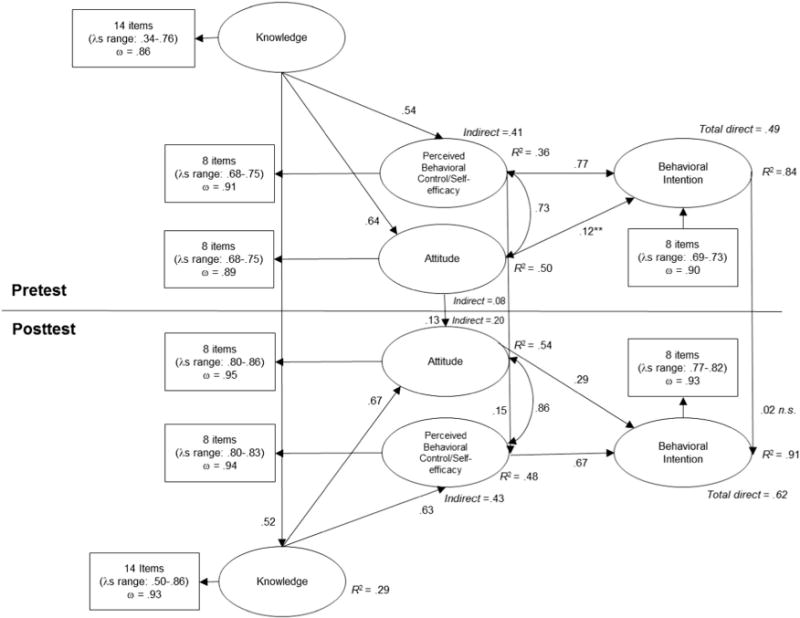
Standardized structural equation modeling results for proposed modified theory of planned behavior model for adolescents’ (N = 2503) workplace safety and health knowledge, attitude, self-efficacy and behavioral intention. ω = omega coefficient (internal consistency of reliability); R2 = explained variability in latent outcome variables; λ = standardized factor pattern loading. All standardized factor pattern loadings come from preliminary confirmatory factor analyses conducted prior to structural equation modeling. For simplicity, student-level covariates are not presented in Fig. 1, but are captured in Table 5. Unless noted (n.s. = not significant; ** = significant at p ≤ .01) all paths are statistically significant at p < .001
Indirect effects
Using the final model, tests for indirect effects were conducted of knowledge to behavioral intention at pretest and posttest. The total effect of knowledge on intention is significant at pretest (b = 1.05, p < .001, β = .49) and posttest (b = 1.44, p < .001, β = .62). In terms of indirect paths, a statistically significant indirect effect was found of knowledge to intention via self-efficacy at pretest, b (unstandardized) = 0.88, p < .001, β (standardized) = .41, and posttest, b = 0.98, p < .001 β = .43. There is also a significant indirect effect for knowledge to intention via attitude at pretest, b = 0.17, p < .01, β = .08, and posttest, b = 0.46, p < .001, β = .20. The effect size (indirect effect/total effect, Wen and Fan 2015) for the indirect effect for attitude is .16 at pretest and .32 at posttest. The effect size for self-efficacy is .84 at pretest and .68 at posttest.
Finally, the study tested the conditional model with and without a direct path between knowledge to behavioral intention at pretest and posttest. As hypothesized, there was no significant direct effect for knowledge to behavioral intention at pretest (p = .40) or posttest (p = .98), indicating these paths should be excluded from the final theory of planned behavior model. Furthermore, information criteria are lower for the model without the direct paths from knowledge to behavioral intention (AIC = 115,705.30; BIC = 116,002.39) compared to the model with the direct paths (AIC = 115,707.30; BIC = 116,016.04). These findings provide additional evidence for use of the modified model without the direct behavioral intention-knowledge path at pretest and posttest (see Fig. 1).
Table 5 displays all standardized and unstandardized path and correlation estimates and standard errors for the final model. An analysis of the three student-level covariates suggests that, after receiving the Talking Safety intervention, there are no statistically significant associations with the paying job variable and any of the outcome variables. At posttest, males demonstrated statistically significantly higher attitude towards workplace safety and health than females (b = 0.66, p < .05, β = .04). Hispanics (vs. non-Hispanics) scored statistically significantly lower on the posttest measures of attitude (b = −0.22, p < .01, β = −.09), self-efficacy (b = −0.19, p < .01, β = −.08) as well as on the knowledge measure (b = −0.13, p < .05, β = −.12).
Table 5.
Unstandardized and standardized path and correlation coefficients for adolescents’ (n = 2503) perceptions of and behavioral intention toward workplace safety and health
| Path | Unstandardized
|
Standardized
|
||
|---|---|---|---|---|
| Estimate | Standard error | Estimate | Standard error | |
| Pretest | ||||
| Attitude on | ||||
| Knowledge | 1.39*** | 0.07 | .64*** | .03 |
| Paying job | −0.79* | 0.31 | −.05* | .02 |
| Male | −0.24 | 0.27 | −.02 | .02 |
| Hispanic | 0.57*** | 0.10 | .29*** | .05 |
| Self−efficacy on | ||||
| Knowledge | 1.11*** | 0.07 | .54*** | .04 |
| Paying job | −0.82* | 0.32 | −.06* | .02 |
| Male | 0.20 | 0.29 | .02 | .02 |
| Hispanic | 0.46*** | 0.13 | .24*** | .07 |
| Behavioral intention on | ||||
| Attitude | 0.12** | 0.04 | .12** | .05 |
| Self-efficacy | 0.79*** | 0.05 | .77*** | .05 |
| Paying job | −0.05 | 0.18 | −.00 | .01 |
| Male | 0.05 | 0.20 | .00 | .02 |
| Hispanic | 0.26* | 0.11 | .14* | .06 |
| Attitude with self-efficacy | 19.32*** | 1.09 | .73*** | .03 |
| Posttest | ||||
| Knowledge on | ||||
| Knowledge (pretest) | 0.59*** | 0.06 | .52*** | .05 |
| Paying job | −0.13 | 0.20 | −.02 | .03 |
| Male | −0.27 | 0.16 | −.04 | .02 |
| Hispanic | −0.13* | 0.05 | −.12* | .05 |
| Attitude on | ||||
| Attitude (pretest) | 0.16*** | 0.04 | .13*** | .03 |
| Knowledge | 1.64*** | 0.08 | .67*** | .03 |
| Paying job | −0.16 | 0.37 | −.01 | .02 |
| Male | 0.66* | 0.30 | .04* | .02 |
| Hispanic | −0.22** | 0.06 | −.09** | .03 |
| Self-efficacy on | ||||
| Self-efficacy (pretest) | 0.19*** | 0.04 | .15*** | .03 |
| Knowledge | 1.50*** | 0.09 | .63*** | .03 |
| Paying job | 0.27 | 0.37 | .01 | .02 |
| Male | 0.45 | 0.34 | .03 | .02 |
| Hispanic | −0.19** | 0.06 | −.08** | .03 |
| Behavioral intention on | ||||
| Behavioral intention (pretest) | 0.02 | 0.03 | .02 | .02 |
| Attitude | 0.28*** | 0.07 | .29*** | .07 |
| Self-efficacy | 0.66*** | 0.07 | .67*** | .07 |
| Paying job | 0.08 | 0.24 | < .001 | .01 |
| Male | −0.35 | 0.25 | −.02 | .02 |
| Hispanic | −0.04 | 0.03 | −.02 | .01 |
| Attitude with self-efficacy | 32.25*** | 3.39 | .86*** | .02 |
p < .05;
p < .01;
p < .001
Discussion
In the United States, work is a nearly ubiquitous feature of the teenage experience. Despite this phenomenon, the study of the role of paid work has received limited attention in the adolescent development literature (Staff et al. 2009). Researchers who focus on the topic of adolescent employment have not reached consensus as to whether work is beneficial, deleterious, or neutral with respect to healthy development. Problem behavior among adolescent workers may be more of a function of pre-existing differences among youth than it is an adverse outcome attributable to their employment (Mortimer 2010; Staff et al. 2009). National injury data do demonstrate that teenagers between the ages of 15 and 17 are almost twice as likely as adults over the age of 25 are to be hurt seriously enough on the job to require a trip to the emergency department (CDC 2010). Through a robust evidence base, public health researchers have demonstrated conclusively a worrisome finding: As work is a consistent feature of adolescent life, the increased burden of job injury is a persistent feature of adolescent work.
Given that most workers enter the labor force during their teenage years and are at an increased risk for injuries with long-term implications for adolescent health and development (Graves et al. 2013; Koehoorn et al. 2008), policy and prevention efforts should target this vulnerable population (Sudhinaraset and Blum 2010). The integration of occupational safety and health curriculum into the middle and high school context may increase adolescents’ job knowledge, including knowledge related to the special protections they are afforded under the child labor laws (Rauscher et al. 2010) and competence in dealing with hazards at work. Such a preparation early in life, before entry into the formal labor market, may contribute to a reduced incidence of job-related injuries and illnesses for this vulnerable population (Boini et al. 2017; Schulte et al. 2005).
A foundational curriculum in workplace safety and health, Talking Safety (NIOSH 2015), is currently in use in middle schools and high schools across the country. This study’s primary aim was to evaluate the extent to which pretest and posttest data from 2503 eighth-grade students in the Miami-Dade Public School System, who received Talking Safety in their science classes, reflect the relationships proposed among the modified theory of planned behavior variables (knowledge, attitude, self-efficacy and behavioral intention to enact workplace safety skills). A secondary aim was to provide evidence about the internal structure and reliability of the scores generated by the intervention measures. The study also examined covariates with demonstrated importance in adolescent occupational injury research, including gender (male/female; McCall et al. 2007), ethnicity (Hispanic vs. non-Hispanic; Weller et al. 2003), and experience having had a paying job (yes vs. no; Zierold et al. 2004).
This study suggests that constructs from the modified theory of planned behavior may be useful in explaining middle school students’ knowledge, attitude, self-efficacy and behavioral intention toward workplace safety and health. The findings from the confirmatory factor analyses suggest that pretest and posttest measures each consist of three unique dimensions reflecting the model, with a separate knowledge factor. Internal consistency of reliability estimates are at or above ω = .83 at pretest and posttest. The modified model, which includes the three student-level covariates and was tested with structural equation modeling techniques, demonstrates good fit to the sample data and significant pathways in directions consistent with the theory (refer to Table 5 and Fig. 1 for all path coefficients). The nonsignificant path between pretest/posttest behavioral intention may be due to the high proportion of posttest variance in behavioral intention (R2 = .91) already accounted for by the influence of other variables. Overall, the findings align with the theory of planned behavior, and explain a higher proportion of variance than did results from other adolescent health research that uses the model (Kroshus et al. 2014; Sasson and Mesch 2016). Prior research also supports the value of designing interventions to target behavioral intention—as was the case with the current study—as a means to change behavior (Webb and Sheeran 2006). Thus, the results presented in the current research are encouraging because the structural equation model explains a high proportion of the latent variable variance in the behavioral intention construct.
Furthermore, the significant, positive paths between knowledge and the other theory of planned behavior variables, as well as results from previous adolescent health research (Escribano et al. 2015; Kroshus et al. 2014), suggest the utility of including knowledge as part of a modified theory of planned behavior model. Although the theory has demonstrated its utility in explaining intention to engage (and actual engagement) in a number of health behaviors, the model may be extended to other constructs if they increase the theory’s predictive ability (Ajzen 1991).
Moreover, results from the indirect effect analyses are consistent with a limited body of theory of planned behavior literature suggesting that knowledge is a predictor of intention and behavior conveyed by more proximal mediators (Kaiser and Fuhrer 2003), including self-efficacy and attitude. The non-significant, near-zero direct paths of knowledge to behavioral intention at both pretest and posttest argue against inclusion of this association, findings which are consistent with previous research (Escribano et al. 2015).
The present results also suggest that the indirect effect of knowledge to behavioral intention through self-efficacy is the largest contributor to the total effect of these associations (.84 at pretest and .68 at posttest). Prior theory of planned behavior research with adolescents suggests self-efficacy is a key influencer of adolescent health intentions and behavior (Hasking and Rose 2016; Johnson 2002), and it is an important predictor of and moderator on the effectiveness of school-based, adolescent prevention programs (Hampel et al. 2008; Pössel et al. 2005). However, more adolescent health and injury research, including research in the area of occupational safety and health, is needed to investigate these relationships.
An analysis of the three covariates (gender, ethnicity, ever had a paying job) included in the conditional model suggests that, after receiving the Talking Safety intervention, males demonstrate statistically significantly higher attitude toward workplace safety and health than females. Hispanics (versus non-Hispanic) scored lower on posttest measures of attitude and self-efficacy, as well as on the knowledge measure. Public health researchers point to the need to tailor workplace safety training to adolescents’ unique physical, psychosocial, and demographic characteristics, including race/ethnicity and gender (Zierold and Anderson 2006). This finding is especially important for vulnerable groups, such as Hispanic adolescents who have been shown to be at higher risk (than White youth) for experiencing work-related injuries (Weller et al. 2003) and fatalities (CDC 2010). More work is needed to tailor the Talking Safety program to meet the unique needs and challenges of those adolescents at highest risk for work injury.
Despite encouraging results, limitations are important to note. First, because participants were young and not integrated into the labor force, this study did not assess subjective norm and behavior. It is generally assumed that when designing an intervention based on the theory of planned behavior, researchers should address all model components (Montaño and Kasprzyk 2015). However, it is also typical for researchers to modify and extend the theory, based on the intervention population (e.g., Kroshus et al. 2014; Sasson and Mesch 2016). Prior research also supports the value of designing interventions to target intention—as was the case with the current study—as a means to change behavior (Webb and Sheeran 2006). Thus, the results are encouraging because the final model explains 84% of pretest and 91% of posttest latent variable variance in behavioral intention. More research is needed to understand the causal mechanisms related to how changing adolescents’ knowledge, attitude about, self-efficacy, and intention to enact occupational safety and health skills will lead to improved work injury outcomes.
Another possible limitation of the current study, which has been discussed in previous adolescent health research that uses the theory of planned behavior (Collins and Carey 2007), is that the study measured perceived behavioral control as a single factor. Future research should explore both perceived behavioral control and controllability beliefs to further test their contributions to the model. In the current study, attitude is also a direct measure. Research is currently underway to develop semantic differential scales with adolescents to assess multiple facets of occupational safety and health attitude. Moreover, although the measures were developed with direct input from students, teachers, and safety professionals, future research will explore the feasibility of including elicitation interviews as part of the formative phase of adapting the Talking Safety intervention to target communities (Montaño and Kasprzyk 2015).
Although socioeconomic status (SES) is an important predictor of adolescent health outcomes, including work-place and health related outcomes (Rauscher and Myers 2008), it was not possible to collect this variable at the individual student level. Moreover, due to privacy concerns, information that is more detailed on the types of employment arrangements in which the eighth graders in the sample were or previously had been engaged could not be collected. At young ages, many teens work informally, in childcare or yard work or in a family-owned business (Staff et al. 2009). Federal and state child labor laws provide special protections for youth under the age of 18. However, federal regulations do not cover young people employed in parent-owned businesses, with the exception of the 17 hazardous occupations defined by the U.S. Department of Labor (2013). Research indicates that adolescents working in family-owned business report a higher percentage of severe injuries than those working for a non-family employer (Zierold et al. 2012). Future research is needed to understand the unique training and education needs and challenges of the most vulnerable young workers, including workers from low SES backgrounds and/or who work in family businesses and may be at increased risk for exposure to hazards. Additional psychometric analyses are also needed to test for measurement invariance—whether items have the same meanings for members of different groups, such as boys and girls—using both confirmatory factor analysis (e.g., Cheung and Rensvold 2002) and item response theory techniques (Osterlind and Everson 2009).
Finally, results may not be generalizable beyond the current research. A multisite, cluster randomized trial is underway in another large, urban school district to assess the causal pathways of a modified theory of planned behavior that measures adolescents’ workplace safety and health knowledge, attitude, self-efficacy, and behavioral intention to enact workplace safety skills.
Conclusion
In the United States, the vast majority of youth work. Labor force participation is a defining feature of adolescence for most American teenagers. A robust body of research explores both the benefits and the hazards of teen work, which include the risk of being seriously injured on the job. Public health researchers have established a substantial evidence base over the past several decades that brings attention to the serious and enduring problem of job-related injuries among working teens. Workplace injuries may be life altering, have long-term consequences for adolescent health and development, and are all the more tragic because they can be predicted and prevented. Schools can be an important setting for preparing youth for entry into the labor force by providing foundational, workplace safety and health education as part of middle school and high school education. A free curriculum (Talking Safety) developed by the National Institute for Occupational Safety and Health (NIOSH) and its partners is one tool that educators may adopt to provide this essential skills training to adolescents.
This study used the theory of planned behavior (Ajzen 1991) modified to include a knowledge construct and performed confirmatory factor analysis and structural equation modeling to examine 2503 eighth graders’ workplace safety and health knowledge, attitude, self-efficacy and behavioral intention to enact workplace safety skills, pre-to-post instruction on Talking Safety. Findings from the confirmatory factor analyses suggest that pretest and posttest measures each consist of three unique dimensions reflecting the model, with a separate knowledge factor. Reliability estimates are ≥ .83. Moreover, the final structural equation model adequately fits the data. With the exception pretest to posttest behavioral intention, all path coefficients are statistically significant. Self-efficacy is the largest contributor to the total effect of these associations. Knowledge has indirect effects on behavioral intention. The results also suggest that Hispanic youth scored lower on most outcome measures (with the exception of behavioral intention) than non-Hispanics, suggesting a need for tailored and targeted materials to reach these youth.
These findings contribute to the adolescent development research because they provide evidence that a modified theory of planned behavior model can be used to evaluate the effectiveness of a foundational curriculum to change teen’s knowledge, perceptions and behavioral intention to engage in safe and healthful activities at work. School-based, occupational safety and health education may contribute to a future reduction in the burden of adolescent, job-related injury (Boini et al. 2017; Schulte et al. 2005), to ensure that not just work—safe and healthy work— becomes integral to the adolescent experience.
Acknowledgments
We thank our partners in the Miami-Dade Public Schools (M-DCPS) for making this research possible: Mr. Cristian Carranza, Administrative Director, Division of Academics (STEAM); Dr. Ava D. Rosales, Executive Director, and Mr. Dane Jaber, Instructional Supervisor, Department of Mathematics and Science; the M-DCPS School Board. For their reviews of the manuscript, we thank Jeff Reese, PhD, and Fred Danner, PhD, University of Kentucky. For editorial comments, we thank John Lechliter and Jeanette Novakovich, NIOSH.
Funding This work was funded with internal NIOSH research funds.
Biographies
Rebecca J. Guerin PhD, CHES, is a Research Social Scientist at the National Institute for Occupational Safety and Health (NIOSH), part of the Centers for Disease Control and Prevention (CDC). Her major research interests include young worker safety and health, adolescent health, health promotion and education, curriculum and training design, planning, implementation and evaluation, and quantitative research methods.
Michael D. Toland PhD, is an Associate Professor at the University of Kentucky, College of Education. His major research interests include the development, evaluation, and refinement of multi-item instruments using item response theory and factor analytic models, the application of multilevel models to complex data structures, and the evaluation of quantitative techniques.
Andrea H. Okun DrPH, is a Senior Scientist at the National Institute for Occupational Safety and Health (NIOSH), part of the Centers for Disease Control and Prevention (CDC). Her major research interests include young worker safety and health, adolescent health, vulnerable populations, global health, and curriculum/training design, planning, implementation and evaluation.
Liliana Rojas-Guyler PhD, CHES, is an Associate Professor at the University of Cincinnati, Health Promotion and Education Program. Her major research interests include health promotion and education, and minority health issues.
Amy L. Bernard PhD, MCHES, is an Associate Professor at the University of Cincinnati, Health Promotion and Education Program. Her major research interests include health program planning, implementation, and evaluation, HIV/AIDS Prevention, prevention of cardiovascular disease, obesity prevention, and women’s health issues.
Footnotes
Disclaimer
The findings and conclusions in this report are those of the authors and do not necessarily represent the views of the National Institute for Occupational Safety and Health.
Authors’ Contributions
R.G. conceived of the study, collected the data, conducted the statistical analyses and drafted the manuscript. M. T. performed the statistical analyses and assisted with drafting the manuscript. A.O. assisted with the research design, coordination, data collection, and manuscript review. L.R.G. and A.B. participated in the interpretation of the data and manuscript review. All authors read and approved the final manuscript.
Data Sharing Declaration This manuscript’s data will not be deposited.
Compliance with Ethical Standards
Conflict of Interest The authors declare that they have no conflict of interest.
Ethical Approval This research was conducted in accordance with the ethical standards of the NIOSH Institutional Review Board (IRB)/NIOSH Human Research Protection Program (HRPP) and with the 1975 Helsinki declaration as revised in 2000.
References
- Anderson V, Brown S, Newitt H, Hoile H. Long-term outcome from childhood traumatic brain injury: Intellectual ability, personality, and quality of life. Neuropsychology. 2011;25(2):176–184. doi: 10.1037/a0021217. [DOI] [PubMed] [Google Scholar]
- Ajzen I. The theory of planned behavior. Organizational Behavior and Human Decision Processes. 1991;50(2):179–211. doi: 10.1016/0749-5978(91)90020-T. [DOI] [Google Scholar]
- Ajzen I. Perceived behavioral control, self-efficacy, locus of control, and the theory of planned behavior. Journal of Applied Social Psychology. 2002;32(4):665–683. doi: 10.1111/j.1559-1816.2002.tb00236.x. [DOI] [Google Scholar]
- Armitage CJ, Conner M. Efficacy of the theory of planned behavior: A meta-analytic review. The British Journal of Social Psychology/the British Psychological Society. 2001;40(Pt 4):471–499. doi: 10.1348/014466601164939. [DOI] [PubMed] [Google Scholar]
- Bandura A. Self-efficacy: The exercise of control. New York, NY: Freeman; 1997. [Google Scholar]
- Bashirian S, Hidarnia A, Allahverdipour H, Hajizadeh E. Application of the theory of planned behavior to predict drug abuse related behaviors among adolescents. Journal of Research in Health Sciences. 2012;12(1):54. [PubMed] [Google Scholar]
- Boini S, Colin R, Grzebyk M. Effect of occupational safety and health education received during schooling on the incidence of workplace injuries in the first 2 years of occupational life: A prospective study. BMJ Open. 2017;7(7) doi: 10.1136/bmjopen-2016-015100. [DOI] [PMC free article] [PubMed] [Google Scholar]
- Buckley L, Sheehan M, Shochet I. Short-term evaluation of a school-based adolescent injury prevention program: Determining positive effects or iatrogenic outcomes. Journal of Early Adolescence. 2010;30:834–853. doi: 10.1177/0272431609361201. [DOI] [Google Scholar]
- Bureau of Labor Statistics. Work activity of high school students: data from the National Longitudinal Survey of Youth 1997. U.S. Department of Labor; 2005. http://www.bls.gov/news.release/archives/nlsyth_04272005.pdf. [Google Scholar]
- Bureau of Labor Statistics. 2016 Survey of occupational injuries & illnesses charts package. U.S. Department of Labor; 2017. https://www.bls.gov/iif/osch0060.pdf. [Google Scholar]
- Bureau of Labor Statistics. Labor force statistics from the current population survey. U.S. Department of Labor; 2018. https://www.bls.gov/cps/cpsaat11b.htm. [Google Scholar]
- Cai L. A two-tier full-information item factor analysis model with applications. Psychometrika. 2010;75(4):581–612. doi: 10.1007/s11336-010-9178-0. [DOI] [Google Scholar]
- Carmack CC, Lewis-Moss RK. Examining the theory of planned behavior applied to condom use: The effect-indicator vs. causal-indicator models. The Journal of Primary Prevention. 2009;30(6):659–676. doi: 10.1007/s10935-009-0199-3. [DOI] [PMC free article] [PubMed] [Google Scholar]
- Cheung GW, Rensvold RB. Evaluating goodness-of-fit indexes for testing measurement invariance. Structural Equation Modeling. 2002;9(2):233. [Google Scholar]
- Cole DA, Preacher KJ. Manifest variable path analysis: Potentially serious and misleading consequences due to uncorrected measurement error. Psychological Methods. 2014;19(2):300–315. doi: 10.1037/a0033805. [DOI] [PubMed] [Google Scholar]
- Collins SE, Carey KB. The theory of planned behavior as a model of heavy episodic drinking among college students. Psychology of Addictive Behaviors. 2007;21(4):498–507. doi: 10.1037/0893-164X.21.4.498. [DOI] [PMC free article] [PubMed] [Google Scholar]
- Comrey AL, Lee HB. A first course in factor analysis. 2nd. Hillsdale, NJ: L. Erlbaum Associates; 1992. [Google Scholar]
- Cunnien KA, MartinRogers N, Mortimer JT. Adolescent work experience and self-efficacy. International Journal of Sociology and Social Policy. 2009;29(3/4):164–175. doi: 10.1108/01443330910947534. [DOI] [PMC free article] [PubMed] [Google Scholar]
- DeVellis RF. Scale development: Theory and applications. 4th. Thousand Oaks, CA: SAGE Publications; 2017. [Google Scholar]
- Escribano S, Espada JP, Morales A, Orgilés M. Mediation analysis of an effective sexual health promotion intervention for spanish adolescents. AIDS and Behavior. 2015;19(10):1850–1859. doi: 10.1007/s10461-015-1163-2. [DOI] [PubMed] [Google Scholar]
- Fisher JD, Fisher WA, Misovich SJ, Kimble DL, Malloy TE. Changing AIDS risk behavior: Effects of an intervention emphasizing AIDS risk reduction information, motivation, and behavioral skills in a college student population. Health Psychology. 1996;15(2):114–123. doi: 10.1037/0278-6133.15.2.114. [DOI] [PubMed] [Google Scholar]
- Gaskin J. Common method bias [Video file] 2011 https://www.youtube.com/watch?v=w7zZCBlRXog.
- Graham JW, Olchowski AE, Gilreath TD. How many imputations are really needed? Some practical clarifications of multiple imputation theory. Prevention Science. 2007;8(3):206–213. doi: 10.1007/s11121-007-0070-9. [DOI] [PubMed] [Google Scholar]
- Graves JM, Sears JM, Vavilala MS, Rivara FP. The burden of traumatic brain injury among adolescent and young adult workers in Washington State. Journal of Safety Research. 2013;45:133–139. doi: 10.1016/j.jsr.2012.11.001. [DOI] [PMC free article] [PubMed] [Google Scholar]
- Greenberger E, Steinberg LD. When teenagers work: The psychological and social costs of teenage employment. New York, NY: Basic Books; 1986. [Google Scholar]
- Guerin RJ, Okun AH, Kelley P. Development and validation of an assessment tool for a national young worker curriculum: Assessment development for a young worker curriculum. American Journal of Industrial Medicine. 2016;59(11):969–978. doi: 10.1002/ajim.22610. [DOI] [PMC free article] [PubMed] [Google Scholar]
- Hampel P, Meier M, Kümmel U. School-based stress management training for adolescents: Longitudinal results from an experimental study. Journal of Youth and Adolescence. 2008;37(8):1009–1024. doi: 10.1007/s10964-007-9204-4. [DOI] [Google Scholar]
- Hasking P, Rose A. A preliminary application of social cognitive theory to nonsuicidal self-injury. Journal of Youth and Adolescence. 2016;45(8):1560–1574. doi: 10.1007/s10964-016-0449-7. [DOI] [PubMed] [Google Scholar]
- Hayduk LA. Structural equation modeling with LISREL: Essentials and advances. Baltimore, MD: Johns Hopkins University Press; 1987. [Google Scholar]
- Helwig AA, Avitable N. School children’s responses on a semantic differential over a 10-year span. Psychological Reports. 2004;95(1):345–354. doi: 10.2466/pr0.95.1.345-354. [DOI] [PubMed] [Google Scholar]
- Herbert PC, Lohrmann DK. It’s all in the delivery! An analysis of instructional strategies from effective health education curricula. Journal of School Health. 2011;81(5):258–264. doi: 10.1111/j.1746-1561.2011.00586.x. [DOI] [PubMed] [Google Scholar]
- Hirschman C, Voloshin I. The structure of teenage employment: Social background and the jobs held by high school seniors. Research in Social Stratification and Mobility. 2007;25(3):189–203. doi: 10.1016/j.rssm.2007.07.001. [DOI] [PMC free article] [PubMed] [Google Scholar]
- Hooper D, Coughlan J, Mullen M. Structural equation modelling: Guidelines for determining model fit. Electronic Journal of Business Research Methods. 2008;6(1):53–60. [Google Scholar]
- Hox JJ, Borgers N, Dirk S. Response effects in surveys on children and adolescents: The effect of number of response options, negative wording, and neutral mid-point. Quality and Quantity. 2004;38(1):17–33. doi: 10.1023/B:QUQU.0000013236.29205.a6. [DOI] [Google Scholar]
- Hu L, Bentler PM. Cutoff criteria for fit indexes in covariance structure analysis: Conventional criteria versus new alternatives. Structural Equation Modeling. 1999;6(1):1. doi: 10.1080/10705519909540118. [DOI] [Google Scholar]
- Johnson RL. Pathways to adolescent health: Early intervention. Journal of Adolescent Health. 2002;31(6):240–250. doi: 10.1016/S1054-139X(02)00497-4. [DOI] [PubMed] [Google Scholar]
- Kaiser FG, Fuhrer U. Ecological behavior’s dependency on different forms of knowledge. Applied Psychology an International Review. 2003;52(4):598–613. doi: 10.1111/1464-0597.00153. [DOI] [Google Scholar]
- Kline RB. Principles and practice of structural equation modeling. 4th. New York, NY: The Guilford Press; 2016. [Google Scholar]
- Koehoorn M, Breslin FC, Xu F. Investigating the longer-term health consequences of work-related injuries among youth. Journal of Adolescent Health. 2008;43(5):466–473. doi: 10.1016/j.jadohealth.2008.04.012. [DOI] [PubMed] [Google Scholar]
- Kroshus E, Baugh CM, Daneshvar DH, Viswanath K. Understanding concussion reporting using a model based on the theory of planned behavior. Journal of Adolescent Health. 2014;54(3):269–274. doi: 10.1016/j.jadohealth.2013.11.011. [DOI] [PubMed] [Google Scholar]
- Linker D, Miller ME, Freeman KS, Burbacher T. Health and safety awareness for working teens: Developing a successful, statewide program for educating teen workers. Family & Community Health. 2005;28(3):225–238. doi: 10.1097/00003727-200507000-00004. [DOI] [PubMed] [Google Scholar]
- Mardis AL, Pratt SG. Nonfatal injuries to young workers in the retail trades and services industries in 1998. Journal of Occupational and Environmental Medicine. 2003;45(3):316–323. doi: 10.1097/01.jom.0000052964.43131.8a. [DOI] [PubMed] [Google Scholar]
- McCall BP, Horwitz IB, Carr BS. Adolescent occupational injuries and workplace risks: An analysis of oregon workers’ compensation data 1990–1997. Journal of Adolescent Health. 2007;41(3):248–255. doi: 10.1016/j.jadohealth.2007.02.004. [DOI] [PubMed] [Google Scholar]
- Miami-Dade Public Schools. 2018 http://www.dadeschools.net/
- Miara C, Gallagher S, Bush D, Dewey R. Developing an effective tool for teaching teens about workplace safety. American Journal of Health Education. 2003;34(sup 5):S-30. [Google Scholar]
- Montaño DE, Kasprzyk D. Theory of reasoned action, theory of planned behavior, and the integrated behavioral model. In: Glanz K, Rimer BK, Viswanath K, editors. Health behavior and health education: Theory, research, and practice. 5th. Philadelphia, PA: John Wiley & Sons; 2015. pp. 95–124. [Google Scholar]
- Mortimer JT. The benefits and risks of adolescent employment. Prevention Researcher. 2010;17(2):8. [PMC free article] [PubMed] [Google Scholar]
- Murnaghan DA, Blanchard CM, Rodgers WM, LaRosa JN, MacQuarrie CR, MacLellan DL, Gray BJ. Predictors of physical activity, healthy eating and being smoke-free in teens: A theory of planned behavior approach. Psychology and Health. 2010;25(8):925–941. doi: 10.1080/08870440902866894. [DOI] [PubMed] [Google Scholar]
- Muthén LK, Muthén BO. Mplus User’s Guide. 7th 1998–2017. [Google Scholar]
- Okun AH, Guerin RJ, Schulte PA. Foundational workplace safety and health competencies for the emerging workforce. Journal of Safety Research. 2016;59:43–51. doi: 10.1016/j.jsr.2016.09.004. [DOI] [PMC free article] [PubMed] [Google Scholar]
- Osterlind SJ, Everson HT. Quantitative applications in the social sciences: Differential item functioning. Thousand Oaks, CA: Sage; 2009. [DOI] [Google Scholar]
- Pisaniello DL, Stewart SK, Jahan N, Pisaniello SL, Winefield H, Braunack-Mayer A. The role of high schools in introductory occupational safety education – teacher perspectives on effectiveness. Safety Science. 2013;55:53–61. doi: 10.1016/j.ssci.2012.12.011. [DOI] [Google Scholar]
- Podsakoff PM, MacKenzie SB, Lee J, Podsakoff NP. Common method biases in behavioral research: A critical review of the literature and recommended remedies. Journal of Applied Psychology. 2003;88(5):879–903. doi: 10.1037/0021-9010.88.5.879. [DOI] [PubMed] [Google Scholar]
- Pössel P, Baldus C, Horn AB, Groen G, Hautzinger M. Influence of general self-efficacy on the effects of a school-based universal primary prevention program of depressive symptoms in adolescents: A randomized and controlled follow-up study. Journal of Child Psychology and Psychiatry. 2005;46(9):982–994. doi: 10.1111/j.1469-7610.2004.00395.x. [DOI] [PubMed] [Google Scholar]
- Rauscher KJ, Myers DJ. Socioeconomic disparities in the prevalence of work-related injuries among adolescents in the United States. Journal of Adolescent Health. 2008;42(1):50–57. doi: 10.1016/j.jadohealth.2007.08.003. [DOI] [PubMed] [Google Scholar]
- Rauscher KJ, Runyan CW, Schulman MD, Bowling JM. U.S. child labor violations in the retail and service industries: Findings from a national survey of working adolescents. American Journal of Public Health. 2008;98(9):1693–1699. doi: 10.2105/AJPH.2007.122853. [DOI] [PMC free article] [PubMed] [Google Scholar]
- Rauscher KJ, Runyan CW, Schulman M. Awareness and knowledge of the U.S. child labor laws among a national sample of working adolescents and their parents. Journal of Adolescent Health. 2010;47(4):414–417. doi: 10.1016/j.jadohealth.2010.02.014. [DOI] [PubMed] [Google Scholar]
- Rimal RN. Closing the knowledge-behavior gap in health promotion: The mediating role of self-efficacy. Health Communication. 2000;12(3):219–237. doi: 10.1207/S15327027HC1203_01. [DOI] [PubMed] [Google Scholar]
- Rimm-Kaufman SE, Larsen RAA, Baroody AE, Curby TW, Ko M, Thomas JB, DeCoster J. Efficacy of the responsive classroom approach: Results from a 3-year, longitudinal randomized controlled trial. American Educational Research Journal. 2014;51(3):567–603. doi: 10.3102/0002831214523821. [DOI] [Google Scholar]
- Runyan CW, Schulman M, Dal Santo J, Bowling JM, Agans R, Ta M. Work-related hazards and workplace safety of US adolescents employed in the retail and service sectors. Pediatrics. 2007;119(3):526–534. doi: 10.1542/peds.2006-2009. [DOI] [PubMed] [Google Scholar]
- Runyan CW, Lewko J, Rauscher K. Setting an agenda for advancing young worker safety in the U.S. and Canada. Public Health Reports. 2012;127(3):246–252. doi: 10.1177/003335491212700303. [DOI] [PMC free article] [PubMed] [Google Scholar]
- Sasson H, Mesch G. Gender differences in the factors explaining risky behavior online. Journal of Youth and Adolescence. 2016;45(5):973. doi: 10.1007/s10964-016-0465-7. [DOI] [PubMed] [Google Scholar]
- Schulte PA, Stephenson CM, Okun AH, Palassis J, Biddle E. Integrating occupational safety and health information into vocational and technical education and other workforce preparation programs. American Journal of Public Health. 2005;95(3):404–411. doi: 10.2105/AJPH.2004.047241. [DOI] [PMC free article] [PubMed] [Google Scholar]
- Staff J, Messersmith EE, Schulenberg JE. Adolescents and the world of work. In: Lerner R, Steinberg L, editors. Handbook of adolescent psychology. 3rd. New York, NY: Wiley; 2009. pp. 270–313. [DOI] [Google Scholar]
- Stapleton LM, McNeish DM, Yang JS. Multilevel and single-level models for measured and latent variables when data are clustered. Educational Psychologist. 2016;51(3–4):317–330. [Google Scholar]
- Steinberg L. A social neuroscience perspective on adolescent risk-taking. Developmental Review. 2008;28(1):78–106. doi: 10.1016/j.dr.2007.08.002. [DOI] [PMC free article] [PubMed] [Google Scholar]
- Steinberg L, Dornbusch SM. Negative correlates of part-time employment during adolescence: Replication and elaboration. Developmental Psychology. 1991;27(2):304–313. doi: 10.1037/0012-1649.27.2.304. [DOI] [Google Scholar]
- Steinberg L, Fegley S, Dornbusch SM. Negative impact of part-time work on adolescent adjustment: Evidence from a longitudinal study. Developmental Psychology. 1993;29(2):171–180. doi: 10.1037/0012-1649.29.2.171. [DOI] [Google Scholar]
- Sudhinaraset M, Blum RW. The unique developmental considerations of youth-related work injuries. International Journal of Occupational and Environmental Health. 2010;16(2):216–222. doi: 10.1179/107735210799160372. [DOI] [PubMed] [Google Scholar]
- Toland MD, Sulis I, Giambona F, Porcu M, Campbell JM. Introduction to bifactor polytomous item response theory analysis. Journal of School Psychology. 2017;60:41–63. doi: 10.1016/j.jsp.2016.11.001. [DOI] [PubMed] [Google Scholar]
- Tucker S, Turner N. Waiting for safety: Responses by young Canadian workers to unsafe work. Journal of Safety Research. 2013;45:103–110. doi: 10.1016/j.jsr.2013.01.006. [DOI] [PubMed] [Google Scholar]
- U.S. Centers for Disease Control and Prevention. Occupational injuries and deaths among younger workers: United States, 1998–2007. Morbidity and Mortality Weekly Report. 2010;59(15):449–455. [PubMed] [Google Scholar]
- U.S. Department of Labor, Wage and Hour Division. The hazardous occupations orders (HOs) for nonagricultural employment. 2013 https://www.dol.gov/whd/regs/compliance/childlabor101_text.htm.
- U.S. Department of Health and Human Services, Centers for Disease Control and Prevention, National Institute for Occupational Safety and Health. Promoting safe work for young workers: A community-based approach (DHHS [NIOSH] Publication No 1999-141) Cincinnati, OH: National Institute for Occupational Safety and Health; 1999. [Google Scholar]
- U.S. Department of Health and Human Services, Centers for Disease Control and Prevention, National Institute for Occupational Safety and Health. Youth@Work—talking safety: A safety and health curriculum for young workers, Nebraska edition (DHHS [NIOSH] Publication No 2015-145) Cincinnati, OH: National Institute for Occupational Safety and Health; 2015. [Google Scholar]
- Webb TL, Sheeran P. Does changing behavioral intentions engender behavior change? A meta-analysis of the experimental evidence. Psychological Bulletin. 2006;132(2):249–268. doi: 10.1037/0033-2909.132.2.249. [DOI] [PubMed] [Google Scholar]
- Weller NF, Cooper SP, Tortolero SR, Kelder SH, Hassan S. Work-related injury among south Texas+middle school students: Prevalence and patterns. Southern Medical Journal. 2003;96(12):1213–1220. doi: 10.1097/01.SMJ.0000077063.17684.6D. [DOI] [PubMed] [Google Scholar]
- Wen Z, Fan X. Monotonicity of effect sizes: Questioning kappa-squared as mediation effect size measure. Psychological Methods. 2015;20(2):193–203. doi: 10.1037/met0000029. [DOI] [PubMed] [Google Scholar]
- Weston R, Gore PA. A brief guide to structural equation modeling. The Counseling Psychologist. 2006;34(5):719–751. doi: 10.1177/0011000006286345. [DOI] [Google Scholar]
- Wiium N, Breivik K, Wold B. The relationship between smoker role models and intentions to smoke among adolescents. Journal of Youth and Adolescence. 2006;35(4):549–560. doi: 10.1007/s10964-006-9065-2. [DOI] [Google Scholar]
- Yu CY. Evaluating cutoff criteria of model fit indices for latent variable models with binary and continuous outcome. Los Angeles: University of California; 2002. Unpublished doctoral dissertation. [Google Scholar]
- Zierold KM, Anderson HA. Severe injury and the need for improved safety training among working teens. American Journal of Health Behavior. 2006;30(5):525. doi: 10.5555/ajhb.2006.30.5.525. [DOI] [PubMed] [Google Scholar]
- Zierold KM, Garman S, Anderson H. Summer work and injury among middle school students, aged 10-14 years. Occupational and Environmental Medicine. 2004;61(6):518–522. doi: 10.1136/oem.2003.010546. [DOI] [PMC free article] [PubMed] [Google Scholar]
- Zierold KM, Appana S, Anderson HA. Working for mom and dad: Are teens more likely to get injured working in family-owned businesses? Journal of Community Health. 2012;37(1):186–194. doi: 10.1007/s10900-011-9435-x. [DOI] [PubMed] [Google Scholar]
- Zinbarg RE, Yovel I, Revelle W, McDonald RP. Estimating generalizability to a latent variable common to all of a scale’s indicators: A comparison of estimators for ω. Applied Psychological Measurement. 2006;30(2):121–144. doi: 10.1177/0146621605278814. [DOI] [Google Scholar]