


Abstract
The present study aimed to observe whether optical coherence tomography (OCT)-guided angioplasty is able to provide useful clinical information beyond that obtained by angiography as well as provide recommendations for physicians that may improve treatment selection. This prospective study included 83 patients with coronary artery disease (>18 years) undergoing coronary angiography (CAG) for ST-elevation myocardial infarction (n=13), non-ST-elevation myocardial infarction (n=19), stable angina (n=22), unstable angina (n=10), silent ischemia (n=11), or elective percutaneous coronary intervention (n=8). Following the initial CAG (CAG-pre), the patients underwent OCT before angioplasty (OCT-pre, 24 patients), after angioplasty (OCT-post, 22 patients), or both (37 patients). The thrombus burden, calcification and plaque dissection or rupture were compared between the OCT-pre and CAG-pre recordings. Following angioplasty, stent malapposition, suboptimal stent deployment, suboptimal stent lesion coverage, and edge dissection were compared between OCT-post and CAG-post alone. Among the 83 patients, 45.7% had single-vessel and 54.3% had multiple-vessel disease. OCT pre- and post-angioplasty revealed significantly more information on the procedure than CAG alone. This clinical information changed the clinical strategies in 41/83 (49.4%) patients, including 58 modifications of therapeutic strategy (69.9%, 58/83): Thrombus aspiration in 2 cases (2.4%), administration of glycoprotein IIb/IIIa inhibitors in 8 cases (9.6%), additional balloon inflation in 23 cases (27.7%), additional stent implantation in 17 cases (20.5%), avoiding stent implantation in 4 cases (4.8%), collateral intervention in 2 cases (2.4%), and guidewire reposition in 2 cases (2.4%). In conclusion, OCT-pre and OCT-post provided additional clinical information beyond that obtained by angiography alone, which resulted in modification of the treatment strategies in half of the included patients.
Keywords: coronary artery disease, coronary angiography, percutaneous coronary intervention, optical coherence tomography
Introduction
Coronary artery disease (CAD) is one of the most common cardiovascular diseases in the elderly population worldwide (1). Percutaneous coronary intervention (PCI) has become the mainstay invasive therapy for CAD patients (2). Recent advances in interventional cardiology have highlighted the importance of a detailed understanding of the tissue characteristics of coronary atherosclerotic lesions, including the identification of plaque stability, estimation of lesion covering, and tearing degree pre- and post-PCI (3,4). Coronary angiography (CAG) has been considered to be the gold standard diagnostic method for CAD and is widely accepted as a firm basis for determining treatment strategies for PCI (5). However, previous evidence indicated that CAG may not provide accurate images in certain cases and may fail to reflect specific critical characteristics of atherosclerotic lesions or vessel-stent associations in high-risk cases (5–7). Therefore, novel techniques that fully reflect lesion and stent features have been developed in interventional cardiology.
Optical coherence tomography (OCT) is a novel technique that can provide cross-sectional and three-dimensional imaging in vivo with ultra-high resolution (10–20 µm) (8–12). It is a particularly attractive technique because it provides real-time images and microstructural information on the tissues (13,14). Furthermore, it can be used to provide a detailed analysis of the coronary artery wall, including plaque characterization, thin-cap fibroatheroma (TCFA) and vulnerable plaque identification, and assessments of the vascular response to PCI, which may be responsible for acute coronary events (11,12,15–17). Considerable evidence currently indicates that the early use of OCT reveals various abnormal vessel reactions associated with stent implantation, such as stent malapposition, suboptimal stent deployment, thrombus, tissue prolapse, and edge dissection (18,19). Finally, OCT is also helpful for guiding coronary management and interventions, including stent apposition and the early identification of procedure-associated complications (17,20). However, the evaluation of OCT clinical usefulness requires a prospective comparison of the two techniques in a significant number of patients.
The present study, a comparative prospective study of the CAG and OCT findings prior to and/or following PCI, was designed and conducted to investigate whether OCT may provide further information in addition to the traditional CAG and lead to substantial changes in PCI treatment strategies.
Materials and methods
Study population
In the present study, 83 consecutive patients (>18 years old) with CAD scheduled to undergo PCI were recruited prospectively at the Department of Cardiology, University Hospital Jean-Minjoz (Besançon, France) between January 2011 and December 2012. The study was designed to separately analyze the treatment strategy changes that were respectively achieved by OCT performance when performed before or after angioplasty and to determine the possible advantages and inconveniences of performing both. OCT was run before angioplasty, subsequent to the initial CAG in 24 patients (OCT-pre group); or it was run after angioplasty following angiography in 22 patients (OCT-post group); 37 patients underwent OCT both before and after angioplasty (Fig. 1). The protocol was approved by the Ethics Committee of the Regional Health Agency Bourgogne/Franche-Comté (Comité de Protection des Personnes EST II), and all patients provided written informed consent for the OCT-guided and CAG-guided PCI and the follow-up.
Figure 1.

Flow chart of OCT-guided angioplasty and treatment strategy alterations based on the OCT data. OCT, optical coherence tomography; OCT-pre, OCT performed following the initial coronary angiography; OCT-post, OCT performed following angioplasty.
Outcomes
The primary study objective was to determine the percentage of patients in whom an alteration in the procedural treatment strategy was decided based on the information obtained from OCT imaging. This was defined as a change in one or more of the following parameters: i) Additional balloon inflation; ii) implantation of Additional stent(s); iii) use of glycoprotein (GP) IIb/IIIa inhibitors; iv) use of thrombus aspiration; v) use of rotational atherectomy; vi) avoiding stenting.
The secondary objective was to compare the percentages of patients in whom OCT revealed the presence of one or more of the following parameters: Thrombus burden, plaque rupture, spontaneous dissection, and identified calcification (11). These parameters identified respectively by OCT-pre and CAG-pre recordings were compared. Following angioplasty, the incidences of stent malapposition, suboptimal stent deployment, suboptimal lesion coverage, and edge dissection were also compared as recorded by OCT-post vs. post-angioplasty fluoroscopy.
Safety outcomes were assessed according to the procedural duration and perioperative outcomes of OCT, including coronary no-reflow phenomenon as described by Berg and Buhari (21), coronary perforation, occlusive dissection, coronary spasm, stent occlusion, and PCI-associated myocardial infarction (MI).
CAG procedure
CAG was performed via femoral or radial artery access in all patients. Unfractionated heparin (2,500 U; Pharmacia & Upjohn, London, UK) was administered prior to CAG, and a 6F guiding catheter was inserted toward the coronary ostium. Adequate views of the region of interest that avoided vessel foreshortening and side-branch overlap were obtained subsequent to the administration of an intracoronary bolus of nitroglycerin (200 µg; Nitronal Injection, Pohl-Boskamp GmbH & Co., Hohenlockstedt, Germany). Classical qualitative angiographic criteria (11) were used, and the quantitative CAG procedure was performed by experienced personnel using standard methodology (22,23).
OCT evaluation
OCT and CAG examinations were consecutively performed during PCI when a patient fulfilled the following criteria: i) Suitable coronary artery anatomy for OCT evaluation as instructed by the international consensus of clinicians (9,24,25); ii) stable hemodynamics; iii) absence of severe co-morbid conditions, including severe renal or liver dysfunction, or other co-morbidities, such as cancer; iv) no contraindications to iodinated contrast media, aspirin, and/or clopidogrel. However, the OCT was not examined if CAG quality was sufficient for the physician to make a suitable treatment decision. OCT images were acquired using the FD-OCT Optis system (Lightlab Imaging Incorporated, Westford, MA, USA) and 6F guide catheter compatible Dragonfly Duo and Dragonfly Optis catheter (Lightlab Imaging Incorporated). The catheter was introduced into the coronary artery via a standard 0.014-inch angioplasty wire, after prior injection of an intracoronary bolus of nitroglycerin. To remove all blood adequately from the imaging site, nonocclusive flushing was performed using continuously injected contrast medium via an automated power injector, and the OCT catheter was pulled back at a speed of 18 mm/sec to guarantee sufficient time to acquire images of a 54-mm long segment (frame density: 10 frames/mm). When poor image quality was obtained, the pullback was repeated subsequent to modification of the flushing intensity or probe position. The data were then digitally stored for offline analysis (25,26). OCT images were analyzed online and offline using Lightlab software (V1.13, Lightlab Imaging Incorporated). All OCT images were analyzed in University Hospital of Besancon by 2 independent operators blinded to the angiographic findings and procedural strategy. Discordant OCT analyses were resolved by consensus.
Definitions and recommendations for modifying treatment strategies
Various features were determined during the OCT examination according to previously published consensus opinions and studies (9,23–25). Any inner-layer plaque profile discontinuity was considered a plaque rupture. A thrombus was defined as any intraluminal mass of ≥200 µm without vessel wall surface continuity or a highly backscattered luminal protrusion in continuity with the vessel wall resulting in signal-free shadowing. Dissection was confirmed as the presence of a linear rim of tissue with a width of ≥200 µm that was evidently separated from the vessel wall or plaque. Stent malapposition was identified as a distance between the stent and lumen that was greater than the sum of strut thickness plus abluminal polymer thickness; this was considered to be significant if the stent-lumen distance was >200 µm. Suboptimal stent expansion was deemed to be present when the ratio of in-stent minimal lumen area (MLA) to average reference area was <80%.
In accordance with previously published studies (24,26), the following actions and decision changes were recommended when the OCT examination detected abnormalities that were not originally recognized by the angiography results: Edge dissection and narrowing of the referenced lumen required additional stent implantation; stent under-expansion and malapposition required further dilation of the previously implanted stent with a non- or semi-compliant balloon; stent implantation was not indicated in patients with confirmed stenosis of <50% at the thrombosis site without dissection or plaque rupture; platelet GP IIb/IIIa receptor antagonist administered to patients with OCT-detected thrombosis who did not originally receive this medication; thrombus aspiration was indicated in patients with major thrombosis burdens; or guidewire relocation was conducted when the original guidewire was inserted into the false lumen of the dissection or out of the struts of the stent. The clinician decided whether to perform additional interventions.
Statistical analysis
Continuous variables are presented as mean ± standard deviation, whereas categorical variables are expressed as absolute number and percentage. Intergroup differences were assessed using Fisher's exact test or Student's t-test when appropriate. All calculations were performed using SPSS software (version 11.5; SPSS Inc., Chicago, IL, USA), and values of P<0.05 were considered to indicate a statistically significant difference.
Results
Clinical baseline characteristics
The baseline characteristics of all patients are listed in Table I. All patients (38 men, 45 women; mean age, 65.8±11.3 years old) were diagnosed with CAD. The comorbidities, concurrent medications and potential numbers of affected coronary arteries are shown in Tables I and II. Among the 83 patients, 13 with ST-segment elevation myocardial infarction (STEMI) (15.7%), 19 with non-STEMI (22.9%), 22 with stable angina (26.5%), 10 with unstable angina (12.0%), 11 with silent ischemia (13.3%), and 8 with elective percutaneous coronary intervention (9.6%) underwent coronary angiography. More than 50% of the patients had multi-vessel disease (54.3%), including 33 with two-vessel disease (39.8%) and 12 with three-vessel disease (14.5%); only 38 had single-vessel disease (45.7%). Three typical cases demonstrating the advantages of the OCT examination compared with CAG are shown in detail in Figs. 2–4.
Table I.
Baseline patient characteristics (n=83).
| Characteristics | n | % |
|---|---|---|
| Sex | ||
| Male | 38 | 45.8 |
| Female | 45 | 54.2 |
| Hypertension | 49 | 59.04 |
| Dyslipidemia | 48 | 57.83 |
| Diabetes mellitus | 13 | 15.66 |
| Smoker | 37 | 44.58 |
| Obesity | 21 | 25.3 |
| Family history of CVD | 20 | 24.10 |
| Prior history | ||
| Myocardial infarction | 38 | 45.8 |
| Heart failure | 4 | 4.82 |
| Stroke | 3 | 3.61 |
| Renal insufficiency | 11 | 13.25 |
| Valvular heart disease | 9 | 10.84 |
| Angioplasty | 38 | 45.8 |
| CABG | 2 | 2.41 |
| Indication for coronary angiography | ||
| STEMI | 13 | 15.7 |
| NSTEMI | 19 | 22.9 |
| Stable angina | 22 | 26.5 |
| Unstable angina | 10 | 12.0 |
| Silent ischemia | 11 | 13.3 |
| Elective PCI | 8 | 9.6 |
| Extent of disease | ||
| Single-vessel disease | 38 | 45.7 |
| Two-vessel disease | 33 | 39.8 |
| Three-vessel disease | 12 | 14.5 |
CVD, cardiovascular diseases; CABG, coronary artery bypass grafting; STEMI, ST-segment elevation myocardial infarction; NSTEMI, non-STEMI; PCI, percutaneous coronary intervention.
Table II.
Treatment of the included patients pre- and/or post-angioplasty (n=83).
| Prior to procedure, n (%) | Following procedure, n (%) | P-value | |
|---|---|---|---|
| Aspirin | 83 (100) | 83 (100) | NS |
| Thienopyridines | |||
| Clopidogrel | 71 (85.5) | 71 (85.5) | NS |
| Prasugrel | 10 (12.1) | 10 (12.1) | NS |
| Ticagrelor | 2 (2.4) | 2 (2.4) | NS |
| Anticoagulant | |||
| Unfractionated heparin | 77 (92.8) | 77 (92.8) | NS |
| Enoxaparin | 2 (2.4) | 2 (2.4) | NS |
| Bivalirudin | 4 (4.8) | 4 (4.8) | NS |
| Glycoprotein IIb/IIa inhibitor | |||
| Tirofiban | 1 (1.2) | 3 (3.6) | 0.37 |
| Abciximab | 2 (2.4) | 10 (12.0) | 0.036 |
| Eptifibatide | 2 (2.4) | 11 (13.3) | 0.018 |
NS, not significant.
Figure 2.

Comparisons of CAG and OCT findings in a patient with variant angina. (A) CAG image showing vascular stenosis (arrow) in the middle segment of the left anterior descending artery. (B) OCT image showing vascular stenosis with a thrombus along the vessel wall in situ without significant atherosclerotic lesions. The patient's symptoms were relieved by the administration of nitroglycerin. Therefore, coronary thrombosis with occasional coronary spasms was considered in this patient following the OCT examination. Accordingly, stent implantation was not conducted and the clinical treatment strategy was changed to the administration of glycoprotein IIb/IIIa receptor inhibitor and antispasmodic medications. Follow-up demonstrated treatment efficacy. CAG, coronary angiography; OCT, optical coherence tomography
Figure 4.
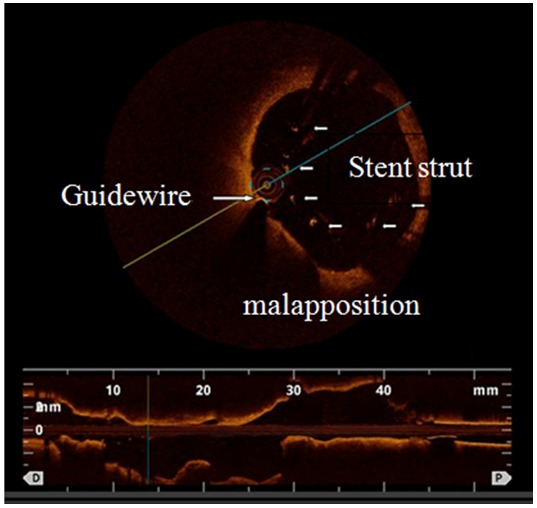
OCT image obtained at 6 months of follow-up in a patient with stent malapposition in the left anterior descending artery. Coronary angiography revealed stenosis distal to the stent; however, OCT identified stent malapposition, endothelial uncovering on the struts of the stent, and that the guidewire (arrow) was protruding beyond the stent. The treatment strategy consisted of guidewire repositioning. OCT, optical coherence tomography.
Qualitative data provided by OCT and CAG prior to and following angioplasty
The qualitative analysis results of the CAG and OCT images pre- and post-PCI are shown in Table III. A flowchart of the OCT-guided angioplasty and OCT-based changes in treatment strategy is also provided in Fig. 1. Among the 83 patients, a total of 61 patients underwent OCT before angioplasty (24 patients received only OCT pre-guided angioplasty and 37 patients received OCT pre- and post-guided angioplasty) and 59 patients underwent OCT following angioplasty (22 patients received only OCT post-guided angioplasty and 37 patients received OCT pre- and post-guided angioplasty). Prior to PCI, compared with CAG, OCT was more sensitive for plaque rupture (0 vs. 10 cases; P=0.007), diagnosing thrombus (9 vs. 20 cases; P=0.0162), dissection (4 vs. 12 cases; P=0.0289), and calcification (15 vs. 49 cases; P<0.001). Subsequent to PCI, compared with CAG, OCT was again more sensitive for the diagnosis of thrombus (1 vs. 24 cases; P<0.001), stent edge dissection (5 vs. 32 cases; P<0.001), stent malapposition (1 vs. 42 cases; P<0.001), intimal tissue protrusion (8 vs. 49 cases;P<0.001), suboptimal stent expansion (15 vs. 29 cases; P=0.0065), stent incomplete lesion coverage (11 vs. 20 cases; P=0.0467) and stent struts coverage bifurcation (0 vs. 35 cases; P<0.001).
Table III.
Qualitative data provided by CAG and OCT pre- and post-angioplasty.
| A, Pre-angioplasty (n=61) | |||
|---|---|---|---|
| Variable | CAG, n (%) | OCT, n (%) | P-value |
| Plaque rupture | 0 (0.0) | 10 (16.4) | 0.0007 |
| Thrombus | 9 (14.8) | 20 (32.8) | 0.0162 |
| Dissection | 4 (6.6) | 12 (19.7) | 0.0289 |
| Calcification | 15 (24.6) | 49 (80.3) | <0.0001 |
| Guidewire into the false lumen | 0 (0.0) | 1 (1.7) | NS |
| Guidewire through outside of stent | 0 (0.0) | 1 (1.7) | NS |
| B, Post-angioplasty (n=59) | |||
| Variable | CAG, n (%) | OCT, n (%) | P-value |
| Thrombus | 1 (1.7) | 24 (40.7) | <0.0001 |
| Dissection | 5 (8.5) | 32 (54.2) | <0.0001 |
| Stent malapposition | 1 e(1.7) | 42 (71.19) | <0.0001 |
| Intimal tissue protruding | 8 (13.6) | 49 (83.1) | <0.0001 |
| Suboptimal stent expansion | 15 (25.4) | 29 (49.2) | 0.0065 |
| Incomplete Lesion coverage | 11 (18.6) | 20 (33.9) | 0.0467 |
| Stent coverage bifurcation | 40 (67.8) | 40 (67.8) | NS |
| Stent strut coverage bifurcation | 0 (0.0) | 35 (59.3) | <0.0001 |
CAG, coronary angiography; OCT, optical coherence tomography; NS, not significant.
Quantitative characteristics provided by OCT and CAG prior to and following angioplasty
The target vessel and lesion characteristics detected pre- and post-PCI are shown in Table IV. Prior to PCI, the lesion diameter and ratio of diameter stenosis identified by OCT were significantly different from those measured by CAG (1.7±0.6 mm vs. 1.3±0.6 mm and 47.1±0.4% vs. 57.0±16.9%, respectively; P<0.001); after PCI, the stent diameter and ratio of diameter stenosis on OCT were significantly different from those measured by CAG (3.0±0.6 mm vs. 2.6±0.5 mm and 10.0±8.3% vs. 14.3.0±8.0%, respectively; P<0.001). The reference vessel diameter measured by OCT was not significantly different from that measured by CAG (3.3±1.7 vs. 3.0±0.9 mm and 3.3±1.5 vs. 3.0±0.6 mm, respectively; P>0.050) both before and after PCI. All vessel cross-sectional areas that could not be measured directly by CAG were also obtained by OCT.
Table IV.
Quantitative characteristics of potentially affected vessels and lesions as provided by CAG and OCT pre- and post-angioplasty.
| A, Pre-angioplasty results (n=61) | |||
|---|---|---|---|
| Variable | CAG | OCT | P-value |
| Lesion diameter (mm) | 1.3±0.6 | 1.7±0.6 | <0.0001 |
| Reference vessel diameter (mm) | 3.0±0.9 | 3.3±1.7 | NS |
| Ratio of diameter stenosis (%) | 57.0±16.9 | 47.1±0.4 | <0.0001 |
| Lesion area (mm2) | – | 2.8±0.6 | – |
| Reference vessel area (mm2) | – | 8.7±2.9 | – |
| Ratio of area stenosis (%) | – | 67.4±0.2 | – |
| B, Post-angioplasty results (n=59) | |||
| Variable | CAG | OCT | P-value |
| Stent diameter (mm) | 2.6±0.5 | 3.0±0.6 | 0.0002 |
| Reference vessel diameter (mm) | 3.0±0.6 | 3.3±1.5 | NS |
| Ratio of diameter stenosis (%) | 14.3±8.0 | 10.0±8.3 | 0.0052 |
| Stent area (mm2) | – | 7.2±2.6 | – |
| Reference vessel area (mm2) | – | 9.0±4.6 | – |
| Ratio of area stenosis (%) | – | 19.9±3.6 | – |
CAG, coronary angiography; OCT, optical coherence tomography; NS, not significant.
Treatment strategy changes based on OCT
Alterations in the treatments provided the patients due to the additional information obtained by OCT images are listed in Table V. The reason for the changes in treatment strategies based on the OCT findings were as follows: Thrombus detection, for which 2 patients were treated with thrombus aspiration and 8 with GP IIb/IIIa inhibitors, while 4 patients avoided stent implantations; dissection detection, for which 11 patients received additional stent implantation; stent malapposition observation, for which 1 patient received additional stent implantation and 11 received additional balloon inflation; suboptimal stent expansion, for which 12 patients were treated with additional balloon inflation; plaque rupture, for which 2 patients were treated with additional stent implantation; stent incomplete coverage lesion detection, for which 3 patients received additional stent implantation; stent coverage bifurcation, for which 2 patients received bifurcation intervention; and guidewire translocation, for which 2 patients were treated by guidewire repositioning. Therefore, there were 58 modifications of the therapeutic strategy in total. Because, in some cases, several types of changes of strategy intervened in a single patient treatment changes occurred in 41 patients among the 83 patients included in the study (i.e., 49.4% of patients). The 41 patients with the treatment strategy changes included 8 (9.6%, 8/83) whose therapy modification was based on OCT-pre data only, 26 (31.3%, 26/83) whose therapy modification was based on OCT-post data only, and 7 (8.4%, 7/83) whose therapy modification was based on both (Fig. 1).
Table V.
Treatment strategy changes based on the optical coherence tomography data (n=83).
| Number of person-times | Thrombus aspiration | Use of GP IIb/IIIa inhibitors | Additional balloon inflation | Additional stent implantation | Avoiding stent implantation | Guidewire repositioning | Bifurcation intervention | Total |
|---|---|---|---|---|---|---|---|---|
| Thrombus, n | 2 | 8 | 4 | 14 | ||||
| Dissection, n | 11 | 11 | ||||||
| Malapposition, n | 11 | 1 | 12 | |||||
| Suboptimal stent expansion, n | 12 | 12 | ||||||
| Plaque rupture, n | 2 | 2 | ||||||
| Stent incomplete coverage lesions, n | 3 | 3 | ||||||
| Stent coverage bifurcation, n | 2 | 2 | ||||||
| Guidewire translocation, n | 2 | 2 | ||||||
| Total strategy modification, n | 2 | 8 | 23 | 17 | 4 | 2 | 2 | 58 |
| Strategy modification percentage, % | 2.4 | 9.6 | 27.7 | 20.5 | 4.8 | 2.4 | 2.4 | 69.9 |
GP, glycoprotein.
Safety outcomes
The mean procedural duration was 48.5±23.5 min for OCT and 12.5±8.1 min for CAG. One patient experienced a coronary spasm during the OCT examination that was relieved following the administration of coronary dilative medication. No perioperative complications of no-reflow, coronary perforation, occlusive dissection, stent occlusion, or PCI-associated MI were observed.
Discussion
Although CAG is widely considered the gold standard for the diagnosis of CAD as well as a primary examination for guiding PCI procedures and judging coronary intervention success (5,27,28), studies have suggested that its use alone may miss important information. Such studies have claimed that treatment strategies would be modified if the OCT examination was used with or instead of CAG (27,29). A previous study demonstrated that OCT use may lead to a change in procedural strategy in 50% of patients in the patients with non-ST-segment elevation acute coronary syndromes (11). Therefore, the present study prospectively compared CAG- and OCT-guided interventional therapies for CAD performed before and/or after the angioplasty procedure and confirmed that evaluating CAD patients with OCT compared with CAG provided additional clinical information for the diagnosis and guiding of PCI therapy. This finding highly suggests that OCT may be necessary for complex lesions in which the correlation between vascular lesions, vessel walls, and stents is not accurately detected by CAG. Thus, the current study findings support the results of the previous studies and indicate that the use of OCT provides crucial information that may modify the treatment strategies in CAD.
However, the present study had certain limitations. Firstly, the number of included cases is relatively small since it was a pilot observational prospective study whose design included data form only 37 patients with both OCT-pre and post-angioplasty; the other patient data was for either OCT-pre or post-angioplasty only. The potential middle- and long-term clinical benefits of OCT-guided PCI compared with the CAG-guided PCI should be confirmed in a large randomized controlled trial. The patients included in the current study were followed up for a limited duration; therefore, the study is currently unable to evaluate the effect of OCT-guided PCI on clinical outcomes. To the best of our knowledge, there is no study comparing the effect of OCT-guided PCI with angiography-guided PCI on the clinical outcome of patients with CAD. A recently published trial identified that OCT-guided PCI was safe and resulted in similar minimum stent area to that of angiography-guided PCI (16).
Previous studies suggested that, despite the limitation of OCT images to a depth of 2–3 mm (29), the high resolution of OCT results in higher sensitivity compared with CAG for identifying lesion characteristics (30,31); thus, it may be a potentially powerful tool to guide PCI. The present prospective study confirmed that OCT was more sensitive for detecting small thrombi along the vessel walls that are difficult to detect by CAG, particularly when the thrombus was crushed by balloons following PCI (29,30). In the present study, 2.4% of patients required thrombus aspiration, 9.6% required administration of a GP IIb/IIIa receptor antagonist, and 4.8% avoided stent implantation when a thrombus with <50% stenosis was identified by OCT, which would be neglected and be considered stenosis by angiography. In addition, OCT appeared to be helpful in patients with vascular dissection (30,32). The current results revealed that OCT compared with CAG indicated a higher prevalence of dissection as was suggested in previous studies (33,34).
OCT performed after angioplasty is better able to demonstrate the stent-vessel wall association as well as visualize individual stent struts and their distance from the vessel wall (10,17,27,35). The present study results indicated that dissections were not identified by CAG; however, they were detected by OCT. Considering that stent malapposition is an important reason for late stent thrombosis (33,34), OCT-guided PCI may reduce the risk of late thrombosis, although this finding requires further confirmation in large randomized controlled trials. OCT is also capable of detecting plaque rupture and intracoronary thrombus (36). Although CAG and OCT can both be used to locate lesions and estimate their pre- and post-PCI severity, OCT is more accurate in comparison with CAG for these purposes (33,34). The present study observed that the reference vessel diameter measured by OCT was larger compared with that measured by CAG. Therefore, the data provided by OCT may assist physicians to select a larger stent than when guided by CAG, thus avoiding stent malapposition.
In the current study, the use of OCT enabled the detection of guidewire translocation in two patients. The guidewire had entered the false lumen of the dissection in one patient, while it had passed through the stent mesh and became positioned between the struts and vascular intima in the other case. Evidently, OCT-guided PCI may reduce these risks by the early detection of guidewire translocation. However, whether these advantages actually translate into clinical benefits has yet to be determined by long-term studies.
A previous study indicated that OCT may not increase periprocedural complications, including coronary no-reflow, coronary perforation, occlusive dissection, and stent occlusion (37). However, those complications were not observed in the current study when either imaging procedure was performed.
In conclusion, the evaluation of CAD patients with OCT compared with CAG provided additional clinical information for the diagnosis and guidance of PCI therapy. Therefore, for cases with unclear images prior to and following angioplasty, it is suggested that an OCT examination should be conducted to further clarify the correlation between vascular lesions, vessel walls, and stents. However, future prospective long-term studies are required to confirm whether the systematic application of OCT, which significantly increases the procedure time as it is currently performed, would improve the long-term prognosis of these patients.
Figure 3.

Comparison of OCT and CAG findings in patients after the implantation of a single stent in the proximal LAD. (A and B) CAG images demonstrating no residual stenosis in the ostium of the LAD post-stent implantation (marked as *) and 40% stenosis in the distal edge of the stent (marked as **). (C) OCT image showing the ostium of LAD (marked as *) in which incomplete expansion with malapposition was found by OCT. (D) OCT image showing the distal edge of the stent (marked as *) and edge dissection with stenosis. The treatment strategy was adjusted to the implantation of another stent at the distal edge of the original stent, while the proximal portion of the original stent in the ostium of LAD was deflated by a high-pressure balloon. CAG, coronary angiography; OCT, optical coherence tomography; LAD, left anterior descending artery.
Acknowledgements
The authors would like to thank Professor Emeritus Dominique Angèle Vuitton (University Bourgogne Franche-Comté, Besancon, France) for her help in correcting the manuscript.
Funding
No external funding sources were used for the present study. Dr Jianfeng Huang was funded in part by the Scholarship program in Science and Technology Department, Consulate General of France in Shanghai, China and by Servier International, Paris, France.
Availability of data and materials
The datasets used and/or analyzed during the current study are available from the corresponding author on reasonable request.
Authors' contributions
JH was involved in the acquisition and analysis of data, and in the preparation and revision of the manuscript at all stages; KB, MC and RC were involved in performing the coronary angiography, including optical coherence tomography in the patients included in the study and in recording the data; MW and XC were involved in the analysis of data and preparation of the manuscript; FE was involved in the design of the study and in the preparation and revision of the manuscript; FS and NM were involved in the design of the study, in the submission of the study to the ethical committee, in performing the coronary angiography in the patients and in the revision of the manuscript.
Ethics approval and consent to participate
The protocol was approved by the Ethics Committee of the Regional Health Agency Bourgogne/Franche-Comté (Comité de Protection des Personnes EST II), and all patients provided written informed consent for the OCT-guided and CAG-guided PCI and the follow-up.
Consent for publication
Not applicable.
Competing interests
The authors declare that they have no competing interests.
References
- 1.Ehara S, Hasegawa T, Nakata S, Matsumoto K, Nishimura S, Iguchi T, Kataoka T, Yoshikawa J, Yoshiyama M. Hyperintense plaque identified by magnetic resonance imaging relates to intracoronary thrombus as detected by optical coherence tomography in patients with angina pectoris. Eur Heart J Cardiovasc Imaging. 2012;13:394–399. doi: 10.1093/ehjci/jer305. [DOI] [PMC free article] [PubMed] [Google Scholar]
- 2.Lin GA, Dudley RA, Lucas FL, Malenka DJ, Vittinghoff E, Redberg RF. Frequency of stress testing to document ischemia prior to elective percutaneous coronary intervention. JAMA. 2008;300:1765–1773. doi: 10.1001/jama.300.15.1765. [DOI] [PubMed] [Google Scholar]
- 3.Finn AV, Nakano M, Narula J, Kolodgie FD, Virmani R. Concept of vulnerable/unstable plaque. Arterioscler Thromb Vasc Biol. 2010;30:1282–1292. doi: 10.1161/ATVBAHA.108.179739. [DOI] [PubMed] [Google Scholar]
- 4.Sirker J, Pereira RG, Affleck I. Diffusion and ballistic transport in one-dimensional quantum systems. Phys Rev Lett. 2009;103:216602. doi: 10.1103/PhysRevLett.103.216602. [DOI] [PubMed] [Google Scholar]
- 5.Nakamura M. Angiography is the gold standard and objective evidence of myocardial ischemia is mandatory if lesion severity is questionable. - Indication of PCI for angiographically significant coronary artery stenosis without objective evidence of myocardial ischemia (Pro) Circ J. 2011;75:204–210. doi: 10.1253/circj.CJ-10-0881. discussion 217. [DOI] [PubMed] [Google Scholar]
- 6.Ghosn MG, Leba M, Vijayananda A, Rezaee P, Morrisett JD, Larin KV. Effect of temperature on permeation of low-density lipoprotein particles through human carotid artery tissues. J Biophotonics. 2009;2:573–580. doi: 10.1002/jbio.200810071. [DOI] [PMC free article] [PubMed] [Google Scholar]
- 7.Raffel OC, Merchant FM, Tearney GJ, Chia S, Gauthier DD, Pomerantsev E, Mizuno K, Bouma BE, Jang IK. In vivo association between positive coronary artery remodelling and coronary plaque characteristics assessed by intravascular optical coherence tomography. Eur Heart J. 2008;29:1721–1728. doi: 10.1093/eurheartj/ehn286. [DOI] [PMC free article] [PubMed] [Google Scholar]
- 8.Ghosn MG, Syed SH, Befrui NA, Leba M, Vijayananda A, Sudheendran N, Larin KV. Quantification of molecular diffusion in arterial tissues with optical coherence tomography and fluorescence microscopy. Laser Phys. 2009;19:1272–1275. doi: 10.1134/S1054660X09060152. [DOI] [Google Scholar]
- 9.Tearney GJ, Regar E, Akasaka T, Adriaenssens T, Barlis P, Bezerra HG, Bouma B, Bruining N, Cho JM, Chowdhary S, et al. Consensus standards for acquisition, measurement, and reporting of intravascular optical coherence tomography studies: A report from the international working group for intravascular optical coherence tomography standardization and validation. J Am Coll Cardiol. 2012;59:1058–1072. doi: 10.1016/j.jacc.2011.09.079. [DOI] [PubMed] [Google Scholar]
- 10.Wijns W, Shite J, Jones MR, Lee SW, Price MJ, Fabbiocchi F, Barbato E, Akasaka T, Bezerra H, Holmes D. Optical coherence tomography imaging during percutaneous coronary intervention impacts physician decision-making: ILUMIEN I study. Eur Heart J. 2015;36:3346–3355. doi: 10.1093/eurheartj/ehv367. [DOI] [PMC free article] [PubMed] [Google Scholar]
- 11.Meneveau N, Souteyrand G, Motreff P, Caussin C, Amabile N, Ohlmann P, Morel O, Lefrançois Y, Descotes-Genon V, Silvain J, et al. Optical coherence tomography to optimize results of percutaneous coronary intervention in patients with non-ST-elevation acute coronary syndrome: Results of the multicenter, randomized DOCTORS Study (Does Optical Coherence Tomography Optimize Results of Stenting) Circulation. 2016;134:906–917. doi: 10.1161/CIRCULATIONAHA.116.024393. [DOI] [PubMed] [Google Scholar]
- 12.Porto I, Mattesini A, Valente S, Prati F, Crea F, Bolognese L. Optical coherence tomography assessment and quantification of intracoronary thrombus: Status and perspectives. Cardiovasc Revasc Med. 2015;16:172–178. doi: 10.1016/j.carrev.2015.01.007. [DOI] [PubMed] [Google Scholar]
- 13.Barlis P, Serruys PW, Gonzalo N, van der Giessen WJ, de Jaegere PJ, Regar E. Assessment of culprit and remote coronary narrowings using optical coherence tomography with long-term outcomes. Am J Cardiol. 2008;102:391–395. doi: 10.1016/j.amjcard.2008.03.071. [DOI] [PubMed] [Google Scholar]
- 14.Larin KV, Tuchin VV. Functional imaging and assessment of the glucose diffusion rate in epithelial tissues in optical coherence tomography. Kvantovaya Elektronika. 2008;38:551–556. doi: 10.1070/QE2008v038n06ABEH013850. [DOI] [Google Scholar]
- 15.Bouma BE, Yun SH, Vakoc BJ, Suter MJ, Tearney GJ. Fourier-domain optical coherence tomography: Recent advances toward clinical utility. Curr Opin Biotechnol. 2009;20:111–118. doi: 10.1016/j.copbio.2009.02.007. [DOI] [PMC free article] [PubMed] [Google Scholar]
- 16.Ali ZA, Maehara A, Généreux P, Shlofmitz RA, Fabbiocchi F, Nazif TM, Guagliumi G, Meraj PM, Alfonso F, Samady H, et al. Optical coherence tomography compared with intravascular ultrasound and with angiography to guide coronary stent implantation (ILUMIEN III: OPTIMIZE PCI): A randomised controlled trial. Lancet. 2016;388:2618–2628. doi: 10.1016/S0140-6736(16)31922-5. [DOI] [PubMed] [Google Scholar]
- 17.Di Vito L, Cattabiani MA, Paoletti G, Yoon JH, Chisari A, Gramegna M, Versaci F, Castriota F, Prati F. Comparison between intermediate and severe coronary stenoses and clinical outcomes of an OCT-guided PCI strategy. J Cardiovasc Med (Hagerstown) 2016;17:361–367. doi: 10.2459/JCM.0000000000000280. [DOI] [PubMed] [Google Scholar]
- 18.Gonzalo N, Serruys PW, Okamura T, Shen ZJ, Onuma Y, Garcia-Garcia HM, Sarno G, Schultz C, van Geuns RJ, Ligthart J, Regar E. Optical coherence tomography assessment of the acute effects of stent implantation on the vessel wall: A systematic quantitative approach. Heart. 2009;95:1913–1919. doi: 10.1136/hrt.2009.172072. [DOI] [PubMed] [Google Scholar]
- 19.Kawamori H, Shite J, Shinke T, Otake H, Sawada T, Kato H, Miyoshi N, Yoshino N, Kozuki A, Hariki H, et al. The ability of optical coherence tomography to monitor percutaneous coronary intervention: Detailed comparison with intravascular ultrasound. J Invasive Cardiol. 2010;22:541–545. [PubMed] [Google Scholar]
- 20.Farooq MU, Khasnis A, Majid A, Kassab MY. The role of optical coherence tomography in vascular medicine. Vasc Med. 2009;14:63–71. doi: 10.1177/1358863X08095153. [DOI] [PubMed] [Google Scholar]
- 21.Berg R, Buhari C. Treating and preventing no reflow in the cardiac catheterization laboratory. Curr Cardiol Rev. 2012;8:209–214. doi: 10.2174/157340312803217148. [DOI] [PMC free article] [PubMed] [Google Scholar]
- 22.Stamper D, Weissman NJ, Brezinski M. Plaque characterization with optical coherence tomography. J Am Coll Cardiol. 2006;47:C69–C79. doi: 10.1016/j.jacc.2005.10.067. [DOI] [PubMed] [Google Scholar]
- 23.Bezerra HG, Costa MA, Guagliumi G, Rollins AM, Simon DI. Intracoronary optical coherence tomography: A comprehensive review clinical and research applications. JACC Cardiovasc Interv. 2009;2:1035–1046. doi: 10.1016/j.jcin.2009.06.019. [DOI] [PMC free article] [PubMed] [Google Scholar]
- 24.Windecker S, Hernandez-Antolin RA, Stefanini GG, Wijns W, Zamorano JL. Management of ST-elevation myocardial infarction according to European and American guidelines. Euro Intervention. 2014;10:T23–T31. doi: 10.4244/EIJV10STA5. (Suppl T): [DOI] [PubMed] [Google Scholar]
- 25.Demir OM, Alfakih K, Plein S. Current international guidelines for the investigation of patients with suspected coronary artery disease. Eur Heart J Cardiovasc Imaging. 2014;15:1422–1424. doi: 10.1093/ehjci/jeu168. [DOI] [PubMed] [Google Scholar]
- 26.Incani A, Poon K, Savage M, Pincus M, Small A, Bett N, Chua R, Mishra A, Walters D, Raffel C. Dynamic Changes to the Proximal Reference Segment Luminal Dimension during Percutaneous Coronary Intervention an Optical Coherence Tomography (OCT) Study. The Prince Charles Hospital. 2012;21(Supplement 1):S37–S38. [Google Scholar]
- 27.Barlis P, Regar E, Serruys PW, Dimopoulos K, van der Giessen WJ, van Geuns RJ, Ferrante G, Wandel S, Windecker S, van Es GA, et al. An optical coherence tomography study of a biodegradable vs. durable polymer-coated limus-eluting stent: A LEADERS trial sub-study. Eur Heart J. 2010;31:165–176. doi: 10.1093/eurheartj/ehp480. [DOI] [PubMed] [Google Scholar]
- 28.Gonzalo N, Serruys PW, Okamura T, Shen ZJ, Garcia-Garcia HM, Onuma Y, van Geuns RJ, Ligthart J, Regar E. Relation between plaque type and dissections at the edges after stent implantation: An optical coherence tomography study. Int J Cardiol. 2011;150:151–155. doi: 10.1016/j.ijcard.2010.03.006. [DOI] [PubMed] [Google Scholar]
- 29.Yonetsu T, Kakuta T, Lee T, Takahashi K, Kawaguchi N, Yamamoto G, Koura K, Hishikari K, Iesaka Y, Fujiwara H, Isobe M. In vivo critical fibrous cap thickness for rupture-prone coronary plaques assessed by optical coherence tomography. Eur Heart J. 2011;32:1251–1259. doi: 10.1093/eurheartj/ehq518. [DOI] [PubMed] [Google Scholar]
- 30.Kubo T, Imanishi T, Takarada S, Kuroi A, Ueno S, Yamano T, Tanimoto T, Matsuo Y, Masho T, Kitabata H, et al. Assessment of culprit lesion morphology in acute myocardial infarction: Ability of optical coherence tomography compared with intravascular ultrasound and coronary angioscopy. J Am Coll Cardiol. 2007;50:933–939. doi: 10.1016/j.jacc.2007.04.082. [DOI] [PubMed] [Google Scholar]
- 31.Feng T, Yundai C, Lian C, Zhijun S, Changfu L, Jun G, Hongbin L. Assessment of coronary plaque characteristics by optical coherence tomography in patients with diabetes mellitus complicated with unstable angina pectoris. Atherosclerosis. 2010;213:482–485. doi: 10.1016/j.atherosclerosis.2010.09.019. [DOI] [PubMed] [Google Scholar]
- 32.Hatsukami TS, Ross R, Polissar NL, Yuan C. Visualization of fibrous cap thickness and rupture in human atherosclerotic carotid plaque in vivo with high-resolution magnetic resonance imaging. Circulation. 2000;102:959–964. doi: 10.1161/01.CIR.102.9.959. [DOI] [PubMed] [Google Scholar]
- 33.Bouma BE, Tearney GJ, Yabushita H, Shishkov M, Kauffman CR, DeJoseph Gauthier D, MacNeill BD, Houser SL, Aretz HT, Halpern EF, Jang IK. Evaluation of intracoronary stenting by intravascular optical coherence tomography. Heart. 2003;89:317–320. doi: 10.1136/heart.89.3.317. [DOI] [PMC free article] [PubMed] [Google Scholar]
- 34.Radu M, Jorgensen E, Kelbaek H, Helqvist S, Skovgaard L, Saunamaki K. Optical coherence tomography at follow-up after percutaneous coronary intervention: Relationship between procedural dissections, stent strut malapposition and stent healing. EuroIntervention. 2011;7:353–361. doi: 10.4244/EIJV7I3A60. [DOI] [PubMed] [Google Scholar]
- 35.Takano M, Yamamoto M, Inami S, Murakami D, Ohba T, Seino Y, Mizuno K. Appearance of lipid-laden intima and neovascularization after implantation of bare-metal stents extended late-phase observation by intracoronary optical coherence tomography. J Am Coll Cardiol. 2009;55:26–32. doi: 10.1016/j.jacc.2009.08.032. [DOI] [PubMed] [Google Scholar]
- 36.Kubo T, Xu C, Wang Z, van Ditzhuijzen NS, Bezerra HG. Plaque and thrombus evaluation by optical coherence tomography. Int J Cardiovasc Imaging. 2011;27:289–298. doi: 10.1007/s10554-010-9790-1. [DOI] [PubMed] [Google Scholar]
- 37.Hayat U, Thondapu V, Ul Haq MA, Foin N, Jang IK, Barlis P. Optical coherence tomography to evaluate coronary stent implantation and complications. Coron Artery Dis. 2015;26E(Suppl 1):e55–e68. doi: 10.1097/MCA.0000000000000215. [DOI] [PubMed] [Google Scholar]
Associated Data
This section collects any data citations, data availability statements, or supplementary materials included in this article.
Data Availability Statement
The datasets used and/or analyzed during the current study are available from the corresponding author on reasonable request.