



Abstract
Purpose
Prostate cancer has a significant heritable component, and rare deleterious germline variants in certain genes can increase the risk of prostate cancer. Our aim was to describe the prevalence of pathogenic germline variants in cancer predisposing genes in men with prostate cancer and at least one additional primary cancer.
Patients and Methods
Using a multi-gene panel, we sequenced germline DNA from 102 men with prostate cancer and at least one additional primary cancer who also met one or more of the following criteria: 1) age ≤ 55 at diagnosis of first malignancy, 2) rare tumor type or atypical presentation of a common tumor, and/or 3) three or more primary malignancies. Cancer family history and clinicopathologic data were independently reviewed by a clinical genetic counselor to determine if the patient met established criteria for testing for a hereditary cancer syndrome.
Results
Sequencing identified ~3500 variants. Nine protein truncating deleterious mutations were found across six genes including BRCA2, ATM, MLH1, BRIP1, PALB2, and FGFR3. Likely pathogenic missense variants were identified in CHEK2 and HOXB13. In total, 11/102 (10.8%) subjects were found to have pathogenic or likely pathogenic mutations in cancer predisposing genes. The majority of these men (64%) did not meet current clinical criteria for germline testing.
Conclusion
Men with prostate cancer and at least one additional primary cancer are enriched for harboring a germline deleterious mutation in a cancer predisposing gene that may impact cancer prognosis and treatment, but most do not meet current criteria for clinical genetic testing.
Keywords: prostate cancer, germline variants, multiple primary malignant neoplasms, genetic testing, gene panel
Introduction
Prostate cancer has been shown to have a strong heritable component and exhibit Mendelian inheritance patterns; however, identification of highly penetrant genes accounting for hereditary prostate cancer has proven challenging. To date, there are a limited number of cancer predisposition genes that have been definitively shown to increase the risk of prostate cancer. In 2012, our laboratory identified a recurrent mutation in the HOXB13 gene on chromosome 17 through linkage analysis.1 The HOXB13 G84E mutation is typically on a common haplotype consistent with a founder allele and accounts for approximately 5% of all cases of hereditary prostate cancer in men of European descent.2 Some studies have found evidence that this G84E mutation increases the risk of other cancers and is seen more frequently in individuals with prostate cancer plus an additional primary cancer.3–5
Prostate cancer is a potential phenotypic manifestation in individuals with germline mutations in homologous DNA damage repair genes and individuals with Lynch Syndrome. Men in families with hereditary breast and ovarian cancer (HBOC) syndrome and who carry deleterious mutations in DNA damage repair genes, including BRCA2, have been observed to have an increased risk of prostate cancer and are more likely to have prostate cancer with a clinically aggressive phenotype.6–8 Multiple recent studies of men with metastatic prostate cancer unselected for family history have shown a significant minority of these individuals harbor pathogenic or likely pathogenic variants in DNA damage repair genes.9–11 Studies have also found prostate cancer is increased in individuals with Lynch Syndrome (LS), which classically presents as multiple individuals in a family presenting with one or more primary cancers including colorectal, small bowel, endometrial, and bladder/ureteral cancers and is due to germline mutations in mismatch repair genes.12,13
Known cancer susceptibility syndromes now number >100, though mutations in high-penetrance genes explain only a fraction of heritable cancers.14 Common features of hereditary cancer syndromes include: early age-of-onset, multiple affected generations, rare tumor types and/or multiple primary malignancies. However, hereditary cancers, like sporadic cancers, can be heterogeneous in their presentation, pathology, and outcomes. Identifying individuals for genetic testing of cancer-susceptibility genes is primarily based on family and personal cancer history with a goal of prevention and early detection of cancers in these high-risk populations.
Multiple primary malignant neoplasms (MPMNs) (defined as tumors of different histology arising in distinct anatomic locations in a single individual) are relatively rare, reportedly comprising 6.3% of tumor registry cases.15 MPMNs may be synchronous, occurring at the same time, or metachronous, occurring greater than six months apart.16 Individuals with certain cancer syndromes, such as Li-Fraumeni (LF), are well known to carry a particularly high risk of developing MPMNs. For example, a study of unselected individuals with sarcoma has shown that sarcoma populations overall have a high incidence of pathogenic germline mutations, and that those germline carriers in the study were significantly more likely to have MPMN phenotype.17,18 In addition, a retrospective study of individuals with multiple primary malignancies who were referred for clinical genetic testing found 44/111 (39.6%) carried a variant in one or more cancer predisposition genes, with DNA mismatch repair genes among the most frequently mutated.19 While the presence of certain constellations of MPMNs in a single individual is considered as one indication for referral for genetic risk assessment, the percentage of individuals with MPMNs referred for genetic assessment and the outcomes of clinical genetics referrals in these persons with multiple primary cancers has not been extensively described.
Given the evidence that rare deleterious mutations in cancer predisposition genes contribute to prostate cancer, we set out to determine the frequency of germline mutations in men with prostate cancer and at least one additional primary neoplasm. We hypothesized that by using a rigorous clinical definition including an MPMN phenotype and early-onset cancers, we would increase the likelihood of detecting those individuals with deleterious germline mutations, which are able to be passed on and confer cancer risk to subsequent generations. We used a multi-gene panel approach which provides the opportunity to sequence the coding regions of multiple genes simultaneously via next generation sequencing.
Patients & Methods
Patient Selection
Subjects were selected from the University of Michigan’s Prostate Cancer Genetics Project (UM PCGP) and the University of Michigan’s Cancer Genetics Clinic registry (UM CGC). Both are approved by the local Institutional Review Board and obtain informed consent from each participant. The UM PCGP enrolls men with prostate cancer who have at least one living first or second degree relative with prostate cancer, and/or who were diagnosed with prostate cancer before age 55 (more than 4,000 consented individuals from 1792 families). The UM CGC recruits patients with personal or family history suggestive of hereditary cancer risk (approximately 5000 consented individuals from 3800 families). Initial queries of these two registries identified 414 men diagnosed with early-onset and/or familial prostate cancer who had been diagnosed with at least one additional primary malignancy (excluding non-melanoma skin cancer). From these cases, we used the following criteria to further select patients for this study: 1) early age of onset of first malignancy (≤55 years old), 2) diagnosed with rare cancers (e.g., pancreatic cancer, testicular cancer, sarcoma, brain cancer, parathyroid cancer, Hodgkin’s lymphoma) and/or 3) three or more primary malignancies in a single individual. Each individual patient provided a cancer-family history, which was pathologically confirmed when possible; and used to construct a 3 generation pedigree. Individuals who were known carriers of pathogenic germline mutations associated with hereditary cancer syndromes were excluded. Medical records pertaining to prostate cancer diagnoses were reviewed and prostate cancers were categorized as clinically aggressive if they exhibited one of more the following features: Gleason sum >7, stage T3b or T4 tumor, pre-diagnosis PSA>15 ng/mL, Gleason score=7 and pre-diagnosis PSA >10ng/mL, N1 or M1 at diagnosis.
Personal and family history for each subject was reviewed by a certified genetic counselor to determine whether these were suggestive of a hereditary cancer syndrome and whether they met published criteria for clinical genetic testing (as defined by the National Comprehensive Cancer Network or NCCN using 2015 guidelines for Hereditary Breast Ovarian Cancer (HBOC), Li Fraumeni Syndrome (LFS), Lynch Syndrome (LS), PTEN Hamartoma Tumor Syndrome (PHTS) or Familial Adenomatous Polyposis (FAP).
Gene Mutational Analysis
Gene mutation profiling was performed on DNA extracted from peripheral blood using the Qiagen GeneRead DNAseq Comprehensive Cancer Panel (CCP) consisting of multiplex PCR primer sets which amplify >95% of the exonic regions of a panel of genes including genes associated with high and moderate penetrance hereditary cancer syndromes as well as genes mutated in pathways involved in carcinogenesis of prostate cancer and additional tumor types. The majority of samples (94) were typed using the Qiagen GeneRead DNAseq CCP version 2, which included 160 genes. The remaining samples (8) were typed using the Qiagen GeneRead DNAseq CCP version 1, which included 124 genes. A list of genes included in each panel is found in Supporting Information Table 1. Sequencing was performed on an Illumina HiSeq, and analysis of data was performed using the GeneRead Targeted Exon Enrichment Panel Data Analysis Portal (http://ngsdataanalysis.sabiosciences.com/NGS2/). In addition, Sanger sequencing for the HOXB13 G84E allele was performed on 93/102 subjects in this cohort for whom DNA was available, as HOXB13 was not included in either Qiagen gene panel.
Called variants were annotated with Annovar.20 Deleterious, protein-truncating variants were identified with putative functional importance preferentially given to stop/loss, frameshift insertions/deletions, splice variants. All deleterious and missense variants were referenced for pathogenicity using the publically available databases, ClinVar (https://www.ncbi.nlm.nih.gov/clinvar/) and BIC (https://research.nhgri.nih.gov/bic/), and established consensus guidelines.21–23 Pathogenic and likely pathogenic variants were confirmed via Sanger sequencing.
Statistical Analysis
Clinicopathogical characteristics including age at diagnosis of first primary, age at diagnosis of prostate cancer, PSA at prostate cancer diagnosis were compared between pathogenic germline mutation carriers and non-carriers via two-sided T test. Gleason score, race, presence of 3 or more primary malignancies, whether or not patient met NCCN criteria for genetic testing of any kind, and the presence of clinically aggressive prostate cancer were compared via Fisher’s exact test. P values <0.05 were deemed significantly different.
Results
Patients
A total of 102 men with prostate cancer, at least one additional primary cancer and meeting one or more of three additional inclusion criteria were selected for germline mutation profiling (Figure 1). The clinical characteristics of this study population are described in Table 1. The mean age at diagnosis of first primary cancer was 51 years and the mean age at prostate cancer diagnosis was 53 years. The majority (76/102) of patients had two primary cancers, 22 had three primary cancers and 4 had four primary cancers. Melanoma was the most common additional primary cancer (Supporting Information Table 2). Over half of the men had Gleason ≥7 prostate cancer, and 30% had clinically aggressive prostate cancer. Forty patients (39% of this cohort) met criteria for clinical genetic testing of any syndrome based on review of personal and family history, with most (38/40) meeting criteria for HBOC.
Figure 1.
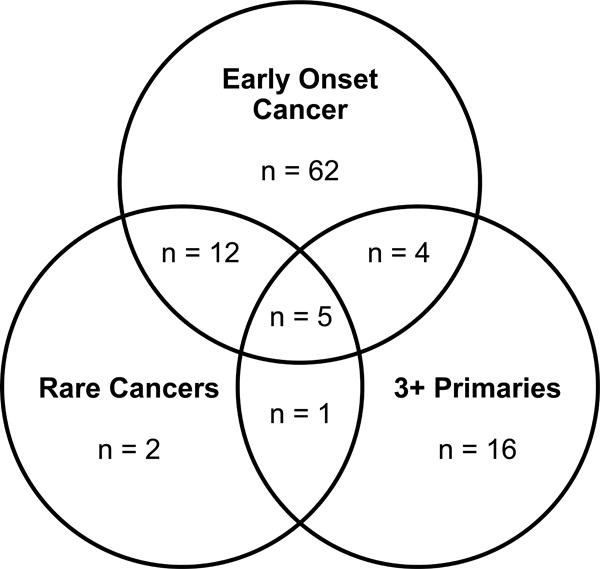
Venn diagram summarizing the qualifying inclusion criteria of the final cohort of 102 men. Criteria included: 1) early age of onset of first malignancy (≤55 years old), 2) diagnosed with rare cancers including pancreatic cancer, sarcoma, male breast cancer and/or 3) three or more primary malignancies in a single individual.
Table 1.
Clinical & pedigree features for the cohort of 102 men with prostate cancer and one or more additional primary cancers.
| Age at diagnosis in years | First Cancer: 51 (5-76) |
| Median (range) | Prostate Cancer: 53 (31-84) |
|
| |
| Race | Caucasian: 96 (94.1) |
| (percentage) | African American: 6 (5.9) |
|
| |
| PSA at diagnosis€ | 5.6 (1.0-75.5) |
| Median (range) | |
|
| |
| Gleason Score | <7: 38 (43.2) |
| N (percentage) | ≥7: 50 (56.8) |
|
| |
| Total number of multiple primaries (including prostate cancer) | Two primary malignancies: 76 (74.5) |
| N (percentage) |
Three primary malignancies: 22 (21.6) Four primary malignancies: 4 (3.9) |
|
| |
| Cancer Syndrome Criteria¶ | None: 62 (60.8) |
| N (percentage) | Any: 40 (39.2) |
| HBOC: 38 (37.3) | |
| LS: 6 (5.9) | |
| LF: 2 (2.0) | |
|
| |
| Clinically Aggressive Prostate Cancer£ | 31 (30.4) |
| N (percentage) | |
PSA=prostate specific antigen;
National Comprehensive Cancer Network guidelines for clinical genetic testing for: HBOC (hereditary breast and ovarian cancer), LS (Lynch syndrome), LF(Li-Fraumeni);
Clinically aggressive prostate cancer defined as meeting one of the following criteria: Gleason sum>7, tumor stage T3b or T4, pre-diagnosis PSA>15ng/ml, Gleason sum=7 and pre-diagnosis PSA>10ng/ml, N1 or M1 at diagnosis.
Germline Mutational Events
In total, over 3500 variants were identified among 102 individuals tested, including 2 nonsense, 7 frameshift, 5 in-frame coding insertions or deletions, and 525 missense variants. Eleven out of 102 (10.8%) men in this study harbored pathogenic or likely pathogenic mutations in cancer-predisposing genes. Eight men were found to harbor protein truncating germline variants in one of six cancer predisposition genes: BRCA2 (3 cases), ATM (2), MLH1 (1), BRIP1 (1), PALB2 (1), and FGFR3 (1), with one man harboring deleterious variants in both BRCA2 and MLH1 (Table 2). This man had three primary malignancies (prostate cancer, kidney cancer, and bladder cancer). Review of 525 missense mutations using Clinvar resulted in the identification of two likely pathogenic missense mutations in two men who had the same likely pathogenic missense variant in CHEK2. Additional sequencing of the HOXB13 prostate cancer predisposing gene in 93/102 men identified two carriers of the known prostate cancer-risk associated G84E allele. One of these G84E carriers also harbored a pathogenic BRCA2 splice variant and had three primary malignancies: prostate cancer, liver cancer, and bladder cancer.
Table 2.
Pathogenic variants in men with prostate cancer and multiple primary malignancies
| Gene | Location* | Variant Type | Allele Change | AA Change | dbSNP ID£ | # Carriers |
|---|---|---|---|---|---|---|
| BRCA2 | 13 | FS1 | A->AT | p.Q1429fs | Rs80359440 | 1 |
| 13 | FS | T->TA | p.Y2215fs | Rs80359615 | 1 | |
| 13 | SV2 | A->T | p.T3085fs | Rs61757642 | 1 | |
| ATM | 11 | FS | ACT->A | p.T761fs | Rs587781658 | 1 |
| 11 | SG3 | T->G | p.L1457X | Rs373226793 | 1 | |
| PALB2 | 16 | FS | GAACAA->G | p.Q60fs | Rs180177143 | 1 |
| BRIP1 | 17 | FS | AT->A | p.N541fs | 1 | |
| MLH1 | 3 | FS | TAGCC->T | p.A661fs | 1 | |
| FGFR3 | 4 | FS | CAG->C | p.D787fs | Rs759113408 | 1 |
| CHEK2 | 22 | MS4 | T->C | p.I157T | Rs17879961 | 2 |
| HOXB13 | 17 | MS | A->G | p.G84E | Rs138213197 | 2 |
Chromosomal location; AA=amino acid;
frameshift;
splice variant;
stopgain;
missense.
Men who harbored a germline mutation did not differ with respect to age of onset, family history, number of primary malignancies, or tumor phenotypes compared to those men who were not found to have a deleterious or pathogenic germline mutation from our panel of genes (Supporting Information Table 3). Based on expert review of pedigrees using 2015 NCCN cancer genetics guidelines, only 4/11 (36%) of the individuals with a pathogenic germline variant met criteria for a hereditary cancer syndrome and would have qualified for clinical genetic testing based on their personal and/or family history. Three of these four individuals met criteria for HBOC testing and harbored pathogenic variants in ATM, BRIP1, and CHEK2 respectively; the fourth individual met criteria for HBOC and LS testing and harbored a pathogenic variant in both BRCA2 and MLH1. The aforementioned HOXB13 G84E allele and BRCA2 splice variant carrier with prostate cancer, liver cancer, and bladder cancer did not meet any criteria for testing.
Discussion
Among men with prostate cancer and one or more additional primary cancers, we identified deleterious or likely pathogenic germline mutations in 10.8% of this selected population. Protein truncating variants were found in six genes (BRCA2, ATM, MLH1, BRIP1, PALB2, and FGFR3) and a likely pathogenic missense mutation in one gene (CHEK2) from a multi-gene panel of 160 selected cancer genes, with the majority of these variants found in genes whose function is important for DNA damage repair (DDR). In addition, the prostate cancer risk associated HOXB13 G84E allele, which has recently been shown to be associated with an increased risk for multiple cancers in a single individual, was found in two individuals with a MPMN phenotype.4 The most frequently mutated gene in our study was the HBOC gene, BRCA2. The majority (7/11) of the individuals with pathogenic or likely pathogenic germline variants did not meet current criteria for clinical genetic testing and thus would likely not have been identified as at risk for a hereditary cancer syndrome otherwise. In this pilot study, there was no difference in carrier versus non carriers in terms of prostate cancer metastatic disease, aggressiveness, or age of onset of prostate cancer. However, as this study selected for early age of onset of malignancy as one of the inclusion criteria, it would be difficult to ascertain a difference in age of onset in carriers versus non carriers from the study population.
Prevalence of germline mutations in this selected population of men with prostate cancer is similar to rates of 8-17% found in recent studies focusing on the identification of germline mutations in men with metastatic prostate cancer unselected for family history9–11,24. Also similarly, the majority of deleterious variants in our study were in DDR pathway genes.9–11,24 Unique to our study population is that there was no statistical difference in presence of metastatic or aggressive disease in mutation carriers, suggesting that patients with multiple primary malignancies including prostate cancer may be at increased risk of harboring deleterious germline mutations in DDR genes regardless of metastatic disease or gleason score (e.g., Figure 2). Identifying these men with DDR mutations is now not only important for risk assessment but also for treatment given DDR deficient tumors’ sensitivity to platinum-based chemotherapeutics and PARP inhibitors. A phase II study of olaparib in previously treated metastatic prostate cancer patients found 6/50 subjects harbored deleterious variants in the DDR-related genes, ATM and BRCA2, with all six showing response to PARP inhibition.9 In the era of targeted therapies, the early identification of a DDR germline mutation in men with prostate cancer and MPMN phenotype could significantly alter the treatment course and outcomes for these patients’ multiple cancers.
Figure 2.
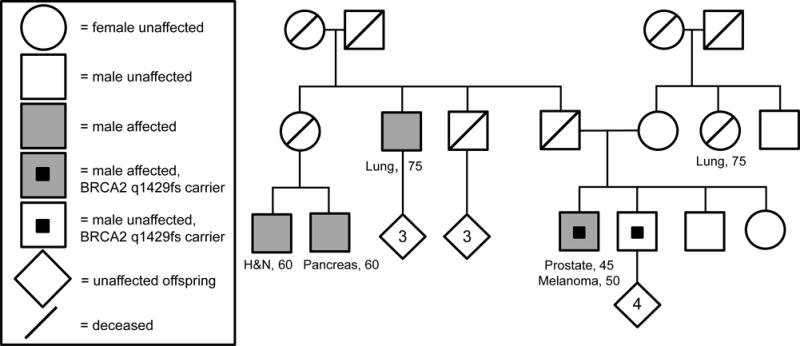
Pedigree analysis of proband with BRCA2 q1429fs germline mutation and multiple primary malignant neoplasm phenotype. H&N= head & neck cancer.
The identification of a risk allele within an individual with cancer also has enormous impact for that patient’s family members in regards to risk assessment, cancer screening, and cancer prevention. For example, men with BRCA2 germline mutations are known to be at increased risk for prostate cancer, and typically display an earlier age of onset of disease and aggressive clinical phenotypes.6,7,25,26 These high-risk prostate cancer features have led to guideline recommendations for prostate cancer screening beginning at age 40 in unaffected BRCA2 mutation carriers. Our current study also suggests that use of multigene panel genetic tests may be particularly useful in this population given the varied tumor phenotypes, genes mutated, and the finding that a majority of the mutation carriers did not meet current NCCN guidelines for clinical genetic testing for hereditary cancer syndromes. For example, as seen in the pedigree in Figure 2, a patient with prostate cancer and melanoma was found to harbor a deleterious BRCA2 mutation; however, this proband did not meet current clinical criteria for germline genetic testing. Upon subsequent testing, this patient’s unaffected brother was also found to have this same deleterious BRCA2 mutation. This exemplary finding will alter recommendations for cancer screening and treatment for the proband, but also for his at-risk relatives, not only for prostate cancer but also other HBOC-associated malignancies.
Large scale tumor sequencing via comprehensive panels focused on actionable mutations is quickly becoming ubiquitous at most comprehensive cancer centers, and the identification of germline variants of undetermined significance are an increasing concern. Our study is in line with multiple recent studies of germline sequencing in cancer patients showing germline aberrations are in general more frequent than previously thought and can be found in patients across age groups and tumor types regardless of family history.17,27–30 These studies highlight potential shortcomings in current clinical genetic testing practices, which rely primarily on constellations of specific personal and family cancer histories to decide whether or not a patient should pursue germline mutation testing. Additional parameters independent of family history, such as multiple primary cancers, early age of disease onset, and/or rare/aggressive histologies may be beneficial to add to the decision algorithm for germline testing in prostate cancer.
While the findings of our study are novel, there are limitations including the small sample size and the lack of paired somatic sequencing to better determine a pathogenic variant’s impact on the tumor(s)’ phenotype. We rely on a germline mutation’s putative functional changes to aid in determining its clinical pathogenic impact, which does not always align across tumor types. For example, a K3326X stop gain variant in BRCA2 was found in two individuals in this study; however, while this variant has been shown to increase the risk of developing breast and/or ovarian cancer, its pathogenicity in prostate cancer is less clear and is categorized as benign in Clinvar and thus was not included in our pathogenic carrier rate for this study.31 In addition, as with most large panel whole-exome sequencing studies, there is a high rate of variants of unknown significance including missense variants of unknown clinical impact. Given the stringent criteria we used selecting for deleterious functional mutations, including restricting missense variants to only those referenced with supporting evidence as cancer-associated pathogenic or likely pathogenic in Clinvar, our pathogenic or likely pathogenic germline variant prevalence in this population may be underestimated. The reported prevalence also does not reflect any pathogenic variants harbored in genes not tested in this panel. It should also be noted that the vast majority of this selected patient population in the study (~90%) were negative for pathogenic or likely pathogenic mutations in the panel of cancer associated genes; in addition, there were individuals who were discovered to have novel mutations or mutations in moderately penetrant genes. However, these individuals and their family members may still have an increased risk for prostate or other cancers and warrant longitudinal cancer screening. These findings highlight the potential clinical and ethical dilemmas for how to best inform patients and their families of cancer risk and highlight the necessity of a multidisciplinary approach to genetic screening and testing in cancer patients that incorporates genetic counselors, physicians, molecular pathology, and psychosocial care for discussing, consenting, performing, and interpreting these genetic tests.
Quantifying and qualifying the prevalence and penetrance of pathogenic germline variants in unique subgroups of men with prostate cancer and multiple primary malignancies will provide a better understanding of the underlying molecular aberrations involved in the pathogenesis of different tumor types, allow for targeted therapeutic approaches, and better define high-risk groups that would benefit from early screening and intervention. Our study, along with other recent germline studies, have shown that certain clinical populations such as those with a MPMN phenotype, early-onset cancer, and/or metastatic/aggressive prostate cancer are enriched for germline variants and thus warrant consideration for genetic testing regardless of meeting current clinical criteria for hereditary cancer syndromes. However, health insurance does not typically cover genetic testing for patients outside of guideline criteria. It is particularly important for prostate cancer patients and their families to identify heritable pathogenic variants that could prompt prostate screening in unaffected carriers- screening that is otherwise not currently recommended in the general US population32. Future larger studies to better define risk and outcomes in this population of men with prostate cancer and MPMNs who harbor deleterious germline variants is warranted.
Supplementary Material
Acknowledgments
Funding Sources: Supported by a grant from the University of Michigan Prostate Cancer Specialized Program of Research Excellence (SPORE) (P50 CA186786) and the University of Michigan Comprehensive Cancer Center Sequencing Core.
Footnotes
Conflict of Interest Disclosures: There are no conflict of interests from any of the authors
Author Contributions:
Conceptualization: Formulation of overarching research goals and aims.
Patrick G. Pilié, Anna M. Johnson, Elena M. Stoffel, Kathleen A. Cooney
Methodology: Development or design of methodology; creation of models.
Patrick G. Pilié, Anna M. Johnson, Kristen Hanson, Megan E. Dayno, Ashley L. Kapron, Elena M. Stoffel, Kathleen A. Cooney
Software: Programming, software development; designing computer programs; implementation of the computer code and supporting algorithms; testing of existing code components.
n/a
Validation: Verification, whether as a part of the activity or separate, of the overall replication/reproducibility of results/experiments and other research outputs.
Anna M. Johnson, Kristen Hanson, Megan E. Dayno, Kathleen A. Cooney
Formal analysis: Application of statistical, mathematical, computational, or other formal techniques to analyze or synthesize study data.
Patrick G. Pilié, Anna M. Johnson, Ashley L. Kapron, Kathleen A. Cooney
Investigation: Research and investigation process, specifically performing the experiments, or data/evidence collection.
Patrick G. Pilié, Anna M. Johnson, Kristen Hanson, Megan E. Dayno, Elena M. Stoffel
Resources: Provision of study materials, reagents, materials, patients, laboratory samples, animals, instrumentation, computing resources, or other analysis tools.
Kathleen A. Cooney
Data curation: Management activities to annotate (produce metadata), scrub data and maintain research data (including software code, where it is necessary for interpreting the data itself) for initial use and later re-use.
Patrick G. Pilié, Anna M. Johnson, Kristen Hanson, Megan E. Dayno, Ashley L. Kapron
Writing – original draft: Preparation, creation and/or presentation of the published work, specifically writing the initial draft (including substantive translation).
Patrick G. Pilié
Writing – review and editing: Preparation, creation and/or presentation of the published work by those from the original research group, specifically critical review, commentary or revision – including pre- or post-publication stages.
Anna M. Johnson, Kristen Hanson, Megan E. Dayno, Ashley L. Kapron, Elena M. Stoffel, Kathleen A. Cooney
Visualization: Preparation, creation and/or presentation of the published work, specifically visualization/data presentation.
Patrick G. Pilié, Anna M. Johnson, Ashley L. Kapron
Supervision: Oversight and leadership responsibility for the research activity planning and execution, including mentorship external to the core team.
Elena M. Stoffel, Kathleen A. Cooney
Project administration: Management and coordination responsibility for the research activity planning and execution.
Elena M. Stoffel, Kathleen A. Cooney
Funding acquisition: Acquisition of the financial support for the project leading to this publication.
Kathleen A. Cooney
References
- 1.Ewing CM, Ray AM, Lange EM, et al. Germline mutations in HOXB13 and prostate-cancer risk. N Engl J Med. 2012;366(2):141–149. doi: 10.1056/NEJMoa1110000. [DOI] [PMC free article] [PubMed] [Google Scholar]
- 2.Xu J, Lange EM, Lu L, et al. HOXB13 is a susceptibility gene for prostate cancer: results from the International Consortium for Prostate Cancer Genetics (ICPCG) Hum Genet. 2013;132(1):5–14. doi: 10.1007/s00439-012-1229-4. [DOI] [PMC free article] [PubMed] [Google Scholar]
- 3.Beebe-Dimmer JL, Hathcock M, Yee C, et al. The HOXB13 G84E Mutation Is Associated with an Increased Risk for Prostate Cancer and Other Malignancies. Cancer Epidemiol Biomarkers Prev. 2015;24(9):1366–1372. doi: 10.1158/1055-9965.EPI-15-0247. [DOI] [PMC free article] [PubMed] [Google Scholar]
- 4.Hoffmann TJ, Sakoda LC, Shen L, et al. Imputation of the rare HOXB13 G84E mutation and cancer risk in a large population-based cohort. PLoS Genet. 2015;11(1):e1004930. doi: 10.1371/journal.pgen.1004930. [DOI] [PMC free article] [PubMed] [Google Scholar]
- 5.Laitinen VH, Wahlfors T, Saaristo L, et al. HOXB13 G84E mutation in Finland: population-based analysis of prostate, breast, and colorectal cancer risk. Cancer Epidemiol Biomarkers Prev. 2013;22(3):452–460. doi: 10.1158/1055-9965.EPI-12-1000-T. [DOI] [PubMed] [Google Scholar]
- 6.Castro E, Goh C, Leongamornlert D, et al. Effect of BRCA Mutations on Metastatic Relapse and Cause-specific Survival After Radical Treatment for Localised Prostate Cancer. Eur Urol. 2015;68(2):186–193. doi: 10.1016/j.eururo.2014.10.022. [DOI] [PubMed] [Google Scholar]
- 7.Castro E, Goh C, Olmos D, et al. Germline BRCA mutations are associated with higher risk of nodal involvement, distant metastasis, and poor survival outcomes in prostate cancer. J Clin Oncol. 2013;31(14):1748–1757. doi: 10.1200/JCO.2012.43.1882. [DOI] [PMC free article] [PubMed] [Google Scholar]
- 8.Gleicher S, Kauffman EC, Kotula L, Bratslavsky G, Vourganti S. Implications of High Rates of Metastatic Prostate Cancer in BRCA2 Mutation Carriers. Prostate. 2016;76(13):1135–1145. doi: 10.1002/pros.23204. [DOI] [PMC free article] [PubMed] [Google Scholar]
- 9.Mateo J, Carreira S, Sandhu S, et al. DNA-Repair Defects and Olaparib in Metastatic Prostate Cancer. N Engl J Med. 2015;373(18):1697–1708. doi: 10.1056/NEJMoa1506859. [DOI] [PMC free article] [PubMed] [Google Scholar]
- 10.Pritchard CC, Mateo J, Walsh MF, et al. Inherited DNA-Repair Gene Mutations in Men with Metastatic Prostate Cancer. N Engl J Med. 2016 doi: 10.1056/NEJMoa1603144. [DOI] [PMC free article] [PubMed] [Google Scholar]
- 11.Robinson D, Van Allen EM, Wu YM, et al. Integrative clinical genomics of advanced prostate cancer. Cell. 2015;161(5):1215–1228. doi: 10.1016/j.cell.2015.05.001. [DOI] [PMC free article] [PubMed] [Google Scholar]
- 12.Raymond VM, Mukherjee B, Wang F, et al. Elevated risk of prostate cancer among men with Lynch syndrome. J Clin Oncol. 2013;31(14):1713–1718. doi: 10.1200/JCO.2012.44.1238. [DOI] [PMC free article] [PubMed] [Google Scholar]
- 13.Haraldsdottir S, Hampel H, Wei L, et al. Prostate cancer incidence in males with Lynch syndrome. Genet Med. 2014;16(7):553–557. doi: 10.1038/gim.2013.193. [DOI] [PMC free article] [PubMed] [Google Scholar]
- 14.Stadler ZK, Schrader KA, Vijai J, Robson ME, Offit K. Cancer genomics and inherited risk. J Clin Oncol. 2014;32(7):687–698. doi: 10.1200/JCO.2013.49.7271. [DOI] [PMC free article] [PubMed] [Google Scholar]
- 15.Rosso S, De Angelis R, Ciccolallo L, et al. Multiple tumours in survival estimates. Eur J Cancer. 2009;45(6):1080–1094. doi: 10.1016/j.ejca.2008.11.030. [DOI] [PubMed] [Google Scholar]
- 16.Xu LL, Gu KS. Clinical retrospective analysis of cases with multiple primary malignant neoplasms. Genet Mol Res. 2014;13(4):9271–9284. doi: 10.4238/2014.March.12.19. [DOI] [PubMed] [Google Scholar]
- 17.Mitchell G, Ballinger ML, Wong S, et al. High frequency of germline TP53 mutations in a prospective adult-onset sarcoma cohort. PLoS One. 2013;8(7):e69026. doi: 10.1371/journal.pone.0069026. [DOI] [PMC free article] [PubMed] [Google Scholar]
- 18.Ballinger ML, Goode DL, Ray-Coquard I, et al. Monogenic and polygenic determinants of sarcoma risk: an international genetic study. Lancet Oncol. 2016;17(9):1261–1271. doi: 10.1016/S1470-2045(16)30147-4. [DOI] [PubMed] [Google Scholar]
- 19.Whitworth J, Hoffman J, Chapman C, et al. A clinical and genetic analysis of multiple primary cancer referrals to genetics services. Eur J Hum Genet. 2015;23(5):581–587. doi: 10.1038/ejhg.2014.157. [DOI] [PMC free article] [PubMed] [Google Scholar]
- 20.Chang X, Wang K. wANNOVAR: annotating genetic variants for personal genomes via the web. J Med Genet. 2012;49(7):433–436. doi: 10.1136/jmedgenet-2012-100918. [DOI] [PMC free article] [PubMed] [Google Scholar]
- 21.Harrison SM, Riggs ER, Maglott DR, et al. Using ClinVar as a Resource to Support Variant Interpretation. Curr Protoc Hum Genet. 2016;89:8 16 11–18 16 23. doi: 10.1002/0471142905.hg0816s89. [DOI] [PMC free article] [PubMed] [Google Scholar]
- 22.Rehm HL, Berg JS, Brooks LD, et al. ClinGen–the Clinical Genome Resource. N Engl J Med. 2015;372(23):2235–2242. doi: 10.1056/NEJMsr1406261. [DOI] [PMC free article] [PubMed] [Google Scholar]
- 23.Richards S, Aziz N, Bale S, et al. Standards and guidelines for the interpretation of sequence variants: a joint consensus recommendation of the American College of Medical Genetics and Genomics and the Association for Molecular Pathology. Genet Med. 2015;17(5):405–424. doi: 10.1038/gim.2015.30. [DOI] [PMC free article] [PubMed] [Google Scholar]
- 24.Hart SN, Ellingson MS, Schahl K, et al. Determining the frequency of pathogenic germline variants from exome sequencing in patients with castrate-resistant prostate cancer. BMJ Open. 2016;6(4):e010332. doi: 10.1136/bmjopen-2015-010332. [DOI] [PMC free article] [PubMed] [Google Scholar]
- 25.Maier C, Herkommer K, Luedeke M, Rinckleb A, Schrader M, Vogel W. Subgroups of familial and aggressive prostate cancer with considerable frequencies of BRCA2 mutations. Prostate. 2014;74(14):1444–1451. doi: 10.1002/pros.22860. [DOI] [PubMed] [Google Scholar]
- 26.Na R, Zheng SL, Han M, et al. Germline Mutations in ATM and BRCA1/2 Distinguish Risk for Lethal and Indolent Prostate Cancer and are Associated with Early Age at Death. Eur Urol. 2016 doi: 10.1016/j.eururo.2016.11.033. [DOI] [PMC free article] [PubMed] [Google Scholar]
- 27.Meric-Bernstam F, Brusco L, Daniels M, et al. Incidental germline variants in 1000 advanced cancers on a prospective somatic genomic profiling protocol. Ann Oncol. 2016;27(5):795–800. doi: 10.1093/annonc/mdw018. [DOI] [PMC free article] [PubMed] [Google Scholar]
- 28.Mork ME, You YN, Ying J, et al. High Prevalence of Hereditary Cancer Syndromes in Adolescents and Young Adults With Colorectal Cancer. J Clin Oncol. 2015;33(31):3544–3549. doi: 10.1200/JCO.2015.61.4503. [DOI] [PMC free article] [PubMed] [Google Scholar]
- 29.Schrader KA, Cheng DT, Joseph V, et al. Germline Variants in Targeted Tumor Sequencing Using Matched Normal DNA. JAMA Oncol. 2016;2(1):104–111. doi: 10.1001/jamaoncol.2015.5208. [DOI] [PMC free article] [PubMed] [Google Scholar]
- 30.Zhang J, Walsh MF, Wu G, et al. Germline Mutations in Predisposition Genes in Pediatric Cancer. N Engl J Med. 2015;373(24):2336–2346. doi: 10.1056/NEJMoa1508054. [DOI] [PMC free article] [PubMed] [Google Scholar]
- 31.Meeks HD, Song H, Michailidou K, et al. BRCA2 Polymorphic Stop Codon K3326X and the Risk of Breast, Prostate, and Ovarian Cancers. J Natl Cancer Inst. 2016;108(2) doi: 10.1093/jnci/djv315. [DOI] [PMC free article] [PubMed] [Google Scholar]
- 32.Jemal A, Fedewa SA, Ma J, et al. Prostate Cancer Incidence and PSA Testing Patterns in Relation to USPSTF Screening Recommendations. JAMA. 2015;314(19):2054–2061. doi: 10.1001/jama.2015.14905. [DOI] [PubMed] [Google Scholar]
Associated Data
This section collects any data citations, data availability statements, or supplementary materials included in this article.