



Abstract
Although parenting behavior and friendship quality predict adolescent externalizing behaviors, individual differences in temperament may differentially affect susceptibility to these factors over time. In a multi-method and multi-informant study of 141 children followed prospectively from toddlerhood to adolescence, we tested the independent and interactive associations of age 3 reactive temperament (e.g., negative emotionality) and age 13 observed parenting (i.e., positive and negative behavior) and friendship (i.e., conflict and warmth), with multi-informant ratings of age 15 aggression and rule-breaking behavior. Negative parenting predicted growth in parent-rated externalizing behavior, but only for adolescents with early reactive temperament. Temperament did not affect sensitivity to positive parenting or friendship. Results are discussed in the context of differential susceptibility theory and intervention implications for adolescents.
Keywords: externalizing behavior, aggression, temperament
Youth externalizing behavior (EB), including overt (e.g., aggression, hitting) and covert offenses (e.g., rule-breaking, stealing), is one of the costliest public health problems in North America (Foster & Jones, 2005; Welsh et al., 2008). Identifying early predictors of EB, including stable individual factors and malleable environmental factors, is critical to designing effective psychosocial intervention and prevention programs for high-risk youth. EB is dynamic across development, given changes in its phenomenology, causal influences, severity, and contexts (e.g., home vs. school). The prevalence of EB increases significantly in adolescence, particularly in mid-late adolescence (Moffitt, 1993). These rapid behavioral changes make adolescence an important developmental period to investigate. Some EB is transient and mild, perhaps normative or even adaptive (Roisman, Monahan, Campbell, Steinberg, & Cauffman, 2010), with aggression and rule-breaking behaviors decreasing for most adolescents in the transition to adulthood. In contrast, severe adolescent EB, especially persistent EB across multiple contexts, predicts poor adult mental health, social, and legal outcomes (Moffitt & Caspi, 2001; Youngstrom, 2011). Thus, understanding how early dispositional factors (e.g., temperament) and environmental factors (e.g., parenting, peer relationships) influence EB trajectories will facilitate innovations in intervention and prevention.
Negative parenting behavior, including hostility, harsh discipline, inconsistent caregiving, and detached parenting, is perhaps the most widely-examined environmental factor linked to EB onset and persistence (Flouri & Midouhas, 2017; Stormshak, Bierman, McMahon, & Lengua, 2000). Despite its potency, there is tremendous variation in the short- and long-term outcomes for children exposed to negative parenting. Several biologically-based factors related to EB may affect children’s sensitivity to early social experiences (Ellis & Boyce, 2011; Pluess, 2015), including temperament, a relatively stable construct that reflects individual differences in neurobiological reactivity in response to stress (Moore & Depue, 2016). Early studies of the “diathesis-stress” (or “dual-risk”) framework proposed that risk factors, such as reactive temperament, not only directly affected child outcomes but heightened vulnerability to social stress (Blackson, Tarter, & Mezzich, 1996; Kiff, Lengua, & Zalewski, 2011). For example, early difficult temperament has been linked with hyperactivity and aggression in middle childhood and late adolescence (Olson, Bates, Sandy, & Lanthier, 2000), as well as vulnerability to negative caregiving environments (Belsky, Hsieh, & Crnic, 1998).
Importantly, however, many studies assuming a diathesis-stress framework did not consider the full range of environmental conditions, including positive environments. More recent evidence guided by the differential susceptibility or biological sensitivity to context theory suggests that the same children more temperamentally vulnerable to negative or stressful environments may also benefit the most from environmental enrichment (Ellis, Boyce, Belsky, Bakermans-Kranenburg, & van IJzendoorn, 2011; Kochanska & Kim, 2013). A meta-analysis of 84 studies found that compared to children with easy temperament, children with difficult temperament were more sensitive to negative parenting and positive parenting (Slagt, Dubas, Deković, & van Aken, 2016). Thus, “difficult” or reactive early temperament may actually reflect sensitivity to the social environment – for better and for worse (Belsky, Bakermans-Kranenburg, & IJzendoorn, 2007; Ellis & Boyce, 2011).
Temperament-based environmental sensitivity reflects multiple levels of biology that likely work together to influence differential susceptibility, including genetic variation, neurotransmitter production, and physiological reactivity (Boyce, 2016; Ellis et al., 2011; Moore & Depue, 2016). Variations in these biologically-based factors may function to enhance adaptive survival in the face of uncertainty and danger (Beery & Francis, 2011; Meaney, 2010). For example, Forgas (2013) found that individuals experiencing more negative affect showed improved attention to details, improved judgmental accuracy, and engaged in more cautious interpersonal strategies, all strategies that help to increase survival in a threatening environment.
In the context of sensitivity to the family environment, children with reactive temperament may be particularly likely to respond to a hostile or angry parent with protective strategies such as aggression, due to their heightened neurobiological sensitivity to threat. Concurrently, given their elevated emotional reactivity, youth with reactive temperaments may have the most potential to benefit from positive parenting strategies focused on increasing regulation of negative emotions and helping the child shift from negative to positive emotional states (Rabinowitz & Drabick, 2017). In contrast, children with less reactive temperaments may have better emotional control overall, and thus require less directive support as well as respond less intensely to harsh or intrusive parenting (Rabinowitz & Drabick, 2017).
Differential susceptibility has important potential implications for maximizing the effectiveness of socially-based interventions (e.g., parent-training) for children at highest temperamental risk for EB. However, most studies of differential susceptibility have focused on early childhood, and much less is understood about if environmental sensitivity changes across development (Rioux et al., 2016; Sroufe, 2009). Increasing evidence indicates that differential susceptibility extends at least to school-age children: among 968 children, youth with reactive temperament exhibited more behavior problems in preschool and kindergarten when exposed to low quality childcare, but these same traits predicted fewer behavior problems secondary to high quality childcare (Pluess & Belsky, 2009). Similar results were found in a separate sample of preadolescent children (age 11-12; Pluess & Belsky, 2010). Understanding if, and how, differential susceptibility extends to adolescence is critical given that many youth at risk for EB may not exhibit severe symptoms until early adolescence (Broidy et al., 2003; Silverthorn & Frick, 1999). Although infancy and early childhood are considered sensitive developmental periods, adolescence may be as well given important social milestones and rapid neurobiological changes affecting emotion and self-regulation (Steinberg, 2008).
Studies exploring patterns of plasticity in adolescence are mixed. While some found that differential susceptibility to positive and negative parenting extended to influence EB in adolescence and even young adulthood (Chhangur et al., 2015; Nikitopoulos et al., 2014), others found diathesis-stress to best characterize EB development in adolescence (Belsky & Pluess, 2012; Rabinowitz, Osigwe, Drabick, & Reynolds, 2016). Interestingly, a recent review found that differential susceptibility predicted adolescent EB and substance use depending on the timing of temperament and family environment assessed (Rioux et al., 2016). Studies that supported differential susceptibility tended to assess both temperament and family environment in childhood, whereas studies assessing temperament and family environment in adolescence tended to support diathesis-stress. These findings suggest that although positive environmental factors such as positive parenting may continue to influence EB overall, adolescents with reactive temperaments may no longer show heightened sensitivity to these positive social influences compared to adolescents without reactive temperaments.
Thus, biologically-based receptivity to environmental support (but not stressors) may attenuate in adolescence; there are at least two plausible reasons for this pattern. First, although more longitudinal studies are beginning to test differential susceptibility in adolescence, the timing of temperament measurement is rarely emphasized. Although temperament and personality are moderately stable across development (Caspi & Roberts, 2001), certain temperament dimensions (e.g., fear, inhibition) are much less stable in early childhood (Dyson et al., 2015; Ferguson, 2010). Early childhood marks a period of rapid neurological changes in the brain that influence the stability and expression of self-regulation, stress-reactivity, and executive functioning, factors closely linked to temperament (Rothbart, 2011; Rothbart, Sheese, Rueda, & Posner, 2011). Furthermore, individual differences in temperament are sensitive to early developmental context including positive and negative parenting (Akker, Deković, Prinzie, & Asscher, 2010) and socially-based interventions (McClowry, Rodriguez, & Koslowitz, 2008). Indeed, both genetic and environmental factors influence temperament expression throughout development, and unique genetic influences on temperament traits can emerge later in development (Saudino & Wang, 2012). Thus, reactive temperament measured in adolescence may not be the same reactive temperament measured in early childhood, making it unclear if studies differing in timing of temperament can be directly compared. To maximize the ability to compare findings to differential susceptibility studies measuring temperament as a sensitivity factor in early childhood, the present study employed a longitudinal design to assess whether youth with reactive temperament measured in toddlerhood show heightened sensitivity to positive and negative environments in adolescence.
Second, studies have not adequately considered changing environments that become more salient across development. Peer relationships become increasingly important during adolescence and the transition to young adulthood (Laible, Carlo, & Raffaelli, 2000), significantly incrementing predictions of adolescent EB above parenting factors (Brown & Bakken, 2011; Laird, Jordan, Dodge, Pettit, & Bates, 2001). A range of peer factors across different settings have been linked to EB, including deviant peer affiliation (Hou et al., 2013), peer acceptance and social status in group settings (Menting, van Lier, & Koot, 2011), and friendship support and dyadic peer conflicts (Sentse & Laird, 2010). To complement tests of sensitivity to dyadic parenting factors, the present study focused on the influence of dyadic friendship factors. To our knowledge, there have been no differential susceptibility studies of temperament conducted with the peer environment, particularly in relation to dyadic friendship closeness/conflict, although a genetic marker of differential susceptibility was sensitive to deviant peer affiliation in a longitudinal sample of adolescents with EB (Latendresse et al., 2011). Thus, the same youth with early reactive temperament who show heightened sensitivity to parenting may also be most sensitive to supportive or stressful friendships in adolescence.
To review, despite the considerable implications of differential susceptibility, previous studies have infrequently considered whether environmental sensitivity extends to adolescence and if it includes social domains outside of the family context (i.e., peers). Furthermore, many studies of differential susceptibility for youth EB were cross-sectional or assessed EB at only one time-point. Without considering the developmental nature of EB, directional inferences cannot be made and prospective change in EB cannot be evaluated. Thus, there is a clear need for longitudinal studies that can test whether these effects influence changes in EB in adolescence. In an ethnically-diverse sample of youth followed prospectively from toddlerhood to adolescence, the present study addressed three questions: (1) do youth with reactive temperament at age 3 exhibit heightened sensitivity to both positive and negative parenting in adolescence, such that they respond to negative parenting with increased EB from age 13-15, but respond to positive parenting with decreased EB?; (2) are adolescents with early reactive temperament also more sensitive to friendship warmth/closeness and conflict?; and (3) given that EB can differ based on subtype (e.g., overt vs. covert) as well as by context (e.g., home vs. school), are predictions of aggression versus rule-breaking behaviors at home and school differentially sensitive to early temperament, parenting, and peer factors?
Method
Participants
Participants were 141 youth (48% female) and their parents in a longitudinal study of youth with or without developmental delays recruited from Southern California and Central Pennsylvania. Participants were ethnically diverse: 55% Caucasian, 18% Hispanic, 10% African American, 1% Asian, and 16% Other. Families were initially recruited from clinics, regional centers, and local preschool and day care programs when children were 3 years old (N = 238). Participants were over-selected for children with lower IQs and were followed until age 15. The present study included families who participated in at least one adolescent time point (i.e., age 13 or 15), and we excluded youth who met criteria for autism spectrum disorder. Attrition across the 12 years was primarily due to families choosing not to participate in later waves or difficulty contacting families. There were no differences between participants included in the current study and those who did not return for the age 13 or 15 assessments with respect to sex, race-ethnicity, or age 3 temperament (p > .05).
Procedures
When children were 3-years-old, school and agency personnel mailed brochures describing the study to eligible families, and interested parents contacted the research centers. After obtaining parental consent, families were visited in their homes for an assessment of the child’s developmental status. The primary parent and child were also invited to the research center for a laboratory assessment, in which parents completed interviews about child psychopathology and general functioning, as well as rating scales about child temperament and socio-emotional and behavioral functioning (e.g., EB). Parents and children were also videotaped during parent-child interaction problem solving tasks. At age 13 and 15, families returned for follow-up assessments with procedures that were highly parallel to those in the earlier time points (i.e., assessment of EB and social relationships, observational measures of parent-child interactions). At the age 13 assessment, adolescents’ cognitive functioning was assessed using the Vocabulary, Matrix Reasoning, and Arithmetic subtests of the Wechsler Intelligence Scale for Children – Fourth Edition (WISC-IV) to estimate IQ (Sattler & Dumont, 2004). Teachers were also mailed a set of rating scales about social and emotional functioning, including EB at school. The Institutional Review Boards approved all study procedures.
Measures
Temperament
At the initial age 3 assessment, mothers completed the Toddler Behavior Assessment Questionnaire (TBAQ; Goldsmith, 1996), a 108-item rating scale. Each item was rated on a 7-point scale, ranging from 1 = never to 4 = about half the time to 7 = always during the past month. These items formed eight total subscales of early temperament; principal component analysis (PCA) identified five subscales that loaded onto one dimension (all loadings ≥ .40) that was conceptually consistent with “difficult” or “reactive” temperament. Youth high on reactive temperament had higher anger (10 items, α = .74, factor loading = .83), sadness (10 items, α = .63, factor loading = .77), and behavioral activity (10 items, α = .57, factor loading = .67), as well as lower inhibition (10 items, α = .82, factor loading = −.40) and soothability (10 items, α = .67, factor loading = −.53). Previous studies using similar composite scores of reactive temperament from the TBAQ have demonstrated excellent reliability (Micalizzi, Wang, & Saudino, 2015), convergent validity with other temperament measures (e.g., Infant Behavior Questionnaire; Majdandžić, Möller, Vente, Bögels, & Boom, 2014), and good temporal stability from infancy to early childhood (Majdandžić et al., 2014).
Observed parenting behavior
At age 13, positive and negative parenting were coded using the Parent-Child Interaction Rating Scale (Belsky, Crnic, & Woodworth, 1995) from a videotaped lab observation of the parent and child in three problem solving tasks of increasing difficulty. Pairs of coders scored videotaped interactions on a 5-point Likert scale that considered both the frequency and intensity of the behavior or expressed affect, to determine a consensus code for each parenting behavior. Two broad scales were Positive Parenting (Positive Affect, Sensitivity, Cognitive Stimulation, Detachment (reverse coded)) and Negative Parenting (Negative Affect, Intrusiveness). These have been established and replicated through factor analyses conducted in several different labs ([authors masked for review], 2007; Aber, Belsky, Slade, & Crnic, 1999). Research assistant coding teams worked together for over a year and achieved high reliability (i.e., minimum of 70% exact agreement with a highly-trained doctoral-level “master coder” and 95% agreement within one scale point). Once reliable, two research assistants were paired to code the tapes as a team, and a master coder met weekly with each team to resolve discrepancies and maintain inter-rater reliability. See [authors masked for review] (2014) for a detailed description of the Positive and Negative Parenting composites.
Friendship Quality
At age 13, the quality of the adolescent’s relationship with his/her closest friend was assessed during a semi-structured interview. Adolescents were asked open-ended questions about the relationship, quality (e.g., closeness, warmth, cooperation, competitiveness, rivalry, conflict), reasons they are close friends, amount of time spent together, and common interests. The interviews were administered by trained doctoral students with established fidelity across interviewers. A team of undergraduate coders led by a master coder rated the adolescents’ relationships with their closest friend on a 0-4 scale, ranging from 0 = no conflict to 4 = predominantly conflictful. Coders also rated each adolescent’s level of warmth and closeness with their closest friend, ranging from 0 = no or very little warmth/closeness to 4 = predominantly warm/close. Coding teams achieved high reliability at least 70% exact agreement with the master coder and 95% agreement within one scale point).
EB
Parents and teachers completed the Child Behavior Checklist (CBCL) and Teacher Report Form (TRF; Achenbach & Rescorla, 2001) at both the age 13 and age 15 assessments. The CBCL is a well-validated, widely-used 113-item standardized rating scale based on a large normative sample (ages 6-18); it yields narrowband scales of youth symptomatology. Parents and teachers rated each behavior based on the preceding 6 months on a 3-point scale, from 0 = not true to 2 = very true or often true. The scales have demonstrated convergent validity with other common measures of behavioral and emotional functioning (Bender, Auciello, Morrison, MacAllister, & Zaroff, 2008). The present study used T-scores from the Aggressive Behavior (e.g., “cruelty, bullying, or meanness to others,” “gets in many fights,”) and Rule-Breaking Behavior scales (e.g., “steals at home,” “lying or cheating”). In the present sample, internal consistencies of the parent-rated aggressive and rule-breaking scales at age 13 and 15 ranged from α = .74-.91; teacher-rated scales ranged from α = .65-.92.
Data Analytic Plan
We fit complementary sets of linear regression models, one predicting parent- and teacher-rated aggression, and a second predicting parent- and teacher-rated rule-breaking. To address missing data and increase power, all linear regressions were conducted using full information maximum likelihood (FIML) estimation with robust standard errors. Compared to other methods (e.g., listwise or pairwise deletion, mean imputation), FIML is significantly advantaged by producing less biased parameter and standard error estimates and decreased Type 1 error (Collins, Schafer, & Kam, 2001). Given that associations between temperament, parenting, friendship, and externalizing behavior may differ based on youth sex, IQ, and previous level of EB, we controlled for these variables in each regression model.
First, to examine how early temperament and negative environmental factors in adolescence influence two-year change in adolescent aggression, we entered the main effects of age 3 temperament, age 13 negative parenting behavior, and age 13 friendship conflict on age 15 parent-rated aggression, controlling for youth sex, IQ, and age 13 aggression. Then, we added separate Temperament × Parenting and Temperament × Friendship interactions to explore interactive associations. We then reproduced this model featuring teacher-rated aggression as the outcome. Next, to examine if temperament-related sensitivity to the environment extends to positive environmental factors in adolescence, we replicated these stepwise models with age 13 positive parenting behavior and friendship closeness/warmth as the environmental variables to predict 15 year parent- and teacher-rated aggressive behavior. Finally, all four models were reproduced with separate parent- and teacher-rated rule-breaking behavior as the outcome.
Differential susceptibility was evaluated using several methods. First, given that differential susceptibility requires that the susceptibility factor is not directly correlated with the environmental variables or outcomes (Belsky & Pluess, 2009), we examined preliminary correlations between reactive temperament, the independent variables (e.g., parenting, friendship) and outcomes (e.g., aggression and rule-breaking behaviors). Significant interactions were probed for differential susceptibility utilizing modern approaches proposed by Roisman et al. (2012). First, interactions were deconstructed by probing the interactions at +1 SD (‘reactive temperament’), grand mean (‘average temperament’), and −1 SD (‘easy temperament’) (West & Aiken, 1991) using the online calculator (Preacher, Curran, & Bauer, 2006) recommended by Roisman et al. (2012). To evaluate further the interactions in relation to differential susceptibility vs. diathesis stress theories, we conducted Regions-of-Significance (RoS) analyses, which identify the specific values of negative and positive parenting in which the slope between reactive temperament and EB shifts from nonsignificance to significance. Next, we examined the Proportion Affected (PA) Index, which identifies the proportion of participants in the sample that benefits from the positive environment; PA indices closer to 0.50 provide support for differential susceptibility, whereas scores below 0.16 indicate weak evidence for differential susceptibility. Finally, an online calculator (http://www.yourpersonality.net/interaction/ros2.pl) estimated the Proportion of Interaction (PoI) for each significant interaction. The PoI evaluates the proportion of the total interaction on the left or right side of the interaction crossover point; PoI values between 0.40-0.60 indicate that the interaction is highly consistent with differential susceptibility, whereas PoI values approaching 0.00 indicate strong evidence for diathesis-stress (Roisman et al., 2012).
Results
Preliminary analyses
Table 1 shows the means, standard deviations, and bivariate correlations among demographic and study variables. In general, boys had higher levels of parent- and teacher-rated aggression and rule-breaking behavior compared to girls. IQ at age 13 was inversely correlated with the externalizing variables, and higher IQ was correlated with more warmth and closeness with friends as well as easier temperament at age 3. Thus, we controlled for gender and IQ in all models. Positive and negative parenting were weakly inversely correlated (r = −.27), whereas friendship warmth/closeness and friendship conflict were weakly positively correlated (r =.28). Furthermore, consistent with commonly observed informant discrepancies in previous studies (Achenbach, 2011; De Los Reyes, 2011), parent and teacher ratings of age 15 aggression and rule-breaking behavior were only moderately correlated (r’s = .46 and .34, respectively), supporting the need to separately examine these behaviors at home and school.
Table 1.
Descriptive statistics and correlations among study variables
| Variable (age) | M (SD) | Range | 1 | 2 | 3 | 4 | 5 | 6 | 7 | 8 | 9 | 10 | 11 | 12 | 13 | 14 | 15 |
|---|---|---|---|---|---|---|---|---|---|---|---|---|---|---|---|---|---|
| 1. Gender a | .52 (.50) | 0-1 | – | ||||||||||||||
| 2. IQ (13) | 95.07 (24.40) | 46-134 | −.01 | – | |||||||||||||
| 3. Temperament (3) | 3.25 (.43) | 2.39-4.2 | .04 | −.23* | – | ||||||||||||
| 4. Positive Parenting (13) | 12.83 (2.30) | 6-18 | .03 | .02 | .09 | – | |||||||||||
| 5. Negative Parenting (13) | 3.32 (1.64) | 2-9 | −.13 | −.15 | .16 | −.27** | – | ||||||||||
| 6. Friend Warmth/Closeness (13) | 2.77 (1.01) | 0-4 | −.23** | .33** | .03 | .10 | −.13 | – | |||||||||
| 7. Friend Conflict (13) | .46 (.59) | 0-2 | −.02 | .17 | −.06 | .01 | .01 | .28* | – | ||||||||
| 8. CBCL Aggression (13) | 4.87 (5.35) | 50-78 | .03 | −.26** | .34** | <.01 | .13 | −.04 | −.11 | – | |||||||
| 9. TRF Aggression (13) | 2.54 (4.16) | 50-68 | .23* | −.29* | .07 | .07 | .22 | −.12 | −.05 | .40** | – | ||||||
| 10. CBCL Rule- breaking (13) | 1.94 (2.43) | 50-69 | .11 | −.27** | .25* | −.05 | .08 | −.04 | −.08 | .75** | .51** | – | |||||
| 11. TRF Rule- breaking (13) | 1.51 (2.28) | 50-70 | .19 | −.16 | .03 | −.02 | .07 | −.09 | −.05 | .16 | .70** | .37** | – | ||||
| 12. CBCL Aggression (15) | 3.83 (4.91) | 50-87 | −.01 | −.22* | .35** | <.01 | .17 | −.05 | −.03 | .68** | .35** | .55** | .17 | – | |||
| 13. TRF Aggression (15) | 2.05 (4.06) | 50-69 | .12 | −.48** | .21 | .07 | .15 | −.25* | −.26* | .28* | .58** | .29** | .41** | .46** | – | ||
| 14. CBCL Rule- breaking (15) | 2.10 (2.86) | 50-69 | .13 | −.15 | .20 | −.09 | .08 | −.04 | −.06 | .47** | .18 | .56** | .28* | .65** | .39** | – | |
| 15. TRF Rule- breaking (15) | .80 (1.34) | 50-64 | .08 | −.24* | .23 | .04 | .14 | −.11 | −.05 | .15 | .15 | .16 | .22 | .19 | .42** | .26* | – |
Note.
1 = boys, 0 = girls.
p < .05
p < .01
Preliminary correlations between the susceptibility factor (temperament), predictors (parenting and friendship variables), and outcomes (aggression and rule-breaking) showed that age 3 temperament was not correlated with any of the parenting or friendship variables (p > .05). Temperament was also not correlated with teacher-rated aggression or parent- and teacher-rated rule-breaking behaviors at age 15. However, temperament was significantly and positively correlated with age 15 parent-reported aggression, which supports a diathesis-stress (vs. differential susceptibility) pattern of sensitivity for this outcome (Belsky & Pluess, 2009).
Predictions of Aggressive Behavior
Negative parenting and friendship conflict
Controlling for sex, IQ, age 13 aggression, friendship conflict, and negative parenting, early reactive temperament predicted parent-rated aggression, but not teacher-rated aggression (Table 2), providing preliminary support for a diathesis stress (vs. differential susceptibility) pattern of results for aggression at home. Negative parenting did not predict parent- or teacher-rated aggression, although it was moderated by temperament in prediction of parent-rated aggression. RoS testing found that aggression significantly differed by temperament when negative parenting scores were above 2.98, indicating that EB significantly differed by temperament at low-moderate to high levels of negative parenting, but not when negative parenting was very low, consistent with an ordinal interaction. Consistent with these results, the PoI (0.11) indicated that the interaction was more consistent with diathesis-stress than differential susceptibility, and the PA Index (0.00) was also well below the range suggestive of differential susceptibility (Roisman et al., 2012). Simple slope analyses (see West & Aiken, 1992) revealed that negative parenting predicted significantly more aggression two years later for adolescents with early reactive temperament (B = 1.77, SE = .78, p = .02), but not for adolescents with average temperament (B = .30, SE = .26, p = .26; Figure 1). Surprisingly, negative parenting was inversely associated with aggression for adolescents with easy temperament (B = −1.18, SE = .44, p = .01; i.e., “contrastive effect”; Belsky et al., 2007). A closer examination of Figure 1 revealed that, for youth with easy temperament, the predicted values (T-scores < 50) fell below the actual range of aggressive behaviors in our sample, suggesting potential floor effects of aggression. Given that narrowband T-scores below 65 on the CBCL are considered normative (Achenbach & Rescorla, 2001), this pattern of results suggest that, although the easy temperament youth showed a statistical sensitivity to negative parenting, this may not be a clinically meaningful effect.
Table 2.
Generalized linear models predicting parent- and teacher-rated aggressive behavior T-scores from early temperament, observed parenting behavior, and friendship quality
| Parent-rated aggression (age 15) | Teacher-rated aggression (age 15) | ||||||||
|---|---|---|---|---|---|---|---|---|---|
|
|
|||||||||
| B | SE B | β | p | B | SE B | β | p | ||
| Step 1 | Child’s sex a | −1.19 | 0.79 | −0.09 | 0.13 | −0.43 | 1.09 | −0.04 | 0.70 |
| IQ | 0.01 | 0.02 | 0.05 | 0.43 | −0.04 | 0.02 | −0.21 | 0.08 | |
| Previous Aggression (age 13) | 0.59 | 0.05 | 0.63 | 0.00 | 0.50 | 0.13 | 0.55 | 0.00 | |
| Early Reactive Temperament | 3.42 | 1.64 | 0.24 | 0.04 | 0.96 | 1.33 | 0.08 | 0.47 | |
| Negative Parenting Behavior | 0.28 | 0.21 | 0.07 | 0.19 | −0.10 | 0.30 | −0.03 | 0.75 | |
| Friendship Conflict | 0.09 | 0.67 | 0.01 | 0.90 | −1.22 | 0.83 | −0.14 | 0.14 | |
| Step 2 | Negative Parenting × Temperament | 3.45 | 1.35 | 3.11 | 0.01 | 1.35 | 0.99 | 1.56 | 0.17 |
| Friendship Conflict × Temperament | −2.77 | 2.75 | −0.82 | 0.31 | 1.06 | 2.56 | 0.40 | 0.68 | |
|
| |||||||||
| Step 1 | Child’s sex a | −1.50 | 0.81 | −0.12 | 0.06 | −0.58 | 1.15 | −0.06 | 0.61 |
| IQ | 0.02 | 0.02 | 0.07 | 0.43 | −0.04 | 0.03 | −0.20 | 0.13 | |
| Previous Aggression (age 13) | 0.60 | 0.06 | 0.64 | 0.00 | 0.48 | 0.13 | 0.52 | 0.00 | |
| Early Reactive Temperament | 3.75 | 1.76 | 0.26 | 0.03 | 1.30 | 1.35 | 0.11 | 0.34 | |
| Positive Parenting Behavior | −0.03 | 0.21 | −0.01 | 0.89 | 0.18 | 0.19 | 0.08 | 0.34 | |
| Friendship Warmth/Closeness | −0.35 | 0.48 | −0.06 | 0.46 | −0.53 | 0.64 | −0.11 | 0.40 | |
| Step 2 | Positive Parenting × Temperament | −1.59 | 0.85 | −2.45 | 0.06 | −0.49 | 0.78 | −0.95 | 0.54 |
| Friendship Closeness × Temperament | 2.19 | 1.51 | 1.17 | 0.15 | 1.31 | 2.62 | 0.89 | 0.62 | |
Note.
1 = boys, 0 = girls. B = unstandardized coefficient. SE B = standard error of unstandardized coefficient. β = standardized coefficient.
Figure 1.
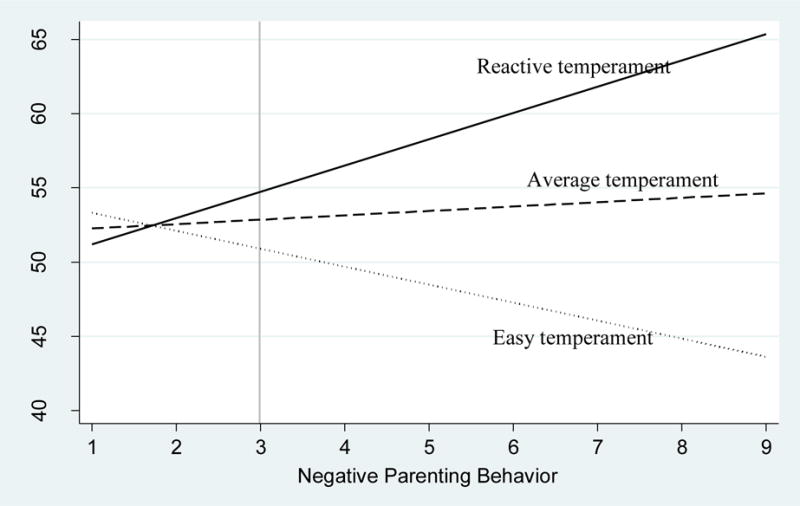
Prospective association between age 13 negative parenting behavior and aggressive behavior two years later for adolescents with “reactive” (+1 SD), average (mean), and “easy” (−1 SD) temperament in toddlerhood. Area to the right of the gray vertical line denotes regions of negative parenting where the three lines significantly differ.
To examine if adolescents were differentially influenced by negative peer factors based on their temperament, we examined main effects and interactive effects between friendship conflict and temperament. After controlling for all covariates, temperament, and negative parenting behavior, friendship conflict was unrelated to parent- and teacher-rated aggression Furthermore, temperament did not moderate the association between friendship conflict and parent- or teacher-rated aggressive behavior.
Positive parenting and friendship warmth/closeness
Next, the role of early temperament on adolescent sensitivity to positive environmental variables was examined (Table 2). Controlling for sex, IQ, age 13 aggression, friendship warmth/closeness, and positive parenting, early reactive temperament predicted significantly more parent-rated aggression, but not teacher-rated aggression. However, positive parenting was unrelated to parent- and teacher-rated aggression, and it also did not interact with temperament. Controlling for sex, IQ, age 13 aggression, and positive parenting behavior, friendship warmth/closeness at age 13 did not predict age 15 parent- or teacher-rated aggression. Also, the interaction between temperament and friendship warmth/closeness did not predict parent- or teacher-rated aggression.
Predictions of Rule-breaking Behavior
Negative parenting and friendship conflict
Early difficult temperament significantly predicted age 15 teacher-rated rule-breaking behavior, with control of age 13 rule-breaking and all other model variables (Table 3). Temperament was unrelated to parent-rated rule-breaking behavior, however. Like findings for aggression, negative parenting behavior was not directly related to rule-breaking behavior; however, temperament moderated the association between negative parenting and parent-rated rule-breaking behavior and marginally moderated the association between negative parenting and teacher-rated rule-breaking. RoS testing showed that rule-breaking significantly differed by temperament when negative parenting was above scores of 5.31. Although the PA Index (0.41) suggested plausibility for differential susceptibility, the PoI (0.16) indicated more support for diathesis-stress than for differential susceptibility (Roisman et al., 2012). Using traditional post hoc test approaches, simple slope analyses revealed that negative parenting predicted marginally more rule-breaking two years later for adolescents with early reactive temperament (B = .96, SE = .51, p = .06), was unrelated to rule-breaking behavior for adolescents with average temperament (B = .10, SE = .25, p = .69), and predicted marginally less rule-breaking behavior for adolescents with easy temperament (B = −.76, SE = .41, p = .06) (Figure 1). This contrastive pattern is consistent with the results for aggressive behavior. Though easy temperament youth showed a statistical decline in rule-breaking behavior, this may not be clinically meaningful due to the prediction of out-of-range scores.
Table 3.
Generalized linear models predicting parent- and teacher-rated rule-breaking behavior from early temperament, observed parenting behavior, and friendship quality
| Parent-rated rule-breaking (age 15) | Teacher-rated rule-breaking (age 15) | ||||||||
|---|---|---|---|---|---|---|---|---|---|
|
|
|||||||||
| B | SE B | β | p | B | SE B | β | p | ||
| Step 1 | Child’s sex a | 0.38 | 0.89 | 0.03 | 0.67 | −1.13 | 0.85 | −0.15 | 0.18 |
| IQ | 0.02 | 0.02 | 0.07 | 0.31 | 0.00 | 0.02 | −0.01 | 0.95 | |
| Previous Rule-breaking (age 13) | 0.61 | 0.12 | 0.53 | 0.00 | 0.24 | 0.10 | 0.34 | 0.01 | |
| Early Reactive Temperament | 1.45 | 1.32 | 0.12 | 0.27 | 3.40 | 1.14 | 0.38 | 0.00 | |
| Negative Parenting Behavior | 0.11 | 0.22 | 0.03 | 0.62 | 0.02 | 0.27 | 0.01 | 0.94 | |
| Friendship Conflict | −0.12 | 0.66 | −0.01 | 0.86 | −0.88 | 0.63 | −0.13 | 0.16 | |
| Step 2 | Negative Parenting × Temperament | 2.02 | 0.92 | 2.13 | 0.03 | 1.76 | 0.99 | 2.63 | 0.08 |
| Friendship Conflict × Temperament | −1.11 | 2.24 | −0.38 | 0.62 | −3.05 | 1.98 | −1.50 | 0.13 | |
|
| |||||||||
| Step 1 | Child’s sex a | 0.33 | 0.90 | 0.03 | 0.72 | −0.80 | 0.96 | −0.10 | 0.40 |
| IQ | 0.02 | 0.02 | 0.08 | 0.34 | −0.01 | 0.02 | −0.08 | 0.56 | |
| Previous Rule-breaking (age 13) | 0.60 | 0.12 | 0.52 | 0.00 | 0.22 | 0.09 | 0.30 | 0.02 | |
| Early Reactive Temperament | 1.95 | 1.38 | 0.16 | 0.16 | 3.41 | 1.25 | 0.38 | 0.01 | |
| Positive Parenting Behavior | −0.18 | 0.22 | −0.08 | 0.41 | −0.19 | 0.15 | −0.12 | 0.19 | |
| Friendship Warmth/Closeness | −0.09 | 0.40 | −0.02 | 0.82 | 0.18 | 0.51 | 0.05 | 0.73 | |
| Step 2 | Positive Parenting × Temperament | 0.34 | 0.89 | 0.61 | 0.70 | 0.50 | 0.66 | 1.26 | 0.45 |
| Friendship Closeness × Temperament | 0.54 | 1.31 | 0.34 | 0.68 | −1.39 | 2.25 | −1.22 | 0.54 | |
Note.
1 = boys, 0 = girls. B = unstandardized coefficient. SE B = standard error of unstandardized coefficient. β = standardized coefficient.
Consistent with results for aggression, friendship conflict did not predict parent- nor teacher-rated rule-breaking behavior, controlling for sex, IQ, age 13 rule-breaking, temperament, and negative parenting behavior. Temperament did not moderate predictions of parent- or teacher rated rule-breaking behavior from friendship conflict.
Positive parenting and friendship warmth/closeness
Controlling for sex, IQ, age 13 rule-breaking, and friendship warmth/closeness, early difficult temperament significantly predicted more teacher-rated, but not parent-rated, rule-breaking behaviors. Neither positive parenting behavior nor friendship warmth/closeness at age 13 predicted rule-breaking behavior at age 15, and their interactions with temperament were also non-significant.
Discussion
In a multi-method and multi-informant study of youth followed prospectively from toddlerhood to adolescence, we tested the independent and interactive associations of early temperament and adolescent sources of support and stress (i.e., positive and negative parenting, friendship conflict and warmth) on multi-informant ratings of adolescent aggression and rule-breaking behavior. First, compared to youth with average temperament, adolescents with early reactive temperament exhibited heightened sensitivity to observed negative parenting behaviors with respect to escalating parent-rated aggression and rule-breaking behaviors in adolescence. Adolescents with a history of easy temperament also showed statistical sensitivity to negative parenting and responded with decreased aggression and rule-breaking, although the actual values associated with this decrease in EB were not clinically meaningful. Results overall did not support a pattern of differential susceptibility, such that adolescents with early reactive temperament did not show heightened sensitivity to positive parenting behaviors compared to those with a history of easy temperament. We observed specificity in Temperament × Environment effects with respect to type of environmental support/stress (parents vs. peers) and context of EB (home vs. school). Whereas we observed temperament-based sensitivity to negative parenting in adolescence, reactive temperament did not heighten sensitivity to adolescent-rated friendship conflict or support. Furthermore, consistent with frequent discrepancies reported for EB based on context and informant (Salbach-Andrae, Lenz, & Lehmkuhl, 2009), Temperament × Parenting effects were largely specific to EB at home (i.e., parent-rated EB).
These results reinforce that negative parenting behaviors, such as expression of negative affect (e.g., anger, hostility) and intrusiveness, prospectively predicted increases in aggressive and rule-breaking behaviors in adolescence, specifically for adolescents with early reactive temperament. These findings build on previous studies of Temperament × Environment interplay and suggest that youth with reactive temperament in toddlerhood continue to exhibit heightened sensitivity to negative parenting in adolescence. However, our findings suggest that this heightened sensitivity was specific to negative environmental factors, given that interactions were not observed at home nor in the context of close friendships. Although studies increasingly support reactive temperament as a differential susceptibility factor for young children (e.g., Slagt et al., 2016), our findings suggest that by the time toddlers with reactive temperament develop into early adolescents, they may only show heightened sensitivity negative parenting, and may no longer benefit more from positive parenting or the absence of negative parenting compared to adolescents with non-reactive temperaments, at least with respect to adolescent EB. However, it is important to note that most studies of differential susceptibility have measured temperament concurrently with the environment. Rioux et al. (2016) reviewed studies of adolescent externalizing behavior and found that those supporting the differential susceptibility model measured both temperament and caregiving environment in childhood, whereas those supporting diathesis-stress assessed both temperament and caregiver environment in adolescence. This temporal overlap of constructs has hindered clarification of whether it is the timing of temperament measurement (i.e., infancy vs. adolescence) or the timing of environmental exposure that drives differences between studies. To address this question, the current study measured temperament in early childhood (age 3) and separately assessed adolescent environment 10 years later to prospectively predict EB. Although studies of young children have identified reactive temperament as a differential susceptibility factor in this early developmental period (Slagt, Dubas, Deković, & van Aken, 2016), results from the current study suggest that if these same children were followed into adolescence, they may no longer show positive benefits from adolescent environments but will continue to show vulnerability to negative parenting behaviors. This pattern is consistent with previous studies showing that sensitivity to positive environmental factors may fade in the transition to adolescence (Rioux et al., 2016; Zhang et al., 2015).
Contrary to expectations, adolescents with early reactive temperament were not more sensitive to friendship conflict or support, suggesting that parents continue to play a unique socialization role in early adolescence. Because parent-child relationships are more enduring than friendships, there may be more opportunities for the temperamentally-reactive adolescent and parent to become ensnared in coercive interaction cycles that contribute to aggression change over time (Lansford et al., 2011; Reid & Patterson, 1989). For example, adolescents with reactive temperament may be more likely to respond to parental intrusiveness, anger, or detachment with increased hostile attribution biases; this may lead to increased aggression that further escalates negative parenting behaviors (Morris et al., 2002; Wang & Dix, 2017). In contrast, adolescent friendships may be more transient in nature and more likely to disrupt in the face of conflict. Alternatively, parent expression of anger/hostility and adolescents’ aggressive behavior may reflect shared underlying temperament traits characterized by negative emotionality and reactivity (Chang, Schwartz, Dodge, & McBride-Chang, 2003). That is, parent negativity may be associated with adolescent aggression and reactive temperament through passive gene-environment correlations, reflecting shared genetic influences underlying all three of these constructs (Jaffee & Price, 2007; Lemery-Chalfant, Kao, Swann, & Goldsmith, 2013).
Interestingly, adolescents with a history of easy temperament showed statistical sensitivity to negative parenting, responding with decreased aggression and rule-breaking. Although this pattern of results should be interpreted with caution given that the predicted values of EB extended below the actual values in the sample, these results suggest that easy temperament may buffer potential deleterious effects from negative parenting contexts. This is consistent with studies linking “easy” temperament traits (e.g., low negative emotionality, higher effortful control) with overall resilience for a wide range of social/emotional outcomes (Derauf et al., 2011; Rothbart, 2011). Whereas youth with reactive temperaments may respond to parental intrusiveness and anger with hostile attribution biases (Morris et al., 2003; Wang & Dix, 2017), youth with less reactive temperaments may be more likely to use adaptive interpretations and coping strategies that reduce EB (Rothbart, 2011). Furthermore, given that the present study observed some floor effects for the predicted values of EB, it may be meaningful for future studies to explore these factors in relationship to prosocial (vs. antisocial) behaviors.
Finally, these results reinforce the value of examining EB across different informants and contexts, given that EB may be etiologically unique when expressed at home versus school (Tung & Lee, 2016). Reactive temperament led to increased parent-rated aggressive and rule-breaking behaviors at home when youth were exposed to negative parenting, whereas sensitivity to negative parenting was unrelated to teacher-rated EB at school. These differences are consistent with cross-informant discrepancies commonly observed for EB (De Los Reyes et al., 2015) and likely reflect differences between parent and teacher perspectives of behaviors and actual differences in the expression of behaviors across contexts (i.e., home vs. school) (Hastings et al., 2015). Early reactive temperament may predict EB at home and school through different mechanisms. Reactive temperament may specifically increase aggressive and rule-breaking behaviors in a stressful home context due to heightened difficulties with the regulation of negative affect in response to harsh parenting (Hubbard, McAuliffe, Morrow, & Romano, 2010). In contrast, early reactive temperament had a main effect on rule-breaking behaviors at school (but not at home), regardless of environmental stress or support. Although aggressive and rule-breaking behaviors can occur across home and school contexts, many youth who present with EB at home may not exhibit these behaviors at school (Fergusson, Boden, & Horwood, 2009). Given that patterns of environmental sensitivity are likely influenced by informant and context of behaviors, more studies integrating multiple-informants to examine patterns of environmental sensitivity are needed.
The present findings should be interpreted in the context of several study limitations. First, this sample over-selected for youth with lower IQs (<70). Although we controlled for youth IQ in all analyses, which did not predict EB in any models, it is nonetheless possible that the sample characteristics influenced the generalizability of our findings. Similarly, due to demographic characteristics (e.g., almost 60% of parents’ annual incomes were above $50,000 at baseline) and sample recruitment from community (vs. clinical) sources, there was a more limited range of EB. It will be important for future studies to replicate these models in higher-risk samples where sources of environmental enrichment and stress may differentially influence severe EB outcomes. Third, although the high activity level, sadness, and soothability subscales loaded appropriately onto the reactive temperament factor in our sample and are core theoretical components of reactive temperament (Rothbart & Bates, 2006), their subscale reliability scores were modest. Similarly, the relatively lower reliability of the Rule-Breaking subscale on the TRF may have influenced the results when predicting teacher-rated rule-breaking outcomes. Fourth, the relatively modest sample size (n = 141) should be considered, as there may have been lower power to detect all interactions, particularly in the context of detecting differential susceptibility effects, which may require particularly large sample sizes (Del Giudice, 2017); thus, studies with larger samples are needed to further assess temperament-based sensitivity to parenting and peer factors in adolescence. Finally, our prospective study provides partial support for causal pathways between early temperament, parenting/peer environments, and EB in adolescence, but the observational nature of the study precludes conclusions about causality. Experimental studies are needed to further examine causal pathways, such as intervention studies that examine how changes in specific parenting and friendship factors influence the development of EB over time based on early temperament traits.
In summary, this study found evidence that reactive temperament in toddlerhood moderated the prospective association between negative parenting and change in adolescent aggressive and rule-breaking behavior at home. Youth with early reactive temperament may be particularly sensitive to negative parenting, and these effects appear to extend into adolescence. Our results have potential implications for integrating temperament measures into treatment planning. It may be informative when conceptualizing an adolescent’s EB to consider the developmental history of temperament (e.g., negative emotionality, soothability) and context of his or her behavior (e.g., home vs. school vs. both). Current treatments for adolescent EB vary significantly across mental health settings to focus on individual skills (e.g., coping, problem solving), parenting strategies (e.g., behavioral parent training), or an integration of both (Weisz & Kazdin, 2017). Some evidence suggests that parent training is more effective for reducing EB in younger children, whereas individual-focused treatments such as cognitive behavioral therapy are better for adolescents (McCart, Priester, Davies, & Azen, 2006). Our findings suggest that these treatment decisions may also depend on temperament: adolescents who are aggressive in the home and have a history of reactive temperament may need a parent-training component of treatment to decrease parents’ negative affect and intrusive behaviors at home. In contrast, interventions targeting EB for adolescents without early reactive temperament might consider factors beyond the family setting that may be contributing to EB. Our findings support the need to examine multiple risk factors across contexts when examining the development of EB. Future research must further identify the underlying mechanisms through which early temperament traits and environmental factors interact to influence changes in EB across development.
Figure 2.
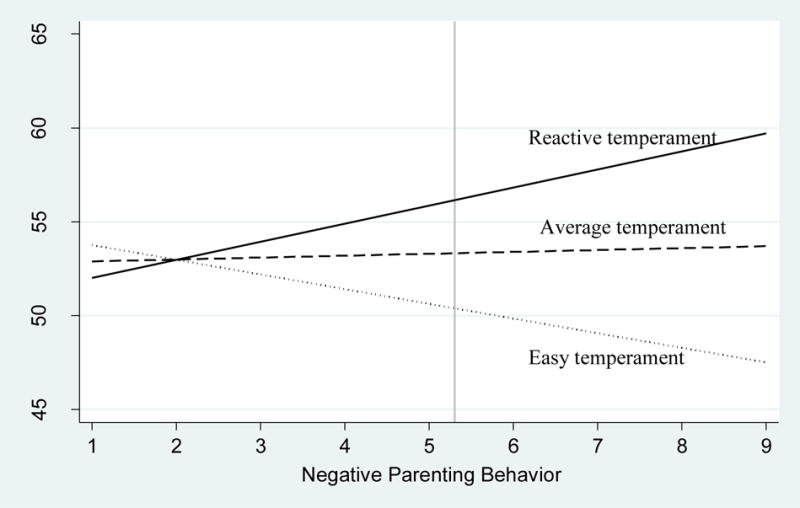
Prospective association between age 13 negative parenting behavior and rule-breaking behavior two years later for adolescents with “reactive” (+1 SD), average (grand mean), and “easy” (−1 SD) temperament in toddlerhood. Area to the right of the gray vertical line denotes regions of negative parenting where the three lines significantly differ.
Acknowledgments
This paper was based on the activities of the Collaborative Family Study, supported by the Eunice Kennedy Shriver National Institute of Child Health and Human Development, Grant number: 34879-1459 (Drs. Bruce L. Baker, Jan Blacher, and Keith Crnic PIs). This work was also partially supported by a National Science Foundation graduate research fellowship (DGE-1144087) awarded to Irene Tung. We are indebted to our staff, doctoral student colleagues, and especially to the families who participated in our research study.
Footnotes
IRENE TUNG (Orcid ID : 0000-0003-1263-066X)
References
- Aber JL, Belsky J, Slade A, Crnic K. Stability and change in mothers’ representations of their relationship with their toddlers. Developmental Psychology. 1999;35(4):1038–1047. doi: 10.1037//0012-1649.35.4.1038. [DOI] [PubMed] [Google Scholar]
- Achenbach TM. Commentary: Definitely more than measurement error: But how should we understand and deal with informant discrepancies? Journal of Clinical Child & Adolescent Psychology. 2011;40(1):80–86. doi: 10.1080/15374416.2011.533416. [DOI] [PubMed] [Google Scholar]
- Achenbach TM, Rescorla L. ASEBA School-Age Forms & Profiles. Burlington: Aseba; 2001. [Google Scholar]
- Akker AL van den, Deković M, Prinzie P, Asscher JJ. Toddlers’ temperament profiles: Stability and relations to negative and positive parenting. Journal of Abnormal Child Psychology. 2010;38(4):485–495. doi: 10.1007/s10802-009-9379-0. [DOI] [PMC free article] [PubMed] [Google Scholar]
- Beery AK, Francis DD. Adaptive significance of natural variations in maternal care in rats: A translational perspective. Neuroscience & Biobehavioral Reviews. 2011;35(7):1552–1561. doi: 10.1016/j.neubiorev.2011.03.012. [DOI] [PMC free article] [PubMed] [Google Scholar]
- Belsky J, Bakermans-Kranenburg MJ, IJzendoorn MH van. For better and for worse: Differential susceptibility to environmental influences. Current Directions in Psychological Science. 2007;16(6):300–304. doi: 10.1111/j.1467-8721.2007.00525.x. [DOI] [Google Scholar]
- Belsky J, Crnic K, Woodworth S. Personality and parenting: Exploring the mediating role of transient mood and daily hassles. Journal of Personality. 1995;63(4):905–929. doi: 10.1111/j.1467-6494.1995.tb00320.x. [DOI] [PubMed] [Google Scholar]
- Belsky J, Hsieh KH, Crnic K. Mothering, fathering, and infant negativity as antecedents of boys’ externalizing problems and inhibition at age 3 years: Differential susceptibility to rearing experience? Development and Psychopathology. 1998;null(02):301–319. doi: 10.1017/s095457949800162x. https://doi.org/null. [DOI] [PubMed] [Google Scholar]
- Belsky J, Pluess M. Beyond diathesis stress: Differential susceptibility to environmental influences. Psychological Bulletin. 2009;135(6):885–908. doi: 10.1037/a0017376. [DOI] [PubMed] [Google Scholar]
- Belsky J, Pluess M. Differential susceptibility to long-term effects of quality of child care on externalizing behavior in adolescence? International Journal of Behavioral Development. 2012;36(1):2–10. doi: 10.1177/0165025411406855. [DOI] [Google Scholar]
- Bender HA, Auciello D, Morrison CE, MacAllister WS, Zaroff CM. Comparing the convergent validity and clinical utility of the Behavior Assessment System for Children-Parent Rating Scales and Child Behavior Checklist in children with epilepsy. Epilepsy & Behavior: E&B. 2008;13(1):237–242. doi: 10.1016/j.yebeh.2008.03.007. [DOI] [PubMed] [Google Scholar]
- Blackson TC, Tarter RE, Mezzich AC. Interaction between childhood temperament and parental discipline practices on behavioral adjustment in preadolescent sons of substance abuse and normal fathers. The American Journal of Drug and Alcohol Abuse. 1996;22(3):335–348. doi: 10.3109/00952999609001663. [DOI] [PubMed] [Google Scholar]
- Boyce WT. Differential susceptibility of the developing brain to contextual adversity and stress. Neuropsychopharmacology. 2016;41(1):142–162. doi: 10.1038/npp.2015.294. [DOI] [PMC free article] [PubMed] [Google Scholar]
- Broidy LM, Nagin DS, Tremblay RE, Bates JE, Brame B, Dodge KA, Vitaro F. Developmental trajectories of childhood disruptive behaviors and adolescent delinquency: A six-site, cross-national study. Developmental Psychology. 2003;39(2):222–245. doi: 10.1037//0012-1649.39.2.222. [DOI] [PMC free article] [PubMed] [Google Scholar]
- Brown BB, Bakken JP. Parenting and peer relationships: Reinvigorating research on family-peer linkages in adolescence. Journal of Research on Adolescence. 2011;21(1):153–165. doi: 10.1111/j.1532-7795.2010.00720.x. [DOI] [Google Scholar]
- Caspi A, Roberts BW. Personality development across the life course: The argument for change and continuity. Psychological Inquiry. 2001;12(2):49–66. doi: 10.1207/S15327965PLI1202_01. [DOI] [Google Scholar]
- Chang L, Schwartz D, Dodge KA, McBride-Chang C. Harsh parenting in relation to child emotion regulation and aggression. Journal of Family Psychology. 2003;17(4):598–606. doi: 10.1037/0893-3200.17.4.598. [DOI] [PMC free article] [PubMed] [Google Scholar]
- Chhangur RR, Overbeek G, Verhagen M, Weeland J, Matthys W, E CM. DRD4 and DRD2 genes, parenting, and adolescent delinquency: Longitudinal evidence for a gene by environment interaction. Journal of Abnormal Psychology. 2015;124(4):791–802. doi: 10.1037/abn0000091. [DOI] [PubMed] [Google Scholar]
- Collins LM, Schafer JL, Kam CM. A comparison of inclusive and restrictive strategies in modern missing data procedures. Psychological Methods. 2001;6(4):330–351. doi: 10.1037/1082-989X.6.4.330. [DOI] [PubMed] [Google Scholar]
- De Los Reyes A. Introduction to the special section: More than measurement error: Discovering meaning behind informant discrepancies in clinical assessments of children and adolescents. Journal of Clinical Child & Adolescent Psychology. 2011;40(1):1–9. doi: 10.1080/15374416.2011.533405. [DOI] [PubMed] [Google Scholar]
- De Los Reyes A, Augenstein TM, Wang M, Thomas SA, G A, Burgers DE, Rabinowitz J. The validity of the multi-informant approach to assessing child and adolescent mental health. Psychological Bulletin, No Pagination Specified. 2015 doi: 10.1037/a0038498. [DOI] [PMC free article] [PubMed]
- Del Giudice M. Statistical tests of differential susceptibility: Performance, limitations, and improvements. Development and Psychopathology. 2017;29(4):1267–1278. doi: 10.1017/S0954579416001292. [DOI] [PubMed] [Google Scholar]
- Derauf C, LaGasse L, Smith L, Newman E, Shah R, Arria A, Lester B. Infant temperament and high risk environment relate to behavior problems and language in toddlers. Journal of Developmental and Behavioral Pediatrics. 2011;32(2):125–135. doi: 10.1097/DBP.0b013e31820839d7. [DOI] [PMC free article] [PubMed] [Google Scholar]
- Dyson MW, Olino TM, Durbin CE, Goldsmith HH, Bufferd SJ, Miller AR, Klein DN. The structural and rank-order stability of temperament in young children based on a laboratory-observational measure. Psychological Assessment. 2015;27(4):1388–1401. doi: 10.1037/pas0000104. [DOI] [PMC free article] [PubMed] [Google Scholar]
- Ellis BJ, Boyce WT. Differential susceptibility to the environment: Toward an understanding of sensitivity to developmental experiences and context. Development and Psychopathology. 2011;23(01):1–5. doi: 10.1017/S095457941000060X. [DOI] [PubMed] [Google Scholar]
- Ellis BJ, Boyce WT, Belsky J, Bakermans-Kranenburg MJ, van IJzendoorn MH. Differential susceptibility to the environment: An evolutionary–neurodevelopmental theory. Development and Psychopathology. 2011;23(01):7–28. doi: 10.1017/S0954579410000611. [DOI] [PubMed] [Google Scholar]
- Ferguson CJ. A meta-analysis of normal and disordered personality across the life span. Journal of Personality and Social Psychology. 2010;98(4):659–667. doi: 10.1037/a0018770. [DOI] [PubMed] [Google Scholar]
- Fergusson DM, Boden JM, Horwood LJ. Situational and generalised conduct problems and later life outcomes: Evidence from a New Zealand birth cohort. Journal of Child Psychology and Psychiatry. 2009;50(9):1084–1092. doi: 10.1111/j.1469-7610.2009.02070.x. [DOI] [PubMed] [Google Scholar]
- Flouri E, Midouhas E. Environmental adversity and children’s early trajectories of problem behavior: The role of harsh parental discipline. Journal of Family Psychology. 2017;31(2):234–243. doi: 10.1037/fam0000258. [DOI] [PMC free article] [PubMed] [Google Scholar]
- Foster EM, Jones DE. The high costs of aggression: Public expenditures resulting from conduct disorder. American Journal of Public Health. 2005;95(10):1767–1772. doi: 10.2105/AJPH.2004.061424. [DOI] [PMC free article] [PubMed] [Google Scholar]
- Goldsmith HH. Studying temperament via construction of the Toddler Behavior Assessment Questionnaire. Child Development. 1996;67(1):218–235. doi: 10.1111/j.1467-8624.1996.tb01730.x. [DOI] [PubMed] [Google Scholar]
- Hastings PD, Helm J, Mills RSL, Serbin LA, Stack DM, Schwartzman AE. Dispositional and environmental predictors of the development of internalizing problems in childhood: Testing a multilevel model. Journal of Abnormal Child Psychology. 2015;43(5):831–845. doi: 10.1007/s10802-014-9951-0. [DOI] [PubMed] [Google Scholar]
- Hou J, Chen Z, Natsuaki MN, Li X, Yang X, Zhang J, Zhang J. A longitudinal investigation of the associations among parenting, deviant peer affiliation, and externalizing nehaviors: A monozygotic twin differences design. Twin Research and Human Genetics. 2013;16(3):698–706. doi: 10.1017/thg.2013.24. [DOI] [PubMed] [Google Scholar]
- Hubbard JA, McAuliffe MD, Morrow MT, Romano LJ. Reactive and proactive aggression in childhood and adolescence: Precursors, outcomes., processes, experiences, and measurement. Journal of Personality. 2010;78(1):95–118. doi: 10.1111/j.1467-6494.2009.00610.x. [DOI] [PubMed] [Google Scholar]
- Jaffee SR, Price TS. Gene–environment correlations: A review of the evidence and implications for prevention of mental illness. Molecular Psychiatry. 2007;12(5):432–442. doi: 10.1038/sj.mp.4001950. [DOI] [PMC free article] [PubMed] [Google Scholar]
- Kiff CJ, Lengua LJ, Zalewski M. Nature and nurturing: Parenting in the context of child temperament. Clinical Child and Family Psychology Review. 2011;14(3):251–301. doi: 10.1007/s10567-011-0093-4. [DOI] [PMC free article] [PubMed] [Google Scholar]
- Kochanska G, Kim S. Difficult temperament moderates links between maternal responsiveness and children’s compliance and behavior problems in low-income families. Journal of Child Psychology and Psychiatry. 2013;54(3):323–332. doi: 10.1111/jcpp.12002. [DOI] [PMC free article] [PubMed] [Google Scholar]
- Laible DJ, Carlo G, Raffaelli M. The differential relations of parent and peer attachment to adolescent adjustment. Journal of Youth and Adolescence. 2000;29(1):45–59. doi: 10.1023/A:1005169004882. [DOI] [Google Scholar]
- Laird RD, Jordan KY, Dodge KA, Pettit GS, Bates JE. Peer rejection in childhood, involvement with antisocial peers in early adolescence, and the development of externalizing behavior problems. Development and Psychopathology. 2001;13(2):337–354. doi: 10.1017/s0954579401002085. [DOI] [PMC free article] [PubMed] [Google Scholar]
- Lansford JE, Criss MM, Laird RD, Shaw DS, Pettit GS, Bates JE, Dodge KA. Reciprocal relations between parents’ physical discipline and children’s externalizing behavior during middle childhood and adolescence. Development and Psychopathology. 2011;23(1):225–238. doi: 10.1017/S0954579410000751. [DOI] [PMC free article] [PubMed] [Google Scholar]
- Latendresse SJ, Bates JE, Goodnight JA, Lansford JE, Budde JP, Goate A, Dick DM. Differential susceptibility to adolescent externalizing trajectories: examining the interplay between CHRM2 and peer group antisocial behavior. Child Development. 2011;82(6):1797–1814. doi: 10.1111/j.1467-8624.2011.01640.x. [DOI] [PMC free article] [PubMed] [Google Scholar]
- Lemery-Chalfant K, Kao K, Swann G, Goldsmith HH. Childhood temperament: Passive gene–environment correlation, gene–environment interaction, and the hidden importance of the family environment. Development and Psychopathology. 2013;25(1):51–63. doi: 10.1017/S0954579412000892. [DOI] [PMC free article] [PubMed] [Google Scholar]
- Majdandžić M, Möller EL, Vente W de, Bögels SM, Boom DC van den. Fathers’ challenging parenting behavior prevents social anxiety development in their 4-year-old children: A longitudinal observational study. Journal of Abnormal Child Psychology. 2014;42(2):301–310. doi: 10.1007/s10802-013-9774-4. [DOI] [PubMed] [Google Scholar]
- McCart MR, Priester PE, Davies WH, Azen R. Differential Effectiveness of Behavioral Parent-Training and Cognitive-Behavioral Therapy for Antisocial Youth: A Meta-Analysis. Journal of Abnormal Child Psychology. 2006;34(4):525–541. doi: 10.1007/s10802-006-9031-1. [DOI] [PubMed] [Google Scholar]
- McClowry SG, Rodriguez ET, Koslowitz R. Temperament-based intervention: Re-examining goodness of fit. European Journal of Developmental Science. 2008;2(1–2):120–135. [PMC free article] [PubMed] [Google Scholar]
- Meaney MJ. Epigenetics and the biological definition of gene × environment interactions. Child Development. 2010;81(1):41–79. doi: 10.1111/j.1467-8624.2009.01381.x. [DOI] [PubMed] [Google Scholar]
- Menting B, van Lier PAC, Koot HM. Language skills, peer rejection, and the development of externalizing behavior from kindergarten to fourth grade. Journal of Child Psychology and Psychiatry. 2011;52(1):72–79. doi: 10.1111/j.1469-7610.2010.02279.x. [DOI] [PubMed] [Google Scholar]
- Micalizzi L, Wang M, Saudino KJ. Difficult temperament and negative parenting in early childhood: A genetically informed cross-lagged analysis. Developmental Science. 2015:n/a–n/a. doi: 10.1111/desc.12355. [DOI] [PMC free article] [PubMed]
- Moffitt TE. Adolescence-limited and life-course-persistent antisocial behavior: A developmental taxonomy. Psychological Review. 1993;100(4):674–701. doi: 10.1037/0033-295X.100.4.674. [DOI] [PubMed] [Google Scholar]
- Moffitt TE, Caspi A. Childhood predictors differentiate life-course persistent and adolescence-limited antisocial pathways among males and females. Development and Psychopathology. 2001;13(02):355–375. doi: 10.1017/s0954579401002097. [DOI] [PubMed] [Google Scholar]
- Moore SR, Depue RA. Neurobehavioral foundation of environmental reactivity. Psychological Bulletin. 2016;142(2):107–164. doi: 10.1037/bul0000028. [DOI] [PubMed] [Google Scholar]
- Morris AS, Silk JS, Steinberg L, Sessa FM, Avenevoli S, Essex MJ. Temperamental vulnerability and negative parenting as interacting predictors of child adjustment. Journal of Marriage and Family. 2002;64(2):461–471. doi: 10.1111/j.1741-3737.2002.00461.x. [DOI] [Google Scholar]
- Nikitopoulos J, Zohsel K, Blomeyer D, Buchmann AF, Schmid B, Jennen-Steinmetz C, Laucht M. Are infants differentially sensitive to parenting? Early maternal care, DRD4 genotype and externalizing behavior during adolescence. Journal of Psychiatric Research. 2014;59:53–59. doi: 10.1016/j.jpsychires.2014.08.012. [DOI] [PubMed] [Google Scholar]
- Olson SL, Bates JE, Sandy JM, Lanthier R. Early developmental precursors of externalizing behavior in middle childhood and adolescence. Journal of Abnormal Child Psychology. 2000;28(2):119–133. doi: 10.1023/A:1005166629744. [DOI] [PubMed] [Google Scholar]
- Pluess M. Individual differences in environmental sensitivity. Child Development Perspectives. 2015;9(3):138–143. doi: 10.1111/cdep.12120. [DOI] [Google Scholar]
- Pluess M, Belsky J. Differential susceptibility to rearing experience: The case of childcare. Journal of Child Psychology and Psychiatry. 2009;50(4):396–404. doi: 10.1111/j.1469-7610.2008.01992.x. [DOI] [PubMed] [Google Scholar]
- Pluess M, Belsky J. Differential susceptibility to parenting and quality child care. Developmental Psychology. 2010;46(2):379–390. doi: 10.1037/a0015203. [DOI] [PubMed] [Google Scholar]
- Rabinowitz JA, Drabick DAG. Do children fare for better and for worse? Associations among child features and parenting with child competence and symptoms. Developmental Review. 2017;45:1–30. doi: 10.1016/j.dr.2017.03.001. [DOI] [Google Scholar]
- Rabinowitz JA, Osigwe I, Drabick DAG, Reynolds MD. Negative emotional reactivity moderates the relations between family cohesion and internalizing and externalizing symptoms in adolescence. Journal of Adolescence. 2016;53:116–126. doi: 10.1016/j.adolescence.2016.09.007. [DOI] [PMC free article] [PubMed] [Google Scholar]
- Reid JB, Patterson GR. The development of antisocial behaviour patterns in childhood and adolescence. European Journal of Personality. 1989;3(2):107–119. doi: 10.1002/per.2410030205. [DOI] [Google Scholar]
- Rioux C, Castellanos-Ryan N, Parent S, Vitaro F, Tremblay RE, Séguin JR. Differential susceptibility to environmental influences: Interactions between child temperament and parenting in adolescent alcohol use. Development and Psychopathology. 2016;28(01):265–275. doi: 10.1017/S0954579415000437. [DOI] [PMC free article] [PubMed] [Google Scholar]
- Roisman GI, Monahan KC, Campbell SB, Steinberg L, Cauffman E. Is adolescence-onset antisocial behavior developmentally normative? Development and Psychopathology. 2010;22(02):295–311. doi: 10.1017/S0954579410000076. [DOI] [PMC free article] [PubMed] [Google Scholar]
- Roisman GI, Newman DA, Fraley RC, Haltigan JD, Groh AM, Haydon KC. Distinguishing differential susceptibility from diathesis–stress: Recommendations for evaluating interaction effects. Development and Psychopathology. 2012;24(02):389–409. doi: 10.1017/S0954579412000065. [DOI] [PubMed] [Google Scholar]
- Rothbart MK. Becoming Who We Are: Temperament and Personality in Development. Guilford Press; 2011. [Google Scholar]
- Rothbart MK, Sheese BE, Rueda MR, Posner MI. Developing mechanisms of self-regulation in early life. Emotion Review. 2011;3(2):207–213. doi: 10.1177/1754073910387943. [DOI] [PMC free article] [PubMed] [Google Scholar]
- Salbach-Andrae H, Lenz K, Lehmkuhl U. Patterns of agreement among parent, teacher and youth ratings in a referred sample. European Psychiatry. 2009;24(5):345–351. doi: 10.1016/j.eurpsy.2008.07.008. [DOI] [PubMed] [Google Scholar]
- Sattler JM, Dumont R. Assessment of Children: WISC-IV and WPPSI-III Supplement. La Mesa, CA: Jerome M. Sattler; 2004. [Google Scholar]
- Saudino KJ, Wang M. Quantitative and molecular genetic studies of temperament. Handbook of Temperament. 2012:315–346. [Google Scholar]
- Sentse M, Laird RD. Parent–child relationships and dyadic friendship experiences as predictors of behavior problems in early adolescence. Journal of Clinical Child & Adolescent Psychology. 2010;39(6):873–884. doi: 10.1080/15374416.2010.517160. [DOI] [PubMed] [Google Scholar]
- Silverthorn P, Frick PJ. Developmental pathways to antisocial behavior: The delayed-onset pathway in girls. Development and Psychopathology. 1999;11(01):101–126. doi: 10.1017/s0954579499001972. [DOI] [PubMed] [Google Scholar]
- Slagt M, Dubas JS, Deković M, van Aken MAG. Differences in sensitivity to parenting depending on child temperament: A meta-analysis. Psychological Bulletin. 2016;142(10):1068–1110. doi: 10.1037/bul0000061. [DOI] [PubMed] [Google Scholar]
- Sroufe LA. The concept of development in developmental psychopathology. Child Development Perspectives. 2009;3(3):178–183. doi: 10.1111/j.1750-8606.2009.00103.x. [DOI] [PMC free article] [PubMed] [Google Scholar]
- Steinberg L. A social neuroscience perspective on adolescent risk-taking. Developmental Review. 2008;28(1):78–106. doi: 10.1016/j.dr.2007.08.002. [DOI] [PMC free article] [PubMed] [Google Scholar]
- Stormshak EA, Bierman KL, McMahon RJ, Lengua LJ. Parenting practices and child disruptive behavior problems in early elementary school. Journal of Clinical Child Psychology. 2000;29(1):17–29. doi: 10.1207/S15374424jccp2901_3. [DOI] [PMC free article] [PubMed] [Google Scholar]
- Tung I, Lee SS. Context-specific associations between harsh parenting and peer rejection on child conduct problems at home and school. Journal of Clinical Child and Adolescent Psychology. 2016:1–13. doi: 10.1080/15374416.2015.1102071. [DOI] [PubMed]
- Wang Y, Dix T. Mothers’ depressive symptoms and children’s externalizing behavior: Children’s negative emotionality in the development of hostile attributions. Journal of Family Psychology. 2017;31(2):214–223. doi: 10.1037/fam0000241. [DOI] [PubMed] [Google Scholar]
- Weisz JR, Kazdin AE. Evidence‑Based Psychotherapies for Children and Adolescents. 3rd. New York, NY: The Guilford Press; 2017. [Google Scholar]
- Welsh BC, Loeber R, Stevens BR, Stouthamer-Loeber M, Cohen MA, Farrington DP. Costs of juvenile crime in urban areas: A longitudinal perspective. Youth Violence and Juvenile Justice. 2008;6(1):3–27. doi: 10.1177/1541204007308427. [DOI] [Google Scholar]
- West SG, Aiken LS. Multiple Regression: Testing and Interpreting Interactions. SAGE; 1991. [Google Scholar]
- Youngstrom E. Secondary Data Analyses Testing the Use of Pervasiveness as a Severity Index. Washington DC: American Psychiatric Association; 2011. Retrieved from http://www.dsm5.org. [Google Scholar]
- Zhang W, Cao Y, Wang M, Ji L, Chen L, Deater-Deckard K. The dopamine D2 receptor polymorphism (DRD2 TaqIA) interacts with maternal parenting in predicting early adolescent depressive symptoms: Evidence of differential susceptibility and age differences. Journal of Youth and Adolescence. 2015;44(7):1428–1440. doi: 10.1007/s10964-015-0297-x. [DOI] [PubMed] [Google Scholar]