



Abstract
There is general consistency among US and European guidelines regarding the initiation of antiretroviral therapy for HIV-infected individuals. Recent and ongoing trials comparing regimens may lead to reevaluation of initial treatment choices. The choice of antiretroviral regimen will also likely be affected by development, evaluation, and availability of newer drugs. This article reviews currently recommended regimens and characteristics of selected current investigational drugs, including the nucleotide analogue reverse transcriptase inhibitor tenofovir alafenamide, the nonnucleoside reverse transcriptase inhibitor doravirine, the integrase strand transfer inhibitor cabotegravir, the HIV entry inhibitor BMS-663068, and the HIV maturation inhibitor BMS-955176. This article summarizes a presentation by Roy M. Gulick, MD, MPH, at the IAS–USA continuing education program, Improving the Management of HIV Disease, held in New York, New York, in March 2015 and September 2015.
Keywords: HIV, antiretroviral drugs, initial therapy, tenofovir, TAF, doravirine, cabotegravir, BMS-663068, BMS-955176, CD4 attachment inhibitor, HIV maturation inhibitor
As of late 2015, 29 antiretroviral drugs are approved by the US Food and Drug Administration (FDA) for the treatment of HIV infection. Over the years, antiretroviral drugs have evolved to have greater potency, safety, and convenience in initial antiretroviral therapy regimens. A recent systematic analysis by Lee and colleagues of 114 antiretroviral therapy trials with intent-to-treat analyses and up to 3 years of follow-up through 2012 showed that the proportion of participants who achieved an undetectable viral load level on their initial antiretroviral treatment increased from 43% in the mid-1990s to more than 80% by 2010.1 The same analysis showed that the rate of participant discontinuations attributable to intolerance or toxic effects decreased from 14% to 4%, with rates of 3% or lower reported in more recent studies.2-4 Today, rates of virologic suppression of 90% or higher are being achieved among HIV-infected individuals in clinical trials and in clinical practice.4,5
An example of the improvement of antiretroviral therapy in clinical practice is provided by findings in British Columbia, Canada, where all HIV-infected individuals in the province receive treatment from a single site. The proportion of individuals receiving any antiretroviral therapy (not only initial) with plasma HIV RNA levels below 50 copies/mL increased from 65% in 2000 to 87% in 2008.6 An informal assessment survey of the HIV clinic at New York–Presbyterian/Weill Cornell Medical Center in New York, New York, indicated that approximately 90% of patients taking antiretroviral therapy had undetectable viral load levels.
What to Start
Initiation of antiretroviral therapy is currently recommended for essentially all HIV-infected adults regardless of CD4+ cell count or viral load.7–11 Updated guidelines from the US Department of Health and Human Services (DHHS) for initial antiretroviral therapy recommend 1) an integrase strand transfer inhibitor (InSTI)-containing regimen of dolutegravir, abacavir, and lamivudine; dolutegravir, tenofovir disoproxil fumarate (TDF), and emtricitabine; cobicistat-boosted elvitegravir, TDF, and emtricitabine; cobicistat-boosted elvitegravir, tenofovir alafenamide (TAF), and emtricitabine; or raltegravir, TDF, and emtricitabine; or 2) a protease inhibitor (PI)-containing regimen of ritonavir-boosted darunavir, TDF, and emtricitabine (Table 1).8
Table 1.
Recommended Initial Antiretroviral Regimens From US Department of Health and Human Services Guidelines
| InSTI-Based Regimens | PI-Based Regimen |
|---|---|
| – Dolutegravir, abacavir, and lamivudinea | – Darunavir boosted with and ritonavir plus tenofovir disoproxil fumarate and emtricitabinea |
| – Dolutegravir, tenofovir disoproxil fumarate, emtricitabinea | |
| – Elvitegravir boosted with cobicistat plus tenofovir disoproxil fumarate and emtricitabine | |
| – Elvitegravir boosted with cobicistat plus tenofovir alafenamide and emtricitabine | |
| – Raltegravir, tenofovir disoproxil fumarate, and emtricitabinea |
Abbreviations: InSTI, integrase strand transfer inhibitor; PI, protease inhibitor. Adapted from US Department of Health and Human Services.8
L amivudine and emtricitabine may be substituted for one another in these regimens.
Current guidelines from the IAS–USA, the European AIDS Clinical Society, and the British HIV Association regarding which regimens to use for initial antiretroviral treatment variably recommend TDF and emtricitabine or abacavir and lamivudine with a third drug chosen from the nonnucleoside analogue reverse transcriptase inhibitors (NNRTIs) efavirenz and rilpirivine, the ritonavir-boosted PIs atazanavir and darunavir, or the InSTIs dolutegravir, elvitegravir, and raltegravir.7,9,10 World Health Organization guidelines for antiretroviral treatment in resource-limited regions recommend TDF in combination with emtricitabine or lamivudine plus efavirenz.11 Regimens categorized as alternative by the DHHS are listed in Table 2.8
Table 2.
Alternative Initial Antiretroviral Regimens From US Department of Health and Human Services Guidelines
| NNRTI-Based Regimens | PI-Based Regimens |
|---|---|
| – Efavirenz, tenofovir disoproxil fumarate, and emtricitabineabold> | – Atazanavir boosted with cobicistat plus tenofovir disoproxil fumarate and emtricitabinea |
| – Atazanavir boosted with ritonavir plus tenofovir disoproxil fumarate and emtricitabinea | |
| – Rilpivirine, tenofovir disoproxil fumarate, and emtricitabinea | – Darunavir boosted with either cobicistat or ritonavir plus abacavir and lamivudinea |
| – Darunavir boosted with cobicistat plus tenofovir disoproxil fumarate and emtricitabinea |
Abbreviations: NNRTI, nonnucleoside reverse transcriptase inhibitor; PI, protease inhibitor. Adapted from Department of Health and Human Services.8
aLamivudine and emtricitabine may be substituted for one another in these regimens.
Recent results from comparative trials of recommended initial regimens in HIV-infected, treatment-naive participants may help practitioners choose from among recommended initial regimens. In the SINGLE trial, which compared once-daily abacavir and lamivudine plus dolutegravir with TDF, emtricitabine, and efavirenz, and in the FLAMINGO trial, which evaluated the once-daily regimens of dual nucleos(t)-ide analogue reverse transcriptase inhibitors (nRTIs) plus dolutegravir or ritonavir-boosted darunavir, dolutegravir-containing therapy was statistically superior in terms of viral suppression rates and appeared to be better tolerated.2,3 In the SPRING-2 trial, which allowed TDF and emtricitabine or abacavir and lamivudine plus either once-daily dolutegravir or twice-daily raltegravir, dolutegravir-containing regimens were statistically noninferior.12
In the AIDS Clinical Trials Group (ACTG) 5257 trial, which evaluated TDF and emtricitabine plus ritonavir-boosted atazanavir, ritonavir-boosted darunavir, or raltegravir, the raltegravir-containing regimen was superior to the 2 PI-containing regimens; additionally, the darunavir-containing regimen was superior to the atazanavir-containing regimen, owing primarily to better tolerability (mostly related to gastrointestinal symptoms and hyperbilirubinemia).4 These data suggest that currently recommended initial antiretroviral regimens may evolve further, and this may be reflected in future updated guidelines.
Newer or Investigational Antiretroviral Agents
Characteristics of the recently approved nRTI TAF, the investigational NNRTI doravirine (also referred to as DOR), the investigational InSTI cabotegravir (also referred to as CAB), the investigational entry inhibitor BMS-663068, and the investigational maturation inhibitor BMS-955176 are discussed below.
Tenofovir Alafenamide
Highly desirable characteristics for a new nRTI are fewer long-term toxic effects and activity against resistant virus. The investigational nRTI TAF, like its predecessor TDF, is a prodrug of tenofovir. TDF is converted to tenofovir in plasma and then converted to tenofovir diphosphate in lymphoid cells, whereas TAF remains in prodrug form until it enters lymphoid cells, where it is also converted to tenofovir diphosphate. When TAF was developed, it was hoped that it would be associated with more efficient delivery to lymphocytes and with less drug delivery to kidney and bone, possibly decreasing toxic effects.
Combined results of 2 identically designed double-blind phase III noninferiority studies that compared TAF with TDF plus cobicistat-boosted elvitegravir and emtricitabine were recently published. Study 104 was conducted in North America, Europe, and Asia, and Study 111 was conducted in North America, Europe, and Latin America.5 The combined efficacy analysis was prespecified. Of 1733 treatment-naive participants with HIV RNA levels of at least 1000 copies/mL and estimated glomerular filtration rates of at least 50 mL/min, 866 were randomly assigned to receive once-daily TAF and 867 were randomly assigned to receive once-daily TDF. The primary end point was the proportion of participants with HIV RNA level below 50 copies/mL; the noninferiority margin was 12% based on an FDA snapshot analysis at week 48.
Combined analysis at week 48 showed that 92% of those who received TAF versus 90% of those who received TDF achieved virologic suppression; 4% and 4%, respectively, experienced virologic failure, and for 4% and 6%, respectively, no data were available. The treatment difference between TAF and TDF was +2.0%, with a 95% confidence interval of -0.7% to +4.7% (that excluded -12.0%), thus meeting the criteria for noninferiority. Analyses of baseline viral load and CD4+ cell count subgroups showed no difference in suppression rates between study groups. In addition, TAF was associated with fewer nephrotoxic effects and less bone mineral density loss. TAF exposure has been found to substantially increase when TAF is coadministered with ritonavir-boosted atazanavir, lopinavir, or darunavir, whereas little effect has been observed when TAF is coadministered with dolutegravir or rilpivirine.13 There are plans for fixed-dose formulations of emtricitabine 200 mg and TAF 10 mg for concomitant use with boosted PIs or elvitegravir or TAF 25 mg for concomitant use with other InSTIs and NNRTIs. TAF was approved by the FDA in November 2015.
Doravirine
Desirable characteristics for a new NNRTI include fewer toxic effects and drug-drug interactions, better tolerability, and activity against NNRTI-resistant virus strains. The investigational NNRTI doravirine is active in vitro against HIV with NNRTI resistance–associated mutations, including K103N, Y181C, G190A, E101K, E138K, and K103N/Y181C. Doravirine is metabolized by cytochrome P450 3A4 (CYP3A4) but is not a CYP450 inhibitor or inducer, suggesting a lower potential for drug-drug interactions.14 However, interactions with rifampin have been observed, and coadministration of rifampin and doravirine reduces doravirine exposure by more than 57%.15 In a study of HIV-seronegative men given single or repeated doses of doravirine, no rash or central nervous system events were reported and pharmacokinetics supported once-daily dosing.16
In a phase Ib study of 18 treatment-naive individuals, reductions of HIV RNA levels of approximately 1.5 log10 copies/mL were observed with daily doses of doravirine 25 mg and doravirine 200 mg given for 7 days.17 In a phase IIb study, treatment-naive individuals were randomly assigned to receive TDF and emtricitabine plus efavirenz (n = 42) or doravirine at 25 mg (n = 40), 50 mg (n = 42), 100 mg (n = 40), or 200 mg (n = 41). At 24 weeks, an HIV RNA level of less than 40 copies/mL was achieved in 80%, 76%, 71%, and 78% of those who received doravirine, respectively, (overall 76%) and in 64% of those who received efavirenz.18 At 48 weeks, the response rates were 73%, 72%, 76%, and 83% for those who received doravirine, respectively, and 71% for those who received efavirenz.19 Nausea was reported in 8% of those who received doravirine and 2% of those in the control group, fatigue in 7% and 5%, respectively, and diarrhea in 5% and 10%, respectively. Doravirine 100 mg was selected for phase III testing. At 48 weeks, the rates of toxic effects in the central nervous system were greater among those who received efavirenz than among those who received doravirine 100 mg (44% vs 22%, respectively; P< .001), including rates of dizziness (28% vs 9%, respectively) and abnormal dreams (17% vs 6%, respectively); rates of insomnia (3% vs 6%, respectively) and nightmares (8% vs 6%, respectively) were similar. Phase III studies are in progress.
Cabotegravir
A desirable characteristic of a new InSTI is less frequent dosing. The investigational InSTI cabotegravir has a similar chemical structure and resistance profile to dolutegravir but may allow for less frequent parenteral dosing. A new investigational nanotechnologic formulation of cabotegravir may be subcutaneously or intramuscularly injected and has a half-life of 21 days to 50 days, supporting monthly or even quarterly dosing (Figure 1).20 Adverse effects were limited to mild injection-site reactions when single doses of this formulation were studied, although nodules were observed with subcutaneous dosing.
Figure 1.
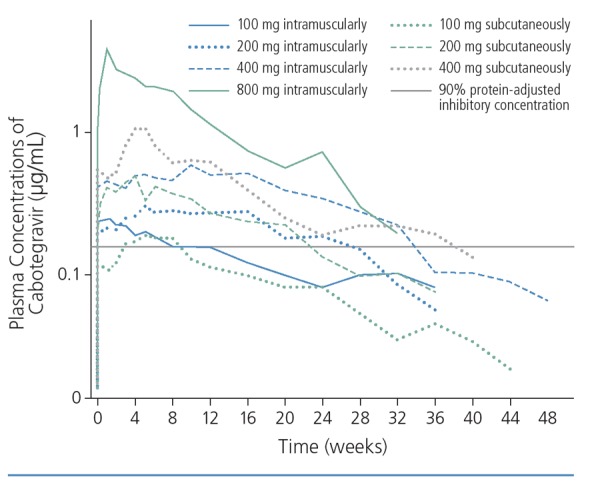
Mean plasma concentration–time profiles following administration of the single-dose, long-acting parenteral formulation of the investigational integrase strand transfer inhibitor cabotegravir. Adapted from Spreen et al.20
The pairing of long-acting parenteral drugs (ie, cabotegravir and rilpivirine) as maintenance antiretroviral therapy that could be given monthly is currently being investigated. The LATTE-1 (Long-Acting Antiretroviral Treatment Enabling –1) study assessed the potential of maintenance therapy with oral forms of cabotegravir and rilpivirine.21 In the study, 243 treatment-naive participants were randomly assigned to receive 2 nRTIs plus daily oral cabotegravir at 10 mg, 30 mg, or 60 mg or efavirenz during an induction phase. For individuals who received cabotegravir, if HIV RNA level was less than 50 copies/mL at 24 weeks, the 2 nRTIs were replaced by daily oral rilpivirine 25 mg. Overall, approximately 80% of participants who received cabotegravir achieved virologic suppression at 24 weeks, and these responses were maintained to 96 weeks with oral cabotegravir plus oral rilpivirine. The LATTE-2 study is currently evaluating oral cabotegravir during induction therapy and parenteral cabotegravir and rilpivirine as maintenance therapy.
BMS-663068
Inhibition of attachment of HIV to CD4+ cells would add a new mechanism of action to HIV treatment options. BMS-663068 is an investigational prodrug of BMS-626529 that inhibits virus from binding to CD4+ cells by binding to HIV envelope glycoprotein 120 (gp120). Pharmacokinetic data support once- or twice-daily dosing of BMS-663068 without boosting. Reduced baseline susceptibility caused by polymorphisms in gp120 was observed in 12% of individuals' virus via retrospective measurement of pretreatment 50% inhibitory concentration (IC50). In phase I testing, BMS-663068 was associated with an approximately 1.5 log10 reduction in HIV RNA level.22 In a phase IIb study, 251 treatment-experienced participants who had an IC50 of the prodrug BMS-626529 of less than 100 nM received TDF and raltegravir plus BMS-663068 400 mg or 800 mg twice daily, BMS-663068 600 mg or 1200 mg once daily, or ritonavir-boosted atazanavir. At week 48, an HIV RNA level below 50 copies/mL was achieved in 61% to 82% of those who received BMS-663068 and in 71% of those who received ritonavir-boosted atazanavir, with no differences observed in response measured by baseline viral load or CD4+ cell count.23 BMS-663068 600 mg twice daily was selected for phase III evaluation, and heavily treatment-experienced participants are currently being enrolled in clinical trials.24
BMS-955176
Inhibition of viral maturation would also be a novel mechanism of action in HIV treatment. A desirable characteristic of a maturation inhibitor is the absence of baseline polymorphisms that confer resistance. BMS-955176 is an oral, second-generation, investigational maturation inhibitor that acts by binding to the HIV Gag polyprotein. It exhibits greater potency and Gag polymorphism coverage than the investigational, first-generation maturation inhibitor bevirimat for which baseline resistance was seen in approximately half of individuals. Pharmacokinetics of BMS-955176 support once-daily dosing.25
In a dose-escalation study of individuals who were naive to PI-containing and maturation inhibitor–containing treatment, reductions in HIV RNA level of approximately 1.5 log10 were achieved with 10 days of treatment with the highest doses of BMS-955176.25 No serious adverse events, grade 3 or 4 adverse events, or treatment-related discontinuations were observed. BMS-955176 has moved into phase II testing.
References
References
- 1.Lee FJ, Amin J, Carr A. Efficacy of initial antiretroviral therapy for HIV-1 infection in adults: a systematic review and meta-analysis of 114 studies with up to 144 weeks' follow-up. PLoS One. 2014; 9(5):e97-482. [DOI] [PMC free article] [PubMed] [Google Scholar]
- 2.Walmsley SL, Antela A, Clumeck N, et al. Dolutegravir plus abacavir-lamivudine for the treatment of HIV-1 infection. N Engl J Med. 2013;369(19): 1807-1818. [DOI] [PubMed] [Google Scholar]
- 3.Clotet B, Feinberg J, van Lunzen J, et al. Once-daily dolutegravir versus darunavir plus ritonavir in antiretroviral-naive adults with HIV-1 infection (FLAMINGO): 48 week results from the randomised open-label phase 3b study. Lancet. 2014;383(9936):2222-2231. [DOI] [PubMed] [Google Scholar]
- 4.Lennox JL, Landovitz RJ, Ribaudo HJ, et al. Efficacy and tolerability of 3 nonnucleoside reverse transcriptase inhibitor-sparing antiretroviral regimens for treatment-naive volunteers infected with HIV-1: a randomized, controlled equivalence trial. Ann Intern Med. 2014;161(7):461-471. [DOI] [PMC free article] [PubMed] [Google Scholar]
- 5.Sax PE, Wohl D, Yin MT, et al. Tenofovir alafenamide versus tenofovir disoproxil fumarate, coformulated with elvitegravir, cobicistat, and emtricitabine, for initial treatment of HIV-1 infection: two randomised, double-blind, phase 3, non-inferiority trials. Lancet. 2015;385(9987):2606-2615. [DOI] [PubMed] [Google Scholar]
- 6.Gill VS, Lima VD, Zhang W, et al. Improved virological outcomes in British Columbia concomitant with decreasing incidence of HIV type 1 drug resistance detection. Clin Infect Dis. 2010;50(1):98-105. [DOI] [PMC free article] [PubMed] [Google Scholar]
- 7.Günthard HF, Aberg JA, Eron JJ, et al. Antiretroviral treatment of adult HIV infection: 2014 recommendations of the International Antiviral Society–USA panel. JAMA. 2014;312(4):410-425. [DOI] [PubMed] [Google Scholar]
- 8.Department of Health and Human Services. Guidelines for the use of antiretroviral agents in HIV-1-infected adults and adolescents. http://aidsinfo.nih.gov/contentfiles/lvguidelines/adultandadolescentgl.pdf. Accessed on November 30, 2015.
- 9.European AIDS Clinical Society. European guidelines for clinical management and treatment of HIV-infected adults in Europe. http://www.eacsociety.org/files/guidelines-7.1-english.pdf. Accessed on November 6, 2015.
- 10.Churchill D, Waters L, Ahmed N, et al. BHIVA guidelines for the treatment of HIV-1-positive adults with antiretroviral therapy 2015. http://www.bhiva.org/documents/Guidelines/Treatment/2015/2015-treatment-guidelines.pdf. Accessed on November 30, 2015. [DOI] [PubMed]
- 11. World Health Organization. Guideline on when to start antiretroviral therapy and on pre-exposure prophylaxis for HIV. http://apps.who.int/iris/bitstream/10665/186275/1/9789241509565_eng.pdf?ua=1. Accessed on November 30, 2015. [PubMed]
- 12.Raffi F, Rachlis A, Stellbrink HJ, et al. Once-daily dolutegravir versus raltegravir in antiretroviral-naive adults with HIV-1 infection: 48 week results from the randomised, double-blind, non-inferiority SPRING-2 study. Lancet. 2013;381(9868):735-743. [DOI] [PubMed] [Google Scholar]
- 13.Lawson EB, Martin H, McCallister S et al. Drug interactions between tenofovir alafenamide and HIV antiretroviral agents. Interscience Conference of Antimicrobial Agents and Chemotherapy. September 5-9, 2014; Washington, DC. [Google Scholar]
- 14.Lai MT, Feng M, Falgueyret JP, et al. In vitro characterization of MK-1439, a novel HIV-1 nonnucleoside reverse transcriptase inhibitor. Antimicrob Agents Chemother. 2014;58(3):1652-1663. [DOI] [PMC free article] [PubMed] [Google Scholar]
- 15.Yee KL, Khalilieh SG, Liu R, et al. The effect of single and multiple dose rifampin on the pharmacokinetics of doravirine [CROI abstract 521]. In Special Issue: Abstracts From the 2015 Conference on Retroviruses and Opportunistic Infections. Top Antivir Med. 2015; 23(e-1):217. [Google Scholar]
- 16.Anderson MS, Gilmartin J, Cilissen C, et al. Safety, tolerability and pharmacokinetics of doravirine, a novel HIV non-nucleoside reverse transcriptase inhibitor, after single and multiple doses in healthy subjects. Antivir Ther. 2014;20(4):397-405. [DOI] [PubMed] [Google Scholar]
- 17.Schurmann D, Sobotha C, Gilmartin J, et al. A randomized, double-blind, placebo-controlled, short-term monotherapy study of doravirine in treatment-naive HIV-infected patients. AIDS. 2015; [Epub ahead of print]. [DOI] [PubMed] [Google Scholar]
- 18.Morales-Ramirez JO, Gatell JM, Hagins DP, et al. Safety and antiviral effect of MK-1439, a novel NNRTI (+FTC/TDF) in ART-naive HIV-infected patients [CROI Abstract 92LB]. In Special Issue: Abstracts From the 2014 Conference on Retroviruses and Opportunistic Infections. Top Antivir Med. 2014;22(e-1):46-47. [Google Scholar]
- 19.Gatell JM, Morales-Ramirez JO, Hagins DP, et al. Forty-eight-week efficacy and safety and early CNS tolerability of doravirine (MK-1439), a novel NNRTI, with TDF/FTC in ART-naive HIV-positive patients. J Int AIDS Soc. 2014;17(4 Suppl 3):19-532. [DOI] [PMC free article] [PubMed] [Google Scholar]
- 20.Spreen W, Ford SL, Chen S, et al. GSK1265744 pharmacokinetics in plasma and tissue after single-dose long-acting injectable administration in healthy subjects. JAIDS 2014;67(5):481-486. [DOI] [PubMed] [Google Scholar]
- 21.Margolis DA, Brinson CC, Smith GH, et al. Cabotegravir plus rilpivirine, once a day, after induction with cabotegravir plus nucleoside reverse transcriptase inhibitors in antiretroviral-naive adults with HIV-1 infection (LATTE): a randomised, phase 2b, dose-ranging trial. Lancet Infect Dis. 2015;15(10):1145-1155. [DOI] [PubMed] [Google Scholar]
- 22.Nettles RE, Schurmann D, Zhu L, et al. Pharmacodynamics, safety, and pharmacokinetics of BMS-663068, an oral HIV-1 attachment inhibitor in HIV-1-infected subjects. J Infect Dis. 2012;206(7):1002-1011. [DOI] [PubMed] [Google Scholar]
- 23.Thompson M, Lalezari J, Kaplan R, et al. Attachment inhibitor prodrug BMS-663068 in ARV-experienced subjects: week 48 analysis [CROI abstract 545]. In Special Issue: Abstracts From the 2015 Conference on Retroviruses and Opportunistic Infections. Top Antivir Med. 2015;23(e-1):227-228. [Google Scholar]
- 24.Landry IS, Zhu L, Abutarif M, et al. HIV-1 attachment inhibitor prodrug BMS-663068: model-based dose selection [CROI abstract 509]. In Special Issue: Abstracts From the 2015 Conference on Retroviruses and Opportunistic Infections. Top Antivir Med. 2015;23 (e-1):211. [Google Scholar]
- 25.Hwang C, Schurmann D, Sobotha C, et al. Antiviral activity/safety of a second-generation HIV-1 maturation inhibitor [CROI abstract 114LB]. In Special Issue: Abstracts From the 2015 Conference on Retroviruses and Opportunistic Infections. Top Antivir Med. 2015; 23(-1):48. [Google Scholar]