



Abstract
With improvements in survival from coronary artery disease (CAD) and an ageing population, refractory angina (RA) is becoming an increasingly common clinical problem facing clinicians in routine clinical practice. These patients experience chronic symptoms in the context of CAD, characterised by angina-type pain, which is uncontrolled despite optimal pharmacological, interventional and surgical therapy. Although mortality rates are no worse in this cohort, patients experience a significantly impaired quality of life with disproportionately high utilisation of healthcare services. It has been increasingly recognised that the needs of RA patients are multifactorial and best provided by specialist multi-disciplinary units. In this review, we consider the variety of therapies available to clinicians in the management of RA and discuss the promise of novel treatments.
Keywords: Angina pectoris, refractory angina pectoris, chest pain, myocardial ischaemia, external enhanced counterpulsation, coronary sinus reducer, neurological manifestations, spinal cord stimulation, pragmatic rehabilitation, specialist angina services
Refractory angina (RA) is conventionally defined as a chronic condition (≥3 months in duration) characterised by angina in the setting of coronary artery disease (CAD), which cannot be controlled by a combination of optimal medical therapy, angioplasty or bypass surgery, and where reversible myocardial ischaemia has been clinically established to be the cause of the symptoms.[1]
In clinical practice, patients diagnosed with RA are a heterogeneous group; common among them, however, is that they remain significantly limited by persistent debilitating chest discomfort despite optimised conventional therapy. In many cases, functional imaging may not demonstrate myocardial ischaemia. It is important to recognise that irrespective of aetiology, patients with refractory chest discomfort often attribute their symptoms to be cardiac in origin and believe that they may herald a life-threatening cardiac event. This predisposes to a progressive decline in their mental wellbeing and increasing anxiety whereby pain begets pain. Consequently, patients can develop persistent symptoms and pessimistic health beliefs, translating to negative behaviours and an impaired quality of life. In this regard, a shift in our approach of RA to that of managing a ‘chronic chest pain syndrome’ may help us not only to better appreciate the multifactorial aetiologies that are in operation in any given patient but also encourage the use of a holistic approach to manage these patients more effectively.
Epidemiology
Precise estimates of the prevalence and incidence of RA are not available; however, several sources suggest that this is a large and growing problem.[2,3] Variations in definition and clinical heterogeneity of patients labelled with a diagnosis of RA significantly complicate such endeavours. Data from the Canadian Community Health Survey (2000–2001) suggest that ~500,000 Canadians are living with unresolved angina.[4] The proportion of these patients with true RA is unknown.[5] In the US, it is estimated that between 600,000 and 1.8 million patients have RA, with approximately 75,000 new cases diagnosed each year.[5,6] In Europe, the annual incidence of RA is estimated at 30,000–50,000 new cases per year.[1,7] Specific figures for the UK are lacking and further work to define the burden of RA in the UK population is needed. However, if the results shown by Williams et al., who found that 6.7 % of patients undergoing angiography in a contemporary cohort had no revascularisation option, are applied to the 247,363 angiograms performed in England in 2014, it can be estimated that ~16,500 new cases of RA may occur in England per year.[3,8] Given improvements in CAD-related survival and increasing age of the population, together with an increasing appreciation from the contemporary Outcome of Percutaneous Coronary Intervention for Stent ThrombosIs Multicentre Study (OPTIMIST) registry that the long term prognosis of RA is not as bad as previously thought, the incidence and prevalence of RA is only set to rise.[5,6,9,10] Furthermore, it has also been recently shown by Povsic et al. that patients with RA use significant healthcare resources, undergoing frequent hospitalisations, and experience high healthcare costs (~US$10,185 over a 3-year period).[11]
Diagnosis
Patients with RA are a heterogeneous group that remain significantly limited by persistent debilitating chest discomfort despite optimal conventional therapy.[1] This syndrome characteristically involves angina-type pain usually in the context of epicardial CAD with or without demonstrable ischaemia. Given the heterogeneity in patients complaining of chronic chest pain, appropriate stratification of patients with regard to their risk of RA helps to direct healthcare resources tailored to individual patients’ needs (see Figure 1).
Figure 1: Triage of Patients with Chronic Chest Pain Syndrome According to Angina Symptoms and Presence of Epicardial Coronary Artery Disease or Reversible Ischaemia on Functional Testing.

A: Stratification of probability of refractory angina into high (red), intermediate (orange) and low (green). Aetiology for each stratification shown (yellow). B: Emphasis of treatment based on stratified probability of refractory angina and likely aetiology. CAD = coronary artery disease; MVD = multivessel disease.
A convincing clinical history of angina, together with circumstantial evidence supporting a diagnosis, should raise clinical suspicion. The coronary anatomy in these patients is highly variable with many having had prior revascularisation (72.4 % by some estimates), and myocardial ischaemia is often difficult to detect using conventional stress imaging protocols.[10] The absence of demonstrable myocardial ischaemia in the context of epicardial CAD is not uncommon in patients referred with suspected RA and should in itself not exclude the diagnosis. Interpretation of negative functional tests must therefore consider the caveat of 1) a false negative test result or 2) the degree of ischaemia lies below the detection threshold of the imaging modality employed. Furthermore, it is important to rule out a diagnosis of non-cardiac chest pain with bystander CAD. However, when a patient’s history is suggestive of angina in the absence of any other causative factor (anaemia, dyspepsia, musculoskeletal pain), the lack of demonstrable myocardial ischaemia should not absolutely preclude a diagnosis of RA.
Pharmacological Therapies
To date, no pharmacological therapy has been shown in adequately-powered placebo-controlled randomised clinical trials (RCTs) to significantly improve symptoms and quality of life in patients with RA. However, a significant body of evidence exists in the literature with regard to pharmacological therapy for stable angina (see Table 1).[12–30] The choice of additional medication over and above first-line treatment (with either a beta-blocker or calcium channel antagonist) follows the rationale for chronic stable angina – i.e. it is considered on an individual patient basis, taking into account age, heart rate, blood pressure, the presence of diabetes mellitus or impaired renal function and tolerability.[31,32] Follow-up 2–4 weeks after initiation of a new medication should assess its efficacy and tolerability, and dependent on whether there is any benefit, uptitration to the maximal tolerated dose should occur. If still ineffective, the medication should be stopped and an alternative considered. However, polypharmacy is a significant problem in patients with RA and rationalising medical therapy to ensure optimal benefit, adherence and tolerability is a major clinical challenge.[1,33]
Table 1: Second- and Third-line Anti-anginal Medication (Above Beta-blockers and Calcium Channel Antagonists).
| Drug | Mechanism of Action | Effects | Source |
|---|---|---|---|
| Nicorandil | KATP - channel opener |
|
IONA Study Group (2002)[12] |
| Ivabradine | If current inhibition |
|
Fox et al. (2008)[13] Tardif et al. (2009)[14] Fox et al. (2014)[15] |
| Ranolazine | Late INa current inhibition |
|
Chaitman et al. (2004)[16] Wilson et al. (2009)[17] Kosiborod et al. (2013)[18] Ling et al. (2013)[19] Banon et al. (2014)[20] Bennett et al. (2014)[21] |
| Trimetazidine | Reversible 3-ketoacyl-thiolase inhibition |
|
Ciapponi et al. (2005)[22] Grabczewska et al. (2008)[23] |
| Perhexiline | O-palmitoyltransferase 1/2 inhibition |
|
Cole et al. (1990)[24] Phan et al. (2009)[25] |
| Allopurinol | Xanthine oxidase inhibition | Reduces:
|
Noman et al. (2010)[26] |
| Molsidomine | Nitric oxide donor |
|
Messin et al. (1995)[27] Messin et al. (2003)[28] Messin et al. (2005)[29] |
| Fasudil/hydroxyfasudil | Rho-kinase inhibition |
|
Vicari et al. (2005)[30] |
LV = left ventricular.
Coronary Sinus Reducer
Preclinical studies have suggested that occlusion of the coronary sinus, the major venous drainage of the left heart, results in preservation of the endocardial to epicardial perfusion ratio and reduction of myocardial infarction size during coronary artery ligation.[34] These data coupled with encouraging early surgical experience motivated the development of a balloon-inflatable coronary sinus reducer device, which can be implanted via a simple trans-jugular approach (see Figure 2).[35–37]
Figure 2: The Coronary Sinus Reducer Device.

A: Angiogram showing the anatomy of the coronary sinus. B: Placement of the reducer device into the coronary sinus and inflation with a balloon (arrow). C: CT showing the correct positioning of the reducer device in the coronary sinus. CSR = coronary sinus reducer; CT = computed tomography; DA = descending aorta; LA = left atrium; LPVC = left pulmonary venous confluence; LV = left ventricle. *Calcified plaque in left circumflex artery.
In normal physiology, exercise induces sympathetic vasoconstriction in the epicardial circulation, which promotes subendocardial perfusion (subendocardial:subepicardial perfusion ratio: ~1.2).[38] In the setting of epicardial CAD, this mechanism is thought to become dysfunctional. Myocardial ischaemia induces impaired regional wall motion and increased left ventricular end-diastolic pressure causes compression of the subendocardial capillaries, reducing perfusion (subendocardial:subepicardial perfusion ratio: <0.8). Following insertion of a reducer, fibrosis occurs around the waist of the hourglass-shaped stent over a period of ~6 weeks, gradually increasing coronary sinus pressure and venous backflow. This results in dilation of venules and capillary recruitment with a reduction of resistance to subendocardial flow, which promotes recruitment of collateral flow from the subepicardium into the ischaemic subendocardium. It has also been suggested that this approach may encourage neovascularisation.[37]
A randomised, blinded, sham-controlled trial (Coronary Sinus Reducer for Treatment of Refractory Angina [COSIRA]) assessing this device has recently demonstrated significant improvements in angina symptoms and quality of life scores.[39] In the treatment group, 35 % of patients had a reduction of ≥2 CCS classes compared to 15 % in the control group (p=0.020). Quality of life, as measured by the Seattle Angina Questionnaire, improved by 17.6 (treatment) versus 7.6 points (control; p=0.030). No major adverse effects were associated with this intervention.[37,39–41] However, it is only suitable for patients with left-sided coronary ischaemia. Consideration whether further intervention of the coronary sinus (e.g. cardiac resynchronisation therapy) may be indicated in the near future should be made, although notably, the waist of the reducer device can be dilated to allow such procedures.[42] Further results of ongoing studies to evaluate this device are eagerly awaited.[43,44]
Cell Therapy
Cellular therapies have gained major interest as potential novel treatments for RA. Eight RCTs have evaluated unselected bone marrow mononuclear cells (BMCs), adipose-derived regenerative cells, CD34+ (with recently published 2-year follow-up) and CD133+ progenitor cells in patients with RA.[45–54] After delivery, cellular products poorly engraft and are thought to improve ischaemia by promoting neovascularisation through paracrine effects although the precise mechanisms have not been fully elucidated.[55–57]
Fischer et al. performed a meta-analysis demonstrating that in patients with ischaemic heart disease unsuitable for revascularisation, BMCs significantly improve Canadian Cardiovascular Society (CCS) class (mean difference −0.55; 95 % confidence interval [CI][−1.00 to −0.10], p<0.020) and reduce frequency of weekly angina episodes (mean difference −5.21; 95 % CI [−7.35 to −3.07]; p<0.00001).[58] A more recent meta-analysis by Khan et al. has confirmed these findings, further reporting that cellular therapies significantly improved a composite endpoint of major adverse cardiac events (myocardial infarction, cardiac-related hospitalisation and death) (OR 0.49, 95 % CI [0.25– 0.98]) as well as angina episodes, use of anti-anginal medication, CCS class, exercise tolerance, myocardial perfusion and arrhythmia occurrence.[59] Safety has been shown to be good.[59,60]
While these results are certainly encouraging, such analyses collate data from small clinical trials (phase I–II) and future work should focus on adequately powered, blinded trials with use of a sham control procedure for comparison.[61] A number of unresolved issues remain; namely the optimal cell type, preparation, dose and method of delivery. In addition, the effects of cell therapy may be short-lived and recent data from Mann et al. suggest a need for repeated administrations to maintain efficacy.[62,63] These issues must be resolved before cellular therapy can enter routine clinical practice.
External Enhanced Counterpulsation
Alternative non-invasive therapies have been investigated for patients with angina pectoris, including external enhanced counterpulsation (EECP). This involves a series of 1–2 hour sessions over several weeks (35 hours total), during which external compressive cuffs are placed on the calves, lower and upper thighs that are sequentially inflated from distal to proximal, synchronised to early diastole, and deflated at the onset of systole.[5,64] This counterpulsation effect, similar to that of an intra-aortic balloon pump, promotes retrograde aortic flow with concomitant increase in diastolic pressure, increased coronary perfusion, venous return and cardiac output. Rapid deflation of the cuffs reduces systemic vascular resistance and cardiac workload.[64]
Furthermore, EECP has been associated with improvement in invasive haemodynamic measures of collateral function;[65,66] flow-mediated dilatation of large peripheral arteries;[67,68] endothelial function;[69] and mediators of inflammation and vasoconstriction.[70] A number of small studies have suggested potential benefit from EECP, the largest of which is the Multicenter Study of Enhanced External Counterpulsation (MUST-EECP) trial (n=139), which showed a reduction of self-reported angina episodes by ~25 % and time to development of 1 mm ST depression increased by ~15 %.[71] Importantly, quality of life was improved. A meta-analysis subsequently suggested that EECP achieved an improvement in angina by at least one CCS class in 86 % of patients with stable angina pectoris, though this analysis was not restricted to those patients with RA.[72] A more recent meta-analysis has reported similar results.[73] However, while this technology has recently received a Class IIa, Level of Evidence B, recommendation in the European Society of Cardiology (ESC) guidelines for the management of stable CAD, a 2009 Health Technology Assessment report and Cochrane systematic review were unable to find clear evidence of clinical or cost-effectiveness.[31,74,75] In addition, this therapy has a number of contraindications, notably arrhythmias, peripheral vascular disease, aortic aneurysm and aortic stenosis.[5,71] Further adequately-powered, blinded, sham-controlled RCTs specifically in patients with RA are needed.
Extracorporeal Shockwave Myocardial Revascularisation Therapy
An investigational non-invasive treatment, extracorporeal shockwave myocardial revascularisation (ESMR) therapy, involves delivering low-energy shockwaves to the border zones of ischaemic myocardium (~10 % of the high-energy counterpart used in the treatment of urolithiasis) in a series of sessions delivered over 4–9 weeks.[76,77] Through inducing local vasodilatation and neovascularisation, it is thought to reduce ischaemia and improve left ventricular function.[78,79] Two small RCTs in the literature have shown improvements in angina in patients with RA.[80,81] More recently, a case-control study of 72 patients (43 cases) not only demonstrated safety but showed ESMR therapy to be associated with modest improvements in the stress myocardial perfusion score (p=0.002), CCS class (p=0.0002), use of glyceryl trinitrate (GTN) (p<0.030), exercise tolerance (p<0.002) and hospitalisation for angina (p<0.030).[76,82] A subsequent multicentre study has also demonstrated similar results.[77]
Interestingly, pretreatment with ESMR therapy has been suggested to enhance the beneficial effects of BMCs delivered by intracoronary infusion in patients with ischaemic left ventricular dysfunction.[83] The effects were small; however, ESMR + BMCs improved left ventricular ejection fraction by 3.2 % (95 % CI [2.0–4.4]) versus ESMR + placebo infusion 1.0 % (95 % CI [0.3–2.2]; p=0.020). Upregulation of signalling molecules (stromal cell-derived factor 1 [SDF-1] and vascular endothelial growth factor [VEGF]) by ESMR is thought to underlie this phenomenon of target tissue preconditioning that may aid progenitor cell engraftment.[84] Further appropriately designed studies are needed to determine the mechanism and role of ESMR in RA.
Neuromodulation
The perception of pain from visceral nociceptive stimuli is complex and the severity of symptoms is often disproportionate to the degree of ischaemia. Various approaches to modulate nociceptive signals are used in patients with RA (see Figure 3), of which, implantation of spinal cord stimulation (SCS) has received a Class IIb, Level of Evidence B, recommendation in recent ESC guidelines.[6,31,85] This minimally invasive procedure involves the placement of multipolar electrodes into the epidural space to deliver an electrical current to the dorsal columns between C7 and T1.[5,86,87] An implanted patient-controlled pulse generator allows stimulation at the onset of angina, inducing paraesthesia at the location of anginal chest discomfort.
Figure 3: Neuromodulation Targets.

SCS = spinal cord stimulation; SENS = subcutaneous electrical nerve stimulation; STT = spinothalamic tract; TENS = transcutaneous electrical nerve stimulation. Figure adapted from Henry et al. Nat Rev Cardiol 2014;11(2):78–95 with permission from Macmillan Publishers Ltd, copyright (2014).
Mechanistically, SCS may result in anti-nociceptive activation of spinal afferent neurons and inhibit sympathetic efferents, attenuating vasoconstriction and reducing ischaemia.[88–90] Several small scale clinical trials of SCS have been aggregated in a meta-analysis, showing significantly improved exercise capacity and quality of life with low complication rates (e.g. infection, lead displacement, etc.).[91] A recent registry of 235 patients demonstrated reduced angina frequency, sublingual GTN use with SCS and improved CCS class as well as quality of life up to 1-year of follow-up.[92] Adequate sham-controlled RCTs to confirm efficacy and cost-effectiveness are needed – pilot studies (e.g. Refractory Angina Spinal Cord Stimulation and Usual Care [RASCAL] study) are important but highlight the potential challenges, particularly regarding patient recruitment.[93]
Pragmatic Rehabilitation
Pragmatic rehabilitation is an important approach to promote patients to manage their own chest pain. Through learning cognitive-behavioural self-management techniques and challenging negative health beliefs, quality of life and psychological wellbeing can improve substantially. The Angina Plan is one such tool whereby patients’ understanding of angina can be evaluated and misconceptions corrected.[94] It provides a structured approach to address maladaptive coping strategies in patients with angina and has been shown to significantly improve psychological wellbeing (anxiety and depression), symptoms (three episodes of angina fewer per week and reduced GTN use) and functional status (reduced physical limitation score and increased daily walking). Furthermore, from our experience, we have found that reassuring patients their symptoms are non-cardiac in origin has as important an impact as successful management of symptoms secondary to ischaemia.
For patients with cardiac ischaemia, pragmatic rehabilitation consists of two main components.
The first involves education to correct common misconceptions about angina and developing a basic understanding of the pain pathway. For example, the notion that stable angina in itself is not life-threatening and their pain not always cardiac in origin is emphasised. Underuse of GTN may occur due to perceptions that it may lose its effectiveness – thus such mistaken beliefs are corrected and patients encouraged to use their GTN more often.
Furthermore, it is explained that the heart can ‘adapt’ to having angina through the process of ischaemic conditioning and collateralisation.[95,96] The heightened perception of death is also challenged by discussing data from the OPTIMIST Registry (n=1,200) showing that 71.6 % of patients with RA have a 9-year life expectancy.[10] Additionally, patient awareness is raised about how their mental state can significantly affect their perception of symptoms.
The second component addresses important lifestyle adaptations that can significantly impact on patients’ symptoms (e.g. learning how to pace oneself, setting realistic goals and deconstructing tasks into manageable portions). Furthermore, behaviours to reduce cardiovascular risk (e.g. smoking cessation, weight loss and exercise) are strongly emphasised as is adherence to aggressive primary and secondary prevention.
Pragmatic rehabilitation is typically delivered by a nurse specialist and a clinical psychologist via a series of group-based education sessions where patients are taught self-management techniques.[97] This facilitates an improvement in their quality of life whilst reducing dependency on resource-limited medical services.[98] Potential avenues to develop the mode of delivery may include the use of technology such as smartphone apps. Novel technological methods to deliver such therapies have been increasingly investigated, and their benefit has been recognised for chronic conditions, including cardiovascular disease, since they can effectively complement rehabilitation as well as improve adherence to medication.[99,100]
The efficacy of psychoeducational interventions in patients with chronic stable angina, including RA, has been investigated in a number of small studies, which have been analysed in a meta-analysis by McGillion et al.[101] Seven RCTs (total n=949) of self-management programmes were assessed, most of which studied the intervention delivered in small groups of 6–15 patients. It revealed that psychoeducational intervention resulted in significantly less angina (~3 fewer episodes per week; −2.85, 95 % CI [−4.04 to −1.66]) and reduced nitrate consumption (~4 times less per week; −3.69, 95 % CI [−5.50 to −1.89]) at 3–6 months follow-up.[101] Importantly, statistically significant improvements in quality of life (as per the Seattle Angina Questionnaire) were observed for physical limitation and disease perception. More recent data from refractory angina services in the UK have reported encouraging results.[97,102,103] A short psychological intervention consisting of four 2-hour sessions based on an angina programme combined with a course of cognitive behaviour therapy has been shown to significantly improve quality of life whilst reducing anxiety and depression.[97] Self-reported scores of 1) restriction from and 2) control over angina also significantly improved. Impressively, these results were maintained in the long term (3-year follow-up).[102]
A Dedicated Multidisciplinary Service
Almost by definition, the management of these ‘no option’ patients with RA is challenging. Their needs are best met via integrated care delivered by specialist multidisciplinary teams in dedicated specialist services (see Figure 4). Such a framework enables addressing the issues of this heterogeneous patient cohort in a bespoke way, and allows the full spectrum of clinical management including investigative and novel treatments for appropriately selected patients.[33] Through such a combination approach involving selection from the spectrum of therapies mentioned above, management can be individually tailored to meet patients’ needs. Although such resources are scarce, the recognition of the importance of multidisciplinary teams in this unique subset of patients will hopefully encourage further provision of services.
Figure 4: Schematic Showing the Assessment of the Patient with Refractory Angina in a Specialist Multidisciplinary Team Setting.
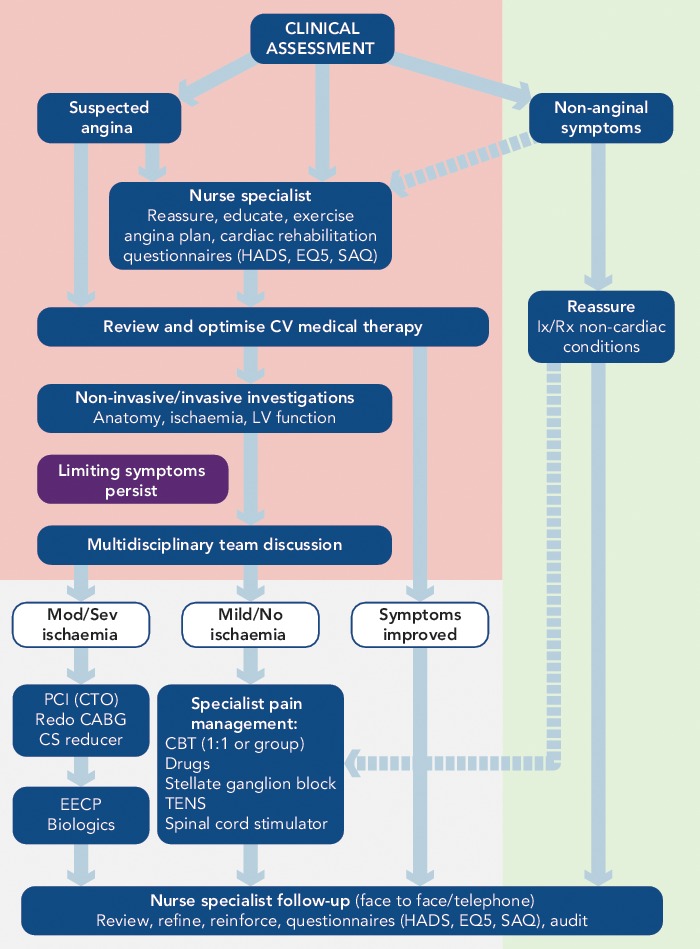
CAGB = coronary artery bypass grafting; CBT = cognitive behavioral therapy; CS = coronary sinus; CTO = chronic total occlusion; CV = cardiovascular; EECP = enhanced external counterpulsation; EQ5 = EuroQol questionnaire; HADS = Hospital Anxiety and Depression Scale; LV = left ventricular; PCI = percutaneous coronary intervention; SAQ = Seattle Angina Questionnaire; TENS = transcutaneous electrical nerve stimulation. Source: Wright and de Silva, 2016.[33] With permission from British Journal of Cardiology © 2016.
Conclusion
Whilst novel therapeutic approaches to managing these patients are welcome, evaluation of their efficacy through robust clinical data must be rigorously pursued. The development of clinical guidelines specific to RA should also be encouraged. Finally, further studies should investigate the effect of novel therapies on reducing healthcare utilisation and demonstrate cost-effectiveness in patients with RA.
Acknowledgments
The authors would like to thank Dr Michael Rubens for assistance with labelling Figure 2c.
References
- 1.Mannheimer C, Camici P, Chester MR et al. The problem of chronic refractory angina; report from the ESC Joint Study Group on the Treatment of Refractory Angina. Eur Heart J. 2002;23:355–70. doi: 10.1053/euhj.2001.2706. [DOI] [PubMed] [Google Scholar]
- 2.Jolicoeur EM, Granger CB, Henry TD et al. Clinical and research issues regarding chronic advanced coronary artery disease: part I: Contemporary and emerging therapies. Am Heart J. 2008;155:418–34. doi: 10.1016/j.ahj.2007.12.004. [DOI] [PubMed] [Google Scholar]
- 3.Williams B, Menon M, Satran D et al. Patients with coronary artery disease not amenable to traditional revascularization: prevalence and 3-year mortality. Catheter Cardiovasc Interv. 2010;75:886–91. doi: 10.1002/ccd.22431. [DOI] [PubMed] [Google Scholar]
- 4.Canadian Community Health Survey (CCHS) 2002. www23.statcan.gc.ca/imdb/p2SV. pl?Function=getSurvey&Id=3359. www23.statcan.gc.ca/imdb/p2SV. pl?Function=getSurvey&Id=3359 Statistics Canada. Available at: (Accessed 15 October 2016).
- 5.McGillion M, Arthur HM, Cook A et al. Management of patients with refractory angina: Canadian Cardiovascular Society/Canadian Pain Society joint guidelines. Can J Cardiol. 2012;28(2 Suppl):S20–41. doi: 10.1016/j.cjca.2011.07.007. [DOI] [PubMed] [Google Scholar]
- 6.Bhatt AB, Stone PH. Current strategies for the prevention of angina in patients with stable coronary artery disease. Curr Opin Cardiol. 2006;21:492–502. doi: 10.1097/01.hco.0000240588.22086.43. [DOI] [PubMed] [Google Scholar]
- 7.Thadani U. Recurrent and refractory angina following revascularization procedures in patients with stable angina pectoris. Coron Artery Dis. 2004;15:S1–4. doi: 10.1097/01.mca.0000129883.86374.6c. [DOI] [PubMed] [Google Scholar]
- 8.British Cardiovascular Intervention Society Audit. 2014. www.bcis.org.uk/pages/page_box_contents. asp?PageID=824. www.bcis.org.uk/pages/page_box_contents. asp?PageID=824 Available at: (Accessed 15 October 2016).
- 9.Chow CM, Donovan L, Manuel D et al. Canadian Cardiovascular Outcomes Research Team. Regional variation in self-reported heart disease prevalence in Canada. Can J Cardiol. 2005;21:1265–71. [PubMed] [Google Scholar]
- 10.Henry TD, Satran D, Hodges JS et al. Long-term survival in patients with refractory angina. Eur Heart J. 2013;34:2683–8. doi: 10.1093/eurheartj/eht165. [DOI] [PubMed] [Google Scholar]
- 11.Povsic TJ, Broderick S, Anstrom KJ et al. Predictors of long-term clinical endpoints in patients with refractory angina. J Am Heart Assoc. 2015;4:e001287. doi: 10.1161/JAHA.114.001287. PMCID: [DOI] [PMC free article] [PubMed] [Google Scholar]
- 12.Effect of nicorandil on coronary events in patients with stable angina: the Impact Of Nicorandil in Angina (IONA) randomised trial. Lancet. 2002;359:1269–75. doi: 10.1016/S0140-6736(02)08265-X. IONA Study Group. [DOI] [PubMed] [Google Scholar]
- 13.Fox K, Ford I, Steg PG et al. BEAUTIFUL Investigators. Ivabradine for patients with stable coronary artery disease and left-ventricular systolic dysfunction (BEAUTIFUL): a randomised, double-blind, placebo-controlled trial. Lancet. 2008;372:807–16. doi: 10.1016/S0140-6736(08)61170-8. [DOI] [PubMed] [Google Scholar]
- 14.Tardif J-C, Ponikowski P, Kahan T. ASSOCIATE Study Investigators. Efficacy of the I(f) current inhibitor ivabradine in patients with chronic stable angina receiving beta-blocker therapy: a 4-month, randomized, placebo-controlled trial. Eur Heart J. 2009;30:540–8. doi: 10.1093/eurheartj/ehn571. [DOI] [PMC free article] [PubMed] [Google Scholar]
- 15.Fox K, Ford I, Steg PG et al. Ivabradine in stable coronary artery disease without clinical heart failure. N Engl J Med. 2014;371:1091–9. doi: 10.1056/NEJMoa1406430. [DOI] [PubMed] [Google Scholar]
- 16.Chaitman BR, Pepine CJ, Parker JO et al. Effects of ranolazine with atenolol, amlodipine, or diltiazem on exercise tolerance and angina frequency in patients with severe chronic angina: a randomized controlled trial. JAMA. 2004;291:309–16. doi: 10.1001/jama.291.3.309. [DOI] [PubMed] [Google Scholar]
- 17.Wilson SR, Scirica BM, Braunwald E et al. Efficacy of ranolazine in patients with chronic angina observations from the randomized, double-blind, placebo-controlled MERLIN-TIMI (Metabolic Efficiency With Ranolazine for Less Ischemia in Non-ST-Segment Elevation Acute Coronary Syndromes) 36 Trial. J Am Coll Cardiol. 2009;53:1510–6. doi: 10.1016/j.jacc.2009.01.037. [DOI] [PubMed] [Google Scholar]
- 18.Kosiborod M, Arnold SV, Spertus JA et al. Evaluation of ranolazine in patients with type 2 diabetes mellitus and chronic stable angina: results from the TERISA randomized clinical trial (Type 2 Diabetes Evaluation of Ranolazine in Subjects With Chronic Stable Angina). J Am Coll Cardiol. 2013;61:2038–45. doi: 10.1016/j.jacc.2013.02.011. [DOI] [PubMed] [Google Scholar]
- 19.Ling H, Packard KA, Burns TL, Hilleman DE. Impact of ranolazine on clinical outcomes and healthcare resource utilization in patients with refractory angina pectoris. Am J Cardiovasc Drugs. 2013;13:407–12. doi: 10.1007/s40256-013-0038-z. [DOI] [PubMed] [Google Scholar]
- 20.Banon D, Filion KB, Budlovsky T et al. The usefulness of ranolazine for the treatment of refractory chronic stable angina pectoris as determined from a systematic review of randomized controlled trials. Am J Cardiol. 2014;113:1075–82. doi: 10.1016/j.amjcard.2013.11.070. [DOI] [PubMed] [Google Scholar]
- 21.Bennett NM, Iyer V, Arndt TL et al. Ranolazine refractory angina registry: 1-year results. Crit Pathw Cardiol. 2014;13:96–8. doi: 10.1097/HPC.0000000000000022. [DOI] [PubMed] [Google Scholar]
- 22.Ciapponi A, Pizarro R, Harrison J. Trimetazidine for stable angina. Cochrane Database Syst Rev. 2005;4:CD003614. doi: 10.1002/14651858.CD003614.pub2. [DOI] [PubMed] [Google Scholar]
- 23.Grabczewska Z, Białoszyński T, Szymański P et al. The effect of trimetazidine added to maximal anti-ischemic therapy in patients with advanced coronary artery disease. Cardiol J. 2008;15:344–50. [PubMed] [Google Scholar]
- 24.Cole PL, Beamer AD, McGowan N et al. Efficacy and safety of perhexiline maleate in refractory angina. A double-blind placebo-controlled clinical trial of a novel antianginal agent. Circulation. 1990;81:1260–70. doi: 10.1161/01.cir.81.4.1260. [DOI] [PubMed] [Google Scholar]
- 25.Phan TT, Shivu GN, Choudhury A et al. Multi-centre experience on the use of perhexiline in chronic heart failure and refractory angina: old drug, new hope. Eur J Heart Fail. 2009;11:881–6. doi: 10.1093/eurjhf/hfp106. [DOI] [PubMed] [Google Scholar]
- 26.Noman A, Ang DSC, Ogston S et al. Effect of high-dose allopurinol on exercise in patients with chronic stable angina: a randomised, placebo controlled crossover trial. Lancet. 2010;375:2161–7. doi: 10.1016/S0140-6736(10)60391-1. PMCID: [DOI] [PMC free article] [PubMed] [Google Scholar]
- 27.Messin R, Boxho G, De Smedt J, Buntinx IM. Acute and chronic effect of molsidomine extended release on exercise capacity in patients with stable angina, a double-blind cross-over clinical trial versus placebo. J Cardiovasc Pharmacol. 1995;25:558–63. doi: 10.1097/00005344-199504000-00008. [DOI] [PubMed] [Google Scholar]
- 28.Messin R, Fenyvesi T, Carreer-Bruhwyler F et al. A pilot double-blind randomized placebo-controlled study of molsidomine 16 mg once-a-day in patients suffering from stable angina pectoris: correlation between efficacy and over time plasma concentrations. Eur J Clin Pharmacol. 2003;59:227–32. doi: 10.1007/s00228-003-0597-z. [DOI] [PubMed] [Google Scholar]
- 29.Messin R, Opolski G, Fenyvesi T et al. Efficacy and safety of molsidomine once-a-day in patients with stable angina pectoris. Int J Cardiol. 2005;98:79–89. doi: 10.1016/j.ijcard.2004.01.007. [DOI] [PubMed] [Google Scholar]
- 30.Vicari RM, Chaitman B, Keefe D et al. Efficacy and safety of fasudil in patients with stable angina: a double-blind, placebo-controlled, phase 2 trial. J Am Coll Cardiol. 2005;46:1803–11. doi: 10.1016/j.jacc.2005.07.047. [DOI] [PubMed] [Google Scholar]
- 31.Montalescot G, Sechtem U, Achenbach S et al. 2013 ESC guidelines on the management of stable coronary artery disease: the Task Force on the management of stable coronary artery disease of the European Society of Cardiology. Eur Heart J. 2013;34:2949–3003. doi: 10.1093/eurheartj/eht296. Task Force Members, [DOI] [PubMed] [Google Scholar]
- 32.Clinical Guideline [CG126] Stable angina: management. 2016. www.nice.org.uk/guidance/Cg126. www.nice.org.uk/guidance/Cg126 National Institute for Health and Care Excellence. Available at: (Accessed 15 October 2016).
- 33.Wright C, de Silva R. Management of refractory angina: the importance of winning over both hearts and minds. Br J Cardiol. 2016;23:45–6. doi: 10.5837/bjc.2016.018. [DOI] [Google Scholar]
- 34.Ido A, Hasebe N, Matsuhashi H, Kikuchi K. Coronary sinus occlusion enhances coronary collateral flow and reduces subendocardial ischemia. Am J Physiol Heart Circ Physiol. 2001;280:H1361–7. doi: 10.1152/ajpheart.2001.280.3.H1361. [DOI] [PubMed] [Google Scholar]
- 35.Beck CS, Leighninger DS. Scientific basis for the surgical treatment of coronary artery disease. J Am Med Assoc. 1955;159:1264–71. doi: 10.1001/jama.1955.02960300008003. [DOI] [PubMed] [Google Scholar]
- 36.Beck CS, Leighninger DS. Operations for coronary artery disease. J Am Med Assoc. 1954;156:1226–33. doi: 10.1001/jama.1954.02950130006002. [DOI] [PubMed] [Google Scholar]
- 37.Banai S, Ben Muvhar S, Parikh KH et al. Coronary sinus reducer stent for the treatment of chronic refractory angina pectoris: a prospective, open-label, multicenter, safety feasibility first-in-man study. J Am Coll Cardiol. 2007;49:1783–9. doi: 10.1016/j.jacc.2007.01.061. [DOI] [PubMed] [Google Scholar]
- 38.Camici PG, Crea F. Coronary microvascular dysfunction. N Engl J Med. 2007;356:830–40. doi: 10.1056/NEJMra061889. [DOI] [PubMed] [Google Scholar]
- 39.Verheye S, Jolicœur EM, Behan MW et al. Efficacy of a device to narrow the coronary sinus in refractory angina. N Engl J Med. 2015;372:519–27. doi: 10.1056/NEJMoa1402556. [DOI] [PMC free article] [PubMed] [Google Scholar]
- 40.Banai S, Schwartz M, Sievert H et al. Long-term follow-up to evaluate the safety of the Neovasc Reducer a device-based therapy for chronic refractory angina. J Am Coll Cardiol. 2010;55:A98–E927. doi: 10.1016/S0735-1097(10)60928-X. [DOI] [Google Scholar]
- 41.Abawi M, Nijhoff F, Stella PR et al. Safety and efficacy of a device to narrow the coronary sinus for the treatment of refractory angina: A single-centre real-world experience. Neth Heart J. 2016;24:544–51. doi: 10.1007/s12471-016-0862-2. PMCID: [DOI] [PMC free article] [PubMed] [Google Scholar]
- 42.Ormerod JOM, Gamble JHP, Betts TR. A device to narrow the coronary sinus for angina. N Engl J Med. 2015;372:1966. doi: 10.1056/NEJMc1503672#SA2. [DOI] [PubMed] [Google Scholar]
- 43.Neovasc Inc. REDUCER-I: An Observational Study of the Neovasc ReducerTM System.ClinicalTrials.gov [Internet] Bethesda (MD)National Library of Medicine (US)2000Available at:www.clinicaltrials.gov/show/NCT02710435 (NLM Identifier NCT02710435)(Accessed 15 October 2016). [Google Scholar]
- 44.ClinicalTrials.gov [Internet] Bethesda (MD): National Library of Medicine (US); 2000. Use of the Neovasc Coronary Sinus Reducer System for the Treatment of Refractory Angina Pectoris in Patients With Ngina Class 3-4 Who Are Not Candidates for Revascularization (Reducer) Tel-Aviv Sourasky Medical Center. Available at: (Accessed 15 October 2016). [Google Scholar]
- 45.van Ramshorst J, Bax JJ, Beeres SLMA et al. Intramyocardial bone marrow cell injection for chronic myocardial ischemia: a randomized controlled trial. JAMA. 2009;301:1997–2004. doi: 10.1001/jama.2009.685. [DOI] [PubMed] [Google Scholar]
- 46.van Ramshorst J, Rodrigo SF, Beeres SL et al. Long term effects of intramyocardial bone marrow cell injection on anginal symptoms and quality of life in patients with chronic myocardial ischemia. Int J Cardiol. 2013;168:3031–2. doi: 10.1016/j.ijcard.2013.04.144. [DOI] [PubMed] [Google Scholar]
- 47.Tse HF, Thambar S, Kwong YL et al. Prospective randomized trial of direct endomyocardial implantation of bone marrow cells for treatment of severe coronary artery diseases (PROTECT-CAD trial). Eur Heart J. 2007;28:2998–3005. doi: 10.1093/eurheartj/ehm485. [DOI] [PubMed] [Google Scholar]
- 48.Henry TD, Pepine CJ, Lambert CR The Athena trials: Autologous adipose-derived regenerative cells for refractory chronic myocardial ischemia with left ventricular dysfunction: ADRCs for Chronic Myocardial Ischemia. Catheter Cardiovasc Interv. 2016. epub ahead of press. [DOI] [PubMed]
- 49.Losordo DW, Schatz RA, White CJ et al. Intramyocardial transplantation of autologous CD34+ stem cells for intractable angina: a phase I/IIa double-blind, randomized controlled trial. Circulation. 2007;115:3165–72. doi: 10.1161/CIRCULATIONAHA.106.687376. [DOI] [PubMed] [Google Scholar]
- 50.Losordo DW, Henry TD, Davidson C et al. Intramyocardial, autologous CD34+ cell therapy for refractory angina. Circ Res. 2011;109:428–36. doi: 10.1161/CIRCRESAHA.111.245993. [DOI] [PMC free article] [PubMed] [Google Scholar]
- 51.Wang S, Cui J, Peng W, Lu M. Intracoronary autologous CD34+ stem cell therapy for intractable angina. Cardiology. 2010;117:140–7. doi: 10.1159/000320217. [DOI] [PubMed] [Google Scholar]
- 52.Povsic TJ, Henry TD, Traverse JH et al. The RENEW Trial: Efficacy and Safety of Intramyocardial Autologous CD34(+) Cell Administration in Patients With Refractory Angina. JACC Cardiovasc Interv. 2016;9:1576–85. doi: 10.1016/j.jcin.2016.05.003. [DOI] [PubMed] [Google Scholar]
- 53.Henry TD, Schaer GL, Traverse JH et al. Autologous CD34(+) Cell Therapy for Refractory Angina: 2-Year Outcomes From the ACT34-CMI Study. Cell Transplant. 2016;25:1701–11. doi: 10.3727/096368916X691484. [DOI] [PubMed] [Google Scholar]
- 54.Jimenez-Quevedo P, Gonzalez-Ferrer JJ, Sabate M et al. Selected CD133+ progenitor cells to promote angiogenesis in patients with refractory angina: final results of the PROGENITOR randomized trial. Circ Res. 2014;115:950–60. doi: 10.1161/CIRCRESAHA.115.303463. [DOI] [PubMed] [Google Scholar]
- 55.Tomita S, Li RK, Weisel RD et al. Autologous Transplantation of Bone Marrow Cells Improves Damaged Heart Function. Circulation. 1999;100(19 Suppl):II247–256. doi: 10.1161/01.cir.100.suppl_2.ii-247. [DOI] [PubMed] [Google Scholar]
- 56.Kinnaird T, Stabile E, Burnett MS et al. Marrow-derived stromal cells express genes encoding a broad spectrum of arteriogenic cytokines and promote in vitro and in vivo arteriogenesis through paracrine mechanisms. Circ Res. 2004;94:678–85. doi: 10.1161/01.RES.0000118601.37875.AC. [DOI] [PubMed] [Google Scholar]
- 57.Kinnaird T, Stabile E, Burnett MS et al. Local delivery of marrow-derived stromal cells augments collateral perfusion through paracrine mechanisms. Circulation. 2004;109:1543–9. doi: 10.1161/01.CIR.0000124062.31102.57. [DOI] [PubMed] [Google Scholar]
- 58.Fisher SA, Dorée C, Brunskill SJ et al. Bone Marrow Stem Cell Treatment for Ischemic Heart Disease in Patients with No Option of Revascularization: A Systematic Review and Meta-Analysis. PLoS One. 2013;8:e64669. doi: 10.1371/journal.pone.0064669. PMCID: [DOI] [PMC free article] [PubMed] [Google Scholar]
- 59.Khan AR, Farid TA, Pathan A et al. Impact of Cell Therapy on Myocardial Perfusion and Cardiovascular Outcomes in Patients With Angina Refractory to Medical Therapy: A Systematic Review and Meta-Analysis. Circ Res. 2016;118:984–93. doi: 10.1161/CIRCRESAHA.115.308056. PMCID: [DOI] [PMC free article] [PubMed] [Google Scholar]
- 60.Li N, Yang YJ, Zhang Q et al. Stem cell therapy is a promising tool for refractory angina: a meta-analysis of randomized controlled trials. Can J Cardiol. 2013;29:908–14. doi: 10.1016/j.cjca.2012.12.003. [DOI] [PubMed] [Google Scholar]
- 61.Florea V, Balkan W, Schulman IH, Hare JM. Cell Therapy Augments Myocardial Perfusion and Improves Quality of Life in Patients With Refractory Angina. Circ Res. 2016;118:911–5. doi: 10.1161/CIRCRESAHA.116.308409. [DOI] [PMC free article] [PubMed] [Google Scholar]
- 62.Mann I, Rodrigo SF, van Ramshorst J et al. Repeated Intramyocardial Bone Marrow Cell Injection in Previously Responding Patients With Refractory Angina Again Improves Myocardial Perfusion, Anginal Complaints, and Quality of Life. Circ Cardiovasc Interv. 2015;8:e002740. doi: 10.1161/CIRCINTERVENTIONS.115.002740. [DOI] [PubMed] [Google Scholar]
- 63.Henry TD, Povsic TJ. Repeat Cell Therapy for Refractory Angina: Déjà vu All Over Again? Circ Cardiovasc Interv. 2015;8:e003049. doi: 10.1161/CIRCINTERVENTIONS.115.003049. [DOI] [PubMed] [Google Scholar]
- 64.Manchanda A, Soran O. Enhanced external counterpulsation and future directions: step beyond medical management for patients with angina and heart failure. J Am Coll Cardiol. 2007;50:1523–31. doi: 10.1016/j.jacc.2007.07.024. [DOI] [PubMed] [Google Scholar]
- 65.Buschmann EE, Utz W, Pagonas N et al. Improvement of fractional flow reserve and collateral flow by treatment with external counterpulsation (Art.Net.-2 Trial). Eur J Clin Invest. 2009;39:866–75. doi: 10.1111/j.1365-2362.2009.02192.x. [DOI] [PubMed] [Google Scholar]
- 66.Gloekler S, Meier P, de Marchi SF et al. Coronary collateral growth by external counterpulsation: a randomised controlled trial. Heart. 2010;96:202–7. doi: 10.1136/hrt.2009.184507. [DOI] [PubMed] [Google Scholar]
- 67.Braith RW, Conti CR, Nichols WW et al. Enhanced external counterpulsation improves peripheral artery flow-mediated dilation in patients with chronic angina: a randomized sham-controlled study. Circulation. 2010;122:1612–20. doi: 10.1161/CIRCULATIONAHA.109.923482. PMCID: [DOI] [PMC free article] [PubMed] [Google Scholar]
- 68.Levenson J, Simon A, Megnien JL et al. Effects of enhanced external counterpulsation on carotid circulation in patients with coronary artery disease. Cardiology. 2007;108:104–10. doi: 10.1159/000095949. [DOI] [PubMed] [Google Scholar]
- 69.Levenson J, Pernollet MG, Iliou MC et al. Cyclic GMP release by acute enhanced external counterpulsation. Am J Hypertens. 2006;19:867–72. doi: 10.1016/j.amjhyper.2006.01.003. [DOI] [PubMed] [Google Scholar]
- 70.Casey DP, Conti CR, Nichols WW et al. Effect of enhanced external counterpulsation on inflammatory cytokines and adhesion molecules in patients with angina pectoris and angiographic coronary artery disease. Am J Cardiol. 2008;101:300–2. doi: 10.1016/j.amjcard.2007.08.031. [DOI] [PMC free article] [PubMed] [Google Scholar]
- 71.Arora RR, Chou TM, Jain D et al. The multicenter study of enhanced external counterpulsation (MUST-EECP): effect of EECP on exercise-induced myocardial ischemia and anginal episodes. J Am Coll Cardiol. 1999;33:1833–40. doi: 10.1016/s0735-1097(99)00140-0. [DOI] [PubMed] [Google Scholar]
- 72.Shah SA, Shapiro RJ, Mehta R, Snyder JA. Impact of enhanced external counterpulsation on Canadian Cardiovascular Society angina class in patients with chronic stable angina: a meta-analysis. Pharmacotherapy. 2010;30:639–45. doi: 10.1592/phco.30.7.639. [DOI] [PubMed] [Google Scholar]
- 73.Zhang C, Liu X, Wang X et al. Efficacy of Enhanced External Counterpulsation in Patients With Chronic Refractory Angina on Canadian Cardiovascular Society (CCS) Angina Class: An Updated Meta-Analysis. Medicine (Baltimore) 2015;94:e2002. doi: 10.1097/MD.0000000000002002. [DOI] [PMC free article] [PubMed] [Google Scholar]
- 74.McKenna C, McDaid C, Suekarran S et al. Enhanced external counterpulsation for the treatment of stable angina and heart failure: a systematic review and economic analysis. Health Technol Assess. 2009;13:iii–iv. ix–xi, 1–90. doi: 10.3310/hta13240. [DOI] [PubMed] [Google Scholar]
- 75.Amin F, Al Hajeri A, Civelek B et al. Enhanced external counterpulsation for chronic angina pectoris. Cochrane Database Syst Rev. 2010;2:CD007219. doi: 10.1002/14651858.CD007219.pub2. [DOI] [PMC free article] [PubMed] [Google Scholar]
- 76.Alunni G, Marra S, Meynet I et al. The beneficial effect of extracorporeal shockwave myocardial revascularization in patients with refractory angina. Cardiovasc Revasc Med. 2015;16:6–11. doi: 10.1016/j.carrev.2014.10.011. [DOI] [PMC free article] [PubMed] [Google Scholar]
- 77.Prasad M, Wan Ahmad WA, Sukmawan R et al. Extracorporeal shockwave myocardial therapy is efficacious in improving symptoms in patients with refractory angina pectoris–a multicenter study. Coron Artery Dis. 2015;26:194–200. doi: 10.1097/MCA.0000000000000218. [DOI] [PMC free article] [PubMed] [Google Scholar]
- 78.Song J, Qi M, Kaul S, Price RJ. Stimulation of arteriogenesis in skeletal muscle by microbubble destruction with ultrasound. Circulation. 2002;106:1550–5. doi: 10.1161/01.cir.0000028810.33423.95. [DOI] [PubMed] [Google Scholar]
- 79.Nishida T, Shimokawa H, Oi K et al. Extracorporeal cardiac shock wave therapy markedly ameliorates ischemia-induced myocardial dysfunction in pigs in vivo. Circulation. 2004;110:3055–61. doi: 10.1161/01.CIR.0000148849.51177.97. [DOI] [PubMed] [Google Scholar]
- 80.Fukumoto Y, Ito A, Uwatoku T et al. Extracorporeal cardiac shock wave therapy ameliorates myocardial ischemia in patients with severe coronary artery disease. Coron Artery Dis. 2006;17:63–70. doi: 10.1097/00019501-200602000-00011. [DOI] [PubMed] [Google Scholar]
- 81.Yang P, Guo T, Wang W et al. Randomized and double-blind controlled clinical trial of extracorporeal cardiac shock wave therapy for coronary heart disease. Heart Vessels. 2013;28:284–91. doi: 10.1007/s00380-012-0244-7. [DOI] [PubMed] [Google Scholar]
- 82.Slavich M, Ancona F, Margonato A. Extracorporeal shockwave myocardial revascularization therapy in refractory angina patients. Int J Cardiol. 2015;194:93. doi: 10.1016/j.ijcard.2015.05.067. [DOI] [PubMed] [Google Scholar]
- 83.Assmus B, Walter DH, Seeger FH et al. Effect of shock wave-facilitated intracoronary cell therapy on LVEF in patients with chronic heart failure: the CELLWAVE randomized clinical trial. JAMA. 2013;309:1622–31. doi: 10.1001/jama.2013.3527. [DOI] [PubMed] [Google Scholar]
- 84.Aicher A, Heeschen C, Sasaki K et al. Low-energy shock wave for enhancing recruitment of endothelial progenitor cells: a new modality to increase efficacy of cell therapy in chronic hind limb ischemia. Circulation. 2006;114:2823–30. doi: 10.1161/CIRCULATIONAHA.106.628623. [DOI] [PubMed] [Google Scholar]
- 85.Rosen SD. From heart to brain: the genesis and processing of cardiac pain. Can J Cardiol. 2012;28(2 Suppl):S7–19. doi: 10.1016/j.cjca.2011.09.010. [DOI] [PubMed] [Google Scholar]
- 86.TenVaarwerk I, Jessurun G, DeJongste M et al. Clinical outcome of patients treated with spinal cord stimulation for therapeutically refractory angina pectoris. The Working Group on Neurocardiology. Heart. 1999;82:82–8. doi: 10.1136/hrt.82.1.82. [DOI] [PMC free article] [PubMed] [Google Scholar]
- 87.Ekre O, Eliasson T, Norrsell H et al. Long-term effects of spinal cord stimulation and coronary artery bypass grafting on quality of life and survival in the ESBY study. Eur Heart J. 2002;23:1938–45. doi: 10.1053/euhj.2002.3286. [DOI] [PubMed] [Google Scholar]
- 88.de Jongste MJ, Haaksma J, Hautvast RW et al. Effects of spinal cord stimulation on myocardial ischaemia during daily life in patients with severe coronary artery disease. A prospective ambulatory electrocardiographic study. Br Heart J. 1994;71:413–8. doi: 10.1136/hrt.71.5.413. [DOI] [PMC free article] [PubMed] [Google Scholar]
- 89.Hautvast RW, Blanksma PK, DeJongste MJ et al. Effect of spinal cord stimulation on myocardial blood flow assessed by positron emission tomography in patients with refractory angina pectoris. Am J Cardiol. 1996;77:462–7. doi: 10.1016/s0002-9149(97)89338-1. [DOI] [PubMed] [Google Scholar]
- 90.Prager JP. What does the mechanism of spinal cord stimulation tell us about complex regional pain syndrome? Pain Med. 2010;11:1278–83. doi: 10.1111/j.1526-4637.2010.00915.x. [DOI] [PubMed] [Google Scholar]
- 91.Taylor RS, De Vries J, Buchser E, Dejongste MJ. Spinal cord stimulation in the treatment of refractory angina: systematic review and meta-analysis of randomised controlled trials. BMC Cardiovasc Disord. 2009;9:13. doi: 10.1186/1471-2261-9-13. [DOI] [PMC free article] [PubMed] [Google Scholar]
- 92.Andréll P, Yu W, Gersbach P et al. Long-term effects of spinal cord stimulation on angina symptoms and quality of life in patients with refractory angina pectoris--results from the European Angina Registry Link Study (EARL). Heart. 2010;96:1132–6. doi: 10.1136/hrt.2009.177188. [DOI] [PubMed] [Google Scholar]
- 93.Eldabe S, Thomson S, Duarte R et al. The Effectiveness and Cost-Effectiveness of Spinal Cord Stimulation for Refractory Angina (RASCAL Study): A Pilot Randomized Controlled Trial. Neuromodulation. 2016;19:60–70. doi: 10.1111/ner.12349. [DOI] [PMC free article] [PubMed] [Google Scholar]
- 94.Lewin RJ, Furze G, Robinson J et al. A randomised controlled trial of a self-management plan for patients with newly diagnosed angina. Br J Gen Pract. 2002;52:194–6. 199–201. PMCID: [PMC free article] [PubMed] [Google Scholar]
- 95.Kloner RA, Shook T, Przyklenk K et al. Previous angina alters in-hospital outcome in TIMI 4. A clinical correlate to preconditioning? Circulation;1995;91:37–45. doi: 10.1161/01.cir.91.1.37. [DOI] [PubMed] [Google Scholar]
- 96.Koerselman J, van der Graaf Y, de Jaegere PPT, Grobbee DE. Coronary collaterals: an important and underexposed aspect of coronary artery disease. Circulation. 2003;107:2507–11. doi: 10.1161/01.CIR.0000065118.99409.5F. [DOI] [PubMed] [Google Scholar]
- 97.Khan M, Thappar S, Taylor S, Sainsbury P. The impact of a short psychological intervention on quality of life and angina control in patients with chronic refractory angina. http://dx.doi.org/10.1093/eurheartj/eht308.P2265 Eur Heart J. 2013;34:P2265. [Google Scholar]
- 98.Moore RK, Groves D, Bateson S et al. Health related quality of life of patients with refractory angina before and one year after enrolment onto a refractory angina program. Eur J Pain. 2005;9:305–10. doi: 10.1016/j.ejpain.2004.07.013. [DOI] [PubMed] [Google Scholar]
- 99.Neubeck L, Lowres N, Benjamin EJ et al. The mobile revolution--using smartphone apps to prevent cardiovascular disease. Nat Rev Cardiol. 2015;12:350–60. doi: 10.1038/nrcardio.2015.34. [DOI] [PubMed] [Google Scholar]
- 100.Cheng K, Ingram N, Keenan J, Choudhury RP. Evidence of poor adherence to secondary prevention after acute coronary syndromes: possible remedies through the application of new technologies. Open Heart. 2015;2:e000166. doi: 10.1136/openhrt-2014-000166. [DOI] [PMC free article] [PubMed] [Google Scholar]
- 101.McGillion M, Arthur H, Victor JC et al. Effectiveness of Psychoeducational Interventions for Improving Symptoms, Health-Related Quality of Life, and Psychological well Being in Patients with Stable Angina. Curr Cardiol Rev. 2008;4:1–11. doi: 10.2174/157340308783565393. PMCID: [DOI] [PMC free article] [PubMed] [Google Scholar]
- 102.Patel PA, Khan M, Thapar S et al. The short- and long-term impact of psychotherapy in patients with chronic, refractory angina. Br J Cardiol. 2016;23:57–60. doi: 10.5837/bjc.2016.019. [DOI] [Google Scholar]
- 103.Tinson D, Swartzman S, Lang K et al. Clinical and psychological outcomes of an angina management programme. Br J Cardiol. 2016;23:61–4. doi: 10.5837/bjc.2016.020. DOI: [DOI] [Google Scholar]