



Abstract
Objective
The purpose of this study was to compare the effects of various taekwondo kicks and age (school level) in absolute terms and relative body mass on the resultant linear acceleration (RLA) of an instrumented head form.
Methods
Forty-eight male (middle school: 16; high school: 16; university: 16) taekwondo athletes were recruited for this study. Subjects performed 10 turning, 10 jump spinning hook, and 10 jump back kicks on a Hybrid II head mounted on a height-adjustable frame.
Results
A 2-way (School × Kick) MANOVA was used to determine the differences in RLA between schools (age groups) by type of kick. There was no univariate School main effect for absolute RLA (η2 = 0.06) and RLA relative to body mass (η2 = 0.06). No univariate Kick main effects were found for absolute (η2 = 0.06) and relative RLA (η2 = 0.06).
Conclusion
It is of concern that RLA did not significantly differ between school levels, implying that young taekwondo athletes generate similar forces to their adult counterparts, possibly exposing young athletes to an increased risk for head injuries.
Keywords: Biomechanics, Concussion, Injury, Martial arts, Taekwondo
1. Introduction
The World Taekwondo Federation (WTF) is one of the largest sport governing bodies with practitioners in over 206 countries.1 Although the exact number of junior athletes participating is unclear, there are 4.3 million and 3.8 million registered adult and junior black belts (an advanced rank), respectively.2 The latest head injury studies demonstrate the concussion incidence in taekwondo over a 15-year period to be 4 times higher than in American football.3 In young taekwondo athletes (6–16 years), cerebral concussions constitute 28% of all injuries.4 Compared to their adult counterparts, boys were more likely to sustain a cerebral concussion: relative risk (RR) = 1.9 (95% confidence interval (CI): 1.5–2.6) and girls were likewise at a higher risk: RR = 3.6 (95%CI: 2.1–6.2).3
The severity of brain injury among young athletes is reported to be due to multi-factorial components, such as biomechanical characteristics, pathophysiological responses, neurobehavioral outcome, and contextual complications.5 It is reported that the material properties of developing and mature rat skulls and the brain are different and so the specific effects of the applied forces may be age-dependent.6 The full effect of developmental factors on the biomechanical response of the brain, such as its water content, cerebral blood volume, level of myelination, skull geometry, and suture elasticity remains unknown.5, 7 Age-specific concussion mechanisms in sport are complex and remain unclear,8 although recent attempts to understand them among adults in taekwondo provide a window of insight into head injury in this sport.9, 10
Fife et al.10 reported head injury measures, such as resultant linear acceleration (RLA) and head injury criterion (HIC) measures associated with the 5 most frequently used head kicks in taekwondo. Alarmingly, the turning kick elicited the highest magnitudes (RLA: 130.1 ± 51.7 g; HIC: 672.7 ± 540.9).9 Furthermore, the axe kick, associated with lower values (RLA: 34.5 ± 17.9 g, HIC: 56.9 ± 54.9),9 caused traumatic subarachnoid hemorrhage in a healthy 23-year-old male in another case study.11 Moreover, 2 deaths were reported12, 13 with one 17-year-old male losing his life due to brain hemorrhage resulting from a kick to the neck by a 15-year-old opponent during a taekwondo competition.12 For these reasons, it is important for the effects of the biomechanical forces on the pre-mature brain to be investigated in this sport.
With the lack of data regarding impact forces to the head in competition taekwondo for juniors, the purpose of this study was to determine the difference in RLA, as a measure of possible head injury severity, between 3 age groups, middle school, high school, and university students in absolute terms and relative body mass on the resultant linear acceleration of an instrumented head form.
2. Methods
2.1. Participants
A total of 48 subjects, including middle school (n = 16, 14.8 ± 0.6 years, 166.1 ± 11.3 cm, 57.0 ± 13.2 kg), high school, (n = 16, 17.4 ± 0.6 years, 177.1 ± 5.9 cm, 69.2 ± 7.4 kg) as well as those from 1 university (n = 16, 20.2 ± 1.3 years, 178.5 ± 7.1 cm, 73.3 ± 10.9 kg) in the Seoul area, Korea, were recruited for this study. All subjects were elite athletes (mean years experience ± SD: middle school: 4.6 ± 1.2 years, high school: 7.0 ± 1.6 years, and university: 9.6 ± 2.0 years) and members of either a school or university taekwondo competition team. Pre-participation screening consisted of completing informed consent (university athletes) or assent (junior athletes) forms by the subjects or their parent/guardian depending on their age. Prior to the commencement of the testing, all subjects were orally briefed on testing procedures then gave their written consent (guardian's signature for the minors), with height, weight, and age recorded. Prior to data collection, this study was given approval by the Seoul National University Institutional Review Board on Human Ethics (IRB #:1104/001-002).
2.2. Testing apparatus: anthropometric test dummy
To simulate head impact in taekwondo, the target consisted of a Hybrid II head and neck (fitted with a large Adidas taekwondo head guard) secured to an aluminum support frame with locations for peg bolts to be fastened at pre-determined increments (Fig. 1), which allowed adjustment of the Hybrid II head and neck to comply with average weight category standing heights of Olympic male taekwondo participants from the Athens 2004 Olympic Games14 for the university athletes. Similarly for middle and high school athletes, the pre-determined increment heights were collected from average standing heights of athletes supplied by 3 middle and high schools (in Korea) as well as the junior Greek national team (Willy Pieter, unpublished data, 2010).
Fig. 1.
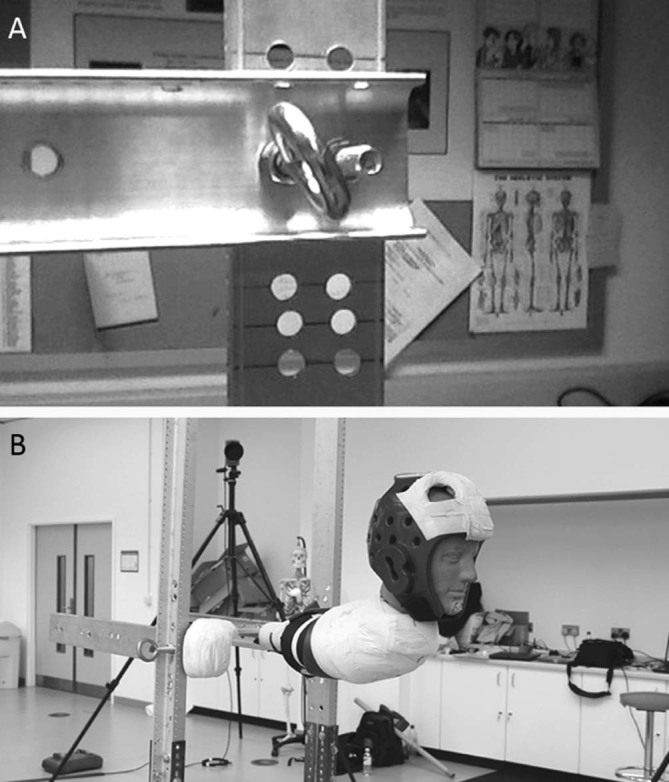
Peg bolt height adjustment (A) and height adjustable Hybrid II (B).
2.3. Testing procedures
Subjects wore lightweight athletic clothing during testing and performed individualized warm-up routines followed by a series of light kicking techniques for specific preparation. The athletes were then given time to practice kicking the Hybrid II by performing the high turning kick, jump back kick, and the jump spinning hook kick to the head to become familiar with the target. Research on head blows and head injury variables in taekwondo have shown these kicks to record the highest RLA and HIC values.9 Following the familiarization and a brief rest period, subjects were asked to perform 10 repetitions of each kick aimed at the Hybrid II head. To ensure a standard criterion was used for successful kicking trials, the technical description was used when awarding points during full-contact competition was adopted.15 This criterion stipulates that all kicks which make contact with the head causing visible head movement are to be awarded a point. Adhering to this criterion ensured that only successful (potentially point-scoring kicks) were used for data analysis. All participants wore a protective footpad that is commonly used during competition and were asked to kick as if in competition (i.e., with maximum effort).
2.4. Data acquisition
The Hybrid II head form was instrumented with a 500 g tri-axial accelerometer (Model 356A66; PCB Piezotronics, Depew, NY, USA) mounted at the head center of gravity to obtain RLA. The accelerometer was attached inside the Hybrid II head on a 4.0 × 4.0 cm aluminum plate secured to the head base by 4 socket head cap screws. Furthermore, a plastic mounting base (manufacturer provided) that allows for the sensor to be mechanically grounded was glued to the aluminum plate to ensure no movement of the accelerometer occurred during each trial (Fig. 2).
Fig. 2.
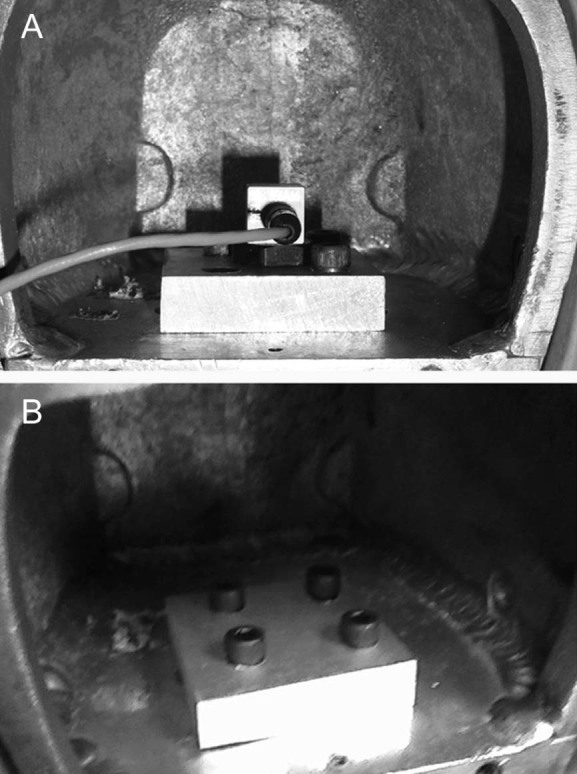
Tri-axial accelerometer mounted to base of head (A) on a 4.0 × 4.0 cm aluminum plate secured to the head base by 4 socket head cap screws (B).
The accelerometer was interfaced via a 3-channel, battery-powered integrated circuit piezoelectric sensor signal conditioner (PCB Piezotronics), and connected to a laptop computer to allow for analysis. Acceleration data were captured at 10,000 Hz using LabVIEW2012 (National Instruments Inc., Austin, TX, USA) and processed in accordance with Society of Automotive Engineers International (Warrendale, PA, USA) J211-1 channel frequency class 1000.16
2.5. Statistical analysis
In addition to comparisons between age groups in absolute terms, RLA relative to body mass in ratio standard was also analyzed as well as in relation to body mass when allometrically scaled. Allometric scaling refers to accounting for differences in size and dimensions when comparing biological systems. A 2-way (School × Kick) MANOVA was used to determine the differences in RLA between schools (age groups) by type of kick. Similar to an α level, an effect size of 0.20 was employed for all analyses.17
3. Results
Table 1 shows the mean ± SD of the kicks by age group (i.e., school level). There was no multivariate Group × Kick interaction (η2 = 0.04) and neither was there a multivariate Kick main effect (η2 = 0.03). However, there was a multivariate Group main effect (η2 = 0.20). The univariate follow-up analysis showed no interaction for absolute (η2 = 0.07) or relative RLA (η2 = 0.06). There was also no univariate Group main effect for absolute (η2 = 0.06) and relative RLA (η2 = 0.06). No univariate Kick main effects were found for absolute (η2 = 0.06) and relative RLA (η2 = 0.06) (Table 2).
Table 1.
Descriptive statistics (mean ± SD) (95%CI) of absolute resultant linear acceleration (g) by type of kick and school level.
| Kick | Middle school | High school | University |
|---|---|---|---|
| Turning | 56 ± 26 (52–60) | 58 ± 33 (53–63) | 95 ± 46 (88–102) |
| Spinning back | 84 ± 41 (77–91) | 60 ± 38 (54–66) | 64 ± 41 (57–70) |
| Spinning hook | 44 ± 30 (39–49) | 45 ± 32 (40–51) | 66 ± 34 (60–71) |
Table 2.
Descriptive statistics (mean ± SD) (95%CI) of relative resultant linear acceleration (g/kg) by type of kick and school level.
| Kick | Middle school | High school | University |
|---|---|---|---|
| Turning | 1.0 ± 0.4 (0.9–1.1) | 0.9 ± 0.5 (0.8–0.9) | 1.4 ± 0.7 (1.2–1.5) |
| Spinning back | 1.5 ± 0.8 (1.4–1.7) | 0.9 ± 0.5 (0.8–0.9) | 0.9 ± 0.6 (0.8–1.0) |
| Spinning hook | 0.8 ± 0.5 (0.7–0.9) | 0.7 ± 0.4 (0.6–0.7) | 0.9 ± 0.5 (0.9–1.0) |
To verify to what extent the ratio standard controlled for the effect of body mass on RLA by age group, a Pearson correlation was run. The zero-order correlations between RLA scaled by ratio standard body mass and body mass as well as RLA allometrically scaled for body mass and the allometric predictor variable are displayed in Table 3.
Table 3.
Zero-order correlations (95%CI) between body mass and resultant linear acceleration.
| School/kick | Ratio standard | Allometrically scaled |
|---|---|---|
| Middle school | ||
| Turning | −0.14(−0.29to0.02) | −0.48(−0.59to−0.35) |
| Spinning back | −0.34(−0.48to−0.19) | −0.24(−0.39to−0.08) |
| Spinning hook | −0.11(−0.27to0.05) | −0.31(−0.45to−0.16) |
| High school | ||
| Turning | −0.09(−0.24to0.06) | 0.07(−0.08to0.22) |
| Spinning back | 0.04(−0.11to0.19) | 0.17(0.02to0.31) |
| Spinning hook | 0.10(−0.06to0.26) | 0.21(0.05to0.36) |
| University | ||
| Turning | −0.55(−0.65to−0.43) | 0.25(0.10to0.39) |
| Spinning back | −0.63(−0.72to−0.53) | 0.41(0.27to0.53) |
| Spinning hook | −0.38(−0.51to−0.24) | 0.09(−0.07to0.24) |
4. Discussion
There have been reports discussing biomechanical factors involved in the injury mechanisms of concussions, such as age, gender, sport type, and neck strength.18, 19 The latest research on American gridiron football provides invaluable insights by supplying live data regarding head impact accelerations, location of impact, and head velocity.20, 21 In view of the high occurrence of cerebral concussions in taekwondo,3, 22 the need for immediate attention to the high accelerations of the head is warranted. In light of the advances in understanding head impact characteristics in other sports8, 18, 20 with the use of in vivo head impact monitoring technology, there is a lack of data regarding the effect of age on the acceleration of the head as a result of taekwondo kicks.
The main finding of this study shows that, although no statistical differences were observed and the clinical meaning between the age groups and the types of kick remain unclear. The turning and back kicks tended to elicit the highest RLA values, however this difference is unclear. Similar to another study10 the turning kick produced the highest RLA. With this technique being responsible for 42.9% of recorded concussions at the 2001 Canadian National Championships,23 increased attention is warranted by medical staff attending competitions. Similarly in middle and high school national tournaments, held in Korea during the same time period, the turning kick was responsible for 45.3% of the concussions recorded, followed by the back (6.3%) and spinning hook kicks (3.1%).24
Based on in vivo professional American gridiron football data, Zhang and colleagues25 suggested an RLA of approximately 85 g as a possible threshold for concussion. In view of the 95%CIs reported in the current study (Table 1), the potential for adolescent athletes to be exposed to high RLA impacts is worrisome. Furthermore, the average values generated by them are similar to those of adult male Olympic boxers: 71 ± 32 g for the hook punch and 71 ± 4 g for the straight punch by super heavyweight adult males26 whereas another study observed 23 concussive impacts among 95 high school football athletes and identified mean peak linear accelerations of 86 g and 6111 rad/s.2, 20 Mihalik et al.8 reported that a weighted composite score that includes both factors of linear and rotational acceleration (i.e., Head Impact Technology Severity Profile) were higher in collisions that were un-anticipated. A similar phenomenon (i.e., un-anticipated impacts) is expected of the impact of the spinning hook kick in taekwondo. This kick tends to be used as a defensive technique and if unanticipated by the offensive athlete, strikes the side of the head, which may cause increased head rotation, may be observed at high levels.
4.1. Suggestions for athlete safety
With the high incidence of head and neck injuries in taekwondo, improving blocking skills was previously recommended to help reduce injury.24, 27 Another suggested method is to improve the safety equipment used during both training and competition, such as padded foot and headgear.3 A recent study reports WTF and Korean Taekwondo Association-approved protective headgear fail American Society for Testing and Materials International impact safety tests and recommends improved design to reduce the incidence and severity of head injury during training and competition.28 It is important to note that only headgear sizes for adults were used, while the tests were done on an adult crash test dummy head form. It will be important to conduct testing of headgear worn by young athletes to better understand how their safety may be ensured. Additionally, the introduction of safer rules (e.g., reducing point allocation for kicks to the head (4 points to 1 point)) employed in American gridiron football, which prohibit head butting and spearing, may reduce injuries. The rules and equipment changes in American football have significantly diminished catastrophic injuries since 197629 and similar preventative measures in taekwondo are needed.
Ultimately, the high magnitude at which competitors execute injurious kicks to the head is an idiosyncrasy of this sport. However, improvements in protective headgear aimed at mitigating the forces of kicks to the head may be an appropriate first step towards ensuring the safety of taekwondo athletes, although head accelerations cannot totally be eliminated. Therefore, based on the results of this study, age-specific headgear designs are recommended considering junior competitors may be exposed to similar impact forces. A recent report demonstrates the lack of qualified and experienced staff working at taekwondo competitions in the Republic of Korea when compared to medical personnel employed in the United States.30 Qualified sports medical practitioners should be employed at all tournaments3, 30 to ensure head injuries sustained at competitions are identified and treated so as to prevent secondary injury. In addition to ensuring qualified sports medical practitioners are presented at competitions, the use of other clinical tools, with established baseline measures for ringside post-concussion evaluation are important.31
4.2. Limitations
The limitations of the current study, such as the biofidelity of the Hybrid II head and neck, the lack of measuring angular accelerations, and the static nature of the set-up, should be considered when interpreting the results. First, as the Hybrid II dummy head is static, unlike a real competition situation, where an opponent is constantly moving, it enables the athletes to take their time performing each technique and this could increase the magnitude of their kicking force. As a result of our study being conducted in a controlled laboratory environment, the subjects recruited were neither confined to pressing time constraints to respond to an offensive attack nor were they under typical psychological stressors customary to high-level competition, which makes this laboratory environment far from realistic. Future attempts to understand head injury mechanics in taekwondo should do so during live competitions. The biofidelity of anthropometric test dummies (e.g., Hybrid II and III) should also be considered as stiffness of the Hybrid III neck is reported to be 3–5 times that of a human neck.32 With these differences in stiffness, the linear acceleration of the head may be amplified or diminished. Furthermore, the National Highway Traffic Safety Administration (USA) has developed a more biofidelic model called THOR Advanced Crash Test Dummy.33 Another inherent problem when dealing with accelerometers is their high sensitivity to the location of the blow. Any strike to the head will create both linear and rotational accelerations, which have been shown vital for predicting the severity of head injury.34 Due to financial constraints, this study was restricted to the use of one tri-axial accelerometer, which only measures linear acceleration.
5. Conclusion
This is the first known study to show the high RLAs that can be produced by middle and high school taekwondo athletes. The data illustrate that there is no difference between school levels in RLA. These results are especially important for junior and high school athletes as their neck and shoulder musculature is not fully developed, therefore diminishing their ability to transfer the impact energy35 to their body as efficiently, possible increasing the risk of injury.5 Future studies should include evaluation of rotational accelerations and cranial pressures relative to head injury severity. It is expected that sport-governing bodies may apply the results to facilitate further investigation (e.g., protective headgear efficacy, in vivo head impact monitoring) into the head injury dilemma in this sport.
Authors' contributions
All the authors contributed to the design and layout of the paper. DOS was responsible for finalising all the work, including design, conducting the experiment and editing the paper. GPF wrote the introduction and discussion to the paper. WP contributed to the methods and the results section. TL contributed to the conducting of the experimental section and IS advised on all sections, especially the discussion. All authors have read and approved the final version of the manuscript, and agree with the order of presentation of the authors.
Competing interests
None of the authors declare any competing financial interests.
Acknowledgment
We would like to thank Humanetics ATD (Plymouth, MI, USA) for donating the Hybrid II device and Hyunju Lee for assistance in editing the figures for this paper.
Footnotes
Peer review under responsibility of Shanghai University of Sport.
References
- 1.World Taekwondo Federation. WTF approves amendments to para-taekwondo competitions rules, Mauritania as new member to increase global membership to 206. 2014. Taekwondo governing body adds 206th member nation to membership. Available at: http://www.worldtaekwondofederation.net/para-taekwondo/item/1360-wtf-approves-amendments-to-para-taekwondo-competition-rules-mauritania-as-new-member-to-increase-global-membership-to-206/1360-wtf-approves-amendments-to-para-taekwondo-competition-rules-mauritania-as-new-member-to-increase-global-membership-to-206; [accessed 14.08.2014].
- 2.Kukiwon World Taekwondo Headquarters. 2008. Public membership records. Available at: http://www.kukkiwon.co.kr; [accessed 14.08.2014].
- 3.Pieter W., Fife G.P., O'Sullivan D.M. Competition injuries in taekwondo: a literature review and suggestions for prevention and surveillance. Br J Sports Med. 2012;46:485–491. doi: 10.1136/bjsports-2012-091011. [DOI] [PubMed] [Google Scholar]
- 4.Pieter W. Taekwondo. In: Kordi R, Maffulli N, Wroble RR, Wallace WA, editors. Combat sports medicine. 1st ed. Springer-Verlag; London: 2009. pp. 263–286. [Google Scholar]
- 5.Kirkwood M.W., Yeates K.O., Wilson P.E. Pediatric sport-related concussion: a review of the clinical management of an often neglected population. Pediatrics. 2006;117:1359–1371. doi: 10.1542/peds.2005-0994. [DOI] [PubMed] [Google Scholar]
- 6.Gefen A., Gefen N., Zhu Q., Raghupathi R., Margulies S.S. Age-dependent changes in material properties of the brain and braincase of the rat. J Neurotrauma. 2003;20:1163–1177. doi: 10.1089/089771503770802853. [DOI] [PubMed] [Google Scholar]
- 7.Prins M.L., Hovda D.A. Developing experimental models to address traumatic brain injury in children. J Neurotrauma. 2003;20:123–137. doi: 10.1089/08977150360547053. [DOI] [PubMed] [Google Scholar]
- 8.Mihalik J.P., Blackburn J.T., Greenwald R.M., Cantu R.C., Marshall S.W., Guskiewicz K.M. Collision type and player anticipation affect head impact severity among youth ice hockey players. Pediatrics. 2010;125:e1394–401. doi: 10.1542/peds.2009-2849. [DOI] [PubMed] [Google Scholar]
- 9.Fife G.P., O'Sullivan D.M., Pieter W., Kaminski T.W. Effects of taekwondo kicks on head accelerations and head injury: a pilot study. Int Sport Med J. 2013;14:53–66. [Google Scholar]
- 10.Fife G.P., O'Sullivan D.M., Pieter W., Cook D.P., Kaminski T.W. Effects of olympic-style taekwondo kicks on an instrumented head-form and resultant injury measures. Br J Sports Med. 2013;47:1161–1165. doi: 10.1136/bjsports-2012-090979. [DOI] [PubMed] [Google Scholar]
- 11.Cohen J.E., Margolin E., Moscovici S., Paldor I., Itshayek E. Life-threatening massive subarachnoid hemorrhage after taekwondo-associated head trauma. Isr Med Assoc J. 2010;12:509–510. [PubMed] [Google Scholar]
- 12.Queck C. The Straights Times. July 11, 2009. Teen dies after match. [Google Scholar]
- 13.Leopold J. Los Angeles Times. January 11, 1999. Kick kills taekwondo black belt. [Google Scholar]
- 14.Kazemi M., Casella C., Perri G. 2004 Olympic taekwondo athlete profile. J Can Chiropr Assoc. 2009;53:144–152. [PMC free article] [PubMed] [Google Scholar]
- 15.Federation W.T. 2013. Rules: competition.http://www.wtf.org/wtf_eng/site/rules/competition.html Available at: [accessed 05.03.2013] [Google Scholar]
- 16.Society of Automotive Engineers . SAE International; Warrendale, PA: 2007. Instrumentation for impact test – part 1: electronic instrumentation; pp. 1–26. [Google Scholar]
- 17.Hopkins WG. A new view of statistics – effect sizes. Available at: http://www.sportsci.org/resource/stats/; [accessed 05.03.2013].
- 18.Naunheim R.S., Standeven J., Richter C., Lewis L.M. Comparison of impact data in hockey, football, and soccer. J Trauma. 2000;48:938–941. doi: 10.1097/00005373-200005000-00020. [DOI] [PubMed] [Google Scholar]
- 19.Viano D.C., Casson I.R., Pellman E.J. Concussion in professional football: biomechanics of the struck player – part 14. Neurosurgery. 2007;61:313–327. doi: 10.1227/01.NEU.0000279969.02685.D0. [DOI] [PubMed] [Google Scholar]
- 20.Broglio S.P., Eckner J.T., Surma T., Kutcher J.S. Postconcussion cognitive declines and symptomatology are not related to concussion biomechanics in high school football players. J Neurotrauma. 2011;28:2061–2068. doi: 10.1089/neu.2011.1905. [DOI] [PMC free article] [PubMed] [Google Scholar]
- 21.Martini D., Eckner J., Kutcher J., Broglio S.P. Subconcussive head impact biomechanics: comparing differing offensive schemes. Med Sci Sports Exerc. 2013;45:755–761. doi: 10.1249/MSS.0b013e3182798758. [DOI] [PMC free article] [PubMed] [Google Scholar]
- 22.Lystad R.P., Graham P.L., Poulos R.G. Exposure-adjusted incidence rates and severity of competition injuries in Australian amateur taekwondo athletes: a 2-year prospective study. Br J Sports Med. 2013;47:441–446. doi: 10.1136/bjsports-2012-091666. [DOI] [PubMed] [Google Scholar]
- 23.Koh J.O., Watkinson E.J. Possible concussions following head blows in the 2001 Canadian National Taekwondo Championships. Crossing Bound Interdiscip J. 2002;1:79–93. [Google Scholar]
- 24.Koh J.O., Watkinson E.J., Yoon Y.J. Video analysis of head blows leading to concussion in competition taekwondo. Brain Inj. 2004;18:1287–1296. doi: 10.1080/02699050410001719907. [DOI] [PubMed] [Google Scholar]
- 25.Zhang L., Yang K.H., King A.I. A proposed injury threshold for mild traumatic brain injury. J Biomech Eng. 2004;126:226–236. doi: 10.1115/1.1691446. [DOI] [PubMed] [Google Scholar]
- 26.Viano D.C., Casson I.R., Pellman E.J., Bir C.A., Zhang L., Sherman D.C. Concussion in professional football: comparison with boxing head impacts–part 10. Neurosurgery. 2005;57:1154–1172. doi: 10.1227/01.neu.0000187541.87937.d9. [DOI] [PubMed] [Google Scholar]
- 27.Zemper E.D., Pieter W. Injury rates during the 1988 US Olympic Team Trials for taekwondo. Br J Sports Med. 1989;23:161–164. doi: 10.1136/bjsm.23.3.161. [DOI] [PMC free article] [PubMed] [Google Scholar]
- 28.O'Sullivan D.M., Fife G.P., Pieter W., Shin I.S. Safety performance evaluation of taekwondo headgear. Br J Sports Med. 2013;47:447–451. doi: 10.1136/bjsports-2012-091416. [DOI] [PubMed] [Google Scholar]
- 29.Torg J.S., Quedenfeld T.C., Moyer R.A., Truex R., Spealman A.D., Nichols C.E. Severe and catastrophic neck injuries resulting from tackle football. J Am Coll Health Assoc. 1977;25:224–226. [PubMed] [Google Scholar]
- 30.Fife G.P., Harter R. A comparison of concussion assessment and management protocols used by medical personnel at elite taekwondo tournaments in the Republic of Korea and the United States. Arch Budo. 2012;8:1–6. [Google Scholar]
- 31.McCrory P., Meeuwise W.H., Aubry M., Cantu B., Dvorák J., Echemendia R.J. Consensus statement on concussion in sport. In: the 4th International Conference on Concussion in sport held in Zurich; November 2012. Br J Sports Med. 2013;47:250–258. doi: 10.1136/bjsports-2013-092313. [DOI] [PubMed] [Google Scholar]
- 32.Spittle EK, Miller DJ, Hipley BW, Kaleps I. Hybrid II and hybrid III dummy neck properties for computer modeling. In: Center DTI, editor. Interim report. Air Force Systems Command; Alexandria, CA: 1992. pp. 1–140. [Google Scholar]
- 33.National Highway Traffic Safety Administration . 2013. THOR advanced crash test dummy.http://www.NHTSA.gov Available at: [accessed 19.08.2014] [Google Scholar]
- 34.Foster J., Kortage J., Wolanin M. Twenty-First Stapp Car Crash Conference. October 19–21, 1977. Hybrid III – A biomechanically based crash test dummy. New Orleans, LO, USA. [Google Scholar]
- 35.Gutierrez G.M., Conte C., Lightbourne K. The relationship between impact force, neck strength, and neurocognitive performance in soccer heading in adolescent females. Pediatr Exerc Sci. 2014;26:33–40. doi: 10.1123/pes.2013-0102. [DOI] [PubMed] [Google Scholar]