



Abstract
Fathers are a crucial source of support for children following the birth of an infant sibling. This study examined whether fathers were more vulnerable to the effects of interparental conflict than mothers, and whether there was a subsequent spillover cascade from interparental conflict to children’s externalizing behavior problems. We followed 241 families after the birth of a second child. Mothers and fathers reported on interparental conflict and parental efficacy at 1 and 4 months postpartum and punitive discipline and firstborn children’s externalizing behavior problems across a longitudinal investigation (prenatal, 4, 8 and 12 months postpartum). For both mothers and fathers, interparental conflict prenatally predicted decreased parental efficacy following the birth. Fathers’ lower parental efficacy was significantly associated with increased punitive discipline toward the older sibling at 4 months, whereas mothers’ lower parental efficacy was not. Coercive family processes were present between mothers’ and fathers’ punitive discipline and older siblings’ externalizing behavior problems. Results were inconsistent with the father vulnerability hypothesis in that both mothers and fathers were both vulnerable to interparental conflict, which in turn, spilled over to create coercive family processes that exacerbated children’s externalizing behavior problems in the year following the birth of a second child.
Keywords: father vulnerability, interparental conflict, spillover cascade process, family transition to second child, externalizing behavior
The family transition after the birth of a second child is a time marked by increases in the older siblings’ externalizing behavior problems (Kolak & Volling, 2013) and greater interparental conflict for some couples (Volling, Oh, Gonzalez, Kuo, & Yu, 2015). Father involvement is considered crucial for supporting the older sibling through this stressful family transition (Stewart, 1990). According to the father vulnerability hypothesis (FVH), interparental conflict has a stronger effect on fathers and their parenting than it does on mothers (Cummings, Goeke-Morey, & Raymond, 2004). Because the roles for father and husband are less clearly defined than the roles for mother and wife, it has been suggested that mothers are better able to compartmentalize their roles across the parent-parent and parent-child subsystems (Cummings, Merrilees, & George, 2010). As parents make the transition and negotiate their new parenting roles involving the care of two young children, one particularly important new role is learning to manage the older sibling’s misbehaviors directed toward the newborn sibling and feeling efficacious in their ability to do so. Interparental conflict has long been associated with harsh, punitive parental discipline in managing children’s behavior problems (Cummings, Koss, & Davies, 2014). The family transition following the birth of a second child may represent a developmental period where the family system is at risk for the spillover of interparental conflict into parent-child relationships, which, in turn, could adversely affect the older sibling’s adjustment to the transition to siblinghood. Fathers are important for supporting children’s adjustment after the birth of a sibling and may also be vulnerable to interparental conflict that may increase after the infant’s birth (Volling et al., 2015). Thus, older siblings may not have the paternal support necessary to help them cope with the changes in the family. The present study addressed whether fathers were more vulnerable to interparental conflict over the transition and to investigate the spillover processes within the family (i.e., interparental conflict to parental efficacy to punitive parental discipline to older siblings’ externalizing problems) in the year following the birth of an infant sibling.
Mothers and fathers parent within the same family system (Cox & Paley, 2003) and the marital relationship is a key determinant of parenting (Belsky, 1984). The literature has provided ample evidence for the presence of spillover processes – that is, interparental conflict spills over into negative parenting practices for both mothers and fathers (Krishnakumar & Buehler, 2000). Yet, no study has examined whether interparental conflict predicts fathering and mothering similarly or differently after the birth of a second child when older siblings are adjusting to the birth of their infant sibling. In this study, we tested three hypotheses as they pertained to this transition. First, we tested the father vulnerability hypothesis (FVH: Cummings, Merrilees, & George, 2010) by examining whether interparental conflict predicted decreased parental efficacy for both mothers and fathers, or was specific to fathers. In line with the FVH, we hypothesized that this effect would be significantly stronger for fathers than mothers. Second, we tested whether there was a conflict spillover cascade process present from interparental conflict to parental efficacy to punitive discipline of the older sibling. We hypothesized that this effect would be stronger for fathers than mothers. Third, we examined the development of coercive family processes following conflict spillover by focusing on the bidirectional relations between children’s externalizing behavior problems and the use of punitive discipline by both mothers and fathers. We hypothesized that there would be bi-directional relations between older siblings’ externalizing behavior problems and the increased use of punitive discipline on the part of both mothers and fathers. In this paper, we focused on the differential impact of interparental conflict on parents from a family systems perspective, in that we were interested in the possibility of conflict spillover between interparental systems and parent-child systems rather than marital interdependence processes such as partner effects (e.g. differential contributions of each parent to interparental conflict) or crossover effects (e.g. the impact of one parent on the other’s efficacy or punitive discipline).
Father Vulnerability Hypothesis
Empirical evidence in support of the FVH is mixed. One meta-analysis found a greater association between interparental conflict and harsh punishment, lax control and inconsistent discipline, and lower parenting quality for fathering than mothering (Krishnakumar & Buehler, 2000), yet another meta-analysis found the effects did not differ for mothers and fathers (Erel & Burman, 1995). Recent empirical studies continue to find both support (Davies, Sturge-Apple, Woitach, & Cummings, 2009; Stevenson et al., 2014) and no support for the FVH (Ponnet et al., 2013). It is important to note that rarely, if ever, is support found for greater vulnerability of mothering than fathering. These mixed findings suggest that perhaps greater attention should be given to when fathering is assessed for vulnerability. That is, fathers may be particularly vulnerable to interparental conflict during times when the fathering role is less clearly defined as might be expected with the impending birth of a second child when both parents need to learn new roles for parenting two children rather than one child.
One way to test the FVH to interparental conflict hypothesis is to examine effects of interparental conflict on parents’ perceptions of their ability to parent; also called parental efficacy. Parental efficacy refers to the beliefs parents have about the degree to which they perceive themselves as capable and effective at performing the varied tasks associated with being a parent. Merrifield and Gamble (2013) found that marital maintenance strategies (e.g., parents put effort into making marital interactions enjoyable; make efforts to be nice and courteous to each other) were associated with higher parental efficacy for both mothers and fathers (Merrifield & Gamble, 2013). Other studies, have found marital functioning was associated only with fathers’ perceptions of parenting competence and not with mothers’ perceptions of competence (Bouchard, Lee, Asgary, & Pelletier, 2007; Sevigny & Loutzenhiser, 2010). Thus, there is some evidence to support the FVH when examining interparental conflict and decreases in parental efficacy. Focusing on parental efficacy may be particularly important during times of transition such as the birth of a second child when parental roles are changing, the family system is in flux, and the older siblings’ difficult behavior increases (Kolak and Volling, 2013). Stressed parents engaged in interparental conflict may also lack the confidence to manage the older sibling’s difficult behavior and eventually resort to more punitive measures in response to the older sibling, leading eventually to coercive patterns of parent-child interaction. In the current study, we tested the links between interparental conflict and both mothers’ and fathers’ parental efficacy in managing the older sibling after the birth of their second child.
Spillover Cascade between Interparental Subsystem and Parenting
Studies have shown that parents who felt less parental efficacy in child rearing were less positively engaged with their children (Roskam & Meunier, 2012) and that when parents felt confident in their child rearing they used more positive and supportive behaviors with their children (Simons, Beaman, Conger, & Chao, 1993). Mothers’ and fathers’ lack of parental efficacy has been specifically associated with more punitive discipline in response to older siblings’ misbehaviors and the development of early-onset and escalating antagonism in sibling relationships after the birth of a sibling (Oh, Volling, & Gonzalez, 2015). Thus, parental efficacy appears to be critical to managing family disruption during the transition to a second child, in addition to a key understudied mechanism for spillover cascade processes from interparental conflict to parenting behavior. Given the increases in children’s externalizing behavior problems often seen during the transition to the birth of a second child (Kolak & Volling, 2013), and the increase in punitive discipline to manage older sibling misbehavior toward the newborn during this period (Baydar, Hyle, & Brooks-Gunn, 1997; Dunn & Kendrick, 1980; Oh et al., 2015), we investigated whether there was a spillover cascade between interparental conflict, decreased parental efficacy, and punitive discipline by parents. For present purposes, we focused on parental punitive responses to children’s misbehaviors toward the infant given how crucial such parenting is for the developing sibling relationship (Oh et al., 2015). Indeed, if the FVH operates during this stressful developmental transition to decrease fathers’ parental efficacy, then interparental conflict may increase the likelihood that children will receive harsher discipline from fathers at a time where father involvement is considered essential to support children’s adjustment (Kreppner, Paulsen, & Schuetze, 1982; Stewart, 1990).
Coercive Family Processes
Interparental conflict impacts children indirectly through more negative parenting practices, such as less emotional availability (Sturge-Apple, Davies, & Cummings, 2006), more harsh and punitive parenting (Krishnakumar & Buehler, 2000), less parental warmth (Schoppe-Sullivan, Schermerhorn, & Cummings, 2007), more inconsistent discipline (McCoy, George, Cummings, & Davies, 2013), and more parent-child conflict and negative coercive process (Gerard, Krishnakumar, & Buehler, 2006). Moreover, these types of negative parenting practices have been consistently associated with the development of childhood externalizing behaviors (Bradley & Corwyn, 2007; MacKenzie, Nicklas, Brooks-Gunn, & Waldfogel, 2014), including oppositional and aggressive behavior (Stormshak, Bierman, McMahon, & Lengua, 2000). In combination, these parent and child behaviors often initiate a positive feedback loop of negative coercive cycles as children act out and parents respond with increases in harsh parenting (Chang & Shaw, 2015; Deater-Deckard, Dodge, Bates, & Pettit, 1998; Patterson, 2002). In the current study, we evaluated whether there were negative and coercive family processes between parents and children subsequent to prenatal older sibling externalizing behavior problems and interparental conflict across first year following the birth of an infant sibling.
Our model and analytical strategy was guided by the call for a process-oriented approach to research investigating the effects of interparental conflict on children (Cummings & Davies, 2002). Specifically, we used a modeling approach similar to Davies et al. (2009) that assessed a mediational process between interparental conflict and negative parenting behavior via parents’ internal representations of adult attachment security (in our case internal perceptions of parental efficacy). We then extended their approach to include direct tests of differences between mothers and fathers through the use of path constraints and chi-square difference tests (discussed in detail in the Analytic Plan). Figure 1 shows the overall conceptual model we considered in the current study that allowed us to test our separate hypotheses in three models: (1) the father-vulnerability hypothesis (FVH) in which interparental conflict would predict decreases in paternal parental efficacy more than maternal parental efficacy, (2) the spillover cascade hypothesis wherein interparental conflict is associated with subsequent decreased parental efficacy and later increased use of punitive discipline to manage the older sibling’s misbehavior towards the infant and (3) parent-child coercive processes in which punitive parental discipline and children’s externalizing behavior create bidirectional, feedback loops from 4 to 12 months after the birth.
Figure 1.
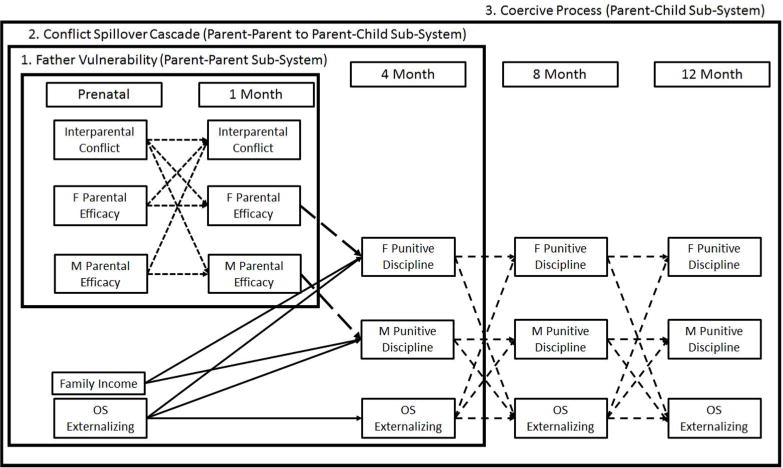
The Conceptual Father Vulnerability Spillover Cascade Model. M = Mother. F = Father. OS = Older sibling.
Given the FVH and the changing role of fathers during the transition to the birth of a second child, we hypothesized there would be a stronger relation between interparental conflict and fathers’ parental efficacy than mothers’ parental efficacy (Hypothesis 1; FVH). We tested the FVH through cross-lagged paths that assessed the directionality of relations between prenatal interparental conflict and mothers’ and fathers’ efficacy 1 month following the birth of an infant sibling (see parent-parent subsystem in top part of Figure 1). To test the father vulnerability hypothesis directly we compared model parameters between mothers and fathers.
We tested the conflict spillover cascade process between the parent-parent and parent-child systems by focusing on the link between parental efficacy and the use of punitive discipline by mothers and fathers (see Figure 1). We hypothesized that decreased parental efficacy following interparental conflict would be associated with subsequent increased use of punitive discipline to manage children’s misbehaviors toward the infant. We hypothesized that the path from parental efficacy to punitive discipline would be stronger for fathers than mothers if fathers’ perceptions of efficacy were more detrimentally impacted by interparental conflict (Hypothesis 2; Spillover Cascade). Support for this hypothesis would demonstrate spillover for fathers between the parent-parent system and the parent-child system, whereas mothers might be able to compartmentalize between the two systems.
Finally, we were interested in whether the interparental conflict spillover cascade process was related to the development of negative and coercive cycles between parents and older siblings in response to these children’s externalizing behavior problems across the transition to the second child (parent-child subsystem in bottom part of Figure 1). We hypothesized that older sibling’s externalizing behavior problems prior to the birth would be associated with increased punitive discipline at 4 months after the birth, and form a coercive parent-child process reflected in bidirectional and concurrent positive relations between children’s externalizing behavior problems and parents’ punitive discipline over time (Hypothesis 3; Coercive Family Process).
Methods
Research Design
Participants were from the Family Transitions Study (FTS), a longitudinal project that investigated changes in family relationships and older sibling adjustment following the birth of a second child. There were five waves of data collection: last trimester of the mother’s pregnancy (prenatal), 1, 4, 8, and 12 months following the infant sibling’s birth. Women pregnant with their second child were recruited from obstetric clinics, advertisements, and flyers posted in local hospitals, child care centers, pediatricians’ offices, and child-birth education classes. Families were admitted into the study based on the following criteria: 1) the mother was pregnant with her second child; 2) the infant’s biological father was residing in the home; 3) the older sibling was between 1 and 5 years of age at the time of the infant’s birth; 4) infants were born full term, and 5) both older sibling and infant were free of developmental and/or physical disabilities. Of the 408 families who met study criteria, 241 (59.1%) consented to participate. Families were compensated $300 for completing all phases of the study (see author citation for full description of FTS study design and participants).
Participants
Participants included 241 mothers, fathers and firstborn children (131 females), who were, on average, 31.12 months of age (SD = 10.12) at the time of the infant’s birth. With respect to ethnicity, 85% of mothers identified as European American, 5.4% as African American, 3.7% as Hispanic, 2.9% as Asian or Asian American, 0.4% as American Indian or Alaska Native, and 2.9% as other. Fathers identified as 86.3% European American, 5.0% African American, 3.7% Asian/Asian American, 2.9% Hispanic, and 2.1% as other. Mothers’ mean age was 31.6 (SD = 4.22) and fathers’ mean age was 33.6 (SD = 4.78); parents were married an average of 5.77 years (SD = 2.74). Annual family income ranged from 10,000 to over 150, 000 and the median family income was 60,000 – 99,999. With respect to education, 46.1% of mothers and 41.9% of fathers reported earning a professional degree, 37.8% of mothers and 37.3 % of fathers a bachelor’s degree, and 16.2% of mothers and 20.3% of fathers a high school degree or some college, and less than 1% of fathers reporting less than a high school degree.
Of the 241 families recruited, 203 families had complete data at the 12-month time point. Family reasons for dropping out included lack of time, moved out of state, separation, or health problems with the infant. Compared to the original 241 families, the families who dropped from the study had lower household income, χ2(3) = 13.94, p < .05, were lower on fathers’ education, χ2(3) = 10.82, p < .05, and lower on mothers’ education, χ2(2) = 7.90, p < .05,) but did not differ on any other demographics (e.g. ethnicity, years of marriage). Fathers’ and mothers’ education did not correlate with any study variables and thus only household income was retained as a covariate as it was significantly and negatively correlated with mothers’, r = −.22, p <.001, and fathers’ punitive discipline, r = −.14, p <.05. Structural equation modeling with Mplus version 7.2 using full-information maximum likelihood (FIML) to handle missing data allowed 231 families to be retained for the first FVH model and 241 families to be retained for the spillover cascade hypothesis and coercive family process models.
Procedure
During home visits at the prenatal and 1 month post-birth visits, both mothers and fathers were given questionnaires to assess interparental conflict and parental efficacy. Parents reported on the older siblings’ externalizing behavior problems at prenatal, 1, 4, 8, and 12 months. Parent reports of punitive discipline in response to older siblings’ misbehavior toward the infant at 1 month were not collected because at 1 month of age, infants have limited opportunity to engage with an older sibling in ways that engender conflict. Further, we wanted to reduce data collection burden on families so soon after the birth, and, in turn sample attrition, so reduced the number of measures collected at 1 month. At 4, 8, and 12 months only, parents completed questionnaires assessing their use of punitive discipline in response to the older siblings’ misbehaviors toward the infant.
Measures
Interparental conflict
Mothers and fathers completed the 25-item Braiker & Kelley Intimate Relations Scale (Braiker & Kelley, 1979) to assess marital relationship functioning using a 9-point scale ranging from 1 (Not at all) to 9 (Very much). To test whether interparental conflict early in the transition may set the stage for FVH that would give rise to coercive parent-child interaction later in the year after the birth, we focused on the 5-item conflict subscale at prenatal and 1 month, which measures the frequency and intensity of conflict, feelings of anger and resentment in the marriage. Example items included, “When you and your spouse/partner argue, how serious are the problems or arguments?” and “How often do you argue with one another?” Higher scores indicated the presence of greater interparental conflict. Internal consistency was acceptable at both prenatal (mother α = .78 and father α = .68) and 1 month (mothers α = .72 and father α = .71). Because mother and father scales were significantly correlated (prenatal r = .51, p <.001, 1 month r = .44, p < .001), scales were standardized and then averaged across parents to create a composite of interparental conflict.
Parental efficacy
Mothers and fathers responded to the 47-item Parental Locus of Control Scale (Campis, Lyman, & Prentice-Dunn, 1986) with respect to the older sibling using a 5-point Likert scale ranging from 1 (Strongly Disagree) to 5 (Strongly Agree). We used the parental efficacy subscale, in which higher scores reflect parents who feel a greater external locus of control (e.g., “What I do has little effect on my older child’s behavior”), with higher scores reflecting feeling less efficacious. For ease of interpretation, scores were multiplied by −1 such that high scores indicated higher parental efficacy. The scale evidenced acceptable reliability at prenatal (mother α = .76 and father α = .67) and 1 month (mother α = .77 and father α = .74).
Punitive discipline in response to older siblings’ misbehavior toward the infant
Mothers and fathers completed a modified version of the Managing Children’s Conflict Questionnaire (Perozynski & Kramer, 1999) at 4, 8, and 12 months. The scale was originally created to measure parents’ management strategies in responding to sibling conflicts, but was slightly modified for the current study to focus on how parents responded to the older siblings’ misbehavior toward the infant. Parents completed the 9-item parent-centered control subscale on a 3-point Likert scale ranging from 1 (almost never) to 3 (usually) to describe how often they used punitive control as a form of discipline (e.g. “used a form of physical punishment to stop my older child’s misbehavior,” “Raised my voice and told my older child to stop misbehavior toward the baby,” “Told my older child that he/she would be punished if he did not stop misbehaving, fully intending to carry through with the threat”). Reliability was acceptable for 4 (mother α = .75 and father α = .74), 8 (mother α = .77 and father α = .74), and 12 months (mother α = and father α = .71). Individual scores for mothers and fathers were used in all models. We refer to this variable as punitive discipline in the remainder of this paper.
Externalizing behavior problems
Mothers and fathers completed the Child Behavior Checklist 1½-5 (Achenbach & Rescorla, 2000) at prenatal, 4, 8, and 12 months for older siblings. The CBCL is a widely used measure of young children’s adaptive and maladaptive functioning. Mothers and fathers rated 99 items about their older child on a 3-point scale (0 = not true to 2 = very true). The present study used the broad band externalizing subscale to be consistent with earlier research linking interparental conflict and coercive parent-child processes (Schoppe-Sullivan et al., 2007). Example items included, “gets in many fights,” “temper tantrums or hot temper,” and had acceptable reliability at all timepoints: (α = .87 - .90). Mother and father scores were moderately correlated across timepoints (r = .34-.50, M = .43) and were standardized and then averaged to create composites of children’s externalizing behavior problems at prenatal, 4, 8, and 12 months.
Results
Preliminary Analyses
Table 1 shows the means, standard deviations, and correlation coefficients among the variables for mothers and fathers. Mothers’ and fathers’ parental efficacy were negatively correlated with interparental conflict at both the prenatal and 1 month timepoints. Only fathers’ parental efficacy at 1 month was negatively correlated with 4-month paternal punitive discipline, r = −.26, p < .001, suggesting parental efficacy may function as a spillover mechanism to poor parenting practices for fathers and possibly not for mothers. Mothers’ and fathers’ punitive discipline and children’s externalizing problems were positively correlated at 4, 8, and 12 months, suggesting that coercive cycles may be in place. Prenatal household income was correlated negatively with 4-month mothers’, r = −.22, p =.001, and fathers’ punitive discipline, r = −.14, p = .047, and was retained as a covariate in the two structural equation models that included punitive discipline.
Table 1.
Means, Standard Deviations, and Intercorrelations among Variables
| Variable | 1 | 2 | 3 | 4 | 5 | 6 | 7 | 8 | 9 | 10 | 11 | 12 |
|---|---|---|---|---|---|---|---|---|---|---|---|---|
| Prenatal | ||||||||||||
| 1. Income | – | −.07 | −.04 | −.04 | .00 | −.03 | −.22** | −.06 | −.16* | −.03 | −.01 | −.06 |
| 2. Interparental Conflict | −.07 | – | −.17* | .15* | .74*** | −.24*** | .09 | .19** | .10 | .14* | .12 | .21** |
| 3. Parental Efficacy | −.02 | −.17** | – | −.24** | −.17* | .66*** | −.02 | −.14* | .06 | −.14* | .03 | −.12 |
| 4. OS Externalizing | −.04 | .15* | −.31*** | – | .18** | .23** | .76*** | .29*** | .75*** | .24*** | .71*** | |
| 1 Month | ||||||||||||
| 5. Interparental Conflict | .00 | .74*** | −.20** | .18** | – | −.20** | .07 | .17* | .21*** | .22** | .15* | .23*** |
| 6. Parental Efficacy | .63*** | −.28*** | – | −.07 | −.26*** | .10 | −.20*** | −.10 | −.21** | |||
| 4 Month | ||||||||||||
| 7. Pun. Discipline | −.14* | .07 | −.19** | .31*** | .14* | −.26*** | – | .26*** | .55*** | .12 | .39*** | .22** |
| 8. OS Externalizing | −.06 | .19** | −.28*** | .75*** | .17* | −.32*** | .26*** | – | .27*** | .75*** | .24*** | .79*** |
| 8 Month | ||||||||||||
| 9. Pun. Discipline | −.08 | .01 | −.21** | .38*** | .13 | −.19** | .59*** | .36*** | – | .33*** | .57*** | .34*** |
| 10. OS Externalizing | −.03 | .14* | −.22** | .75*** | .22** | −.29*** | .12** | .75*** | .39*** | – | .28*** | .77*** |
| 12 Month | ||||||||||||
| 11. Pun. Discipline | −.17* | .02 | −.09 | .29*** | .07 | −.14 | .51*** | .29*** | .61*** | .28*** | – | .36*** |
| 12. OS Externalizing | −.06 | .21** | −.19** | .71*** | .23** | −.27*** | .32** | .79*** | .43*** | .77*** | .39*** | – |
|
| ||||||||||||
| Mean | 3.02 | 0.00 |
1.77 1.75 |
0.00 | .00 |
1.76 1.75 |
1.56 1.68 |
−0.01 |
1.63 1.72 |
.00 |
1.75 1.86 |
.00 |
| SD | 0.82 | 0.88 |
0.35 0.40 |
0.83 | 0.85 |
0.41 0.43 |
.35 0.37 |
0.89 |
0.34 0.38 |
.09 |
0.33 0.33 |
.09 |
Note. OS = Older Sibling. Pun = Punitive. SD = Standard deviation. Correlations for fathers are below the diagonal and for mothers are above. For mean and SD fathers are in italics and mothers are in bold. Interparental Conflict and OS Externalizing are composites of mother and father report and are identical variables for mothers and fathers.
p < .05.
p < .01.
p <.001.
Analytic Plan
We used structural equation modeling in three models to test our hypotheses. To test the hypothesis that fathers were more vulnerable to interparental conflict, we fit one model with stability paths for interparental conflict, father efficacy and mother efficacy and cross-lagged paths from interparental conflict to each of fathers’ parental efficacy and mothers’ parental efficacy (see 1. Father Vulnerability in Figure 1). Because we were not interested in partner effects for the scope of this paper, we did not include cross-lagged paths between mothers’ and fathers’ parental efficacy. We implemented the FVH by testing the difference between a model where the paths from interparental conflict to parental efficacy were freely estimated and a model where the paths from interparental conflict to parental efficacy were constrained to be equal across mothers and fathers.
To test the second hypothesis that there was a conflict spillover cascade between the parent-parent and parent-child subsystems, we added to the Father Vulnerability model fathers’ punitive discipline, mothers’ punitive discipline, and older siblings’ externalizing problems at 4 months, and controlled for the older siblings’ externalizing problems prenatally, as well as family income (see 2. Conflict Spillover Cascade in Figure 1). To test whether spillover cascade effects were different for mothers and fathers, we compared an unrestricted model to a model where the paths from parental efficacy to punitive discipline were constrained to be equal across mothers and fathers.
Lastly, we investigated downstream coercive parent-child processes by adding fathers’ punitive discipline, mothers’ punitive discipline, and older siblings’ externalizing problems to the model at 8 and 12 months to see if there were bidirectional effects following the conflict spillover cascade (see 3. Coercive Process in Figure 1). Significant cross-lagged paths were then constrained to be equal across mothers and fathers and compared to the unconstrained model to test for differential effects by parent. All results are presented in unstandardized coefficients.
Hypothesis 1: Paternal efficacy is more vulnerable to interparental conflict than maternal efficacy
Path analyses using structural equation modeling (SEM) in Mplus version 7.2 were conducted to examine within-parent spillover effects from interparental conflict and parental efficacy. We were not interested in testing for traditional actor and partner effects in a APIM approach (e.g. APIM, Ponnet et al., 2013) because the FVH does not propose that husbands or wives are more responsible for conflict, only that they may be differentially affected by it. Due to the similar correlations from prenatal to 1-month parental efficacy for mothers and fathers, we constrained the autoregressive stability paths for parental efficacy to be equal across mothers and fathers. Results from the Father Vulnerability model indicated that prenatal interparental conflict was associated with later parenting efficacy for mothers, β = −.06, p = .02, and for fathers, β = −.08, p = .002, χ2 (3, N = 231) = 1.32, p = .73, CFI = 1.00, RMSEA = .00, SRMR = .01 (see Figure 2). There were no significant paths from parental efficacy pre-birth to interparental conflict for mothers or for fathers at 1 month. To test whether fathers were more vulnerable to interparental conflict, we ran the same model with the paths from interparental conflict to parental efficacy constrained to be equal across mothers and fathers. Model fit was, again, good, χ2 (4, N = 231) = 1.57, p = .81, CFI = 1.00, RMSEA = .00, SRMR = .01. A chi-square difference test was conducted to assess whether there was a significant change in model fit between the unconstrained model and the model with mother and father paths from prenatal interparental conflict to 1 month parental efficacy constrained to be equal. The test revealed no significant difference in the path coefficient for mothers and fathers, χ2diff = .25, df = 1, p = .62. Thus, the evidence did not support the hypothesis that fathers would be more vulnerable to the impact of interparental conflict on parental efficacy.
Figure 2.

Model 1: Father Vulnerability Hypothesis. M = Mother. F = Father. Results are reported in unstandardized coefficients. Non-significant paths are omitted for ease of interpretation. * p < .05. ** p < .01. *** p < .001. Results are reported for the model with unconstrained cross-lagged paths from interparental conflict to mothers’ and fathers’ parental efficacy.
Hypothesis 2. The parent-parent system and the parent-child system will be linked through paths from parental efficacy to punitive discipline. This path will be stronger for fathers
As described in the analysis plan above, we added fathers’ punitive discipline, mothers’ punitive discipline, and older siblings’ externalizing problems at 4 months to the previous father vulnerability model and controlled for prenatal family income and older siblings’ externalizing behavior problems, to test for spillover cascade effects from interparental conflict to parental efficacy to punitive discipline. We retained the equality constraint from the previous model for autoregressive paths from prenatal parental efficacy to 1-month parental efficacy across mothers and fathers. Results for the unconstrained model are presented in Figure 3. The path from fathers’ parental efficacy to fathers’ punitive discipline was significant, β = −.17, p = .002, but the same path for mothers was not significant, β = −.07, p = .22. Older criteria for mediation using a three step approach would suggest to stop at this point (Baron & Kenny, 1986) but newer criteria for establishing mediation focuses on the product of the a and b coefficients (MacKinnon, Lockwood, Hoffman, West, & Sheets, 2002). Thus, we proceeded to test for mediation using the product of the coefficients with bias-corrected bootstrapped confidence intervals. Although not shown in the models due to non-significance, we did include the direct path from prenatal interparental conflict to mothers’ punitive discipline at 4 months and from prenatal interparental conflict to fathers’ prenatal discipline at 4 months in all models and tests of mediation. Tests of mediation of the relation between prenatal interparental conflict and 4 month punitive discipline by 1 month parental efficacy were significant for fathers and not for mothers, unstandardized ab = .013, 95% C.I. [.004, .028], unstandardized ab = .004, 95% C.I. [−.001, .018], respectively. As in the previous step, we then constrained the paths from 1-month parental efficacy to punitive discipline at 4 months to be equal across mothers and fathers to test for differential effects. A chi-square difference test revealed no significant difference in model fit for the constrained versus unconstrained path coefficient for mothers and fathers, χ2diff = 1.53, df = 1, p = .22. Thus, results suggested that the unconstrained path for fathers was significantly different from zero, and that fathers only showed significant mediation from prenatal interparental conflict to 1 - month parental efficacy to 4-month punitive discipline, but the paths for mothers and fathers between parental efficacy at 1 month and punitive discipline at 4 months were not significantly different from each other.
Figure 3.
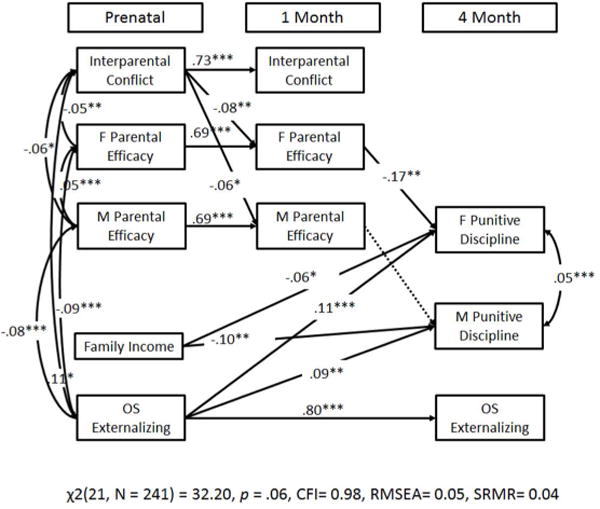
Test of Spillover Cascade Process. Results are reported in unstandardized coefficients. M = Mother. F = Father. OS = Older sibling. Family income was significantly correlated with mothers’ and fathers’ punitive discipline and was retained as a covariate. Non-significant paths are omitted for ease of interpretation. * p < .05. ** p < .01. *** p < .001. We included a path from prenatal interparental conflict to 4 months mothers’ and fathers’ punitive discipline in order to test for mediation by parental efficacy. Results are presented with the paths unconstrained to be equal across mothers and fathers from 1-month parental efficacy to 4-month punitive discipline.
Hypothesis 3: There will be bi-directional coercive family processes between older siblings’ externalizing behavior problems and parents’ punitive discipline
To test hypothesis 3, we added mothers’ punitive discipline, fathers’ punitive discipline, and older siblings’ externalizing behaviors at 8 and 12 months to the previous spillover cascade model. This enabled us to test if bi-directional cross-lagged paths existed between older siblings’ externalizing problems and fathers’ punitive discipline and older siblings’ externalizing problems and mothers’ punitive discipline. We again retained the equality constraint from the previous model for autoregressive paths from prenatal parental efficacy to 1-month parental efficacy across mothers and fathers. Because we were not interested in partner effects in this paper, we did not include cross-lagged paths between fathers’ and mothers’ punitive discipline. Due to the significant and similar stability correlations, we constrained the stability paths between fathers’ and mother’s 4 to 8 and 8 to 12 month paths on punitive discipline to be equal to reduce the number of total paths estimated. Model fit was good, χ2 (84, N=241) = 158.133, p < .001, CFI =.95, RMSEA = .06, SRMR = .06. Older siblings’ externalizing problems predicted increased punitive discipline by fathers and mothers at 4 months, β = .11, p < .001, β = .09, p = .005. There were also child effects from older siblings’ externalizing problems to increased fathers’ and mothers’ punitive discipline from 4 to 8 months, β = .09, p < .001, β = .06, p = .03, respectively. Older siblings’ externalizing problems at 4 months were positively associated with fathers’ and mothers’ punitive discipline at 8 months, β = .09, p < .001, β = .06, p = .03, respectively. Interestingly, the path from mothers’ punitive discipline at 4 months to older siblings’ externalizing problems at 8 months was negative and significant, β = −. 27, p = .02, which suggested that mothers’ use of punitive discipline was initially effective at reducing older siblings’ misbehaviors. The corresponding path from fathers’ punitive discipline at 4 months to older siblings’ externalizing problems at 8 months was not significant. Following the positive prediction of fathers’ punitive discipline at 8 months by prior instances of the older sibling’s externalizing behavior problems at 4 months, a positive feedback loop was found wherein fathers’ punitive discipline at 8 months further predicted older siblings’ externalizing problems at 12 months, β = .22, p =. 046.
Next, we tested for differences in feedback loops for mothers and fathers by using the previous full model with stability paths constrained to be equal across mothers and fathers from prenatal parental efficacy at 1 month and for 4 to 8 and 8 to 12 month punitive discipline as a “baseline” model to contrast with models where significant cross-lagged paths were constrained to be equal across mothers and fathers. First, we constrained the path from older siblings’ externalizing behavior at 4 months to punitive discipline 8 months to be equal across mothers and used a chi-square difference test to test for significant differences in model fit compared to the baseline model. The paths were not significantly different across mothers and fathers, β = .08, p < .001, χ2diff = 1.17, df = 1, p = .28. Following the same procedure, the paths from punitive discipline at 4 months to 8 months were not significantly different across mothers and fathers and were both non-significant when constrained equal, β = −.11, p = .09, χ2diff = 2.58, df = 1, p = .11. Lastly, the paths from punitive discipline at 8 months to older siblings’ externalizing problems at 12 months were not significantly different across mothers and fathers and both were significant and positive when constrained equal, β = .16, p = .007, χ2diff = .34, df = 1, p = .56. Overall, there was some evidence for positive feedback processes among mothers and children and fathers and children. The hypothesis that there would be bidirectional relationships was not fully supported, although concurrent relationships suggested both mothers’ and father’ punitive discipline and older siblings’ externalizing problems were positively associated at 8 and 12 months.
Discussion
The birth of an infant sibling is a common experience for most older siblings in the U.S. and can be a stressful transition for some families (Volling, 2012). This study was the first to examine a spillover cascade process across this developmental transition with respect to the potential association between interparental conflict transpiring before the infant’s birth and the emergence of negative coercive cycles between parents and older siblings in the year following the birth of the second child. This study was also unique in that it was the first to examine proximal internal aspects of fathers’ vulnerability to interparental conflict - perceptions of parental efficacy - during the transition to the birth of a second child and whether the parent-parent system and parent-child systems were linked via parental efficacy and punitive discipline. The present study added new findings to the father vulnerability literature, examined the presence of spillover cascades between the parent-parent and parent-child family subsystems, and addressed several limitations of previous research.
This study had three aims. The first was to test the father vulnerability hypothesis and examine whether the path from interparental conflict to parental efficacy was stronger for fathers than mothers. The second was to examine whether the parent-parent and parent-child sub systems were linked via a spillover cascade from interparental conflict to low parental efficacy to punitive discipline of the older sibling. The third was to test whether there were bidirectional coercive family processes in place in the association between older siblings’ externalizing behavior, and mothers’ and fathers’ use of punitive discipline. We now turn to a discussion of each one.
The literature on spillover of interparental conflict into other family subsystems has frequently included calls for the inclusion of both mothers and fathers and the use of longitudinal data to test the father vulnerability hypothesis. Yet, most studies continue to discuss spillover effects of interparental conflict on “parenting” when, in fact, only mothers are included (Hosokawa & Katsura, 2017), or do not separate mothers’ and fathers’ parenting (Hsieh, Dopkins Stright, & Yen, 2016). Longitudinal designs that seek to uncover the underlying mechanisms for father-vulnerability have found long-term spillover mechanisms such as the association between adult relationship insecurity and fathers’ psychological control and insensitivity (Davies et al., 2009) and maternal gatekeeping following marital problems that reduced father involvement with children (Stevenson et al., 2014). One unique aspect of the current study was that we tested directly for differences in the strength of associations between interparental conflict and parental efficacy for mothers and fathers to examine father vulnerability. Further, we move the field forward in two important ways with this work: (1) investigating the father vulnerability hypothesis during the transition to the birth of a second child; a period of heightened family risk when parental roles are in flux, and (2) directly testing differences between mother and father paths for differential vulnerability using a longitudinal conflict spillover cascade model.
Future discussions of whether fathers are more vulnerable to interparental conflict may need to consider the context of family risk and whether there are specific developmental periods during which fathering and mothering are more vulnerable to interparental conflict and other familial stressors. A focus on developmental periods may help explain the heterogeneity of findings supporting and refuting the father vulnerability hypothesis. The family transition after the birth of a second child may be particularly telling for studying the father vulnerability spillover cascade process as it is a time in which men have heightened uncertainty about their role as a father (Genesoni & Tallandini, 2009). The birth of a child is often associated with general declines in marital satisfaction and marital relationship change (Cowan & Cowan, 2000). Indeed, the transition after the birth of a second child is a time when mothers and fathers must negotiate their new parental roles and balance the care of two young children. As such, being able to work together as coparents is especially important during this time (Kolak & Volling, 2013; Song & Volling, 2015). For these reasons, we expected to find support for the father vulnerability hypothesis in that there would be a stronger association between interparental conflict and parental efficacy for fathers than mothers. Our results suggested that interparental conflict negatively predicted both mothers’ and fathers’ parental efficacy in managing the older sibling similarly. Thus, findings from the present study examining parental efficacy refute the father vulnerability hypothesis and suggest that the transition to the birth of a second child is a time when both fathers and mothers are equally vulnerable to interparental conflict. Prior studies that have not considered this developmental transition period have also found little support for father vulnerability (Kaczynski, Lindahl, Malik, & Laurenceau, 2006; Ponnett et al., 2013).
The fact that interparental conflict was associated with reduced parental efficacy for mothers and fathers equally during the transition to the birth of a second child provides important information for future interventions for families. Parental efficacy has, surprisingly, rarely been investigated as a consequence of interparental conflict, although evidence does suggest that positive marital maintenance strategies promote parental efficacy and that negative undermining coparenting is related to reduced parental efficacy (Merrifield & Gamble, 2013). Parental efficacy has been related to a wide range of parental functioning, such as depression, stress and coping, positive and negative parenting practices, and to child outcomes, such as feelings of self-worth, anxiety, and school achievement (for review see Jones & Prinz, 2005). Indeed, Jones and Prinz (2005) identified parental efficacy as a prime target for interventions in at-risk families, and evidence-based interventions such as the Triple P Positive Parenting Program, have proven effective at reducing children’s emotional and behavioral problems by targeting parental knowledge, skills, and confidence (de Graaf, Speetjens, Smit, de Wolff, & Tavecchio, 2008). Thus, parental efficacy may serve as a key link to problems present in other parts of the family system, such as marital conflict, stress, child problems, or parental mental health problems, particularly so during the family transition to the birth of a second child.
The second aim of the present study was to examine whether there was a link between the parent-parent subsystem and the parent-child subsystem through spillover effects from interparental conflict to decreased parental efficacy to increased use of punitive discipline with the older siblings. In addition to the link between family subsystems, the spillover cascade model also represented a second test of father vulnerability by focusing on a distal cascading process as compared to a proximal process (e.g. parental efficacy). The father vulnerability hypothesis proposes that mothers are better able to compartmentalize between the interparental and the parent-child subsystems and prevent negative spillover into parenting (Belsky, Youngblade, Rovine, & Volling, 1991; Cummings et al., 2010). We found a significant association between lower parental efficacy following interparental conflict and increased punitive discipline in response to the older siblings’ misbehavior for fathers, but not for mothers. When we constrained paths to be equal across mothers and fathers, however, there was no statistically significant difference. Thus, we are unable to conclude with certainty that fathers’ parenting is more vulnerable than mothers’ parenting. Initially, the path between parental efficacy at 1 month and punitive discipline at 4 months was non-significant for mothers although significant for fathers, but changed from non-significance to significance for both parents when paths were constrained to be equal across parents. Thus, we must remain cautious interpreting our findings as evidence of father vulnerability for the spillover cascade process.
Further work is needed to replicate our findings and to determine whether mothers are able to compartmentalize their marital and parental roles. Some have suggested that the parenthood role may be identified with more strongly by women than men as a consequence of traditional gender roles and greater involvement of women as primary caregivers (Cummings et al., 2010; Davies et al., 2009; Thompson & Walker, 1989). Cultural and societal expectations about motherhood as natural and highly desirable may be responsible, in part, for women’s internalization of an ideal of the full-time mother who is always available to children no matter the family circumstances (see Hattery, 2001). Some have suggested that women have both external and internal pressures to be a “good” mother and care for their children, which may be a preventative factor against punitive mothering. (Maher & Saugeres, 2007). That said, we did not assess any form of compartmentalizing in this study and so the null finding could represent any number of processes that operate to reduce spillover for mothers. Additional research is clearly needed to uncover the factors that make both men and women vulnerable to interparental conflict in times of developmental transitions. The present study does not offer a conclusive answer here.
A third aim of the present study was to assess whether there were bidirectional, coercive family processes between older siblings’ externalizing behavior, and mothers’ and fathers’ punitive discipline in response to children’s misbehavior toward the newborn. We found mixed support for bidirectional processes in our results. Older siblings’ externalizing behavior problems before the infant’s birth were associated with increased use of punitive discipline for both mothers and fathers as early as 4 months after the birth. Children are active members of the family and can exert influence on parental behavior (Bell, 1979). It is quite possible that children who are aggressive toward their infant sibling elicit more punitive controlling parental behavior intended to protect the vulnerable infant (Mendelson, 1990). These findings suggest that, at least initially, maternal punitive parenting in response to children’s externalizing behaviors was effective in reducing the older sibling’s misbehaviors. Others have noted the increase in harsh discipline and confrontations between mothers and their firstborn children in the months following the birth (Baydar, Hyle, & Brooks-Gunn, 1997; Dunn & Kendrick, 1982). Increased prohibitions and maternal punitive discipline in response to children’s misbehavior may be one means for mothers to protect the vulnerable infant from the older sibling’s aggression. Punitive discipline in response to older siblings’ misbehaviors was not measured earlier than 4 months post birth in the present study due to the fact that young infants have limited abilities to interact with older siblings in ways that engender conflict in the first few months of life. We did find evidence for a positive feedback from older siblings’ externalizing behavior at 4 months to increased punitive discipline for both mothers and fathers at 8 months to increased older siblings’ externalizing behavior at 12 months. That said, significant concurrent associations between both parents’ punitive discipline and older siblings’ externalizing behavior problems were evident at both 8 and 12 months, underscoring the reciprocal nature of coercive processes within as well as across time.
These findings are consistent with Patterson’s work on the development of coercive family processes (Patterson, 2002). Harsh parenting in response to child misbehavior is a key mechanism that initiates negative coercive cycles of family interaction and exacerbates children’s problem behaviors (Dishion & Bullock, 2002). It appears we have uncovered a similar family process here during the transition to the second child. These findings seem likely to represent the early development of long-term cascade effects that may further reinforce coercive family processes over time (Masten & Cicchetti, 2010). Others have noted that fathers’ support and care are considered crucial for older siblings’ adjustment during after the birth of a second child, given the increase in harsh discipline and mother-child confrontations during this time (Baydar et al., 1997; Dunn & Kendrick, 1982). Thus, the transition to the birth of a second child appears to be a developmental period of heightened risk for the early development of children’s externalizing behavior problems (Kolak & Volling, 2013), and parental use of punitive discipline in response to sibling conflict may exacerbate aggression between siblings and externalizing behavior problems over time (Oh et al., 2015). The current findings uncovering a spillover cascade from interparental conflict to punitive discipline that instigates parent-child coercion is consistent with a developmental ecological systems perspective of interrelated family processes predicting children’s adjustment after the birth of a second child (Volling, 2005).
It is interesting to note that the concurrent association between mothers’ and fathers’ punitive discipline and older siblings’ externalizing behavior problems was not significant at 4 months, but was significant at both 8 and 12 months. One explanation for the later development of consistent associations reflecting coercive negative cycles may involve the rapid changes in infant locomotive ability and motor development over the first year. Indeed, crawling does not typically emerge until around 5 months of age and standing and walking for some infants may emerge as early as 10 months of age (Adolph & Robinson, 2015). Thus, we may have captured a developmentally-driven phenomenon where there was less chance of the infant initiating engagement with the older sibling in undesired ways, such as grabbing, touching, or moving into the older child’s play space during the first few months of life. By 8 and 12 months following birth, it seems likely that the infant siblings’ increased ability to move around and physically interact may have created the opportunity for increased conflict between older siblings’ and their infant sibling, and, as such, more opportunities for parents to intervene in sibling squabbles (Kendrick & Dunn, 1983).
We are able to offer several suggestions for intervention and prevention efforts based on our findings. First, couples with heightened levels of interparental conflict prior to the birth of their second child reported decreased competence in effectively parenting the older sibling and these feelings of ineffective parenting were associated with later use of more punitive discipline when older siblings directed misbehavior toward their infant sibling. Couples high in conflict prior to the birth of a second child and during the subsequent family adjustment period would benefit from interventions aimed at strengthening the interparental relationship and feelings of parental efficacy. Indeed, there are empirically-based and successful interventions that specifically target the marital and coparental relationship prior to childbirth and across the transition to parenthood (Schulz, Cowan, & Cowan, 2006; Feinberg & Kan, 2008) and similar programs may benefit parents having their second child. The bidirectional association between negative, coercive parenting and children’s externalizing problems is already well established and there are numerous parent-training programs available. One well-established program, the Triple-P Positive Parenting Program, has years of empirical research demonstrating improved parental efficacy and decreased children’s social and emotional problem outcomes (Sanders, Kirby, Tellegen, & Day, 2014). Given that both parents’ parental efficacy was equally affected by interparental conflict, and evidence suggesting that parental efficacy predicted subsequent punitive discipline equally for mothers and fathers, it seems prudent that prevention and intervention efforts target and include both fathers and mothers for families negotiating the transition to a second child.
Limitations and Future Directions
Despite many strengths, this study is not without limitations. The study was designed to examine child and parent adjustment after the infant sibling’s birth, with a particular interest in the supportive role of fathers for their firstborn children. As such, the sample consisted of heterosexual couples with biological fathers. Further, most families were Caucasian and well-educated so findings cannot be generalized to families from other sociodemographic and cultural backgrounds. Given the diversity present in parenting and family structure in the U.S., such as step-fathers, same-sex couples, social fathers, low-income families, and families from diverse racial and ethnic backgrounds, there is a need for future studies to examine the role of fathers and mothers across the transition to the birth of a second child in non-traditional family structures and across other developmental family transitions (Volling, 2012). Family dynamics and relationship processes may differ across family structures and for families from different cultural backgrounds.
Although we used both mother and father reports across multiple timepoints of a longitudinal study to examine the spillover cascade, the use of parental reports presents potential issues with shared method variance across time. We attempted to minimize single reporter bias by creating composites across mothers’ and fathers’ reports to assess interparental conflict and the older siblings’ externalizing problems in order to obtain more robust assessments of couple-level conflict and children’s externalizing behaviors. Future studies will benefit from multi-method approaches that include observations of parent-child and interparental interactions.
Additionally, several characteristics of our sample deserve careful consideration. Indeed, it is possible that our low risk, community sample may have exhibited less vulnerability to conflict spillover processes. The current families were middle-class and had less demographic and psychosocial risks than may be typically found in higher risk samples. Parents were in relatively stable relationships and had been married an average of 5.77 years, which would be expected for many parents deciding to have two or more children. We recruited a community-based sample and did not pre-screen or recruit children for clinically elevated levels of externalizing problems, or parents with diagnosed psychopathology, both of which would amplify coercive family processes and conflict spillover. As such, future research is necessary with families from higher risk backgrounds in order to determine if the findings reported here on parental vulnerability to interparental conflict hold in other family situations. That said, findings from this low-risk, community sample provide some of the first evidence of family conflict spillover processes that give rise to punitive discipline and coercive parenting after the birth of a sibling.
Given that this study was the first to directly test father vulnerability processes during the family transition to the birth of a second child, results are far from conclusive regarding this common, but often overlooked, transition. Future studies that examine father vulnerability during targeted developmental transitions will benefit from consideration of the following issues. First, it is possible that there are aspects of the transition that outweigh any protective factors associated with the maternal role in preventing conflict spillover. This transition period is rarely studied so it is difficult to pinpoint what these factors may be, although there is evidence that multiparous mothers often have different concerns and worries than primiparous mothers pending the birth of an infant (Krieg, 2007, Moss, 1981). These mothers were faced with the primary care of both a newborn and an older sibling with increased behavior problems shortly after the birth that may very well have left them emotionally exhausted, with less available energy for positive parenting, and as a result, highly vulnerable to interparental conflict. Second, there may be additional processes not studied here that would support the father vulnerability hypothesis and are deserving of future investigation. For instance, fathers may be more vulnerable to marital conflict (e.g. decreased social support) when they experience depression following the birth of a child. Postnatal depression has been found to occur in about 10% of fathers (Paulson & Bazelmore, 2010), but has not been studied to the same extent as postpartum depression in mothers. Third, participants in this study were highly educated and predominantly middle-class, which may have reduced the potential for father vulnerability processes. Whatever the case may be, the current findings suggest that when examining feelings of parental self-efficacy, fathers and mothers are vulnerable to interparental conflict after the birth of their second child.
Conclusions
In sum, we found support for spillover of interparental conflict in the family system but mixed results for the vulnerability of father to interparental conflict during the transition to the birth of a second child. Specifically, interparental conflict was associated with decreased parental efficacy for mothers and fathers. For fathers only, parental efficacy was associated with later punitive discipline directed to the older siblings when misbehaving, yet the paths for mothers and fathers were not significantly different from each other, suggesting that mothers and fathers appear to be vulnerable to the stresses of interparental conflict that spills over into father-child and mother-child interaction. Both mothers and fathers responded to children’s externalizing behavior with increased punitive discipline. This study is the first test of the father vulnerability hypothesis during the transition after the birth of an infant sibling, a time when the father’s support is considered critical for the older sibling’s adjustment. Future studies examining the father vulnerability hypothesis are advised to test directly for statistical differences between mothers and fathers to disentangle complex family systems’ processes rather than simply running models for mothers and fathers separately.
Figure 4.

Overall model linking the parent-parent subsystem with the parent-child system via parental efficacy to punitive discipline. Results from the unconstrained model are presented, only stability paths from 4 to 8 and 8 to 12 months are constrained equal across mothers and fathers for punitive discipline. M = Mother. F = Father. OS = Older sibling. Results are reported in unstandardized coefficients. Non-significant paths are omitted for ease of interpretation. * p < .05. ** p < .01. *** p < .001.
Acknowledgments
This research was supported by grants from the Eunice Kennedy Shriver National Institute of Child Health and Human Development (R01HD042607, K02HD047423) to Brenda L. Volling. We are grateful to the parents and children of the Family Transitions Study, and the assistance of the many research staff who collected data over the course of the investigation.
References
- Achenbach TM, Rescorla L. Manual for the ASEBA Preschool Forms & Profiles. Burlington, VT: University of Vermont, Research Center for Children, Youth & Families; 2000. [Google Scholar]
- Baron RM, Kenny DA. The moderator–mediator variable distinction in social psychological research: Conceptual, strategic, and statistical considerations. Journal of Personality and Social Psychology. 1986;51(6):1173–1182. doi: 10.1037/0022-3514.51.6.1173. [DOI] [PubMed] [Google Scholar]
- Baydar N, Hyle P, Brooks-Gunn J. A longitudinal study of the effects of the birth of a sibling during preschool and early grade school years. Journal of Marriage and Family. 1997;59(4):957–965. doi: 10.2307/353795. [DOI] [Google Scholar]
- Bell RQ. Parent, child, and reciprocal influences. American Psychologist. 1979;34(10):821–826. doi: 10.1037/0003-066X.34.10.821. [DOI] [Google Scholar]
- Belsky J. The determinants of parenting: A process model. Child Development. 1984;55(1):83–96. doi: 10.2307/1129836. [DOI] [PubMed] [Google Scholar]
- Belsky J, Youngblade L, Rovine M, Volling B. Patterns of marital change and parent-child Interaction. Journal of Marriage and Family. 1991;53(2):487–498. doi: 10.2307/352914. [DOI] [Google Scholar]
- Bouchard G, Lee CM, Asgary V, Pelletier L. Fathers’ motivation for involvement with their children: A self-determination theory perspective. Fathering. 2007;5(1):25–35. 41. [Google Scholar]
- Bradley RH, Corwyn RF. Externalizing problems in fifth grade: Relations with productive activity, maternal sensitivity, and harsh parenting from infancy through middle childhood. Developmental Psychology. 2007;43(6):1390–1401. doi: 10.1037/0012-1649.43.6.1390. [DOI] [PubMed] [Google Scholar]
- Braiker HB, Kelley HH. Conflict in the development of close relationships. In: Burgess RL, Huston TL, editors. Social exchange in developing relationships. New York, NY, US: Academic Press; 1979. pp. 135–168. [Google Scholar]
- Campis LK, Lyman RD, Prentice-Dunn S. The parental locus of control scale: Development and validation. Journal of Clinical Child Psychology. 1986;15(3):260–267. doi: 10.1207/s15374424jccp1503_10. [DOI] [Google Scholar]
- Chang H, Shaw DS. The emergence of parent–child coercive processes in toddlerhood. Child Psychiatry & Human Development. 2015;47(2):226–235. doi: 10.1007/s10578-015-0559-6. [DOI] [PMC free article] [PubMed] [Google Scholar]
- Cowan CP, Cowan PA. When partners become parents: The big life change for couples (Vol xxi) Mahwah, NJ, US: Lawrence Erlbaum Associates Publishers; 2000. [Google Scholar]
- Cox MJ, Paley B. Understanding families as systems. Current Directions in Psychological Science. 2003;12(5):193–196. doi: 10.1111/1467-8721.01259. [DOI] [Google Scholar]
- Cummings EM, Davies PT. Effects of marital conflict on children: recent advances and emerging themes in process-oriented research. Journal of Child Psychology and Psychiatry. 2002;43(1):31–63. doi: 10.1111/1469-7610.00003. [DOI] [PubMed] [Google Scholar]
- Cummings EM, Koss KJ, Davies PT. Prospective relations between family conflict and adolescent maladjustment: Security in the family system as a mediating process. Journal of Abnormal Child Psychology. 2014;43(3):503–515. doi: 10.1007/s10802-014-9926-1. [DOI] [PMC free article] [PubMed] [Google Scholar]
- Cummings M, Goeke-Morey M, Raymond J. The Role of the Father in Child Development. Hoboken, NJ, US: John Wiley & Sons; 2004. Marital quality and conflict are related to children’s functiong and adjustment; pp. 196–121. [Google Scholar]
- Cummings M, Merrilees CE, George MW. The role of the father in child development. 5th. Hoboken, NJ, US: John Wiley & Sons Inc; 2010. Fathers, marriages, and families: Revisiting and updating the framework for fathering in family context; pp. 154–176. [Google Scholar]
- Davies PT, Sturge-Apple ML, Woitach MJ, Cummings M. A process analysis of the transmission of distress from interparental conflict to parenting: Adult relationship security as an explanatory mechanism. Developmental Psychology. 2009;45(6):1761–1773. doi: 10.1037/a0016426. [DOI] [PMC free article] [PubMed] [Google Scholar]
- de Graaf I, Speetjens P, Smit F, de Wolff M, Tavecchio L. Effectiveness of the Triple P Positive Parenting Program on behavioral problems in children: A Meta-Analysis. Behavior Modification. 2008;32(5):714–735. doi: 10.1177/0145445508317134. [DOI] [PubMed] [Google Scholar]
- Deater-Deckard K, Dodge KA, Bates JE, Pettit GS. Multiple risk factors in the development of externalizing behavior problems: Group and individual differences. Development and Psychopathology. 1998;(3):469–493. doi: 10.1017/s0954579498001709. null. https://doi.org/null. [DOI] [PMC free article] [PubMed]
- Dishion TJ, Bullock BM. Parenting and adolescent problem behavior: An ecological analysis of the nurturance hypothesis. In: Borkowski JG, Ramey SL, Bristol-Power M, editors. Parenting and the child’s world: Influences on academic, intellectual, and social-emotional development. Mahwah, NJ, US: Lawrence Erlbaum Associates Publishers; 2002. pp. 231–249. [Google Scholar]
- Dunn J, Kendrick C. The arrival of a sibling: Changes in patterns of interaction between mother and first-born child. Journal of Child Psychology and Psychiatry. 1980;21(2):119–132. doi: 10.1111/j.1469-7610.1980.tb00024.x. [DOI] [PubMed] [Google Scholar]
- Erel O, Burman B. Interrelatedness of marital relations and parent-child relations: A meta-analytic review. Psychological Bulletin. 1995;118(1):108–132. doi: 10.1037/0033-2909.118.1.108. [DOI] [PubMed] [Google Scholar]
- Genesoni L, Tallandini MA. Men’s psychological transition to fatherhood: An analysis of the literature, 1989–2008. Birth. 2009;36(4):305–318. doi: 10.1111/j.1523-536X.2009.00358.x. [DOI] [PubMed] [Google Scholar]
- Gerard JM, Krishnakumar A, Buehler C. Marital conflict, parent-child relations, and youth maladjustment A longitudinal investigation of spillover effects. Journal of Family Issues. 2006;27(7):951–975. doi: 10.1177/0192513X05286020. [DOI] [Google Scholar]
- Hosokawa R, Katsura T. Marital relationship, parenting practices, and social skills development in preschool children. Child and Adolescent Psychiatry and Mental Health. 2017;11:2. doi: 10.1186/s13034-016-0139-y. [DOI] [PMC free article] [PubMed] [Google Scholar]
- Hsieh YP, Dopkins Stright A, Yen LL. Child characteristics, parent education and depressive symptoms, and marital conflict predicting trajectories of parenting behavior from childhood through early adolescence in Taiwan. Family Process. 2016 doi: 10.1111/famp.12253. n/a-n/a. [DOI] [PubMed]
- Jones TL, Prinz RJ. Potential roles of parental self-efficacy in parent and child adjustment: A review. Clinical Psychology Review. 2005;25(3):341–363. doi: 10.1016/j.cpr.2004.12.004. [DOI] [PubMed] [Google Scholar]
- Kaczynski KJ, Lindahl KM, Malik NM, Laurenceau JP. Marital conflict, maternal and paternal parenting, and child adjustment: A test of mediation and moderation. Journal of Family Psychology. 2006;20(2):199–208. doi: 10.1037/0893-3200.20.2.199. [DOI] [PubMed] [Google Scholar]
- Kolak AM, Volling BL. Coparenting moderates the association between firstborn children’s temperament and problem behavior across the transition to siblinghood. Journal of Family Psychology. 2013;27(3):355–364. doi: 10.1037/a0032864. [DOI] [PMC free article] [PubMed] [Google Scholar]
- Krieg D. Does motherhood get easier the second-time around? Examining parenting stress and marital quality among mothers having their first or second child. Parenting: Science and Practice. 2007;7:149–175. [Google Scholar]
- Kreppner K, Paulsen S, Schuetze Y. Infant and family development: From triads to tetrads. Human Development. 1982;25(6):373–391. doi: 10.1159/000272821. [DOI] [PubMed] [Google Scholar]
- Krishnakumar A, Buehler C. Interparental conflict and parenting behaviors: A meta-analytic review. Family Relations. 2000;49(1):25–44. doi: 10.1111/j.1741-3729.2000.00025.x. [DOI] [Google Scholar]
- MacKenzie MJ, Nicklas E, Brooks-Gunn J, Waldfogel J. Repeated exposure to high-frequency spanking and child externalizing behavior across the first decade: A moderating role for cumulative risk. Child Abuse & Neglect. 2014;38(12):1895–1901. doi: 10.1016/j.chiabu.2014.11.004. [DOI] [PMC free article] [PubMed] [Google Scholar]
- MacKinnon DP, Lockwood CM, Hoffman JM, West SG, Sheets V. A comparison of methods to test mediation and other intervening variable effects. Psychological Methods. 2002;7(1):83–104. doi: 10.1037/1082-989X.7.1.83. [DOI] [PMC free article] [PubMed] [Google Scholar]
- Masten AS, Cicchetti D. Developmental cascades. Development and Psychopathology. 2010;22(3):491–495. doi: 10.1017/S0954579410000222. [DOI] [PubMed] [Google Scholar]
- McCoy KP, George MRW, Cummings EM, Davies PT. Constructive and destructive marital conflict, parenting, and children’s school and social adjustment. Social Development. 2013;22(4):641–662. doi: 10.1111/sode.12015. [DOI] [PMC free article] [PubMed] [Google Scholar]
- Merrifield KA, Gamble WC. Associations among marital qualities, supportive and undermining coparenting, and parenting self-efficacy testing spillover and stress-buffering processes. Journal of Family Issues. 2013;34(4):510–533. doi: 10.1177/0192513X12445561. [DOI] [Google Scholar]
- Moss JR. Concerns of multiparas on the third post-partum day. Journal of Obstetric, Gynecologic, and Neonatal Nursing. 1981;19:421–424. doi: 10.1111/j.1552-6909.1981.tb00985.x. [DOI] [PubMed] [Google Scholar]
- Oh W, Volling BL, Gonzalez R. Trajectories of children’s social interactions with their infant sibling in the first year: A multidimensional approach. Journal of Family Psychology. 2015;29(1):119–129. doi: 10.1037/fam0000051. [DOI] [PMC free article] [PubMed] [Google Scholar]
- Patterson GR. The early development of coercive family process. In: Reid JB, Patterson GR, Snyder J, editors. Antisocial behavior in children and adolescents: A developmental analysis and model for intervention. Washington, DC, US: American Psychological Association; 2002. pp. 25–44. [Google Scholar]
- Paulson JF, Bazemore SD. Prenatal and postpartum depression in fathers and its association with maternal depression: A meta-analysis. Journal of the American Medical Association. 2010;303(19):1961–1969. doi: 10.1001/jama.2010.605. [DOI] [PubMed] [Google Scholar]
- Perozynski L, Kramer L. Parental beliefs about managing sibling conflict. Developmental Psychology. 1999;35(2):489–499. doi: 10.1037/0012-1649.35.2.489. [DOI] [PubMed] [Google Scholar]
- Ponnet K, Mortelmans D, Wouters E, Van Leeuwen K, Bastaits K, Pasteels I. Parenting stress and marital relationship as determinants of mothers’ and fathers’ parenting. Personal Relationships. 2013;20(2):259–276. doi: 10.1111/j.1475-6811.2012.01404.x. [DOI] [Google Scholar]
- Roskam I, Meunier JC. The determinants of parental childrearing behavior trajectories: The effects of parental and child time-varying and time-invariant predictors. International Journal of Behavioral Development. 2012;36(3):186–196. doi: 10.1177/0165025411434651. [DOI] [Google Scholar]
- Schoppe-Sullivan SJ, Schermerhorn AC, Cummings EM. Marital conflict and children’s adjustment: Evaluation of the parenting process model. Journal of Marriage and Family. 2007;69(5):1118–1134. doi: 10.1111/j.1741-3737.2007.00436.x. [DOI] [Google Scholar]
- Simons RL, Beaman J, Conger RD, Chao W. Childhood experience, conceptions of parenting, and attitudes of spouse as determinants of parental behavior. Journal of Marriage and Family. 1993;55(1):91–106. doi: 10.2307/352961. [DOI] [Google Scholar]
- Stevenson MM, Fabricius WV, Cookston JT, Parke RD, Coltrane S, Braver SL, Saenz DS. Marital problems, maternal gatekeeping attitudes, and father–child relationships in adolescence. Developmental Psychology. 2014;50(4):1208–1218. doi: 10.1037/a0035327. [DOI] [PMC free article] [PubMed] [Google Scholar]
- Stewart RB. The second child: Family transition and adjustment. Thousand Oaks, CA, US: Sage Publications, Inc; 1990. [Google Scholar]
- Stormshak EA, Bierman KL, McMahon RJ, Lengua LJ. Parenting practices and child disruptive behavior problems in early elementary cchool. Journal of Clinical Child Psychology. 2000;29(1):17–29. doi: 10.1207/S15374424jccp2901_3. [DOI] [PMC free article] [PubMed] [Google Scholar]
- Sturge-Apple ML, Davies PT, Cummings EM. Impact of hostility and withdrawal in interparental conflict on parental emotional unavailability and children’s adjustment difficulties. Child Development. 2006;77(6):1623–1641. doi: 10.1111/j.1467-8624.2006.00963.x. [DOI] [PubMed] [Google Scholar]
- Thompson L, Walker AJ. Gender in families: Women and men in marriage, work, and parenthood. Journal of Marriage and Family. 1989;51(4):845–871. doi: 10.2307/353201. [DOI] [Google Scholar]
- Volling BL. The transition to siblinghood: a developmental ecological systems perspective and directions for future research. Journal of Family Psychology. 2005;19(4):542–549. doi: 10.1037/0893-3200.19.4.542. [DOI] [PubMed] [Google Scholar]
- Volling BL. Family transitions following the birth of a sibling: An empirical review of changes in the firstborn’s adjustment. Psychological Bulletin. 2012;138(3):497–528. doi: 10.1037/a0026921. [DOI] [PMC free article] [PubMed] [Google Scholar]
- Volling BL, Oh W, Gonzalez R, Kuo PX, Yu T. Patterns of marital relationship change across the transition from one child to two. Couple and Family Psychology: Research and Practice. 2015;4(3):177–197. doi: 10.1037/cfp0000046. [DOI] [PMC free article] [PubMed] [Google Scholar]