



ABSTRACT
Objective: This study provides an assessment of heat stress in indoor rice vermicelli manufacturing factories.
Methods: Worker interviews and heat stress assessments were conducted in food manufacturing factories in Singapore. The Wet Bulb Globe Temperature (WBGT) and Heat Stress Index (HSI) were used as heat stress indicators.
Results: The highest WBGT and HSI levels recorded in the rice vermicelli manufacturing factories were 36.68°C and 3777 in the drying and steaming process respectively. These levels were above the recommended permissible HSI and WBGT action limit for heat exposure and considered to be high risk.
Conclusion: Workers in indoor rice vermicelli manufacturing factories can be exposed to heat stress, and the current measures in place may not be sufficient to protect workers against heat stress injuries. Preventive measures such as engineering controls and heat acclimatization programs are important.
KEYWORDS: Occupational medicine, occupational disease, heat stress, indoor, heat injuries
Introduction
Singapore is situated near the equator and has a tropical climate, with high temperatures and humidity all year round [1]. Heat stress injuries include heat cramps, heat exhaustion and heat stroke [2], which can occur in both outdoor and indoor settings [3].
Heat stress is the net heat load to which a worker may be exposed from metabolic heat and environmental factors (via conduction, convection and radiation) modified by humidity, air movements, clothing and the use of personal protective equipment [4]. Heat stress may be assessed by measuring the climatic and physical factors in the environment and then evaluating their effects on the human body via an appropriate heat stress index. The environmental factors of heat stress are temperature and movement of air, water vapor pressure, and radiant heat. Physical work contributes to total heat stress by producing metabolic heat in the body in proportion to the work intensity. The thermal characteristics and type of clothing worn will alter the rate of heat exchange between the skin and the air [5]. Heat injuries mainly occur amongst workers performing strenuous work outdoors, but they can occur in indoor facilities with a local heat source [6].
Occurrences of heat strokes during work
Acute heat injuries are known to occur in Singapore. In 2016, the Occupational Safety and Health Division (OSHD), Ministry of Manpower (MOM), was informed of a worker who developed heat stroke while working in a rice vermicelli manufacturing factory. Rice vermicelli is a thin version of noodles made from rice. In Singapore, there are factories manufacturing rice vermicelli for sale locally and for export. Diseases caused by excessive heat are one of the reportable diseases under the list of 35 Occupational Diseases under the Workplace Safety and Health (WSH) Act [7]. There were no previous reported cases of heat injuries occurring indoors in a rice vermicelli manufacturing factory.
Study objective and aims
Review of literature on PubMed showed that there are no studies published on the topic of heat stress injuries in indoor food manufacturing factories. This study provided an assessment of the indoor heat stress in the setting of indoor rice vermicelli manufacturing factories. It will add evidence and emphasize the importance of heat stress prevention not only in outdoor but also in indoor working environments in a tropical country.
Methods
OSHD was notified of a case of worker with heat injury in an indoor rice vermicelli manufacturing factory in 2016. Worker interviews and heat stress assessments were conducted by the Occupational Health Practitioners and Hygienists from OSHD. Heat stress assessments were carried for the other two major rice vermicelli manufacturing factories in Singapore, to obtain a perspective on existing control measures in place.
The 3M™ QUESTemp Heat Stress Monitor QT-36 was used to measure wet bulb temperature, dry bulb temperature, globe temperature, air speed and relativity humidity. Wet bulb temperature was assumed to be the natural wet bulb temperature. The sensors were allowed to stabilize with the environmental conditions for about 10 min, before the readings were taken and recorded. The vapor pressure was approximated using a psychometric chart, via the intersection of the dry bulb temperature and relative humidity readings obtained from the heat stress meter. The Wet Bulb Globe Temperature (WBGT) and Heat Stress Index (HSI) were assessed.
Wet bulb globe temperature (WBGT)
The WBGT levels for the indoor environment were measured using the following equation:
where Tnwb = Natural wet bulb temperature, °C and Tg = Globe temperature, °C.
The calculated WBGT values were adjusted for the contributions of work demands, clothing, and state of acclimatization. Based on American Conference of Governmental Industrial Hygienists (ACGIH)’s guidelines, the recommended permissible WBGT action limit for heat exposure is 25.0°C [4].
Heat stress index (HSI)
The HSI takes into consideration the environmental heat (radiation and convection) and metabolic heat. It is expressed as the ratio of the required evaporation of sweat (Ereq) to stay at thermal equilibrium to the maximum evaporative capacity of the environment (Emax). The HSI levels for the indoor environment were measured using the following equation:
where Ereq = M ± R ± C; Emax = 122V0.6 (5.6 – Pa); R = 7.7 (Tw – 35); C = 8.1V0.6 (Tdb – 35); Tw = Tg + 1.8V0.5(Tg – Tdb); V = air speed, m/s; Pa = Water vapor pressure of air, kPa; Tw = mean radiant temperature, °C; Tdb = air temperature, °C; Tg = globe temperature, °C; R = radiant heat exchange, W; C = convective heat exchange, W; M = metabolic heat generated, W.
When HSI is at the level of 100, evaporation required is the maximum that can be achieved, and thus represents the upper limit of the prescriptive zone. It also represents the maximum strain tolerated daily by fit acclimatized young men [8].
Results
Heat stroke case
A worker sustained heat stroke in an indoor rice vermicelli manufacturing factory in 2016. The worker was not known to have any heat injuries before and is not taking any medications. He arrived from his hometown which had a cold temperate climate and temperature of 3°C, and started work as a general worker the following day without undergoing a heat acclimatization program. The next day, the worker carried out his duties of transporting loaded trolleys of rice vermicelli. He was in the drying room for about 15 min, and was noted by colleagues to have unsteady gait, sudden confusion, and had an episode of syncope. First aid was administered by the paramedics and he was sent to the hospital by ambulance. At the emergency department, he was found to have hyperthermia of 42.7°C and developed 1 seizure episode. The worker was subsequently intubated and admitted to the intensive care unit for 7 days. He was later transferred to general ward and eventually discharged after 33 days of inpatient admission. However, the worker had persistent neurological deficit, where he is wheelchair ambulant, urinary incontinent, and has dysarthria.
Case investigation
Investigation was carried out and workplace assessment was done for the rice vermicelli manufacturing factory where the worker sustained heat stroke. The rice vermicelli manufacturing process is highlighted in Figure 1. Sacks of rice were stored in the warehouse. The rice would be soaked, rinsed and grinded, before it was mixed with flour and blended. The dough was extruded into strips, before they were steamed. The rice vermicelli would be aged and cooled before they were dried in the drying room. The dried rice vermicelli would be packed and sent for delivery. The workers’ attire includes cotton polo shirts supplied by the company, shorts and safety boots. The workers were assigned to the various workstations with different job scopes: administrative workers; general workers transporting loaded trolleys of rice vermicelli; machine operators; packing of the rice vermicelli into bags; and delivery of final products to consumers. The other workers did not experience any heat stress injuries before.
Figure 1.
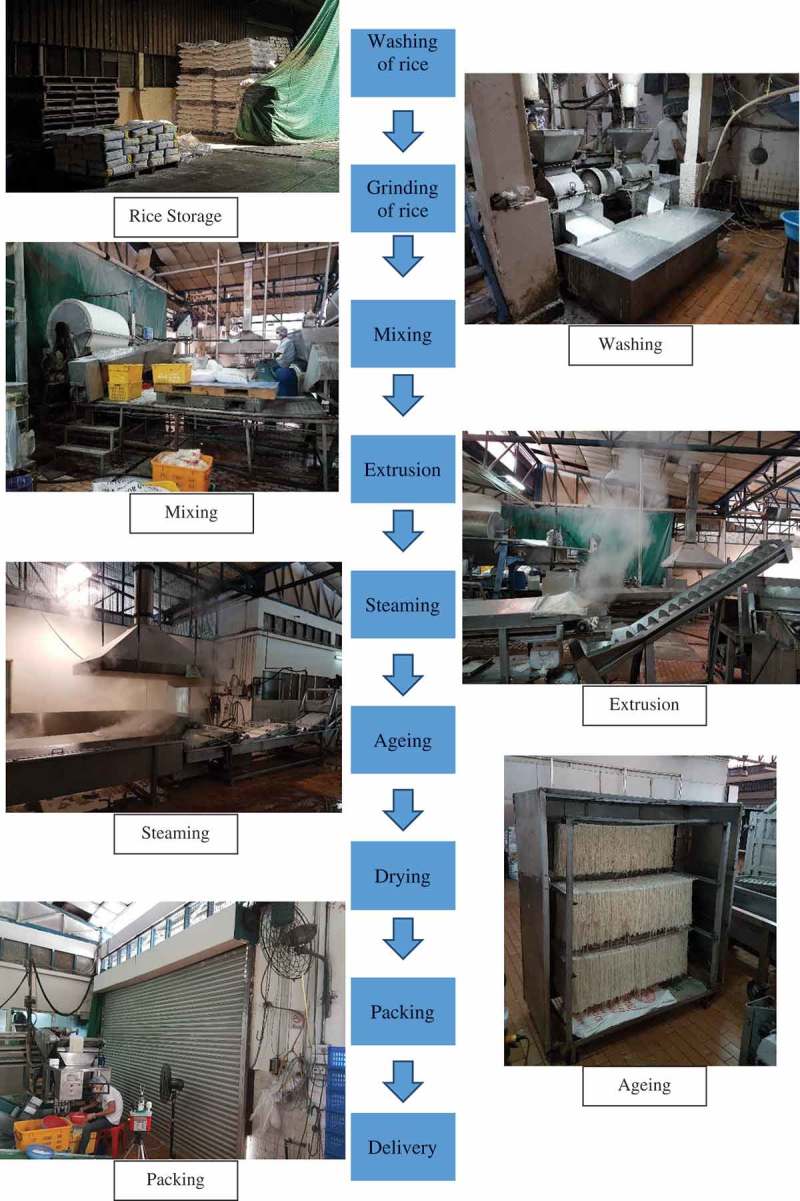
Rice vermicelli manufacturing process.
The workplace assessment revealed findings which contributed to the accumulation of heat stress in the factory. Heat stress measurements done at the drying room showed that the WBGT was 36.7°C and HSI was 517. Factors contributing to heat stress included steam generated from the extrusion and steaming process to produce rice vermicelli strips. Hot air from the drying room was also escaping into the environment. There was inadequate ventilation in the factory, contributing to the increase in temperature and humidity of the work space. No exhaust fans were installed due to concerns about contaminants in the factory.
The employer of the worker who developed heat stroke was issued with composition fines for violations under the WSH Act. OSHD also audited the company to ensure that they have implemented the necessary measures to mitigate heat stress exposure and protect their workers. The employer explored engineering options to increase the ventilation in the workplace, and implemented administrative controls such as heat acclimatization programs and screening for their workers.
Other workplace assessments
The processes contributing to high environmental heat stress included the steaming and drying process. Steam was generated during the steaming process, and hot dry air was used in the drying room. The production areas were in an indoor environment which was not exposed to direct sunlight. The three indoor rice vermicelli factories had a similar factory layout and production process. An overview of one of the indoor rice vermicelli manufacturing factory is shown in Figure 2, while the layout plan is shown in Figure 3. Higher WBGT and HSI levels were measured in the extrusion, steaming and drying process. The heat stress measurements are summarized in Table 1, with the highest WBGT (36.7°C) and HSI levels (3777) recorded in the drying and steaming process respectively. These levels were above the recommended permissible WBGT action limit for heat exposure, and considered to be high risk.
Figure 2.
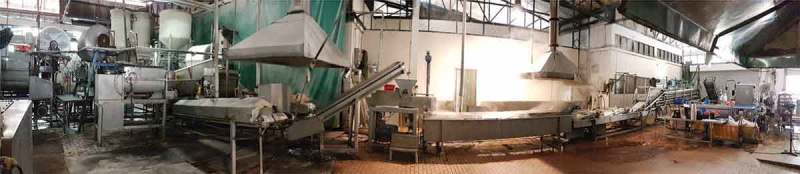
Overview of an indoor rice vermicelli manufacturing factory.
Figure 3.

Layout plan of a rice vermicelli manufacturing factory.
Table 1.
Heat stress measurements.
| WBGT (°C) |
HSI |
|||||||
|---|---|---|---|---|---|---|---|---|
| Location | Factory 1 | Factory 2 | Factory 3 | Mean | Factory 1 | Factory 2 | Factory 3 | Mean |
| Washing | 27.6 | 29.9 | – | 28.7 | 195 | 384 | – | 289.5 |
| Extruder | 32.9 | 30.8 | 30.5 | 31.4 | 1105 | 317 | 436 | 619.3 |
| Steaming | 33.8 | 35.4 | 32.1 | 33.8 | 3777 | 339 | 458 | 1524.7 |
| Drying | 36.7 | 29.2 | 29.2 | 31.7 | 517 | 202 | 356 | 358.3 |
| Packing | 27.7 | 29.4 | 28.2 | 28.4 | 332 | 245 | 212 | 263 |
| Rest area | 26.4 | 30.6 | 26.4 | 27.8 | 56 | 170 | 72 | 99.3 |
There were mitigating measures such as installation of fans at the packing area to improve ventilation. Engineering controls such as local exhaust ventilation (LEV) were installed on certain parts of the machineries, but appears to be inadequate, as steam was escaping around the LEVs as shown in the extrusion and steaming process. The workers were allowed rest breaks but there were no job rotations. The workers were assigned to their job scope and would remain in their respective workstation. Although there were new workers from foreign countries in the factories, none of them had undergone heat acclimatization programs before.
Discussion
Exposure to excessive heat puts workers at risk for heat stress, which can result in heat injuries or even death. Heat injuries can occur amongst workers performing tasks in hot environments, causing them to build metabolic heat faster that their bodies can release heat and cool down. Lack of heat acclimatization is an important factor associated with death from heat injuries [9]. Other factors such as type of clothing worn by the workers and inadequate ventilation also increase the heat stress in an indoor environment.
There were other hazards identified during the workplace assessments. Physical hazards such as excessive noise were produced by the machineries used to manufacture rice vermicelli. There were also safety hazards such as slippery floors due to wet work from the manufacturing process. Ergonomic hazards were also present due to awkward posture and repetitive work, especially in the packing department.
There are limitations for this study. The source of data was limited to three indoor rice vermicelli manufacturing factories in Singapore. The results from this study will not be generalizable to other indoor food manufacturing factories with different manufacturing processes. The heat stress measured was also variable depending on the workload of the day. If there were increased orders for that period, the work intensity would be increased, and machines may generate more heat.
Recommendations
Employers should be aware of the preventive actions necessary to protect their workers. Measures recommended to the employers to mitigate heat stress in indoor food manufacturing factories are summarized in Figure 4. The recommendations for mitigating heat stress were made based on the hierarchy of hazard control [5]. The heat generating machines should be substituted with those that emit less heat. Engineering controls can also be implemented, such as enclosing the machines to prevent heat transmission, and increasing ventilation by installing exhausts, fans, blowers or air conditioning [10]. Increasing air movement and decreasing the ambient water vapor pressure will increase the rate of evaporation of sweat from the skin.
Figure 4.
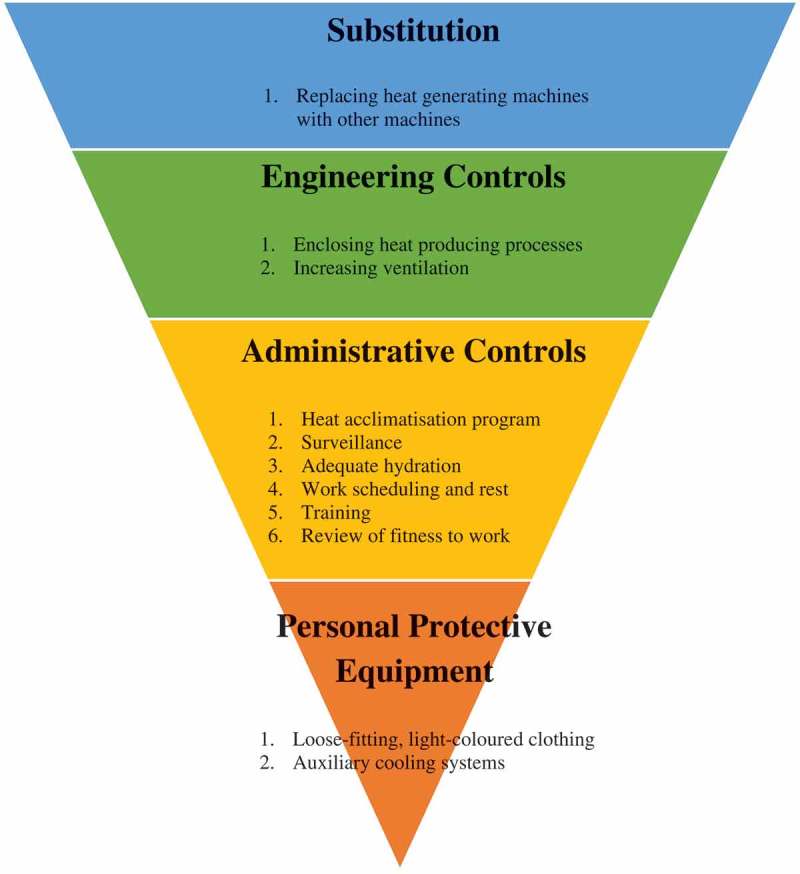
Preventive measures to mitigate heat stress in indoor food manufacturing factories.
Administrative controls include implementation of heat acclimatization programs for new workers or those returning from prolonged leave of more than one week. New and returning workers, especially those who come from a colder climate must be acclimatized to the hot weather [5]. New workers would need at least one to two weeks to adjust to the local weather conditions and workload. Workers exposed to heat stress should not start working at full workload in the hot environment upon arrival, but should undergo a heat acclimatization program in the first two weeks of starting work. Heat acclimatization comprises daily exposure to heat stress (working under hot environment) for up to 14 days. This can take the form of a gradual increase in work duration under the hot environment [11]. Other administrative controls include adequate water intake and drinking facilities provided for workers; alternate work and rest periods for working in hot environment; review of fitness to work; and training on symptoms, preventive measures of heat stress injuries, healthy lifestyles, ideal body weight and electrolyte balance.
Personal protective equipment can be provided for workers. These include loose-fitting, light-colored work clothes while working in the hot environment, or auxiliary cooling systems such as water-cooled or air-cooled clothing, cooling vests or wetted outer-clothing.
The OSHD, MOM, Singapore has adopted a multi-pronged approach towards the management of heat stress injuries in workplaces. These measures include education and outreach, enforcement and surveillance as well as ongoing legislative reviews.
Education and outreach
Much efforts have been made to step up education and outreach to increase awareness and knowledge on the prevention of heat stress injuries in workplaces including the food manufacturing industry. For example, employers and employees have been reminded about the preventive measures through seminars, workshops, roadshows and collaterals such as electronic bulletins, information cards, posters, newsletters, etc. In the communication efforts, heat stress measurements such as WBGT are recommended for high risk workplaces. In addition, WSH guidelines on managing heat stress in the workplace was published by the Workplace Safety and Health Council (WSHC) to further provide practical guidance to employers, employees and stakeholders about the signs and symptoms of heat stress, risk assessment, environmental measurements and preventive actions. The guide would be revised to provide more information on indoor heat stress. MOM in collaboration with the WSHC and its industry partners works closely to promote best practices in managing heat stress in workplaces to further reinforce the importance of the preventive measures.
Enforcement and surveillance
In addition to promotional efforts, MOM conducts regular enforcement and surveillance activities to ensure compliance of regulatory requirements involving heat stress in workplaces. For example, under the WSH (Risk Management) Regulations, risk assessments are to be conducted to address the safety and health risks posed to any person who may be affected by the activities in the workplace, including risks due to heat stress. The risk assessment allows identification of hazards related to heat stress in the workplace and implementation of effective risk control measures to eliminate or mitigate the risks to as low as is reasonably practicable. OSHD have also worked with the WSH Auditors to enhance the components in the Construction Safety Audit Scoring System (ConSASS) audit for worksites, to ensure the workers are adequately protected from heat stress injuries.
Errant employers will be issued with composition fines or for more for serious cases, prosecuted for violations of heat stress requirements under the WSH Act. Any person guilty of an offence under this Act shall be liable on conviction to a fine or to imprisonment or to both. An individual first-time offender can face a maximum fine of up to $200,000 or a jail term of two years or both, while a corporate body as a first-time offender can face a maximum fine of up to $500,000.
Conclusion
Workers in indoor rice vermicelli manufacturing factories can be exposed to heat stress, and the current measures in place may not be sufficient to protect workers against heat stress injuries. Heat stress injuries occurring in an indoor environment may be under-reported. These cases are important and should not be overlooked, because they can cause death or severe consequences on the workers. Heat stress is prevalent in the indoor food manufacturing factories, and risk assessments for heat hazards should be carried out by employers. Environmental monitoring using heat stress measurements can help to identify high risk areas in the factories. Heat injuries are preventable, and measures such as engineering controls and heat acclimatization program are important. Continued vigilance by employers, and efforts to prevent work-related heat injuries are important. Exposure to heat is a foreseeable health hazard which should be considered in the WSH risk assessment, and appropriate measures needs to be taken to mitigate the risks.
Acknowledgments
We would like thank the Occupational Safety and Health Division, Ministry of Manpower, Singapore for providing the resources to organize and support this study.
Financial support
This research did not receive any specific grant from funding agencies, whether in commercial or not-for-profit sectors.
Disclosure statement
No potential conflict of interest was reported by the authors.
References
- [1].Meteorological Service Singapore Past climate trends. Available at: http://www.weather.gov.sg/climate-past-climate-trends/ [Last accessed 2016 May26]
- [2].Workplace Safety and Health Council Managing heat stress in the workplace. Workplace Safety and Health Guidelines; 2012. [Google Scholar]
- [3].Kondo M, Ono M, Nakazawa K, et al. Population at high-risk of indoor heatstroke: the usage of cooling appliances among urban elderlies in Japan. Environ Health Prev Med. 2013May;18(3):251–257. [DOI] [PMC free article] [PubMed] [Google Scholar]
- [4].2016 TLVs and BEIs Threshold limit values for chemical substances and physical agents and biological exposure indices. Cincinnati, Ohio: American Conference of Governmental Industrial Hygienists; 2016. p. 214. [Google Scholar]
- [5].Centers for Disease Control and Prevention , National institute for occupational safety and health. Criteria for a recommended standard occupational exposure to heat and hot environments. 2016. Available at: http://www.cdc.gov/niosh/docs/2016-106/pdfs/2016-106.pdf [Last accessed 2016 November11].
- [6].Arbury S, Jacklitsch B, Farquah O, et al. Heat illness and death among workers – United States, 20122013. Occupational Safety and Health Administration (OSHA). MMWR Morb Mortal Wkly Rep. 2014August8;63(31):661–5. [PMC free article] [PubMed] [Google Scholar]
- [7].Workplace Safety and Health Council Diagnosis and management of occupational diseases. Workplace Safety and Health Guidelines; 2012. [Google Scholar]
- [8].International Labour Organization Assessment of heat stress and heat stress indices. International Labor Organization, Geneva.© 2011. Available athttp://www.iloencyclopaedia.org/part-vi-16255/heat-and-cold/76-42-heat-and-cold/assessment-of-heat-stress-and-heat-stress-indicies [Last accessed 2016 November11]
- [9].Arbury S, Lindsley M, Hodgson M, et al. Review of OSHA heat enforcement cases: lessons learned. J Occup Environ Med. 2016April;58(4):359–63. [DOI] [PubMed] [Google Scholar]
- [10].DiNardi SR, American Industrial Hygiene Association . The occupational environment: its evaluation and control. Fairfax, VA: AIHA Press (American Industrial Hygiene Association); 1997. p. 612–645. [Google Scholar]
- [11].Lee L, Fock KM, Lim CL, et al. Singapore armed forces medical corps – ministry of health clinical practice guidelines: management of heat injury. Singapore Med J. 2010October;51(10):831–4. [PubMed] [Google Scholar]