



Abstract
ABSTRACT: Purpose: Evaluation of possibilities of obtaining type I fibrillar collagen from fish skin using the Black Sea marine resources and suitable cross-linking agent for this one to stay stable at body or room temperature. Materials and methods: Collagen has been extracted from the skin of the Grey mullet and Sturgeon by the acidic method with Acetic acid 0.5M. Cross-linking has been performed by using Tanic acid at 4-6°C. The rheological behaviour was determined by using a Haake VT 550 rheo-viscometer. Results: The collagen was isolated from the skin of Gray mullet and Sturgeon. (Acipenser gueldenstaedtii). Hydrogels have a pseudoplastic behavior. Tanic acid was used for cross-linking like a better alternative, eliminating the toxicity of glutaraldehyde. Conclusion. The yield of collagen extraction was higher for the Gray mullet skin, than Sturgeon. Pseudo-plastic behavior allows them to be successfully applied in the treatment of wounds. The isolated type I collagen may serve as an attractive alternative to mammalian collagen for biomedical and pharmaceutical applications.
Keywords: marine collagen, collagen hydrolysates, tissue regeneration
Introduction
The presence of collagen in almost all tissues and organs, it structural and biochemical features justify the effort of scientists in knowing the implications of the various normal and pathological processes in the human body. Some researchers have attributed a role in the aging process, even naming it "old age protein", following due to the finding of essential change of the old bodies compared to young adults. It had an important structural role. Possibilities to exploit to obtain good yields collagen and denatured collagen type I fibrillar collagen extraction consists of marine fish skins.
Marine collagen has been isolated from many marine sources such as marine fishes [1,2], sponges [3,4] and mollusks [5,6]. In marine fishes, the fish tissues, including the skin, bone and scale, account for approximately 30% of the processing waste [7].
The use of biomaterials in order to repair and function in humans has increased considerably in the last 30-40 years. Artificial materials used in veterinary medicine as implants, medical devices, wound dressings, tables, sutures, contain at least one natural component with important role for enhancing the biocompatibility and haste the healing process [8]. Collagen being the ideal support for the immobilization of active principles from plants, the combination of the anti-inflammatory, anti-bacterial and drying (of harmed surfaces) properties of substances with the healing capability of collagen is expected to result in efficient dressings for wound healing [9]. The high viscosity at rest assures a good adherence of the hydrogels on wound, while their elasticity prevents the breakdown of the applied layer [10].
Being composed from macromolecules, collagen is successfully used in the biomedical field: orthopedics, dentistry, dermatology, urology, cardio-vascular surgery. Particularly important is that this biopolymer can be conditioned in various forms: injectable solutions, gelatine, foams, solutions, pastes. One of the possibilities of recovery of denatured collagen type I fibrillar consist of extraction of marine fish skin. Fish contain more collagen in the skin, the wings of the dorsal fin and the bladder.
Our aims was to evaluate the possibilities of obtaining type I fibrillar collagen from fish skin using the Black Sea marine resources.
Materials and Methods
Materials
Fresh Gray mullet fish and Sturgeon fish were collected from market during the month of October. The fish was skinned. The skin was washed thoroughly with distilled water, and stored at-25°C until used. The scales and fins were collected separately. For obtaining collagen from marine fish, we used the acid treatment method, with acetic acid 0.5M.
Chemical reagents: All reagents used were of analytical grade. Acetic acid, sodium chloride (NaCl), were purchased from Chemical Company, Triethanoleamine from Sigma Aldrich, Tanic acid from Merck KGaA.
Demineralization Process Initially, the fish skin was washed twice in 10wt% of NaCl solutions to remove unnecessary proteins on the surface by stirring the solution for 24h. Demineralization was achieved with 0.4mol/L HCl solution (dry scales: solution=1:15) for 90min. The demineralized skin was washed three times with distilled water for collagen extraction.
Results
For the extraction of marine collagen from marine fish were selected two species of fish: Gray mullet and Sturgeron. The stages of work in the acid treatment are presented in the 1
Figure 1.
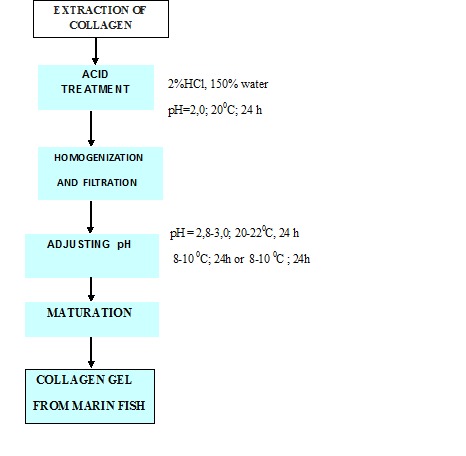
Extraction of collagen by acid treatment
To obtain good yields and denatured collagen type I fibrillar collagen extraction from the skin of marine fish are involved the following steps:
removal of non-collagenous by pretreatment with sodium chloride solution, preferably 10% at room temperature for 24 hours, at the same time it takes to remove grease and deodorizing;
removing the salt by exhaustive washing with distilled water and sewage water until no chloride ions, with most of the fat and smell;
treatment with 0.5 M acetic acid solution of skin pretreated for 24-48 hours to remove the epidermis;
extracting collagen in 0.5M acetic acid solution of temperature reduction on the cleaned skin of 4-6 ° C, in order to eliminate degradation;
filtering the extract to separate collagen from the rest of the skin at the same temperature and centrifuged at room temperature at which extraction was made, where there is the possibility;
maintaining the collagen in appropriate conditions, possibly by introducing preservative sodium nitrate.
Figure 2.
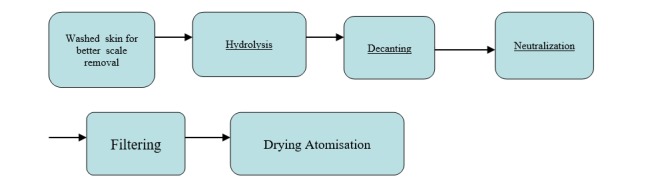
The process of obtaining of collagen
Stabilization of Collagen Extracted from Fish
To use collagen extracted from fish skin at room temperature and more to the human body, it must have the collagen type I fiber structure that should be stabilized. This can be done by cross-linking.
Figure 3.

Collagen extracted from fish
Cross-Linking
Collagen extracted from fish skin can be stabilized by cross-linking, as with mammalian products by two types of methods:
- by physical treatment, the use on the one hand of ultraviolet radiation and on the other hand of hydrothermal methods;
- by chemical treatment using glutaraldehyde as cross-linking agents or carbodiimide.
Rheological Behavior
Rheological properties give information on the consistency and plasticity of hydrogels, allowing to determinate their behavior under application conditions. In addition, they influences the kinetics of drug release and staging at application side.
Gel without Alcohol
They do not contain ethyl alcohol and have been subjected to maturation for at least 12 hours at 4°C. [11,12] Then they have undergone rheological measurements under the above conditions. For the gel containing no ethyl alcohol solution, measurements can be made to allow a shear rate of between 48.6 and 1312 s -1 according to the rheogram described in the following figures (see 4 and 5).
Figure 4.
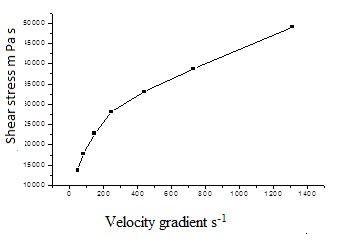
Rheogram of gel with collagen concentration of 0.6% without ethyl alcohol
Figure 5.
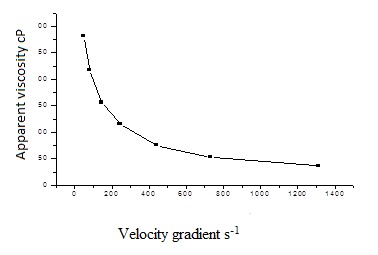
Fluctuation of apparent collagen concentration of 0.6% without ethyl alcohol
As the inclination of the curve decreases with shear according to the speed increases, the rheogram 5 confirms the pseudoplastic behavior of the collagen gel. The collagen gel being relatively diluted, tends ideally to a pseudo-plastic behavior at high shear rates of over approx. 440 s-1, which means that the gel does not continue to modify the STI structure mentioned at shear rates exceeding the value (very diluted gels exhibit this behavior).
The apparent viscosities have been calculated for every point on the rheogram as ratio between the shearing stress and speed. Variation curve of apparent viscosities with shearing speeds for this gel is presented in 5. This is also representative for materials with pseudo-plastic behavior and it is more pronounced for small shearing decrease speeds and tends to a limit value at high shearing speeds.
The cross-linking was made with Tanic acid 2%.
The highest viscosity and stability under shear forces are hydrogels with acidic pHs ranging between 3 and 3.6 and basically low bases of about 7.5.
Collagen’s mechanical properties have a substantial importance: its elasticity and stiffness on the macroscale. These are important for materials performance, while on the microscale we are increasingly learning about the importance of mechanics in dictating cellular fate [13].
Discussion
The marine fish collagen Gray mullet presents the best stability. It has been isolated with superior yields than Sturgeron.
The printing stability of the collagen matrix with chemical cross-linking gives a particular mechanical strength, but can lead to a potential cytotoxicity and a reduced biocompatibility.
Cross-linking was made with Tanic acid, which has showed good results and also was exploited his antimicrobial activity. Thus, toxicity induced by glutaraldehyde, frequently used like cross-linking agent, was eliminated.
All hydrogels have a pseudo-plastic behavior, but viscosities are much higher at a given concentration. This rheological behavior can be also confirmed by the represantation after the model of Ostwald-De Waele.
Modelling of Rheological Behaviour using Ostwald-De Waele Model
Ostwald-De Waele model or “power law model” consider the formula:
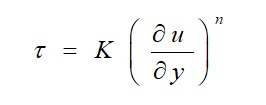
where:
K is the flow consistency index
∂u/∂y is the shear rate or the velocity gradient perpendicular to the plane of shear and
n is the flow behavior index.
Further, apparent or dynamic viscosity, will be:

Since for n=1, it obtains the Newton law, it is usual to call the model under the name of “power law” and to consider it as a generalization of Newton model for ideal fluids. [14]
When n<1, the model predicts that the apparent viscosity would decrease to zero at high share rate and to infinity in its absence, therefore, applicability restrains to intermediate domain of share rate. In spite of these limitations, the law is largely applicable due to its very simple form.
After logarithmic transformations both relations become linear dependences between variables:

As can be seen in 6, the first form of the law is appropriate if we eliminate the first and the last points in the graph. The flow index n appears to be 0.38, a clear sign of pseudo-plastic behavior.
Figure 6.
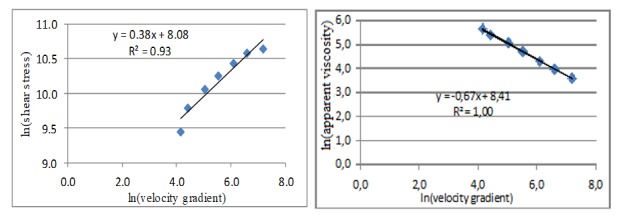
The rheological behavior of fish collagen after logarithmic
An extraordinary good fitting (correlation coefficient 1,00) appeared in case of relation between apparent viscosity and velocity gradient. In this case n-1=-0,67 so that n=0,33 which is very closed with the value obtained in first law. Consistency index was obtained.
Conclusion
In this study, the Gray mullet skin and Sturgeon skin collagen was extracted by 0.5M acetic acid.
Extraction yields were better for Gray mullet skin, 83%.
Cross-linking was performed with Tanic acid to eliminate toxicity of glutaraldehyde.
Rheological properties give information on the consistency and plasticity of hydrogels.
All hydrogels have a pseudo-plastic behavior but viscosities are much higher at the initial concentration.
Experimental data was well fitted in case of shear stress-velocity dependence in power law model and excellent fitted in case of apparent viscosity predictions.
The isolated type I collagen may serve as an attractive alternative to mammalian collagen for biomedical and pharmaceutical applications.
Acknowledgments
This work has benefited from financial support through the project; CERO-PROFILE OF HIS CAREER: ROMANIAN RESEARCHER; contract no. POSDRU /159/1.5/S/135760, Project being co-financed from the European Social Fund Through Sectoral Operational Program Human Resources Development 2007-2013.
References
- 1.Silva TH, Moreira Silva J, Marques AL, Domingues A, Bayon Y, Reis RL. Marine origin collagens and its potential applications. Marine Drugs. 2014;12(12):5881–5901. doi: 10.3390/md12125881. [DOI] [PMC free article] [PubMed] [Google Scholar]
- 2.Muthumari K, Anand M, Maruthupandy M. Collagen extract from marine finfish scales as a potential mosquito larvicide. Protein Journal. 2016;35(6):391–400. doi: 10.1007/s10930-016-9685-7. [DOI] [PubMed] [Google Scholar]
- 3.Swatschek D, Schatton W, Kellermann J, Müller WEG, Kreuter J. Marine sponge collagen: Isolation, characterization and effects on the skin parameters surface-pH, moisture and sebum. European Journal of Pharmaceutics and Biopharmaceutics. 2002;53:107–113. doi: 10.1016/s0939-6411(01)00192-8. [DOI] [PubMed] [Google Scholar]
- 4.Moreira Silva J, Silva TH, Prata MB, Cerqueira MT, Pirraco R, Giovine M, Marques AP, Reis RL. Potential of marine sponge collagen coatings for skin regeneration strategies. Journal of Tissue Engineering and Regenerative Medicine. 2013;7(1):12. [Google Scholar]
- 5.Shen XR, Kurihara H, Takahashi K. ACharacterization of molecular species of collagen in scallop mantle. Food Chemistry. 2007;102:1187–1191. [Google Scholar]
- 6.Kolodziejska I, Sikorski ZE, Niecikowska C. Parameters affecting the isolation of collagen from squid (Illex argentinus) skins. Food Chemistry. 1999;(66):153–157. [Google Scholar]
- 7.Wang BR, An X Yang, Xin F, Zhao Z, L Hu Q. Isolation and characterisation of collagens from the skin, scale and bone of deep - sea redfish (Sebastes mentella) Food Chemistry. 2008;(108):616–623. doi: 10.1016/j.foodchem.2007.11.017. [DOI] [PubMed] [Google Scholar]
- 8.Parks JB. Biomaterials: Principle and Applications. CRC Press, Boca Raton. 2002 [Google Scholar]
- 9.Sulea D, Micutz M, Albu MG, Staicu T, Leca M. Collagen-thuja tincture biomaterials for wound treatment. Hydrogels and porous matrices. Revue Roumaine De Chimie. 2011;56(2):129–136. [Google Scholar]
- 10.Brazdaru L, Micutz M, Staicu T, Albu M, Sulea D, Leca M. Structural and rheological properties of collagen hydrogels containing tannic acid and chlorhexidine digluconate intended for topical applications. Comptes Rendus Chimie. 2015;18(2):160–169. [Google Scholar]
- 11.Bechir AM, Sirbu R, Pacurar M, Podariu AC, Monea M, Bechir ES, Ghergic DL. The effect of collagenic gels with marine algae extracts mixtures in the treatment of recurrent aphthous stomatitis. Revista de Chimie. 2014;65(3):362–368. [Google Scholar]
- 12.Sîrbu R, Zaharia T, Maximov V, Bechir AM, Mariş M, Negreanu-Pîrjol B, Mariş D, Negreanu-Pîrjol T, Leca M, Cadar EM, Stoicescu RM, Mocanu L, Jurja S. Clean bio-technologies for obtaining new pharmaceutical formulations based on collagen gels and marine algae extracts for medical applications. Journal of Environmental Protection and Ecology. 2010;11(2):654–665. [Google Scholar]
- 13.Shayegan M, Forde NR. Microrheological Characterization of Collagen Systems: From Molecular Solutions to Fibrillar. Gels.PLOS ONE. 2013;8(8) doi: 10.1371/journal.pone.0070590. [DOI] [PMC free article] [PubMed] [Google Scholar]
- 14.De Waele A. Viscometry and Plastometry. Journal of the Oil and Colour. 1923;6:33–69. [Google Scholar]