


Abstract
Methylenetetrahydrofolate reductase (MTHFR) catalyzes conversion of methylene tetrahydrofolate to methylte trahydrofolate. MTHFR C677T polymorphism has been regarded as a risk factor for various vascular diseases. Our study aimed to investigate the distribution frequencies of this polymorphism among Hakka population living in southern China. We retrospectively recruited 5102 unrelated Chinese Hakka subjects. MTHFR C677T polymorphism was tested using the polymerase chain reaction (PCR) and DNA sequencing. A total of 2358 males and 2744 females (aged from 10 years to 101 years) were included in this study. In total, 2835 (55.63%) subjects were homozygous for the C allele (CC), 1939 (38.00%) subjects were heterozygous (CT), and 325 (6.37%) subjects were homozygous for the T allele (TT). The allelic frequency of mutant T was 25.37% with 325 individual homozygous for this defective allele resulting in a frequency of about 6.37% for the TT genotype. According to the study results, the overall frequency of MTHFR C677T genotypes did not differ significantly among the gender and age groups. Our study showed the prevalence of MTHFR C677T polymorphism in a large ethnic Hakka population living in southern China. It would be important implications for the primary prevention of various vascular diseases.
Keywords: genetic polymorphism, Hakka population, methylenetetrahydrofolate reductase, southern China
1. Introduction
The 5,10-methylenetetrahydrofolate reductase (MTHFR) gene, a folate-dependent enzyme that catalyzes the irreversible conversion of 5,10-methylenetetrahydrofolate to 5-methyltetrahydrofolate, thereby directing folate metabolites towards the DNA methylation pathway from the DNA synthesis pathway.[1–3] The MTHFR gene has been mapped to the end of the short arm of chromosome 1p36.3 and at least 2 significant functional polymorphisms of the MTHFR gene, C677T, and A1298C, have been identified.[4,5] The most common polymorphism in the gene encoding the catalytic domain of MTHFR, namely there is a cytosine (C) to thymine (T) substitution at nucleotide 677 in exon 4, which subsequently leads to an alanine-to-valine conversion at amino acid 222 in the MTHFR protein, with eventual reduction or loss of MTHFR activity.[6–8] Individuals with the 677TT genotype, have approximately 30% the MTHFR enzyme activity as compared with those with the 677CC genotype, whereas heterozygotes 677CT have around 65% of enzymatic activity.[9–12] A large number of epidemiological studies have investigated the relationship between the C677T polymorphism of MTHFR and many diseases, including breast cancer, colorectal cancer, ischemic stroke, depressive disorders, and hypertension.[13–17]
Hakka is one of intriguing Chinese Han population that mainly inhabit in southern China and also widely distribute in Southeast Asia. With a total area of 15,876 square kilometers and a population of 5.43 million, the Meizhou region is located in the northeast of Guangdong Province, China. It is noteworthy that more than 95% of people who live in this area are Hakka and exhibited lots of unique features including in dialects, life styles, intra-ethnic marriages, customs, and architecture.[18] Previous studies have revealed that the prevalence of MTHFR C677T is different in distinct geographical areas, races and ethnic populations.[19–22] However, polymorphism of MTHFR in the Hakka population remains unclear. Therefore, the aim of the present study was to examine the distribution frequencies of MTHFR C677T polymorphism in the Hakka populations in southern China.
2. Material and methods
2.1. Population sample
We retrospectively recruited 5102 unrelated Chinese Hakka subjects who visited Meizhou People's Hospital (Huangtang Hospital), Meizhou Hospital Affiliated to Sun Yat-sen University, Guangdong Province, China, between July 2015 and October 2017. All subjects were from families who had been living in the Meizhou area for at least 3 generations of Hakka paternal ancestry. The geographical location of the sampled area is shown in Figure 1. All participants for the study signed written informed consent form according to the ethical guidelines of the Helsinki Declaration before their enrollment. The study was approved by the Committee of Ethics and Research of the Meizhou People's Hospital for experiments involving humans.
Figure 1.
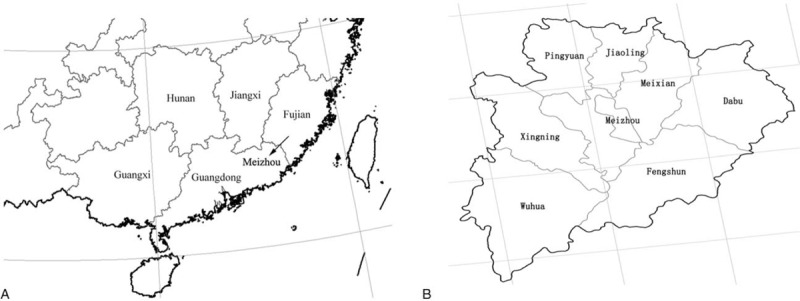
The geographical location and surrounding area of Meizhou area. A: The Meizhou region in southern China. B: The administrative region of Meizhou.
2.2. DNA extractions
Three millilitres of venous blood was sampled from each subject and collected into tubes containing ethylene diamine tetra-acetic acid (EDTA). Genomic DNA extraction was carried out using Puregene Blood Core Kit C (Qiagen, Germantown, MD) following the manufacturer's instructions and quantified using Nanodrop 2000 Spectrophotometer (Thermo Scientific, DE). The extracted DNA was dissolved in sterile distilled water and stored at −20°C until the day of analysis.
2.3. Polymerase chain reaction (PCR) and DNA direct sequencing
Detection of the C677T polymorphism of MTHFR was performed using a PCR and DNA direct sequencing method according to the manufacturer's instructions (SinoMDgene Technology Co., Ltd., Beijing, China). Briefly, the initiated PCR were amplified in a total volume of 25 uL, containing 20 ng DNA, and the recommended amounts of dNTPs, primers and of Hotstar Taq DNA polymerase. For PCR, an initial denaturation step at 95°C for 3 minutes. was followed by 45 cycles of denaturation at 94°C for 15 seconds, annealing and extension at 60°C at the indicated temperature for 45 seconds, followed by a final extension step of 25°C for 1 min. The PCR products were then purified and for sequenced by dye termination sequencing using BigDye Terminator Cycle Sequencing V3.1 Kit and 3500Dx DNA Analyzer 5.4 (Applied Biosystems, CA). DNA sequences were assembled using ABI PRISM sequencing analysis software version 5.4 (Applied Biosystems, CA). Additionally, to control for correct sample handling, genotyping was randomly repeated in 10% of the samples, and no discrepancies were detected in all repeated experiments when compared with the initial genotyping. The chromatograms of different single nucleotide polymorphism variants using reverse primers for sequencing are presented in Figure 2. The observed genotype frequencies of C677T were compared with expected genotype frequencies according to the Hardy–Weinberg law.
Figure 2.

Sequence chromatogram of MTHFR C677T gene polymorphism (a) genotype 677CC, (b) genotype 677CT, (c) genotype 677TT.
2.4. Statistics
The statistical package for the social sciences software (version 19.0; SPSS Inc., Chicago, IL) was used for data all statistical analysis. Genotype and allele frequency differences between groups were assessed using Chi-square and Fisher exact tests. Probability values less than .050 were considered statistically significant.
3. Results
A total of 5102 subjects (2358 males and 2744 females, aged from 10 years to 101 years), from a Hakka population living in the city of Meizhou, in southern China were included in this study. Genotype and allelic frequencies of the C677T polymorphism of MTHFR according to gender and age are presented in Table 1. No significant departures from Hardy–Weinberg equilibrium was observed for the frequencies of alleles and genotypes of C677T in the Hakka population (χ2 = 0.06, P >.05). In total, 2835 (55.63%) subjects were homozygous for the C allele (CC), 1939 (38.00%) subjects were heterozygous (CT), and 325 (6.37%) subjects were homozygous for the T allele (TT). The allelic frequency of mutant T was 25.37% with 325 individual homozygous for this defective allele resulting in a frequency of about 6.37% for the TT genotype. According to the study results, the overall frequency of MTHFR C677T genotypes did not differ significantly among the gender and age groups.
Table 1.
Genotypes and alleles frequencies of MTHFR C677T in the Hakka population.

We compared genotype and allele frequencies between our data and previously published data from different countries and ethnic groups worldwide, as shown in Table 2. We further compared the genotype and allele frequencies estimated here for MTHFR C677T with respect to previously studied population from different regions and ethnic in China (Table 3). Our results showed that the frequency of MTHFR C677T was significantly different according to the geographic region and the ethnicity of the population.
Table 2.
Allele frequencies of MTHFR C677T polymorphisms among the Hakka ethic population and other previously studied populations worldwide.

Table 3.
Allele frequencies of MTHFR C677T polymorphisms among the Hakka ethic population and other previously studied populations in China.

4. Discussion
Methylene tetrahydrofolate reductase is an important enzyme involved in the conversion of methylene tetrahydrofolate to methylte trahydrofolate, which affects DNA methylation and synthesis.[1,23] Previous studies demonstrated cytosine to thymidine (C > T) base change at nucleotide position 677 of the MTHFR gene is often regarded as a risk factor for a wide range of serious diseases and MTHFR C677T polymorphisms were distributed by ethnicity.[10,24] To our knowledge, we firstly analyzed the frequency of MTHFR C677T polymorphisms in the Hakka population in the world. We compared these results with that of other region and racial populations worldwide. Analysis of the study group for the MTHFR C677T polymorphism indicated that 55.63% of individuals were homozygous for the wild-type (CC), 38.00% were heterozygous (CT), and the remaining (6.37%) were homozygous for the mutant allele (TT). The identification of this polymorphism in the Hakka population as a health risk factor will help people who are predisposed to susceptible disease to make adequate health decisions in order to delay or halt the disease.
The homozygous 677TT genotype of this mutation has been found to specify a variant enzyme with reduced activity and to be associated with elevated plasma levels of total homocysteine (tHcy), particularly in the setting of low folate levels, as compared to the wild-type (677CC) and heterozygous (677CT) genotypes.[25,26]MTHFR C677T polymorphism has been extensively investigated and considered to be a risk factor for various diseases, such as cancer, inflammatory bowel diseases, ischemic stroke, and coronary artery disease.[27–30]
The ethnic difference in MTHFR C677T polymorphism is well known. Some studies revealed that homozygous state of MTHFR C677T polymorphism is variable in populations with certain ethnic backgrounds from Asia, Africa, Europe, and America.[10,11,19,22] Homozygous 677TT were rare or completely absent in African and the frequency of the homozygous wild-type 677CC genotype is more prevalent in Asian and European Caucasian.[7,9,17,24,25] The MTHFR 677TT genotype affects an estimated 10% of individuals worldwide (range from 0%–30%). These studies of MTHFR gene polymorphisms showed a considerable heterogeneity from country to country, and similar results were also observed among Chinese populations. The previous studies revealed the frequency of homozygous 677TT is high in residents in Shandong (40.78%), Tianjin (30.50%) and Shanxi (30.36%) of China.[31] While in our study the frequency of homozygous 677TT is found to be 6.37% in the Hakka population, similarly 6.14% in residents in Hainan of China.[32] In addition, inconsistent of rates of homozygous 677TT carriers were found in residents of Inner Mongolia (10.43%), Jiangsu (17.93%), Sichuan (10.98%) and Guangxi (14.5%) of China.[33–38] Generally, these results show that the frequency of homozygous mutation genotype of 677TT in northern cities is higher than that in southern cities of China. In the current study, MTHFR C677T gene polymorphisms were compared with published data of different ethnic groups in Chinese population. Chinese-Han in Tianjin exhibited the highest proportion of frequency of the 677TT genotype (30.50%).[16] The relatively lower frequency of the 677TT genotype (6.37%) was found in our group, as well as in Kazak (5.32%) and Bai Ku Yao (3.97%) national minority were observed when compared with the frequencies reported in other Chinese study populations.[38,39]
Ample evidence has implicated the importance of MTHFR gene in the onset and progression of various disorders, particularly those associated with folate and homocysteine status.[40,41] Interestingly, identification of genetic predisposition may hold promises in the development of strategies for personalized risk prediction and strategic health-care planning and substantial studies have revealed an interaction between lifestyle factors and MTHFR polymorphisms worldwide. For example, in 2010, Songserm et al performed a nested case–control study in the Thailand population and the result strongly suggest that polymorphisms in MTHFR genotypes act together with alcohol drinking and low folate intake to increase the risk of cholangiocarcinomas.[42] Di Daniele et al have explored the effects of Italian Mediterranean organic diet versus low-protein diet in nephropathic patients according to MTHFR genotypes. The study result showed that a significant reduction of tHcy in T allele carriers after Italian-style Mediterranean diet and in both genotypes after Italian Mediterranean organic diet subsequently might lead to a lower incidence of cardiovascular disease and could be of particular significance in chronic kidney disease patients.[43] Also, folate and homocysteine were implicated in human reproductive health and, in particular, subfertility. A previous literature revealed significant folate deficiency and higher homocysteine in mediterranean population carrying the MTHFR TT genotype, thus emphasizing that periconceptional supplementation combined with the food-based approach or supplement.[44,45] In the present study, we investigate the distribution frequencies of MTHFR C677T polymorphism among Hakka population living in southern China. Given these genetic differences, genome-based nutritional advice might be tailored in a regionalized and individualized manner that may lead to a healthier dietary pattern.
Several limitations of the present study deserve to be stressed. First, all the subjects were recruited from hospital, therefore there was a potential selection bias. Second, the present study is lacking information on serum folate and tHcy status. Third, the association between MTHFR polymorphisms and risk of disease was not observed.
5. Conclusions
Our study is the first report on MTHFR C677T polymorphisms in a large Hakka population in southern China. It would be important implications for the primary prevention of various vascular diseases.
Acknowledgments
The author would like to thank other colleagues who were not listed in the authorship of Clinical Core Laboratory and Center for Precision Medicine, Meizhou People's Hospital (Huangtang Hospital), Meizhou Hospital Affiliated to Sun Yat-sen University for their helpful comments on the manuscript.
Author contributions
Pingsen Zhao conceived and designed the experiments; Jingyuna Hou and Pingsen Zhao recruited subjects and collected clinical data. Jingyuna Hou, Hesen Wu and Miaocai Zhong conducted the laboratory testing. Pingsen Zhao and Jingyuna Hou prepared the manuscript.
Conceptualization: Pingsen Zhao.
Data curation: Pingsen Zhao, Jingyuan Hou, Hesen Wu, Miaocai Zhong.
Formal analysis: Pingsen Zhao.
Funding acquisition: Pingsen Zhao.
Investigation: Pingsen Zhao.
Methodology: Pingsen Zhao, Jingyuan Hou, Hesen Wu, Miaocai Zhong.
Project administration: Pingsen Zhao.
Resources: Pingsen Zhao.
Software: Pingsen Zhao.
Supervision: Pingsen Zhao.
Validation: Pingsen Zhao, Jingyuan Hou.
Visualization: Pingsen Zhao.
Writing – original draft: Pingsen Zhao, Jingyuan Hou.
Writing – review & editing: Pingsen Zhao.
Footnotes
Abbreviations: MTHFR = methylenetetrahydrofolate reductase, PCR = polymerase chain reaction.
PZ and JH contributed equally to this work.
This study was supported by Medical Scientific Research Foundation of Guangdong Province, China (Grant No.: A2016306 to Dr. Pingsen Zhao), National Key Research and Development Program of China (Grant No.: 2017YFD0501705 to Dr. Pingsen Zhao), National Key Research and Development Program of China (Grant No.: 2016YFD0050405 to Dr. Pingsen Zhao), Natural Science Foundation of Guangdong Province, China (Grant No.: 2016A030307031 to Dr. Pingsen Zhao) and Key Scientific and Technological Project of Meizhou People's Hospital (Huangtang Hospital), Meizhou Hospital Affiliated to Sun Yat-sen University, Guangdong Province, China (Grant No.: MPHKSTP-20170102 to Dr. Pingsen Zhao) and Medical Scientific Research Foundation of Guangdong Province, China (Grant No.: A2017404 to Dr. Jingyuan Hou).
The authors declared no conflicts of interest.
References
- [1].Keku T, Millikan R, Worley K, et al. 5,10-Methylenetetrahydrofolate reductase codon 677 and 1298 polymorphisms and colon cancer in African Americans and whites. Cancer Epidemiol Biomarkers Prev 2002;11:1611–21. [PubMed] [Google Scholar]
- [2].Yousef AM, Shomaf M, Berger S, et al. Allele and genotype frequencies of the polymorphic methylenetetrahydrofolate reductase and colorectal cancer among Jordanian population. Asian Pac J Cancer Prev 2013;14:4559–65. [DOI] [PubMed] [Google Scholar]
- [3].Spiroski I, Kedev S, Antov S, et al. Association of methylenetetrahydrofolate reductase (MTHFR-677 and MTHFR-1298) genetic polymorphisms with occlusive artery disease and deep venous thrombosis in Macedonians. Croatian Med J 2008;49:39–49. [DOI] [PMC free article] [PubMed] [Google Scholar]
- [4].Noori N, Miri-Moghaddam E, Dejkam A, et al. Are polymorphisms in MTRR A66G and MTHFR C677T genes associated with congenital heart diseases in Iranian population. Caspian J Intern Med 2017;8:83–90. [DOI] [PMC free article] [PubMed] [Google Scholar]
- [5].Nassereddine S, Kassogue Y, Korchi F, et al. Association of methylenetetrahydrofolate reductase gene (C677T) with the risk of hypertension in Morocco. BMC Res Notes 2015;8:775. [DOI] [PMC free article] [PubMed] [Google Scholar]
- [6].Irfan M, Ismail M, Azhar Beg M, et al. Association of the MTHFR C677T (rs1801133) polymorphism with idiopathic male infertility in a local Pakistani population. Balkan J Med Genet 2016;19:51–62. [DOI] [PMC free article] [PubMed] [Google Scholar]
- [7].Al-Shahrani H, Al-Dabbagh N, Al-Dohayan N, et al. Association of the methylenetetrahydrofolate reductase (MTHFR) C677T polymorphism with primary glaucoma in Saudi population. BMC Ophthalmol 2016;16:156. [DOI] [PMC free article] [PubMed] [Google Scholar]
- [8].Kurzawski M, Wajda A, Malinowski D, et al. Association study of folate-related enzymes (MTHFR, MTR, MTRR) genetic variants with non-obstructive male infertility in a Polish population. Genet Mol Biol 2015;38:42–7. [DOI] [PMC free article] [PubMed] [Google Scholar]
- [9].Vranekovic J, Babic Bozovic I, Starcevic Cizmarevic N, et al. Functional inference of methylenetetrahydrofolate reductase gene polymorphisms on enzyme stability as a potential risk factor for Down syndrome in Croatia. Dis Markers 2010;28:293–8. [DOI] [PMC free article] [PubMed] [Google Scholar]
- [10].Berglund M, Enblad G, Turesson I, et al. Folate-metabolizing genes in lymphoma patients from Sweden. Scand J Immunol 2009;70:408–10. [DOI] [PubMed] [Google Scholar]
- [11].Atadzhanov M, Mwaba MH, Mukomena PN, et al. Frequency of APOE, MTHFR and ACE polymorphisms in the Zambian population. BMC Res Notes 2014;7:194. [DOI] [PMC free article] [PubMed] [Google Scholar]
- [12].Aly RM, Taalab MM, Ghazy HF. MTHFR A1298C and C677T gene polymorphisms and susceptibility to chronic myeloid leukemia in Egypt. Int J Clin Exp Pathol 2014;7:2571–8. [PMC free article] [PubMed] [Google Scholar]
- [13].Zhang S, Chen S, Chen Y, et al. Investigation of methylenetetrahydrofolate reductase tagging polymorphisms with colorectal cancer in Chinese Han population. Oncotarget 2017;8:63518–27. [DOI] [PMC free article] [PubMed] [Google Scholar]
- [14].Waseem M, Hussain SR, Kumar S, et al. Association of MTHFR (C677T) gene polymorphism with breast cancer in north India. Biomark Cancer 2016;8:111–7. [DOI] [PMC free article] [PubMed] [Google Scholar]
- [15].Li Z, Yadav U, Mahemuti A, et al. Association of MTHFR genetic polymorphisms with venous thromboembolism in Uyghur population in Xinjiang, China. Int J Clin Exp Med 2015;8:17703–11. [PMC free article] [PubMed] [Google Scholar]
- [16].Zhi X, Yang B, Fan S, et al. Gender-specific interactions of MTHFR C677T and MTRR A66G polymorphisms with overweight/obesity on serum lipid levels in a Chinese Han population. Lipids Health Dis 2016;15:185. [DOI] [PMC free article] [PubMed] [Google Scholar]
- [17].Bondarenko EA, Shadrina MI, Grishkina MN, et al. Genetic analysis of BDNF, GNB3, MTHFR, ACE, and APOE variants in major and recurrent depressive disorders in Russia. Int J Med Sci 2016;13:977–83. [DOI] [PMC free article] [PubMed] [Google Scholar]
- [18].Zhong Z, Hou J, Li B, et al. Analysis of CYP2C19 genetic polymorphism in a large ethnic Hakka population in southern China. Med Sci Monit 2017;23:6186–92. [DOI] [PMC free article] [PubMed] [Google Scholar]
- [19].Kaya EF, Karakus N, Ulusoy AN, et al. Association of the MTHFR gene C677T polymorphism with breast cancer in a Turkish population. Oncol Res Treat 2016;39:534–8. [DOI] [PubMed] [Google Scholar]
- [20].Ramos-Silva A, Figuera LE, Soto-Quintana OM, et al. Association of the C677T polymorphism in the methylenetetrahydrofolate reductase gene with breast cancer in a Mexican population. Genet Mol Res GMR 2015;14:4015–26. [DOI] [PubMed] [Google Scholar]
- [21].Romero-Sanchez C, Gomez-Gutierrez A, Gomez PE, et al. C677T (RS1801133) MTHFR gene polymorphism frequency in a colombian population. Colombia Med (Cali, Colombia) 2015;46:75–9. [PMC free article] [PubMed] [Google Scholar]
- [22].Couto FD, Adorno EV, Menezes JF, et al. C677T polymorphism of the MTHFR gene and variant hemoglobins: a study in newborns from Salvador, Bahia, Brazil. Cad Saude Publica 2004;20:529–33. [DOI] [PubMed] [Google Scholar]
- [23].van den Donk M, Buijsse B, van den Berg SW, et al. Dietary intake of folate and riboflavin, MTHFR C677T genotype, and colorectal adenoma risk: a Dutch case-control study. Cancer Epidemiol Biomarkers Prev 2005;14:1562–6. [DOI] [PubMed] [Google Scholar]
- [24].Cui LH, Shin MH, Kweon SS, et al. Methylenetetrahydrofolate reductase C677T polymorphism in patients with gastric and colorectal cancer in a Korean population. BMC Cancer 2010;10:236. [DOI] [PMC free article] [PubMed] [Google Scholar]
- [25].Lopez-Cortes A, Cabrera-Andrade A, Salazar-Ruales C, et al. Genotyping the high altitude Mestizo Ecuadorian population affected with prostate cancer. BioMed Res Int 2017;2017:3507671. [DOI] [PMC free article] [PubMed] [Google Scholar]
- [26].Deligezer U, Akisik EE, Dalay N. Homozygosity at the C677T of the MTHFR gene is associated with increased breast cancer risk in the Turkish population. In Vivo 2005;19:889–93. [PubMed] [Google Scholar]
- [27].Li A, Shi Y, Xu L, et al. A possible synergistic effect of MTHFR C677T polymorphism on homocysteine level variations increased risk for ischemic stroke. Medicine (Baltimore) 2017;96:e9300. [DOI] [PMC free article] [PubMed] [Google Scholar]
- [28].Bennouar N, Allami A, Azeddoug H, et al. Thermolabile methylenetetrahydrofolate reductase C677T polymorphism and homocysteine are risk factors for coronary artery disease in Moroccan population. J Biomed Biotechnol 2007;2007:80687. [DOI] [PMC free article] [PubMed] [Google Scholar]
- [29].Karban A, Feldman T, Waterman M, et al. The association of the MTHFR C677T polymorphism with inflammatory bowel diseases in the Israeli Jewish population: an example of genetic heterogeneity. Medicine (Baltimore) 2016;95:e5611. [DOI] [PMC free article] [PubMed] [Google Scholar]
- [30].Ping MA, Qin S, Liu HY, et al. A study of gene ploymorphism of N5,10-methylenetetrahydrofolate reductase (MTHFR) between Hui and Han nationalities in Ningxia and the relationship with essential hypertension. J Chongqing Med Univ 2011;36:1364–7. [Google Scholar]
- [31].Fan S, Yang B, Zhi X, et al. Combined genotype and haplotype distributions of MTHFR C677T and A1298C polymorphisms: A cross-sectional descriptive study of 13,473 Chinese adult women. Medicine (Baltimore) 2016;95:e5355. [DOI] [PMC free article] [PubMed] [Google Scholar]
- [32].Wang S, Yanqiang LU, Shaojie MA, et al. Relationship of plasma homocysteine with gene polymorphisms of MTHFR and MTRR among Han women in Xiangtan City. Tianjin Med J 2014. [Google Scholar]
- [33].Ri-Le HU, Niu GM, Zhao SG, et al. The association between gene polymorphisms of N5,10-methylene tetrahydrofolate reductase and mongolian patients with drimary hypertension. 2006;14:274–6. [Google Scholar]
- [34].Huang P, Zhou ZY, Heng tai MA, et al. MTHFR polymorphisms and colorectal cancer susceptibility in Chongqing people. Acta Acad Med Mil Tertiae 2003. [Google Scholar]
- [35].Zhao YM, Wang DX, Wei-Yan XU, et al. Relationship between homocysteine or gene polymorphisms of methylenetetrahydrofolate reductase and essential hypertension complicating coronary heart disease in elderly patients. Chin J Evid-Based Cardiovasc Med 2016. [Google Scholar]
- [36].Li H, Xu WL, Shen HL, et al. Methylenetetrahydrofolate reductase genotypes and haplotypes associated with susceptibility to colorectal cancer in an eastern Chinese Han population. Genet Mol Res GMR 2011;10:3738–46. [DOI] [PubMed] [Google Scholar]
- [37].Song A, Zhao L, Li Y, et al. Haplotypes of the MTHFR gene are associated with an increased risk of breast cancer in a Han Chinese population in Gansu province. IUBMB Life 2016;68:526–34. [DOI] [PubMed] [Google Scholar]
- [38].Zhang L, Yin RX, Liu WY, et al. Association of methylenetetrahydrofolate reductase C677T polymorphism and serum lipid levels in the Guangxi Bai Ku Yao and Han populations. Lipids Health Dis 2010;9:123. [DOI] [PMC free article] [PubMed] [Google Scholar]
- [39].Mao R, Fan Y, Chen F, et al. Methylenetetrahydrofolate reductase gene polymorphisms in 13 Chinese ethnic populations. Cell Biochem Funct 2008;26:352–8. [DOI] [PubMed] [Google Scholar]
- [40].Williams EA, Welfare M, Spiers A, et al. Systemic folate status, rectal mucosal folate concentration and dietary intake in patients at differential risk of bowel cancer (The FAB2 Study). Eur J Nutr 2013;52:1801–10. [DOI] [PubMed] [Google Scholar]
- [41].Thuesen BH, Husemoen LL, Ovesen L, et al. Lifestyle and genetic determinants of folate and vitamin B12 levels in a general adult population. Br J Nutr 2010;103:1195–204. [DOI] [PubMed] [Google Scholar]
- [42].Songserm N, Promthet S, Sithithaworn P, et al. Risk factors for cholangiocarcinoma in high-risk area of Thailand: role of lifestyle, diet and methylenetetrahydrofolate reductase polymorphisms. Cancer Epidemiol 2012;36:e89–94. [DOI] [PubMed] [Google Scholar]
- [43].Di Daniele N, Di Renzo L, Noce A, et al. Effects of Italian Mediterranean organic diet vs. low-protein diet in nephropathic patients according to MTHFR genotypes. J Nephrol 2014;27:529–36. [DOI] [PubMed] [Google Scholar]
- [44].Agodi A, Barchitta M, Valenti G, et al. Dietary folate intake and blood biomarkers reveal high-risk groups in a Mediterranean population of healthy women of childbearing potential. Ann Nutr Metab 2013;63:179–85. [DOI] [PubMed] [Google Scholar]
- [45].Taruscio D, Carbone P, Granata O, et al. Folic acid and primary prevention of birth defects. Biofactors 2011;37:280–4. [DOI] [PubMed] [Google Scholar]