



Abstract
Objective:
The objective of this study is to compute the potential benefit of Pramipexole ER on total levodopa equivalent dose (LED) and Unified Parkinson Disease Rating Score (UPDRS-III) compared to mono- or combined therapy of pramipexole IR and/or carbidopa/levodopa.
Methods:
This is a retrospective observational study conducted in a specialized PD (Parkinson Disease) and movement disease center in Lebanon between January and December 2017.
Results:
A total of 176 patient’s record was reviewed. Pramipexole ER showed a significant difference on the mean changes in LED and UPDRS-III score. After 13 weeks of initiating Pramipexole ER, the mean decrease in LED was -49.42 mg for all patients (p < 0.001, CI 95% [35.28-63.55]) and the mean decrease in UPDRS-III score for all patients was -6 points (P< 0.001).
According to the subgroup analysis, patients aged 65 years and below, the change in mean total LED from baseline (350.80 mg) was a decrease of 63.19 mg with a p<0.001, CI 95% [42.07-84.31]. In patients aged more than 65 years and shifted to mono or combined pramipexole ER therapy, the change in mean total LED from baseline (559.25 mg) was a decrease of 34.67 mg with a p<0.001 CI 95% [16.16-53.18]. In addition the results showed that in patients having an UPDRS-III score of less than or equal to 33, the change in mean total LED from baseline (436.73 mg) was a decrease of 56.76 mg (p<0.001; CI 95% [41.32-72.20]). However, in patients having an UPDRS-III score of more than 33 the change in mean total LED from baseline (545.06 mg) was a decrease of 2.96 mg with a p value < 0.844 CI 95% [27.32-33.15].
Conclusions:
This study demonstrated the efficacy of Pramipexole ER on decreasing the total levodopa equivalent dose (LED).The role of health care professionals is to maintain the patient on the lowest effective levodopa equivalent daily dose and optimize the treatment therapy, thus decreasing the side effects that might arise from overdosing of antiparkinsonian drugs.
Keywords: Pramipexole, Levodopa, Antiparkinson Agents, Parkinson Disease, Dose-Response Relationship, Drug, Retrospective Studies, Lebanon
INTRODUCTION
Parkinson’s disease (PD) is a chronic, irreversible neurodegenerative disorder, induced by massive dopamine loss and it is recognized by motor and non-motor symptoms.1 PD available treatment is symptomatic with no proven efficacy to slow or reverse the disease progression.2 The estimated prevalence of PD, in 2004, among Lebanese population is 0.36%.3 Lebanese PD annual mortality rate is 0.2 per 100,000 people due to disease progression, and or medication related adverse events.4
Levodopa and dopamine agonists are considered essential options in early and advanced PD treatment guidelines.5,6 Among all multiple antiparkinsonian therapies that are now available, the standardized levodopa equivalent dose (LED) is set to provide a useful tool to compare dose intensities of different medications in clinical trials. It is the dose that produces the same antiparkinsonian effect as 100 mg of immediate release levodopa.7
Pramipexole is a non-ergot dopamine agonist approved for the treatment of early PD. It is indicated either to delay the use of Levodopa, or as an add-on to Levodopa for patients with advanced PD experiencing Levodopa induced dyskinesia, and off periods.8,9 Various in vivo and in vitro studies have showed that pramipexole has promising neuroprotective effects10,11, while clinical human studies did not.12 Pramipexole was expected to hold a significant potential in PD treatment since it is associated with lower motor complication risks, and higher reduction in Unified Parkinson Disease Rating Score (UPDRS).13,14 UPRDS is used to follow the longitudinal course of PD and is divided into 6 sections, where section III includes a clinician-scored motor evaluation that can be used as a measure of Pramipexole efficacy on motor functioning.14
Pramipexole is available in two formulations; an immediate release (IR), and a once-daily extended release (ER) formula. The ER was verified to be bioequivalent to the IR formulation.15 Furthermore the ER formulation was associated with better patient adherence to therapy, constant plasma concentration drug level, improved clinical response, and safety profile.15,16 Several studies investigated the effect of pramipexole addition to PD patients’ regimens on levodopa daily dose.17,18 According to our knowledge there are no studies comparing the addition of pramipexole ER into the same patient’s regimen before and after Pramipexole ER introduction.
Moreover, there is not enough information regarding the PD treatment, complication, and prognosis among the Lebanese population. Therefore, this study was undertaken to quantify the potential benefit of pramipexole ER on total LED and UPDRS-III score. The primary objective was to compare the total LED before and after introduction of pramipexole ER into the regimen for each individual PD patient.
METHODS
Study Design
This is a retrospective observational, single arm study conducted in a specialized PD and movement disease center in Lebanon between January and December 2017. Initially, total of 698 subjects’ records were screened with PD. PD patients were excluded from the study if they had history of any psychiatric disorder, atypical PD symptoms, dementia, hypotension or any other clinical significant disease at any point of their lives, to make sure that the symptoms encountered are solely due to Parkinson disease. Patients were also excluded if they had received any of the following drugs; typical and atypical antipsychotics, centrally active antiemetic, amphetamine, and/or methyldopa because these medications have the ability to cause Parkinson-like side effects.
Only 176 PD patients who were shifted from their ongoing antiparkinsonian therapy (consisting of mono- or combined therapy of pramipexole IR and/or carbidopa/levodopa) to mono or combined pramipexole ER therapy were included in the study. The main reason for introducing pramipexole ER to the patients’ regimens was due to the lack of efficacy of the previous regimens.
It is worth noting that pramipexole dose was increased by 0.75 mg/day every week to reach a maximum of 4.5 mg/week, whereas the levodopa/carbidopa initial dose was 25 mg-100 mg orally three times a day or 10 mg-100 mg orally 3 or 4 times a day, increased by 1 tablet every day or every other day as needed, until a dose of 8 tablets (2000 mg) was reached. When adding pramipexole ER to the regimen, the doses were adjusted according to patients’ symptoms.19
The enrolled patients’ medications were recorded and their baseline total levodopa equivalent dose (LED) was calculated before and after shifting the patient to pramipexole ER. LED was calculated based on the conversion factors in Table 1.
Table 1. Levodopa equivalent daily dose conversion factors5.
| Drug | Conversion factor |
|---|---|
| Levodopa | x 1 |
| Entacapone | LD x 0.33 |
| Tolcapone | LD x 0.5 |
| Pramipexole | x 100 |
| Ropinirole | x 20 |
| Rotigotine | x 30 |
| Selegiline oral | x 10 |
| Selegiline sublingual | x 80 |
| Rasagiline | x 100 |
| Amantadine | x 1 |
| Apomorphine | x 10 |
Outcome measures
The primary endpoint was defined as the change in LED after introducing Pramipexole ER into the regimen. The secondary endpoint was defined as the mean change from baseline to week 13 in the UPDRS-III score. A cutoff point for a minimal clinical important difference in UPDRS-III was a decrease in 2.5-5 points.20,21 Other endpoints observed were the change in LED based on age (<65 vs. >65 years) and the severity of motor symptoms defined as mild for UPDRS-III <32, moderate 33-58, and severe >59.22
Data Analysis
Statistical analysis was performed using the SPSS version 20.0. Descriptive statistics were used to describe patient characteristics (frequencies and percentages for categorical variables), and mean (standard deviation) for continuous variables. Pearson chi-square test was used to study the association between different categorical variables and student-t-test for continuous variables. The LED before and after pramipexole ER introduction in the same patient was compared for statistically significant differences using the paired student-t-test. A decrease in LED was analyzed as a drug dose reduction and/or elimination from baseline PD regimens. All reported p-values were two-sided with the alpha set at a significance of 0.05.
RESULTS
Out of 176 patients 54.5% were males and 45.5% were females. The mean age of the patients ranged from 27-88 was 60 years old (SD=8.1), 56.8% were less than or equal to 65 years. Regarding the disease duration, the mean was 2.5 years (SD=2.4). The mean baseline LED was 451.5 mg and the mean baseline UPDRS-III score was 18.99 points (SD=12.7) with 86.3% of patients less or equal to 30. (Table 2)
Table 2. Baseline patient characteristics.
| Variable | N=176 |
|---|---|
| Age | Mean: 60.7 (SD=8.39) |
| < 65 | 100 (56.8) |
| > 65 | 76 (43.2) |
| Gender | |
| Male | 96 (54.5) |
| Female | 80 (45.5) |
| Duration of PD (y) | 2.5 (2.6) |
| UPDRS III | 18.9 (12.9) |
| Total Levodopa equivalent dose | 451.5 mg (272.5) |
Data are mean or number of subjects (%) unless otherwise indicated.
Pramipexole ER showed a significant difference on the mean changes in LED and UPDRS-III score. After 13 weeks of initiating Pramipexole ER, the mean decrease in LED was for all patients -49.42 mg (p<0.001, 95%CI [35.28-63.55]) and the mean decrease in UPDRS-III score for all patients was -6 points (p<0.001).
Subgroup analyses
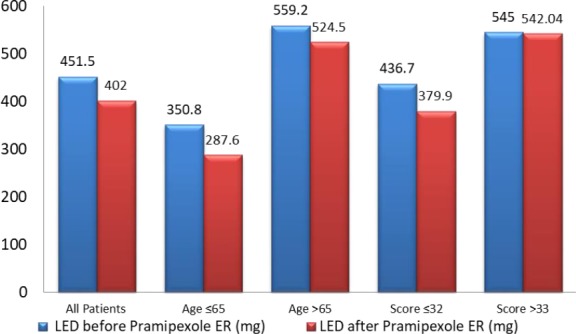
In patients aged 65 years and below, the change in mean total LED from baseline (350.80 mg) was a decrease of 63.19 mg with a p<0.001, 95%CI [42.07-84.31]. In patients aged more than 65 years, the change in mean total LED from baseline (559.25 mg) was a decrease of 34.67 mg with a p<0.001 CI 95% [16.16-53.18].
In patients having an UPDRS-III score of less than or equal to 33, the change in mean total LED from baseline (436.73 mg) was a decrease of 56.76 mg (p<0.001; 95%CI [41.32-72.20]). However, in patients having an UPDRS-III score of more than 33 the change in mean total LED from baseline (545.06 mg) was a decrease of 2.96 mg with a p value<0.844 95%CI [27.32-33.15] (Figure 1).
Figure 1. Change in levodopa equivalent dose.
DISCUSSION
According to our knowledge there are no studies evaluating the change in total LED in the same patient before and after introduction of pramipexole ER in Lebanon. In this study, it was observed that the total LED can be significantly reduced. Either due to symptom’s improvement or patient’s adherence using the Pramipexole ER, PD medication’s dose or agents were reduced or removed from the regimen. This result was consistent with other related studies.23,24
Our study showed an 8 points decrease in UPDRS-III score at 13 weeks with pramipexole ER, greater than the suggested cutoff point for efficacy. A similar study demonstrated a decrease of 6.1 points in pramipexole ER treated group.25
When taking age into consideration, pramipexole ER use was associated with lower LED in both groups (≤65 and >65 years), this indicates that pramipexole ER is an effective option in elderly patients. This correlates well with previous studies done to evaluate the efficacy of pramipexole in older patients.26-29 A research that was conducted Pellicano et al. showed that pramipexole ER has levodopa sparing effect in patients older than 65 years 16. This theory is aligned with the standards of care in levodopa therapy among older adults with functional impairments due to the potential of worsening of the quality of life as well as greater risk of psychiatric side effects with dopamine agonists versus levodopa. However, in terms of doses, pramipexole ER decrease LED in older patients therefore further studies are required to proven the effect of dose reduction to be either beneficial or clinically insignificant and unnecessary.
With respect to the UPDRS-III score pramipexole ER was significantly correlated with lower LED total doses in patients with mild motor symptoms.
(UPDRS-III ≤33). In contrast, pramipexole ER levodopa sparing effect in patients having moderate to severe motor symptoms (UPDRS-III >33) was not significantly different. This result correlates well with other studies showing that the use of pramipexole ER was associated with lower LED in patients having mild-moderate PD30,31 and not with severe PD, which can be explained by the need of combination therapies and higher doses to control advanced PD symptoms.
Although PD is a progressive degenerative disorder, pramipexole ER showed its ability to spare or delay the use of high levodopa doses and the absolute dependency to Levodopa, thus sparing the patient from complications that may arise from levodopa multiple daily dosing.
Limitations
Though our results were homogeneous with most previous studies, there still exist several limitations. Some of the limitations in this study are that it is retrospective and single-centered. Extra patients’ visits before week 13 were not recorded. Concerning efficacy measures, we used the UPDRS-III section only, while in other trials more parts of this scoring system were used. Besides, the LED conversion factors are not universally unified and thus may affect the accuracy and reliability of our results. We couldn’t study the prevalence of side effects before and after the addition of pramipexole ER and those of levodopa since data was not readily available in patient’s charts. In addition, adherence to the treatment along with baseline characteristics such as co-morbidities and treatment patterns couldn’t be retrieved from the available patients’ charts as well because of the retrospective nature of the study. Future studies that will address all these limitations are needed.
CONCLUSIONS
The total LED is significantly lowered when pramipexole ER is introduced to the same patient. The dose reduction is mostly prominent in patients aged less than 65 years with an UPDRS score less than 33. Furthermore, patients aged more than 65 years can also benefit from the LED reduction. This study opens new horizons on the potential role of health care professionals in maintaining the patient on the lowest effective levodopa equivalent daily dose and optimize the treatment therapy, thus decreasing the side effects that might arise from overdosing of antiparkinsonian drugs.
Footnotes
CONFLICT OF INTEREST
The authors declare no conflicts of interest.
FUNDING
None.
Contributor Information
Lama Faddoul, School of Pharmacy, Lebanese International University. Beirut (Lebanon). lama.faddoul@liu.edu.lb.
Bahia Chahine, School of Pharmacy, Lebanese International University. Beirut (Lebanon). bahia.chahine@liu.edu.lb.
Sahar Haydar, School of Pharmacy, Lebanese International University. Beirut (Lebanon). sahar.haydar@liu.edu.lb.
Sahar Abourida, School of Pharmacy, Lebanese International University. Beirut (Lebanon). sahar.abourida@liu.edu.lb.
Souheil Hallit, Faculty of Medicine and Medical Sciences, Holy Spirit University of Kaslik (USEK); & Institut National de Sante Publique, Epidemiologie Clinique et Toxicologie, Beirut (Lebanon). souheilhallit@hotmail.com.
Etwal Bou Raad, School of Pharmacy, Lebanese International University. Beirut (Lebanon). etwal.bouraad@liu.edu.lb.
References
- 1.Parkinson's Disease -- American Academy of Neurology. [(accessed February 26, 2018)];Patients.aan.com. Available at: http://patients.aan.com/disorders/?event=view&disorder_id=1029 .
- 2.Seidl SE, Potashkin JA. The promise of neuroprotective agents in Parkinson's Disease. Front Neurol. 2011;2:68. doi: 10.3389/fneur.2011.00068. [DOI] [PMC free article] [PubMed] [Google Scholar]
- 3.Statistics by Country for Parkinson's Disease. [(accessed February 26, 2018)]; Available at: http://www.cureresearch.com/p/parkinsons_disease/stats-country_printer.htm .
- 4.Parkinson Disease in Lebanon. [(accessed February 26, 2018)]; Available at: http://global-disease-burden.healthgrove.com/l/55401/Parkinson-Disease-in-Lebanon .
- 5.Connolly BS, Lang AE. Pharmacological treatment of Parkinson disease: a review. JAMA. 2014;311(16):1670–1683. doi: 10.1001/jama.2014.3654. [DOI] [PubMed] [Google Scholar]
- 6.Rao SS, Hofmann LA, Shakil A. Parkinson's Disease: Diagnosis and Treatment. Am Fam Physician. 2006;74(12):2046–2054. [PubMed] [Google Scholar]
- 7.Tomlinson CL, Stowe R, Patel S, Rick C, Gray R, Clarke CE. Systematic review of levodopa dose equivalency reporting in Parkinson's disease. Mov Disord. 2010;25(15):2649–2653. doi: 10.1002/mds.23429. [DOI] [PubMed] [Google Scholar]
- 8.Pahwa R, Factor SA, Lyons KE, Ondo WG, Gronseth G, Bronte-Stewart H, Hallett M, Miyasaki J, Stevens J, Weiner WJ. Quality Standards Subcommittee of the American Academy of Neurology. Practice Parameter: Treatment of Parkinson disease with motor fluctuations and dyskinesia (an evidence-based review) Neurology. 2006;66(7):983–995. doi: 10.1212/01.wnl.0000215250.82576.87. [DOI] [PubMed] [Google Scholar]
- 9.Zhuo C, Zhu X, Jiang R, Ji F, Su Z, Xue R, Zhou Y. Comparison for efficacy and tolerability among ten drugs for treatment of Parkinson's Disease: A Network Meta-Analysis. Sci Rep. 2017;8:45865. doi: 10.1038/srep45865. [DOI] [PMC free article] [PubMed] [Google Scholar]
- 10.Li C, Guo Y, Xie W, Li X, Janokovic J, Le W. Neuroprotection of pramipexole in UPS impairment induced animal model of Parkinson's disease. Neurochem Res. 2010;35(10):1546–1556. doi: 10.1007/s11064-010-0214-3. [DOI] [PubMed] [Google Scholar]
- 11.Albrecht S, Buerger E. Potential neuroprotection mechanisms in PD: focus on dopamine agonist pramipexole. Curr Med Res Opin. 2009;25(12):2977–2987. doi: 10.1185/03007990903364954. [DOI] [PubMed] [Google Scholar]
- 12.Schapira AH, McDermott MP, Barone P, Comella CL, Albrecht S, Hsu HH, Massey DH, Mizuno Y, Poewe W, Rascol O, Marek K. Pramipexole in patients with early Parkinson's disease (PROUD): a randomized delayed-start trial. Lancet Neurol. 2013;12(8):747–755. doi: 10.1016/S1474-4422(13)70117-0. [DOI] [PMC free article] [PubMed] [Google Scholar]
- 13.Holloway RG, Shoulson I, Fahn S, Kieburtz K, Lang A, Marek K, McDermott M, Seibyl J, Weiner W, Musch B, Kamp C, Welsh M, Shinaman A, Pahwa R, Barclay L, Hubble J, LeWitt P, Miyasaki J, Suchowersky O, Stacy M, Russell DS, Ford B, Hammerstad J, Riley D, Standaert D, Wooten F, Factor S, Jankovic J, Atassi F, Kurlan R, Panisset M, Rajput A, Rodnitzky R, Shults C, Petsinger G, Waters C, Pfeiffer R, Biglan K, Borchert L, Montgomery A, Sutherland L, Weeks C, DeAngelis M, Sime E, Wood S, Pantella C, Harrigan M, Fussell B, Dillon S, Alexander-Brown B, Rainey P, Tennis M, Rost-Ruffner E, Brown D, Evans S, Berry D, Hall J, Shirley T, Dobson J, Fontaine D, Pfeiffer B, Brocht A, Bennett S, Daigneault S, Hodgeman K, O'Connell C, Ross T, Richard K, Watts A Parkinson Study Group. Pramipexole vs levodopa as initial treatment for Parkinson disease: a 4-year randomized controlled trial. Arch Neurol. 2004;61(7):1044–1053. doi: 10.1001/archneur.61.7.1044. [DOI] [PubMed] [Google Scholar]
- 14.Fahn S, Elton RL. UPDRS Development Committee. Unified Parkinson's Disease Rating Scale. In: Fahn S, Marsden CD, Calne DB, Goldstein M, editors. Recent developments in Parkinson's disease. Florham Park, NJ: Macmillan; 1987. [Google Scholar]
- 15.Mizuno Y, Yamamoto M, Kuno S, Hasegawa K, Hattori N, Kagimura T, Sarashina A, Rascol O, Schapira AH, Barone P, Hauser RA, Poewe W, Pramipexole ER, Study Group Efficacy and safety of extended- versus immediate-release pramipexole in Japanese patients with advanced and L-dopa-undertreated Parkinson disease: a double-blind, randomized trial. Clin Neuropharmacol. 2012;35(4):174–181. doi: 10.1097/WNF.0b013e31825f77b9. [DOI] [PubMed] [Google Scholar]
- 16.Wang Y, Sun S, Zhu S, Liu C, Liu Y, Di Q, Shang H, Ren Y, Lu C, Gordon MF, Juhel N, Chen S. The efficacy and safety of pramipexole ER versus IR in Chinese patients with Parkinson's disease: a randomized, double-blind, double-dummy, parallel-group study. Transl Neurodegener. 2014;3:11. doi: 10.1186/2047-9158-3-11. [DOI] [PMC free article] [PubMed] [Google Scholar]
- 17.Antonini A, Calandrella D. Once-daily pramipexole for the treatment of early and advanced idiopathic Parkinson's disease: Implications for patients. Neuropsychiatr Dis Treat. 2011;7:297–302. doi: 10.2147/NDT.S10097. [DOI] [PMC free article] [PubMed] [Google Scholar]
- 18.Poewe W, Rascol O, Barone P, Hauser RA, Mizuno Y, Haaksma M, Salin L, Juhel N, Schapira AH, Pramipexole ER Studies Group. Extended-release pramipexole in early Parkinson disease: a 33-week randomized controlled trial. Neurology. 2011;77(8):759–766. doi: 10.1212/WNL.0b013e31822affb0. [DOI] [PubMed] [Google Scholar]
- 19.Drug Monograph: Pramipexole (Mirapex, Mirapex ER) [(accessed February 26, 2018)]; Available at: https://www.ebmconsult.com/articles/monograph-pramipexole-mirapex-mirapex-er .
- 20.Schrag A, Sampaio C, Counsell N, Poewe W. Minimal clinically important change on the Unified Parkinson's Disease Rating Scale. Mov Disord. 2006;21(8):1200–1207. doi: 10.1002/mds.20914. [DOI] [PubMed] [Google Scholar]
- 21.Shulman LM, Gruber-Baldini AL, Anderson KE, Fishman PS, Reich SG, Weiner WJ. The clinically important difference on the Unified Parkinson's Disease Rating Scale. Arch Neurol. 2010;67(1):64–70. doi: 10.1001/archneurol.2009.295. [DOI] [PubMed] [Google Scholar]
- 22.Martínez-Martín P, Rodríguez-Blázquez C, Alvarez M, Arakaki T, Arillo VC, Chaná P, Fernández W, Garretto N, Martínez-Castrillo JC, Rodríguez-Violante M, Serrano-Dueñas M, Ballesteros D, Rojo-Abuin JM, Chaudhuri KR, Merello M. Parkinson's disease severity levels and MDS-unified Parkinson's disease rating scale. Parkinsonism Relat Disord. 2015;21(1):50–54. doi: 10.1016/j.parkreldis.2014.10.026. [DOI] [PubMed] [Google Scholar]
- 23.Takanashi M, Shimo Y, Hatano T, Oyama G, Hattori N. Efficacy and safety of a once-daily extended-release formulation of pramipexole switched from an immediate-release formulation in patients with advanced Parkinson's disease: results from an open-label study. Drug Res (Stuttg) 2013;63(12):639–643. doi: 10.1055/s-0033-1351257. [DOI] [PubMed] [Google Scholar]
- 24.Grosset D, Antonini A, Canesi M, Pezzoli G, Lees A, Shaw K, Cubo E, Martinez-Martin P, Rascol O, Negre-Pages L, Senard A, Schwarz J, Strecker K, Reichmann H, Storch A, Löhle M, Stocchi F, Grosset K. Adherence to antiparkinson medication in a multicenter European study. Mov Disord. 2009;24(6):826–832. doi: 10.1002/mds.22112. [DOI] [PubMed] [Google Scholar]
- 25.Pellicano C, Benincasa D, Fanciulli A, Latino P, Giovannelli M, Pontieri FE. The impact of extended release dopamine agonists on prescribing patterns for therapy of early Parkinson's disease: An observational study. Eur J Med Res. 2013;18:60. doi: 10.1186/2047-783X-18-60. [DOI] [PMC free article] [PubMed] [Google Scholar]
- 26.Mizuno Y, Yamamoto M, Kuno S, Hasegawa K, Hattori N, Kagimura T, Sarashina A, Rascol O, Schapira AH, Barone P, Hauser RA, Poewe W, Pramipexole ER Study Group. Efficacy and safety of extended- versus immediate-release pramipexole in japanese patients with advanced and L-dopa–undertreated Parkinson disease. Clin Neuropharmacol. 2012;35(4):174–181. doi: 10.1097/WNF.0b013e31825f77b9. [DOI] [PubMed] [Google Scholar]
- 27.Rascol O, Barone P, Hauser RA, Mizuno Y, Poewe W, Schapira AH, Salin L, Sohr M, Debieuvre C, Pramipexole Switch Study Group Efficacy, safety, and tolerability of overnight switching from immediate- to once daily extended-release pramipexole in early Parkinson's disease. Mov Disord. 2010;25(14):2326–2332. doi: 10.1002/mds.23262. [DOI] [PubMed] [Google Scholar]
- 28.Eisenreich W, Sommer B, Hartter S, Jost WH. Pramipexole extended release: a novel treatment option in Parkinson's disease. Parkinsons Dis. 2010;2010:612–619. doi: 10.4061/2010/612619. [DOI] [PMC free article] [PubMed] [Google Scholar]
- 29.Hauser RA, Schapira AH, Barone P, Mizuno Y, Rascol O, Busse M, Debieuvre C, Fraessdorf M, Poewe W, Pramipexole ER Studies Group. Long-term safety and sustained efficacy of extended-release pramipexole in early and advanced Parkinson's disease. Eur J Neurol. 2014;21(5):736–743. doi: 10.1111/ene.12375. [DOI] [PMC free article] [PubMed] [Google Scholar]
- 30.Wang Y, Sun S, Zhu S, Liu C, Liu Y, Di Q, Shang H, Ren Y, Lu C, Gordon MF, Juhel N, Chen S. The efficacy and safety of pramipexole ER versus IR in Chinese patients with Parkinson's disease: a randomized, double-blind, double-dummy, parallel-group study. Transl Neurodegener. 2014;3:11. doi: 10.1186/2047-9158-3-11. [DOI] [PMC free article] [PubMed] [Google Scholar]
- 31.Shannon KM, Bennett JP, Jr, Friedman JH. Efficacy of pramipexole, a novel dopamine agonist, as monotherapy in mild to moderate Parkinson's disease. Neurology. 1997;49(3):724–728. doi: 10.1212/wnl.49.3.724. [DOI] [PubMed] [Google Scholar]