



Abstract
Background:
Substance use problems are often characterized by dysregulation in reward sensitivity and inhibitory control. In line with this representation, the goal of this investigation was to determine how substance abuse tendencies among university students affect incentivized response inhibition. Additionally, this study examined whether striatal dopamine moderates the impact of substance use on response inhibition performance.
Methods:
The sample included ninety-eight university students. Participants completed this prospective experimental study at an on-campus laboratory. All participants completed substance abuse and disinhibition subscales of the Externalizing Spectrum Inventory-Brief Form. Using a within-subjects design, participants then performed the Stop Signal Task under both neutral (unrewarded) and reward conditions, in which correct response cancellations resulted in a monetary reward. Striatal tonic dopamine levels were operationalized using spontaneous eyeblink rate.
Results:
The outcome measures were Stop Signal Reaction Time (SSRT) performance in the unrewarded and rewarded phases of the task. A hierarchical linear regression analysis, controlling for trait disinhibition, age, gender, and cigarette smoking status, identified an interactive effect of substance use and striatal dopamine levels on incentivized SSRT. Substance abuse tendencies were associated with slower SSRT and thus poorer inhibitory control under reward conditions among individuals with low levels of striatal dopamine (F = 7.613, p = .007).
Conclusions:
This work has implications for research examining advanced drug use trajectories. In situations in which rewards are at stake, drug users with low tonic dopamine may be more motivated to seek those rewards at the expense of regulating inhibitory control.
Keywords: Substance Abuse, Inhibitory Control, Response Inhibition, Reward
1. Introduction
Substance abuse can be broadly characterized by dysregulation in inhibitory control and reward processing systems (e.g., Goldstein and Volkow, 2002; Heitzeg et al., 2015; Robinson and Berridge, 1993). This behavioral pattern is manifested as increased sensitivity for immediate rewards and impaired response inhibition: the process of rapidly inhibiting an inappropriate prepotent or ongoing motor response (Logan and Cowan, 1984). Individuals who have difficulty regulating inhibitory control over their initial drug use are at risk of developing advanced drug use problems (Feil et al., 2010). Thus, altered reward sensitivity coupled with poor inhibition can fuel the substance abuse cycle. In spite of this established relationship, there has been limited work aimed at understanding how substance abuse tendencies influence situations in which there is a competition between rewards and inhibitory control. Consequently, the purpose of the current study is to determine how substance abuse tendencies affect incentivized response inhibition and assess the possible role of striatal dopamine in moderating this relationship.
The process of developing substance abuse problems is dependent upon the dopaminergic system (Robinson and Berridge, 1993; 2000). According to the incentive sensitization theory of addiction, as an individual transitions from initial drug use to compulsive drug use, dopaminergic changes enhance incentive salience of drug stimuli, resulting in increased “wanting” of those drugs (Robinson and Berridge, 1993). In this way, the dopaminergic system becomes progressively sensitized to reward cues. Dopaminergic sensitization is therefore associated with a hyper-reactive reward response to drug cues which in turn enhances incentive salience on those cues. Furthermore, allelic variation in dopaminergic genes such as DRD2, DAT, and DRD4 have been associated with substance abuse problems (e.g., Blum et al., 1996; Comings et al., 1994; Kreek et al., 2005; Uhl et al., 1993). This evidence indicates that risk for developing substance abuse problems may have a common genetic basis that influences striatal dopaminergic function.
An abundance of research suggests that individuals with substance use problems tend to have deficits in response inhibition, as indicated by stop signal reaction times (SSRTs) on the Stop Signal Task (e.g., Colzato et al., 2007; Li et al., 2006; Monterosso et al., 2005; Moreno et al., 2012; Rubio et al., 2008; Smith et al., 2014). Furthermore, two studies have examined the effect of substance abuse on incentivized response inhibition, but the findings appear somewhat mixed. Heavy alcohol users exhibit improved inhibitory control in the presence of delayed rewards but show similar performance to controls under non-reward conditions on a monetary Go/NoGo Task (Rossiter et al., 2012). However, other work has found that opiate-dependent individuals display deficits in response inhibition on a similar task under both reward and non-reward conditions (Charles-Walsh et al., 2016). These results indicate that the presence of rewards did not significantly affect inhibitory control in opiate users. Though these studies observe different findings, there are notable distinctions between the sample populations that may influence the interaction between response inhibition and reward including drug type (alcohol vs. opiates), degree of substance abuse (heavy users vs. dependent users), and use of other substances (alcohol only vs. polydrug use). Nevertheless, these findings suggest that substance abuse affects incentivized response inhibition differently than in healthy adults. While reward incentives have consistently been shown to facilitate response inhibition performance in healthy individuals (Boehler et al., 2012; 2014; O’Connor et al., 2012), this effect is not evident in individuals with substance abuse problems (Charles-Upton et al., 2016; Rossiter et al., 2012).
The current investigation seeks to advance this work in two key ways. First, this study examines incentivized response inhibition performance in a college sample with a range of problematic substance use behaviors who use various types of substances (alcohol, cannabis, stimulants, polysubstance use, etc.) rather than one particular drug. As it is a transitional period to adulthood, college is often when individuals begin to engage in maladaptive substance use behaviors (Lipari and Jean-Francois, 2016). Through this sample, we can assess how inhibitory control can be altered in individuals who may be at risk for developing advanced substance use trajectories. This work may therefore help distinguish cognitive indicators of risk for developing substance abuse problems compared to consequences of substance abuse for a specific drug.
Secondly, this experiment uniquely seeks to determine how variation in striatal dopamine may moderate the relationship between substance abuse tendencies and incentivized response inhibition. In reward contexts, variation in striatal dopamine levels, as operationalized by spontaneous eyeblink rate, has been shown to affect learning of action-outcome contingencies during decision-making in substance users. Specifically, the negative effect of substance abuse on reward learning is most pronounced among those with low striatal dopamine levels (Byrne et al., 2016). Based on this work, we considered the possibility that variation in striatal dopamine may also alter the interaction between reward and inhibitory control in individuals with substance abuse tendencies. When rewarding inhibitory control, however, the “action” in action-outcome contingencies is to inhibit one’s response, and thus take no action, in order to receive the reward outcome. While both of these decision-making and incentivized response inhibition paradigms rely on learning such action-outcome contingencies, they serve distinct cognitive functions and are mediated by different neural processes (e.g., Bechara, 2005; Chambers et al., 2009; Fellows, 2004). Thus, it is unclear whether an interaction between striatal dopamine and substance abuse tendencies would affect response inhibition.
1.1. Current study
The present investigation was designed to compare reward and inhibition demands and their relationship with substance use problems. The Externalizing Spectrum Inventory (Patrick et al., 2013) was employed to assess substance abuse tendencies. The scale also includes a measure of disinhibition, although prior work does not show a relationship between disinhibition and response inhibition (Aichert et al., 2012; Lijffijt et al., 2004; Roberts et al., 2011; Wilbertz et al., 2014). This study incorporated a reward incentive component into a classic inhibitory control task: the Stop Signal Task. The SSRT measure from this task provides an estimated duration of the time that it takes to inhibit this response such that longer SSRTs are indicative of poorer inhibitory control.
To assess whether striatal dopamine would influence the relationship between substance abuse tendencies and incentivized response inhibition, we utilized spontaneous eyeblink rate (EBR). Evidence from numerous research studies has demonstrated that EBR provides an indirect physiological index for striatal tonic dopaminergic functioning (e.g., Cavanagh et al., 2014; Elsworth et al., 1991; Groman et al., 2014; Jutkiewicz and Bergman, 2004; Kaminer et al., 2011; Karson, 1983; Taylor et al., 1999). Specifically, previous research has established that faster spontaneous EBR corresponds to elevated tonic dopamine levels in the striatum (Colzato et al., 2009; Karson, 1983; Taylor et al., 1999) and is correlated with dopamine D2 receptor density in the ventral striatum and caudate nucleus (Dreyer et al., 2010; Groman et al., 2014; Slagter et al., 2015). Furthermore, a recent review concluded that EBR consistently predicts individual differences in performance on dopamine-dependent tasks (Jongkees and Colzato, 2016). Previous studies have observed that substance abuse problems are generally associated with lower EBRs (Colzato, van den Wildenberg, and Hommel, 2008; Mathar et al., 2018). However, it should be noted that two recent studies using Positron Emission Tomography (PET) did not find a strong positive link between EBR and dopamine activity (Dang et al., 2017; Sescousse et al., 2017). Thus, in line with prior studies, we use EBR as an indirect proxy for dopaminergic activity while acknowledging some uncertainty regarding the link between EBR and striatal tonic dopamine levels. Elevated dopamine levels were operationalized as faster EBR.
Based on prior work, it was predicted that greater substance abuse tendencies would be associated with poorer response inhibition, as indicated by slower SSRTs, in the standard Stop Signal Task. Furthermore, prior research shows that reward incentives can alter inhibitory control in substance users (Rossiter et al., 2012), and variation in striatal dopamine influences the relationship between substance abuse tendencies and reward learning (Byrne et al., 2016). Based on this work, we expected a crossover interaction between substance use and striatal dopamine levels to predict incentivized response inhibition performance. Specifically, individuals with high substance abuse tendencies and high dopamine levels may exhibit faster SSRTs, indicative of better inhibitory control, for rewarded responses compared to unrewarded responses. In contrast, individuals with high substance abuse behaviors and low dopamine levels were expected to have significantly poorer inhibitory control performance (slower SSRTs) when there was a reward offered for correct inhibition relative to when there was not a reward offered. Previous research findings suggest that individuals with low dopamine levels and high substance abuse tendencies are motivated by immediate rewards even when they lead to a greater effort cost or maladaptive long-term performance (Byrne et al., 2016). Thus, in an effort to obtain immediate rewards, these individuals may also be more likely to risk an associated response time “cost,” as indicated by slower SSRTs, when rewards are provided for correct inhibition.
2. Method
2.1. Participants
Ninety-eight undergraduate students (62 females; age range 18 – 23; Mage = 19.31, SDage = 1.13) completed the study for partial course credit in their introduction to psychology course. Three percent of participants reported regular, daily cigarette smoking. In addition, 70% reported regular use of alcohol, 51% reported recreational marijuana use, 5% reported hallucinogen use, and 4% reported sedative use. In this within-subjects design, all participants completed both the standard and reward phase of the Stop Signal Task.
2.2. Measures
2.2.1. Externalizing Spectrum Inventory–Brief Form.
The 20-item Disinhibition and 18-item Substance Abuse subscales of the Externalizing Spectrum Inventory-Brief Form (ESI-BF) were administered in order to measure trait disinhibition and substance abuse (Patrick et al., 2013). The Disinhibition subscale measures one’s general proclivity for externalizing problems, characterized by tendencies toward reckless and impulsive behavior (Krueger et al., 2007). The Substance Abuse subscale measures problematic use of drugs and alcohol. For both scales, participants responded on a 4-point Likert scale from 1 (True) to 4 (False), and items were subsequently reverse-scored so that higher scores reflect higher degrees of Disinhibition or Substance Abuse. Both subscales have shown strong validity to relevant criterion measures (Patrick and Drislane, 2015). In the present sample, both the Disinhibition (α = .93) and Substance Abuse (α = .94) subscales exhibited very high internal consistency.
2.2.2. Spontaneous eyeblink rate (Tonic Dopamine Index).
Following approaches from prior research (e.g., Byrne et al., 2015; Byrne et al., 2016; Colzato et al., 2009; Hua and Kerns, 2018; Jongkees and Colzato, 2016; Korponay et al., 2017), we utilized electrooculogram (EOG) recording to measure spontaneous eyeblink rate (EBR) as an indirect proxy for available levels of striatal tonic dopamine. The procedure described by Fairclough and Venables (2006) was followed to record EBR. Vertical eyeblink activity was collected by attaching Ag-AgCl electrodes above and below the left eye; a ground electrode was placed on the forehead. All EOG signals were filtered at 0.01–10 Hz and amplified by a Biopac EOG100C differential corneal-retinal potential amplifier. Eyeblinks were defined as phasic increases in EOG activity of >100 μV and occurring within intervals of 400ms or less over the recording interval. Eye blink frequency was both manually counted and derived using BioPac Acqknowledge software functions, which calculated the frequency of amplitude changes of greater than 100μV, but not duration differences, to best ensure valid results. The manual EBR results and BioPac Acqknowledge automated EBR results were strongly positively correlated; r = .97, p<.001. Manual EBR was used for all statistical analyses reported below.
Furthermore, previous work demonstrates that spontaneous EBR can be affected by diurnal fluctuations in evening hours (Barbato et al., 2000). Therefore, all recordings were performed between 10:00am to 5:00pm. A black fixation cross (“X”) was displayed at eye level on a wall placed one meter from where the participant was seated. Participants were instructed to gaze at the fixation cross for the duration of the recording and avoid moving or turning their head. Eye blinks were recorded for six minutes under this basic resting condition. Each participant’s EBR was quantified as the average number of blinks per minute over the 6-min recording period.
2.2.3. Stop Signal Reward Task.
In the first phase of the task (Figure 1a), participants performed a standard stop signal task that allows for testing individual differences in the ability to voluntarily inhibit an ongoing motor response (Logan and Cowan, 1984; Logan et al., 1997; Moreno et al., 2012). The stimuli presented were left or right arrows. In line with instructions given in previous research (Congdon et al., 2012), on Go trials (green arrows), participants were instructed to respond as quickly as possible, while keeping in mind that a red arrow may appear occasionally, by pressing the left arrow key when the arrow faced leftward and the right key when the arrow faced rightward (see Supplementary Material for exact instructions1). If the arrow turned red after the original arrow was presented, then participants were instructed to inhibit their response on that trial. The red arrow cue was presented at 200ms, 300ms, or 400ms (randomly varied) after the original arrow was presented. Participants had up to 2 seconds to respond on each trial. The inter-trial interval (ITI) varied between 700ms, 1000ms, or 1300ms (randomly varied) after the end of the previous trial and appeared as a white fixation cross, which was shown for 1 second.
Figure 1.
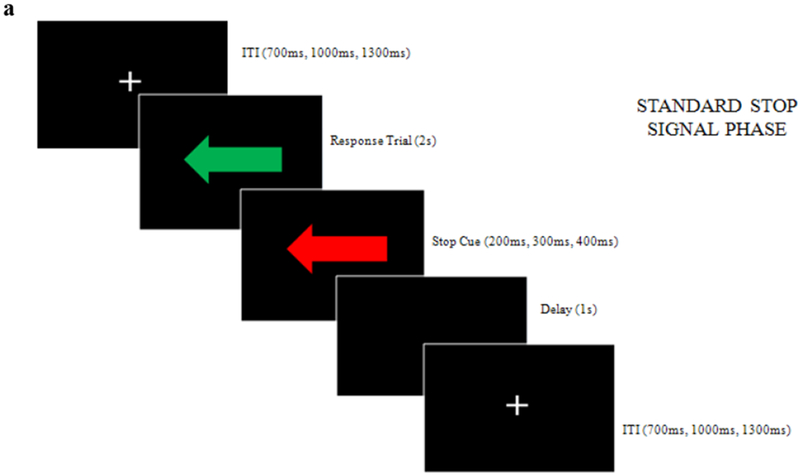
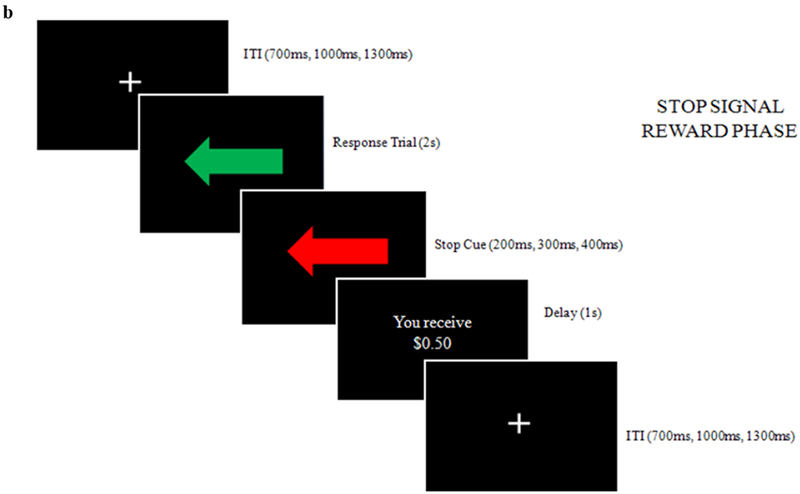
Sample of a stop trial in the standard stop signal phase of the task (a) and a stop trial of the stop signal reward phase (b) of the task.
In the second phase of the task (Figure 1b), participants received instructions that they would now have an opportunity to earn a monetary bonus of up to ten dollars based on their performance in the rest of the task. They were told that the bonus was based on both how quickly and accurately they responded on Go trials and how accurately they responded on stop trials. Instructions also indicated that if they responded too slowly or made too many mistakes on Go trials, then they may not receive a bonus even if they correctly stopped their response on stop trials. In reality, however, half of the Stop trials were accompanied by a reward of $0.50 for correct inhibition. The reward feedback was presented immediately before the ITI screen for 1 second. The probability of each trial being a Go trial was 75%, and the probability of a Stop trial was 25%. Stop signal reaction times (SSRTs) were measured for each phase separately. The SSRT measure provides an estimated duration of the time that it takes to inhibit this response such that longer SSRTs are indicative of worse inhibitory control. To compute SSRT, the integration approach was employed (Verbruggen and Logan, 2009). In this approach, the Go trial reaction times are rank ordered. Then the average unsuccessful stop trials, or errors, are multiplied by the number of Go trials. The rank ordered Go trial RT that corresponds to that value is the RT value.
2.3. Procedure
After providing informed consent, participants began the session with a 6-min assessment of EBR. Participants then completed demographics questionnaires (gender and age), the ESI-BF Disinhibition and Substance Abuse subscales, and then completed 12 (~75% Go trials, ~25% Stop trials) practice trials of the standard stop signal task. Participants completed 200 trials (~75% Go trials and ~25% Stop trials) of the standard stop signal phase and 200 trials of reward phase of the task (~75% Go trials and ~25% Stop trials). Upon completion of the study, participants received their monetary bonus and were debriefed about the nature of the study.
2.4. Data analysis
The independent variables were specified as Substance Use and EBR, and the dependent measures were specified as overall SSRT on the Unrewarded and Rewarded Phases of the Stop Signal Task. Given previous research showing associations with the predictor variables (e.g., Nederkoorn et al., 2009; Patrick et al., 2013), Disinhibition, Age, Gender, and Cigarette Smoking Status were included as covariates. In line with previous research using the ESI-BF and/or eyeblink rate as predictor variables (Byrne, Patrick, et al., 2016; Byrne et al., in press; Meehan et al., 2013; Nelson et al., 2016; Sellbom et al., 2016), we performed regression analyses to test our a priori hypotheses. Many taxometric analyses suggest that substance abuse and dependence can be conceptualized along dimensions of severity and allow for capturing greater variability in substance use symptoms than categorical approaches (e.g., Helzer et al., 2006; Krueger et al., 2004; Slade et al., 2009). By examining substance abuse on a continuum, rather than a taxonomy, we can better capture broad variability in substance abuse tendencies in our sample.
To test the prediction that substance abuse tendencies would be associated with poorer response inhibition on the standard Stop Signal Task, a hierarchical regression was conducted with the independent variables predicting Unrewarded Phase SSRT, controlling for the four covariate variables. We expected a main effect of Substance Use predicting Unrewarded SSRTs, indicative of poorer inhibitory control. Additionally, to assess the hypothesis that the effect of Substance Use on incentivized response inhibition would depend on variation in striatal dopamine, we conducted a regression analysis for Rewarded Phase SSRT controlling for Disinhibition, Age, Gender, and Cigarette Smoking Status2. We anticipated that a significant interaction between Substance Use and EBR would emerge. These data are available on the Open Science Framework (https://osf.io/rq98e/).
3. Results
3.1. Descriptive statistics
Individual EBRs ranged from 2.50 to 40.80 blinks/min (M = 14.73, SD = 8.52). Females (M = 16.11, SD = 9.06) displayed significantly higher EBR scores than males (M = 12.36, SD = 7.00), t(96) = 2.14, p = .04. Scores on the ESI-BF Disinhibition subscale ranged from 1 to 33 (M = 11.77, SD = 6.45), and the range of scores on the ESI-BF Substance Abuse subscale ranged from 0 to 51 (M= 16.54, SD = 13.45)3. Correlations between all variables are presented in Table 1.
Table 1.
Correlational Analyses.
| Substance Use | EBR | Disinhibition | |
|---|---|---|---|
| Substance Use | |||
| EBR | 0.02 | ||
| Disinhibition | 0.37** | 0.03 | |
| Stop Accuracy (Unrewarded) | −0.02 | −0.13 | −0.15 |
| SSRT (Unrewarded) | 0.15 | −0.10 | −0.05 |
| Stop Accuracy (Rewarded) | 0.07 | −0.09 | −0.23* |
| SSRT (Rewarded) | 0.22* | −0.12 | 0.04 |
Note.
indicates significance at the p < .05 level.
indicates significance at the p < .01 level.
3.2. Task comparison
Paired samples t-tests were conducted to compare response inhibition performance between the standard and rewarded phases of the Stop Signal Task. Results indicated that Stop trial accuracy was higher in the rewarded phase (M = .64, SD = .26) compared to the standard, unrewarded phase (M= .52, SD = .28), t(97) = −6.31, p <.001, d= .44. While there was a numerical trend for SSRTs in which performance in the rewarded phase was faster than in the unrewarded phase, no significant difference emerged, p = .18.
3.3. Regression analyses
3.3.1. Regression analysis for SSRT in the standard (unrewarded) Stop Signal Phase.
A hierarchical regression analysis was performed for SSRT in the unrewarded portion of the task. Disinhibition (p = .58), Age (p = .23), Gender (p = .12), and Cigarette Smoking Status (p = .91) were entered as covariates in the first step of the model but were nonsignificant. In the second step of the model, the first-order factors were entered. There was no significant effect of Substance Use (β = 0.15, p = .20) or EBR (β = −0.08, p = .46). The omnibus test was not significant at this step, p = .29. Similarly, when added in the last step of the model, the interaction term did not significantly influence SSRT, p = .71.
3.3.2. Regression analysis for rewarded phase SSRT.
An additional hierarchical regression was performed for SSRT in the rewarded phase. In the first step of the model, the covariates Disinhibition (p =.32), Age (p = .26), Gender (p = .27), Cigarette Smoking Status (p = .43), and unrewarded phase SSRT (β = 0.69, p <001) were added, R2 =.50, F(5, 92) = 18.21, p <.001. In the second step, the first-order terms were entered (Substance Use and EBR). However, neither of the first-order predictors (ps >.10) were significant, ΔR2 =.02, F(2, 90) = 1.60, p =.26. In the last step of the model, the EBR X Substance Use interaction was added, ΔR2 =.04, F(1, 90) = 7.61 , p <.01. At this step, the EBR X Substance Use interaction term (β = .49, p < 01) was a significant predictor of SSRT in rewarded phase.
Figure 2 shows simple regression lines for the effect of substance abuse scores on the SSRT difference measure at (a) the mean for striatal dopamine, (b) one standard deviation above the mean for striatal dopamine, and (c) one standard deviation below the mean for striatal dopamine. Striatal dopamine and substance abuse variables were centered prior to creating the centered interaction terms. The simple regression slope coefficients when centered at the mean (β = .10, p = .36) and at one standard deviation above the mean (β = −.08, p = .49) were not significant, but the simple regression slope coefficient centered at one standard deviation below the mean significantly predicted SSRT in the rewarded part of the stop signal task, β = .35, p < .01. At low levels of striatal dopamine, individuals with higher substance abuse tendencies had slower SSRTs in the rewarded part of the task. This result suggests that striatal tonic dopamine moderates the effect of substance abuse tendencies on incentivized inhibitory control. Specifically, individuals reporting high levels of substance use with low striatal tonic dopamine were slower, indicative of poorer cognitive control, in inhibiting their responses on Stop trials in the rewarded phase of the task.
Figure 2.
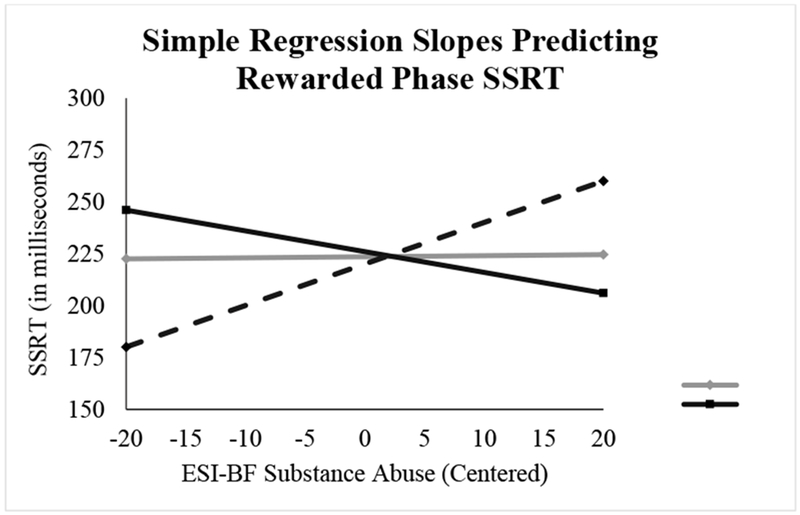
Simple regression slopes for the effect of substance abuse on stop signal reaction time (SSRT) in the rewarded phase of the Stop Signal Task.
4. Discussion
It was predicted that variation in striatal dopamine levels would differentially impact the role of substance use on incentivized response inhibition. This hypothesis was partially supported. The results revealed that individuals with high substance abuse tendencies and low striatal tonic dopamine showed deficits in SSRTs, and thus inhibitory control, in the rewarded phase of the task. Although it was also predicted that individuals with high substance abuse tendencies and high EBR would show enhanced response inhibition performance in the presence of rewards, this effect was not observed. Our findings show that the relationship between substance abuse tendencies and reward-based response inhibition is specific to individuals with low EBR.
Although previous research has found that substance abuse is associated with poorer response inhibition (e.g., Monterosso et al., 2005; Moreno et al., 2012; Rubio et al., 2008; Smith et al., 2014), our results showed a positive but ultimately nonsignificant relationship between substance abuse tendencies and response inhibition on the standard stop signal phase of the task. One potential explanation is that our study focused on problematic drug and alcohol use behaviors rather than clinical levels of drug addiction or dependence. Additionally, previous work demonstrates that heavy alcohol users exhibit better inhibitory control when a reward is provided for correct response cancellations compared to non-rewarded responses (Rossiter et al., 2012). Our results are consistent with this research, although we observe this effect only in individuals with high levels of substance abuse tendencies and low EBR levels. Thus, these results suggest the possibility that impaired response inhibition for unrewarded cues may be a consequence of general substance abuse tendencies rather than a predictor of it. In contrast, impaired response inhibition for rewarded cues specifically may represent a predictor of substance abuse problems, particularly in individuals with low striatal dopamine levels.
Our findings are in line with previous research showing that substance abuse tendencies lead to poorer reward-based outcomes in those with low levels of EBR (Byrne et al., 2016). The observation that this association is only found in individuals with lower striatal tonic dopamine levels offers unique insight into the relationship between substance abuse and dopaminergic functioning. Specifically, the negative relationship between substance abuse tendencies and incentivized response inhibition may be particularly robust in individuals with diminished striatal tonic dopamine. Rather than reward incentives improving cognitive control, as has been observed in healthy adults (Boehler et al., 2012; 2014; O’Connor et al., 2012), the presence of monetary rewards slowed performance in this group, resulting in slower response inhibition.
One explanation for these results is that in contexts when there is a competition between immediate rewards, such as the positive feelings drug use elicit, and inhibitory control, such as trying not to use drugs, these individuals with low EBR may have greater difficulty in inhibiting the urge or desire to use. Outside of reward contexts, individuals with substance abuse problems may not show substantial deficits in inhibitory control. However, in contexts where rewards (like drugs) are at stake, individuals with low tonic dopamine may be more motivated to attain the reward at the expense of inhibitory control processes. When rewards are provided for correct inhibition, this group may be more likely to risk a response time “cost” in an attempt to acquire a reward. Thus, the potential for reward may essentially “backfire” in this group: when there is a competition between reward and inhibitory control, dopamine involved in reward processing overrides inhibitory control mechanisms. One possible mechanism to account for this behavior is that the dopaminergic system becomes increasingly sensitized to reward cues as individuals transition into compulsive drug use (Robinson and Berridge, 1993). This dopaminergic sensitization may lead to heightened responses to reward cues, which may then account for the decreased inhibitory control in the presence of reward cues observed in this study. As a result, individuals with substance abuse tendencies and low dopamine may be less successful in attaining the rewards that motivate them and have greater difficulty in inhibiting their responses.
Alternatively, it is possible that substance users with low EBR showed deficits in the rewarded phase because they are hyposensitive to rewards; this possibility is consistent with the reward deficiency hypothesis, which proposes that diminished sensitivity to natural rewards can predispose individuals to engage in drug seeking behaviors (Blum et al., 1996). Molecular and genetics research shows that this blunted sensitivity is mediated by hypodopaminergic function and specifically a deficiency of D2 receptors (Comings and Blum, 2000). Drug users with low EBR, and consequently low dopamine, may be less motivated to attain monetary rewards. Thus, it is plausible that responses were slower because these individuals were either distracted by the possibility of reward or because they are hyposensitive to monetary rewards. Given the observed deficits in incentivized response inhibition for substance users with low dopamine, these results underscore the importance of future research aimed at increasing striatal dopamine function in individuals with substance abuse problems. Though speculative, such work may have implications for reducing risk for substance abuse problems or potentially reducing craving.
4.1. Limitations
In generalizing these results, it should be noted that the purpose of this study was primarily to examine individual differences in substance abuse tendencies in the general college-aged population and not to characterize individuals with Substance Use Disorders. It is possible that more advanced drug use trajectories, such as addiction or dependence, may be associated with different inhibitory control patterns than those observed in our college student sample. Additionally, spontaneous eyeblink rate has been characterized as an indirect physiological index of striatal tonic dopamine levels, and thus inferences should be made with caution. Finally, we did not control for sleep deprivation or recent use of substances or stimulants, which could alter blink rates. Furthermore, within our within-subjects design, all participants completed the standard, unrewarded phase of the Stop Signal Task first followed by the rewarded phase. One drawback of this design is that it is difficult to disentangle learning or order effects from the rewarded and unrewarded response inhibition results. Future work should consider examining how substance abuse influences learning of reward-dependent inhibition responses from unrewarded responses.
5. Conclusion
The findings of this study advance research on substance abuse by demonstrating that the presence of reward hinders response inhibition in individuals with substance abuse tendencies. Critically, however, this deficit in inhibitory control is specific to substance users with low eyeblink rate. The prospect of potential rewards obstructs the recruitment of effective inhibitory control resources, resulting in poorer response inhibition. Although substance abuse is often characterized by increased reward sensitivity and poorer response inhibition, providing rewards for good response inhibition performance appears to create a ‘catch-22’ situation. In individuals with substance abuse tendencies and low dopamine, the potential reward for correction response inhibition exerts the opposite of the desired effect, resulting in both diminished inhibitory control and decreased success in obtaining the sought-after rewards.
Supplementary Material
Highlights.
The role of drug use on rewarded and unrewarded response inhibition was tested.
The effect of spontaneous eyeblink rate (EBR) was also examined.
Results indicated an interaction between drug use and EBR on response inhibition.
Drug users with low EBR showed deficits in incentivized response inhibition.
Reward motivation hinders inhibitory control in drug users with low EBR.
Acknowledgements
We thank Sumedha Rao for her assistance with collecting data for this study.
Role of the Funding Source
This work was supported by NIA grant AG043425 to D.A.W.
Footnotes
Publisher's Disclaimer: This is a PDF file of an unedited manuscript that has been accepted for publication. As a service to our customers we are providing this early version of the manuscript. The manuscript will undergo copyediting, typesetting, and review of the resulting proof before it is published in its final citable form. Please note that during the production process errors may be discovered which could affect the content, and all legal disclaimers that apply to the journal pertain.
Conflict of Interest
No conflict declared.
Similar regression analyses were conducted with Stop trial accuracy as the outcome measure. However, no significant main effects for Substance Use or EBR or interactive effects were observed in either the unrewarded or rewarded phases.
We note that the distribution for the Substance Abuse scale data is positively skewed, as has been previously observed with college-aged sample populations (Byrne et al., 2016). However, when samples with scores more than 2.5 standard deviation units above the mean are excluded, the pattern of statistically significant results remains the same.
References
- Aichert DS, Wöstmann NM, Costa A, Macare C, Wenig JR, Möller HJ, Ettinger U, 2012. Associations between trait impulsivity and prepotent response inhibition. J. Clin. Exp. Neuropsychol 34, 1016–1032. [DOI] [PubMed] [Google Scholar]
- Barbato G, Ficca G, Muscettola G, Fichele M, Beatrice M, Rinaldi F, 2000. Diurnal variation in spontaneous eye-blink rate. Psychiatry Res. 93, 145–151. [DOI] [PubMed] [Google Scholar]
- Bechara A, 2005. Decision making, impulse control and loss of willpower to resist drugs: A neurocognitive perspective. Nat. Neurosci 8, 1458–1464. [DOI] [PubMed] [Google Scholar]
- Blum K, Cull JG, Braverman ER, Comings DE, 1996. Reward deficiency syndrome. Am. Sci 8, 132–145. [Google Scholar]
- Boehler CN, Hopf JM, Stoppel CM, Krebs RM, 2012. Motivating inhibition– Reward prospect speeds up response cancellation. Cognition 125, 498–503. [DOI] [PubMed] [Google Scholar]
- Boehler CN, Schevernels FL, Hopf JM, Stoppel CM, Krebs RM, 2014. Reward prospect rapidly speeds up response inhibition via reactive control. Cogn. Affect. Behav. Neurosci 14, 593–609. [DOI] [PubMed] [Google Scholar]
- Byrne KA, Norris DD, Worthy DA, 2016. Dopamine, depressive symptoms, and decision-making: The relationship between spontaneous eye blink rate and depressive symptoms predicts Iowa Gambling Task performance. Cogn. Affect. Behav. Neurosci 16, 23–36. [DOI] [PMC free article] [PubMed] [Google Scholar]
- Byrne KA, Otto AR, Pang B, Patrick CP, Worthy DA Substance use is associated with reduced devaluation sensitivity. Cogn. Affect. Behav. Neurosci [Epub ahead of print]. [DOI] [PMC free article] [PubMed] [Google Scholar]
- Byrne KA, Patrick CJ, Worthy DA, 2016. Striatal dopamine, externalizing proneness, and substance abuse: Effects on wanting and learning during reward-based decision making. Clin. Psychol. Sci 4, 760–774. [DOI] [PMC free article] [PubMed] [Google Scholar]
- Cavanagh JF, Masters SE, Bath K, Frank MJ, 2014. Conflict acts as an implicit cost in reinforcement learning. Nat. Commun 5, 5394. [DOI] [PubMed] [Google Scholar]
- Chambers CD, Garavan FL, Bellgrove MA, 2009. Insights into the neural basis of response inhibition from cognitive and clinical neuroscience. Neurosci. Biobehav. Rev 33, 631–646. [DOI] [PubMed] [Google Scholar]
- Charles-Walsh K, Upton DJ, Hester R, 2016. Examining the interaction between cognitive control and reward sensitivity in substance use dependence. Drug Alcohol Depend 166, 235–242. [DOI] [PubMed] [Google Scholar]
- Colzato LS, Slagter HA, van den Wildenberg WP, Hommel B, 2009. Closing one’s eyes to reality: Evidence for a dopaminergic basis of psychoticism from spontaneous eye blink rates. Pers. Individ. Dif 46, 377–380. [Google Scholar]
- Colzato LS, Van den Wildenberg WP, Hommel B, 2007. Impaired inhibitory control in recreational cocaine users. PLoS One 2, el143. [DOI] [PMC free article] [PubMed] [Google Scholar]
- Colzato LS, van den Wildenberg WP, Hommel B, 2008. Reduced spontaneous eye blink rates in recreational cocaine users: Evidence for dopaminergic hypoactivity. PLoS One 3, e3461. [DOI] [PMC free article] [PubMed] [Google Scholar]
- Comings DE, Blum K, 2000. Reward deficiency syndrome: Genetic aspects of behavioral disorders. Brain Res. 126, 325–341. [DOI] [PubMed] [Google Scholar]
- Dang LC, Samanez-Larkin GR, Castrellon JJ, Perkins SF, Cowan RL, Newhouse PA, Zald DH, 2017. Spontaneous eye blink rate (EBR) is uncorrelated with dopamine D2 receptor availability and unmodulated by dopamine agonism in healthy adults. eNeuro 4, ENEURO-0211. [DOI] [PMC free article] [PubMed] [Google Scholar]
- Doehring A, von Hentig N, Graff J, Salamat S, Schmidt M, Geisslinger G, Lötsch J, 2009. Genetic variants altering dopamine D2 receptor expression or function modulate the risk of opiate addiction and the dosage requirements of methadone substitution. Pharmacogenet. Genomics 19, 407–414. [DOI] [PubMed] [Google Scholar]
- Dreyer JK, Herrik KF, Berg RW, Hounsgaard JD, 2010. Influence of phasic and tonic dopamine release on receptor activation. J. Neurosci 30, 14273–14283. [DOI] [PMC free article] [PubMed] [Google Scholar]
- Eagle DM, Wong JC, Allan ME, Mar AC, Theobald DE, Robbins TW, 2011. Contrasting roles for dopamine D1 and D2 receptor subtypes in the dorsomedial striatum but not the nucleus accumbens core during behavioral inhibition in the stop-signal task in rats. J. Neurosci 31, 7349–7356. [DOI] [PMC free article] [PubMed] [Google Scholar]
- Elsworth JD, Lawrence MS, Roth RH, Taylor JR, Mailman RB, Nichols DE, Redmond DE, 1991. D1 and D2 dopamine receptors independently regulate spontaneous blink rate in the vervet monkey. J. Pharmacol. Exp. Ther 259, 595–600. [PubMed] [Google Scholar]
- Fairclough SH, Venables L, 2006. Prediction of subjective states from psychophysiology: A multivariate approach. Biol. Psychol 71, 100–110. [DOI] [PubMed] [Google Scholar]
- Feil J, Sheppard D, Fitzgerald PB, Yücel M, Lubman DI, Bradshaw JL, 2010. Addiction, compulsive drug seeking, and the role of frontostriatal mechanisms in regulating inhibitory control. Neurosci. Biobehav. Rev 35, 248–275. [DOI] [PubMed] [Google Scholar]
- Fellows LK, 2004. The cognitive neuroscience of human decision making: A review and conceptual framework. Behav. Cogn. Neurosci. Rev 3, 159–172. [DOI] [PubMed] [Google Scholar]
- Groman SM, James AS, Seu E, Tran S, Clark TA, Harpster SN, Elsworth JD, 2014. In the blink of an eye: Relating positive-feedback sensitivity to striatal dopamine D2-like receptors through blink rate. J. Neurosci 34, 14443–14454. [DOI] [PMC free article] [PubMed] [Google Scholar]
- Goldstein RZ, Volkow ND, 2002. Drug addiction and its underlying neurobiological basis: Neuroimaging evidence for the involvement of the frontal cortex. Am J. Psychiatry. 159, 1642–1652. [DOI] [PMC free article] [PubMed] [Google Scholar]
- Heitzeg MM, Cope LM, Martz ME, Hardee JE, 2015. Neuroimaging risk markers for substance abuse: Recent findings on inhibitory control and reward system functioning. Curr. Addict. Rep 2, 91–103. [DOI] [PMC free article] [PubMed] [Google Scholar]
- Helzer JE, Van Den Brink W, Guth SE, 2006. Should there be both categorical and dimensional criteria for the substance use disorders in DSM-V? Addiction 101, 17–22. [DOI] [PubMed] [Google Scholar]
- Hua JP, Kerns JG, 2018. Differentiating positive schizotypy and mania risk scales and their associations with spontaneous eye blink rate. Psychiatry Res. 264, 58–66. [DOI] [PubMed] [Google Scholar]
- Jongkees BJ, Colzato LS, 2016. Spontaneous eye blink rate as predictor of dopamine-related cognitive function—A review. Neurosci. Biobehav. Rev 71, 58–82. [DOI] [PubMed] [Google Scholar]
- Kaminer J, Powers AS, Horn KG, Hui C, Evinger C, 2011. Characterizing the spontaneous blink generator: An animal model. J. Neurosci 31,11256–11267. [DOI] [PMC free article] [PubMed] [Google Scholar]
- Karson CN, 1983. Spontaneous eye-blink rates and dopaminergic systems. Brain 106, 643–653. [DOI] [PubMed] [Google Scholar]
- Kim-Spoon J, Deater-Deckard K, Holmes C, Lee J, Chiu P, King-Casas B, 2016. Behavioral and neural inhibitory control moderates the effects of reward sensitivity on adolescent substance use. Neuropsychologia 91, 318–326. [DOI] [PMC free article] [PubMed] [Google Scholar]
- Korponay C, Dentico D, Krai T, Ly M, Kruis A, Goldman R, Davidson RJ, 2017. Neurobiological correlates of impulsivity in healthy adults: Lower prefrontal gray matter volume and spontaneous eye-blink rate but greater resting-state functional connectivity in basal ganglia-thalamo-cortical circuitry. NeuroImage 157, 288–296. [DOI] [PMC free article] [PubMed] [Google Scholar]
- Krueger RF, Markon KE, Patrick CJ, Benning SD, Kramer MD, 2007. Linking antisocial behavior, substance use, and personality: An integrative quantitative model of the adult externalizing spectrum. J. Abnorm. Psychol 116, 645–666. [DOI] [PMC free article] [PubMed] [Google Scholar]
- Krueger RF, Nichol PE, Hicks BM, Markon KE, Patrick CJ, McGue M, 2004. Using latent trait modeling to conceptualize an alcohol problems continuum. Psychol. Assess 16, 107–119. [DOI] [PubMed] [Google Scholar]
- Leyton M, Vezina P, 2013. Striatal ups and downs: Their roles in vulnerability to addictions in humans. Neurosci. Biobehav. Rev 37, 1999–2014. [DOI] [PMC free article] [PubMed] [Google Scholar]
- Li CSR, Milivojevic V, Kemp K, Hong K, Sinha R, 2006. Performance monitoring and stop signal inhibition in abstinent patients with cocaine dependence. Drug Alcohol Depend 85, 205–212. [DOI] [PubMed] [Google Scholar]
- Lijffijt M, Bekker EM, Quik EH, Bakker J, Kenemans JL, Verbaten MN, 2004. Differences between low and high trait impulsivity are not associated with differences in inhibitory motor control. J. Atten. Disord 8, 25–32. [DOI] [PubMed] [Google Scholar]
- Lipari RN, Jean-Francois B, 2016. A day in the life of college students aged 18 to 22: Substance use facts The CBHSQ report: May 26, 2016. Center for Behavioral Health Statistics and Quality, Substance Abuse and Mental Health Services Administration, Rockville, MD. [PubMed] [Google Scholar]
- Logan GD, Cowan WB, 1984. On the ability to inhibit thought and action: A theory of an act of control. Psychol. Rev 91, 295–327. [DOI] [PubMed] [Google Scholar]
- Logan GD, Schachar RJ, Tannock R, 1997. Impulsivity and inhibitory control. Psychol. Sci 8, 60–64. [Google Scholar]
- Mathar D, Wiehler A, Chakroun K, Goltz D, Peters J, 2018. A potential link between gambling addiction severity and central dopamine levels: Evidence from spontaneous eye blink rates. Sci. Rep 8, 13371. [DOI] [PMC free article] [PubMed] [Google Scholar]
- Meehan KB, De Panfilis C, Cain NM, Clarkin JF, 2013. Effortful control and externalizing problems in young adults. Pers. Individ. Dif 55, 553–558. [Google Scholar]
- Monterosso JR, Aron AR, Cordova X, Xu J, London ED, 2005. Deficits in response inhibition associated with chronic methamphetamine abuse. Drug Alcohol Depend 79, 273–277. [DOI] [PubMed] [Google Scholar]
- Moreno M, Estevez AF, Zaldivar F, Montes JMG, Gutiérrez-Ferre VE, Esteban L, Flores P, 2012. Impulsivity differences in recreational cannabis users and binge drinkers in a university population. Drug Alcohol Depend. 124, 355–362. [DOI] [PubMed] [Google Scholar]
- Nelson LD, Strickland C, Krueger RF, Arbisi PA, Patrick CJ, 2016. Neurobehavioral traits as transdiagnostic predictors of clinical problems. Assessment 23, 75–85. [DOI] [PMC free article] [PubMed] [Google Scholar]
- O’Connor DA, Rossiter S, Yücel M, Lubman DI, Hester R, 2012. Successful inhibitory control over an immediate reward is associated with attentional disengagement in visual processing areas. Neuroimage 62, 1841–1847. [DOI] [PubMed] [Google Scholar]
- Patrick CJ, Drislane LE, 2015. Triarchic model of psychopathy: Origins, operationalizations, and observed linkages with personality and general psychopathology. J. Pers 83, 627–643. [DOI] [PubMed] [Google Scholar]
- Patrick CJ, Kramer MD, Krueger RF, Markon KE, 2013. Optimizing efficiency of psychopathology assessment through quantitative modeling: Development of a brief form of the Externalizing Spectrum Inventory. Psychol. Assess 25, 1332–1348. [DOI] [PMC free article] [PubMed] [Google Scholar]
- Roberts W, Fillmore MT, Milich R, 2011. Linking impulsivity and inhibitory control using manual and oculomotor response inhibition tasks. Acta Psychologica 138, 419–428. [DOI] [PMC free article] [PubMed] [Google Scholar]
- Robinson TE, Berridge KC, 1993. The neural basis of drug craving: An incentive-sensitization theory of addiction. Brain Res. Rev. 18, 247–291. [DOI] [PubMed] [Google Scholar]
- Rossiter S, Thompson J, Hester R, 2012. Improving control over the impulse for reward: Sensitivity of harmful alcohol drinkers to delayed reward but not immediate punishment. Drug Alcohol Depend. 125, 89–94. [DOI] [PubMed] [Google Scholar]
- Rubio G, Jimenez M, Rodríguez-Jiménez R, Martínez I, Ávila C, Ferre F, Palomo T, 2008. The role of behavioral impulsivity in the development of alcohol dependence: A 4-year follow-up study. Alcohol. Clin. Exp. Res 32, 1681–1687. [DOI] [PubMed] [Google Scholar]
- Sellbom M, Donnelly KM, Rock RC, Phillips TR, Ben-Porath YS, 2017. Examining gender as moderating the association between psychopathy and substance abuse. Psychol. Crime Law 23, 376–390. [Google Scholar]
- Sescousse G, Ligneul R, van Holst RJ, Janssen LK, de Boer F, Janssen M, Cools R, 2017. Spontaneous eye blink rate and dopamine synthesis capacity: Preliminary evidence for an absence of positive correlation. Eur. J. Neurosci 47, 1081–1086. [DOI] [PMC free article] [PubMed] [Google Scholar]
- Slade T, Grove R, and Teesson M, 2009. A taxometric study of alcohol abuse and dependence in a general population sample: Evidence of dimensional latent structure and implications for DSM-V. Addiction 104, 742–751. [DOI] [PubMed] [Google Scholar]
- Slagter HA, Georgopoulou K, Frank MJ, 2015. Spontaneous eye blink rate predicts learning from negative, but not positive, outcomes. Neuropsychologia 71, 126–132. [DOI] [PubMed] [Google Scholar]
- Smith JL, Mattick RP, Jamadar SD, Iredale JM, 2014. Deficits in behavioural inhibition in substance abuse and addiction: A meta-analysis. Drug Alcohol Depend. 145, 1–33. [DOI] [PubMed] [Google Scholar]
- Taylor JR, Elsworth JD, Lawrence MS, Sladek JR Jr., Roth RH,Redmond DE Jr., 1999. Spontaneous blink rates correlate with dopamine levels in the caudate nucleus of MPTP-treated monkeys. Exp. Neurol 158, 214–220. [DOI] [PubMed] [Google Scholar]
- Verbruggen F, Logan GD, 2009. Models of response inhibition in the stop-signal and stop-change paradigms. Neurosci. Biobehav. Rev 33, 647–661. [DOI] [PMC free article] [PubMed] [Google Scholar]
- Volkow ND, Wang GJ, Begleiter H, Poijesz B, Fowler JS, Telang F, Alexoff D, 2006. High levels of dopamine D2 receptors in unaffected members of alcoholic families Possible protective factors. Arch. Gen. Psychiatry 63, 999–1008. [DOI] [PubMed] [Google Scholar]
- Volkow ND, Wang GJ, Fowler JS, Tomasi D, Telang F, 2011. Addiction: Beyond dopamine reward circuitry. Proc. Natl. Acad. Sci. U. S. A 108, 15037–15042. [DOI] [PMC free article] [PubMed] [Google Scholar]
- Wilbertz T, Deserno L, Horstmann A, Neumann J, Villringer A, Heinze HJ, Schlagenhauf F, 2014. Response inhibition and its relation to multidimensional impulsivity. Neuroimage 103, 241–248. [DOI] [PubMed] [Google Scholar]
Associated Data
This section collects any data citations, data availability statements, or supplementary materials included in this article.