



Abstract
Tonsillectomy is one of the commonly performed otolaryngological operations. Despite a range of different techniques post-operative pain remains a major side-effect of this operation. Coblation assisted tonsillectomy is a latest technique of tonsillectomy. This technique is said to be associated with less intra-operative bleeding and less postoperative morbidity. We conducted a study in 100 patients to compare the pain scores between coblation assisted and bipolar diathermy tonsillectomy by FLACC score and Wong Baker scale score. The data so collected was statistically analysed using a t test and p values were calculated. The p value was highly significant (p < 0.001) for both scores in coblation assisted tonsillectomy 6 h postoperatively and on 1st postoperative day (p < 0.05). On 7th post-operative day however there was no significant difference in post-operative pain score using FLACC score in both groups but Wong baker scale scores were still significant. We concluded that post-operative pain was less with coblator assisted tonsillectomy as compared to bipolar diathermy tonsillectomy at least in early post-operative period.
Keywords: Coblation, Tonsillectomy, Pain score
Introduction
Tonsillectomy remains one of the most common childhood surgeries with an increasing number of surgeries being done to treat obstructive sleep apnea or sleep disordered breathing and it remains most routinely performed surgical operation in recent years [1].
For more than a century, traditional dissection tonsillectomy has remained gold standard for tonsil removal [2]. The two most frequent post operative complication of tonsillectomy are bleeding and pain. This is the reason pioneers usually concentrate to decrease these two problems by comparing various techniques. With advent of noninflammable agents; monopolar and subsequently bipolar diathermy was introduced as a means of securing hemostasis after standard dissection technique and later on; were used in performing surgery itself. Although there is significantly less operative time and blood loss with Bipolar diathermy tonsillectomy but however no difference was found in postoperative morbidity when it was compared with standard dissection technique [3].
Coblation tonsillectomy is a new technique that involves passing radiofrequency energy through a conductive medium such as isotonic saline leading to the production of plasma field which causes low temperature molecular disintegration resulting in volumetric removal of tissue with minimal damage to adjacent tissue [4]. Coblation assisted tonsillectomy is gaining popularity based on reduced intraoperative blood loss and pain [5].
Present study was undertaken to compare postoperative pain between bipolar diathermy tonsillectomy and coblation assisted tonsillectomy.
Materials and Methods
Present study titled ‘Comparative post-operative pain analysis between coblator assisted and bipolar diathermy tonsillectomy’ is a prospective randomised controlled trial conducted in ENT department of a tertiary care centre from January 2017 to January 2018.
All the necessary ethical clearance points were discussed with ethical committee of the institution and ethical clearance was granted before initiation of recruitment of subjects. Thorough written informed consent was taken from the parents of patients in the language best understood by them. All measures of documentation were taken all for maintaining patient confidentiality.
Present study was a non funded study.
The study included 100 fully immunized patients of age group between 4 and 15 years from Out patient ENT department between January 2017 to January 2018 fulfilling the SIGN guidelines for tonsillectomy.
Patients were assigned to groups A and B, Group A as Bipolar diathermy tonsillectomy and Group B as Coblator Tonsillectomy. Random numbers were allotted to patients and were randomly allocated to two groups after informed consent for tonsillectomy. Patient demographics between group A and B group were comparable with no significant differences between groups.
Surgical team and technique for Coblation assisted and Bipolar diathermy tonsillectomy were kept same with special emphasis to keep wattage in both groups same (7 for ablation and 3 for coagulation in coblation group and 12 W)in bipolar group to reduce bias.
Inclusion criteria:
Paediatric patient (n = 100) between age group of 4–14 years were selected for tonsillectomy which were according to SIGN guidelines. The following are recommended as indications for consideration of tonsillectomy for recurrent acute sore throat in both children and adults:
Sore throats are due to acute tonsillitis.
The episodes of sore throat are disabling and prevent normal functioning.
7 or more well documented, clinically significant, adequately treated sore throats in the preceding year or 5 or more such episodes in each of the preceding 2 years or 3 or more such episodes in each of the preceding 3 years.
Exclusion criteria:
Bleeding and clotting disorders.
Syndromic children.
Patient with history of recent peritonsillar abscess.
Ongoing analgesia use for medical condition.
Preoperative work up: all patients underwent detailed documentation of relevant clinical history and clinical examination.
Haematological investigation included CBC; BT; CT; PTI and INR.
Radiological investigation included X-ray nasopharynx for adenoids and chest X-ray.
Pre-anaesthetic check-up was done in every case night before surgery with detailed anaesthesia and surgical written consent duly signed by parents.
Standard pre-operative antibiotic was administered according to antibiotic policy of our hospital night before surgery according to dose weight chart after test dose, no topical or local anaesthesia or other medication were administered before surgery. Anaesthetic approach was same for patients as follows: Induction was performed using intravenous Fentanyl, propofol 2 mg/kg and atracurium 0.5 mg/kg before intubation. Fentanyl boluses of 25 mcg were given when blood pressure and heart rate increased by 20% or more during surgery, following reversal in recovery status. After beginning of anaesthesia, the patients were allocated in each group by surgeon based on a randomly generated number sequence.
Surgery was either performed in the standard way using Coviden bipolar cautery with 12 w settings in group A and by Arthocare 2 assisted Evac 70 coblator wand with ablation 7 and coblation 3 settings in group B. Coblation device was made by arthocare company, Sunnyvale, CA, USA. Surgeon using coblation technique performed many coblation tonsillectomies prior to trial to eliminate a learning curve related bias.
Estimation of pain:
Post operative estimation was calculated by WONG BAKER and FLACC score.
Face 0 very happy no pain
Face 2 little pain
Face 4 hurts little more
Face 6 hurts even more
Face 8 hurts a wole lot
Face 10 as much as u can imagine
FLACC Score (face, legs, activity, cry, consolability)is scored on 0–2 scale.
| Criteria [1] | Score 0 | Score 1 | Score 2 |
|---|---|---|---|
| Face | No particular expression or smile | Occasional grimace or frown, withdrawn, uninterested | Frequent to constant quivering chin, clenched jaw |
| Legs | Normal position or relaxed | Uneasy, restless, tense | Kicking, or legs drawn up |
| Activity | Lying quietly, normal position, moves easily | Squirming, shifting, back and forth, tense | Arched, rigid or jerking |
| Cry | No cry (awake or asleep) | Moans or whimpers; occasional complaint | Crying steadily, screams or sobs, frequent complaints |
| Consolability | Content, relaxed | Reassured by occasional touching, hugging or being talked to, distractible | Difficult to console or comfort |
Pain scale was calculated and noted for post op 6 h after surgery.
1st post-operative day and 7th post-operative day by same assessor for both groups.
Data were entered into data base and analysed using SPSS software (SPSS, window, version 16). Standard student t test were used, mean values of pain score, standard deviation and p calculated to test the null hypothesis.
Results
The data so collected was tabulated and following results were obtained. Table 1 shows the age distribution of children in both the groups. Figures 1 and 2 shows the mean pain score values using FLACC score and Wong Baker pain scale scores. Table 2 shows the t values and p values.
Table 1.
Age distribution among bipolar diathermy and coblator assisted tonsillectomy group
| Age (years) | Group A | Group B |
|---|---|---|
| 0–03 | 0 | 0 |
| 03–06 | 14 | 10 |
| 06–09 | 30 | 24 |
| 09–12 | 4 | 14 |
| 12–14 | 2 | 2 |
Fig. 1.
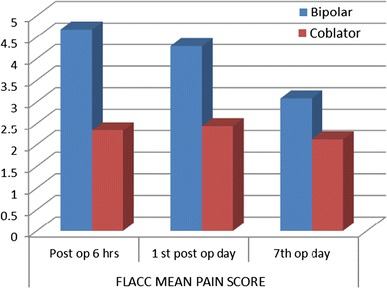
Mean FLACC score. Mean FLACC score 6 hours post-operatively was 2.34 ± 0.55 in Coblation assisted tonsillectomy group and 4.68±0.95 in Bipolar Diathermy tonsillectomy group. Mean FLACC score on 1st postoperative day was 2.44 ± 0.64 in Coblation assisted tonsillectomy group and 4.29 ± 0.96 in Bipolar Diathermy group . Mean FLACC score on 7th post operative day was 2.12 ± 0.38 in coblation assisted tonsillectomy group and 3.08±0.922 in Bipolar Diathermy group
Fig. 2.
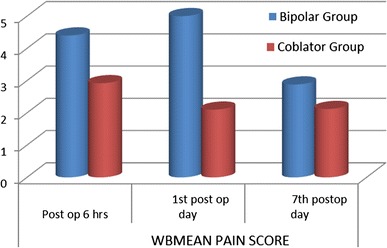
Mean Wong Baker pain scale score. Mean wong baker pain scale score for Post op 6 hours in coblation group is 2.92 ± 1.08 and bipolar group is 4.4 ± 0.83. Mean Wong baker pain scale score for 1stPost operative day in coblation group is 2.1 ± 0.45 and bipolar group is 5 ± 1.63. Mean Wong Baker pain scale score for 7th postoperative day in coblation group is 2.12 ± 0.479 and Bipolar group is 2.88 ± 1.002
Table 2.
T score and p value calculation
| T score | p value | |
|---|---|---|
| Comparison of flacc score in both groups using t test | ||
| 6 h post-operatively | 5.2415 | < 0.0001 |
| 1st day post-operative | 3.4543 | < 0.05 |
| 7th day post-operative | 8.6454 | 0.3894 |
| Comparison of Wong Baker pain scale score in both groups using t test | ||
| 6 h post-operatively | 5.453 | < 0.001 |
| 1st day post-operative | 2.4927 | < 0.05 |
| 7th day post-operative | 4.95 | < 0.001 |
Discussion
There are many studies comparing various parameters of tonsillectomy among cold steel and coblator tonsillectomy, however in present literature there are only few references available when it comes to question of comparing pain score among coblator tonsillectomy and bipolar tonsillectomy, in our present study we tried to overcome these questions by statistically comparing pain scores by standard FLACC score and WONG BAKER pain scale for coblator assisted tonsillectomy and bipolar diathermy tonsillectomy.
In our present study we found that both FLACC score and Wong Baker Score were significantly lower in coblator assisted tonsillectomy group 6 h post-operative and 1st post-operative day however there wasn’t much difference in both groups on 7th post-operative day.
However major limitation of study was that during standard randomization procedure there were patients who had adenoid hypertrophy in both groups and were treated by microdebrider, that was one of confounding factor during pain calculation, however by increasing sample size in both groups we tried to control confounding factor.
The strength of this study was standard randomization, a single surgical and post-operative team for both groups, well designed pain calculation method and statistically analysis.
Coblation is newly introduced technique of surgery and is based on non heat driven process of soft tissue dissolution which makes use of bipolar radiofrequency energy [5]. The energy is made to flow through conductive medium like normal saline; the plasma so formed breaks the molecular bonds within soft tissue and cause dissolution which is in contrast to the bipolar technique where heat is use tissue ablation and coagulation. There is marked of temperature between two groups coblation 40–70 °C compared to electrosurgical 400–600 °C [6].
Vaporization caused by coblator results in effective dissection and less post-operative pain from thermal injury [7, 8]
There are two of the main tools used for pain assessment for infants, child, and for group 3–18 years FLACC and WONG BAKER score. These reflect a combination of self-report and behavioural assessment [9].
In present study FLACC SCORE and WONG BAKER SCALE was significantly low in coblation arm 6 h postoperatively and 1st post-operative day. The mean FLACC score and WONG BAKER scale score was 2.34 ± 0.55 and 2.92 ± 1.08 in Group B respectively for 6 h post-operatively (Figs. 1, 2). The mean FLACC score and WONG BAKER scale score was 4.68 ± 0.95 and 4.4 ± 0.83 respectively in group A (Figs. 1, 2). The mean FLACC score for 1st postoperative day was 2.44 ± 0.64 and 4.29 ± 0.96 for groups B and A respectively (Fig. 1). The mean WONG BAKER scale score for 1st post-operative day for Group B and Group A were 2.1 ± 0.45 and 5 ± 1.63 respectively (Fig. 2).
However, the mean FLACC score on 7th post-operative day was 2.12 ± 0.38 and 3.08 ± 0.922 for groups B and A respectively (Fig. 1). The mean WONG BAKER scale score was 2.12 ± 0.479 and 2.88 ± 1.002 respectively for groups B and A on 7th post-operative day (Fig. 2).
Using standard t score; p value was calculated for both FLACC and WONG BAKER SCORE for 6 h postoperatively, 1st day postoperatively and 7th day for both arms.
p value was statistically highly significant < 0.0019 (Table 2) for coblator group at 6 h post operatively in both FLACC scores and WONG BAKER scale scores. The p value was significant for both pain scores again in Coblation assisted tonsillectomy. The p value for 7th postoperative day was significant for WONG BAKER Scale score (p < 0.0001) (Table 2) in coblation assisted tonsillectomy but however no significant difference was found for FLACC SCORE.
Mitic et al. compared the intraoperative and post-operative outcome of coblation assisted tonsillectomy and bipolar diathermy tonsillectomy in 40 patients and reported intraoperative blood loss and postoperative pain were significantly less in coblator tonsillectomy group and these patients returned quicker to normal diet than with bipolar group [10].
Singh et al. in their study of 60 patients undergoing tonsillectomy compared one tonsil removed by subcapsular radio frequency ablation method and other by bipolar method also reported that 77% patents with coblator reported less pain for over all 20 day recovery period [11].
Both these studies correlated with our study and findings.
Burton in a Cochrane review tilted “coblation versus other surgical techniques for tonsillectomy to assess effectiveness of coblation tonsillectomy compared with other surgical techniques in reducing morbidity” concluded there is adequate evidence in terms of reduced post operative pain in coblation assisted tonsillectomy [12].
Critical reason for above findings is that effect of plasma on tissue is mainly chemical and not thermal in coblation arm. Plasma generates H+ and OH −ions. It is these ions that make plasma destructive. OH− radical causes protein degradation and molecular disintegration leading to less trauma to tissue bed [13].
The significant advantage to coblation in postoperative period is less pain leading to an early return to daily activities; fewer secondary infections in tonsil bed and lesser incidence of delayed haemorrhage [14].
Though cost is a factor which limits use of coblation but considering the less intraoperative time and less post operative recovery we agree to many studies in literature that it is a cost effective procedure; still we always give our patients a choice as to which technique they prefer after explaining the benefits and cost involved [15].
Conclusion
Authors recommend as far as pain score analysis is concerned coblator is better tool for tonsillectomy than bipolar cautery on immediate post op period and on 1st day. However there is not much significance for method of tonsillectomy as far as pain score is concerned on 7th post op day. We recommend our peers to undertake similar studies so that a large multicentric data can be collected.
Contributor Information
Bhanu Bhardwaj, Email: entwithdrbhanu@gmail.com.
Jaskaran Singh, Email: jassigill001@gmail.com.
References
- 1.Lowe D, van der Meulen J, Cromwell D, Lewsey J, Copley L, Browne J, et al. Key messages from the national prospective tonsillectomy audit. Laryngoscope. 2007;117(4):717–724. doi: 10.1097/mlg.0b013e318031f0b0. [DOI] [PubMed] [Google Scholar]
- 2.Pinder DK, Wilson H, Hilton MP (2011) Dissection versus diathermy for tonsillectomy. Cochrane Database Sys Rev (3):CD002211. 10.1002/14651858.CD002211.pub2 [DOI] [PMC free article] [PubMed]
- 3.Hesham A. Bipolar diathermy versus cold dissection in paediatric tonsillectomy. Int J Paediatr Otorhinolaryngol. 2009;73:793–795. doi: 10.1016/j.ijporl.2008.09.026. [DOI] [PubMed] [Google Scholar]
- 4.Sergeev VN, Belov SV. Coblation technology: a new method for high-frequency electrosurgery. Springer Biomed Eng. 2003;37(1):22–25. doi: 10.1023/A:1023729611717. [DOI] [PubMed] [Google Scholar]
- 5.Nithya V, Dutta A, Sabari Girish K. A comparative study of coblation assisted adenotonsillectomy and cold dissection adenotonsillectomy in children. Int J Otorhinolaryngol Head Neck Surg. 2017;3:122–127. doi: 10.1016/S2095-8811(17)30076-8. [DOI] [Google Scholar]
- 6.Woloszko J, Gilbride C (2000) Coblation technology: plasma mediated ablation for otolaryngology applications. In: Proceedings of the SPIE, vol 3907, pp 306–316. 10.1117/12.386267
- 7.Balasubramanian (2014) Coblation tonsillectomy—our experience. Otolaryngology. ISSN:22500359.4(1.5). https://worldwidescience.org/topicpages/t/tonsillectomy. Accessed 3 May 2018
- 8.Temple RH, Timms MS. Paediatric coblation tonsillectomy. Int J Pediatr Otorhinolaryngol. 2001;61:195–198. doi: 10.1016/S0165-5876(01)00553-5. [DOI] [PubMed] [Google Scholar]
- 9.Timms MS, Temple RH. Coblation tonsillectomy: a double blind randomized controlled study. J Laryngolotol. 2002;116:450–452. doi: 10.1258/0022215021911031. [DOI] [PubMed] [Google Scholar]
- 10.The Royal Children’s Hospital Melbourne (2018) Clinical Guidelines (nursing). Pain Assess Meas. https://www.rch.org.au/rchcpg/hospital_clinical_guideline_index/Pain_Assessment_and_Measurement/. Accessed 3 May 2018
- 11.Mitic S, Tvinnereim M, Lie E, Saltyte BJ. A pilot randomized controlled trial of coblation tonsillectomy versus dissection tonsillectomy with bipolar diathermy haemostasis. Clin Otolaryngol. 2007;32:261–267. doi: 10.1111/j.1365-2273.2007.01468.x. [DOI] [PubMed] [Google Scholar]
- 12.Singh R, Anand TS, Garg P, Kulshreshtha P. A prospective, randomized, double-blind study of coblation versus dissection tonsillectomy in adult patients. Indian J Otolaryngol Head Neck Surg. 2012;64(3):290–294. doi: 10.1007/s12070-011-0361-0. [DOI] [PMC free article] [PubMed] [Google Scholar]
- 13.Burton MJ, Doree C (2007) Coblation versus other surgical techniques for tonsillectomy. Cochrane Database Syst Rev (3):CD004619. 10.1002/14651858.CD004619.pub2 [DOI] [PubMed]
- 14.Noordzji JP, Affleck BD. Coblation versus unipolar electrocautery tonsillectomy. Laryngoscope. 2006;116(8):1303–1309. doi: 10.1097/01.mlg.0000225944.00189.e9. [DOI] [PubMed] [Google Scholar]
- 15.Omrani M, Barati B, Omidifar N, Okhovvat A, Hashemi S. Coblation versus traditional tonsillectomy: a double blind randomized controlled trial. J Res Med Sci. 2012;17(1):45–50. [PMC free article] [PubMed] [Google Scholar]