



Abstract
There are substantial and persistent health disparities among Native Hawaiians that are best addressed through multilevel socio-ecological approaches, which are tailored to the needs of the community. Partnerships that link academic investigators with grass roots community members have the potential to profoundly reduce health disparities and improve health and wellness by increasing the capacity of community-based organizations to provide leadership in health advocacy, support community health promotion, and participate in health research. We describe a 14-year partnership to reduce Native Hawaiian health disparities between investigators from The Queen's Medical Center and University of Hawai‘i John A. Burns School of Medicine (QMC-JABSOM) and community members in Hana, a geographically isolated, underserved, rural community with the second largest concentration of Native Hawaiians in the state. Our relationship started as an investigator-initiated, National Institutes of Health-sponsored study to explore familial cardiomyopathy, and transitioned to a community-based project that combined community cardiovascular health screening fairs with a qualitative research study to understand attitudes towards genetic research. Most recently, QMC-JABSOM has partnered closely with Ma Ka Hana Ka ‘Ike, an award-winning construction skills training program for at-risk youth in Hana, to develop innovative, culturally based interventions to improve health and well-being among Native Hawaiians using principles of community-based participatory research.
Introduction
There are substantial and persistent health disparities among Native Hawaiians that are deeply imbedded in the social, political, and economic power inequities common to many indigenous peoples and their communities.1 Difficulties in reducing Native Hawaiian health disparities highlight the need for a multilevel socio-ecological approach that moves beyond reductionist, disease-based interventions to one that embraces ancestral ways of knowing and a broader sense of “self” and “community.”2–5
Hana is a small, rural, predominantly Native Hawaiian community on the island of Maui that is one of the most remote communities in Hawai‘i. Economically distressed, with over 30% of families living below the federal poverty level and nearly 80% of students eligible for school lunch assistance,6 Hana also has significant health disparities, including high rates of substance abuse, obesity, diabetes, and hypertension. Despite these inequities, Hana is resilient and navigating towards a place of health and wellbeing. In this article, we describe a 14-year collaborative journey between a team from The Queen's Medical Center and University of Hawai‘i John A. Burns School of Medicine (QMC-JABSOM) and community partners in Hana.
Phase 1: From Hospital to Community-based Research (2005–2011)
Introduction to Hana: Patterns of Heritable Cardiomyopathy (2005–2009)
In 2005, The Queen's Medical Center received a National Institutes of Health (NIH)—National Heart Lung and Blood Institute (NHLBI) funded grant to develop family trees of Native Hawaiians with heart failure to better understand patterns of heritable cardiomyopathy and lay the groundwork for future genetic analyses. We identified 45 probands from the hospital inpatient and outpatient services and created family trees that generally demonstrated sporadic or autosomal dominant patterns of inheritance.
In the course of our work, one family in Hana challenged us to do more. Mrs. Patsy Kaina had already recognized that heart failure and premature death extended across at least four generations of her family, and she shared their history and genealogy, first at an office visit, then at a family member's home on O‘ahu, and then during invited visits to her home in Hana. From the start, Mrs. Kaina recognized the benefits of a partnership, and moved us beyond the narrow focus of our study. As we constructed a family tree of more than 300 family members, we spoke with community members about the complexity and reality of delivering heart disease care and conducting research in Hana. These conversations addressed the need for cultural context and community ownership, how past harms influence current attitudes, and the need for mutual trust and respect.
Moving Forward: Heart Screening Program and Qualitative Research Study (2010–2011)
Recognizing the sensitivity about performing genetic research with Native Hawaiian communities,7–9 we conducted semi-structured interviews with families affected by heart failure during a community heart screening program that included blood pressure checks, EKGs, cardiac ultrasound, and individualized health education. More than 80 community members participated in these biannual screening events, which were coordinated by Mrs. Kaina and supported by a grant from the University of Hawai‘i Center for Native and Pacific Health Disparities Research. We found that the community was open to participating in genetic research if there was adequate trust, mutual benefit, and a key community voice.10
Phase 2: From Community-based to Community-based Participatory Research (CBPR) (2012–2013)
Hana Ulu Pono Project (2012–2013)
Encouraged by our community partners to move beyond health screening to test interventions that improve well-being, we followed CBPR principles to develop a culturally relevant, community-based program that built on the cultural wisdom and practices within Hana. With funding from the Office of Hawaiian Affairs (OHA) and matching funds from QMC, and with Dr. Seto and Mrs. Kaina as co-principal investigators, the Hana Ulu Pono Project recruited community members to participate in community-developed activities consistent with indigenous practices, including net fishing, lauhala (leaves of the hala tree) gathering and weaving for kupuna (elders), walking groups, gardening, and kalo (taro) farming. With community-members recruiting participants, running the activities, and tracking attendance, the QMC-JABSOM team developed individualized exercise prescriptions, led health education and screening events, and performed endpoint assessments, including measures of hypertension, diabetes, and obesity.
Hana Ulu Pono Project 2 (2013)
With the continued support of OHA and QMC, community partnerships were expanded to include Maui County Department of Parks and Recreation, the Hawai‘i State Department of Health, and local businesses to provide expanded programs for keiki (children), public health nurse visits for the home-bound, and water-based activities for kupuna. The unfortunate passing of Mrs. Kaina, our partner and key community voice, was a great loss for the community and a setback for our program.
Phase 3: Extending the Concept of Health with Ma Ka Hana Ka ‘Ike (2014–18)
Ma Ka Hana Ka ‘Ike Hana Ola Project (2014–18)
In January 2014, a new partnership was developed between QMC-JABSOM and Ma Ka Hana Ka ‘Ike (MKHKI) (“In working one learns”), an award-winning construction skills training program for at-risk youth based at Hana School. An important and trusted fixture in the Hana community for more than 14 years under the leadership of Mr. Rick Rutiz and his team, MKHKI's perspectives on building community resilience through education, mentoring, protecting natural resources, caring for the vulnerable, and honoring cultural practices made it a natural partner for efforts to improve the community's health.
The new partnership, called the MKHKI Hana Ola Project, was developed following the principles of CBPR. The project recruited Hana community members into two core activities that integrated physical activity, health education, and ancestral and cultural practices. The Youth Community Program engaged youth and young adults in a building skills program that included a focus on mentorship and community service. Completed projects included cottages for kupuna and home improvements that increased safety and access for people with disabilities (Figure 1). Additional activities for participants included hula and fishing. The Mahele Farm Program, based at a 10-acre farm that serves Hana as an educational, sustainable, and health food resource, offered participants nutrition education, hand-on experience with cooking and sustainable farming techniques, helping with the harvest, and sharing with the community (Figure 2). The addition of a satellite garden at Hana School allowed school-aged participants to more regularly participate in activities.
Figure 1.

MKHKI Youth: Building a kupuna cottage as community caretakers.
Figure 2.

Youth participants with Mahele Farm harvest.
In 2015, a third program, Malama Haloa, arose from MKHKI's expanded infrastructure and the community's overwhelming interest in the weekly ku‘i ‘ai (poi pounding). Under the direction on Mr. Viliami Tukuafu, the program included multiple components: (1) restoring and gaining stewardship of lo‘i kalo (wetland taro fields) in Wailua Nui; (2) malama ‘aina (caring for the land before planting); (3) learning Hawaiian chants, mo‘olelo (stories, myth, legends, history), values, and protocols associated with food and eating; (4) carving papa and pohaku (poi pounding boards and stones); (5) pounding kalo to make pa‘i ‘ai and poi (Figure 3); (6) workshops and weekly kalo subscription service for families; 7) classes and field trips for students; 8) mala kalo (dry-land kalo gardens) at Hana School and Mahele Farm (Figure 4).
Figure 3.
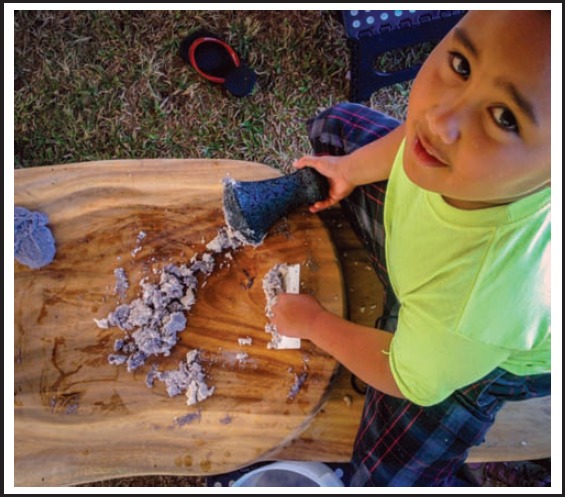
Keiki participant pounding poi.
Figure 4.

Talk story in the taro patch at Mahele Farm.
As part of Malama Haloa, we were awarded a pilot grant from the Mountain West CTR-IN to conduct a randomized controlled trial, Ke Ala Haloa: Reclaiming Cardiometabolic Health in Hana, which measured the impact of a Traditional Hawaiian Eating Pattern (THEP) on cardiometabolic risk factors and quality of life. The intervention and study protocol was developed by Mr. Tukuafu, who also oversaw recruitment and study implementation. The QMC-JABSOM team helped to design the study, select study endpoints, and perform endpoint assessments. During the 1-year study, we randomized 50 participants to THEP or their usual diet, and found that those on THEP had significantly lower rates of obesity and overweight, less sedentary time and more physical activity, with a trend towards less hypertension.11
Phase 4: Ho‘oma‘ama‘a a pa‘a i ka mana‘o (“Practice Until it is Firm in One's Thoughts”) (2019)
A new project currently under design builds on the infrastructure developed in Malama Haloa. Na ‘Umeke Piha Pono (“A Perfectly Full Bowl of Poi”) will provide families with weekly access to kalo, mea ku‘i, and mana to help participants fill their ‘umeke (a poi calabash) every week. In addition, all Hana High and Elementary School students will have the opportunity to participate in an annual 10-part Haloa-based educational program, which will promote mentorship opportunities in ku‘i ‘ai, mahi ‘ai kalo (farming kalo), ‘olelo Hawai‘i (the Hawaiian language), and community engagement. The Kumu Ku‘i (teacher) will allow students to have project-based activities that help them to learn in traditional ways alongside more modern methods. It is our hope that the Na ‘Umeke Piha Pono project will nurture and encourage a new generation of mahi ‘ai kalo practitioners through MKHKI-grounded partnerships that will provide intergenerational mentorship and apprenticeship opportunities.
Discussion
Efforts to reduce racial and ethnic health disparities often require a multilevel socio-ecological approach, particularly among indigenous and geographically isolated communities.1–6,12 The ongoing 14-year relationship between QMC-JABSOM and the community of Hana is a story of friendship, mutual trust, shared benefit, and continued learning. What started as an academic project to understand heart failure inheritance has evolved into a multilevel, community-embraced program to improve health and wellness that builds on the community's strength and resources, and embraces local traditions and ancestral ways of knowing.
Our experience is consistent with recommendations that the multi-level “upstream” changes needed to reduce health disparities require an increase in the capacity of community-based organizations to provide leadership in health advocacy, support community health promotion, and participate in community health research.1,4,5 In many ways, MKHKI was the ideal partner: The organization was trusted in the community, had developed an extensive network of partners, maintained strong administrative leadership and key community voices, cultivated a strong link to cultural practices, and fostered a spirit of innovation and creativity.
We encountered several challenges. First, while we have been fortunate to obtain support from the NIH, OHA, and QMC, it is increasingly difficult to secure extramural funding, particularly for CBPR studies that may take several years to develop.12 Second, we occasionally struggled to balance outcome measures that are meaningful to the community (eg, quality of life, engagement) and those that may be meaningful to grant funders and the scientific community (eg, HbA1c levels, inflammatory markers). Third, while we were able to successfully run a community-based randomized, controlled clinical trial, the burden on the community was tremendous as the constraints of randomization are essentially disconnected from the social fabric cohesiveness that is a core strength of this community. This means that implementing clinical research studies in the community setting will necessitate innovative, pragmatic designs.
In conclusion, through our partnership, we have developed the capacity to provide community-designed, culturally informed, and community-implemented interventions to reduce Native Hawaiian health disparities and improve health and well-being in Hana.
Acknowledgements
This project was supported, in part, by grants from the National Institutes of Health (NIH) National Institute on Minority Health and Health Disparities (U54MD007584) and National Heart Lung and Blood Institute (U01HL079152), and Office of Hawaiian Affairs. We thank Mr. Arthur Ushijima and The Queen's Medical Center for their support of the Hana community. Our work is dedicated to Mrs. Patsy Kaina, our original key voice in Hana.
Contributor Information
Tetine L Sentell, Office of Public Health Studies at the University of Hawai‘i at Manoa.
Lance K Ching, Hawai‘i Department of Health.
References
- 1.Iton AB. The ethics of the medical model in addressing the root causes of health disparities in local public health practice. J Public Health Manag Pract. 2008;14(4):335–339. doi: 10.1097/01.PHH.0000324560.42039.0e. [DOI] [PubMed] [Google Scholar]
- 2.Bertoni AG, Foy CG, Hunter JC, Quandt SA, Vitolins MZ, Whitt-Glover MC. A multilevel assessment of barriers to adoption of Dietary Approaches to Stop Hypertension (DASH) among African Americans of low socioeconomic status. J Health Care Poor Underserved. 2011;22(4):1205–1220. doi: 10.1353/hpu.2011.0142. [DOI] [PMC free article] [PubMed] [Google Scholar]
- 3.Boddington P, Räisänen U. Theoretical and Practical Issues in the Definition of Health: Insights from Aboriginal Australia. J Med Philos. 2009;34:49–67. doi: 10.1093/jmp/jhn035. [DOI] [PubMed] [Google Scholar]
- 4.Vallesi S, Wood L, Dimer L, Zada M. «In Their Own Voice»-Incorporating Underlying Social Determinants into Aboriginal Health Promotion Programs. Int J Environ Res Public Health. 2018;15(7):1514. doi: 10.3390/ijerph15071514. Published 2018 Jul 18. [DOI] [PMC free article] [PubMed] [Google Scholar]
- 5.Okihiro M, Sehgal V, Wilkinson T, Voloch KA, Enos R, O'Brien J. Addressing health disparities by building organizational capacity in the community: a case study of the Wai'anae Coast Comprehensive Health Center. Hawaii J Med Public Health. 2014;73(12 Suppl 3):34–39. [PMC free article] [PubMed] [Google Scholar]
- 6.Healthy Communities Institute, author. Maui County community health needs assessment. Honolulu, HI: Healthcare Association of Hawai‘i; 2015. [Google Scholar]
- 7.Singeo L. The patentability of the Native Hawaiian genome. Am J Law Med. 2007;33:119–139. doi: 10.1177/009885880703300104. [DOI] [PubMed] [Google Scholar]
- 8.Chang RM, Lowenthal PH. Genetic research and the vulnerability of Native Hawaiians. Pac Health Dialog. 2001;8:364–367. [PubMed] [Google Scholar]
- 9.Association of Hawaiian Civic Clubs, author. Resolution urging the University of Hawai‘i to cease development of the Hawaiian genome project or other patenting or licensing of Native Hawaiian genetic material until such time as the Native Hawaiian people have been consulted and given their full, prior and informed consent to such project. 2003. [cited 2013 Mar 3]. Available from: http://www.ipcb.org/pdf_files/hi_GenReso.pdf.
- 10.Vawer M, Kaina P, Leonard A, et al. Navigating the cultural geography of indigenous peoples> attitude toward genetic research: the Ohana (family) heart project. Int J Circumpolar Health. 2013;72 doi: 10.3402/ijch.v72i0.21346. Published 2013 Aug 5. doi:10.3402/ijch.v72i0.21346. [DOI] [PMC free article] [PubMed] [Google Scholar]
- 11.Tukuafu V, Sreejayan N, Seto TB. “Malama Haloa”; paper presented at the Mountain West Clinical and Translational Research Infrastructure Network 5th annual meeting; June 11–12, 2018. [Google Scholar]
- 12.Harris DA, Pensa MA, Redlich CA, Pisani MA, Rosenthal MS. Community-based participatory research is needed to address pulmonary health disparities. Annals ATS. 2016;13(8):1231–1238. doi: 10.1513/AnnalsATS.201601-054PS. [DOI] [PubMed] [Google Scholar]