



Abstract
Background
Previous studies have demonstrated a possible association between the induction of coenzyme Q10 (CoQ10) after statin treatment and statin‐induced myopathy. However, whether CoQ10 supplementation ameliorates statin‐induced myopathy remains unclear.
Methods and Results
PubMed, EMBASE, and Cochrane Library were searched to identify randomized controlled trials investigating the effect of CoQ10 on statin‐induced myopathy. We calculated the pooled weighted mean difference (WMD) using a fixed‐effect model and a random‐effect model to assess the effects of CoQ10 supplementation on statin‐associated muscle symptoms and plasma creatine kinase. The methodological quality of the studies was determined, according to the Cochrane Handbook. Publication bias was evaluated by a funnel plot, Egger regression test, and the Begg‐Mazumdar correlation test. Twelve randomized controlled trials with a total of 575 patients were enrolled; of them, 294 patients were in the CoQ10 supplementation group and 281 were in the placebo group. Compared with placebo, CoQ10 supplementation ameliorated statin‐associated muscle symptoms, such as muscle pain (WMD, −1.60; 95% confidence interval [CI], −1.75 to −1.44; P<0.001), muscle weakness (WMD, −2.28; 95% CI, −2.79 to −1.77; P=0.006), muscle cramp (WMD, −1.78; 95% CI, −2.31 to −1.24; P<0.001), and muscle tiredness (WMD, −1.75; 95% CI, −2.31 to −1.19; P<0.001), whereas no reduction in the plasma creatine kinase level was observed after CoQ10 supplementation (WMD, 0.09; 95% CI, −0.06 to 0.24; P=0.23).
Conclusions
CoQ10 supplementation ameliorated statin‐associated muscle symptoms, implying that CoQ10 supplementation may be a complementary approach to manage statin‐induced myopathy.
Keywords: coenzyme Q10, coronary disease, meta‐analysis, statin therapy, statin‐induced myopathy
Subject Categories: Coronary Artery Disease, Pharmacology, Treatment
Clinical Perspective
What Is New?
Coenzyme Q10 supplementation ameliorated statin‐associated muscle symptoms, such as muscle pain, muscle weakness, muscle cramps, and muscle tiredness, demonstrated by the present meta‐analysis.
What Are the Clinical Implications?
Coenzyme Q10 supplementation provided a complementary approach to statin‐associated muscle symptoms, which would be significant for the patients with cardiovascular diseases who are intolerant to statin treatment because of statin‐associated muscle symptoms.
Introduction
Statins are conventionally used to prevent and treat coronary heart disease with a good safety and well‐tolerated profile.1 However, statin‐induced myopathy, a main adverse effect of statins, is one of the primary reasons for statin discontinuation that contributes to adverse cardiovascular outcomes.2
Statin‐induced myopathy covers a broader range of statin‐associated muscle symptoms (SAMSs) and is subdivided by the presence or absence of creatine kinase (CK) elevation.3 Previous studies4, 5, 6 have demonstrated a reduction in coenzyme Q10 (CoQ10) after statin treatment, which might be associated with statin‐induced myopathy. However, whether CoQ10 supplementation ameliorates statin‐induced myopathy remains controversial. Some studies7, 8, 9, 10 have indicated that CoQ10 supplementation ameliorated statin‐induced myopathy. In contrast, other studies11, 12, 13, 14, 15 have suggested that there is no beneficial effect of CoQ10 supplementation. A previous meta‐analysis, performed by Banach et al,16 failed to validate the benefit of CoQ10 supplementation on statin‐induced myopathy, which did not include the latest published randomized controlled trials (RCTs)9, 10, 11, 14, 17 of CoQ10 supplementation. Therefore, the present meta‐analysis of RCTs was designed to reassess whether CoQ10 supplementation ameliorates statin‐induced myopathy.
Methods
The data, analytic methods, and study materials will not be made available to other researchers for purposes of reproducing the results or replicating the procedure because the present article is a systematic review and meta‐analysis; thus, the source data are available for consultation, reproduction, and analysis on web‐based medical libraries.
This study was performed according to the guidelines of the 2009 Preferred Reporting Items for Systematic Reviews and Meta‐Analysis statement.18
Data Source and Search Strategies
Two reviewers (H.Q. and M.G.) searched PubMed, EMBASE, and Cochrane Library with no language restrictions from inception to January 2018 to identify all existing literature. Medical subject headings terms and free‐text terms were used in each database with the following relevant keywords: “coenzyme Q10” and “statin” and “randomized controlled trials.” A manual search was also performed to identify relevant references from the selected articles and published reviews. The studies were eligible if they met the following inclusion criteria: (1) randomized, controlled, parallel, or crossover trial; (2) the intervention group received statin plus CoQ10, and the comparison group received statin plus placebo; and (3) the outcome involved in the severity of muscle symptoms or plasma CK was available.
Data Extraction and Assessment of Study Quality
Two reviewers (H.Q. and M.G.) extracted data independently. If a disagreement occurred between them, it was resolved by consulting with a third investigator (D.‐z.S.). We would contact the authors if the article was only published with abstracts, and the studies failing to obtain original data were excluded. The data were extracted from each individual eligible study as follows: (1) the first author's name and publication year; (2) intervention duration; (3) inclusion criteria; (4) patient number; (5) patients’ age; (6) percentage of men; and (7) clinical outcomes. The methodological quality of eligible studies was determined according to the recommendation of the Cochrane Handbook.19
Statistical Analysis
In this meta‐analysis, continuous data were used to analyze the weighted mean difference (WMD) with the effect size of the 95% confidence interval (CI). Heterogeneity in eligible studies was evaluated using the χ2 test on the basis of Cochran's Q test and I2 statistic at the P<0.10 level of significance, and quantification of heterogeneity was calculated using the I2 metric, which describes the percentage of total variation estimated to be attributable to heterogeneity rather than chance. When P for the heterogeneity is <0.1 and I2≥50%, the interstudy heterogeneity is considered to be statistically significant. The fixed‐effect model and random‐effect model were used in the meta‐analysis.20 We performed subgroup analysis and meta‐regression to detect the potential sources of heterogeneity in the condition of I2≥50%. Sensitivity analysis was performed to assess the robustness of the pooled WMDs by eliminating one study at a time. The meta‐regression, providing a linear regression using the random‐effects model, predicts the effect size from a predictor variable. Exp indicates the change in the average effect size associated with 1‐SD increase in the predictor, and the effect size of the 95% CI is presented. Adjusted R 2 explains the proportion of the predictor variable on between‐study variance. The publication bias was evaluated by funnel plot, Egger regression test, and the Begg‐Mazumdar correlation test. Statistical analysis was performed using Stata (version 12.0). There is no registered protocol for the present meta‐analysis.
Results
Description of Included Studies
A total of 868 studies (351 from PubMed, 404 from EMBASE, and 113 from the Cochrane Library) were identified; 231 articles were excluded as duplicated records. After the titles and abstracts of articles were screened, 586 were excluded because of review format, an improper study type, and/or improper comparisons. After the remaining 51 full‐text articles were reviewed, 39 were excluded because of improper comparisons, irrelevant outcomes, and/or unavailable outcomes. Finally, 12 articles7, 8, 9, 10, 11, 12, 13, 14, 15, 17, 21, 22 published in English from 2007 to 2017, with sample sizes ranging from 37 to 76 patients and intervention duration ranging from 30 days to 3 months, were entered into our meta‐analysis (Figure 1, Table). The effect of CoQ10 supplementation on SAMSs was evaluated in 9 RCTs,7, 8, 9, 10, 11, 12, 13, 14, 15 and plasma CK was evaluated in 10 RCTs.7, 8, 9, 10, 11, 12, 15, 17, 21, 22 The total number of patients was 575 (294 in the CoQ10 supplementation group and 281 in the placebo group).
Figure 1.
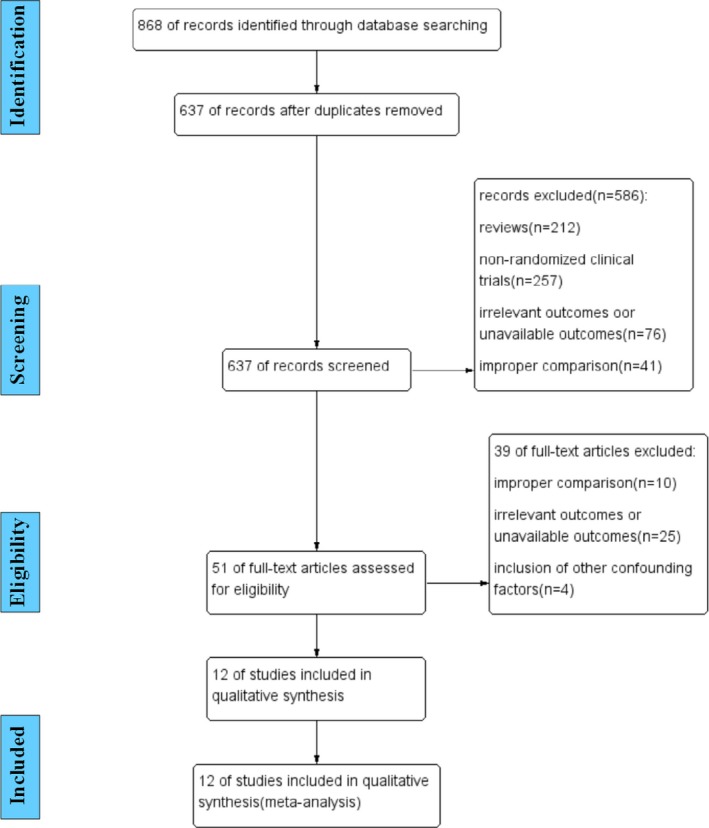
Literature search process and study selection.
Table 1.
Basic Characteristics of Patients
| Study | Duration | Inclusion Criteria | Patients (T/P) | Age, y | Men, % | Outcome | ||
|---|---|---|---|---|---|---|---|---|
| T | P | T | P | |||||
| Caso et al, 20077 | 30 d | Dyslipidemia treated with statin and reporting MSs | 32 (18/14) | 58±3 | 64±2 | 66.6 | 35.7 | Muscle pain (PSS, PIS), plasma CK concentrations |
| Fedacko et al, 20138 | 3 mo | Patients treated with statin and reporting MSs | 60 (34/26) | 59.6±8.9 | 55.4±12.4 | 54.5 | 36.8 | Muscle pain, muscle weakness, tiredness, muscle cramps (VAS score), plasma CK |
| Skarlovnik et al, 20149 | 30 d | Patients treated with statin and reporting MSs | 50 (25/25) | 64.5±1.9 | 65.6±2.1 | 44 | 48 | Muscle pain (PSS, PIS), plasma CK |
| Tóth et al, 201710 | 3 mo | Dyslipidemia treated with statin | 70 (35/35) | 58.4±13.8 | 61.96±12.2 | 51.4 | 48.6 | Muscle pain, muscle weakness, muscle cramps, and muscle fatigue (subject questionnaire), plasma CK concentrations |
| Taylor et al, 201511 | 8 wk | Dyslipidemia treated with statin and reporting MSs | 38 (20/18) | 58±10 | 60±10 | N | N | Muscle pain (PSS, PIS), plasma CK concentrations |
| Young et al, 200712 | 12 wk | Patients treated with simvastatin and reporting MSs | 44 (22/22) | 59±2 | 59±2 | 54.5 | 45.4 | Myalgia score, plasma CK, plasma CoQ10 concentrations |
| Bookstaver et al, 201213 | 3 mo | Patients treated with statin and reporting MSs | 76 (40/36) | 61.6 | 61.8 | 52.5 | 30.5 | Muscle pain (VAS score) |
| Rott et al, 201614 | 12 wk | Patients treated with statin and reporting MSs | 37 (17/20) | 61±18 | 57.4±11 | 64.7 | 70 | Muscle pain (VAS score) |
| Bogsrud et al, 201315 | 12 wk | Patients treated with atorvastatin and reporting MSs | 41 (20/21) | 58 (32, 73) | 58 (32, 73) | 42.8 | 45 | Muscle pain (VAS score), plasma CK concentrations |
| Pek et al, 201617 | 12 wk | Dyslipidemia treated with statin | 40 (20/20) | 43.1±11.3 | 49.2±12.2 | 90 | 80 | Plasma CK concentrations |
| Mabuchi et al, 200721 | 12 wk | Dyslipidemia treated with atorvastatin | 49 (24/25) | 61±8 | 60±8 | 25 | 32 | Plasma CK concentrations |
| Deichmann et al, 201322 | 6 wk | Athletes aged ≥50 years and taking statin | 38 (19/19) | 63.5±8.2 | 63.5±8.2 | 78.9 | 78.9 | Plasma CK concentrations |
CK indicates creatine kinase; CoQ10, coenzyme Q10; MS, muscle symptom; N, not mentioned; P, placebo group; PIS, pain interference score; PSS, pain severity score; T, CoQ10 supplementation group; VAS, visual analog scale.
Quality Assessment
“Low risk,” “high risk,” or “unclear risk” was categorized for all of the included 12 studies, according to 7 risk biases presented in sequence generation, allocation sequence concealment, blinding of patients and personnel, blinding of outcome assessment, incomplete outcome data, selective outcome reporting, and other potential sources of bias (Figure 2). Taken together, no obvious attrition bias or reporting bias was observed, and the randomization and blinding in the included studies were considered adequate in the meta‐analysis, according to the Cochrane Handbook.19
Figure 2.

Risk of bias summary.
Meta‐Analysis
Nine RCTs7, 8, 9, 10, 11, 12, 13, 14, 15 (222 patients in the CoQ10 supplementation group versus 211 patients in the placebo group) evaluated the effect of CoQ10 supplementation on SAMSs. Compared with the placebo, CoQ10 supplementation ameliorated muscle pain (WMD, −1.60; 95% CI, −1.75 to −1.44; P<0.001), muscle weakness (WMD, −2.28; 95% CI, −2.79 to −1.77; P=0.006), muscle cramps (WMD, −1.78; 95% CI, −2.31 to −1.24; P<0.001), and muscle tiredness (WMD, −1.75; 95% CI, −2.31 to −1.19; P<0.001) from the results of the fixed‐effect model (Figure 3). To ensure the reliability of the outcome, the analysis using a randomized effect model was also performed, and the results showed that CoQ10 supplementation ameliorated muscle pain (WMD, −1.46; 95% CI, −2.16 to −0.76; P<0.001) and muscle weakness (WMD, −2.54; 95% CI, −4.07 to −1.01; P=0.006) (Figure 4). A significant heterogeneity for the outcome of muscle pain was observed (I2=89.6%, P<0.001) (Figures 3 and 4), which had no obvious correlation with administration doses of CoQ10 (exp, 1.00; 95% CI, 0.99–1.01; adjusted R 2=−12.33%; P=0.79), CoQ10 supplementation time (exp, 1.04; 95% CI, 0.96–1.04; adjusted R 2=−23.96%; P=0.98), or year of publication (exp, 1.15; 95% CI, 0.85–1.55; adjusted R 2=2.57%; P=0.31) (Figure 5A through 5C).
Figure 3.

Forest plot for statin‐associated muscle symptoms: coenzyme Q10 vs placebo (fixed‐effect model). CI indicates confidence interval; ID, identification; WMD, weighted mean difference.
Figure 4.
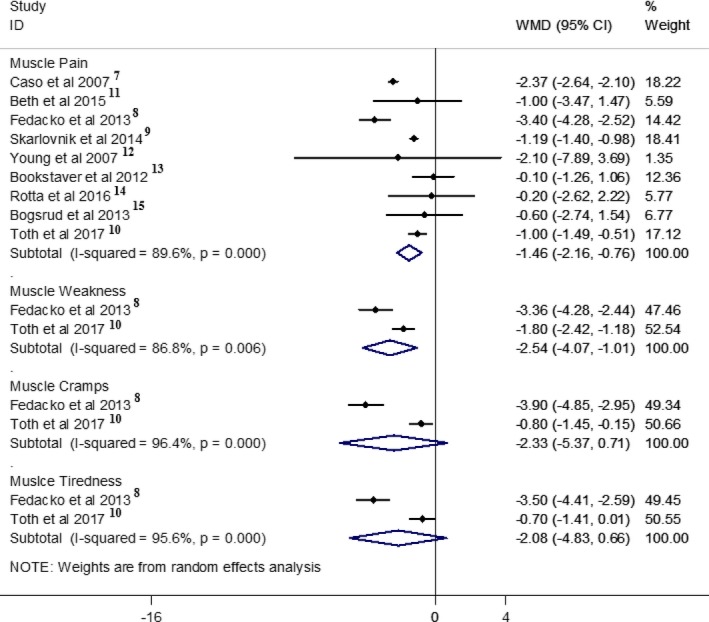
Forest plot for statin‐associated muscle symptoms: coenzyme Q10 vs placebo (random‐effect model). CI indicates confidence interval; ID, identification; WMD, weighted mean difference.
Figure 5.

Meta‐regression plot. A, Mean change in muscle pain score according to administration doses of coenzyme Q10 (CoQ10). B, Mean change in muscle pain score according to CoQ10 supplementation time. C, Mean change in muscle pain score according to year of publication. D, Mean change in plasma creatine kinase (CK) according to administration doses of CoQ10. E, Mean change in plasma CK level according to CoQ10 supplementation time. F, Mean change in plasma CK level according to year of publication.
Ten RCTs7, 8, 9, 10, 11, 12, 15, 17, 21, 22 (237 patients in the CoQ10 supplementation group versus 225 patients in the placebo group) evaluated the effect of CoQ10 supplementation on plasma CK. Compared with placebo, CoQ10 supplementation did not decrease the plasma CK (WMD, 0.09; 95% CI, −0.06 to 0.24; P=0.23), according to the result from the fixed‐effect model (Figure 6), which was consistent with the result from the random‐effect model (WMD, 0.03; 95% CI, −0.40 to 0.46; P=0.85) (Figure 7). There was no difference among regions on the outcome (Figures 8 and 9). A significant heterogeneity (I2=80.3%, P<0.001) (Figures 6 and 7) was observed in the included studies, which was independent of the administration doses of CoQ10 (exp, 0.99; 95% CI, 0.99–1.00; adjusted R 2=6.59%; P=0.45), CoQ10 supplementation time (exp, 0.99; 95% CI, 0.97–1.01; adjusted R 2=8.27%; P=0.30), and year of publication (exp, 0.95; 95% CI, 0.83–1.06; adjusted R 2=20.7%; P=0.24) (Figure 5D through 5F).
Figure 6.

Forest plot for plasma creatine kinase: coenzyme Q10 vs placebo (fixed‐effect model). CI indicates confidence interval; ID, identification; WMD, weighted mean difference.
Figure 7.

Forest plot for plasma creatine kinase: coenzyme Q10 vs placebo (random‐effect model). CI indicates confidence interval; ID, identification; WMD, weighted mean difference.
Figure 8.

Forest plot for plasma creatine kinase on the basis of region (fixed‐effect model). CI indicates confidence interval; ID, identification; WMD, weighted mean difference.
Figure 9.

Forest plot for plasma creatine kinase on the basis of region (random‐effect model). CI indicates confidence interval; ID, identification; WMD, weighted mean difference.
Sensitivity Analysis
To ensure the reliability of the present meta‐analysis, we performed sensitivity analysis to evaluate the robustness of the pooled WMDs by eliminating each study one at a time sequentially, which indicated that the heterogeneity among the studies did not change significantly for the effect of CoQ10 supplementation on SAMSs and on plasma CK.
Publication Bias
Three methods, including funnel plot, Egger regression test, and the Begg‐Mazumdar correlation test, were used to evaluate publication bias for the effect of CoQ10 on SAMSs, and no obvious publication bias was found (Begg‐Mazumdar correlation test, Kendall's score=−8, continuity‐corrected z=−0.83, continuity‐corrected P=0.47; Egger regression test, coefficient, 0.29; 95% CI, −3.41 to 3.99; P=0.86) (Figure 10A through 10C). For the effect of CoQ10 on plasma CK, there was also no evidence of publication bias according to the results of a funnel plot, the Begg‐Mazumdar correlation test (Kendall's score=13, continuity‐corrected z=1.16, continuity‐corrected P=0.28), and the Egger regression test (coefficient, −0.25; 95% CI, −3.24 to 2.73; P=0.85) (Figure 10D through 10F).
Figure 10.
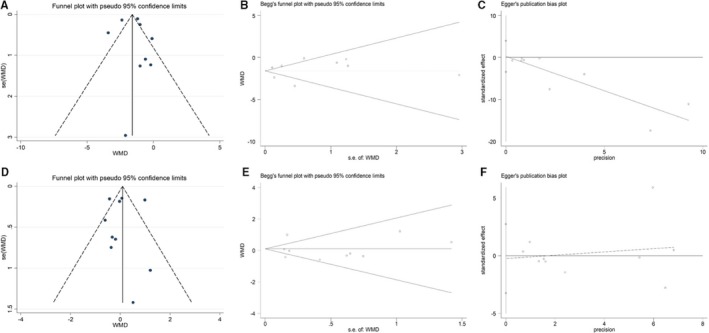
Publication bias. A, Funnel plot for muscle pain. B, Begg test for muscle pain. C, Egger test for muscle pain. D, Funnel plot for plasma creatine kinase (CK). E, Begg test for plasma CK. F, Egger test for plasma CK. WMD indicates weighted mean difference.
Discussion
In the meta‐analysis performed by Banach et al,16 only 6 studies with 302 patients were included, and no beneficial effect of CoQ10 supplementation on statin‐induced myopathy was documented, which might be attributed to the limited number of enrolled studies and their small sample sizes. In the present meta‐analysis, 6 newly published RCT studies were included, and the effect of CoQ10 supplementation on statin‐induced myopathy in 12 RCTs with 575 patients was comprehensively evaluated. In contrast to the previous meta‐analysis, the present study demonstrated that CoQ10 supplementation ameliorated SAMSs, such as muscle pain, muscle weakness, muscle cramps, and muscle tiredness, independent of administration doses of CoQ10 (100–600 mg/d) or CoQ10 supplementation time (30 days to 3 months).
Lowering low‐density lipoprotein cholesterol with statin therapy reduces cardiovascular disease risk by up to 40% in a wide range of patients. However, a high prevalence of statin‐induced myopathy reported from studies adversely affects the cardiovascular disease benefits of statins.23 The present study demonstrated that CoQ10 supplementation ameliorated SAMSs, indicating that CoQ10 supplementation might be a therapeutic approach for statin‐induced myopathy. The mechanism of statin‐induced myopathy is not yet clear, but one possible mechanism is mitochondrial dysfunction resulting from a reduction in circulating/intramuscular CoQ10.3, 4 The RCT results15, 17, 24, 25, 26, 27, 28 demonstrated that statins reduced circulating CoQ10 by 16% to 54%; a meta‐analysis6 of 6 RCTs also suggested a significant reduction in plasma CoQ10 after statin treatment, regardless of the statin solution, treatment duration, or treatment dose. For changes in intramuscular CoQ10, Choi et al documented that statins decreased CoQ10 levels in cardiac muscle and skeletal muscle.29, 30 The studies performed by Liu et al revealed that the reduction of circulating/intramuscular CoQ10 after statin treatment decreased the phosphorylation potential of adenosine diphosphate and the activity of mitochondrial complex I and IV, which contributes to mitochondrial dysfunction.31, 32, 33, 34 Recently, polymorphisms in the coenzyme Q2 gene, important in the synthesis of CoQ10, were reportedly strongly associated with statin‐induced myopathy.35, 36 Therefore, a deficiency of CoQ10 may be involved in statin‐induced myopathy, and CoQ10 supplementation might be an approach to ameliorate statin‐induced myopathy.
Compared with placebo, CoQ10 supplementation did not decrease plasma CK regardless of the administration doses of CoQ10 and the duration of CoQ10 supplementation, which was consistent with previous clinical studies and a meta‐analysis8, 10, 11, 16, 17 because of certain reasons. First, no clear correlation between plasma CK and statin‐induced myopathy has yet been demonstrated, indicating that plasma CK would not be regarded as a sensitive marker for statin‐induced myopathy.37, 38 Second, the baseline plasma CK levels in the enrolled studies could not be extracted from the included studies, so whether CoQ10 supplementation had a beneficial effect on plasma CK in the patients with CK elevation could not be evaluated. Third, the plasma CK level generally increased after membrane damage of muscle cells, such as rhabdomyolysis. There was no reduction of plasma CK after CoQ10 supplementation, suggesting that the effect of CoQ10 on statin‐induced myopathy might be attributed to maintaining mitochondrial function rather than protecting the membrane of muscle cells.3
There are several limitations in the present meta‐analysis. First, there were only few eligible RCTs, and most of them included relatively small populations; thus, the impact of the variables (eg, age, sex, and exercise) on the outcome could not be evaluated. Second, the eligible studies were heterogeneous because of the enrolled population characteristics and dose and duration of CoQ10 supplementation. However, we performed meta‐regression and sensitivity analysis to warrant the reliability of the present meta‐analysis.
Conclusion
CoQ10 supplementation ameliorated SAMSs, implying that CoQ10 supplementation might be a complementary approach to ameliorate statin‐induced myopathy.
Sources of Funding
This work was supported by the National Natural Science Foundation of China (no. 81030063), the National Sci‐Tech Support Plan of China (no. 2013BAI02B01), the Major National Research and Development Project of China (no. 2018ZX09201009‐002‐006), and the National Natural Science Foundation of China (no. 81303150).
Disclosures
The authors declare no competing interests.
(J Am Heart Assoc. 2018;7:e009835 DOI: 10.1161/JAHA.118.009835.)
Contributor Information
Zhu‐ye Gao, Email: zhuyegao@126.com
Da‐zhuo Shi, Email: shidztcm@163.com.
References
- 1. Reiner Z, Catapano AL, De Backer G, Graham I, Taskinen M‐R, Wiklund O, Agewall S, Alegria E, Chapman MJ, Durrington P, Erdine S, Halcox J, Hobbs R, Kjekshus J, Filardi PP, Riccardi G, Storey RF, Wood D, ESC Committee for Practice Guidelines (CPG) 2008‐2010 and 2010‐2012 Committees . ESC/EAS guidelines for the management of dyslipidaemias: the Task Force for the management of dyslipidaemias of the European Society of Cardiology (ESC) and the European Atherosclerosis Society (EAS). Eur Heart J. 2011;32:1769–1818. [DOI] [PubMed] [Google Scholar]
- 2. Law M, Rudnicka AR. Statin safety: a systematic review. Am J Cardiol. 2006;97:S52–S60. [DOI] [PubMed] [Google Scholar]
- 3. Stroes ES, Thompson PD, Corsini A, Vladutiu GD, Raal FJ, Ray KK, Roden M, Stein E, Tokgozo lu L, Nordestgaard BG, Bruckert E, De Backer G, Krauss RM, Laufs U, Santos RD, Hegele RA, Hovingh GK, Leiter LA, Mach F, Marz W, Newman CB, Wiklund O, Jacobson TA, Catapano AL, Chapman MJ, Ginsberg HN; European Atherosclerosis Society Consensus , Stroes E, Thompson PD, Corsini A, Vladutiu GD, Raal FJ, Ray KK, Roden M, Stein E, Tokgozo lu L, Nordestgaard BG, Bruckert E, Krauss RM, Laufs U, Santos RD, Marz W, Newman CB, John Chapman M, Ginsberg HN, John Chapman M, Ginsberg HN, de Backer G, Catapano AL, Hegele RA, Kees Hovingh G, Jacobson TA, Leiter L, Mach F, Wiklund O. Statin‐associated muscle symptoms: impact on statin therapy—European Atherosclerosis Society Consensus Panel Statement on Assessment, Aetiology and Management. Eur Heart J. 2015;36:1012–1022. [DOI] [PMC free article] [PubMed] [Google Scholar]
- 4. Marcoff L, Thompson PD. The role of coenzyme Q10 in statin‐associated myopathy: a systematic review. J Am Coll Cardiol. 2007;49:2231–2237. [DOI] [PubMed] [Google Scholar]
- 5. Langsjoen PH, Langsjoen AM. The clinical use of HMG CoA‐reductase inhibitors and the associated depletion of coenzyme Q10: a review of animal and human publications. Biofactors. 2003;18:101–111. [DOI] [PubMed] [Google Scholar]
- 6. Banach M, Serban C, Ursoniu S, Rysz J, Muntner P, Toth PP, Jones SR, Rizzo M, Glasser SP, Watts GF, Blumenthal RS, Lip GY, Mikhailidis DP, Sahebkar A. Statin therapy and plasma coenzyme Q10 concentrations: a systematic review and meta‐analysis of placebo‐controlled trials. Pharmacol Res. 2015;99:329–336. [DOI] [PubMed] [Google Scholar]
- 7. Caso G, Kelly P, McNurlan MA, Lawson WE. Effect of coenzyme Q10 on myopathic symptoms in patients treated with statins. Am J Cardiol. 2007;99:1409–1412. [DOI] [PubMed] [Google Scholar]
- 8. Fedacko J, Pella D, Fedackova P, Hänninen O, Tuomainen P, Jarcuska P, Lopuchovsky T, Jedlickova L, Merkovska L, Littarru GP. Coenzyme Q10 and selenium in statin‐associated myopathy treatment. Can J Physiol Pharmacol. 2013;91:165–170. [DOI] [PubMed] [Google Scholar]
- 9. Skarlovnik A, Janić M, Lunder M, Turk M, Šabovič M. Coenzyme Q10 supplementation decreases statin‐related mild‐to‐moderate muscle symptoms: a randomized clinical study. Med Sci Monit. 2014;20:2183–2188. [DOI] [PMC free article] [PubMed] [Google Scholar]
- 10. Tóth Š, Šajty M, Pekárová T, Mughees A, Štefanič P, Katz M, Spišáková K, Pella J, Pella D. Addition of omega‐3 fatty acid and coenzyme Q10 to statin therapy in patients with combined dyslipidemia. J Basic Clin Physiol Pharmacol. 2017;28:327–336. [DOI] [PubMed] [Google Scholar]
- 11. Taylor BA, Lorson L, White CM, Thompson PD. A randomized trial of coenzyme Q10 in patients with confirmed statin myopathy. Atherosclerosis. 2015;238:329–335. [DOI] [PMC free article] [PubMed] [Google Scholar]
- 12. Young JM, Florkowski CM, Molyneux SL, McEwan RG, Frampton CM, George PM, Scott RS. Effect of coenzyme Q10 supplementation on simvastatin‐induced myalgia. Am J Cardiol. 2007;100:1400–1403. [DOI] [PubMed] [Google Scholar]
- 13. Bookstaver DA, Burkhalter NA, Hatzigeorgiou C. Effect of coenzyme Q10 supplementation on statin‐induced myalgias. Am J Cardiol. 2012;110:526–529. [DOI] [PubMed] [Google Scholar]
- 14. Rott D, Leibowitz D, Goldenberg I, Klempfner R. Effect of coenzyme Q 10 supplementation on statin‐induced myalgia, a randomized double‐blind, placebo‐controlled study. J Prev Med Care. 2016;1:16–22. [Google Scholar]
- 15. Bogsrud MP, Langslet G, Ose L, Arnesen KE, Sm Stuen MC, Malt UF, Woldseth B, Retterstol K. No effect of combined coenzyme Q10 and selenium supplementation on atorvastatin‐induced myopathy. Scand Cardiovasc J. 2013;47:80–87. [DOI] [PubMed] [Google Scholar]
- 16. Banach M, Serban C, Sahebkar A, Ursoniu S, Rysz J, Muntner P, Toth PP, Jones SR, Rizzo M, Glasser SP, Lip GY, Dragan S, Mikhailidis DP. Effects of coenzyme Q10 on statin‐induced myopathy: a meta‐analysis of randomized controlled trials. Mayo Clin Proc. 2015;90:24–34. [DOI] [PubMed] [Google Scholar]
- 17. Pek SLT, Tavintharan S, Woon K, Lin L, Ong CN, Lim SC, Sum CF. MicroRNAs as biomarkers of hepatotoxicity in a randomized placebo‐controlled study of simvastatin and ubiquinol supplementation. Exp Biol Med. 2016;241:317–330. [DOI] [PMC free article] [PubMed] [Google Scholar]
- 18. Moher D, Liberati A, Tetzlaff J, Altman DG. Preferred reporting items for systematic reviews and meta‐analyses: the PRISMA statement. PLoS Med. 2009;6:e1000097. [DOI] [PMC free article] [PubMed] [Google Scholar]
- 19. Higgins JPT, Altman DG, Gøtzsche PC, Jüni P, Moher D, Oxman AD, Savović J, Schulz KF, Weeks L, Sterne JAC. The Cochrane Collaboration's tool for assessing risk of bias in randomised trials. BMJ. 2011;343:d5928. [DOI] [PMC free article] [PubMed] [Google Scholar]
- 20. Rice K, Higgins JPT, Lumley T. A re‐evaluation of fixed effect(s) meta‐analysis. J R Stat Soc Ser A Stat Soc. 2018;181:205–227. [Google Scholar]
- 21. Mabuchi H, Nohara A, Kobayashi J, Kawashiri MA, Katsuda S, Inazu A, Koizumi J. Effects of CoQ10 supplementation on plasma lipoprotein lipid, CoQ10 and liver and muscle enzyme levels in hypercholesterolemic patients treated with atorvastatin: a randomized double‐blind study. Atherosclerosis. 2007;195:182–189. [DOI] [PubMed] [Google Scholar]
- 22. Deichmann RE, Lavie CJ, Dornelles AC. Impact of coenzyme Q‐10 on parameters of cardiorespiratory fitness and muscle performance in older athletes taking statins. Phys Sportsmed. 2013;40:88–95. [DOI] [PubMed] [Google Scholar]
- 23. Nanna MG, Navar AM, Wang TY, Mi X, Virani SS, Louie MJ, Lee LV, Goldberg AC, Roger VL, Robinson J, Peterson ED. Statin use and adverse effects among adults >75 years of age: insights from the patient and provider assessment of lipid management (PALM) registry. J Am Heart Assoc. 2018;7:e008546 DOI: 10.1161/JAHA.118.008546. [DOI] [PMC free article] [PubMed] [Google Scholar]
- 24. Ashton E, Windebank E, Skiba M, Reid C, Schneider H, Rosenfeldt F, Tonkin A, Krum H. Why did high‐dose rosuvastatin not improve cardiac remodeling in chronic heart failure? Mechanistic insights from the UNIVERSE study. Int J Cardiol. 2011;146:404–407. [DOI] [PubMed] [Google Scholar]
- 25. Berthold HK, Naini A, Di Mauro S, Hallikainen M, Gylling H, Krone W, Gouni‐Berthold I. Effect of ezetimibe and/or simvastatin on coenzyme Q10 levels in plasma: a randomised trial. Drug Saf. 2006;29:703–712. [DOI] [PubMed] [Google Scholar]
- 26. McMurray JJ, Dunselman P, Wedel H, Cleland JG, Lindberg M, Hjalmarson A, Kjekshus J, Waagstein F, Apetrei E, Barrios V, Böhm M, Kamenský G, Komajda M, Mareev V, Wikstrand J. Coenzyme Q10, rosuvastatin, and clinical outcomes in heart failure: a pre‐specified substudy of CORONA (Controlled Rosuvastatin Multinational Study in Heart Failure). J Am Coll Cardiol. 2010;56:1196–1204. [DOI] [PubMed] [Google Scholar]
- 27. Päivä H, Thelen KM, Van Coster R, Smet J, De Paepe B, Mattila KM, Laakso J, Lehtimäki T, Von Bergmann K, Lütjohann D, Laaksonen R. High‐dose statins and skeletal muscle metabolism in humans: a randomized, controlled trial. Clin Pharmacol Ther. 2005;78:60–68. [DOI] [PubMed] [Google Scholar]
- 28. Lee B, Tseng Y, Yen C, Lin P. Effects of coenzyme Q10 supplementation (300 mg/day) on antioxidation and anti‐inflammation in coronary artery disease patients during statins therapy: a randomized, placebo‐controlled trial. Nutr J. 2013;12:1. [DOI] [PMC free article] [PubMed] [Google Scholar]
- 29. Choi H‐K, Won E‐K, Choung S‐Y. Effect of coenzyme Q10 supplementation in statin‐treated obese rats. Biomol Ther (Seoul). 2016;24:171–177. [DOI] [PMC free article] [PubMed] [Google Scholar]
- 30. Pasha R, Moon TW. Coenzyme Q10 protects against statin‐induced myotoxicity in zebrafish larvae (Danio rerio). Environ Toxicol Pharmacol. 2017;52:150–160. [DOI] [PubMed] [Google Scholar]
- 31. Choi SY, Park JS, Roh MS, Kim C‐R, Kim MH, Serebruany V. Inhibition of angiotensin II‐induced cardiac fibrosis by atorvastatin in adiponectin knockout mice. Lipids. 2017;52:415–422. [DOI] [PubMed] [Google Scholar]
- 32. Liu C‐W, Yang F, Cheng S‐Z, Liu Y, Wan L‐H, Cong H‐L. Rosuvastatin postconditioning protects isolated hearts against ischemia‐reperfusion injury: the role of radical oxygen species, PI3K‐Akt‐GSK‐3β pathway, and mitochondrial permeability transition pore. Cardiovasc Ther. 2017;35:3–9. [DOI] [PubMed] [Google Scholar]
- 33. Mikashinovich ZI, Belousova ES, Sarkisyan OG. Impairment of energy‐dependent processes in the muscle tissue as a pathogenetic mechanism of statin‐induced myopathy. Bull Exp Biol Med. 2017;162:433–435. [DOI] [PubMed] [Google Scholar]
- 34. Almukhtar H, Garle MJ, Smith PA, Roberts RE. Effect of simvastatin on vascular tone in porcine coronary artery: potential role of the mitochondria. Toxicol Appl Pharmacol. 2016;305:176–185. [DOI] [PubMed] [Google Scholar]
- 35. Stránecký V, Neřoldová M, Hodaňová K, Hartmannová H, Piherová L, Zemánková P, Přistoupilová A, Vrablík M, Adámková V, Kmoch S, Jirsa M. Large copy‐number variations in patients with statin‐associated myopathy affecting statin myopathy‐related loci. Physiol Res. 2016;65:1005–1011. [DOI] [PubMed] [Google Scholar]
- 36. Needham M, Mastaglia FL. Statin myotoxicity: a review of genetic susceptibility factors. Neuromuscul Disord. 2014;24:4–15. [DOI] [PubMed] [Google Scholar]
- 37. Toma E, Loignon M. Statin‐associated myopathy with normal creatine kinase levels. Ann Intern Med. 2003;138:1007–1008; author reply 1008‐1009. [DOI] [PubMed] [Google Scholar]
- 38. Mohaupt MG, Karas RH, Babiychuk EB, Sanchez‐Freire V, Monastyrskaya K, Iyer L, Hoppeler H, Breil F, Draeger A. Association between statin‐associated myopathy and skeletal muscle damage. Can Med Assoc J. 2009;181:E11–E18. [DOI] [PMC free article] [PubMed] [Google Scholar]