



Abstract
Few studies correlate anatomical parameters of the transected pancreatic neck to occurrence of the dangerous complication—post Whipple’s pancreaticoduodenectomy pancreatic fistula. To evaluate the correlation between anatomical details of the transected neck of the pancreas and post-operative pancreatic fistula (POPF) following Whipple’s pancreaticoduodenectomy. Observational study. The study included 66 patients undergoing Whipple’s pancreaticoduodenectomy with pancreaticojejunostomy at tertiary care centre between December 2009 and December 2014. Student’s t test, Fisher’s exact test, Pearson’s chi-squared test and forward stepwise. Clinically relevant POPF (grade B and C) was noted in 12 patients. Morbidity/mortality was 30.30% and 4.54% respectively. Among the fistula v/s no fistula groups, (a) mean thickness of the pancreatic stump was 12.17 ± 1.40 mm v/s 14.94 ± 1.87 mm (P = 0.000), (b) mean width of the pancreatic stump was 24.33 ± 4.14 mm v/s 25.87 ± 4.02 mm (P = 0.238) and (c) mean pancreatic duct (PD) diameter was 2.92 ± 0.79 mm v/s 4.27 ± 1.39 mm (P = 0.001). Mean distances of PD from anterior, posterior, superior and inferior pancreatic borders in the fistula group v/s no fistula group were 6.08 ± 1.62 mm, 3.17 ± 0.72 mm, 9.92 ± 2.15 mm, and 11.42 ± 3.45 mm v/s 5.93 ± 1.71 mm, 4.83 ± 1.26 mm, 11.83 ± 2.79 mm and 9.96 ± 3.25 mm respectively. Eleven of 38 patients (28.9%) with soft pancreas developed POPF. Pancreatic duct < 3 mm diameter, < 3 mm from posterior border, < 12 mm from superior border, pancreatic neck thickness < 12 mm and soft pancreas consistency were significantly associated with POPF.
Keywords: Pancreatic fistula, Pancreatic neck anatomy, Pancreatic duct position
Introduction
Pancreaticoduodenectomy (PD) is the standard surgical operation for malignant and benign diseases in the pancreatic head and periampullary region [1]. The morbidity remains considerably high even in high-volume centres and accounts for the majority of surgical complications following pancreatic head resection [2, 3]. Mortality increases dramatically in those patients who develop major complications like a pancreatic leak. There is an extensive literature illustrating many predictive factors for post-operative pancreatic fistula (POPF) development, classified as patient-related, operative and gland-related factors [4, 5]. Prediction of POPF can be useful to decide the management strategies for patients undergoing pancreatic resections including anastomotic techniques or perioperative precautions.
This study pertains only to the gland-related details at the transected pancreatic neck about which there is a paucity of studies in the literature. This study was undertaken to address the question—Does the anatomy of the transected pancreatic neck influence post Whipple’s operation pancreatic fistula (POPF)? Therefore, our aim of the study was to evaluate the correlation between the anatomical details of the transected neck of the pancreas and post-operative pancreatic fistula in patients undergoing Whipple’s pancreaticoduodenectomy.
Subjects and Methods
This study was undertaken in the Department of Surgical Gastroenterology and HPB Surgery at tertiary care centre, India, between December 2009 and December 2014. The main aim was to correlate the outcome of pancreaticoduodenectomy with pancreatic duct size, position of pancreatic duct, thickness and width of pancreatic parenchyma and the pancreatic gland consistency. Only patients undergoing pancreatic stump reconstruction by pancreaticojejunostomy and operated by a single surgeon were included. Patients undergoing pancreaticogastrostomy for anastomosis or patients undergoing pancreaticoduodenectomy by other techniques/surgeons at the institute were excluded. This study was approved by the Institutional Scientific and Ethics Committee. An informed consent was obtained from all patients at enrolment.
Intra-operative assessment and details of pancreatic texture, diameter of the pancreatic duct, thickness and width of pancreatic parenchyma at the transected neck of the pancreas, position of pancreatic duct in relation to anterior, posterior, superior and inferior border of transacted pancreatic stump using callipers were meticulously recorded. Standard pancreaticoduodenectomy steps were performed in all the patients by the surgical team headed by same surgeon. The pancreatic fistula was graded into grade A, B and C as per ISGPF grading system [6] (Images 1 and 2).
Image 1.
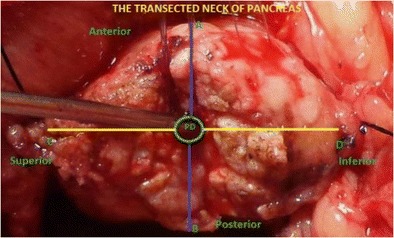
Relation of pancreatic duct to anterior, posterior, superior and inferior border of pancreatic stump
Image 2.
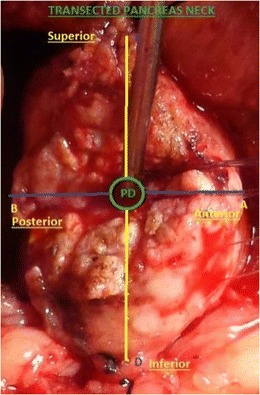
Pancreatic stump with pancreatic thickness and width. a + b + PD diameter = thickness of pancreas neck (antero-posterior). c + d + PD diameter = width of pancreas neck (supero-inferior)
Statistical Analysis
The data of the present study were recorded/fed into the computer and after its proper validation, check for error, coding and decoding, it was compiled and analysed with the help of SPSS 20 software for Windows. Appropriate univariate and bivariate analysis were carried out and Student’s t test and Fisher’s exact test were used.
Test and Pearson’s chi-squared test for categorical data were applied to check the hypothesis according to the type of data, and forward stepwise (Wald method) test was used for binary logistic regression. Multinomial logistic regression analysis was done to predict the independent risk factors for development of post-operative pancreatic fistula.
All means were expressed as median, mean ± standard deviation and the proportion as in percentage (%). The critical value for the significance of the result was considered at 0.05 levels.
Results
Sixty-six patients undergoing Whipple’s PD satisfying the inclusion criteria were studied. There were 44 male and 22 female patients. The mean age of patients in this study was 55.26 ± 7.24 years with a range from 30 to 73 years.
The mean blood loss was 480 ml. The median duration of the stay in the hospital was 16 days. Eleven patients had grade A POPF (16.66%). Since these were only biochemically detected a pancreatic leak and had no impact on the clinical outcome, they were not included in the clinically significant post-operative pancreatic fistula group.
The underlying diseases are listed in detail in Table 1.
Table 1.
List of underlying diseases
| Site of tumour | N | Percentage |
|---|---|---|
| Periampullary carcinoma | 34 | 51.5% |
| D2 adenocarcinoma | 7 | 10. 6% |
| Distal cholangiocarcinoma | 9 | 13.6% |
| Head of pancreas carcinoma | 11 | 16.7% |
| Uncinate process carcinoma | 3 | 4. 5% |
| Head of pancreas mass due to chronic pancreatitis | 2 | 3.1% |
| Total | 66 | 100.0% |
Twelve patients (18.18%) had significant post-operative pancreatic fistula. Among these patients, six patients (9.09%) had grade B POPF and the other six patients (9.09%) had grade C POPF. The incidence of complications in the fistula group patients was higher than in the patients with no fistula group, as expected. The overall morbidity was around 30.3%. Four patients with grade C POPF underwent re-operation for peritoneal lavage and drainage (1 patient), revision of anastomosis (1 patient) or failed embolization for intra-abdominal bleeding (2 patients). There were three deaths (4.54%). All three patients died due to septic complications and sequelae secondary to POPF grade C.
This study mainly concentrated on the correlation of features of the pancreatic neck with post-operative pancreatic fistula (gland-related parameters). The morphological or the anatomical risk factors at the transected neck of the pancreas and its relation to the post-operative pancreatic fistula were analysed.
Overall, the mean thickness and width of the pancreatic stump was 14.44 ± 2.08 mm and 25.59 ± 4.06 mm. The mean thickness of the pancreatic stump in the fistula and no fistula group was 12.17 ± 1.40 mm and 14.94 ± 1.87 mm (P = 0.000). The mean width of the pancreatic stump in the fistula and no fistula group was 24.33 ± 4.14 mm and 25.87 ± 4.02 mm (P = 0.238). The mean pancreatic duct diameter in our study group was 4.02 ± 1.33 mm. The mean pancreatic duct diameter in the fistula and no fistula group 2.92 ± 0.79 mm and 4.27 ± 1.31 mm respectively (P = 0.001). The mean distance of the PD from the anterior border in the fistula and no fistula group was 6.08 ± 1.62 and 5.93 ± 1.71 mm respectively (P = 0.772). The mean distance of the PD from the posterior border in the fistula and no fistula group was 3.17 ± 0.72 and 4.83 ± 1.26 mm respectively (P = 0.000). The mean distance of the PD from the superior border in the fistula and no fistula group was 9.92 ± 2.15 and 11.83 ± 2.79 mm respectively (P = 0.029). The mean distance of the PD from the inferior border in the fistula and no fistula group was 11.42 ± 3.45 and 9.96 ± 3.25 mm respectively (P = 0.170). The variables of patients with fistula group were compared with patients with no fistula group.
The correlation of pancreatic texture with POPF revealed higher incidence of POPF in patients with soft pancreatic texture (28.9%) and only 3.8% incidence in patients with firm and hard pancreas (P = 0.030). The means and standard deviations of variables in the fistula and no fistula group are presented in Tables 2, 3, 4 and 5.
Table 2.
Comparison of the means of variables between fistula and no fistula groups in the study
| Variables | Pancreatic fistula | N | Mean | Std. deviation | Unpaired t test | P Value |
|---|---|---|---|---|---|---|
| PD diameter (mm) | Yes | 12 | 2.92 | 0.79 | − 3.436 | 0.001* |
| No | 54 | 4.27 | 1.31 | |||
| Pancreas thickness (A-P) | Yes | 12 | 12.17 | 1.40 | − 4.846 | 0.000* |
| No | 54 | 14.94 | 1.87 | |||
| Pancreatic width (S-I) | Yes | 12 | 24.33 | 4.14 | − 1.191 | 0.238 |
| No | 54 | 25.87 | 4.02 | |||
| PD from post. margin | Yes | 12 | 3.17 | 0.72 | − 4.424 | 0.000* |
| No | 54 | 4.83 | 1.26 | |||
| PD from ant. margin | Yes | 12 | 6.08 | 1.62 | 0.290 | 0.772 |
| No | 54 | 5.93 | 1.71 | |||
| PD from sup. margin | Yes | 12 | 9.92 | 2.15 | − 2.234 | 0.029* |
| No | 54 | 11.83 | 2.79 | |||
| PD from inf. margin | Yes | 12 | 11.42 | 3.45 | 1.386 | 0.170 |
| No | 54 | 9.96 | 3.25 |
*Denotes P value is significant
Table 3.
Comparison of pancreatic neck stump details between fistula and no fistula groups in the study
| Study variables | Texture/dimensions | Fistula group | No fistula group | N | P value |
|---|---|---|---|---|---|
| Pancreatic texture | Soft | 11 (28.9%) | 27 (71.1%) | 38 | 0.030 |
| Firm | 1 (3.8%) | 25 (96.2%) | 26 | ||
| Hard, fibrotic | 0 | 2 (100%) | 2 | ||
| Pancreatic duct diameter | ≤ 3 mm | 9 (37.5%) | 15 (62.5%) | 24 | 0.008 |
| 4–5 mm | 3 (8.3%) | 33 (91.7%) | 36 | ||
| > 5 mm | 0 | 6 (100%) | 6 | ||
| Pancreatic thickness | ≤ 12 mm | 8 (66.7%) | 4 (33.3%) | 12 | 0.000 |
| > 12 mm | 4 (7.4%) | 50 (92.6%) | 54 | ||
| Pancreatic width (SI) | ≤ 20 mm | 2 (20.0%) | 8 (80.0%) | 10 | 0.871 |
| > 20 mm | 10 (17.9%) | 46 (82.1%) | 56 | ||
| PD from posterior margin | ≤ 3 mm | 10 (62.5%) | 6 (37.5%) | 16 | 0.000 |
| 3.1 to 5 mm | 2 (5.9%) | 32 (94.1%) | 34 | ||
| > 5 mm | 0 | 16 (100%) | 16 | ||
| PD from anterior margin | 3 to 5 mm | 4 | 27 | 31 | 0.521 |
| 6 to 7 mm | 5 | 19 | 24 | ||
| > 7 mm | 3 | 8 | 11 | ||
| PD from superior margin | > 12 mm | 7 (12.5%) | 49 (87.5%) | 56 | 0.005 |
| ≤ 12 mm | 5 (50%) | 5 (50%) | 10 | ||
| PD from inferior margin | > 12 mm | 10 (22.7%) | 34 (77.3%) | 44 | 0.176 |
| ≤ 12 mm | 2 (9.1%) | 20 (90.9%) | 22 |
*Denotes P value is significant
Table 4.
Binary logistic regression with pancreatic fistula as dependent group with pancreatic thickness and superior border as independent factors
| Variables in | B | S.E. | Wald | df | P value | Odds ratio | 95.0% C.I. for OR | ||
|---|---|---|---|---|---|---|---|---|---|
| Lower | Upper | ||||||||
| Step 1 | Pancreatic thickness (> 12 mm) | − 3.219 | 0.803 | 16.064 | 1 | 0.000 | 0.040 | 0.008 | 0.193 |
| Constant | 0.693 | 0.612 | 1.281 | 1 | 0.258 | 2.000 | |||
| Step 2 | Pancreatic thickness(> 12 mm) | − 3.520 | 0.942 | 13.976 | 1 | 0.000 | 0.030 | 0.005 | 0.187 |
| Superior border (< 12 mm) | 2.423 | 1.017 | 5.681 | 1 | 0.017 | 11.280 | 1.538 | 82.734 | |
| Constant | 0.306 | 0.654 | 0.220 | 1 | 0.639 | 1.358 | |||
Variable(s) entered on step 1: pancreatic thickness
Variable(s) entered on step 2: superior border
Table 5.
Comparison between other studies in English literature
| Variables | Fistula | This study (66) | P value | Tajima et al. [14] | P value | Nakeeb et al. [13] (471) | P value | Ridolfi et al. [15] (145) | P value |
|---|---|---|---|---|---|---|---|---|---|
| Duct diameter | Yes | 2.92 ± 0.79 | 0.001 | Not mentioned | 3.12 ± 1.43 | 0.08 | 3.19 ± 1.21 | < 0.001 | |
| No | 4.27 ± 1.31 | 3.45 ± 1.32 | 4.29 ± 1.73 | ||||||
| Thickness | Yes | 12.17 ± 1.40 | 0.000 | 16.6 ± 3.8 | 0.878 | Not mentioned | Not mentioned | ||
| No | 14.94 ± 1.87 | 16.3 ± 3.4 | |||||||
| Posteriorly placed duct | Yes | 3.17 ± 0.72 | 0.000 | 3.3 ± 1.92 | 0.041 | 3.2 ± 1.20 | 0.001 | – | – |
| No | 4.83 ± 1.26 | 4.3 ± 1.72 | 2.0 ± 0.42 | – | – | ||||
| Width | Yes | 24.33 ± 4.14 | 0.238 | 28.3 ± 6.3 | 0.868 | Not mentioned | Not mentioned | ||
| No | 25.87 ± 4.02 | 27.9 ± 5.52 | |||||||
Based on the above analysis, the incidence of POPF increases with pancreatic thickness less than 12 mm and superiorly positioned pancreatic duct < 12 mm. Pancreatic duct size, thickness of pancreatic stump, distance of pancreatic duct from the posterior border and distance of pancreatic duct from the superior border in the fistula were statistically significant parameters on univariate analysis.
Discussion
In this study, a strong association was found between anastomotic leakage and anatomy of the transected neck of the pancreas. Texture of pancreatic stump and pancreatic duct diameter are often considered risk factors for POPF [7–10]. In this study, the incidence of fistula in patients with soft pancreatic parenchyma was 28.9% and no fistula was noted in patients with hard pancreatic parenchyma (P = 0.030). This result can partly be explained by the technical difficulties of a pancreaticoenteric anastomosis in the presence of a soft, friable pancreatic tissue, which cannot hold the sutures. Yeo et al. [7] have documented that POPF rate was 0% among patients with hardened remaining pancreas and increased to 25% in patients with soft parenchyma. Other investigators have also confirmed low POPF rates in the presence of firm pancreatic consistency. In a series of nearly 2000 pancreaticoduodenectomies, it was noted that a soft pancreas was associated with a 22.6% fistula rate and led to a 10-fold increased risk of pancreatic fistula v/s an intermediate or hard gland [11].
We believe that increased fibrosis of pancreatic tissue reduces pancreatic juice output and also helps in holding of suture well. Our multivariate analysis confirmed that pancreatic texture was not an independent predictive factor for pancreatic fistula. However, texture being subjective, has interobserver variation unless a durometer is used.
A small pancreatic duct diameter or non-dilated pancreatic duct can make the duct-to-mucosa anastomosis difficult or even impossible at times. Hamanaka et al. [12] used pancreatic duct diameter less than 3 mm (v/s > 3 mm) as a cut-off limit for risk factor for post-operative pancreatic fistula which is supported by many studies [13–15]. Univariate and multivariate analysis by de Castro [10] showed a strong association between the diameter of the main pancreatic duct (< 3 mm) and POPF (P < 0.001 and P < 0.002, respectively). The hypothesis that a main pancreatic duct of less than 3 mm influences pancreatic fistula includes the following possible reasons: (a) pancreatic secretion may be higher in this setting, (b) secondary ducts are larger and may give rise to more secretions when divided and (c) the small duct diameter is associated with normal soft pancreatic parenchyma [16].
There are very few studies in the available literature correlating the pancreatic duct position and POPF. Along the antero-posterior axis, the duct decentralisation towards the posterior margin showed a significant influence on fistula occurrence. We assume that a central location has a protective role in the pancreaticojejunal anastomosis tightness, probably because a centrally located Wirsung duct makes it easier to place the opening of the jejunal loop accurately in front of the pancreatic stump and performing a good tension-free anastomosis. Moreover, when the duct is close to the posterior margin, less pancreatic parenchyma can be encompassed by stitches placed inside the Wirsung duct, making them at higher risk of failure. The technical difficulty of placing the trans-ductal sutures in a posteriorly positioned pancreatic duct adds to the problem.
The superiorly positioned pancreatic duct along the supero-inferior axis showed an increased incidence of post-operative pancreatic fistula in this study. Five out of ten patients (50%) had post-operative pancreatic fistula when pancreatic duct was positioned within 12 mm from the superior border. Hence with the above results, we could assume that a pancreatic duct positioned close to the superior border has less parenchyma to be encompassed superiorly by stitches placed inside the Wirsung duct. However, there are no data available in the literature in support of the abovementioned results. Tajima et al [14] differ from our observations for superiorly placed duct and pancreatic thickness but concur with us that width of pancreatic parenchyma, relationship of PD to inferior margin and anterior margin are insignificant.
Ridolfi et al. [15] had observed that mean stump area in the fistula and no fistula group (219 and 138 mm2 respectively) was statistically significant (P < 0.001) when the gland is soft.
Tajima et al. [14] did not show any significant correlation between the pancreatic thickness and POPF. In contrast to this finding, in this study, the mean thickness of the pancreatic stump in the fistula and no fistula group is 12.17 ± 1.40 mm and 14.94 ± 1.87 mm respectively (P = 0.00) and incidence of POPF in patients with pancreatic thickness less than 12 mm is 66.7%. Similar to findings in Tajima et al.’s study [14], this study did not show a significant correlation between the pancreatic width and POPF.
Conclusion
Pancreatic duct diameter less than 3 mm, posteriorly positioned (< 3 mm from the posterior border), superiorly positioned pancreatic duct (< 12 mm from the superior border), pancreatic thickness less than 12 mm and soft pancreatic parenchyma texture were significantly associated with post-operative pancreatic fistula. There is no significant correlation between the pancreatic width and post-operative pancreatic fistula. These factors may help in predicting a POPF and its identification. Further research is warranted to see if POPF rates can be brought down by either tailoring the already described surgical techniques or by a new surgical technique which might alter the duct and gland parameters. Perhaps achieving a better understanding of the geometry at the transected pancreatic neck might bring a favourable outcome.
Compliance with Ethical Standards
This study was approved by the Institutional Scientific and Ethics Committee. An informed consent was obtained from all patients at enrolment.
Footnotes
Key Messages
Apart from small pancreatic duct and soft pancreatic parenchyma, posteriorly positioned pancreatic duct, superiorly positioned pancreatic duct and pancreatic thickness are important determinants of post-operative pancreatic fistula.
References
- 1.Jimenez R, Fernandez-del Castillo C, Rattner D, Chang Y, Warshaw A. Outcome of pancreaticoduodenectomy with pylorus preservation or with antrectomy in the treatment of chronic pancreatitis. Ann Surg. 2000;231(3):293–300. doi: 10.1097/00000658-200003000-00001. [DOI] [PMC free article] [PubMed] [Google Scholar]
- 2.Lin J, Cameron J, Yeo C, Riall t, Lillemoe K. Risk factors and outcomes in postpancreaticoduodenectomy pancreaticocutaneous fistula. J Gastrointest Surg. 2004;8(8):951–959. doi: 10.1016/j.gassur.2004.09.044. [DOI] [PubMed] [Google Scholar]
- 3.Balcom J., IV Ten-year experience with 733 pancreatic resections. Arch Surg. 2001;136(4):391. doi: 10.1001/archsurg.136.4.391. [DOI] [PubMed] [Google Scholar]
- 4.Yeo, C. J., Cameron, J. L., Maher, M. M., Sauter, P. K., Zahurak, M. L., Talamini, M. A., … Pitt, H. A. (1995). A prospective randomized trial of pancreaticogastrostomy versus pancreaticojejunostomy after pancreaticoduodenectomy. Ann Surg, 222(4), 580–592 [DOI] [PMC free article] [PubMed]
- 5.Tejedor L, Serrablo A. Postoperative pancreatic biliary surgical complications. J Gastroenterol Hepatol Res. 2013;2(7):661–671. [Google Scholar]
- 6.Bassi C, Dervenis C, Butturini G, Fingerhut A, Yeo C, Izbicki J, Neoptolemos J, Sarr M, Traverso W, Buchler M, International Study Group on Pancreatic Fistula Definition Postoperative pancreatic fistula: an international study group (ISGPF) definition. Surgery. 2005;138(1):8–13. doi: 10.1016/j.surg.2005.05.001. [DOI] [PubMed] [Google Scholar]
- 7.Yeo C, Cameron J, Sohn T, Lillemoe K, Pitt H, Talamini M, et al. Six hundred fifty consecutive pancreaticoduodenectomies in the 1990s. Ann Surg. 1997;226(3):248–260. doi: 10.1097/00000658-199709000-00004. [DOI] [PMC free article] [PubMed] [Google Scholar]
- 8.Mathur A, Pitt H, Marine M, Saxena R, Schmidt C, Howard T, et al. Fatty pancreas. Ann Surg. 2007;246(6):1058–1064. doi: 10.1097/SLA.0b013e31814a6906. [DOI] [PubMed] [Google Scholar]
- 9.Ishikawa O. Concomitant benefit of preoperative irradiation in preventing pancreas fistula formation after pancreatoduodenectomy. Arch Surg. 1991;126(7):885–889. doi: 10.1001/archsurg.1991.01410310095014. [DOI] [PubMed] [Google Scholar]
- 10.De Castro S, Busch O, Van Gulik T, Obertop H, Gouma D. Incidence and management of pancreatic leakage after pancreatoduodenectomy. Br J Surg. 2005;92(9):1117–1123. doi: 10.1002/bjs.5047. [DOI] [PubMed] [Google Scholar]
- 11.Lin J, Cameron J, Lillemoe KD, Sitzmann JV, Hruban RH, Goodman SN, Dooley WC, Coleman J, Pitt HA. Pancreaticoduodenectomy for cancer of the head of the pancreas in 201 patients. Ann Surg. 1995;221(6):721–733. doi: 10.1097/00000658-199506000-00011. [DOI] [PMC free article] [PubMed] [Google Scholar]
- 12.Hamanaka Y, Nishihara K, Hamasaki T, Kawabata A, Yamamoto S, Tsurumi M, Ueno T, Suzuki T. Pancreatic juice output after pancreatoduodenectomy in relation to pancreatic consistency, duct size, and leakage. Surgery. 1996;119(3):281–287. doi: 10.1016/S0039-6060(96)80114-0. [DOI] [PubMed] [Google Scholar]
- 13.El Nakeeb A, Salah T, Sultan A, El Hemaly M, Askr W, Ezzat H, et al. Pancreatic anastomotic leakage after pancreaticoduodenectomy. Risk factors, clinical predictors, and management (single center experience) World J Surg. 2013;37(6):1405–1418. doi: 10.1007/s00268-013-1998-5. [DOI] [PubMed] [Google Scholar]
- 14.Tajima Y, Kuroki T, Tsuneoka N, Adachi T, Kosaka T, Okamoto T, Takatsuki M, Eguchi S, Kanematsu T. Anatomy-specific pancreatic stump management to reduce the risk of pancreatic fistula after pancreatic head resection. World J Surg. 2009;33(10):2166–2176. doi: 10.1007/s00268-009-0179-z. [DOI] [PubMed] [Google Scholar]
- 15.Ridolfi C, Angiolini M, Gavazzi F, Spaggiari P, Tinti M, Uccelli F, et al. Morphohistological features of pancreatic stump are the main determinant of pancreatic fistula after pancreatoduodenectomy. Biomed Res Int. 2014;2014:1–8. doi: 10.1155/2014/641239. [DOI] [PMC free article] [PubMed] [Google Scholar]
- 16.Suc B, Msika S, Fingerhut A, Fourtanier G, Hay J, Holmières F, Sastre B, Fagniez PL, French Associations for Surgical Research Temporary fibrin glue occlusion of the main pancreatic duct in the prevention of intra-abdominal complications after pancreatic resection. Ann Surg. 2003;237(1):57–65. doi: 10.1097/00000658-200301000-00009. [DOI] [PMC free article] [PubMed] [Google Scholar]