



Abstract
In positive-blank feedback learning, positive feedback is given to a correct response whereas blank feedback is given to an incorrect response. Conversely, in negative-blank feedback learning, blank feedback is given to a correct response and negative feedback to an incorrect response. As blank feedback might be subjectively interpreted as signalling a correct response, negative-blank feedback might be more informative than positive-blank feedback, and thus may result in better performance. However, positive-blank feedback might also be superior as it motivates the learner in lengthy tasks. These “information” and “motivation” accounts were tested in a two-block feedback learning paradigm. In the first block, that is, when the task duration was still short, children but not adults profited more from negative than from positive feedback. The results in children thus support the information account. In the second block, that is, when the task duration had become longer, children and adults profited more from positive feedback, thereby supporting the motivation account. Results are discussed in light of behavioural and neuroscientific theories on feedback learning.
Keywords: Feedback learning, positive and negative feedback, child development, motivation, time on task effects
Children often encounter feedback, for example, at school when teachers mark a spelling of a word as incorrect, or at home when parents indicate that helping of others is good. The same applies to adults, for example, at work when supervisors indicate that monthly targets have not been met, or at home when partners indicate that cooking was delicious. Given the omnipresence of negative and positive feedback in children’s and adults’ lives, the current article addresses the question whether negative and positive feedback differentially affect learning, and if so, whether this differential effect differs between children and adults.
Feedback learning is often studied in paradigms in which the participant has to discriminate between two stimuli and select the one yielding the most favourable feedback. These studies generally implement a mixed feedback schedule in which positive feedback is given to correct responses and negative feedback to incorrect responses (Eppinger, Mock, & Kray, 2009; Hämmerer, Li, Müller, & Lindenberger, 2011; Hauser, Iannaccone, Walitza, Brandeis, & Brem, 2015; Peters, Braams, Raijmakers, Koolschijn, & Crone, 2014; van den Bos, Cohen, Kahnt, & Crone, 2012; van den Bos, Güroğlu, van den Bulk, Rombouts, & Crone, 2009; van der Schaaf, Warmerdam, Crone, & Cools, 2011; van Leijenhorst, Crone, & Bunge, 2006).
These mixed feedback studies have yielded a wealth of information on the processing of negative and positive feedback during learning. However, as both negative and positive feedback are provided, it cannot be assessed whether positive or negative feedback results in better ultimate attainment and in better retention on a post-learning task. That is, it cannot be assessed whether the end result of learning differs between positive and negative feedback. Such differences in the end result of learning can be studied if distinct positive and negative feedback conditions are incorporated. In such unmixed paradigms, in the positive-blank condition, positive feedback is given if a choice is correct, whereas blank, that is, zero, feedback is provided if it is incorrect. In the negative-blank condition, negative feedback is given if the choice is incorrect, and blank feedback if it is correct.
Several studies into unmixed feedback learning by adults implemented valence as a within-subjects factor (Eppinger, Herbert, & Kray, 2010; Eppinger & Kray, 2011; Eppinger, Schuck, Nystrom, & Cohen, 2013; Kim, Shimojo, & O’Doherty, 2006; Palminteri, Khamassi, Joffily, & Coricelli, 2015; Pessiglione, Seymour, Flandin, Dolan, & Frith, 2006; van de Vijver, Ridderinkhof, & de Wit, 2015). That is, within a learning block, some stimuli had to be learned from positive-blank feedback whereas others had to be learned from negative-blank feedback. In one of these studies (van de Vijver et al., 2015), adults performed better during learning in the negative-blank as compared with the positive-blank condition in one task but not in the other. The other studies either did not report (Eppinger & Kray, 2011) or did not observe (Eppinger et al., 2010; Eppinger et al., 2013; Kim et al., 2006; Palminteri et al., 2015; Pessiglione et al., 2006) valence-related differences during learning. Only one study reported effects on the end result of learning (Eppinger et al., 2010), indicating that positive-blank resulted in a higher retention accuracy than negative-blank feedback. Together, these studies in adults thus indicate that positive feedback might result in better learning and a better end result of learning, although the results are far from unequivocal.
In these studies, in which feedback valence was varied within subjects, blank feedback is likely to be ambiguous, as it indicates for some stimuli, those belonging to the negative condition, that the choice was correct, whereas for other stimuli, those belonging to the positive condition, that the choice was incorrect. Therefore, if participants are not able to identify and remember the valence condition a stimulus belongs to, such ambiguity might hinder learning (cf. Eppinger et al., 2010; Eppinger & Kray, 2011; Kim et al., 2006; Palminteri et al., 2015; van de Vijver et al., 2015). This might be the reason why valence is often implemented between subjects in the developmental literature. In contrast to the former adult studies, this literature consistently indicates that children perform better during learning in negative-blank as compared with positive-blank conditions (Barringer & Gholson, 1979; Curry, 1960; Meyer & Offenbach, 1962; Meyer & Seidman, 1960, 1961; Penney, 1967; Penney & Lupton, 1961; Ratliff & Tindall, 1970; Spence, 1966b; Tindall & Ratliff, 1974; see also Luking, Pagliaccio, Luby, & Barch, 2016). With respect to the end result of learning, three studies reported that learned materials were better maintained during extinction if they had been learned in negative-blank as compared with positive-blank conditions (Meyer & Seidman, 1960, 1961; Ratliff & Tindall, 1970), whereas other studies did not report end result data. Taken together, these studies indicate that children learn better in negative as compared with positive feedback conditions, whereas effects on the end result of learning are not unequivocal.
Children’s suboptimal positive-blank feedback learning has been explained by the notion that children subjectively interpret the blank in positive-blank feedback as being positive, that is, as “no news is good news.” As both positive and blank feedback are thus interpreted as positive, the positive-blank feedback condition has low informative value (Levine, Leitenberg, & Richter, 1964). So, although objectively positive-blank and negative-blank feedback conditions carry the same information, subjectively they do not. The notion that negative-blank feedback is superior to positive-blank feedback as it subjectively carries more information will be referred to as the information account of feedback learning, because it focuses on the informative value of feedback. As indicated above, several studies have suggested that children experience difficulty in interpreting blank feedback in positive-blank conditions (Barringer & Gholson, 1979; Curry, 1960; Meyer & Offenbach, 1962; Meyer & Seidman, 1960, 1961; Penney, 1967; Penney & Lupton, 1961; Ratliff & Tindall, 1970; Spence, 1966b; Tindall & Ratliff, 1974), whereas adults are able to do so (Holroyd, Larsen, & Cohen, 2004; Kim et al., 2006; but see Levine et al., 1964; Spence, 1964, 1966a, 1970).
The information account neglects motivational aspects of feedback which might also be present, as it has been shown that positive incentives motivate both children and adults to perform well (Cerasoli, Nicklin, & Ford, 2014; Hidi, 2015; Marsden, Ma, Deci, Ryan, & Chiu, 2015). If the motivational aspects of positive feedback are so important, why then do children perform better in negative-blank than in positive-blank conditions?
A potential explanation might be that, in these studies, the learning task was relatively short, although none of the studies explicitly mentioned task duration. Positive feedback might only motivate the learner if the learning task is of longer duration. That is, it has been shown that performance on a wide variety of tasks decreases if these tasks have to be performed over an extensive period of time, an effect which can be counteracted by providing incentives (Boksem, Meijman, & Lorist, 2006; Dekkers et al., 2017; Dovis, Van Der Oord, Wiers, & Prins, 2012; Hagger, Wood, Stiff, & Chatzisarantis, 2010; Muraven & Slessareva, 2003; Robinson, Schmeichel, & Inzlicht, 2010). For example, in Dekkers et al. (2017), performance decreased in a second as compared with a first block, but this effect was partly counteracted by providing incentives. A tentative motivation account thus predicts that positive-blank feedback is superior as it motivates the learner if feedback learning has to be performed over a prolonged period of time.
To test the information and motivation accounts of feedback learning, we manipulated feedback valence and task duration by having participants learn in two subsequent blocks of equal length. Participants were randomly assigned to either a positive-blank block followed by a negative-blank block, or vice versa. Performance was operationalised in three ways: by speed of learning during the task, by ultimate attainment at the end of the task, and by retention on a post-learning dictation task. The latter two allowed us to assess the end result of learning.
We argue that in the first block, only the information account applies, the motivation account does not, as task duration is still short. In the first block, the information account predicts better performance in case of negative-blank as compared with positive-blank feedback. The information account applies only to children because adults are able to interpret the relative value of blank feedback. We therefore predict that children perform better in negative-blank than positive-blank conditions, whereas for adults no performance differences between conditions are expected.
We argue that in the second block, not only the information but also the motivation account applies, as the second block is preceded by the first. Therefore, task duration is longer. In children, both the information and motivation account are of relevance. If they affect performance to an equal but opposite extent, no performance differences between positive-blank and negative-blank feedback will be expected. If the information account predominates, negative-blank feedback will be superior, whereas if the motivation account predominates, positive-blank feedback will be superior. As adults are not affected by the information account, the motivation account predicts, in the second block, better performance in case of positive-blank than in case of negative-blank feedback.
Method
Participants
A power analysis on the Valence, Age Group, and Valence × Age Group interaction effects, using an alpha of .05 and a medium effect size, indicated that a total of 128 participants were required for an intended power of .8 (Faul, Erdfelder, Buchner, & Lang, 2009). Children’s age range (9-12 years of age) was chosen to match recent feedback learning studies in children (e.g., Eppinger et al., 2009; Hämmerer et al., 2011; van den Bos et al., 2012; van der Schaaf et al., 2011; van Leijenhorst et al., 2006). Children were recruited from three primary schools across the Netherlands. The initial sample consisted of 101 children. Fifteen children were excluded from the initial sample because of technical problems during testing, absence during the testing day, or because they were previously diagnosed with dyslexia.1 Most of the adults participating in the study were recruited via the University of Amsterdam, the Netherlands; the initial sample consisted of 81 adults. Inclusion criteria were the absence of dyslexia and age between 18 and 35 years. No adults were excluded from the sample. The final sample thus consisted of 86 children (mean age = 10.7 [SD = 0.93], percentage of male participants 51%) and 81 adults (mean age = 25.6 [SD = 6.95], percentage of male participants 25%). The study was approved by the Ethics Review Board of the Faculty of Social and Behavioural Sciences, University of Amsterdam (title: “What is the best way to provide feedback in spelling education?”). For all children, parental informed consent was obtained. All adults signed an informed consent form.
Experimental design
Participants were randomly assigned to a condition starting with a positive followed by a negative block, or to a condition in which the order was reversed. As is common in feedback learning studies, in every block, half of the stimuli received deterministic feedback (100% adequate) and the other half probabilistic feedback (70% adequate). Stimuli receiving probabilistic or deterministic feedback were presented in random order.
Materials
Learning task
The learning task is illustrated in Figure 1. In each trial, participants were presented with two pseudo-words with alternative spellings. For example, participants were visually presented with the pair STOUK and STAUK. Participants were instructed to select the option with the supposedly correct spelling, and received feedback afterwards, thus enabling learning of the correct spelling.
Figure 1.

Schematic diagram of learning task in the negative feedback condition. The stimulus screen presents the two pseudo-words (STOUK and STAUK) accompanied by a picture, in this case a flower. The feedback screen provides feedback, which was in this case negative.
The stimuli were one-syllable pseudo-words, with two alternative spellings that included the letter (combination)s au/ou, ij/ei, g/ch, or d/t. The two alternative spellings were Dutch homophones, that is, they sound the same. The pseudo-words were partly derived from previous research (de Jong, Bitter, van Setten, & Marinus, 2009) and partly constructed for the present purposes. Criteria for pseudo-word construction were that they should (a) consist of four to six letters, (b) include one of the above letter (combination)s, (c) follow Dutch language rules, and (d) differ at least one letter from existing Dutch words. For a complete list of the pseudo-words used during learning, see Table S1 in the Supplementary Online Materials (SOM). As previous research has shown that semantic information has a positive influence on the learning of spelling (e.g., Ouellette & Fraser, 2009), we presented each pseudo-word pair together with an image (cf. Figure 1).
In the deterministic condition, feedback was always adequate. That is, in the positive condition, a correct answer was given positive feedback (+10 points) and an incorrect answer blank feedback (0 points); in the negative condition, a correct answer was given blank feedback (0 points) and an incorrect answer negative feedback (–10 points). In the probabilistic condition, 70% of the feedback was adequate, but 30% of the feedback was inadequate.
Block 1 of the learning task consisted of two practice blocks, one with deterministic and one with probabilistic feedback, followed by an experimental block (positive or negative feedback, depending on the condition). Block 2, in which participants had to learn different words, again consisted of two practice blocks, followed by an experimental block (positive or negative, counterbalancing the feedback condition of Block 1). In all practice blocks, one pseudo-word pair appeared 15 times (so in total four pseudo-word pairs were used in the practice blocks). Each experimental block consisted of four pseudo-word pairs, each presented 40 times, with deterministic feedback for two of the pairs and probabilistic feedback for the other two pairs.
The pseudo-words presented in the practice blocks were equal for all participants. Pseudo-words in the experimental blocks were randomly assigned to different conditions. In every block, there was a word with the letters d/t, g/ch, ei/ij, and au/ou, but the pseudo-word combinations differed per participant. The location of the pseudo-words (left and right) was alternated, to avoid response bias and to make sure participants learned the correct spelling and not the location of the correct word.
Each trial started with a fixation cross (500 ms), followed by a stimulus (no more than 2,000 ms) (cf. Figure 1). Every stimulus consisted of an image and two pseudo-words presented on the left and right of the screen. Participants chose the pseudo-word by pressing a key on the left side of the keyboard (a yellow stickered key, the “z” on the QWERTY keyboard) for the word on the left, or a key on the right (a blue stickered key, the “/” on the keyboard) for the word on the right. If participants had not pressed a key before 2,000 ms, an empty screen appeared (250 ms) and then a feedback screen (1,250 ms) saying, “Te laat!” (“Too late!”). If participants had pressed one of the two choice keys, an empty screen appeared (250 ms) and then a feedback screen (1,250 ms) with the number of points (–10, 0, or +10). After the feedback screen, the next trial was presented, starting with a fixation cross.
Post-learning dictation task
To assess the end result of learning, participants were administered a dictation task after they had completed the learning task. Words were presented once through headphones; there was no possibility to hear the word again. There was no time limit for typing the spelling of the pseudo-words. The backspace key could be used to correct mistypings. To save the word, participants had to press the enter key. Thereafter, participants could start presentation of the next word by pressing the “w”-key of the keyboard. The dictation task included nine pseudo-words: One pseudo-word was previously used in the practice blocks (results on this word were not included in the analyses), followed by the eight pseudo-words from the experimental blocks. The pseudo-words were recorded in a sound-proof studio, using the program praat (http://www.fon.hum.uva.nl/praat/).
Procedure
First, we describe the procedure for children; next, we describe how the procedure differed for adults. Participants were tested individually or in pairs. In case two participants were tested in a pair, a screen was placed between them to prevent them from looking at each other’s responses. A participant was seated in front of a table with a laptop. The instructions (read from the computer screen by the experimenter) were followed by a deterministic practice block, short instructions, a probabilistic practice block, and the first experimental block. This procedure was repeated for the second practice and experimental blocks.
In the instructions, it was stated that the task would consist of two blocks. The instructions made clear that words would be pseudo-words and that feedback might be probabilistic. In addition, the instructions in the positive condition stated that correct choices would be followed by positive feedback and incorrect responses by blank feedback. Instructions in the negative condition stated that incorrect choices would be followed by negative feedback and correct responses by blank feedback. Duration of the two-block learning task was approximately 25 min, including instructions.
After completion of the learning task, there was a short break. Then the dictation task was administered. The dictation task required about 6 min, depending on the particular participant’s working speed.
After children had performed the dictation task, they were rewarded with a small present (pencils, stickers), its value independent of performance. The experimenter was present during the entire task but, apart from the instructions, remained silent.
For adults, the experiment was administered individually or in pairs. After switching off mobile telephones and reading and signing an informed consent form, participants performed the learning and dictation task. After they had performed the dictation task, students were rewarded with course credit, and non-students were not rewarded.
Results
Learning task
To assess learning during the task, we grouped a total of 160 trials into five bins. As our hypotheses refer to each block separately, we performed, for each block separately, a 2 (age group, between) × 2 (valence, between) × 2 (probability, within) × 5 (bin, within) repeated-measures analysis of variance (ANOVA) on the proportion of correct responses in each bin. As there was variability in age within age groups, we also included standardised age within age group, coined Z_Age, as an additional continuous independent variable. To assess the end result of learning, a similar data analytic strategy was adopted, on the understanding that we only analysed accuracy in the fifth bin and thus omitted the factor bin. In all ANOVAs, p values were Greenhouse–Geisser corrected, although we report in the text the uncorrected degrees of freedom. In the main text, only results including the key factor valence are reported; the results of the other analyses are reported in the SOM.
Analyses for each block separately suggested that the effects of valence differed between the two blocks. We therefore also tested whether Block × Valence interactions were present. However, analysis on Valence × Block interactions cannot be carried out by a regular repeated-measures ANOVA, as the design is not fully crossed, that is, every feedback condition was only administered in one block. For example, if a participant performed first in a positive block and then in a negative block, results for a second positive block and a first negative block are missing for this particular participant. In a regular repeated-measures ANOVA, all participants with missing values will be removed, thus leaving no participants at all. Fortunately, such designs can be analysed with a multilevel analysis (Huizenga et al., 2012; Snijders & Bosker, 2012). In the multilevel analysis, we assumed a compound symmetry covariance structure for the 20 within-subjects observations (5 Bins × 2 Probability Conditions × 2 Valence Conditions) and included all main and interaction effects of the nominal variables, Valence, Probability, Bin, and Block, and the continuous variable, Z_Age.
Block 1
The Block 1 results depicted in Figure 2 suggest that the effects of valence on learning differed between children and adults. This was supported by the repeated-measures ANOVA. That is, this analysis indicated that the effect of valence on learning differed between the two age groups (Bin × Valence × Age group interaction), F(4, 636) = 3.59, p = .012, η2 = .022, whereas the four-way interaction also including probability was non-significant. Therefore, we analysed the two age groups separately. In the following, we only report effects containing valence; a complete list of results is given in Tables S2 and S3 in the SOM.
Figure 2.

Learning task: Proportion of correct responses for children (left panel) and adults (right panel) as a function of Block and Bin (x-axis), Valence (Positive: P, Negative: N) and Probability (Probabilistic: prob, Deterministic: det).
In children, there was a Bin × Valence interaction, F(4, 328) = 4.71, p = .002, η2 = .05, but the other main or interaction effects containing Valence were not significant. The Bin × Valence interaction in Figure 2 suggests that the learning curve was steeper if children received negative instead of positive feedback. This was supported by a significant interaction between valence and the linear contrast of bin, F(1, 82) = 11.19, p = .001, η2 = .12. The ultimate attainment analysis on the fifth bin only indicated a main effect of valence, F(1, 82) = 4.43, p = .04, η2 = .05, and no interactions including valence. That is, negative as compared with positive feedback resulted in a higher proportion of correct answers.
In adults, no main nor interaction effects with valence were observed on learning, and the ultimate attainment analysis on the fifth bin also indicated no significant effects including valence.
Taken together, these results indicate that in the first block, negative as compared with positive feedback promotes faster learning and better ultimate attainment in children, but not in adults.
Block 2
The Block 2 results reported in Figure 2 do not suggest pronounced age-group-related differences in the effects of valence on learning. Indeed, a 2 (age group) × 2 (valence) × 2 (probability) × 5 (bin) repeated-measures ANOVA revealed no significant Valence × Bin × Age group interaction, nor a significant Valence × Bin × Probability × Age group interaction. However, to maintain comparability with Block 1, we report the analysis of the two age groups separately. Below, we only report effects, including valence; a complete list of results is provided in the SOM (Tables S4 and S5).
In children, there was an interaction effect of valence and probability, F(1, 82) = 5.14, p = .03, η2 = .06. A follow-up analysis on deterministic and probabilistic feedback separately indicated, for probabilistic stimuli, a main effect of valence, F(1, 82) = 6.23, p = .015, η2 = .07: The proportion of correct responses was higher if feedback was positive instead of negative. This effect was not observed for deterministic stimuli. Other effects including valence were not significant. The ultimate attainment analysis on the fifth bin showed a trend towards an interaction between valence and probability, F(1, 82) = 3.28, p = .07, η² = 0.04. A follow-up analysis for probabilistic and deterministic stimuli separately indicated that for probabilistic stimuli, there was a main effect of valence, F(1, 82) = 5.37, p = .023, η² = 0.06, positive feedback was superior to negative feedback, whereas for deterministic stimuli, this effect was absent. In addition, the interaction between Valence and Z-Age was significant, F(1, 82) = 4.42, p = .04, η2 = .05. Parameter estimates indicated that the increased accuracy in Bin 5 in the positive as compared with the negative condition decreased with Z-Age. All other effects including valence were not significant.
In adults, there was a significant main effect of valence, F(1, 77) = 7.35, p < .01, η2 = .09: The proportion of correct responses was higher if feedback was positive instead of negative. Other effects including valence were not significant. The ultimate attainment analysis on Bin 5 showed a main effect of valence, F(1, 77) = 4.61, p = .04, η2 = .06, indicating that positive as compared with negative feedback resulted in better ultimate attainment. In the fifth bin, no interactions with valence were observed.
Taken together, these results indicate that in Block 2, positive feedback yields a higher proportion of correct responses during the entire task, both in adults and in children, on the understanding that in children this effect was only observed for probabilistic stimuli.
Tests of between-block differences
The analyses above suggest that the two blocks differed in the effects of valence. To formally test potential Valence × Block interactions, we performed a multilevel analysis for each age group separately. The analysis on learning, including the effects of valence, block, probability, bin, Z_Age, and their interactions, indicated that for children the crucial Valence × Block × Bin interaction was significant, F(4, 1558) = 2.52, p = .04, whereas this was not the case for adults.2 Similarly, the analysis on ultimate attainment in the fifth bin, including the effects of valence, block, probability, Z_Age, and their interactions, indicated that for children the crucial Valence × Block interaction was significant, F(1, 82) = 4.27, p = .04, whereas this was not the case for adults. In children, these multilevel results thus corroborate the suggestion of block differences in valence effects: Negative feedback outperformed positive feedback in the first block, whereas in the second block the reverse was true. In adults, these multilevel results indicate that valence effects did not differ between blocks, although regular ANOVA’s per block indicated that in the first block no valence effects were present, whereas in the second block positive feedback was superior to negative feedback.
Post-learning dictation task
In the dictation task, conditions were nested within participants, and the outcome variable was discrete (correct or incorrect response). We therefore analysed these data with a mixed model analysis for discrete dependent variables, that is, by a Generalised Linear Mixed Model. Analyses were performed for each block separately. We included a random intercept, a fixed intercept, and fixed effects of age group, valence, probability, Z_Age, and their interactions. We applied a model selection procedure to identify the fixed effects that were required to obtain the best fitting model to the data. Analyses were performed with the glmer function in the R package lme4 (Bates, Maechler, Bolker, & Walker, 2014). The model that fitted the data best according to the small sample size corrected Akaike Information Criterion (AICc) (Burnham & Anderson, 2002) was determined with the dredge function in the R package MuMIN (Barton, 2015).
The proportion of correct responses in the dictation task is shown in Figure 3. Analyses were performed separately for words learned during Block 1 and during Block 2. In both analyses, model selection indicated that a valence effect had to be included in the model. For the words learned in Block 1, it indicated an advantage of negative over positive feedback; the reverse was true for words learned in Block 2. Note, however, that although in both blocks a valence effect had to be included, the parameter estimates of the valence effect themselves were not significant (p = .13 and p = .15, respectively). Therefore, these results suggest only a weak tendency towards a valence effect. A complete list of results is given in Table S6 in the SOM.
Figure 3.
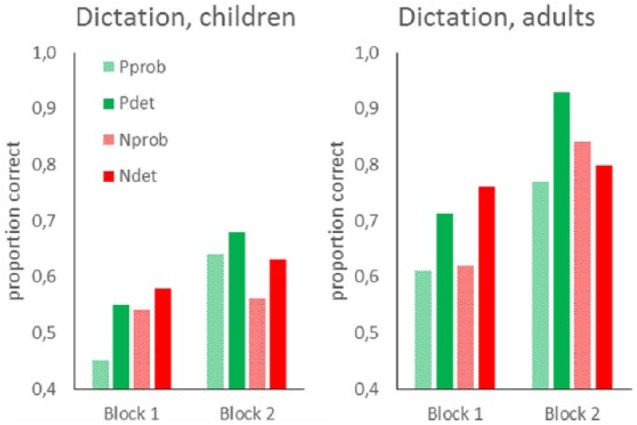
Dictation task: Proportion of correct responses for children (left panel) and adults (right panel) as a function of Block, Valence (Positive: P, Negative: N), and Probability (Probabilistic: prob, Deterministic: det).
Discussion
In the current study, we aimed to test the information and motivation accounts of feedback learning. To do so, we implemented a two-block feedback learning paradigm in which participants received in a first block negative-blank feedback and in a subsequent second block positive-blank feedback, or vice versa. We assessed both effects on learning and effects on the end result of learning, operationalised by performance at the end of the learning task and by performance on a post-learning dictation task. Below, we discuss the results and their implications for the two accounts of feedback learning.
In the first block, children’s learning profited more from negative than from positive feedback. This finding was paralleled by results at the end of the task and by the trend-level results on the post-learning dictation task. These findings in children thus support the information account of feedback learning. That is, children evaluate blank feedback subjectively: They are likely to consider blank feedback to be positive (Barringer & Gholson, 1979; Curry, 1960; Luking et al., 2016; Meyer & Offenbach, 1962; Meyer & Seidman, 1960, 1961; Penney, 1967; Penney & Lupton, 1961; Ratliff & Tindall, 1970; Spence, 1966b; Tindall & Ratliff, 1974). In adults, there were neither valence-related differences during learning nor at the end of the learning task, although there was a trend-level advantage of negative-blank feedback on the post-learning dictation task. The absence of pronounced valence-related effects in adults suggests that adults are able to interpret the relative value of a blank in positive-blank feedback. This finding matches previous behavioural and imaging studies in adults (Holroyd et al., 2004; Kim et al., 2006; Palminteri & Pessiglione, 2017; Pessiglione & Delgado, 2015; Rangel & Clithero, 2012; Vlaev, Chater, Stewart, & Brown, 2011; yet see Levine et al., 1964; Spence, 1964, 1966a, 1970).
The second block was administered immediately after the first block, and therefore task duration was increased. In the second block, both children’s and adults’ performance during the entire second block, their performance at the end of the learning task, and their performance at post-learning dictation were better for positive than for negative feedback. Yet note that the positive over negative feedback advantage in children was only observed for probabilistic, and not deterministic, feedback. These findings support the motivation account of feedback learning stating that positive feedback is beneficial as it promotes performance in prolonged tasks (Boksem et al., 2006; Dekkers et al., 2017; Dovis et al., 2012; Hagger et al., 2010; Muraven & Slessareva, 2003; Robinson et al., 2010).
We therefore conclude that children’s performance supports both the information and the motivation account of feedback learning. This implies that if task duration is still short, negative feedback is superior as it subjectively carries more information, whereas if task duration becomes longer, positive feedback is superior as it motivates the child. In adults, however, only evidence for the motivation account was obtained, implying that adults are not affected by feedback valence if task duration is still short, and profit more from positive feedback if task duration becomes longer.
We interpreted the superiority of negative over positive feedback as yielding support for the information account. However, it might also be argued that it provides evidence for prospect theory, stating that losses are overweighted as compared with gains (Kahneman & Tversky, 1979; Tversky & Kahneman, 1992; see also Amitay, Moore, Molloy, & Halliday, 2015; Baumeister, Bratslavsky, Finkenauer, & Vohs, 2001; Luking et al., 2016). However, the fact that we only observed a negative feedback advantage for children and not for adults would then imply that overweighting of losses decreases with age. To our knowledge, the only study that actually tested this implication did not find evidence for such a developmental trend (Harbaugh, Krause, & Vesterlund, 2001).
The superiority of negative over positive feedback might also be explained by a neurobiological account. That is, it has been proposed that suboptimal learning in positive feedback conditions is due to malfunctioning of the dopaminergic reward system, as such suboptimal learning is observed in Parkinson’s disease (Frank, O’Reilly, & Seeberger, 2004), characterised by deficient dopamine systems, and, in healthy ageing, characterised by reduced dopaminergic functioning (Eppinger et al., 2013). However, we would like to argue that it is not very likely that this neurobiological account explains the current findings in children around 9 to 12 years of age, as it is still subject to debate whether the dopaminergic reward system can be considered as immature around that age (for reviews, see Hämmerer & Eppinger, 2012; van der Schaaf et al., 2011).
Notwithstanding this argumentation, the prospect theory account and the neurobiological account might be viable alternatives to the information account. To provide an additional test of the information account, we administered an “interpretation of blank feedback” questionnaire to 118 children (age 11.39 [SD = .70], 55.1% males) who had not participated in the first experiment. The questionnaire, given in the SOM (S8), consisted of eight items like “Elisa did math. The teacher did not write anything next to problem 5.” The participant then had to indicate whether Problem 5 was answered “correct,” “incorrect,” or “don’t know.” If children act according to the information account, they will more often interpret the absence of feedback as “correct” instead of “incorrect” or “don’t know.” This was exactly what was observed: On all questions, the most likely answer was “correct” (results in the SOM, S10 and S11). So children were more likely to interpret the absence of feedback as being positive instead of negative or neutral. These findings thus further strengthen the information account interpretation of the superiority of negative feedback in children’s first block performance: Negative-blank feedback is superior to positive-blank feedback as children interpret blank feedback as being positive.
Several issues might be raised with respect to the current study. First, we cannot rule out that the current differences between age groups are due to differences in ethnicity, socioeconomic status (SES), or IQ. That is, the majority of adults participating in the study were university students, who are more likely to be of a non-immigrant and high SES background, and who are more likely to have a higher IQ than participants sampled from the entire population. Follow-up studies therefore should assess a random sample from the adult population.
Another potential issue relates to our interpretation of block differences in valence effects, which we assumed to originate in differences in task duration. However, it might also be argued that they are due to differences in the understanding of the task. For example, participants first performing a positive followed by a negative block should switch their interpretation of blank feedback from signalling an error in Block 1 to an adequate response in Block 2. However, we consider this unlikely as participants received explicit instructions on the interpretation of blanks before each block and were extensively retrained before each block. Moreover, if understanding of the blank feedback had indeed decreased from the first to the second block, this would have applied to both the negative and positive feedback condition in Block 2, and therefore valence effects would have remained similar to those in Block 1, which clearly was not the case. The materials of the learning task might also raise considerations, as the to-be learned materials might have been too easy for adults. Especially in the first block, their performance in the deterministic condition approached ceiling. Therefore, more pronounced valence-related effects might have been observed if the materials had been more difficult (for a similar argument, see van de Vijver et al., 2015), for example, if all feedback had been probabilistic or if more words had to be learned.
Another issue might be raised with respect to the current post-learning dictation task. Children’s dictation performance on words learned during Block 1 hardly exceeded chance level, indicating that retention of these words was very weak. Alternatively, the dictation task might have been too difficult as there was no possibility to hear a word again before writing it down.
To conclude, the current results suggest that the optimal form of feedback depends on task duration and the age group involved. That is, if the task is short, children profit most from negative feedback, as it subjectively carries more information. However, if task duration becomes longer, both children and adults benefit most from positive feedback, as it promotes performance in such lengthy tasks. Therefore, these findings provide support for both the information and motivation account of feedback learning.
Supplemental Material
Supplemental material, QJE-STD-17-360.R1-Supplementary_Material for Positive-blank versus negative-blank feedback learning in children and adults by Marjolijn Verburg, Patrick Snellings and Maaike Helena Titia Zeguers, Hilde Maria Huizenga in Quarterly Journal of Experimental Psychology
The to-be learned materials were pseudo-words; therefore, participants with dyslexia were excluded.
In adults, the model with a compound symmetry covariance structure failed to converge; therefore, we refitted the data with a scaled identity covariance structure.
Footnotes
Declaration of conflicting interests: The author(s) declared no potential conflicts of interest with respect to the research, authorship, and/or publication of this article.
Funding: The author(s) disclosed receipt of the following financial support for the research, authorship, and/or publication of this article: Hilde Maria Huizenga was supported by an NWO VICI grant (453-12-005).
Supplementary material: Supplementary material is available at journals.sagepub.com/doi/suppl/10.1177/1747021818769038.
References
- Amitay S., Moore D. R., Molloy K., Halliday L. F. (2015). Feedback valence affects auditory perceptual learning independently of feedback probability. PLoS ONE, 10, e0126412. doi: 10.1371/journal.pone.0126412 [DOI] [PMC free article] [PubMed] [Google Scholar]
- Barringer C., Gholson B. (1979). Effects of type and combination of feedback upon conceptual learning by children: Implications for research in academic learning. Review of Educational Research, 49, 459–478. doi: 10.3102/00346543049003459 [DOI] [Google Scholar]
- Barton K. (2015). MuMIn: Multi-model inference, version 1.15.6. Retrieved from https://cran.r-project.org/web/packages/MuMIn/MuMIn.pdf
- Bates D., Maechler M., Bolker B., Walker S. (2014). lme4: Linear mixed-effects models using Eigen and S4. R package version 1.1-7. Retrieved from http://cran.r-project.org/package=lme4
- Baumeister R. F., Bratslavsky E., Finkenauer C., Vohs K. D. (2001). Bad is stronger than good. Review of General Psychology, 5, 323–370. doi: 10.1037//1089-2680.5.4.323 [DOI] [Google Scholar]
- Boksem M. A., Meijman T. F., Lorist M. M. (2006). Mental fatigue, motivation and action monitoring. Biological Psychology, 72, 123–132. doi: 10.1016/j.biopsycho.2005.08.007 [DOI] [PubMed] [Google Scholar]
- Burnham K. P., Anderson D. R. (2002). Model selection and multimodel inference: a practical information-theoretic approach (2nd ed.). New York, NY: Springer. [Google Scholar]
- Cerasoli C. P., Nicklin J. M., Ford M. T. (2014). Intrinsic motivation and extrinsic incentives jointly predict performance: A 40-year meta-analysis. Psychological Bulletin, 140, 980–1008. doi: 10.1037/a0035661 [DOI] [PubMed] [Google Scholar]
- Curry C. (1960). Supplementary report: The effects of verbal reinforcement combinations on learning in children. Journal of Experimental Psychology, 59, 434. [DOI] [PubMed] [Google Scholar]
- de Jong P. F., Bitter D. J. L., van Setten M., Marinus E. (2009). Does phonological recoding occur during silent reading, and is it necessary for orthographic learning? Journal of Experimental Child Psychology, 104, 267–282. doi: 10.1016/j.jecp.2009.06.002. [DOI] [PubMed] [Google Scholar]
- Dekkers T., Agelink van Rentergem J., Koole A., van den Wildenberg W., Popma A., Bexkens A., … Huizenga H. (2017). Time-on-task effects in children with and without ADHD: Depletion of executive resources or depletion of motivation? European Child & Adolescent Psychiatry, 26, 1471–1481. doi: 10.1007/s00787-017-1006-y. [DOI] [PMC free article] [PubMed] [Google Scholar]
- Dovis S., Van Der Oord S., Wiers R. W., Prins P. J. M. (2012). Can motivation normalize working memory and task persistence in children with attention-deficit/hyperactivity disorder? The effects of money and computer-gaming. Journal of Abnormal Child Psychology, 40, 669–681. doi: 10.1007/s10802-011-9601-8. [DOI] [PMC free article] [PubMed] [Google Scholar]
- Eppinger B., Herbert M., Kray J. (2010). We remember the good things: Age differences in learning and memory. Neurobiology of Learning and Memory, 93, 515–521. doi: 10.1016/j.nlm.2010.01.009 [DOI] [PubMed] [Google Scholar]
- Eppinger B., Kray J. (2011). To choose or to avoid: Age differences in learning from positive and negative feedback. Journal of Cognitive Neuroscience, 23, 41–52. doi: 10.1162/jocn.2009.21364 [DOI] [PubMed] [Google Scholar]
- Eppinger B., Mock B., Kray J. (2009). Developmental differences in learning and error processing: Evidence from ERPs. Psychophysiology, 46, 1043–1053. doi: 10.1111/j.1469-8986.2009.00838.x [DOI] [PubMed] [Google Scholar]
- Eppinger B., Schuck N. W., Nystrom L. E., Cohen J. D. (2013). Reduced striatal responses to reward prediction errors in older compared with younger adults. Journal of Neuroscience, 33, 9905–9912. doi: 10.1523/JNEUROSCI.2942-12.2013 [DOI] [PMC free article] [PubMed] [Google Scholar]
- Faul F., Erdfelder E., Buchner A., Lang A. -G. (2009). Statistical power analyses using G*Power 3.1: Tests for correlation and regression analyses. Behavior Research Methods, 41, 1149–1160. doi: 10.3758/BRM.41.4.1149 [DOI] [PubMed] [Google Scholar]
- Frank M. J., O’Reilly R. C., Seeberger L. C. (2004). By carrot or by stick: Cognitive reinforcement learning in Parkinsonism. Science, 306, 1940–1943. doi: 10.1126/science.1102941 [DOI] [PubMed] [Google Scholar]
- Hagger M. S., Wood C., Stiff C., Chatzisarantis N. L. D. (2010). Ego depletion and the strength model of self-control: A meta-analysis. Psychological Bulletin, 136, 495–525. doi: 10.1037/a0019486 [DOI] [PubMed] [Google Scholar]
- Hämmerer D., Eppinger B. (2012). Dopaminergic and prefrontal contributions to reward-based learning and outcome monitoring during child development and aging. Developmental Psychology, 48, 862–874. doi: 10.1037/a0027342 [DOI] [PubMed] [Google Scholar]
- Hämmerer D., Li S. -C., Müller V., Lindenberger U. (2011). Life span differences in electrophysiological correlates of monitoring gains and losses during probabilistic reinforcement learning. Journal of Cognitive Neuroscience, 23, 579–592. doi: 10.1162/jocn.2010.21475 [DOI] [PubMed] [Google Scholar]
- Harbaugh W. T., Krause K., Vesterlund L. (2001). Are adults better behaved than children? Age, experience, and the endowment effect. Economics Letters, 70, 175–181. doi: 10.1016/S0165-1765(00)00359-1 [DOI] [Google Scholar]
- Hauser T. U., Iannaccone R., Walitza S., Brandeis D., Brem S. (2015). Cognitive flexibility in adolescence: Neural and behavioral mechanisms of reward prediction error processing in adaptive decision making during development. Neuroimage, 104, 347–354. doi: 10.1016/j.neuroimage.2014.09.018 [DOI] [PMC free article] [PubMed] [Google Scholar]
- Hidi S. (2015). Revisiting the role of rewards in motivation and learning: Implications of neuroscientific research. Educational Psychology Review, 28, 61–93. doi: 10.1007/s10648-015-9307-5 [DOI] [Google Scholar]
- Holroyd C. B., Larsen J. T., Cohen J. D. (2004). Context dependence of the event-related brain potential associated with reward and punishment. Psychophysiology, 41, 245–253. doi: 10.1111/j.1469-8986.2004.00152.x [DOI] [PubMed] [Google Scholar]
- Huizenga H. M., van der Molen M. W., Bexkens A., Bos M. G. N., van den Wildenberg W. P. M. (2012). Muscle or motivation? A stop-signal study on the effects of sequential cognitive control. Frontiers in Psychology, 3, 126. doi: 10.3389/fpsyg.2012.00126 [DOI] [PMC free article] [PubMed] [Google Scholar]
- Kahneman D., Tversky A. (1979). Prospect theory: An analysis of decision under risk. Econometrica, 47, 263–292. [Google Scholar]
- Kim H., Shimojo S., O’Doherty J. P. (2006). Is avoiding an aversive outcome rewarding? Neural substrates of avoidance learning in the human brain. PLoS Biology, 4, 1453–1461. doi: 10.1371/journal.pbio.0040233 [DOI] [PMC free article] [PubMed] [Google Scholar]
- Levine M., Leitenberg H., Richter M. (1964). The blank trial law: The equivalence of positive reinforcement and nonreinforcement. Psychological Review, 71, 94–103. [DOI] [PubMed] [Google Scholar]
- Luking K. R., Pagliaccio D., Luby J. L., Barch D. M. (2016). Do losses loom larger for children than adults? Emotion, 16, 338–348. doi: 10.1037/emo0000122 [DOI] [PMC free article] [PubMed] [Google Scholar]
- Marsden K. E., Ma W. J., Deci E. L., Ryan R. M., Chiu P. H. (2015). Diminished neural responses predict enhanced intrinsic motivation and sensitivity to external incentive. Cognitive, Affective & Behavioral Neuroscience, 15, 276–286. doi: 10.3758/s13415-014-0324-5 [DOI] [PMC free article] [PubMed] [Google Scholar]
- Meyer W., Offenbach S. (1962). Effectiveness of reward and punishment as a function of task complexity. Journal of Comparative and Physiological Psychology, 55, 532–534. doi: 10.1037/h0049119 [DOI] [Google Scholar]
- Meyer W., Seidman S. (1960). Age differences in the effectiveness of different reinforcement combinations on the acquisition and extinction of a simple concept learning problem. Child Development, 31, 419–429. [PubMed] [Google Scholar]
- Meyer W., Seidman S. (1961). Relative effectiveness of different reinforcement combinations on concept learning of children at two developmental levels. Child Development, 32, 117–127. [PubMed] [Google Scholar]
- Muraven M., Slessareva E. (2003). Mechanisms of self-control failure: Motivation and limited resources. Personality and Social Psychology Bulletin, 29, 894–906. doi: 10.1177/0146167203253209 [DOI] [PubMed] [Google Scholar]
- Ouellette G., Fraser J. R. (2009). What exactly is a yait anyway: The role of semantics in orthographic learning. Journal of Experimental Child Psychology, 104, 239–251. doi: 10.1016/j.jecp.2009.05.001 [DOI] [PubMed] [Google Scholar]
- Palminteri S., Khamassi M., Joffily M., Coricelli G. (2015). Contextual modulation of value signals in reward and punishment learning. Nature Communications, 6, 80–96. doi: 10.1038/ncomms9096 [DOI] [PMC free article] [PubMed] [Google Scholar]
- Palminteri S., Pessiglione M. (2017). Opponent brain systems for reward and punishment learning. Decision Neuroscience, 291–303. doi: 10.1016/B978-0-12-805308-9.00023-3 [DOI] [Google Scholar]
- Penney R. (1967). Effect of reward and punishment on children’s orientation and discrimination learning. Journal of Experimental Psychology, 75, 140–142. [DOI] [PubMed] [Google Scholar]
- Penney R., Lupton A. (1961). Children’s discrimination learning as a function of reward and punishment. Journal of Comparative and Physiological Psychology, 54, 449–451. doi: 10.1037/h0045445 [DOI] [PubMed] [Google Scholar]
- Pessiglione M., Delgado M. R. (2015). The good, the bad and the brain: Neural correlates of appetitive and aversive values underlying decision making. Current Opinion in Behavioral Sciences, 5, 78–84. doi: 10.1016/j.cobeha.2015.08.006 [DOI] [PMC free article] [PubMed] [Google Scholar]
- Pessiglione M., Seymour B., Flandin G., Dolan R. J., Frith C. D. (2006). Dopamine-dependent prediction errors underpin reward-seeking behaviour in humans. Nature, 442, 1042–1045. doi: 10.1038/nature05051 [DOI] [PMC free article] [PubMed] [Google Scholar]
- Peters S., Braams B., Raijmakers M., Koolschijn P., Crone E. (2014). The neural coding of feedback learning across child and adolescent development. Journal of Cognitive Neuroscience, 26, 1705–1720. doi: 10.1162/jocn_a_00594 [DOI] [PubMed] [Google Scholar]
- Rangel A., Clithero J. A. (2012). Value normalization in decision making: Theory and evidence. Current Opinion in Neurobiology, 22, 970–981. doi: 10.1016/j.conb.2012.07.011 [DOI] [PMC free article] [PubMed] [Google Scholar]
- Ratliff R., Tindall R. (1970). Interaction of reward, punishment, and sex in a two-choice discrimination task with children. Developmental Psychology, 3, 150. [Google Scholar]
- Robinson M. D., Schmeichel B. J., Inzlicht M. (2010). A cognitive control perspective of self-control strength and its depletion. Psychology, 3, 189–200. [Google Scholar]
- Snijders T. A. B., Bosker R. J. (2012). Multilevel analysis: An introduction to basic and advanced multilevel modeling (2nd ed.). London, England: SAGE. [Google Scholar]
- Spence J. (1964). Verbal discrimination performance under different verbal reinforcement combinations. Journal of Experimental Psychology, 67, 195–197. [DOI] [PubMed] [Google Scholar]
- Spence J. (1966. a). Effects of verbal reinforcement combination and instructional condition on performance of a problem-solving task. Journal of Personality and Social Psychology, 3, 163–170. [DOI] [PubMed] [Google Scholar]
- Spence J. (1966. b). Verbal-discrimination performance as a function of instructions and verbal-reinforcement combination in normal and retarded children. Child Development, 37, 269–281. [PubMed] [Google Scholar]
- Spence J. (1970). Verbal reinforcement combinations and concept-identification learning: The role of nonreinforcement. Journal of Experimental Psychology, 85, 321–329. [Google Scholar]
- Tindall R., Ratliff R. (1974). Interaction of reinforcement conditions and developmental level in a two-choice discrimination task with children. Journal of Experimental Child Psychology, 18, 183–189. doi: 10.1016/0022-0965(74)90099-X [DOI] [Google Scholar]
- Tversky A., Kahneman D. (1992). Advances in prospect theory: Cumulative representation of uncertainty. Journal of Risk and Uncertainty, 5, 297–323. doi: 10.1007/BF00122574 [DOI] [Google Scholar]
- van den Bos W., Cohen M. X., Kahnt T., Crone E. A. (2012). Striatum-medial prefrontal cortex connectivity predicts developmental changes in reinforcement learning. Cerebral Cortex, 22, 1247–1255. doi: 10.1093/cercor/bhr198 [DOI] [PMC free article] [PubMed] [Google Scholar]
- van den Bos W., Güroğlu B., van den Bulk B. G., Rombouts S. A. R. B., Crone E. A. (2009). Better than expected or as bad as you thought? The neurocognitive development of probabilistic feedback processing. Frontiers in Human Neuroscience, 3, 52. doi: 10.3389/neuro.09.052.2009 [DOI] [PMC free article] [PubMed] [Google Scholar]
- van der Schaaf M. E., Warmerdam E., Crone E. A., Cools R. (2011). Distinct linear and non-linear trajectories of reward and punishment reversal learning during development: Relevance for dopamine’s role in adolescent decision making. Developmental Cognitive Neuroscience, 1, 578–590. doi: 10.1016/j.dcn.2011.06.007 [DOI] [PMC free article] [PubMed] [Google Scholar]
- van de Vijver I., Ridderinkhof K. R., de Wit S. (2015). Age-related changes in deterministic learning from positive versus negative performance feedback. Neuropsychology, Development, and Cognition. Section B, Aging, Neuropsychology and Cognition, 5585, 1–25. doi: 10.1080/13825585.2015.1020917 [DOI] [PubMed] [Google Scholar]
- van Leijenhorst L., Crone E. A, Bunge S. A. (2006). Neural correlates of developmental differences in risk estimation and feedback processing. Neuropsychologia, 44, 2158–2170. doi: 10.1016/j.neuropsychologia.2006.02.002 [DOI] [PubMed] [Google Scholar]
- Vlaev I., Chater N., Stewart N., Brown G. D. A. (2011). Does the brain calculate value? Trends in Cognitive Sciences, 15, 546–554. doi: 10.1016/j.tics.2011.09.008 [DOI] [PubMed] [Google Scholar]
Associated Data
This section collects any data citations, data availability statements, or supplementary materials included in this article.
Supplementary Materials
Supplemental material, QJE-STD-17-360.R1-Supplementary_Material for Positive-blank versus negative-blank feedback learning in children and adults by Marjolijn Verburg, Patrick Snellings and Maaike Helena Titia Zeguers, Hilde Maria Huizenga in Quarterly Journal of Experimental Psychology