



Watch a video presentation of this article
Watch the interview with the author
Overview
Colonoscopy is an endoscopic procedure performed by passing a flexible scope with a camera from the anus to the cecum and terminal ileum (Fig. 1). This procedure is done for both diagnostic and therapeutic purposes. In the past, it was done with a rigid scope, but recent use of flexible scopes with high‐definition cameras has greatly increased patient comfort along with increasing diagnostic and therapeutic yield of the procedure. The procedure is typically done under conscious sedation but is also done under general anesthesia if a patient has many comorbid medical conditions. The typical procedure time is 30 to 60 minutes, but additional time for preprocedure and postprocedure monitoring may be necessary.
Figure 1.
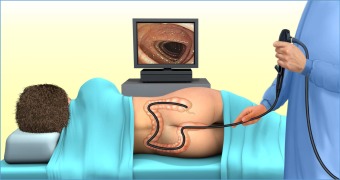
Typical colonoscopy equipment and patient position.
Indications for Colonoscopy in Liver Disease
Gastrointestinal bleeding: melena or hematochezia.
Screening for colorectal cancer prior to undergoing liver transplantation.
Evaluation of patients with warning symptoms: abnormal weight loss, abnormal imaging studies, and iron deficiency anemia.
Screening colonoscopy every 1 to 2 years in patients with primary sclerosing cholangitis (PSC), who have increased risk of incidence for colorectal cancer.
Pyogenic liver abscess.1
Risks and Benefits
Risks
The potential risks of colonoscopy include colonic perforation and gastrointestinal bleeding and have been reported to occur with an incidence of 0.001 to 0.12 percent and 1 to 2 percent,3 respectively, in general population undergoing screening colonoscopy and polypectomy. Similar rate of immediate postpolypectomy bleeding was reported in patients with Child‐Pugh class A or B liver cirrhosis.4 Cardiorespiratory arrest due to procedure‐related sedation is another known risk,5 but a recent study reported that propofol sedation appears to be safe despite compromised hepatic function in cirrhotic patients.6
Benefits
Early detection of premalignant lesions prior to transplant prevents progression to malignancy when immunosuppression is used after transplant.7
A recent study by Weismuler et al.8 showed that colonoscopy in patients with liver disease awaiting transplantation was safe with acceptable risks despite being done in patients with multiple medical comorbidities and coagulopathy.
Preparation for Colonoscopy
In preparation for colonoscopy, patients are usually advised to adhere to a low‐fiber diet for 1 to 2 days prior to colonoscopy, in addition to taking nothing by mouth for at least 6 hours prior to colonoscopy. There are several laxative bowel‐preparation regimens available to cleanse the bowel prior to colonoscopy. Traditionally large‐volume, 4‐liter polyethylene glycol‐based regimens have been used, but recently the use of low‐volume regimens and split‐dose regimens has improved tolerability of the preparations. Split‐dose regimens, wherein half of the bowel preparation is given the night before and the other half on the day of colonoscopy, have shown to improve the quality of bowel preparation.9 For colonoscopies done in the afternoon, same day 4‐liter polyethylene glycol (PEG) preparation has been reported to confer better‐quality cleansing than prior day preparations.10 The majority of the quality of bowel preparation studies were done in a healthy population undergoing screening colonoscopies, hence it is unclear if those results are generalizable to patients with liver disease. However, bowel preparation for colonoscopy in general appears to be safe even in patients with liver disease.11
Description of Equipment and Procedure
Currently all colonoscopies are performed with high‐definition white light colonoscopes, which are available in two different diameter sizes. Adult scopes with a diameter of 13 mm are prone to less looping than the pediatric scopes with a diameter of 11 mm, which are used predominantly in women and in patients with abdominal surgeries. Variable stiffness scopes have the option of increasing rigidity of the scope during the colonoscopy and have been shown in some studies to increase cecal intubation rates.12
Patients are usually placed in a left lateral position, and a careful digital rectal exam and perianal exam are done before inserting the scope. The rectum is initially entered and inspected, and the scope is then passed beyond the rectosigmoid junction into the sigmoid colon. The scope is next advanced through the descending, transverse, and ascending colon and then into the cecum and terminal ileum. Throughout the procedure, various combinations of techniques, including using up and down and right and left knobs, along with torquing the shaft of the scope, are employed depending on the preference and skill of the performing endoscopist. Additional maneuvers such as applying external abdominal pressure and changing the position of patient to supine or left lateral are frequently used to aid passage of the scope into the cecum. Typically, air is used to insufflate the colon during advancement of the scope, but recently using water to distend the colon has been reported to help advancement of the scope and reduce pain during the procedure.13, 14
What the Patient Needs to Know
| • Colonoscopy is a safe and well tolerated procedure performed by gastroenterologists to diagnose and treat gastrointestinal problems as well as remove precancerous polyps. |
| • All individuals over the age of 50 years should undergo periodic screening colonoscopy to prevent colorectal cancer. |
| • All patients undergoing liver transplantation should undergo colonoscopy to rule out colorectal cancer prior to transplantation. |
| • In preparation for colonoscopy, patients are required to drink a laxative bowel preparation the night before colonoscopy and fast for 6 hours prior to the procedure. |
| • During colonoscopy, mild intravenous sedation is usually given to keep the patient comfortable; therefore, patients are advised to refrain from driving and making important decisions until the next day. |
| • Recommendations for the need and timing of a follow‐up colonoscopy will be made by the gastroenterologist based on the findings of the exam. |
Postprocedure Recommendations and Follow‐Up
Patients who had their colonoscopy performed under sedation are advised to refrain from driving, operating heavy machinery, and making important decisions on the day of colonoscopy. They are advised to resume liquid diet within 3 hours after the procedure and to advance as tolerated. Recommendations for the timing of follow‐up surveillance colonoscopy are made based on the quality of bowel cleansing along with the number, size, and polyp pathology as per established guidelines (Table 1).15
Table 1.
US Multisociety Task Force on Colorectal Cancer Guidelines on Interval of Follow‐up Surveillance Colonoscopy
| Initial Colonoscopy Findings (no. and type of polyps) | Recommended Surveillance Interval (yrs) |
|---|---|
| No polyps found | 10 |
| Small (<10 mm) hyperplastic polyps | 10 |
| 1‐2 small (<10 mm) tubular adenomas | 5‐10 |
| 3‐10 tubular adenomas | 3 |
| Any tubular adenoma ≥10 mm | 3 |
| >10 adenomas | < 3 |
Colonoscopy is a safe and well tolerated diagnostic procedure with therapeutic benefits. A detailed preoperative assessment and careful sedation during the procedure may be sufficient to make this procedure an important tool for patients with advanced liver disease. Patients who are considered candidates for liver transplantation, particularly those with primary sclerosing cholangitis, should undergo colonoscopy to rule out colorectal cancer pretransplantation.
Potential conflict of interest: Nothing to report.
References
- 1. Koo HC, Kim YS, Kim SG, et al. Should colonoscopy be performed in patients with cryptogenic liver abscess? Clin Res Hepatol Gastroenterol 2013;37:86‐92. [DOI] [PubMed] [Google Scholar]
- 2. Whitlock EP, Lin JS, Liles E, Beil TL, Fu R. Screening for colorectal cancer: a targeted, updated systematic review for the U.S. Preventive Services Task Force. Ann Intern Med 2008;149:638‐658. [DOI] [PubMed] [Google Scholar]
- 3. Zubarik R, Fleischer DE, Mastropietro C, Lopez J, Carroll J, Benjamin S, Eisen G. Prospective analysis of complications 30 days after outpatient colonoscopy. Gastrointest Endosc 1999;50:322‐328. [DOI] [PubMed] [Google Scholar]
- 4. Jeon JW, Shin HP, Lee JI, Joo KR, Pack KM, Cha JM, Park JJ, Lim JU, Lim K. The risk of postpolypectomy bleeding during colonoscopy in patients with early liver cirrhosis. Surg Endosc 2012;26:3258‐3263. [DOI] [PubMed] [Google Scholar]
- 5. Arrowsmith JB, Gerstman BB, Fleischer DE, Benjamin SB. Results from the American Society for Gastrointestinal Endoscopy/U.S. Food and Drug Administration collaborative study on complication rates and drug use during gastrointestinal endoscopy. Gastrointest Endosc 1991;37:421‐427. [DOI] [PubMed] [Google Scholar]
- 6. Faga E, De Cento M, Giordanino C, et al. Safety of propofol in cirrhotic patients undergoing colonoscopy and endoscopic retrograde cholangiography: results of a prospective controlled study. Eur J Gastroenterol Hepatol 2012;24:70‐76. [DOI] [PubMed] [Google Scholar]
- 7. Atassi T. Thuluvath PJ. Risk of colorectal adenoma in liver transplant recipients compared to immunocompetent control population undergoing routine screening colonoscopy. J Clin Gastroenterol 2003;37:72‐73. [DOI] [PubMed] [Google Scholar]
- 8. Weismuller TJ, Bleich F, Negm AA, Schneider A, Lankisch TO, Manns MP, Strassburg CP, Wedemeyer J. Screening colonoscopy in liver transplant candidates: risks and findings. Clin Transplant 2013;27:E161‐E168. [DOI] [PubMed] [Google Scholar]
- 9. Enestvedt BK, Tofani C, Laine LA, Tierney A, Fennerty MB. 4‐Liter split‐dose polyethylene glycol is superior to other bowel preparations, based on systematic review and meta‐analysis. Clin Gastroenterol Hepatol 2012;10:1225‐1231. [DOI] [PubMed] [Google Scholar]
- 10. Gurudu SR, Ratuapli S, Heigh R, DiBaise J, Leighton J, Crowell M. Quality of bowel cleansing for afternoon colonoscopy is influenced by time of administration. Am J Gastroenterol 2010;105:2318‐2322. [DOI] [PubMed] [Google Scholar]
- 11. Boryczka G, Hartleb M, Gutkowski K. [Endoscopic assessment of large bowel and safety of bowel preparation and sedoanalgesia in patients with advanced liver cirrhosis]. Przegl Lek 2011;68:348‐353. [PubMed] [Google Scholar]
- 12. Othman MO, Bradley AG, Choudhary A, Hoffman RM, Roy PK. Variable stiffness colonoscope versus regular adult colonoscope: meta‐analysis of randomized controlled trials. Endoscopy 2009;41:17‐24. [DOI] [PubMed] [Google Scholar]
- 13. Luo H, Zhang L, Li X u, Leung FW, Liu Z, Wang X, Xue L, Wu K, Fan D, Pan Y, Guo X. Water exchange enhanced cecal intubation in potentially difficult colonoscopy. Unsedated patients with prior abdominal or pelvic surgery: a prospective, randomized, controlled trial. Gastrointest Endosc 2013;77:767‐773. [DOI] [PubMed] [Google Scholar]
- 14. Leung FW, Harker JO, Jackson G, Okamoto KE, Behbahani OM, Jamgotchian NJ, Aharonian HS, Guth PH, Mann SK, Leung JW. A proof‐of‐principle, prospective, randomized, controlled trial demonstrating improved outcomes in scheduled unsedated colonoscopy by the water method. Gastrointest Endosc 2010;72:693‐700. [DOI] [PubMed] [Google Scholar]
- 15. Lieberman DA, Rex DK, Winawer SJ, Giardiello FM, Johnson DA, Levin TR. Guidelines for colonoscopy surveillance after screening and polypectomy: a consensus update by the US Multi‐Society Task Force on Colorectal Cancer. Gastroenterology 2012;143:844‐857. [DOI] [PubMed] [Google Scholar]